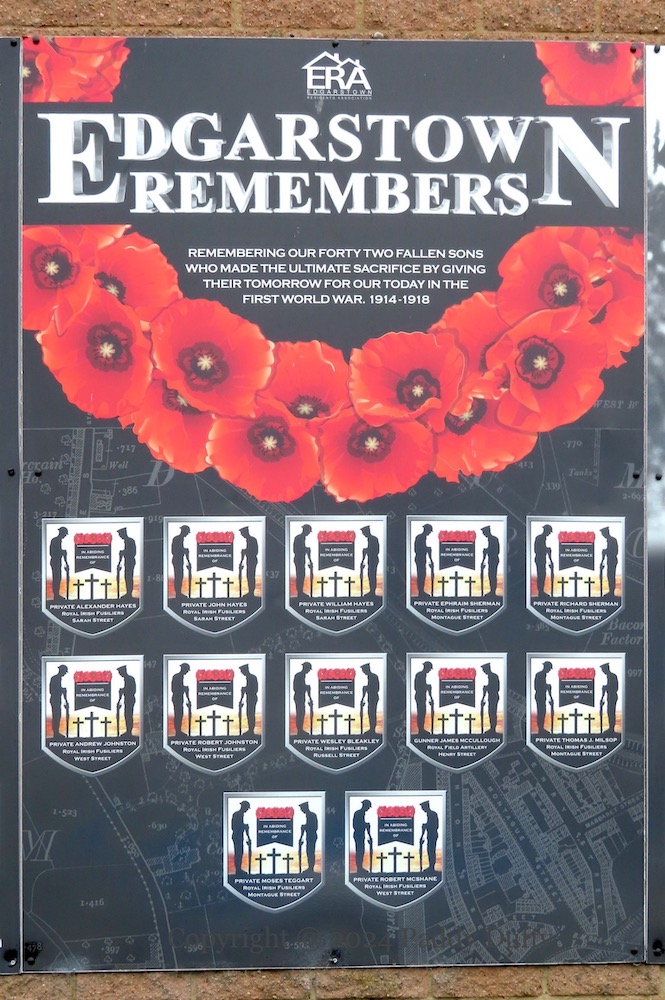
“In Deo speramus”. “Edgarstown Remembers” “our forty-two fallen sons who made the ultimate sacrifice by giving their tomorrow for our today in the Great War 1914-1918.” “Dear Lord, I am just a soldier, a protector of our land/A servant called to battle when my country takes a stand./I pray for strength and courage and a heart that will forgive/For peace and understanding in a world for all to live./My family’s prayers are with me, no matter where I roam./Please listen when I’m lonely and return me safely home – Unknown”
On July 1st, 1916, the Battle of Albert began, the first of many battles in what is known collectively as the Battle of the Somme. Soldiers from the 36th (Ulster) Brigade went “over the top” at 7:28 a.m. By the end of the day, more than nineteen thousand British soldiers were dead, five thousand from the 36th.
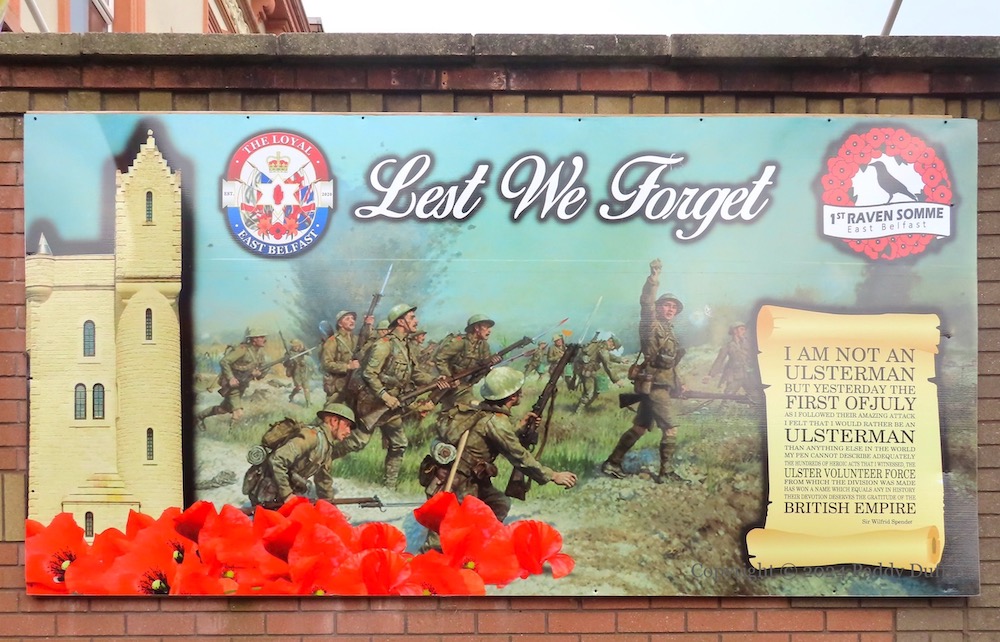
Below the main panel, which shows combat at close quarters, are the words of Wilfrid Spender: “I am not an Ulsterman but yesterday, the 1st. July, as I followed their amazing attack, I felt that I would rather be an Ulsterman than anything else in the world … the Ulster Volunteer Force, from which the Division was made, has won a name that equals any in history.”
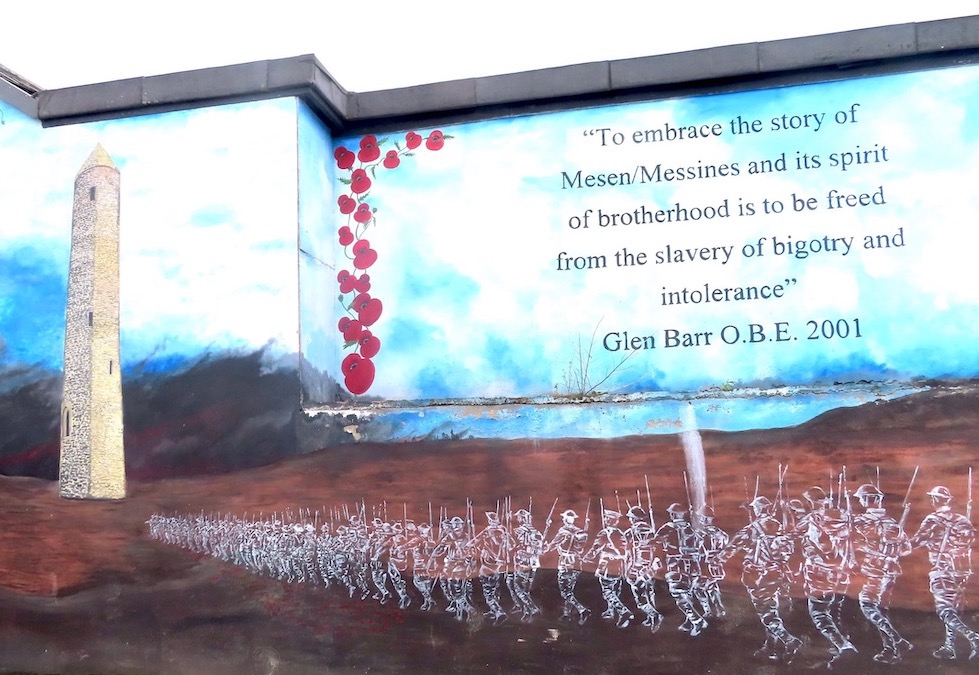
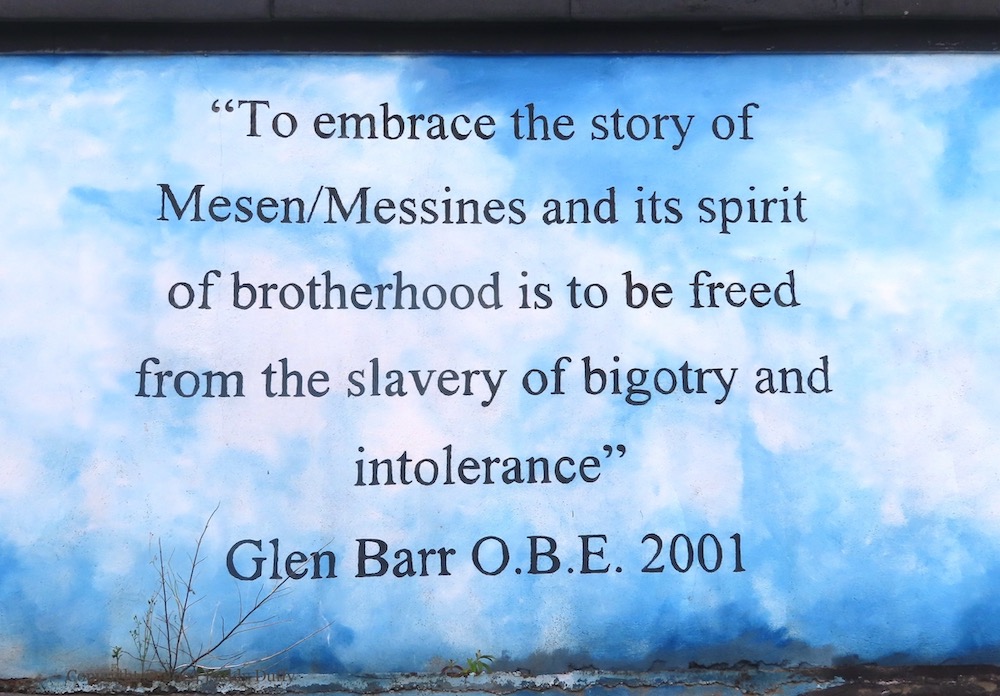
“”To embrace the story of Mesen/Messines and its spirit of brotherhood is to be freed from the slavery of bigotry and intolerance.” – Glen[n] Barr O.B.E. 2001″
Glenn Barr was a UDA brigadier and spokesperson for NUPRG and its policy of an independent Northern Ireland – see Common Sense. In the 1980s and beyond, his efforts were directed mainly at tackling youth unemployment in Londonderry, for which he received an OBE in 2005. He died in 2017. (WP)
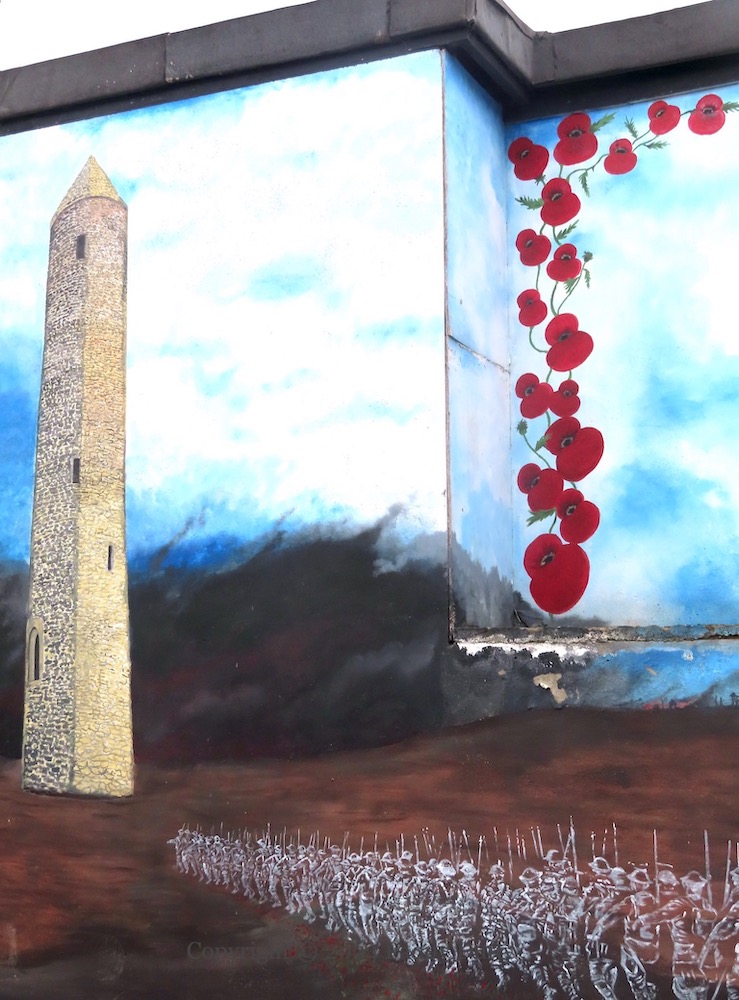
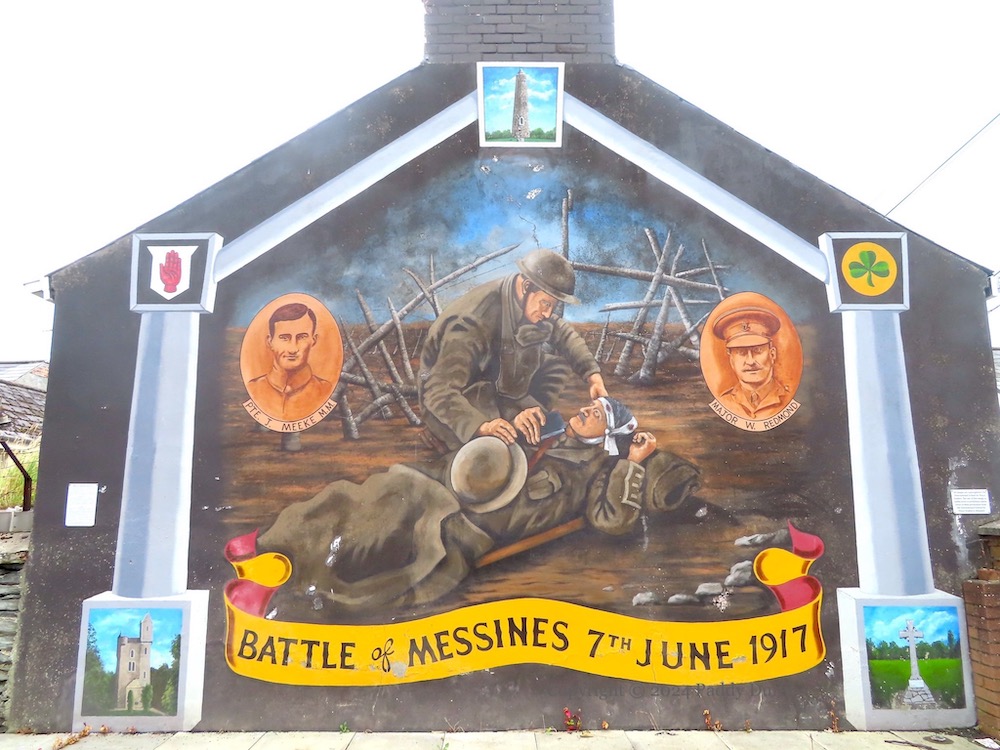
The tower in the mural shown here is (perhaps) the round tower at the ‘Island Of Ireland Peace Park’ in Messines, a cross-community project of Barr’s and (former Donegal T.D.) Paddy Harte’s. The Park honours the soldiers – from both the 36th (Ulster) and 16th (Irish) divisions – who were killed or wounded in the Battle Of Messines Ridge in June, 1917. The source of Barr’s quotation is unknown but he made similar remarks on other occasions (NIWorld | ISPS).
The mural is in the Ebrington Centre’s car park, off Bond’s Street, Waterside, Londonderry. It joins three other murals to the Irish dead of WWI: The Cost of War (which also features the Peace Park) | We Are The Dead | Comrades In Arms.
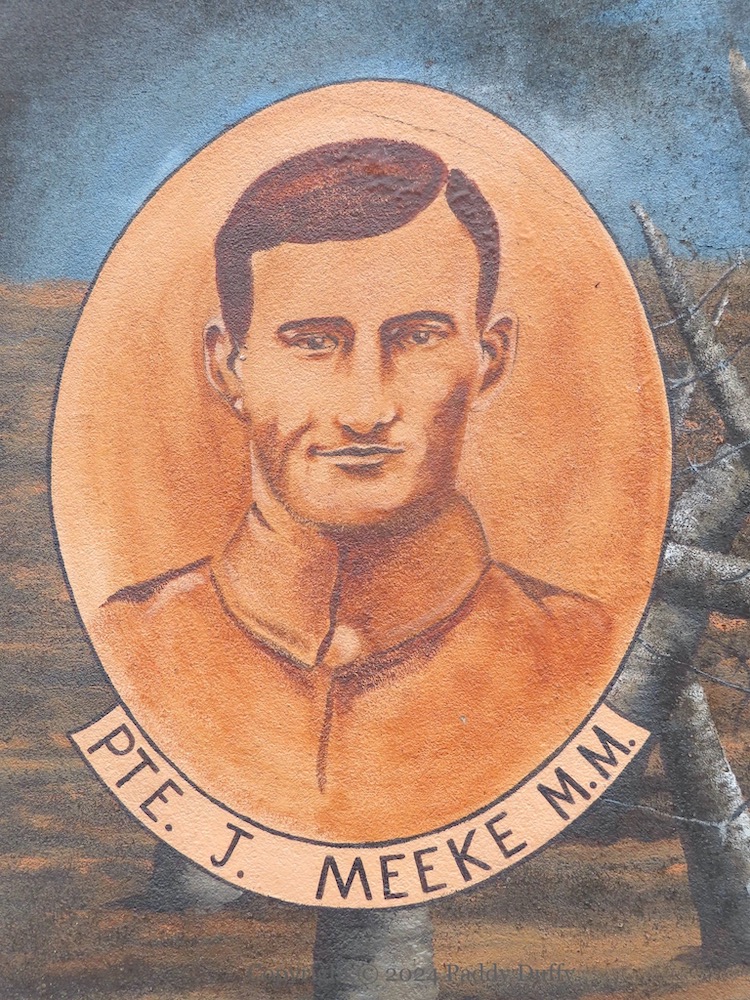
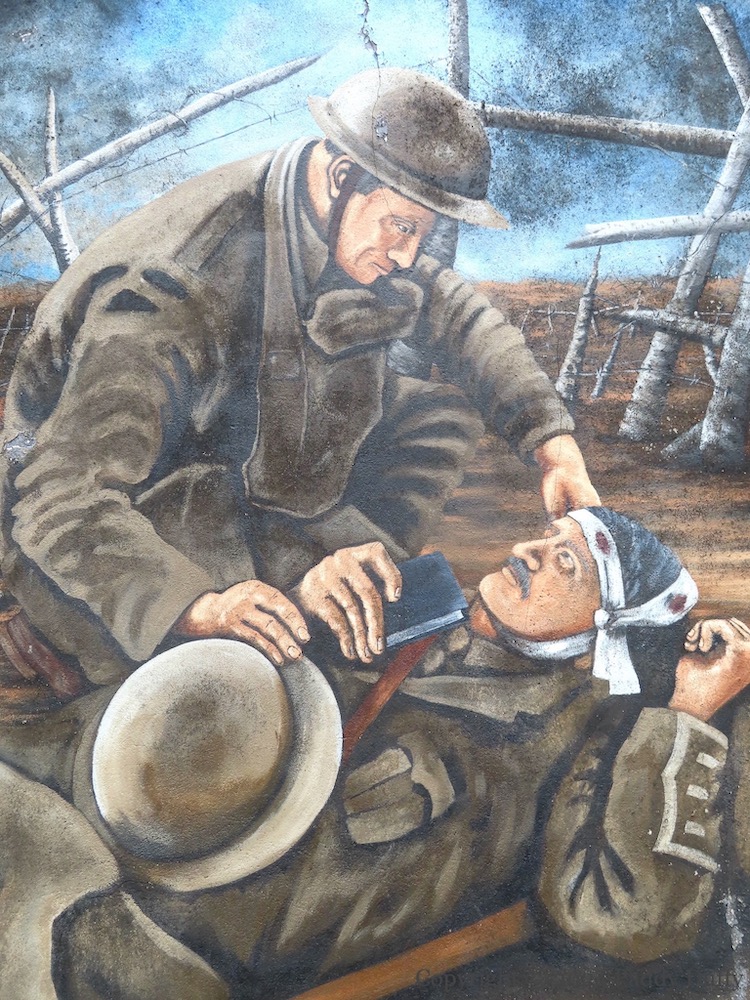
John Meeke signed the Ulster Covenant in Dervock Orange Hall in 1912 and went to war with the Ulster Volunteers. Willie Redmond, brother of John Redmond, had been jailed three times and was a nationalist MP at Westminster when, at age 53, he signed up for service.
Major Redmond went over the top with the 16th (Irish) Division at Messines Ridge and was hit by machine-gun fire. Private Meeke, a stretcher-bearer with the Royal Inniskilling Fusiliers in the 36th (Ulster) Division, found and stayed with Redmond under heavy fire, taking two bullets himself.
Redmond would die that night. He was awarded the Legion Of Honour by the French. His East Clare seat was taken by Éamon de Valera. Meeke survived after several surgeries. He was awarded the Military Medal by the British. After the World War, he joined the Specials and LOL 1001 in Benvarden before dying of TB in 1923 (NALIL | Irish Times | WP | BelTel).
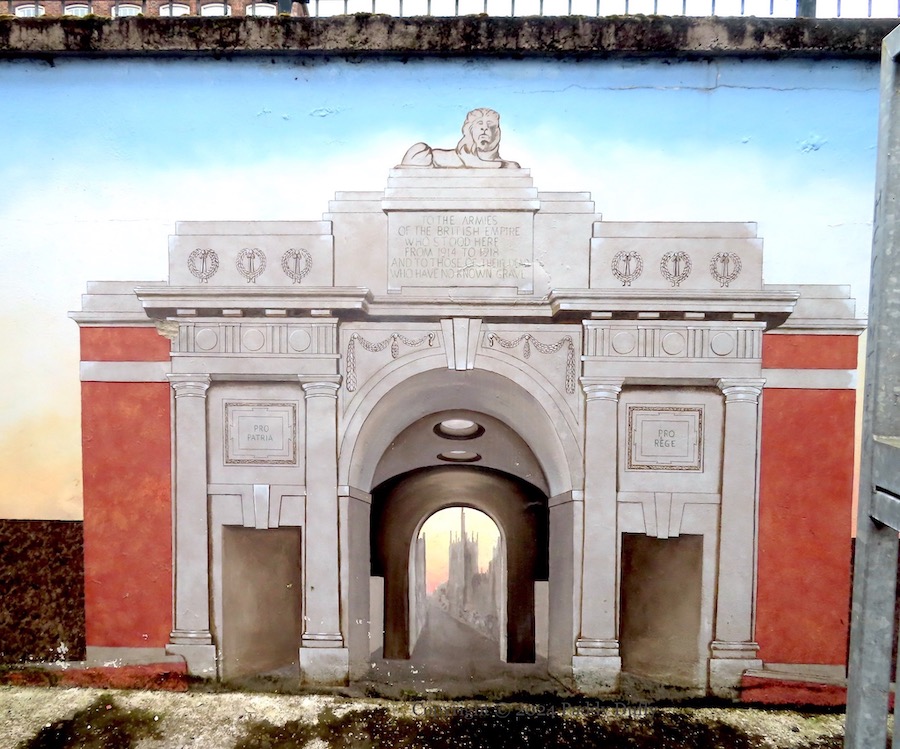
This mural (and its very odd accompanying plaque, for a public mural) is in the Ebrington Centre car park, in the Waterside, Londonderry.
The Menin Gate memorial, at the eastern edge of Ypres, Belgium, commemorates 54,896 Commonwealth soldiers who died in the area during WWI and whose bodies were not recovered. “To the armies of the British Empire who stood here from 1914 to 1918 and to those of their dead who have no known grave.”
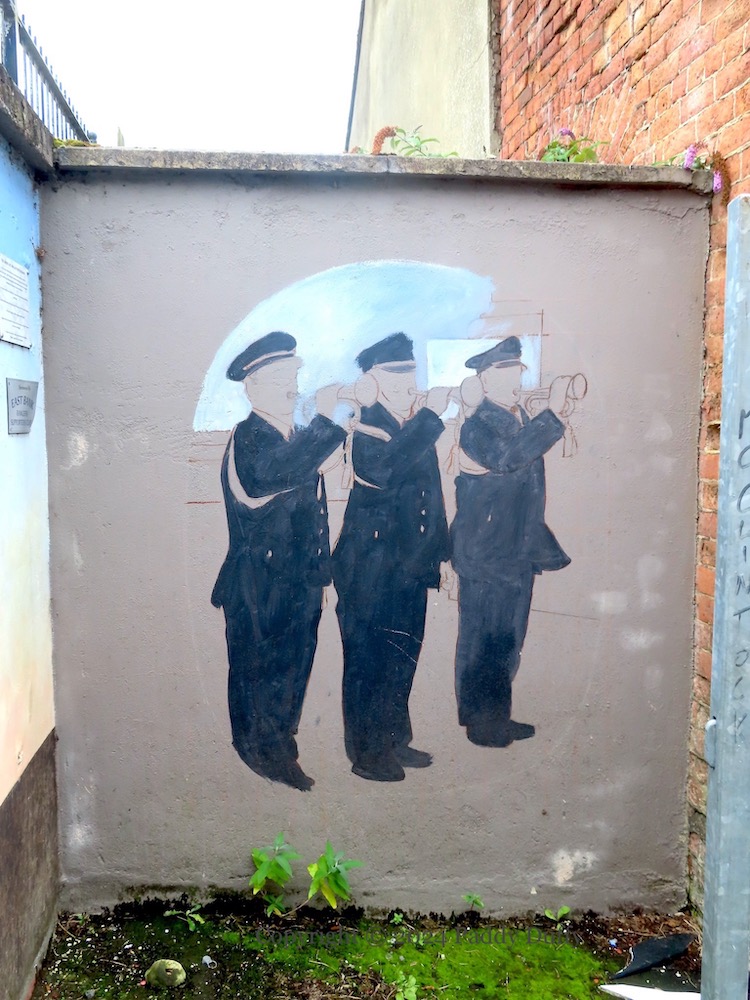
The buglers below have remained unfinished since (at least) 2018.
Ebrington Street, off Bond’s Street, Londonderry, leading to the Ebrington Centre car park.
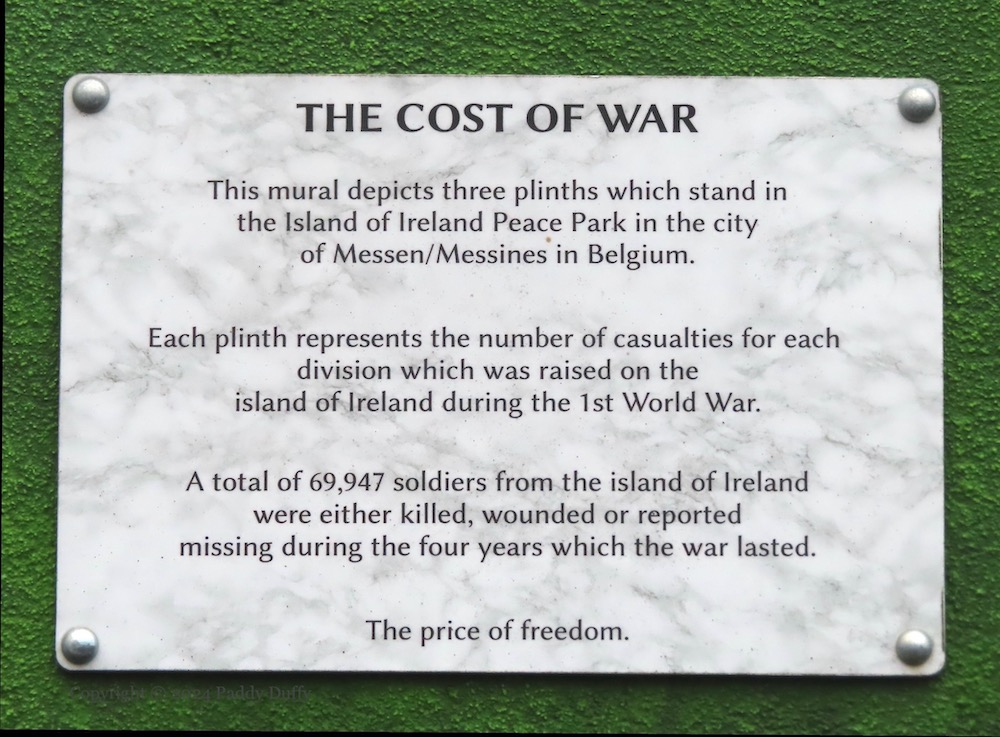
From the info plaque (shown last below): “This mural depicts three plinths which stand in the Island Of Ireland Peace Park in the city of Messen [Mesen]/Messines in Belgium. Each plinth represents the number of casualties for each division which was raised on the island of Ireland during the 1st World War. A total of 69,947 soldiers from the island of Ireland were either killed, wounded or reported missing during the four years which the war lasted. The price of freedom.”
The numbers given are: 36th (Ulster) division, 32,186; 16th (Irish) division, 28,398; 10th (Irish) division, 9,363.
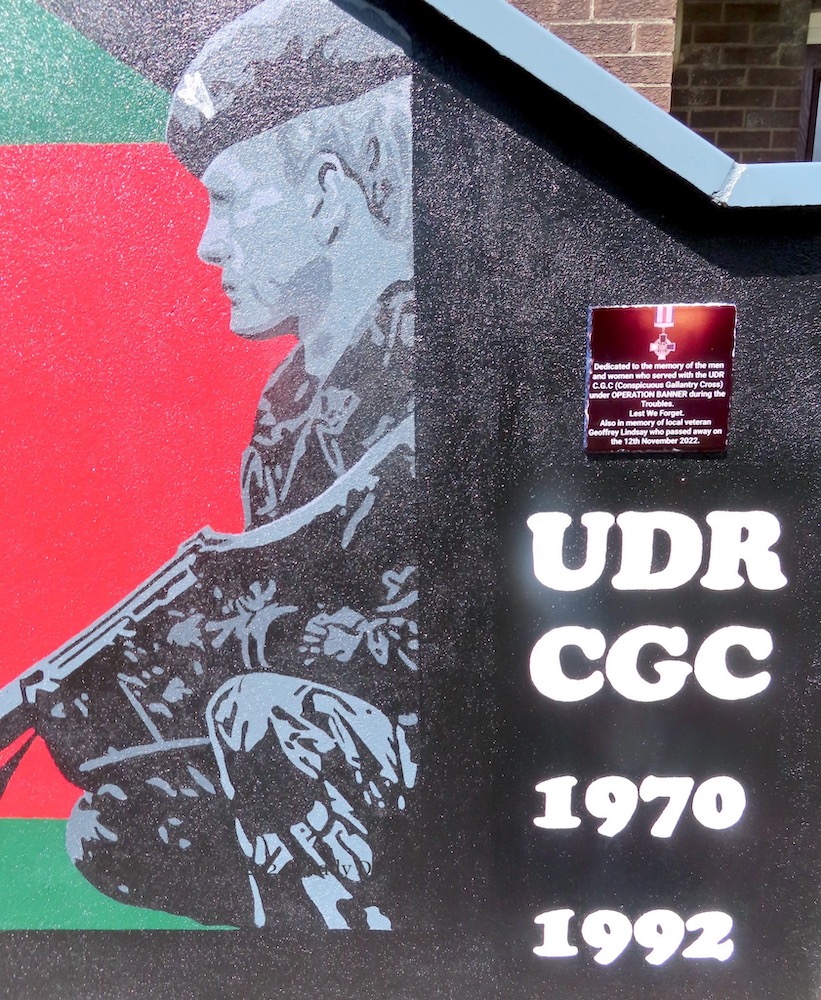
“Dedicated to the memory of the men and women who served with the UDR C.G.C (Conspicuous Gallantry Cross) under OPERATION BANNER during the Troubles. Lest we forget. Also in memory of local veteran Geoffrey Lindsay who passed away on the 12th November 2022.”
The Conspicuous Gallantry Cross is shown (in the close-up below) at the top of the board; it was awarded to the UDR retroactively in 2006 for its role in ‘Operation Banner’, i.e. the deployment of British Army troops to Northern Ireland – the regiment had been folded into the Royal Irish Regiment in 1992. The mural is specifically to the 5th (Co. Londonderry) battalion – here is a list of the 11 battalions (and bases).
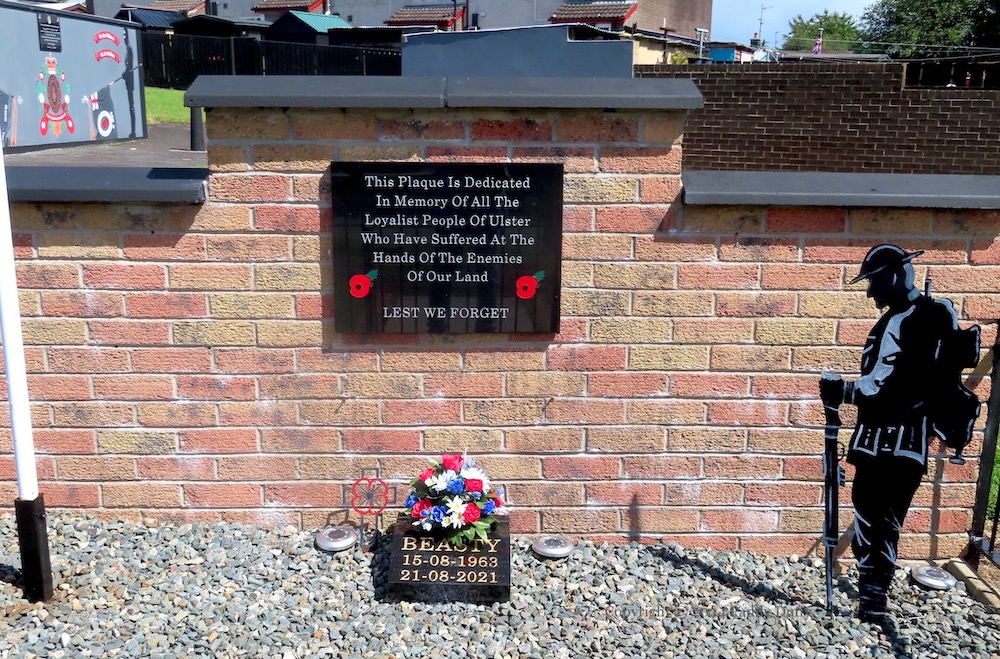
There is also a UDR information board (and an Ulster Volunteers board) in the green-space in front of this mural – see Leckagh Remembers The Fallen.
The memorial mural to the 36th (Ulster) Division on the end wall has also been completed since last (2023) year – in-progress images for both murals from last August are included below. For the previous murals on these walls, see C07766.
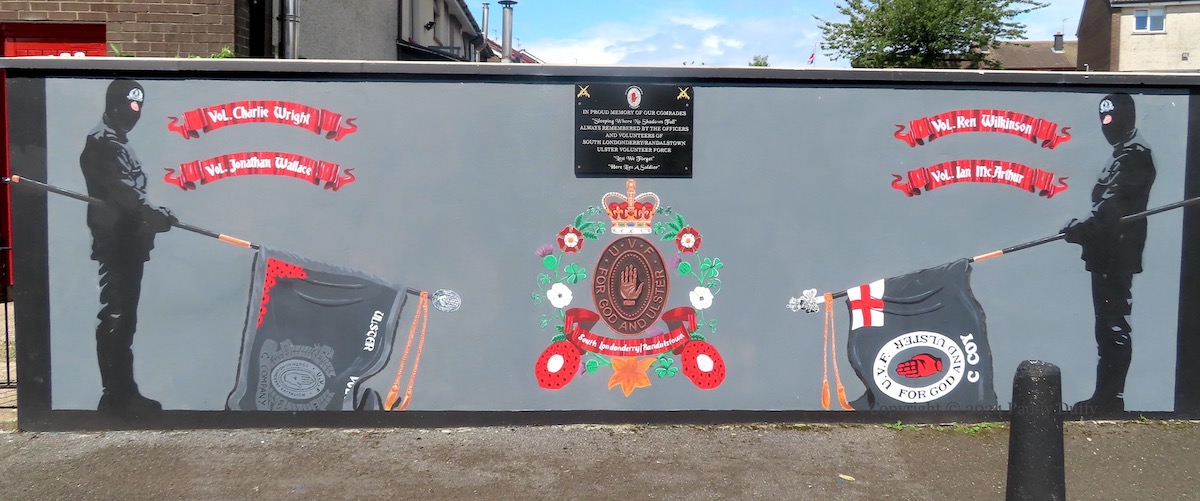
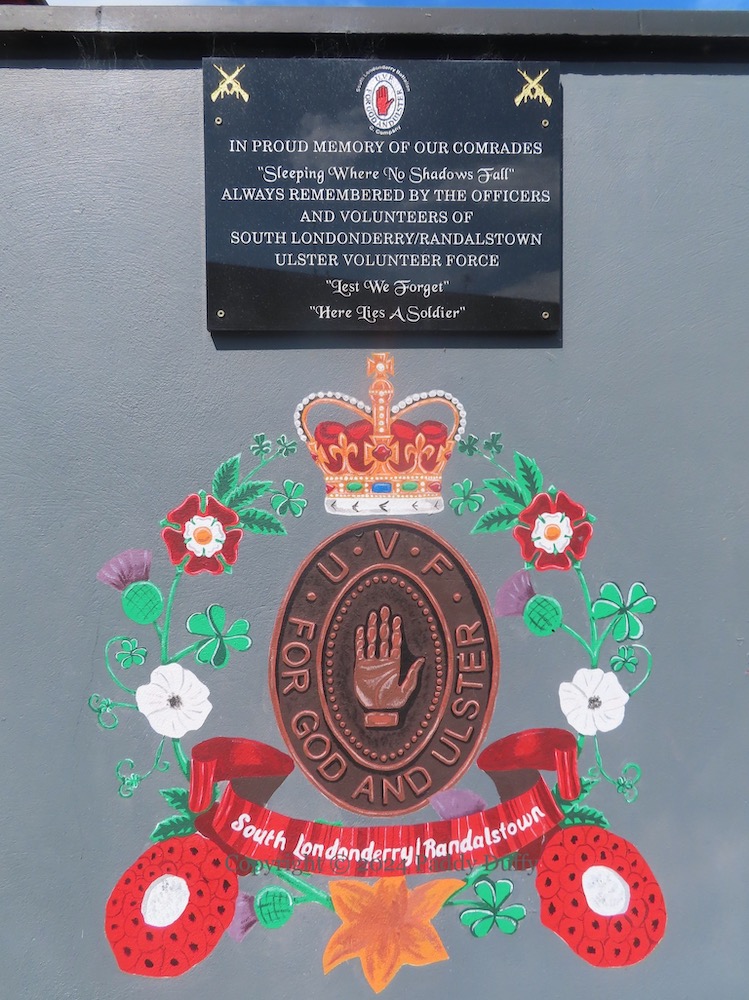
Two other pieces are included, below: the UVF mural was seen last year in Pause, Reflect, Remember; the ‘Ignite the fire’ board appears to be new.
Leckagh Drive, Magherafelt
August 27th green-washing of previous mural:
August 27th in-progress image of mural immediately above:
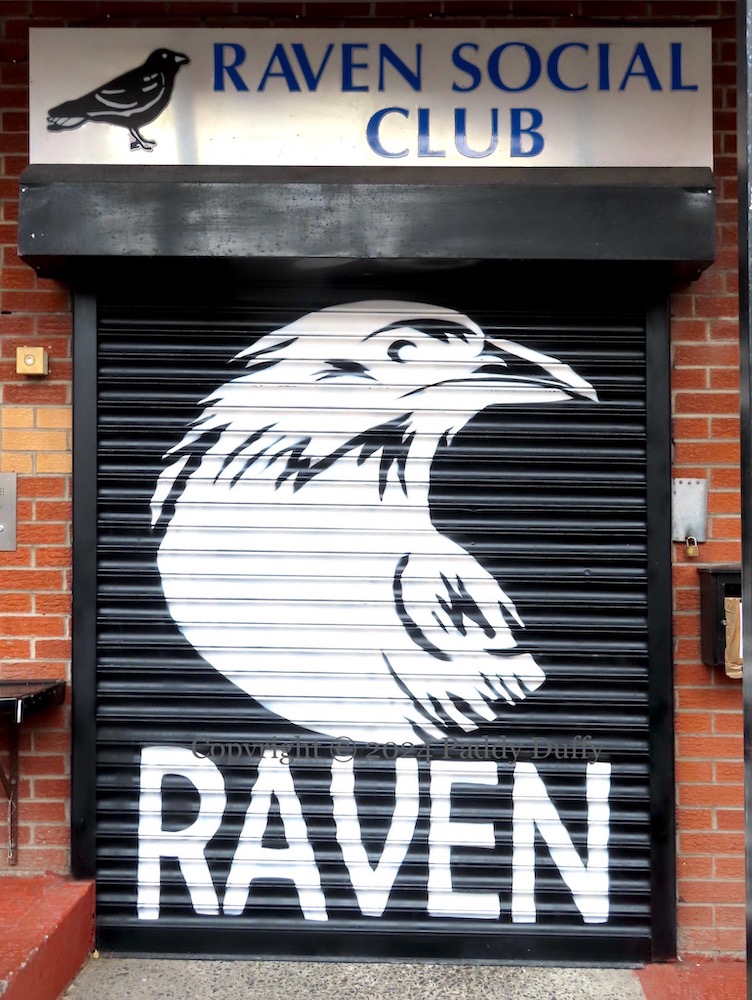
A new board was unveiled on July 1st 2024, by the 1st Raven Somme Society and The Loyal (Fb) at the Raven social club (Fb), putting together the Ulster Tower (see e.g. A Thought Is Not A Lot), JP Beadle’s painting of the 36th going ‘over the top’ (see The Trenches Have Vanished Under The Ploughs) and Wilfrid Spender’s famous quote about the first day of the Battle Of The Somme (see I Would Rather Be An Ulsterman).
This board takes the place of the King Charles board (seen previously in Long Live The King), which has been moved to the other side of Castlereagh Street and joined by the board that it replaced, to Queen Elizabeth (both on top of some old (2012) panels depicting east Belfast of yesteryear – see Shipyard Workers).
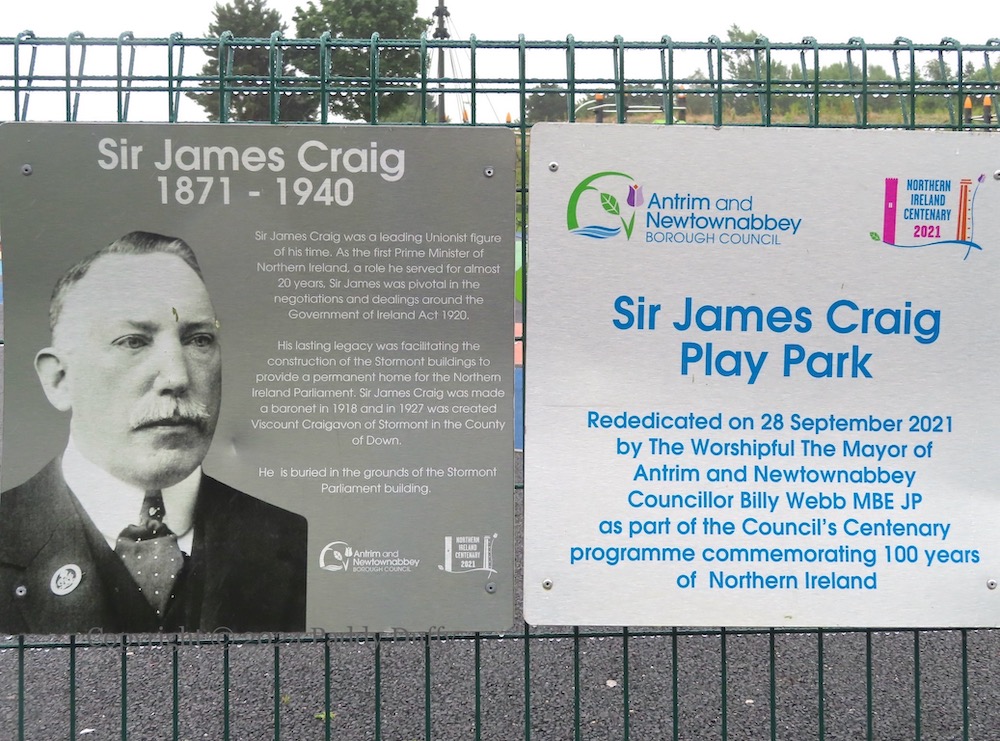
This images in this entry depict, above and below the information board about the park, the World Wars installation inside the park and the banners on the fence along Derrycoole Way.
There is an annual commemoration of the fallen in the World Wars in Rathcoole each year. The monument consisting of mourning soldiers and sandbags) was created in 2020 (Fb group | News Letter) and the bench was perhaps added in 2022. Images from the 2023 ‘row on row’ commemoration can be seen at NI World. The Row On Row group (web) hope to create a permanent memorial on the spot.
Rathcoole People’s Park was renamed the Sir James Craig Play Park by Antrim & Newtownabbey council in September, 2021, as part of the council’s celebrations of the centenary of Northern Ireland (NI World).
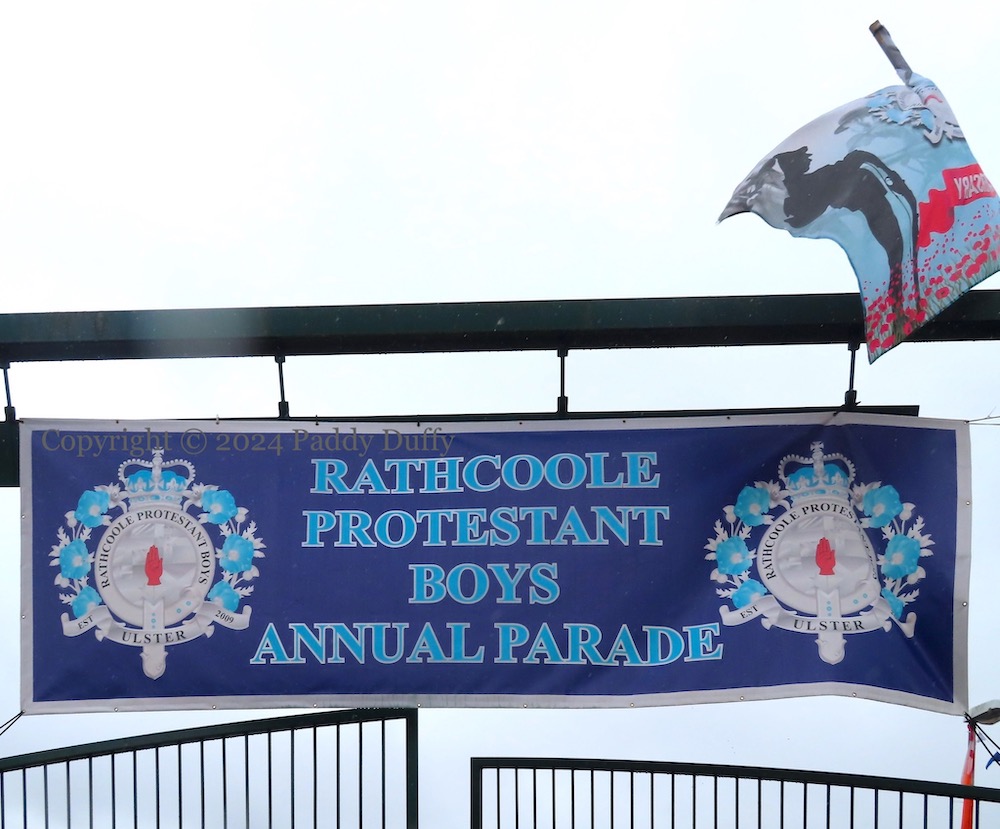
The banners on the side are from the Rathcoole Protestant Boys flute band (Fb) whose annual parade was at the end of June, and the Whitehouse Williamite Historical Society (Fb) whose fun-day on June 15th included a historical re-enactment of William’s army landing at Whitehouse. (For more on William’s connection to Whitehouse, see June 14th, 1690.)
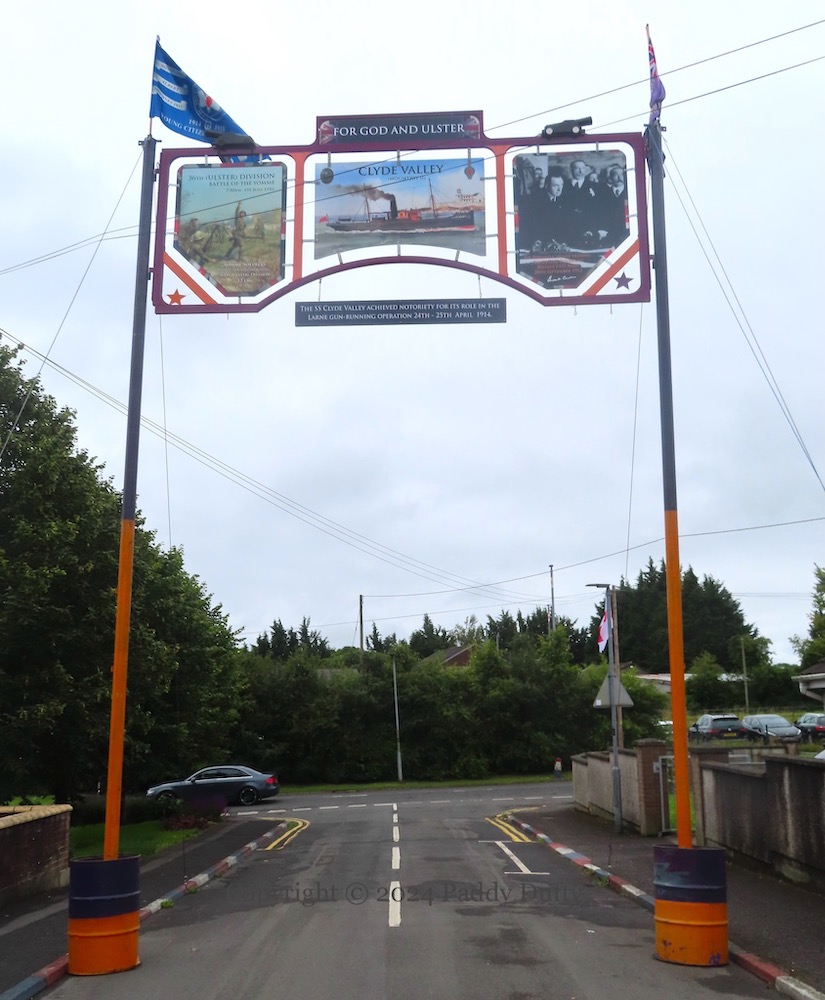
The Millbrook arch has three panels: “36th (Ulster) Division, Battle Of The Somme, 7:30 am 1st July 1916”; the Clyde Valley (Mountjoy II) “The SS Clyde Valley achieved notoriety for its role in the Larne gun-running operation 24th-25th April 1914”; “Sir Edward Carson signing the Ulster Covenant, Belfast City Hall 28th September 1912”.



















 Paddy Duffy Collection