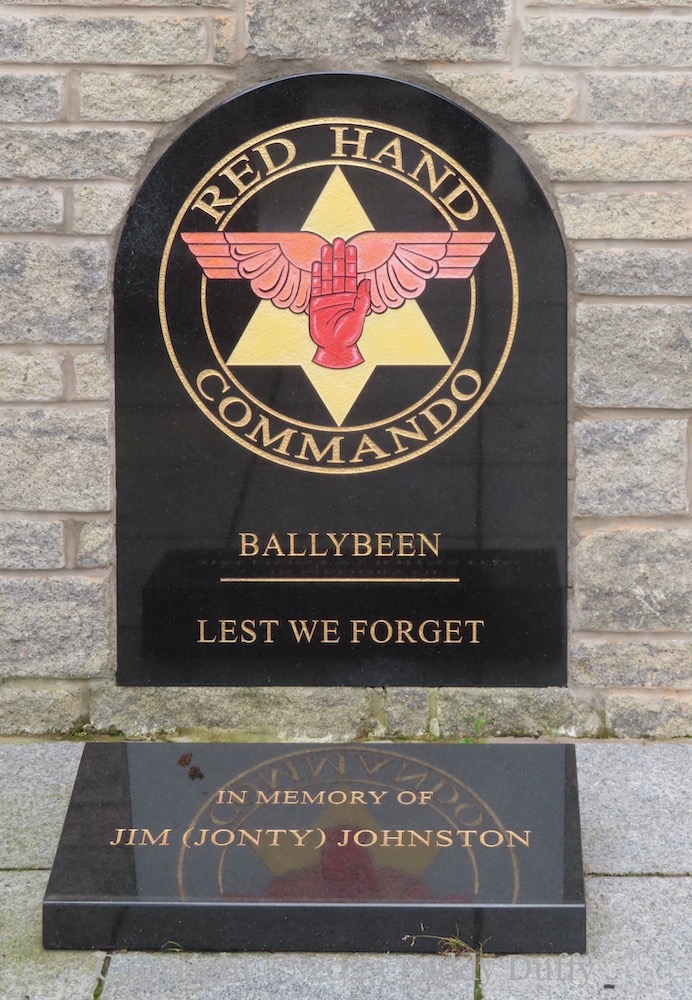
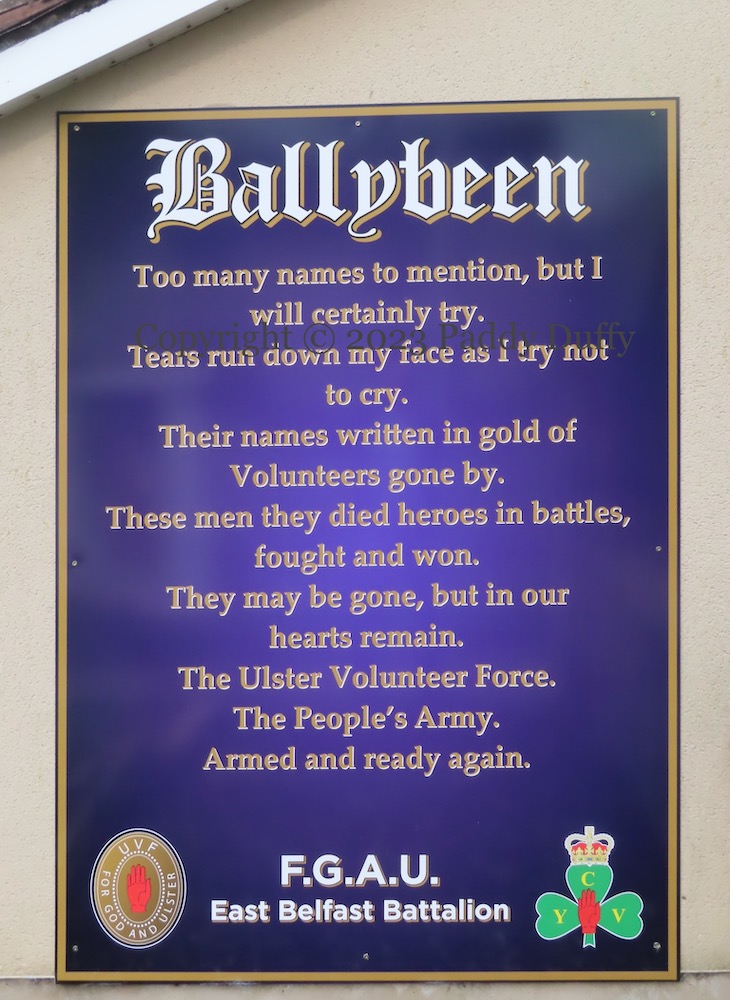
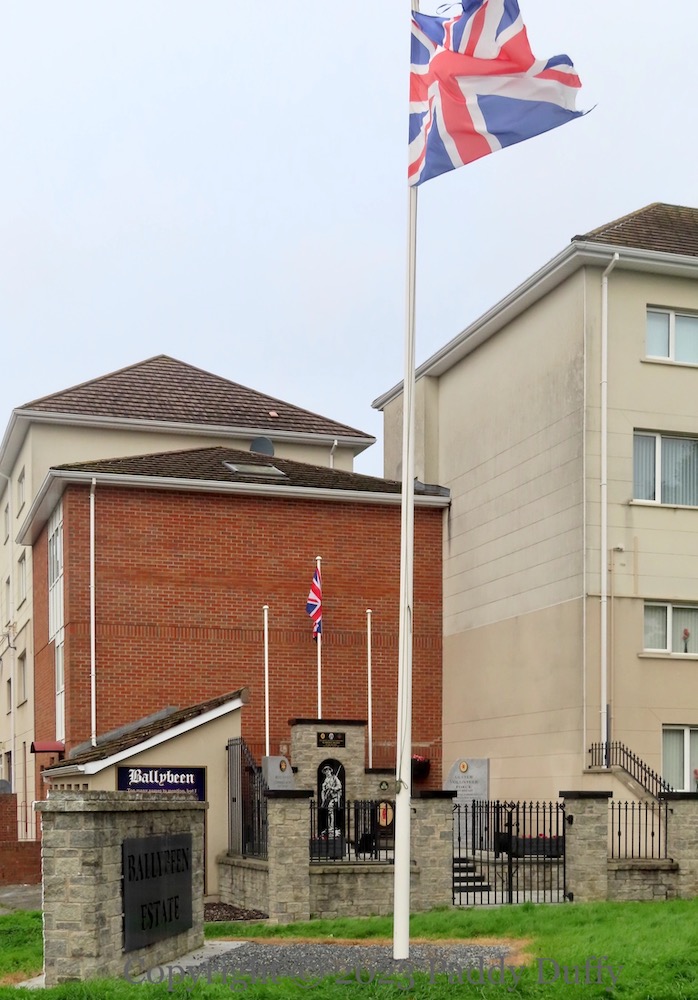
This is the UVF/RHC memorial garden in Ballybeen, with individual plaques to “East Belfast battalion commander” RJ ‘Mickey’ Wilson (died 2022), Jim ‘Jonty’ Johnston (killed in 2003 BelTel), M. Walker, G. McCartney, David Brown. While most of the plaques and stones are to the modern UVF, there are three pieces to the 36th (Ulster) Division.
“Too many names to mention, but I will certainly try./Tears run down my face as I try not to cry./Their names written in gold of Volunteers gone by./These men they died heroes in battles, fought and won./They may be gone, but in our hearts remain./The Ulster Volunteer Force. The People’s Army./Armed and ready again.”
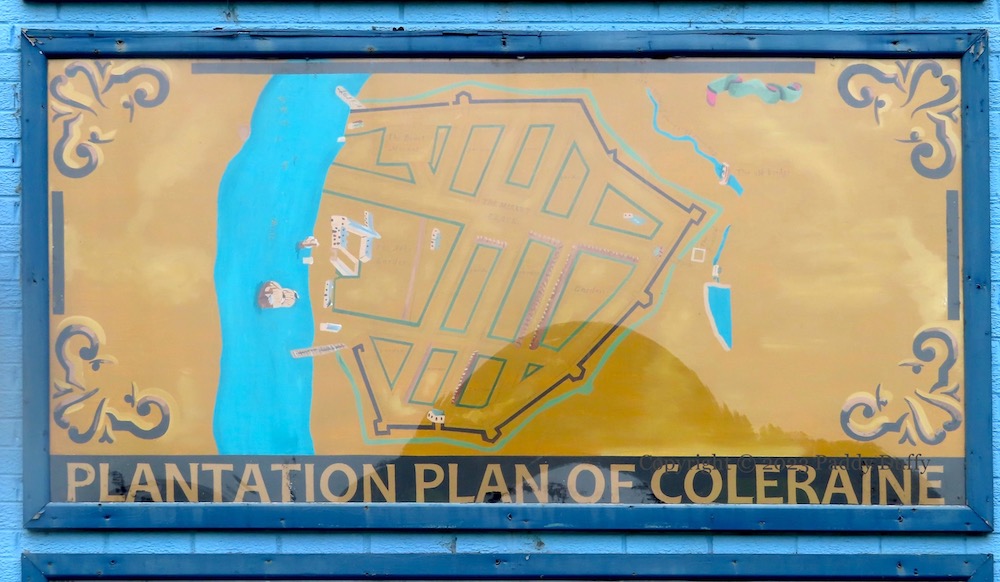
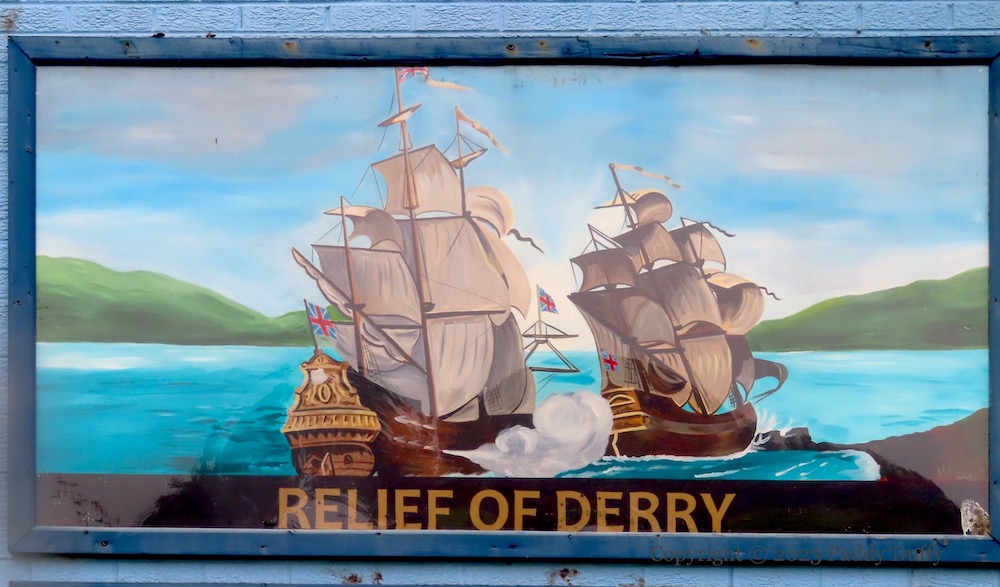
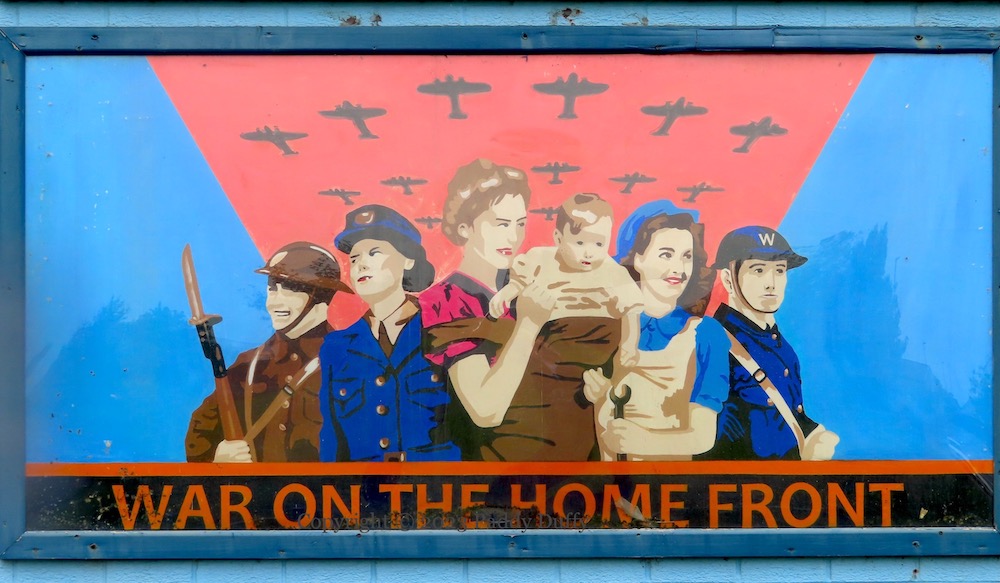
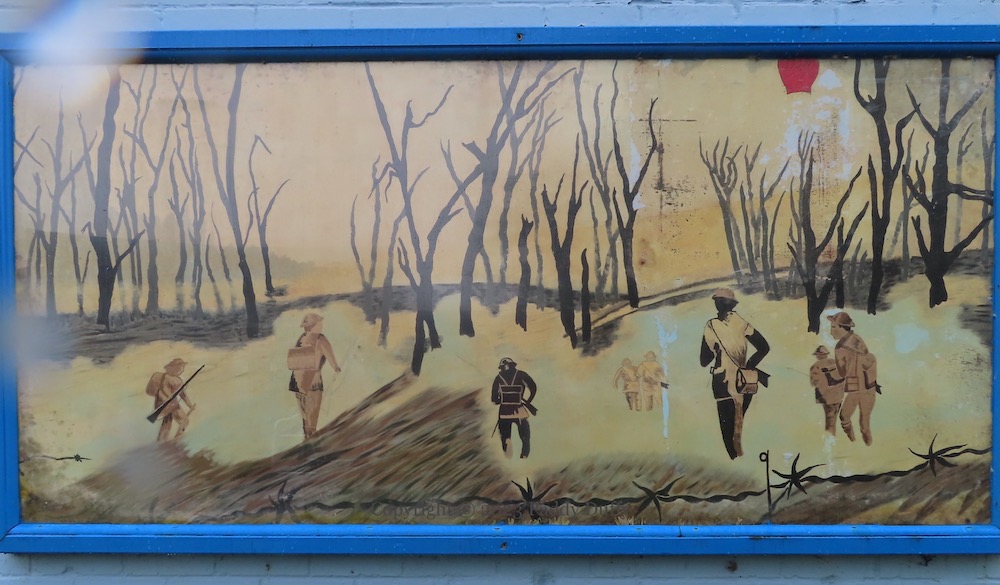
Footsteps through the history of Coleraine, from top to bottom: Martin Luther (c. 1521); John Knox, who led the reformation in Scotland (c. 1560); the plan of Coleraine (c. 1611); the relief of Derry (1689); the Williamite campaign (1690); (and then a jump to) WWI (“Christmas truce, western front”); WWII (“War on the home front”).
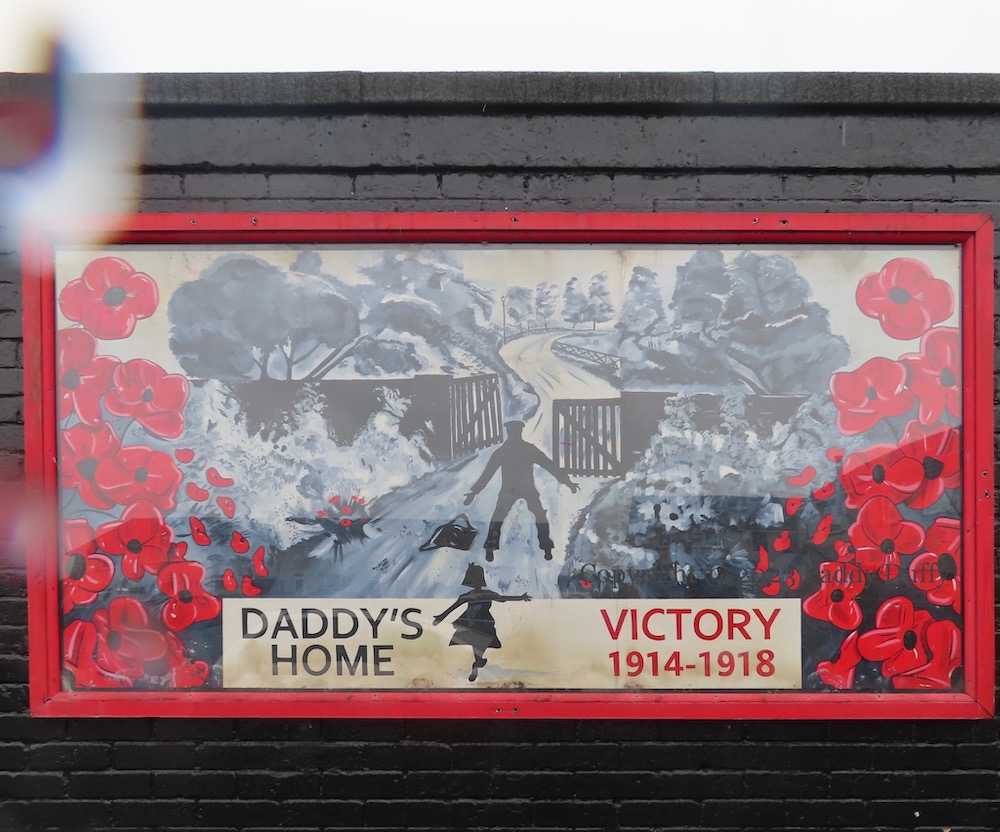
There was previously a mural of the UDA emblem and flags on the substation on the Loughanhill side of Ballysally (Coleraine) (seen in The Hell They Call Highwood) which has now been replaced by the painting of a daughter greeting her father who is returning home after “Victory 1914-1918”. There is also a new version of the painting of the attack on Highwood, as seen below.
The Inniskilling Fusiliers were recruited from the four Ulster counties of Fermanagh, Tyrone, Derry, and Donegal. In WWI, battalions served in the 4th, 29th, and 10th divisions, as well as in the 9th, 10th, and 11th battalions of the 109th brigade of the 36th division. In WWII (represented here by the Spitfire in pursuit of the Messerschmitt) the Fusiliers served in France, India, and Italy. (Ciroca | Long Trail | WP)
(For a broader history, from the Williamite campaign to modern Afghanistan, see Inniskilling.)
This Tyndale mural appears to have be painted without fanfare in 2022.
Above is a mural in Carlingford St, east Belfast showing gravestones of two deceased locals: “6322 Private J. Condon, Royal Irish Regiment, 24th May, 1915, age 14” and “10/16015 Rifleman S. Thompson Royal Irish Rifles, 5th October, 1918”. Their gravestones are the end-point of a journey that began with the Covenant and the Ulster Volunteers (illustrated by images of Carson, the Covenant, gun-running, and Volunteers drilling).
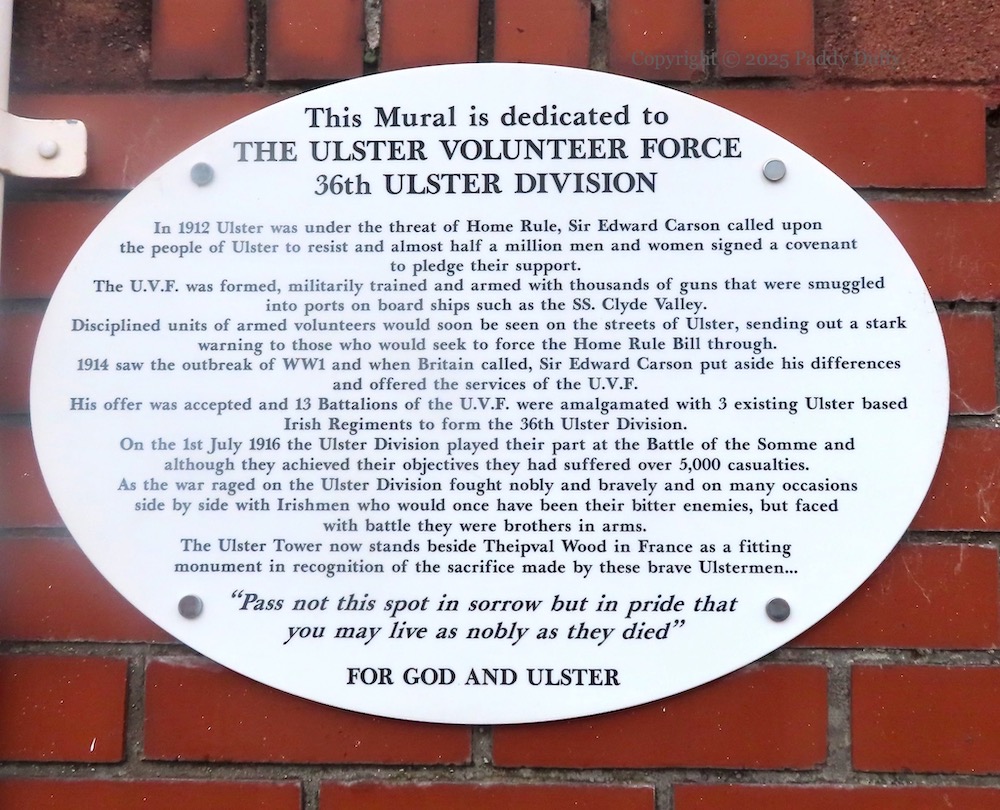
To the left is a plaque describing the journey from the Covenant to the Ulster Volunteers to the Somme: “In 1912 Ulster was under the threat of Home Rule, Sir Edward Carson called upon the people of Ulster to resist and almost half a million men and women signed a covenant to pledge their support. The U.V.F. was formed, militarily trained and armed with thousands of guns that were smuggled into ports on board ships such as the SS. Clyde Valley. Disciplined units of armed volunteers would soon be seen on the streets of Ulster, sending out a stark warning to those who would seek to force the Home Rule bill through. 1914 saw the outbreak of WW1 and when Britain called, Sir Edward Carson put aside his differences and offered the services of the U.V.F. His offer was accepted and 13 battalions of the U.V. F. were amalgamated with 3 existing Ulster based Irish regiments to form the on the 36th (Ulster) Division. On the 1st july the Ulster Division played their part at the Battle of the Somme and although they achieved their objectives they had suffered over 5,000 casualties. As the war raged on the Ulster Division fought nobly and bravely and on many occasions side by side with Irishmen who would once have been their bitter enemies, but faced with battle they were brothers in arms. The Ulster Tower now stands beside Theipval [sic] Wood in France as a fitting monument in recognition of the sacrifice made by these brave Ulstermen … “Pass not this spot in sorrow but in pride that you may live as nobly as they died” For God and Ulster”
There is also a side-wall (out of frame to the right) with the words of Captain Wilfrid Spender, describing the first day of the Battle Of The Somme, 1916, but it is in poor condition.
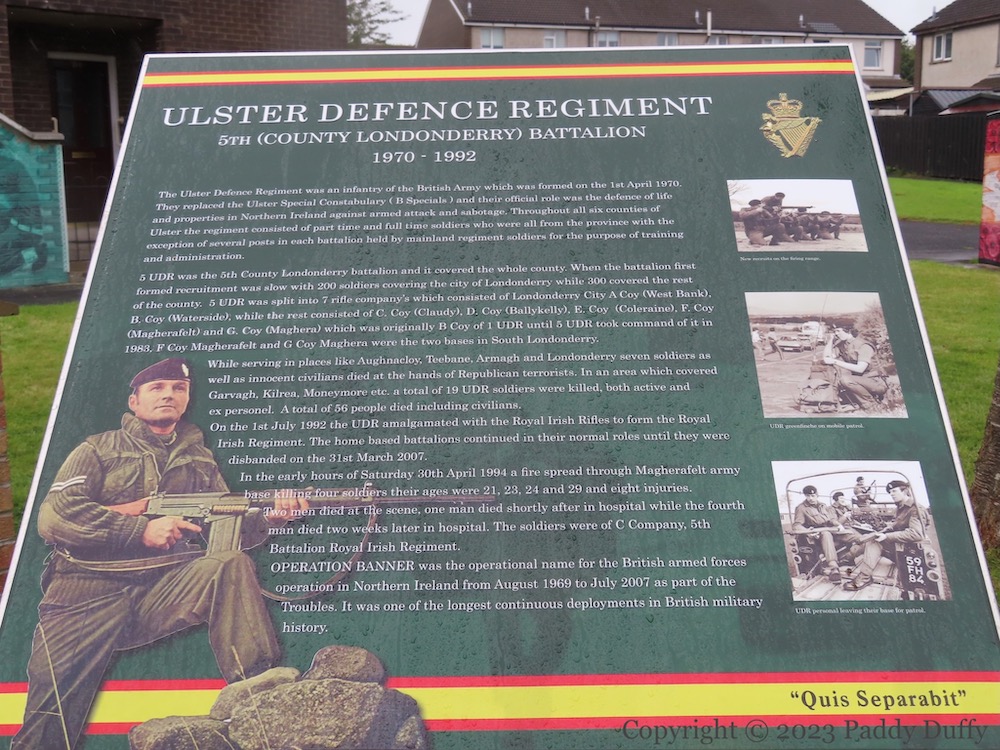
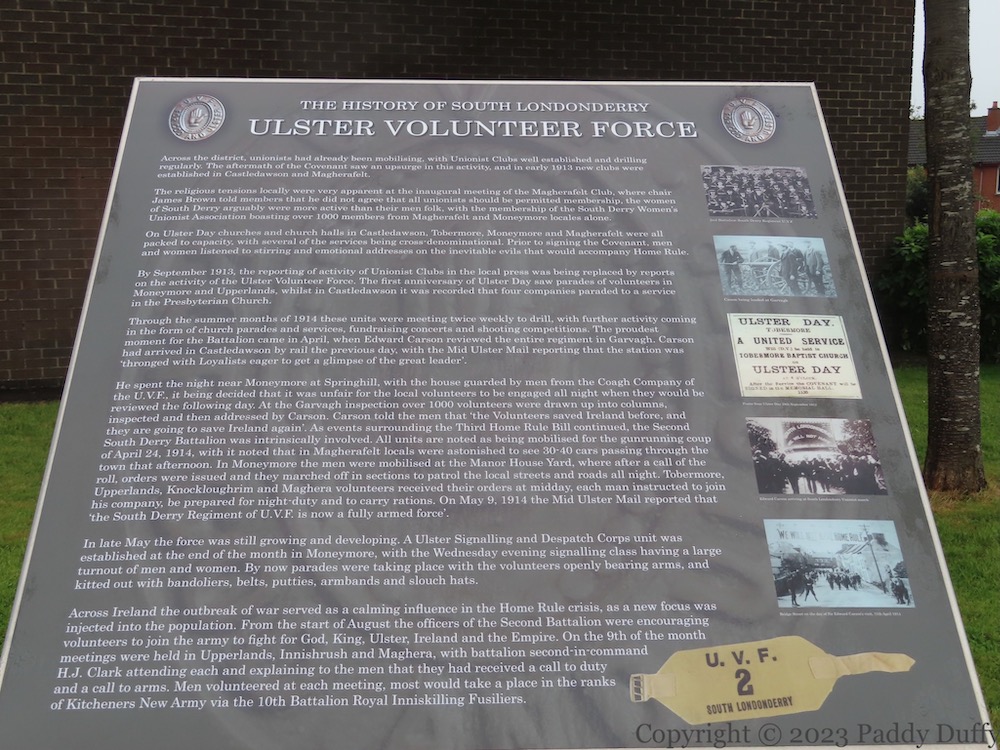
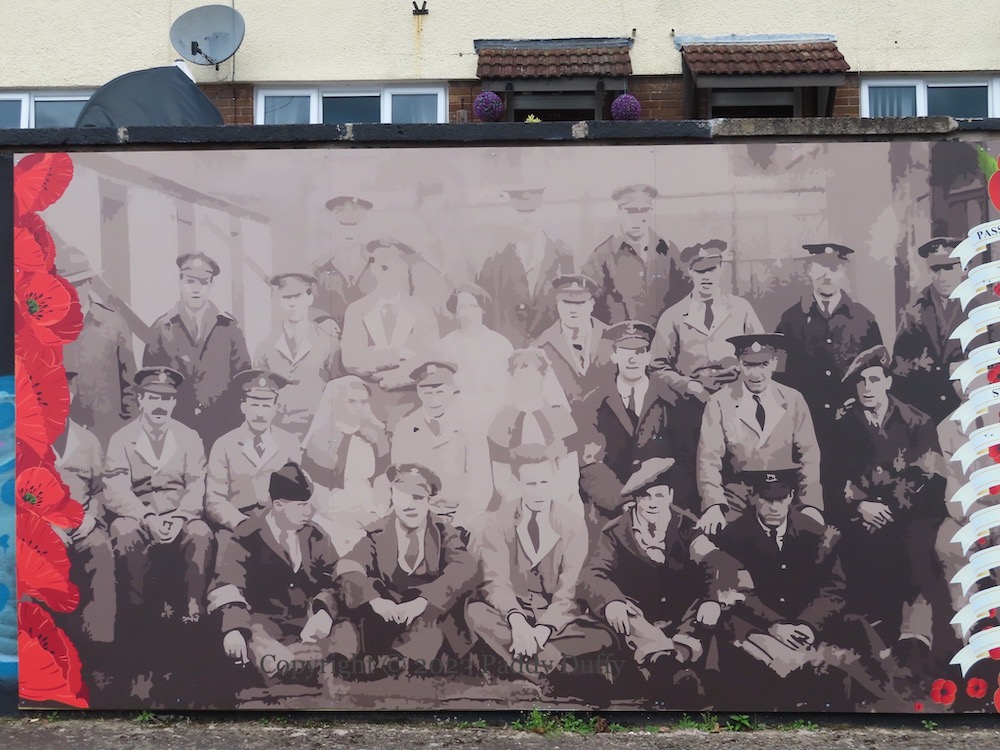
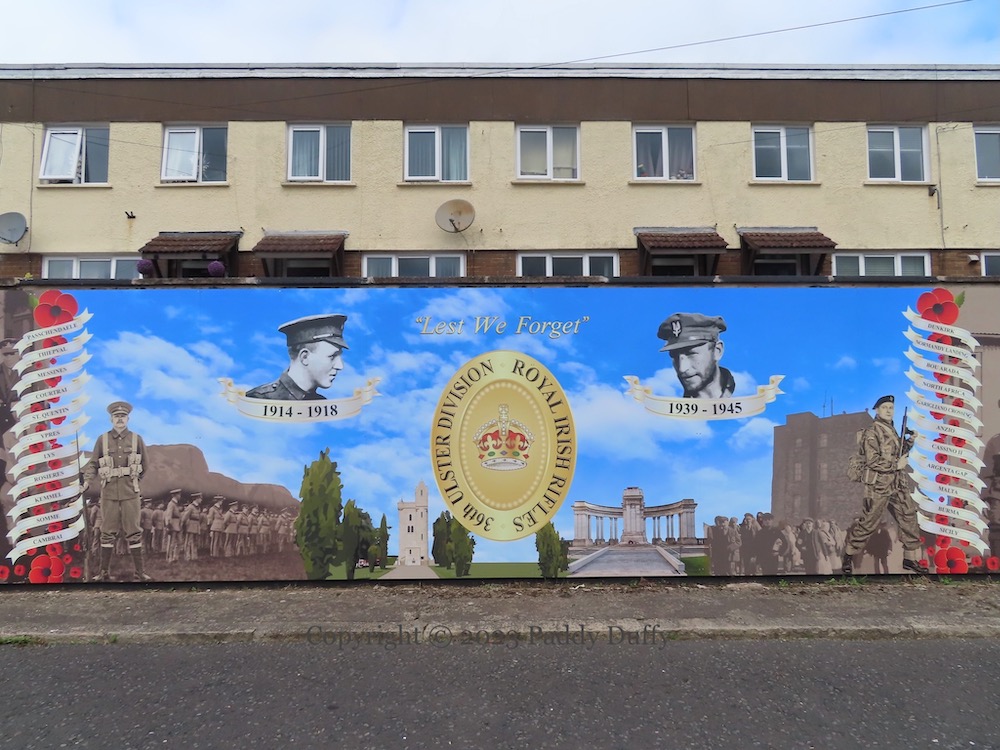
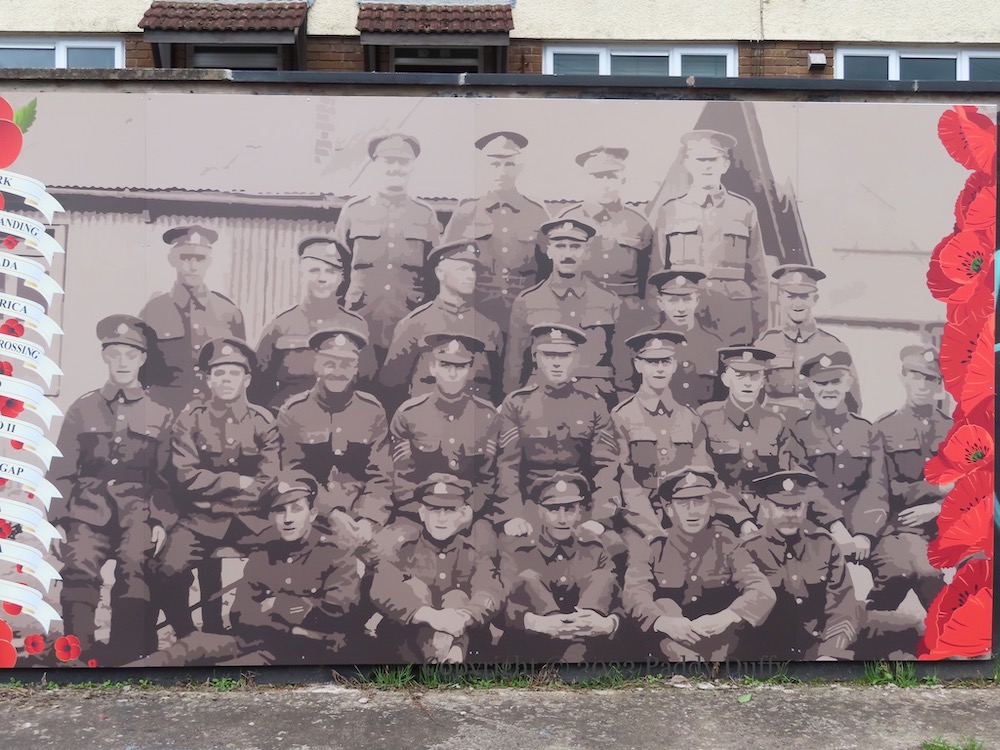
This selection of images from Leckagh Drive, Magherafelt, focuses on the memorials to the dead of WWI (and WWII in the mural above), with an additional board commemorating the UDR 5th (County Londonderry) battalion); there is also a mural and some plaques commemorating (modern-day) UVF volunteers, which will be in tomorrow’s post.
The board shown in the final image provides a history of the South Londonderry volunteers from towns such as Magherafelt, Castledawson, Moneymore, and Tobermore. Edward Carson reviewed the volunteers in April 1914. Later that same month, arms were received from the weapons landed in Larne. In the Great War, the men from the area served in the 10th battalion of the Royal Inniskilling Fusiliers in the 109th brigade of the 36th Division.
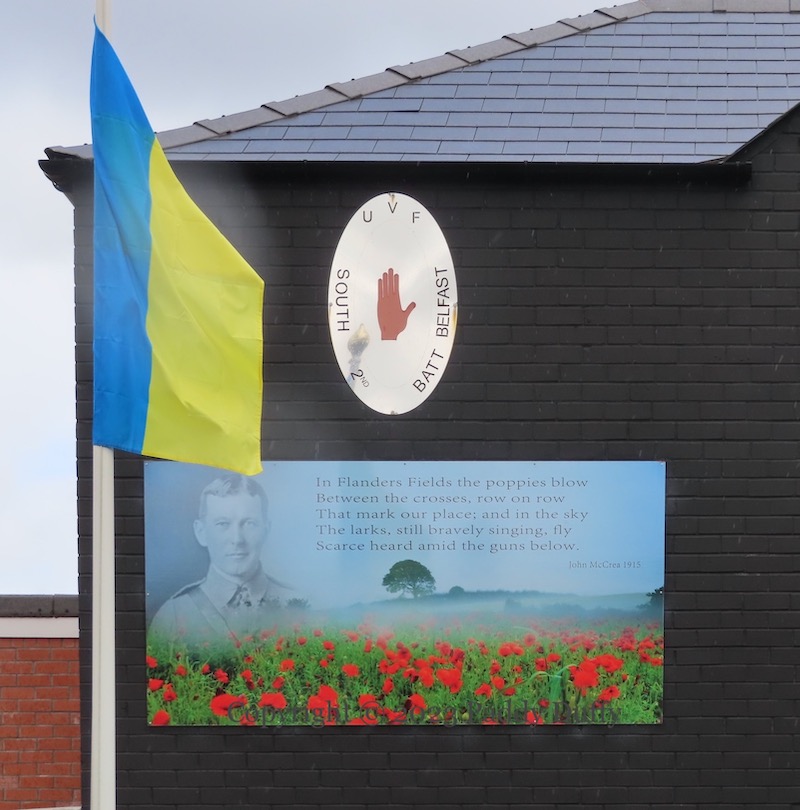
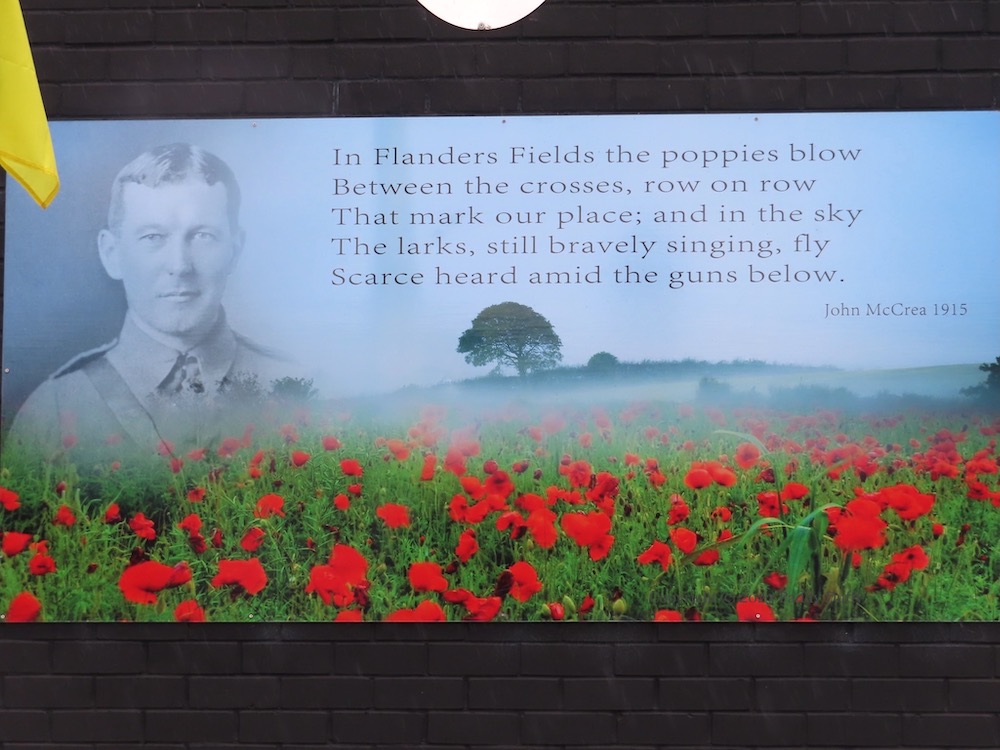
The house next to the Village memorial garden got an extension at the back in 2020 and with it the left-hand part of the house’s gable wall was extended upward (compare with the images from 2017 in Continuing Conflicts). The board with a verse from McCrea’s In Flanders Fields was present previously, but has been raised, and above it there now stands a red-hand emblem of the “UVF 2nd batt. south Belfast”.
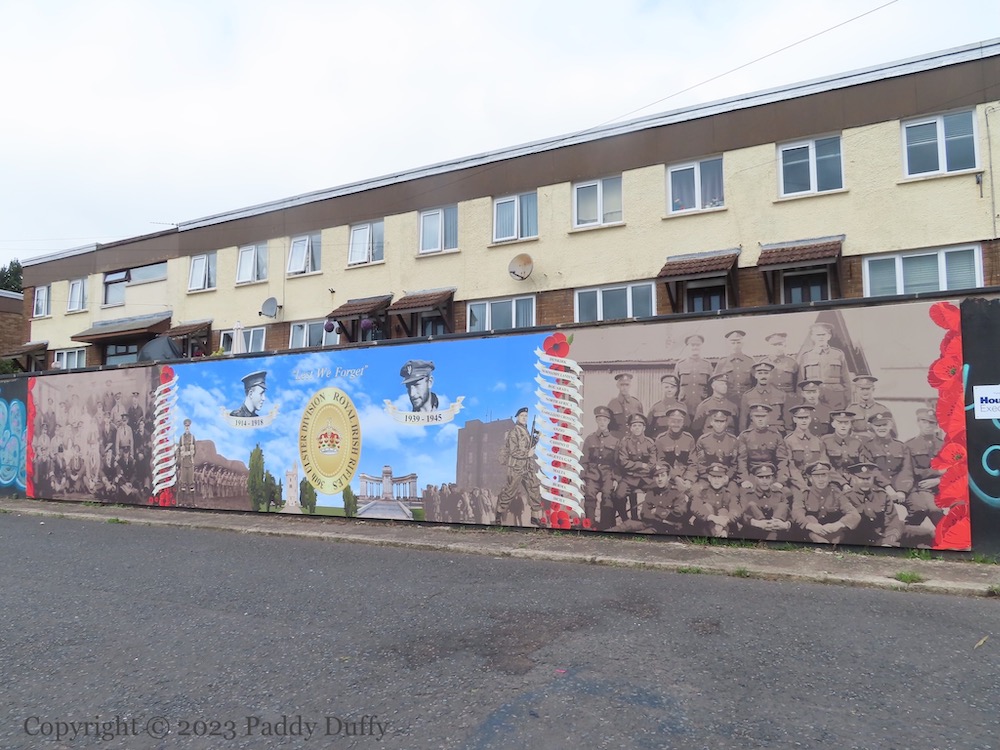
After WWI, the Royal Irish Rifles became the Royal Ulster Rifles (and later became part of the Royal Irish Rangers). This board prioritises WWI as the Rifles were part of the 36th Division. The hero of WWI portrayed in the central panel is William McFadzean, awarded the VC for falling on two live grenades in the trenches on July 1st, 1916. McFadzean is familiar from many previous murals both individually and in the company of other VC winners; for his family home in Cregagh, see Rubicon.
Alongside McFadzean, the hero of WWII is Blair “Paddy” Mayne, who was only briefly in the Ulster Rifles before making his name in the Parachute Unit (later, and better, known as the SAS). His many medals of honour are shown in an old Newtownards mural, though he was denied the VC.
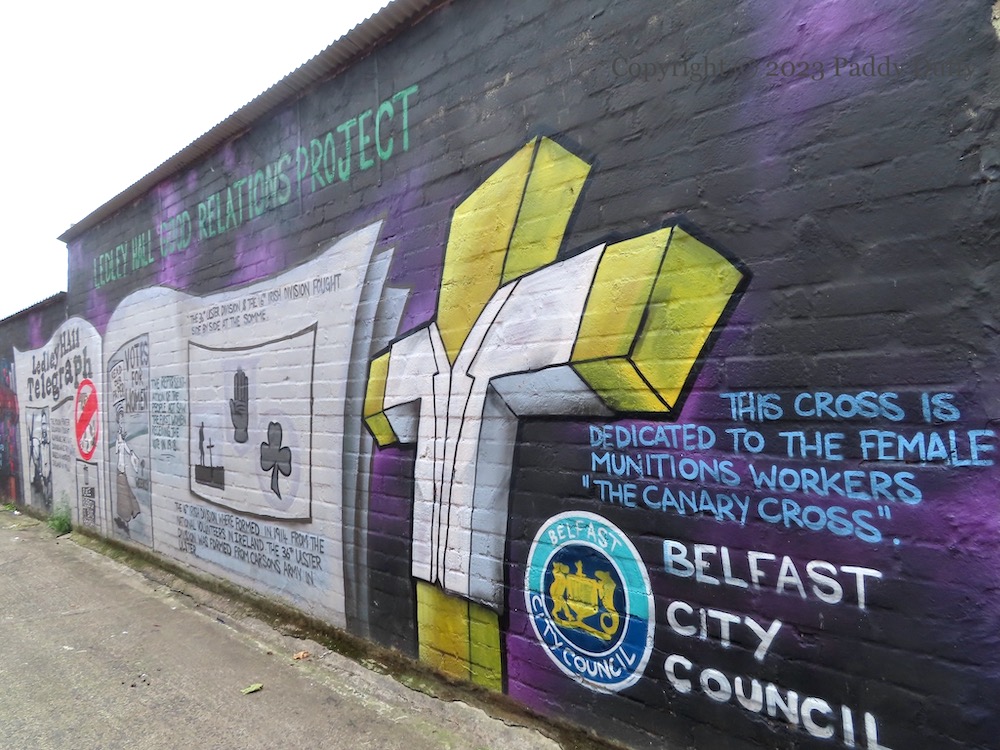
An imaginary newspaper called the “Ledley Hall Telegraph” includes stories on the 303 (Polish) RAF Squadron (which was stationed in Northern Ireland from 1943 to 1944), “Votes for women” (“the Representation Of The People Act saw the first women receiving the vote in 1918”), and the 16th and 36th Divisions (the mural says they “fought side by side at the Somme” – but the 36th was withdrawn on July 2nd after the Battle Of Albert and the 16th arrived in September and fought in the battles of Guillemont and Ginchy; both were withdrawn to Messines and both would take part in the Battle Of Messines in June 1917).
The “newspaper” is bookended by two painted crosses (for Row On Row), one for Guardsman Connor Lilley, a member of the Gertrude Star flute band, who was serving with the 1st battalion Royal Irish Guards when he was killed in an accident in Canada (Fb), and the other for WWI female munitions workers who, because of their work with TNT, risked yellowing skin both from direct exposure and from liver damage (“toxic jaundice”) (WP).
Also included is “The Kindness Hut”: “Be the reason someone smiles today”, “Kindness is free – please share”, “In a world where you can be anything, be kind”, “Take only what you need! If everyone shares there’s enough to go around”.
“O valiant hearts who to your glory came/Through dust of conflict and through battle flame//Tranquil you lie, your knightly virtue proved/Your memory hallowed [not “hollowed”] in the land you loved.” The hymn ‘O Valiant Hearts’ was a poem written during the first World War to commemorate the Allied dead, and was put to a variety of tunes during the 1920s, including arrangements by Vaughan Williams and Holst (WP); the most commonly sung tune, however, is that of Charles Harris (youtube, includes the full poem).
The memorial shown in the middle of the board is a Cross Of Sacrifice (see previously: One In Design And Intention) built on top of a German pill box at the centre of Tyne Cot cemetery, near Passchendaele, Belgium. The title of today’s post comes from remarks made by George V during a 1922 visit to the cemetery (History.org). The map in the background shows the area just south of Ypres (Canadian Soldiers).
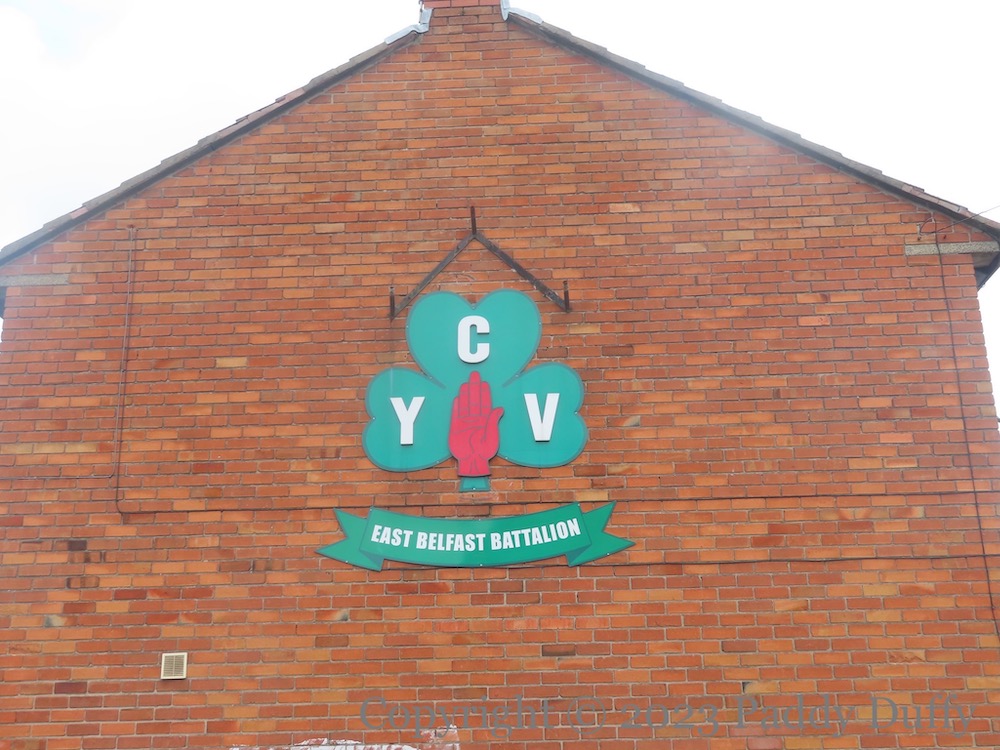
The board is in Pim’s Avenue, Belfast, opposite the older YCV emblem shown below.















 Paddy Duffy Collection