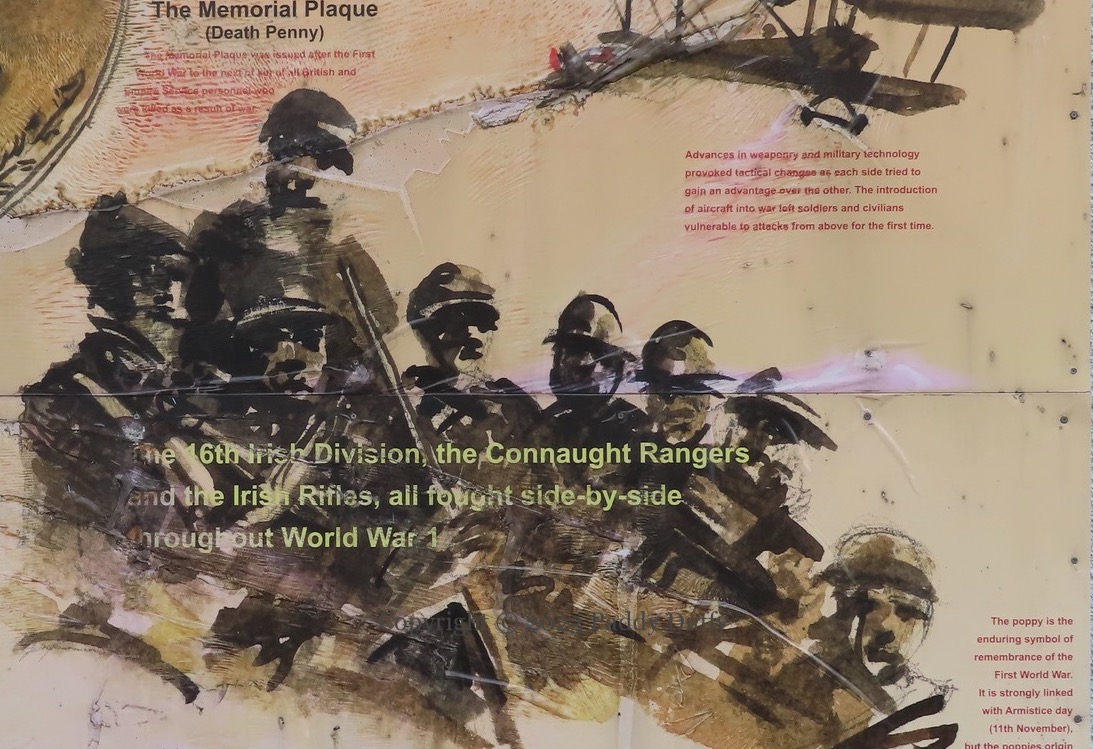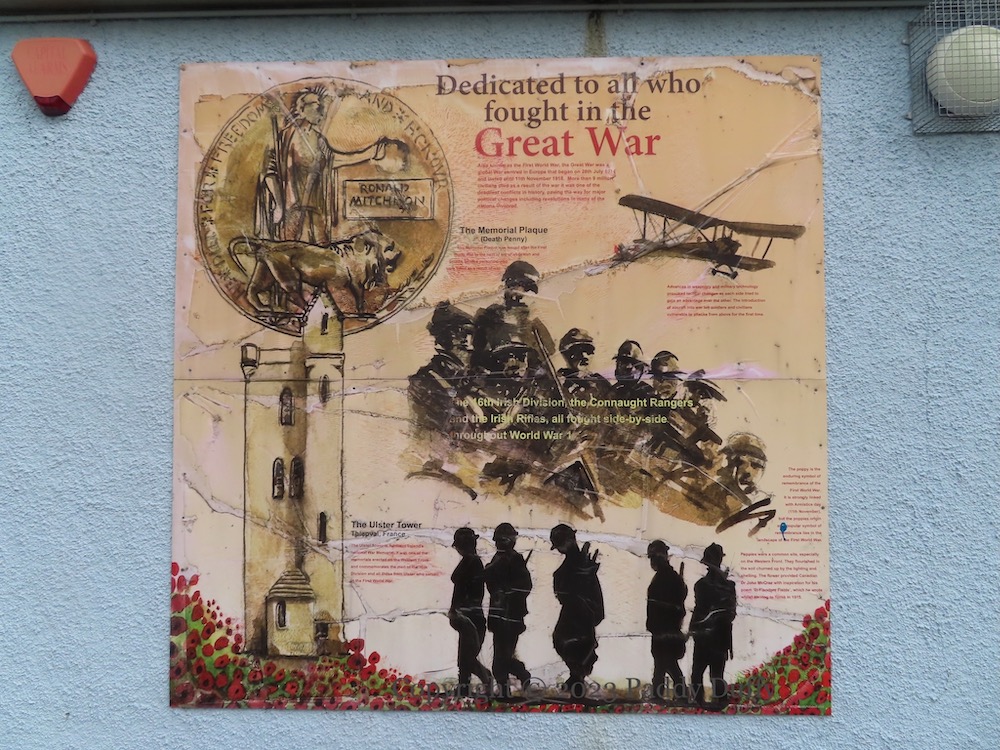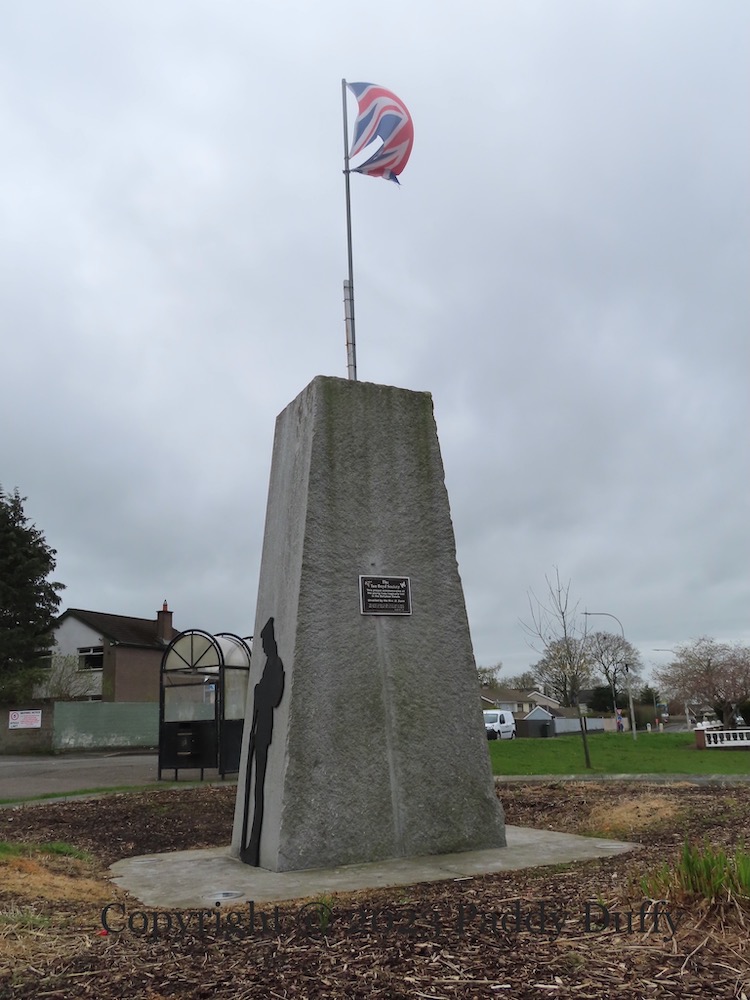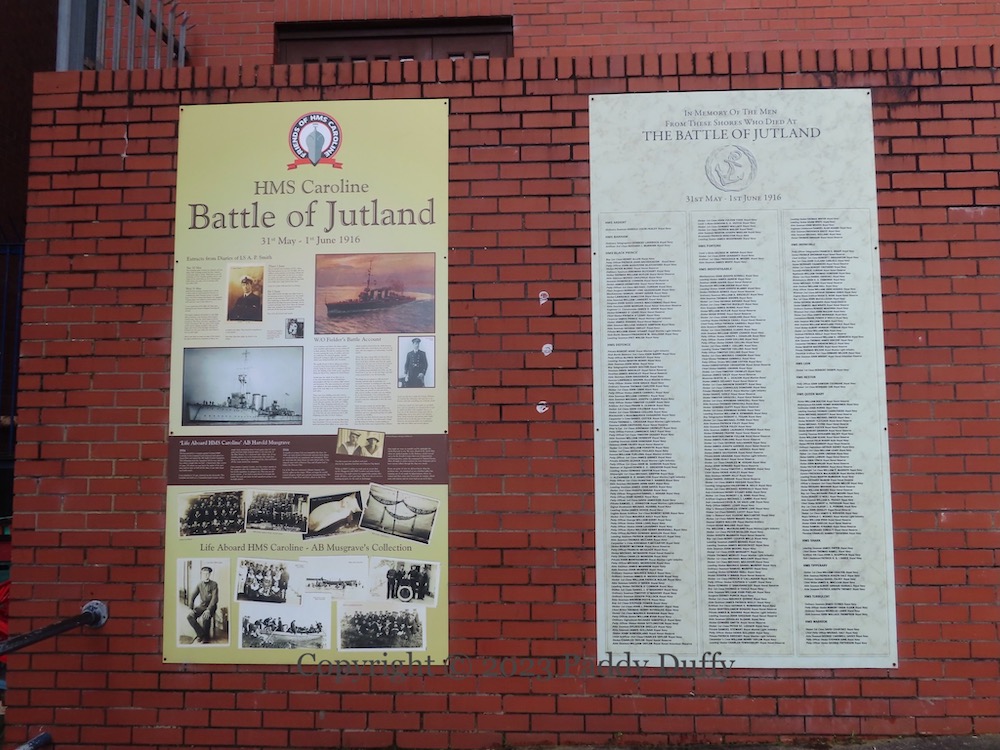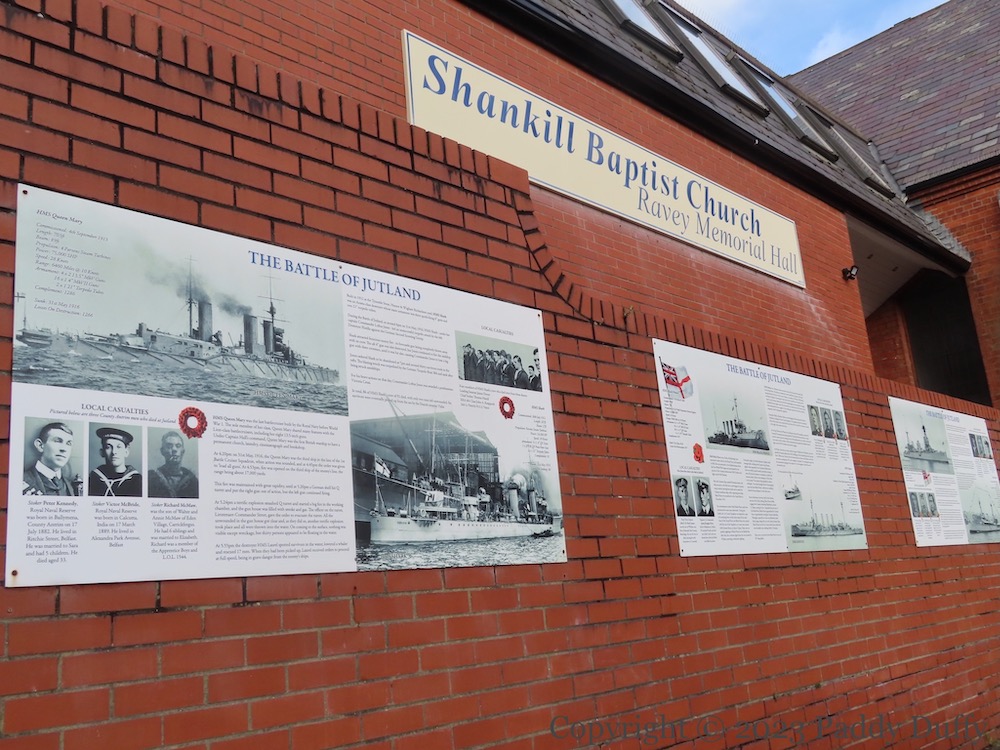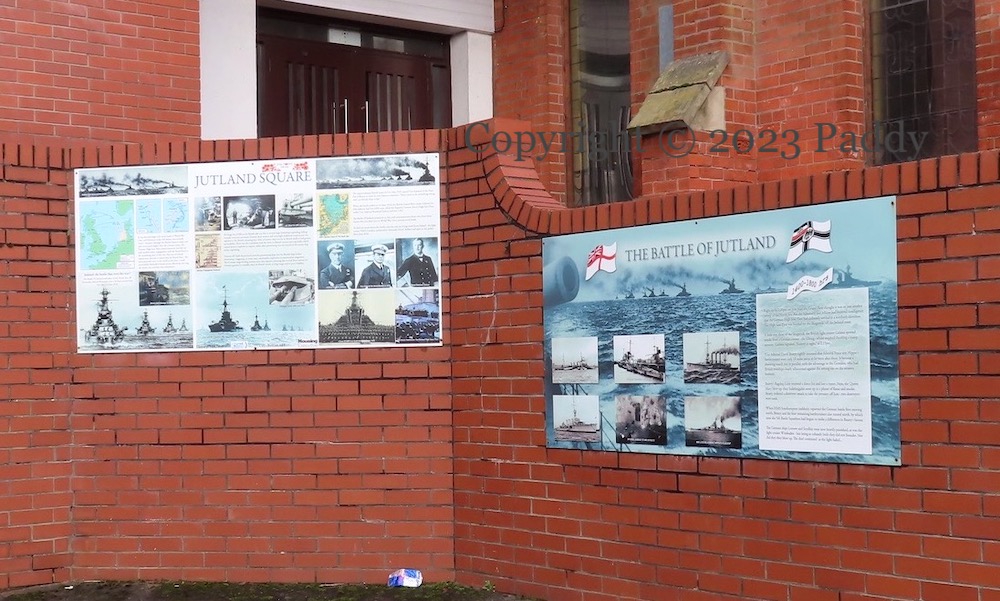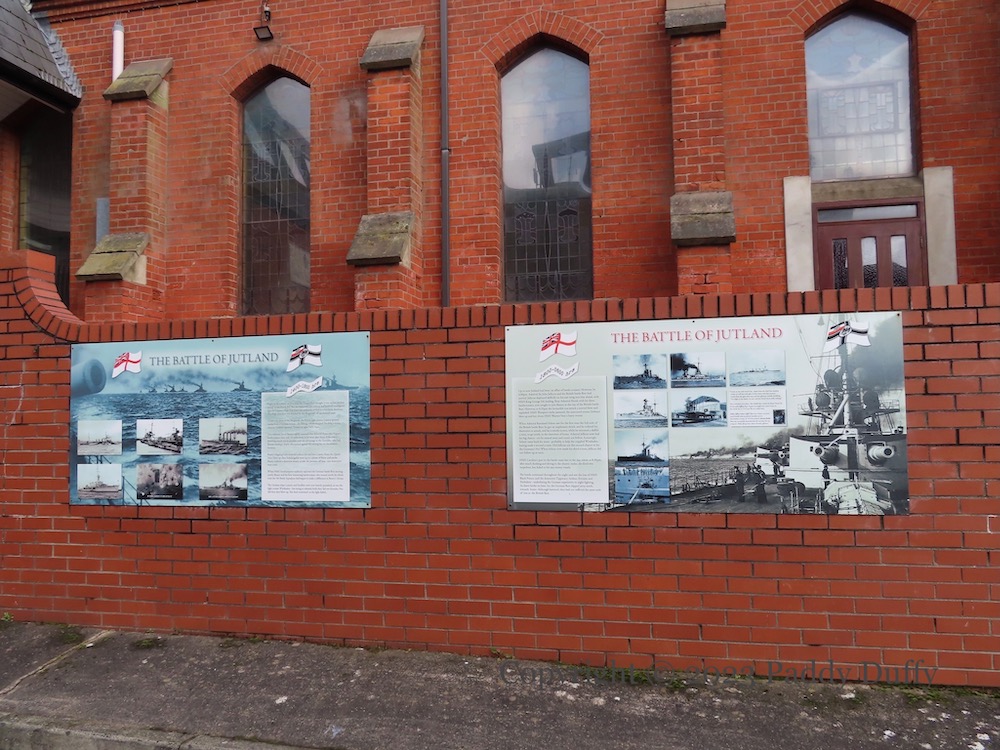
HMS Caroline re-opened in March, post Covid (Royal Navy). It opened as a floating museum in 2016, in time for the centenary of the Battle Of Jutland on May 31st-June 1st, 1916. There were almost 10,000 casualties and 25 ships were sunk that day but the Caroline survived. She served as a Navy headquarters during WWII, in Belfast habour, before being returned to reserves. (WP)
These eight panels are in Tennent Street in the Shankill. There was previously a painting of HMS Caroline at the Battle Of Jutland off the Shore Road in north Belfast – see HMS Caroline.
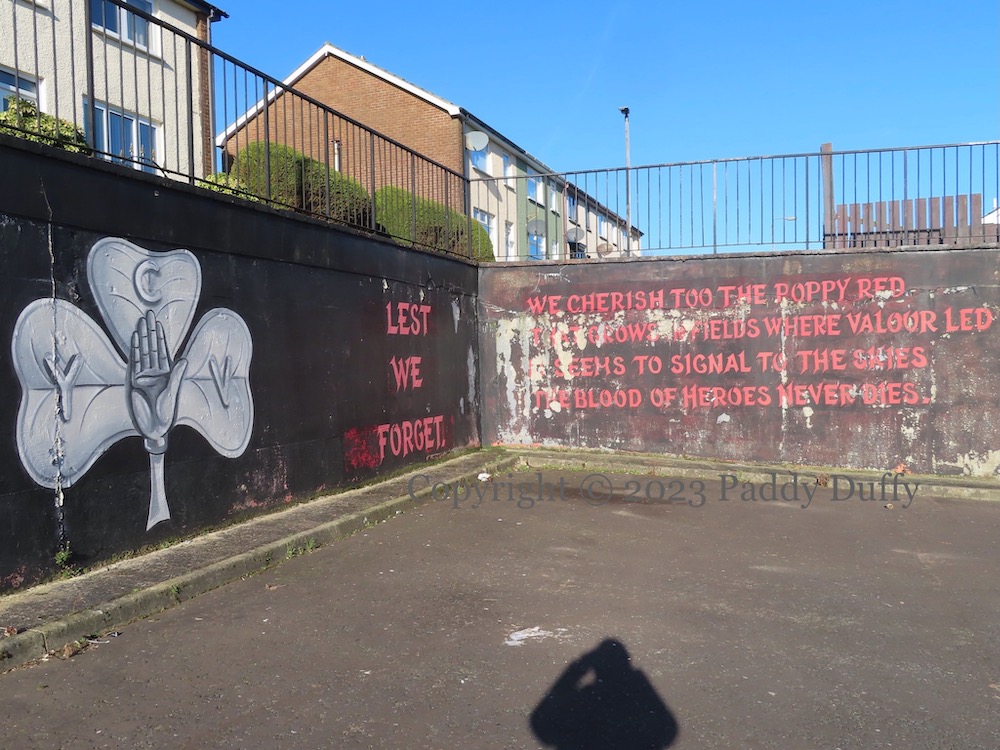
“We cherish too the poppy red/That grows in fields where valour led/It seems to signal to the skies/The blood of heroes never dies.” From Moina Michael’s poem We Shall Keep The Faith.
“Officer in command Vol. Ernest “Ernie” Dougan (30/04/65-22/03/20) Ballyduff/Glengormley Ulster Volunteer Force 1st East Antrim Battalion.” Dougan died at the beginning of lockdown and so the public commemoration of his passing did not take place until 2022. He was also involved in the Ballyduff Community Redevelopment Group (Fb). According to a Sunday World article, Dougan did not join the UVF until sometime after the Agreement, after he was given a punishment beating by the UDA in north Belfast (see Irish Times | Mirror) and moved out to Ballyduff.
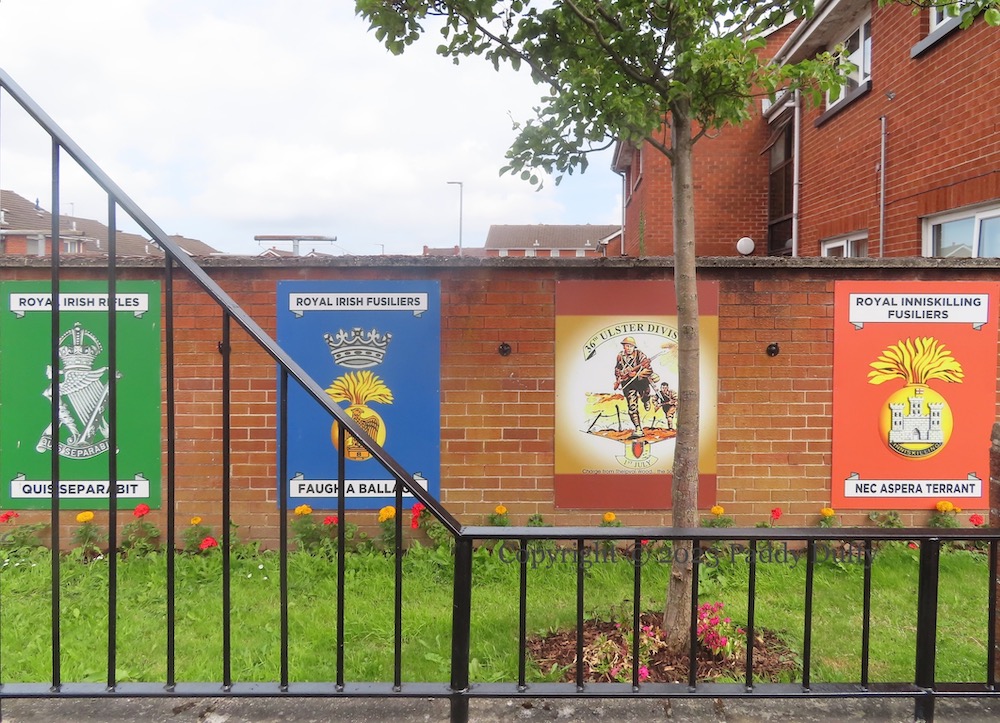
The 11th and 12th battalions of the Royal Irish Rifles were part of the 108th brigade and the 36th (Ulster) Division in WWI.
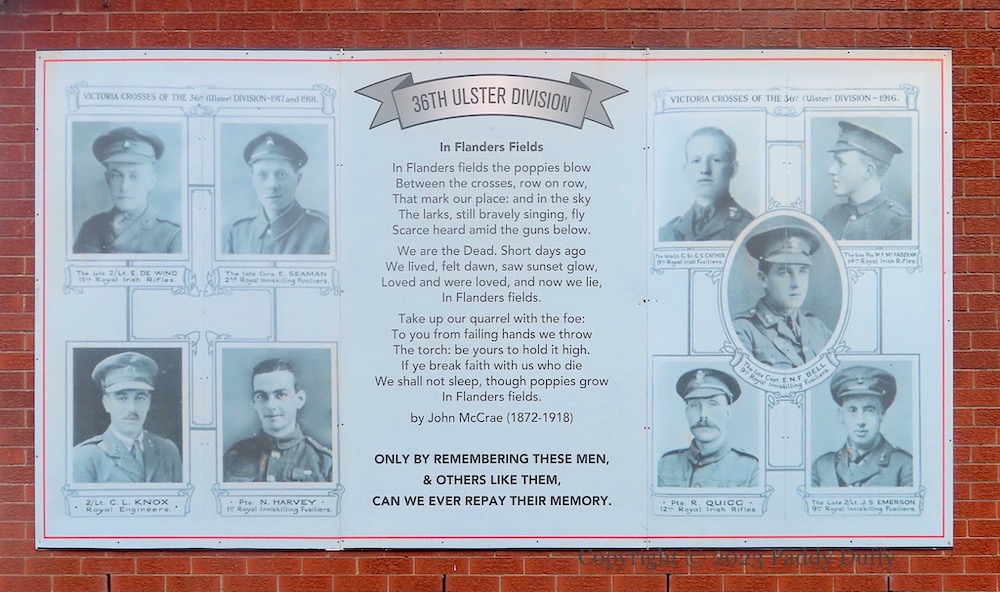
On July 1st, 1916, the 12th battalion’s objective was to reach the German trenches beyond Beaucourt railway station with the 9th battalion Royal Irish Fusiliers (Armagh, Monaghan & Cavan Volunteers); they were cut down by machine-gun fire and unable to achieve their goal. Robert Quigg of the 12th Rifles and Geoffrey Cather of the 9th Fusiliers were awarded the VC (see previously VCs Of The 36th). The 11th was part of the attack on the Schwaben Redoubt and reached the German second line before being pushed back in the evening. (Royal Irish | Web Matters)
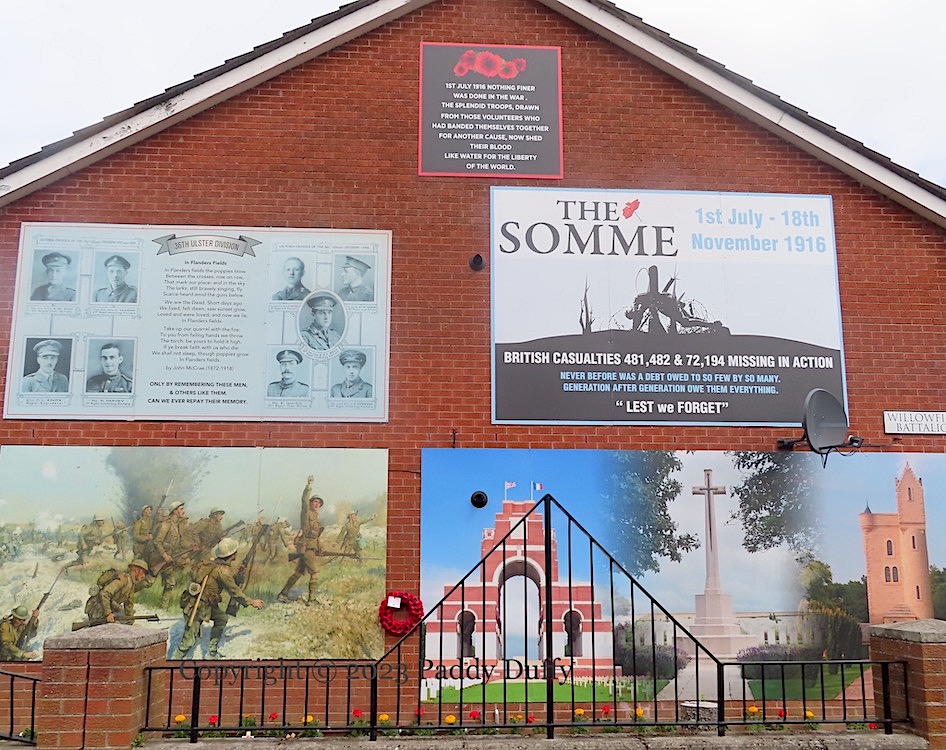
“I am not an Ulsterman but yesterday, the First of July, as I followed their amazing attack, I felt that I would rather be an Ulsterman than anything else in the world. My pen cannot describe adequately the hundreds of heroic acts I witnessed, the Ulster Volunteer Force, from which the Division was made, has won a name that equals any in history. Their devotion deserves the gratitude of the British empire.”
These are the words of Wilfrid (not “Wilfred”) Spender, Plymouth-born newspaper manager, quartermaster of the Ulster Volunteers, general staff officer of the 36th (Ulster) Division, winner of the Military Cross for actions at Thiepval, and Cabinet Secretary of the new “Northern Ireland” in 1921.
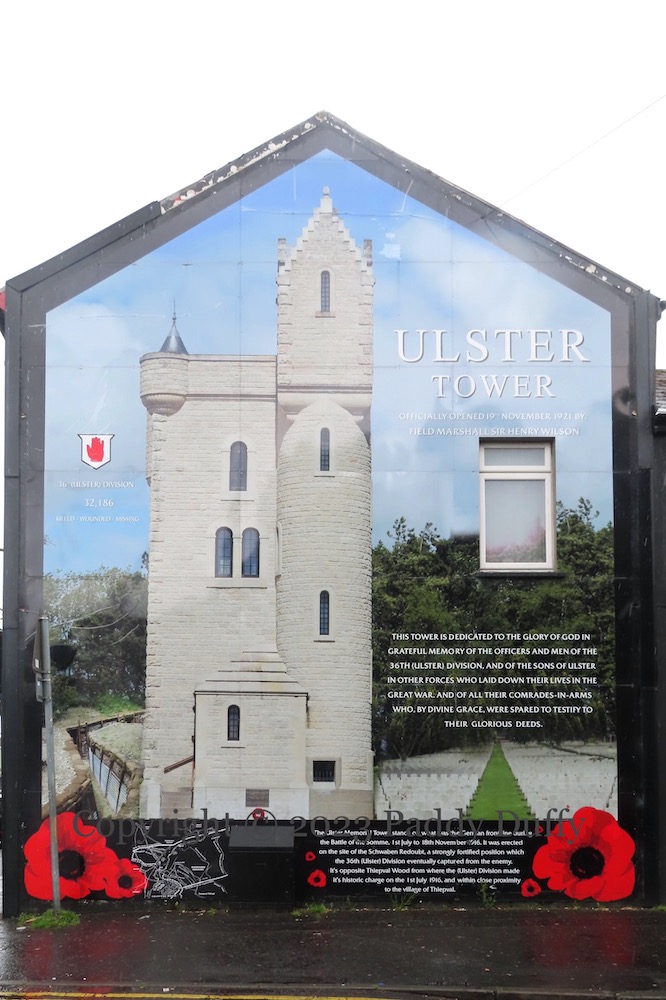
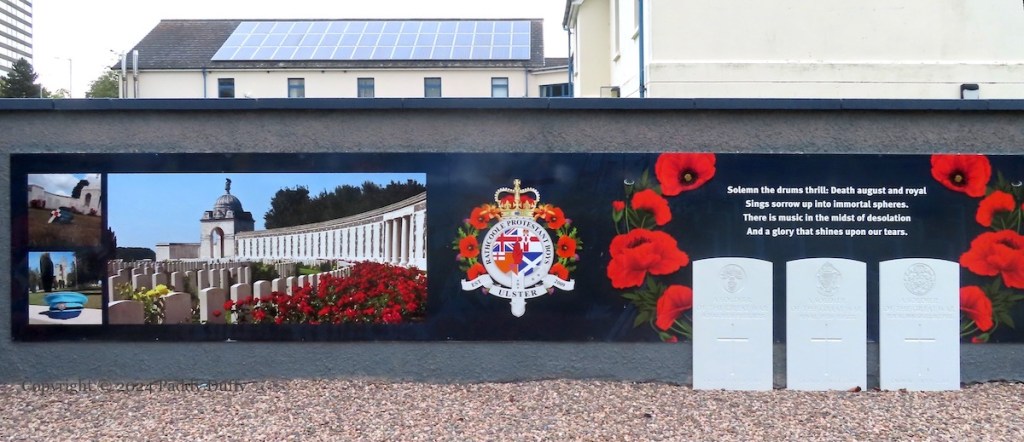
The Ulster Tower memorial is in the top left and the Thiepval Memorial To The Missing is in the top right. The emblems are of the Royal Irish Rifles.
Main Street, Greyabbey, Co. Down, on the outside wall of the Orange Hall.
There was previously a (painted) mural on this wall – see Passchendaele Court – but this latest display is a large printed board, with photographs blended together and framed by graveside mourners, poppies, and the emblems of the Pride Of Govan flute band and the Govan Somme Association (Fb), which also supported the previous mural.
To the left, as seen in the final images, is a smaller UVF (1st Battalion) A Company 5th Platoon board – like the other new board in the street We Will Always Be Ready (and on the other side of Conway Street – see When Needed We Shall Rise Again).
This board from the Maiden City Somme Society (Fb) traces the history of 1912-1918, from the protests against Home Rule and the signing of the Ulster Covenant (both the men’s (middle left) and women’s (top row, second from left) versions of the declaration are shown; also in the top row are postcards seen previously in The Red Hand And The Winning Hand and Ulster Girl), to the formation and training of the Ulster Volunteers (specifically the City of Derry regiment – emblem left of the city crest), to the Ulster Division’s service in WWI (specifically the 10th Battalion Royal Inniskilling Fusiliers or ‘Derry Volunteers’ – emblem right of the city crest) shown in the bottom row by JP Beadle’s painting (see Over The Top) flanked by the Thiepval and Ulster Tower memorials.
The board was launched in August 2016 in the Fountain, Londonderry.
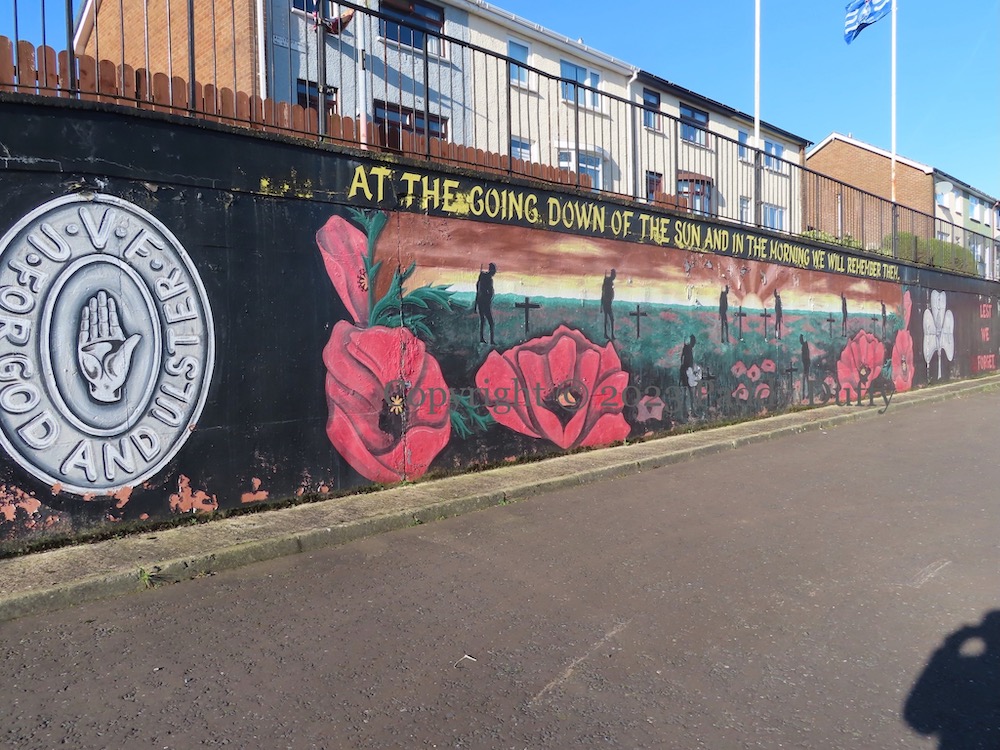
There has been a 36th Division board on this wall since 2003 (see Steeple Defenders) and this second one is now more than a decade old – see the 2013 post on Peter’s site. It is accompanied by two quotations: “Pass not this spot in sorrow but in pride/That you may live as nobly as they died.” These lines are also used in a WWI memorial mural in Carlingford Street, Belfast. “They shall not grow old as we that are left grow old./Age shall not weary them nor the years condemn./At the going down of the sun and in the morning, we will remember them.” from Binyon’s For The Fallen.
The mural below, with YCV and 36th Division emblems and a “South Antrim 1st Batt” flag was added in 2016. There’s no mention on-line of “Vol. Jimmy Fee” of the 1st (and only) battalion of the South Antrim brigade.
The board and mural are on the gable next to the Steeple memorial mural to Denver Smith; between the two gables is the UVF flag shown below.
Ulster Tower in Thiepval, France, provides a background for 13 jigsaw pieces with partial images relating to the Great War, including a uniform with a Victoria Cross and badge of the 36th (Ulster) Division, the 10th (Irish) Division, the 16th (Irish) Division, and the Royal Irish Fusiliers (and a fourteenth piece for information).
Kilgreel Road, Antrim. The mural is more than a decade old and is bleached from the sun (the pinks were formerly brown); on the former site of The People’s Army (a UVF board).
“This artwork, commemorating the sacrifices made during the Great War and subsequent conflicts, was produced by the young people of Parkhall Youth & Community Club and was completed in 2010. It is part of a larger Re-imaging project undertaken by Parkhall Cultural Awareness Association & Parkhall Community Association. 14 jigsaw pieces are representated as that was the age of the youngest soldier to die on the Somme. The Royal Irish Fusiliers, who recruited in the Antrim area, served with the 10th Irish Division and 36th Ulster Division during World War I. The cap badge is surrounded with poppies. The poppy is an international symbol commemorating the sacrifices of members of the armed forces and of civilians specifically since the Great War. Birds were used extensively during World War I delivering important logistic message from the front line. HMS Antrim served in the Great War and survived. After the war she became the first ship to be fitted with an experimental sonar system in 1920. Her bell can presently be viewed in Antrim Civic Centre. The grounds of Shane’s Castle in Antrim were used as a training ground and a campsite for the 36th Ulster Division prior to their deployment to France. Of all bell tents and parachutes during the Great War 90% were made from Irish Linen. During the Great War a service man’s basic wage was one shilling a day (5 pence). The sound of the bugle was heard throughout each day in the trenches, starting with Reveille to rouse you from slumber. ‘Flowers of the Forest’, a powerful Scottish lament, is often played by a lone piper at services of Remembrance. “I am not an Ulsterman but yesterday, the 1st July, as I followed their amazing attack, I felt that I would rather be an Ulsterman than anything else in the world.” Extract from the speech by Captain Wilfred [Wilfrid] Spencer 2st July 1916. Men from the 36th Ulster Division received 9 Victoria Crosses. Women played a vital role in field hospitals during the Great War caring for the injured, from the front line. The flags of the 16th and 10th Irish Divisions. 36th Ulster division. The Ulster Tower is a memorial to the men of the 36th Ulster Division. It is situated near the entrance to Thiepval Wood, France.
UVF volunteer Denver Smith was killed in the early morning of January 1st, 2000 by a gang of six men with machetes and pikes; the incident was perhaps drugs-related (Guardian | BBC-NI | Irish Times). The iconography, however, is all related to WWI, with soldiers moving across the fields of Flanders in the mural, above, and mourning by a graveside in the memorial garden, below.