The 36th (Ulster) Division Memorial Association (Fb) put on a play called From The Shipyard To The Somme (Fb | watch on youtube) in Connswater Community Centre in 2013. It follows a group of men from east Belfast who joined the Ulster Volunteers in Belfast but are now training at Abercorn barracks in Ballykinlar (later an internment camp) as members of the 36th Division, before going to the Battle Of The Somme in France.
Belfast – with one tenth of the population – provided about a third of the Irish soldier to participate in WWI. In the shipyards, Harland & Wolff responded to the slow-down in production not by putting everyone on short time but by letting go of employees, particularly unskilled employees, for whom the wages of soldiering were competitive (particularly if married), while skilled men were reclassified as “munitions workers” needed to fulfill war contracts (History Ireland | Long Kesh Inside Out).
Two types of mourner at the grave of a fallen WWI soldier: on the left, comrades in arms; on the right, members of the family they left behind.
Work on the mural began in December, 2021, but progress seems to have stalled. One of the bayonets is in outline as is the giant poppy overheard. The effect is that the scene seems to be taking place under the stars.
“Sgt. Thomas George Wortley , “D Coy” 14th Btn. Royal Irish Rifles, Service No. 14/17063, Died Messines 07-06-1917, Spanbroekmolen British Cemetary Grave C10″. Wortley was born in Carrickfergus, lived in Belfast, died on the first day of the battle at Messines (findagrave), buried in a small cemetery of British soldiers, many from the 36th (Ulster) Division, in Spanbroekmolen on the Ypres Salient in Flanders (WP) – shown in the mural – and is remembered in Carrickfergus with a parade each year on the date of his death (carrickfergusrollofhonour).
In this board the Rising Sons Flute Band (“RSFB”) portrays itself as following in the footsteps of the Ulster Volunteers who joined the British Army and specifically the 8th battalion of the Royal Irish Rifles in the 36th (Ulster) Division, which was drawn from east Belfast’s Ulster Volunteers in 1914.
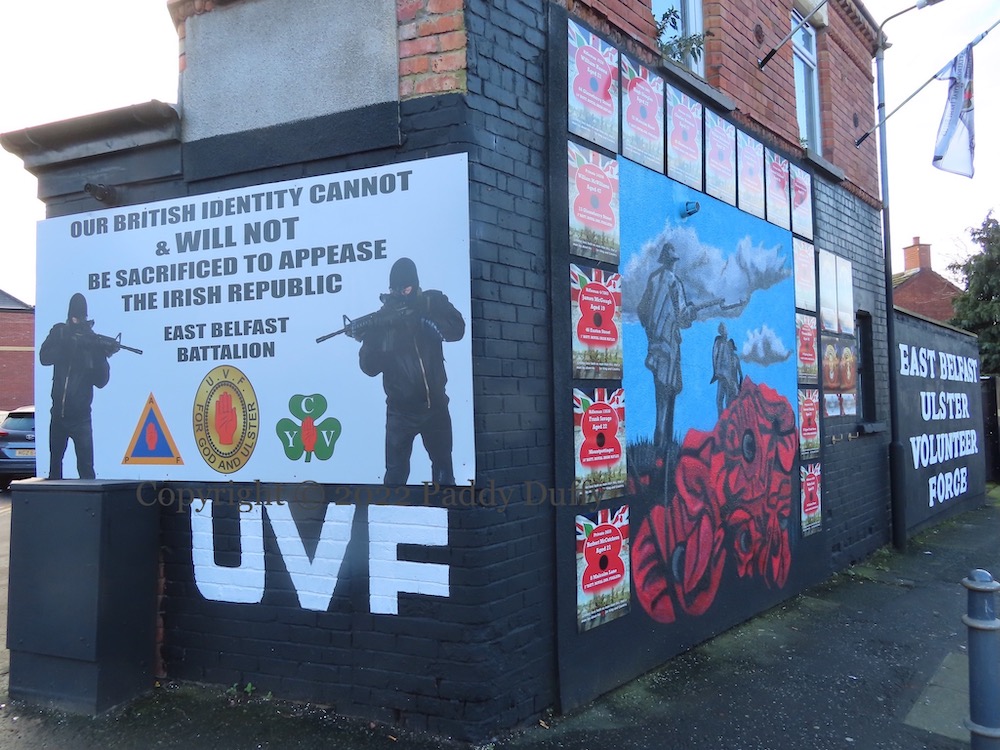
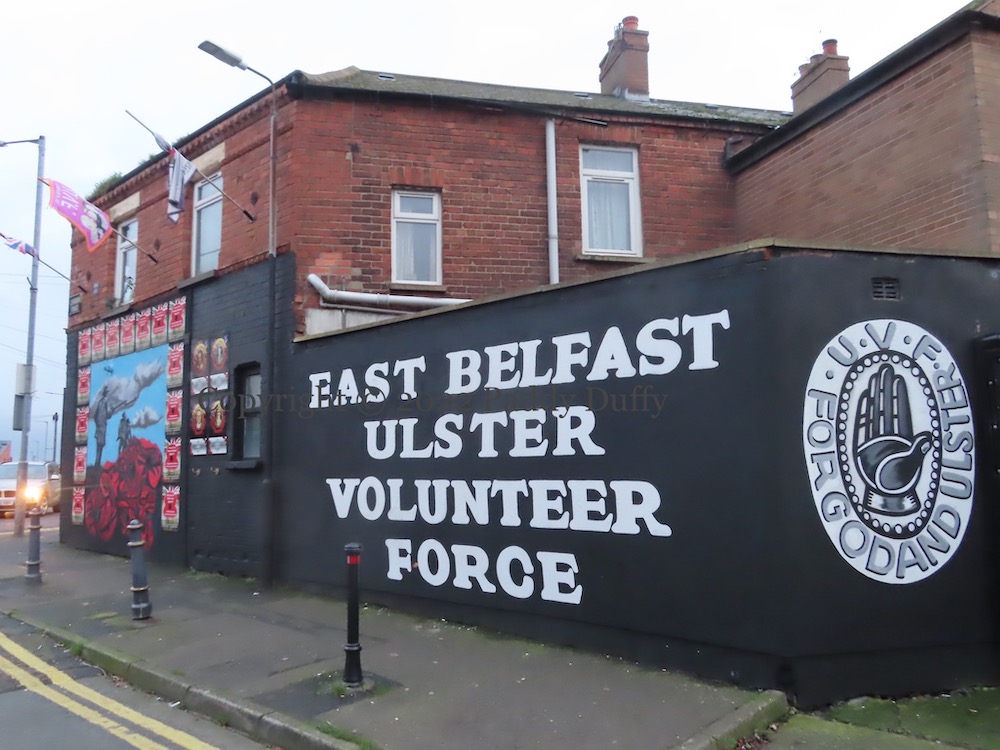
Various changes and additions have been made to the Ulster Volunteers/UVF mural in London Road, east Belfast, compared to the version that replaced a religious mural (Jesus Strong Man) in 2017. The ‘hooded gunman’ board seen in the image above previously replaced a Union Flag in London Road (see East Belfast Ulster Volunteers) but has now been moved to the main Our Lady’s Road: “Our British identity cannot & will not be sacrificed to appease the Irish Republic – East Belfast Battalion [UVF]”.
The side-wall has been modified, to include a UVF emblem and larger lettering for “East Belfast Ulster Volunteer Force”.
For close-ups of the WWI portion, painted by Mark Ervine, see Between The Crosses; for a close-up of the four portraits of volunteers Seymour, Long, Cordner, and Bennett, see Ulster’s Brave.
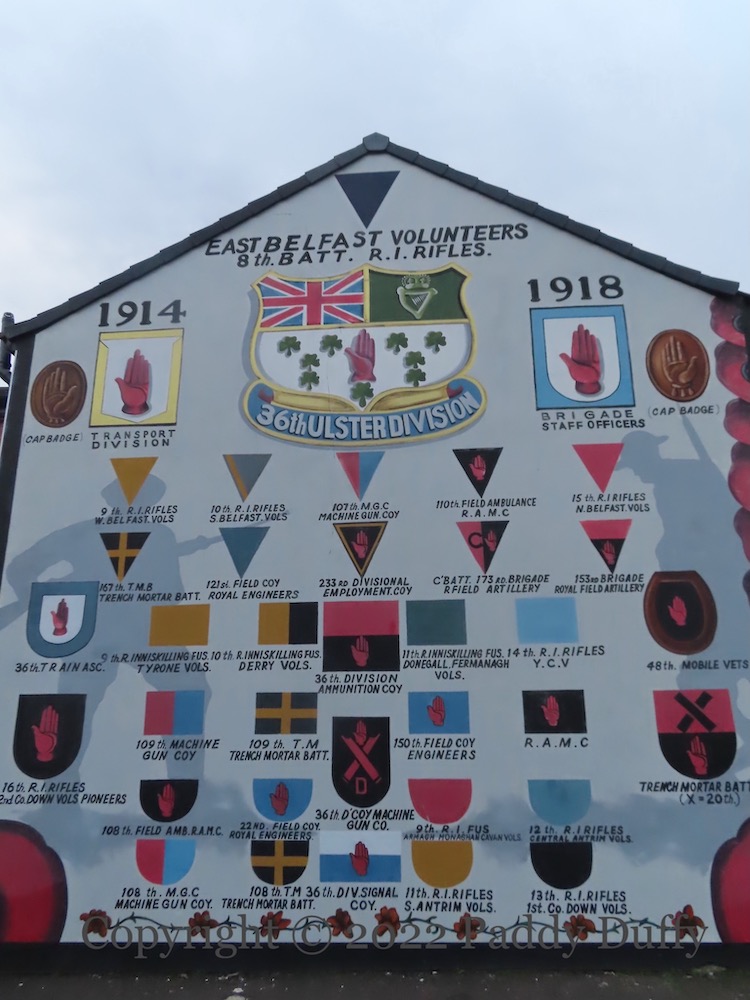
This mural and its accompanying plaques, at the mouth of Canada Street, commemorate WWI and celebrate the Victoria Crosses won by members of the 36th (Ulster) Division “For valour”: Cather, McFadzean, Bell, Quigg, Emerson, De Wind, Seaman, Knox, and Harvey. The main mural features insignia of more than thirty units of types ranging from machine gunners to vets.
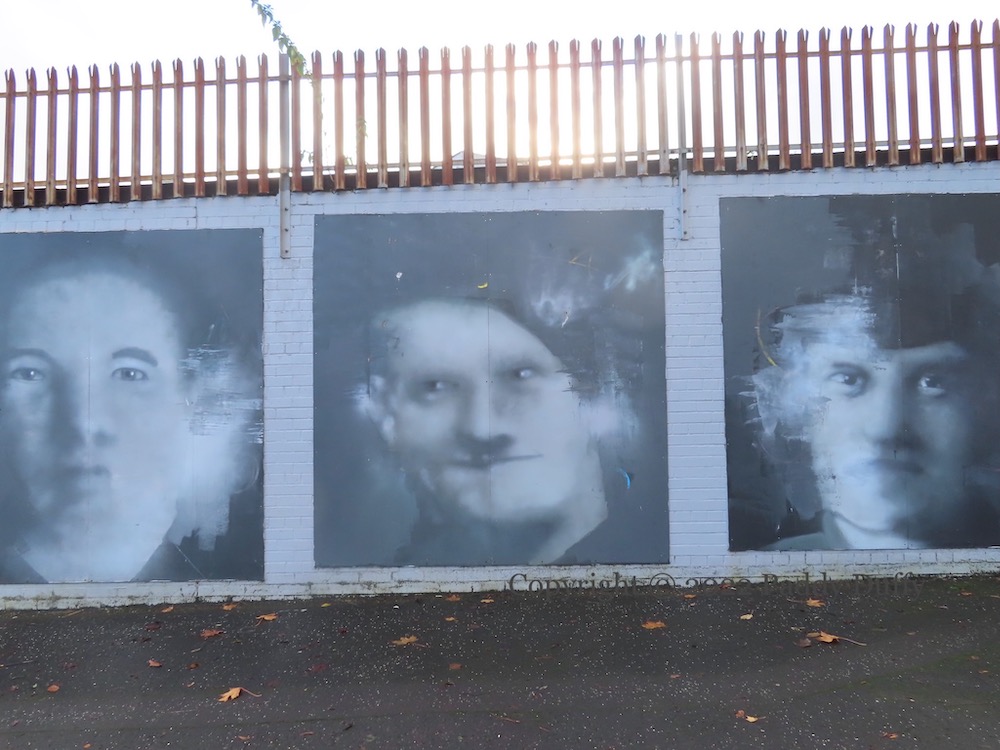
Nell (l) and Elizabeth (r) Corr from 107 Ormeau Road joined Cumann Na mBan in 1915 and travelled to Dublin in 1916 (with Nora Connolly, Ina Connolly, Bridie Farrell, Lizie Allen, Kathleen Murphy, and another girl called O’Neill (Treason Felony)) to serve as messengers in the preparations for April’s Easter Rising. They were in Liberty Hall (shown in the detail above) on the morning of the rising before heading north. Brother George, on the other hand, died at the Somme as a soldier in the Australian infantry, while another brother, Charles, fought in WWI with the Canadian Expeditionary Force. They are pictured on the left-hand side of the mural. (BBC | BBC video)
Soldiers from the 36th (Ulster) division in the trenches of WWI prepare to go ‘over the top’. One waits for the precise moment according to his watch, ready to fire a shot, while the other prepares to blow a whistle and launch a flare.
There is no definitive source for the quotation, and many sources are at odds, but all agree on the basic wording and that the words belong to George V: “Throughout the long years of struggle, [which now so gloriously ended,] the men of Ulster have proved [on many fields] how nobly they fight and die.” The date is given as ‘November 16’ or as ‘December’ 1918, and possibly come from a note sent to Edward Carson. The quote also appears on the Ulster Tower in Thiepval (Ulster Tower) and on the Cenotaph in Belfast (WP).
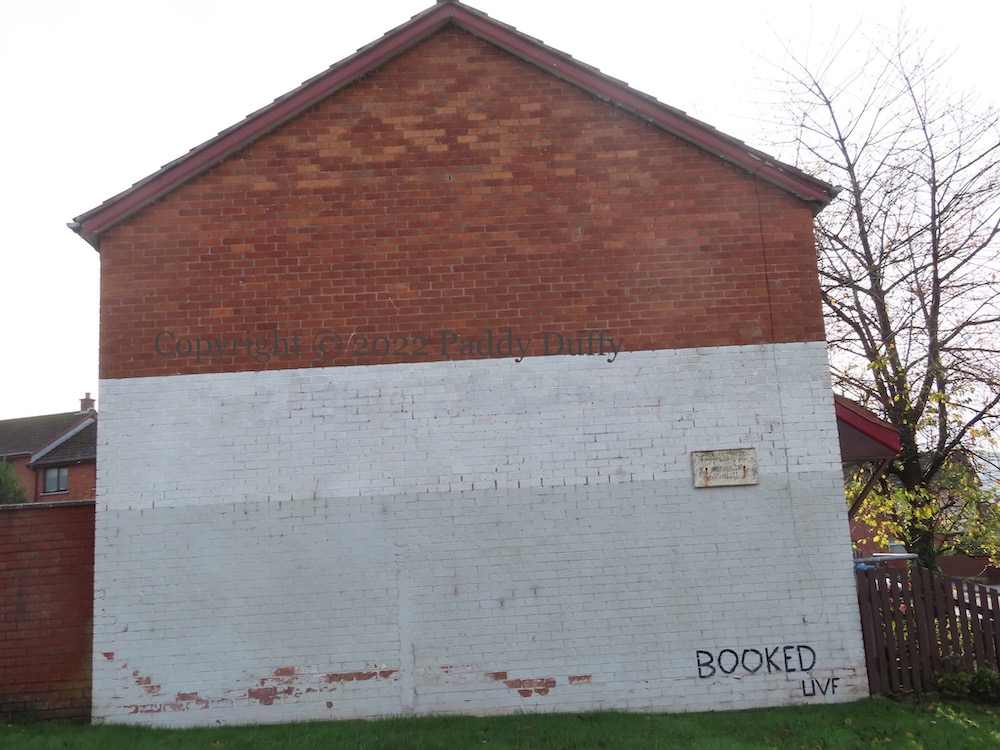
Included below is a “Booked UVF” on an adjacent wall. Queens Avenue, Glengormley.
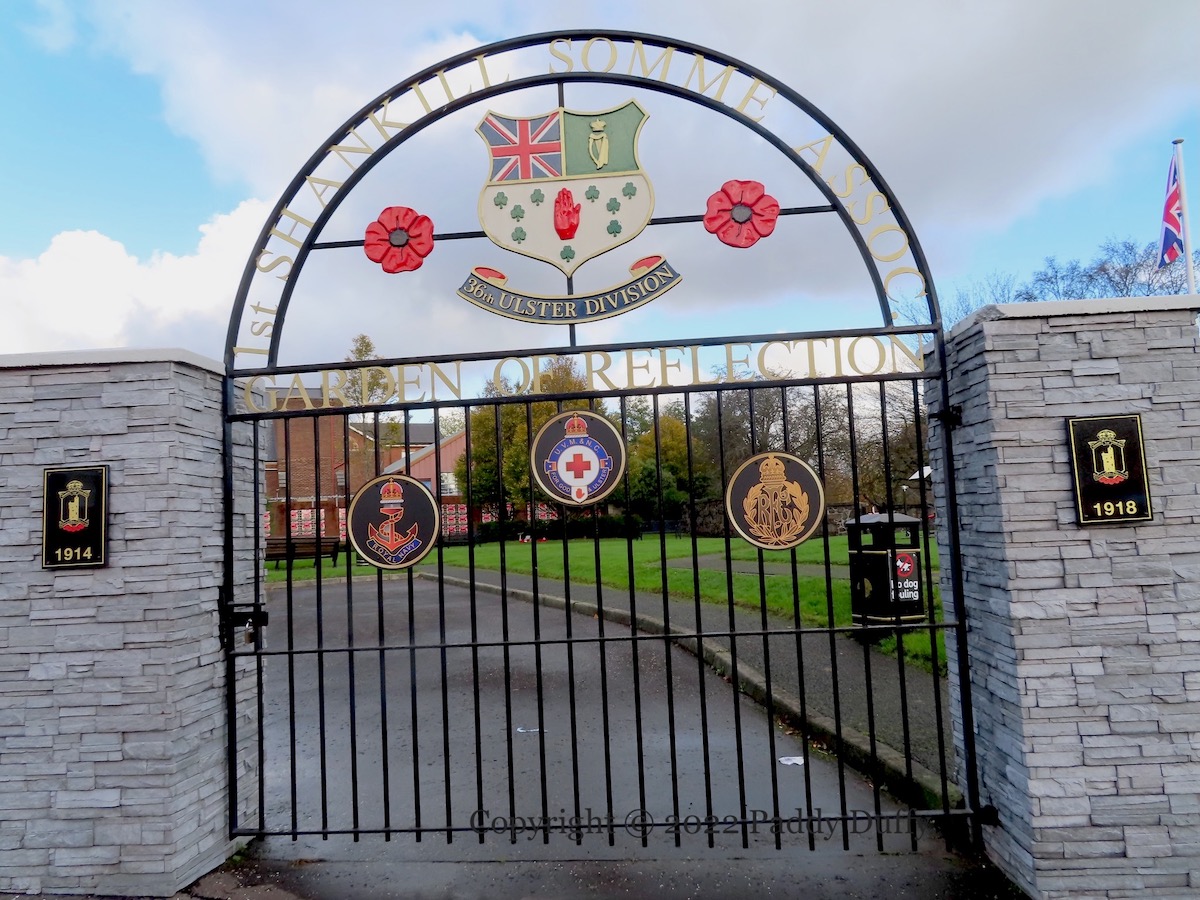
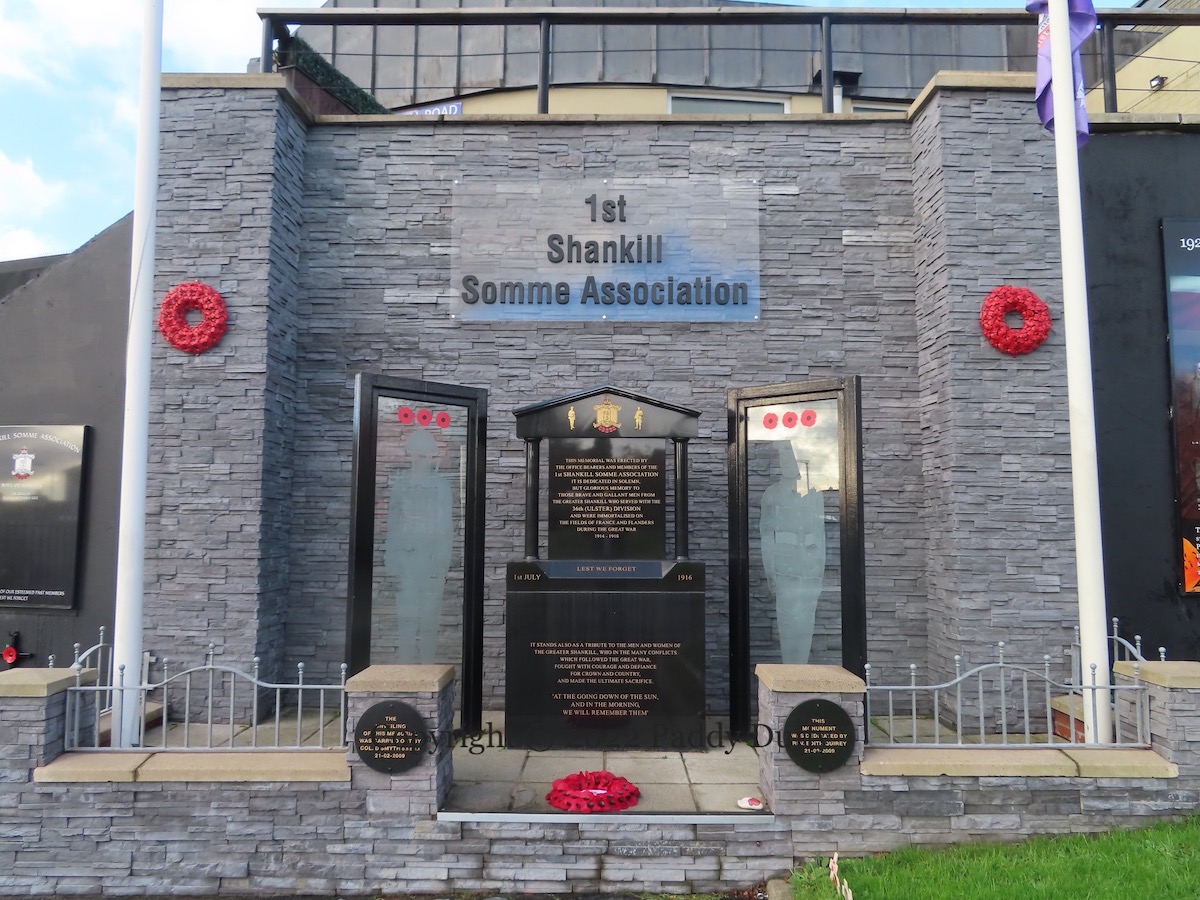
The Shankill Somme Association’s garden of reflection has added a number of new boards.
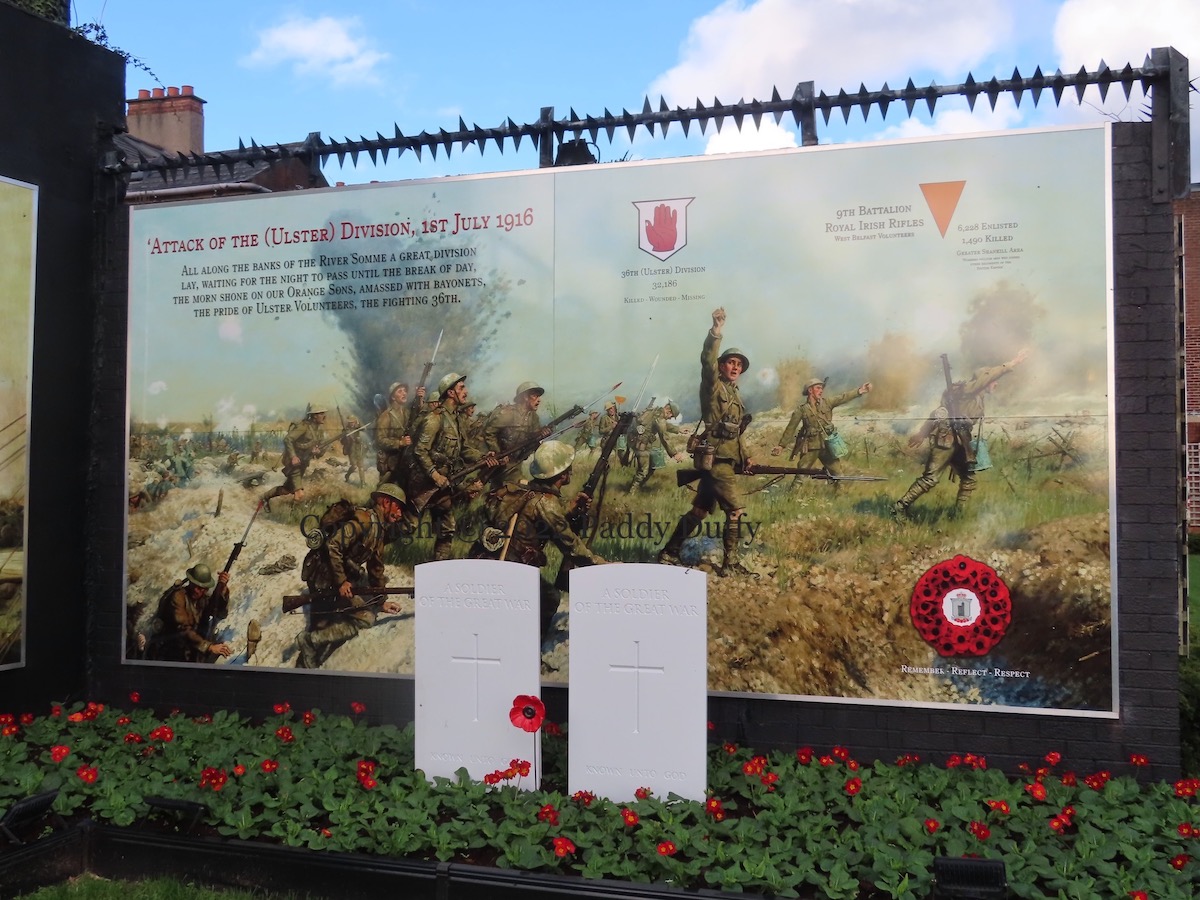
The board shown above is JP Beadle’s painting “Battle of the Somme: Attack of the Ulster Division”, which hangs in Belfast City Hall (militaryprints.com). It replaces a painting of a soldier in a field of poppies, seen in The Great War.
To its left is John Singer Sargent’s painting “Gassed”, showing the “aftermath of an indiscriminate mustard gas attack on British forces during the Battle of Arras 21st August 1918” (which also forms a part of a memorial in east Belfast) with the GK Chesterton quote “The true soldier fights not because he hates what is front of him, but because he loves what is behind him”.
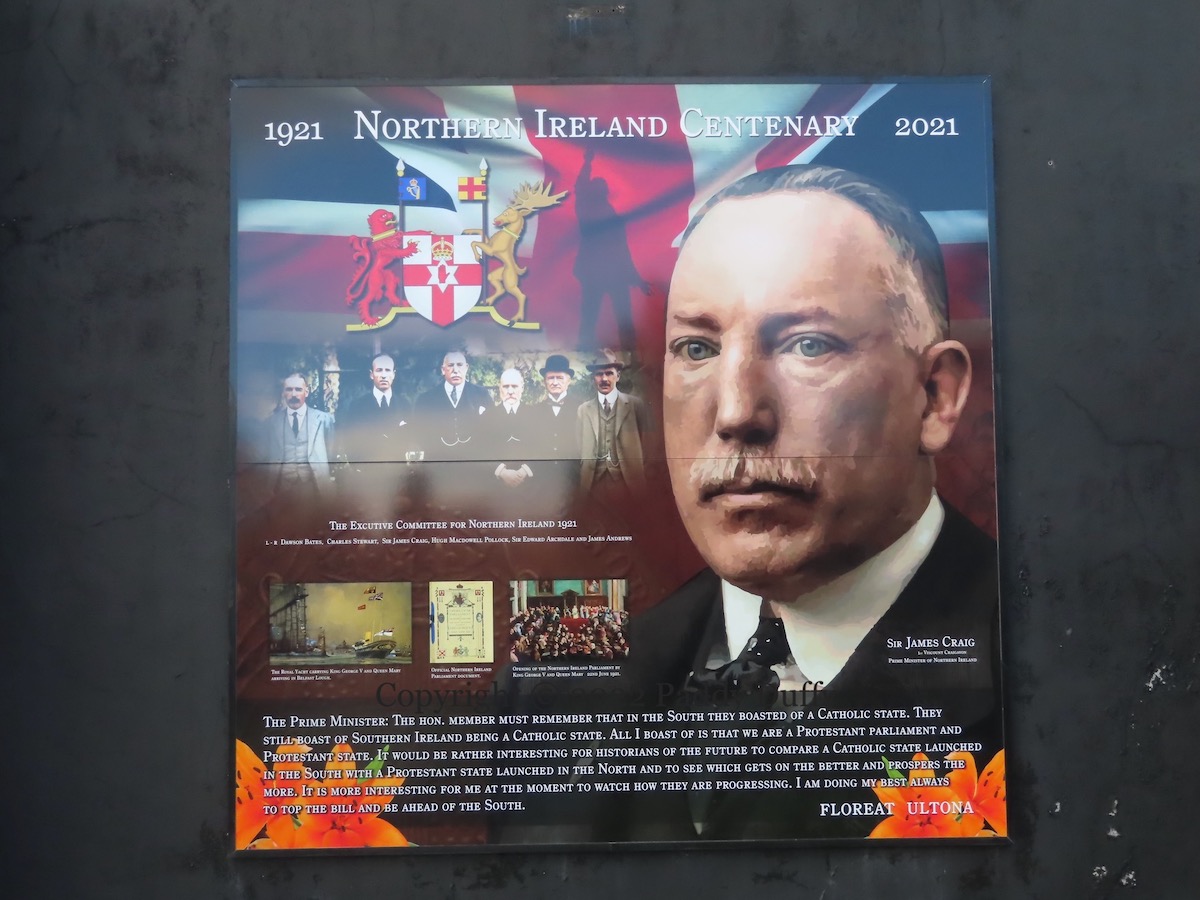
Also new – and somewhat out of place – is the Northern Ireland Centenary board featuring James Craig: “It would be rather interesting for historians of the future to compare a Catholic state launched in the south with a Protestant state launched in the north and to see which gets on the better and prospers the more”. There are other “floreat Ultona” boards/murals in the Village (focusing on the B Specials and UDR) and in Rathcoole (where “Ulster welcomes her King and Queen”).
There are also three insignia on the gates (compare with M05717), to the Royal Navy, the Ulster Volunteer Medical & Nursing Corps, and the Royal Flying Corp.
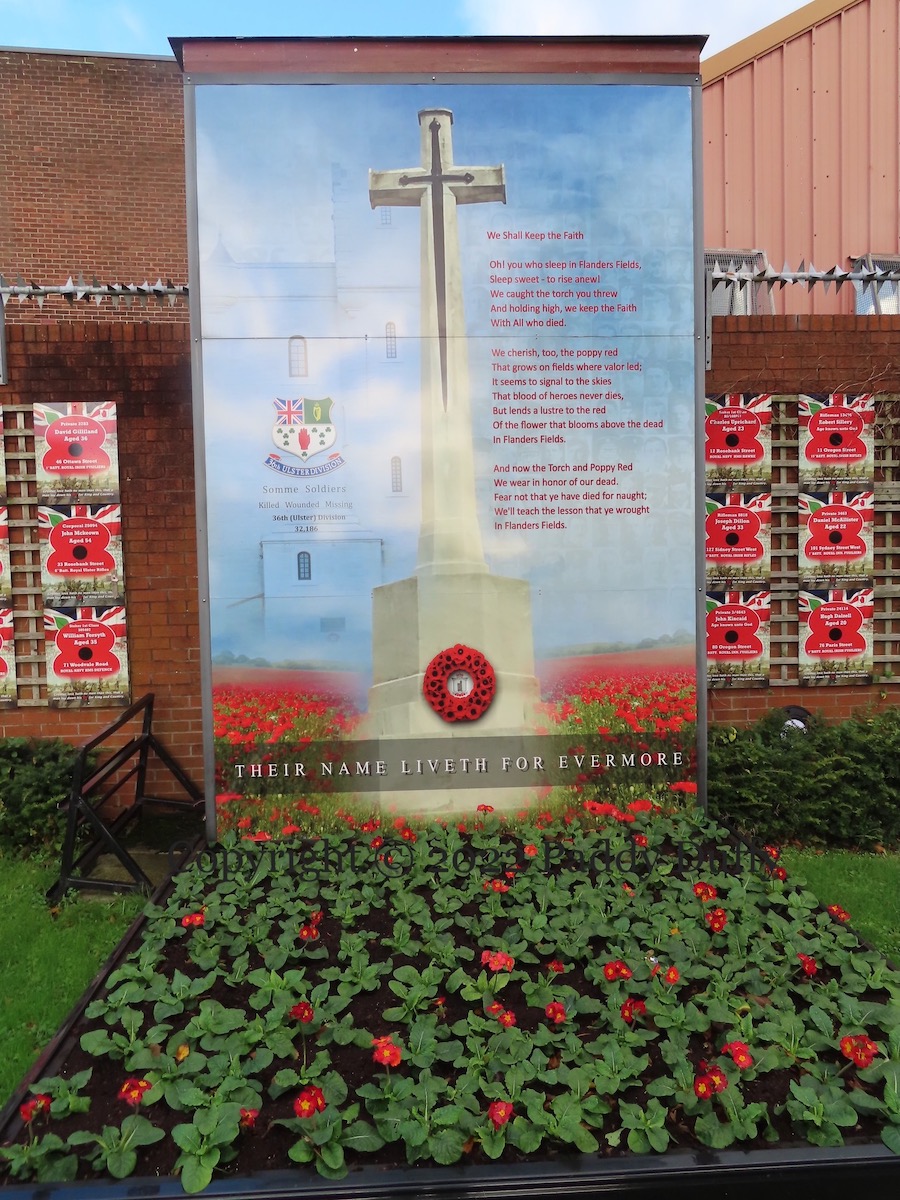
Previously (c. 2017), the undead soldiers of We Shall Not Sleep were replaced with an image of the Cross Of Sacrifice memorial – the original is in Ypres, Belgium but there is also one in the City Cemetery – see One In Design And Intention. At the same time, the poppy plaques for individual local soldiers and the image of the Menin Gate were also added.
The Flanders Field board appears to have survived since 2012 – see Somme Memorial.
The final image below shows the new stone surround for the main memorial. See (again) Somme Memorial.












 Paddy Duffy Collection