“‘The day has passed for patching up the capitalist system; it must go. [… We reject the firebrand of capitalist warfare and offer you the olive leaf of brotherhood and justice to and for all.]’ – James Connolly” [in 1910’s Labour, Nationality And Religion, part 6]
Lasaır Dhearg (web) paste-up at the Grosvenor Road entrance to the Royal, to coincide with the general strike of January 18th that included dieticians, physiotherapists, radiographers, midwives, and nurses (BBC).
Quotations from Pádraıg Mac Pıaraıs [Patrick Pearse] and Séamus Ó Conghaıle [James Connolly] are super-imposed upon an Irish-language version of the 1916 Proclamation. From Mac Pıaraıs: Ní [h]amháın saor ach Gaelach chomh maıth; ní [h]amháın Gaelach ach saor chomh maıth [not merely free but Gaelic too; not merely Gaelic but free too]; from Ó Conghaıle: “The cause of labour is the cause of Ireland, the cause of Ireland is the cause of labour’ (from ‘The Irish Flag’ 1916).
The portraits might well be by, or based on, prints by Jim Fitzpatrick (Revolutionaries).
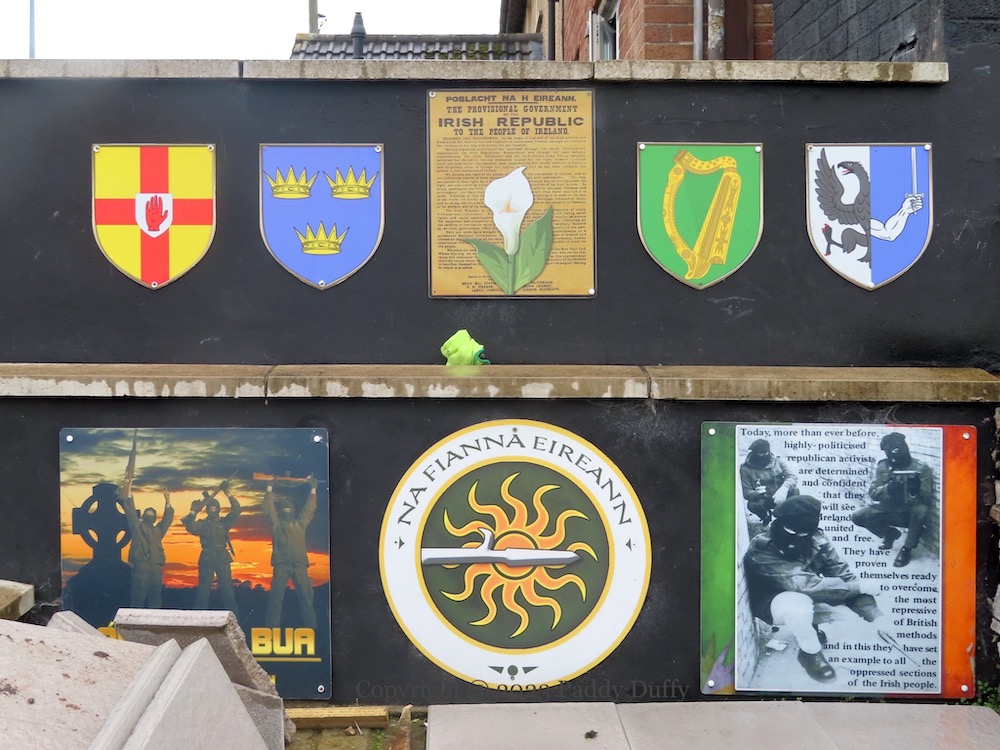
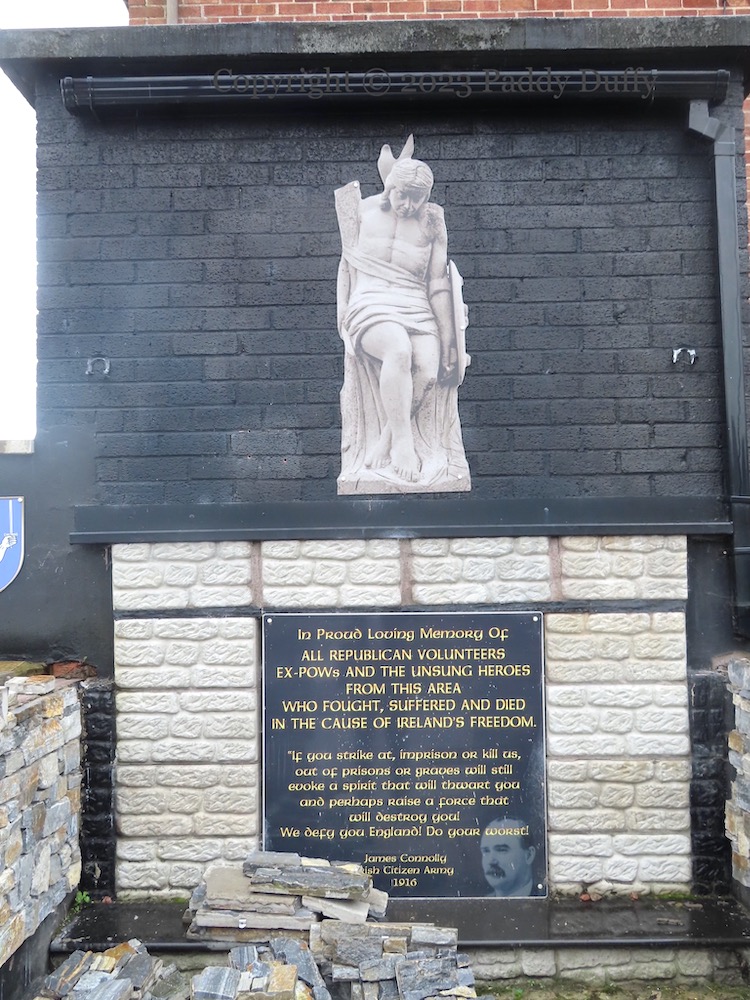
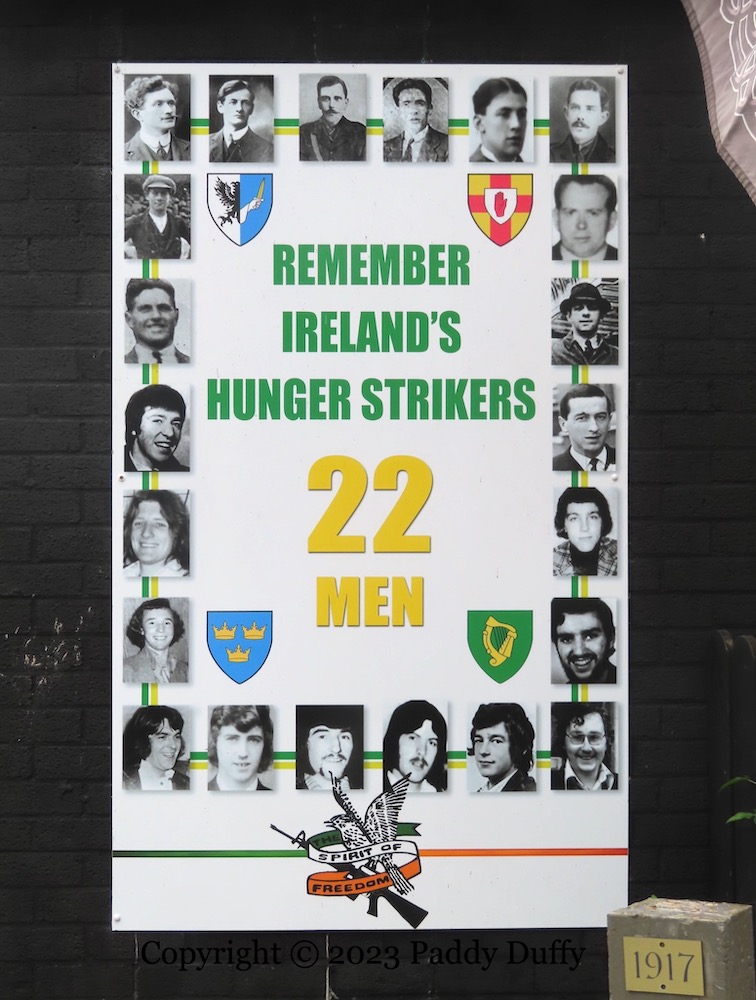
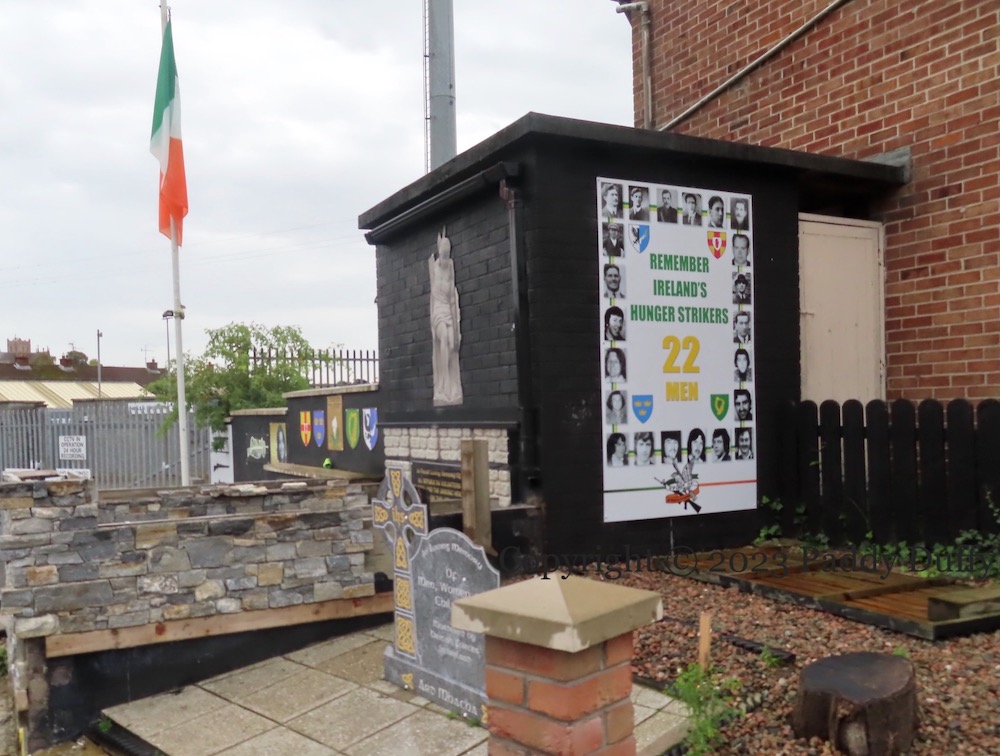
There is a memorial garden to the history of Irish resistance at the entrance to the Athletic Grounds in Armagh. From left to right, the images presented here show:
“More than 800 years of Irish resistence” – a sword for the Norman invasion under Strongbow, a pike for the 1798 and 1803 rebellions, a bolt-action rifle for the Easter Rising of 1916, and an assault rifle for the Troubles;
Cumann Na mBan, Mairéad Farrell and republican women who made “the supreme sacrifice”;
The Proclamation, Provisional IRA and Na Fianna;
The dying Cú Chulainn and a plaque “in proud and loving memory of all republican volunteers, ex-POWs and the unsung heroes from this area who fought, suffered and died in the cause of Ireland’s freedom, with a quote from James Connolly: ‘If you strike at, imprison or kill us, out of prisons or graves will still evoke a spirit that will thwart you and perhaps raise a force that will destroy you! We defy you England! Do your worst!”;
“Remember Ireland’s hunger strikers – 22 men” – the ten 1981 hunger strikers and Thomas Ashe, Terence MacSwiney, Michael Fitzgerald, Joe Murphy, Joseph Whitty, Andy O’Sullivan, Denny Barry, Tony D’Arcy, Jack McNeela, Seán McCaughey, Michael Gaughan, Frank Stagg;
A stone “in loving memory of men, women and children murdered by British forces in Ireland.”
“Est 1913 Irish Citizen Army / Irish National Liberation Army Est. 1974”. The Irish Citizen Army was founded in Dublin in 1913 to protect striking workers from police violence. After taking part in the Easter Rising of 1916, however, the ICA did not participate in the War Of Independence and the Civil War. In 1974, some founding members considered reviving the “ICA” name to reflect the organisation’s “allegiance to the working class” while Costello (pictured on the right) suggested “National Liberation Army”, which was then amended to include “Irish” (History Ireland | WP | WP). MNI includes an “ICA-INLA” Starry Plough on the stairs into the New Lodge from 1989 (C00105).
The banner raised over the Liberty Hall headquarters of the ICA read “We serve neither king nor kaiser but Ireland” – the famous photograph is included in the post of the same name – but this has been updated. The Belfast version of the board, on Northumberland Street (above) and outside Costello House on the Falls Road (below), reads “nor Nato”.
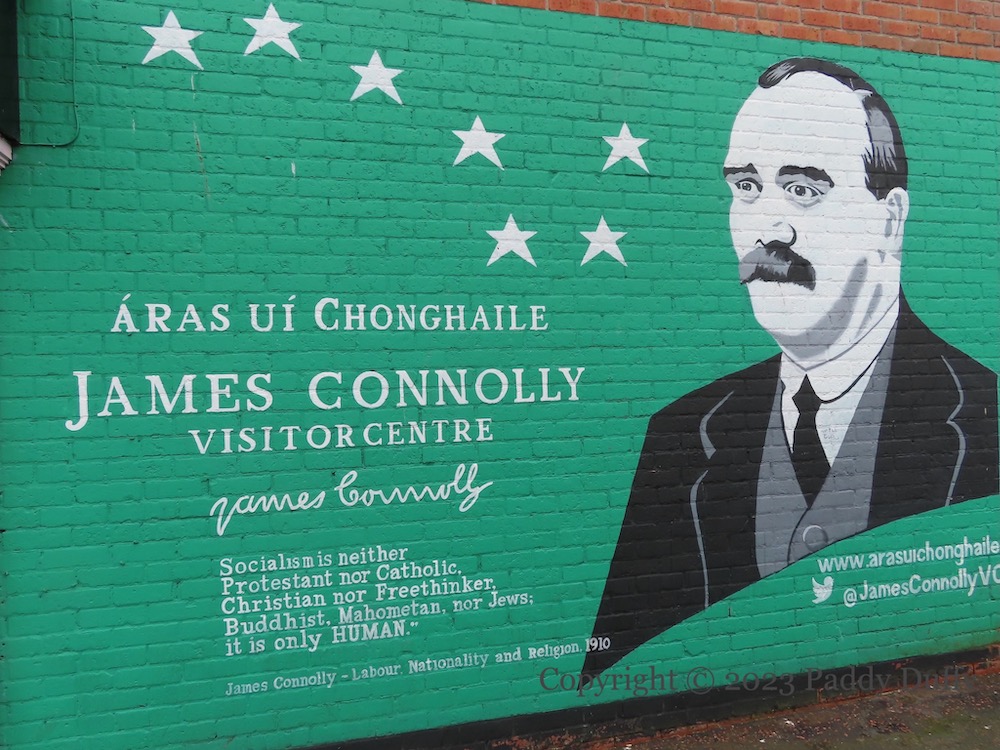
“Socialism is neither Protestant nor Catholic, Christian nor Freethinker, Buddhist, Mahometan, nor Jews [sic]. It is only human. We of the Socialist working class realise that as we suffer together we must work together that we may enjoy together. We reject the firebrand of capitalist warfare and offer you the olive leaf of brotherhood and justice to and for all.” From part 6 of Connolly’s Labour, Nationality And Religion in 1910.
“A free Ireland will control its own destiny from the plough to the stars.” So James Connolly is said to have explained the significance of “the plough in the stars” (Ursa Major) as a symbol of Irish revolutionary socialism. (Though no source is given for the remark. See From The Plough To The Stars for more.)
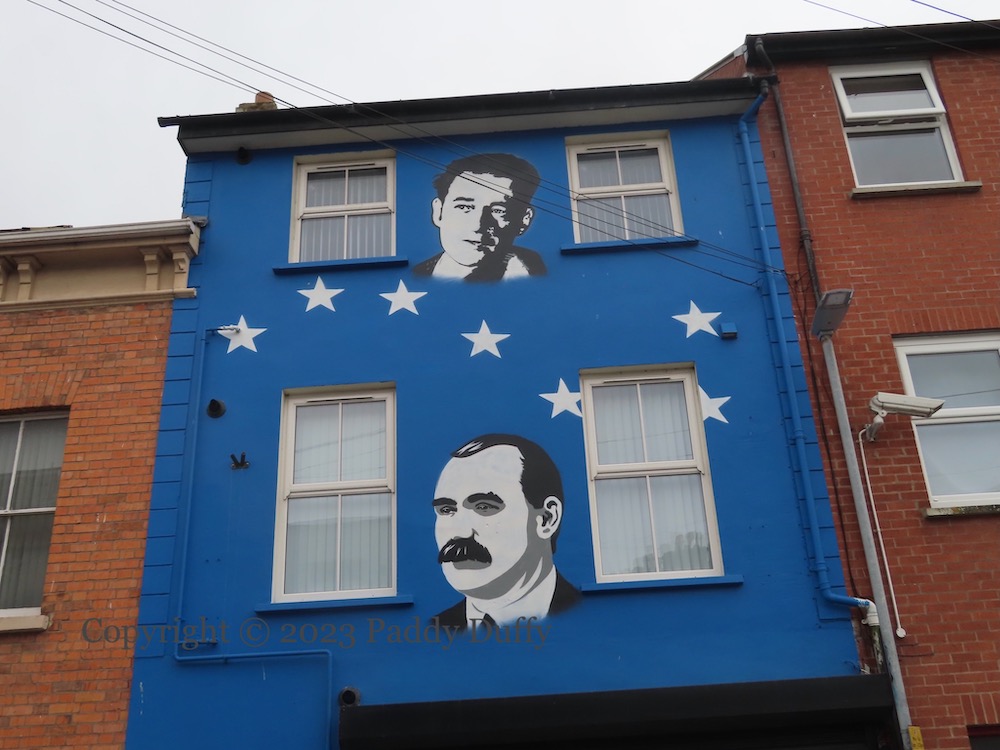
Connolly and Seamus Costello, heroes of the IRSP (web) are painted on James Connolly house in Chamberlain Street, Derry, which is also home to Teach Na Fáılte, the Republican Socialist Ex-Prisoners group.
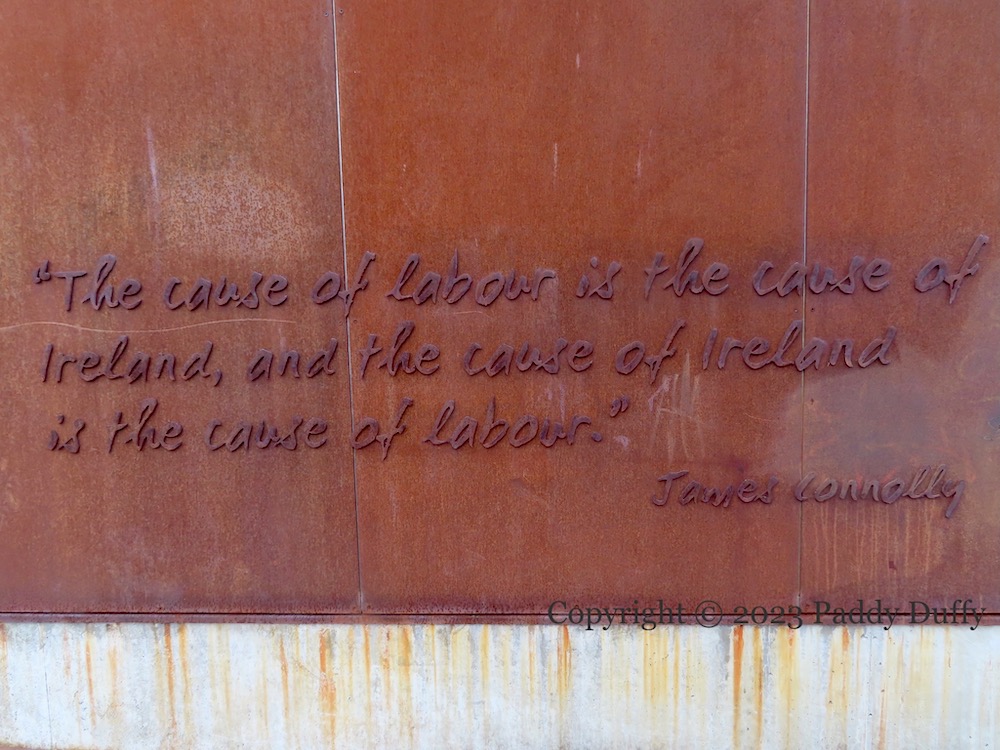
“”The cause of labour is the cause of Ireland, and the cause of Ireland is the cause of labour” – James Connolly”. From The Irish Flag, 1916.
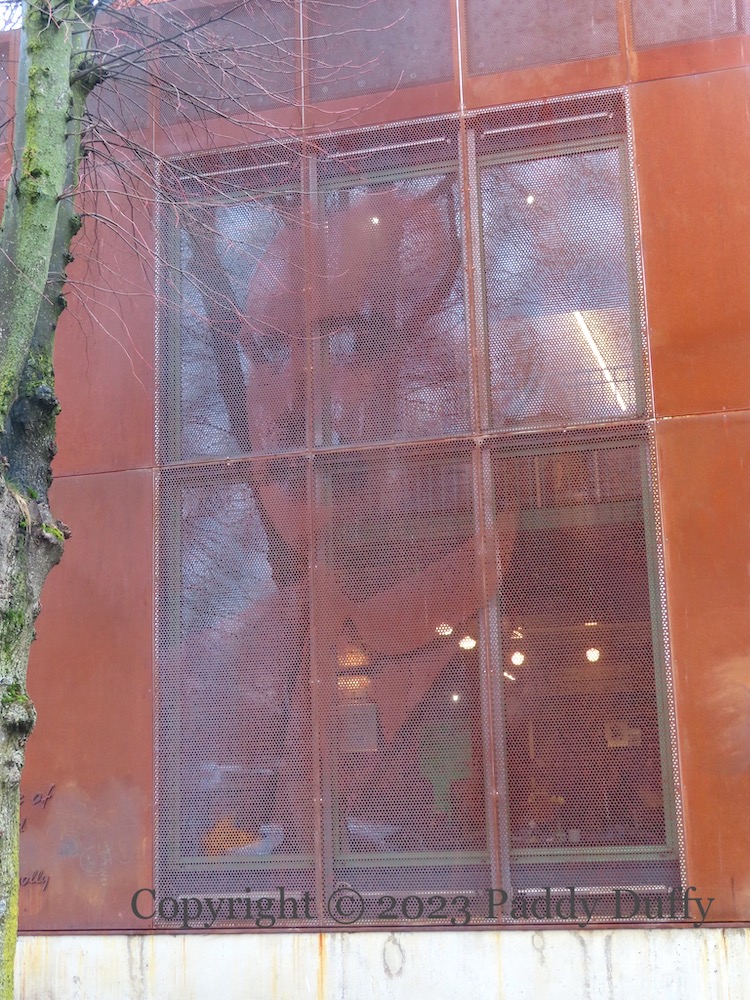
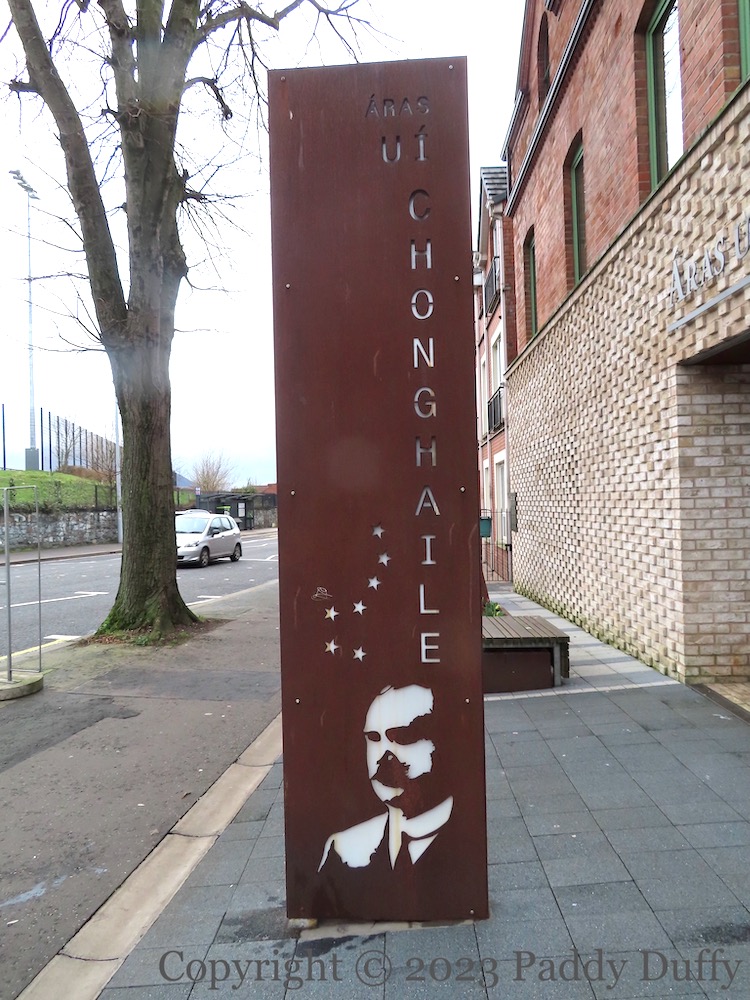
The renovation and expansion of Áras Uí Chonghaile (web) was officially opened in 2019 and included “a bespoke corten steel extension that has an intricate perforated image of Connolly’s face” (RIBAJ).
Falls Road, west Belfast, a short distance from the house in which Connolly lived for a time – see the Peter Moloney collection.
In the Workers’ Republic of February 12th, 1916, James Connolly posed the question “What is a free nation?” and, further, whether the Home Rule bill would make Ireland free in the requisite sense. “No” was his answer to the latter, and instead sovereignty would have to be reclaimed, by force if necessary: “There can be no perfect Europe in which Ireland is denied even the least of its national rights; there can be no worthy Ireland whose children brook tamely such denial. If such denial has been accepted by soulless slaves of politicians then it must be repudiated by Irish men and women whose souls are still their own. … A destiny not of our fashioning has chosen this generation as the one called upon for the supreme act of self-sacrifice – to die if need be that our race might live in freedom.”
Joe McCann was IRA/OIRA OC in the Markets area of Belfast. He was famously photographed among burning buildings in Inglis’s bakery, during protests against the introduction on internment, crouched beneath a Starry Plough and holding an M1. (For more, see Battle Of The Markets, which features the same photograph.) For McCann’s death the following year (on April 15th, 1972) see Joe McCann.
Thomas Ashe was working as an Irish teacher in Dublin when he joined the Irish Volunteers and in 1916 served as a battalion commander in the Easter Rising, for which he was sentenced to penal servitude for life. He went on hunger strike in May 1917 and again in September when he was rearrested by the British authorities for a “seditious” speech. He died on September 25th, one hundred years ago, becoming “an chéad staılceoır ocraıs a maraíodh san 20ú haoıs” (“first hunger striker to die in the 20th century”).
In the five circles around his portrait are Countess Markievicz, Pádraig Pearse, and James Connolly – fellow fighters in the Rising – and (in the bottom left) Máırtín Ó Cadhaın (author of Cré na Cılle and IRA member interned during WWII), and the symbol of Laochra Loch Lao and more generally of An Ceathrú Gaeltachta/Gaeltacht Quarter (see previously The Big Plan and Onwards). In the middle is a march from An Dream Dearg in support of Acht Na Gaeılge (an Irish language Act) past the Bobby Sands mural on Sevastopol Street.







 Paddy Duffy Collection