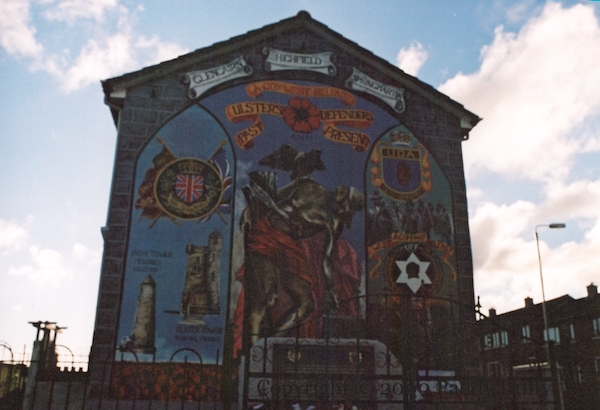
Cú Chulaınn (or, as here, Cuchulainn) is usually shown dying, in the pose made famous by Oliver Sheppard in his statue that was installed in the General Post Office in Dublin in 1935. (See the Visual History page about Cú Chulaınn in murals.) Here, however, he is a living warrior (carrying a sword and a shield emblazoned with the crest of Northern Ireland) as an analogue to loyalist paramilitaries and prisoners of war (“LPOW” on the right).
Ulster’s defenders, past and present, from Cuchulainn “Ancient defender of Ulster from Gael attacks”, via the 1893 UDU and WWI soldiers memorialised in the towers at Messines and Thiepval, to the modern UDA/UFF: “In memory of the officers and volunteers of A. Coy. [“Glencairn, Highfield, Springmartin”] UDA/UFF West Belfast Brigade who unselfishly dedicated their lives in defence of their country.”
The dying Cú Chulaınn and the Blessed Virgin Mary make an odd pairing in this Ligoniel memorial garden to locals who died during the Troubles. Cú Chulaınn is typically used to memorialise paramilitary volunteers (see the Visual History page) but the plaque does not mention volunteers and the statuary suggests prayer rather than a final salute as a fitting form of remembrance.
The plaque in the centre, which was previously at the crux of a Celtic Cross mural, reads “I ndıl chuımhne [in fond memory]. This plaque is dedicated to the memory of all those from Ligoniel who lost their lives as a result of the conflict in our country. A Mhuıre banríon na nGael guıgh orthu [Mary, queen of the Gael, pray for them]”
The other mural in the yard is a greatly re-designed presentation of Éıre, taking up the whole wall, and replacing the Maid Of Erin harp with Érıu, the mythological queen of Ireland/Éıre, as designed by (or at least, in the style of) Richard J King/Rísteard Ó Cíonga. (Also seen in the Short Strand.)
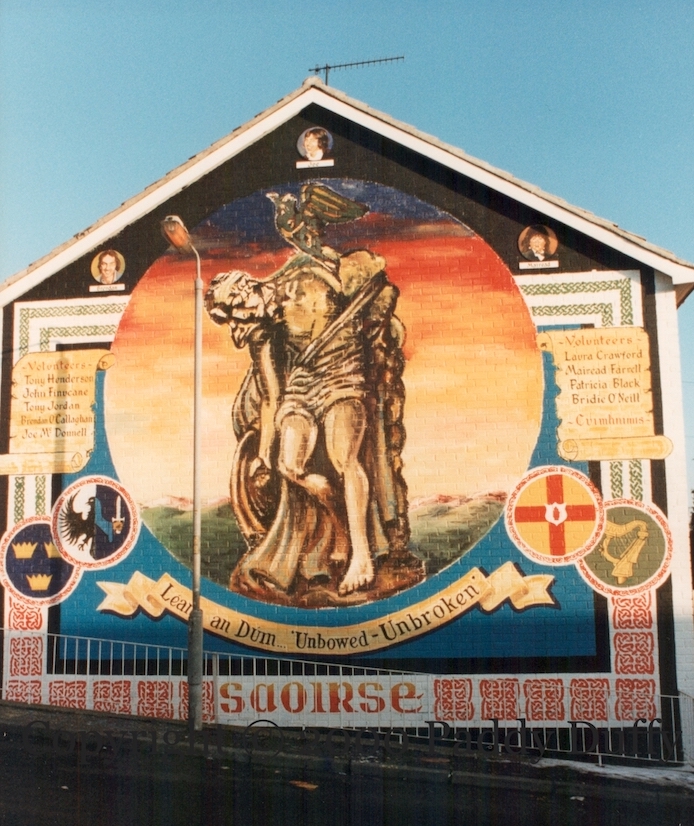
The dying Cú Chulaınn (as portrayed in bronze by Oliver Sheppard, in a statue installed in the GPO in 1935) is used as a symbol for the locals from Lenadoon area of west Belfast who fought for freedom (“saoırse”): Tony Henderson, John Finucane, Brendan O’Callaghan, Joe McDonnell, Laura Crawford, Maıréad Farrell, Patricia Black, Bridie O’Neill (subsequently changed to Bridie Quinn).
There were originally portraits of all nine people in the apex when the mural was launched in 1996, but only three remain.
Words from Padraıg Mac Pıaraıs’s poem Mıse Éıre are included alongside the portraits of the seven signatories to the 1916 Proclamation. It includes the line “Great is my glory, I who bore brave Cú Chulaınn” and Cú Chulaınn is pictured on the right, in the death pose made famous by Oliver Sheppard in a statue installed in the GPO in 1935 – see Cú Chulaınn’s Visual History page.
Mıse Éıre: Sıne mé ná an Chaılleach Bhéarra. Mór mo ghlóır: Mé a rug Cú Chulaınn cróga. Mór mo náır: Mo chlann féın a dhíol a máthaır. [Mór mo phıan: Bıthnaımhde do mo shíorchıapadh.] [Mór mo bhrón: D’éag an dream ınar chuıreas dóchas.] Mıse Éıre: Uaıgní mé ná an Chaılleach Bhéarra.
Painted by Mo Chara Kelly in Norglen Gardens, west Belfast
This is an interesting mural from North Queen Street, if only because of its psychedelic colour-scheme and composite style.
The two bulls (presumably from the Táın though they are not the classic brown and white bulls) provide a centre, on either side of which we find Cú Chulaınn dying (and Tuan the eagle) and a dolmen. The horse on the right is perhaps Galloper. There are four faces superimposed on flying geese. The cranes Samson and Goliath are on the left (which suggests a cross-community sponsorship) and a Pride rainbow is on the right.
A wide shot of the whole can be seen in the Peter Moloney Collection. If you have any information about the piece, please get in touch.
North Queen Street, presumably at the bottom of the New Lodge (either where the playing pitch opposite (what was then) Artillery House (now Teach Ghráınne) is, or on a wall of Gallagher’s factory, where the car park for the shopping centre now is?).





 Paddy Duffy Collection