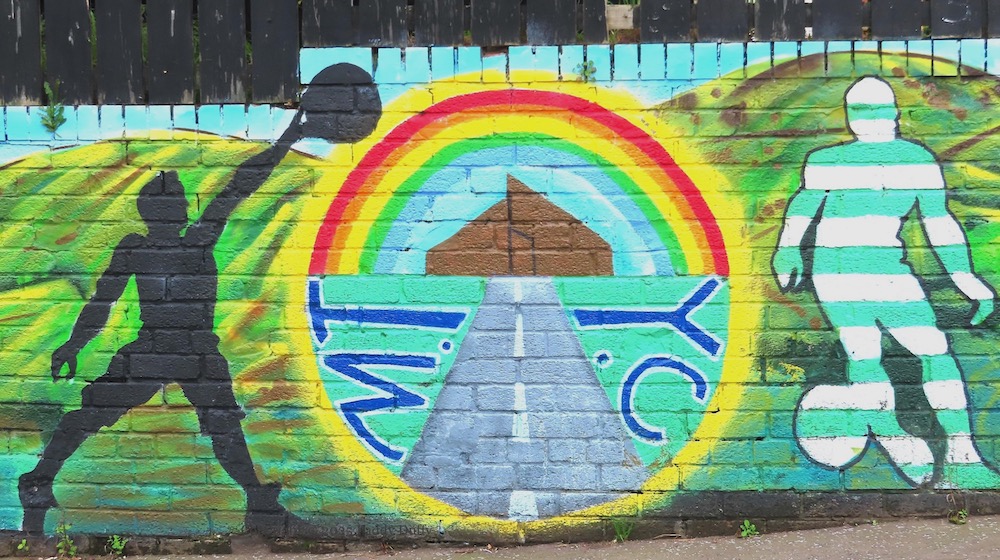
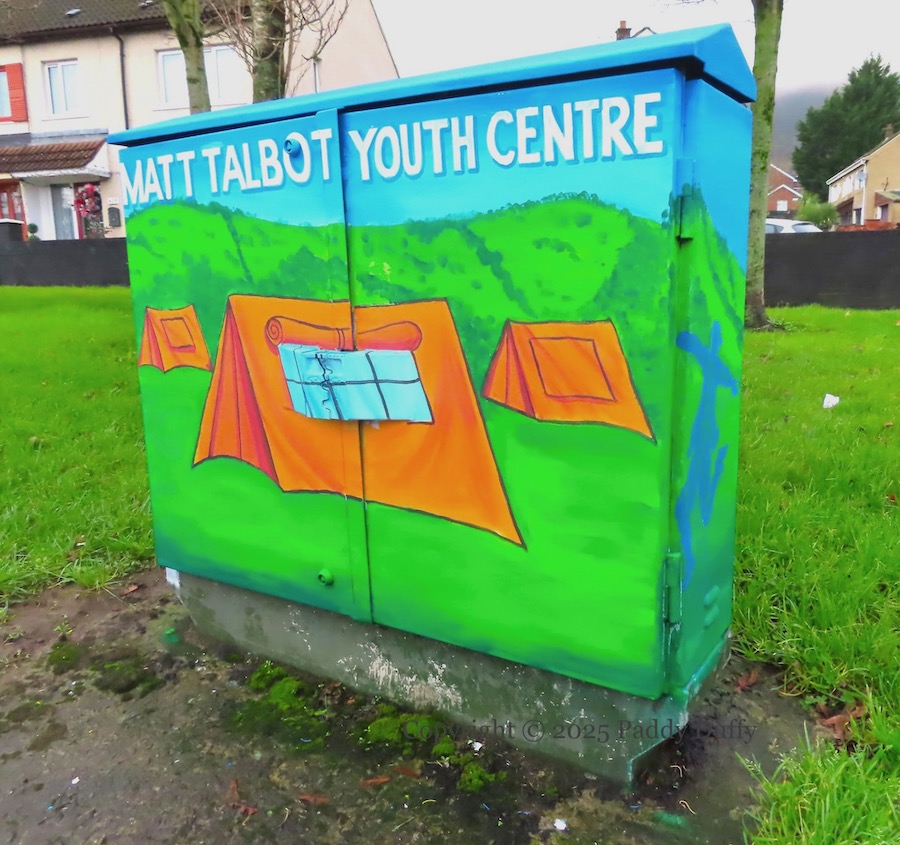
Matt Talbot Youth Centre (Fb) provides activities and services for young people from New Barnsley and Moyard, including an afternoon club, trips during the summer months, and Halloween and Christmas parties.
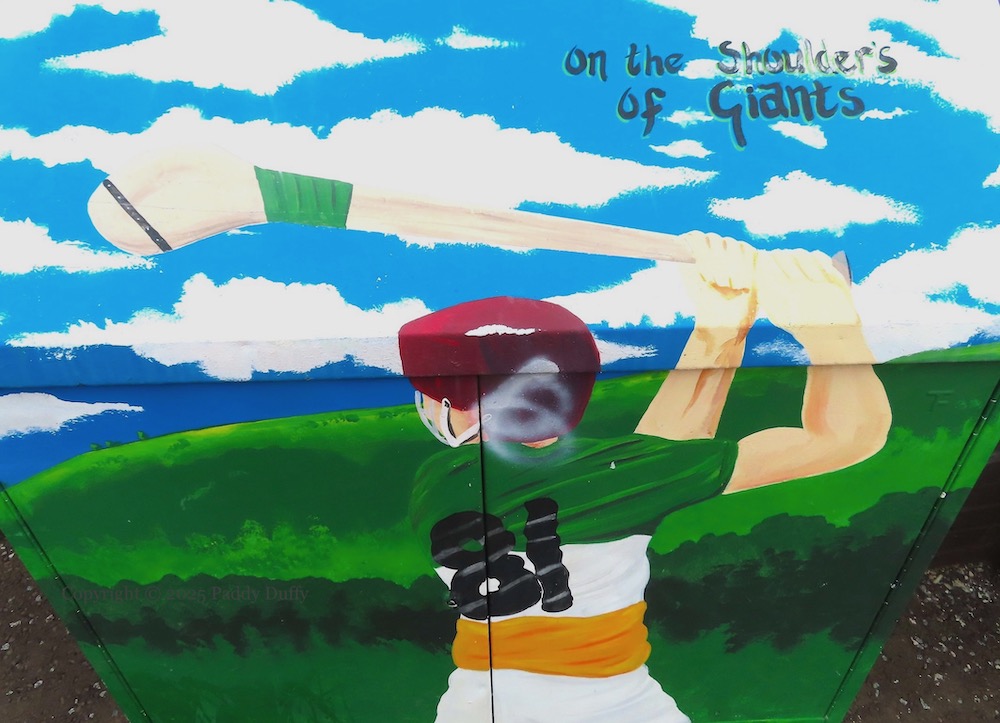
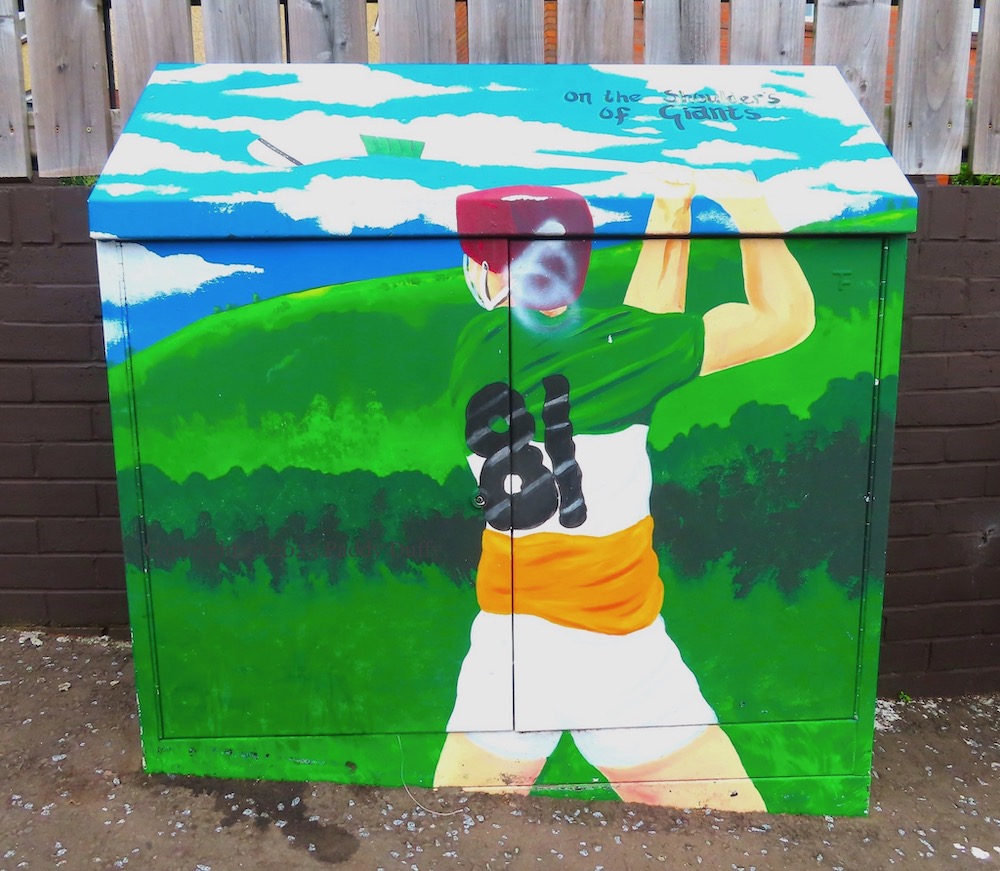
The two murals are face-to-face in New Barnsley Gardens. Also included are some painted utility boxes in the area, including a hurler/camogie-player from Michael Davitt’s GAC (web).
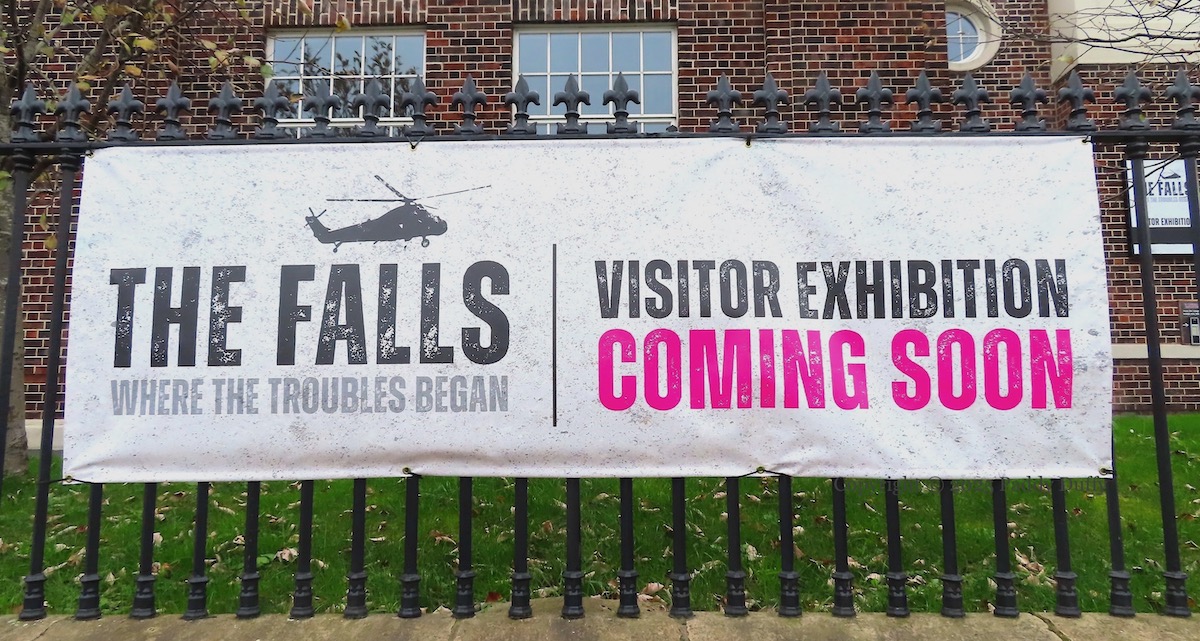
A new visitor exhibition will open on Thursday November 6th at Ionad Eileen Howell with images, video, and audio recordings covering the period from the start of the Troubles in 1969 to the Falls Curfew in 1970 (Belfast Media). The new exhibition is hosted by the Falls Community Council (Fb); tickets via Visit Belfast.
The Troubles are generally said to have started in August, 1969, rather than (e.g.) October, 1968, because the Battle Of The Bogside in Derry (beginning on August 12th) and the rioting in Belfast (beginning on the 13th) led to the deployment of British troops (on August 14th and 15th).
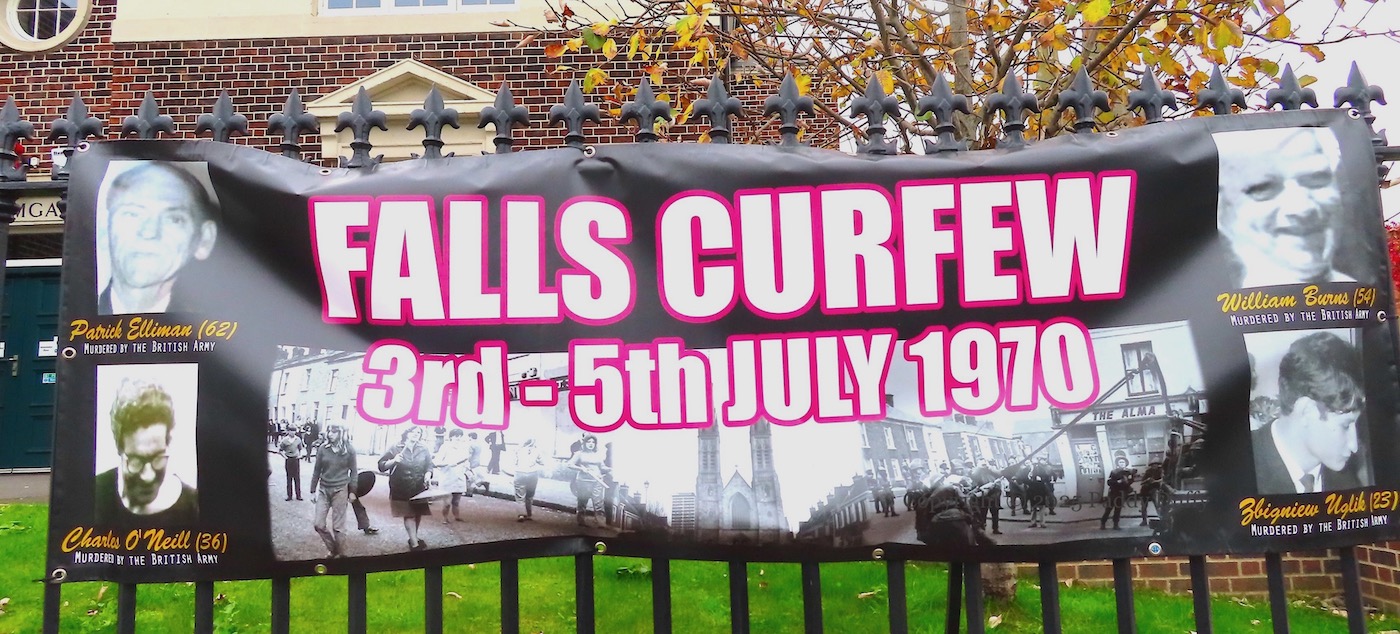
The Falls Curfew, in July 1970, was a pivotal event in the souring of relations between the CNR population and the British Army. About 3,000 homes were cordoned off, the area was saturated with CS gas, and thousands of bullets were fired by the Officials and Army soldiers, the latter killing Charles O’Neill, William Burns, Zbigniew Uglik, and Patrick Elliman; there is a plaque commemorating the four a little further up the road – see The Falls Curfew.
The upper Woodvale plaque “in memory of all those Protestants and members of the security forces who lost their lives in the greater Shankill area as a result of conflict” has sat unadorned since at least 2008 but now has a pair of boards to accompany it.
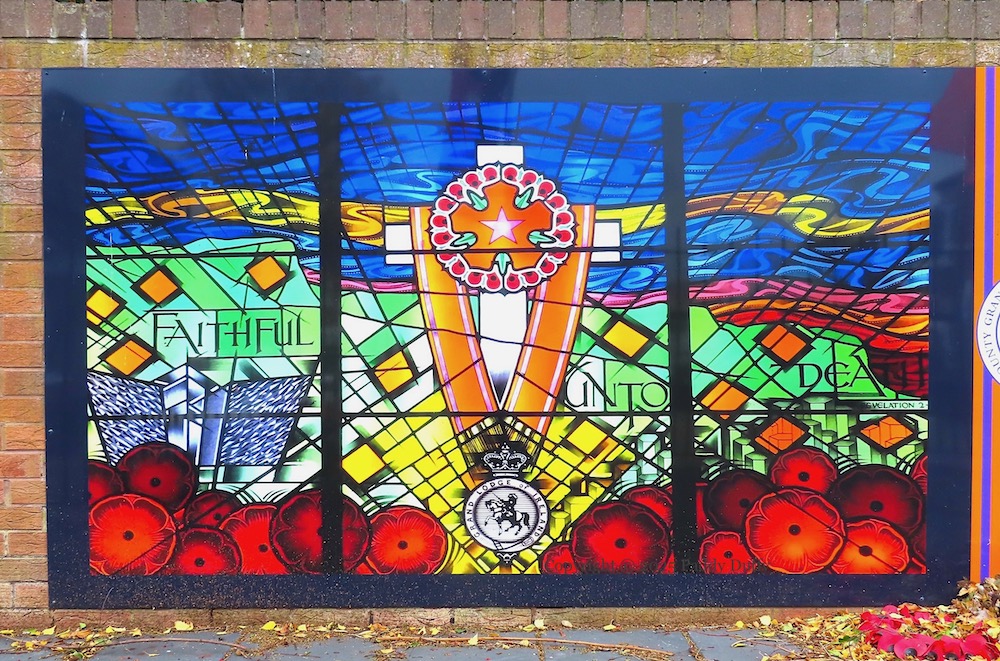
On the left, a reproduction of the “Faithful Unto Death” stained-glass window in the Museum of Orange Heritage in Schomberg House on the Cregagh Road (also reproduced in Newbuildings in 2022), along with the emblem of the Country Grand Orange Lodge Of Belfast (Fb).
On the right, a memorial to “all local residents whose lives were cruelly taken by Republican terrorists. Also those who selflessly gave their lives in the service of our country, and those who continue to do so.” (LOL “423” appears to be Banbridge Bible And Crown Defenders.)
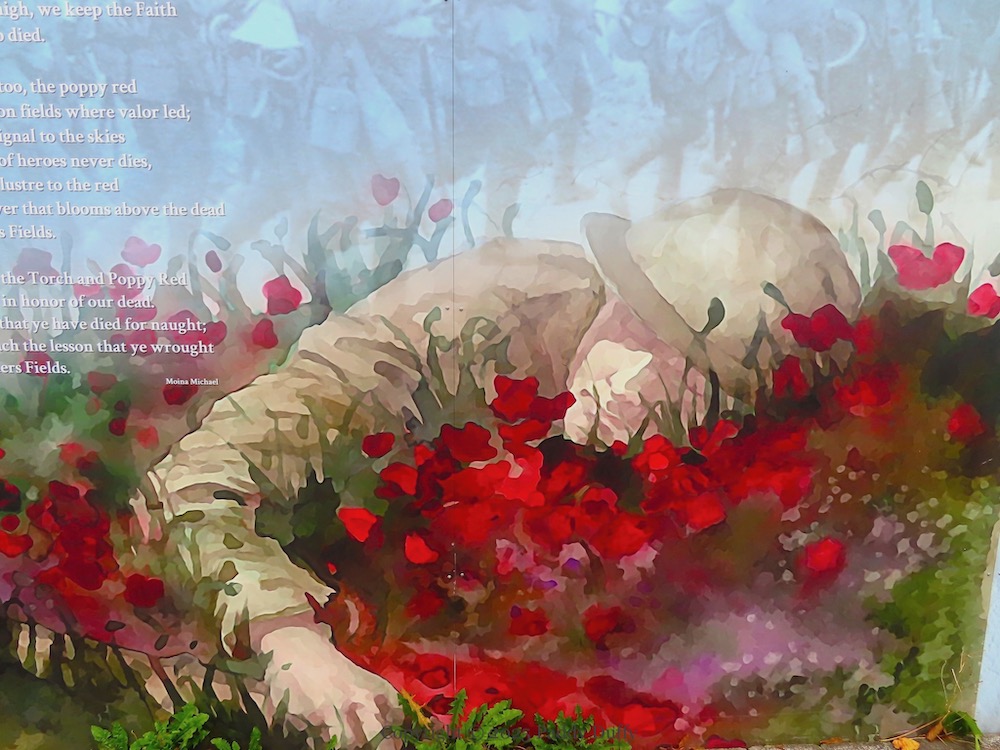
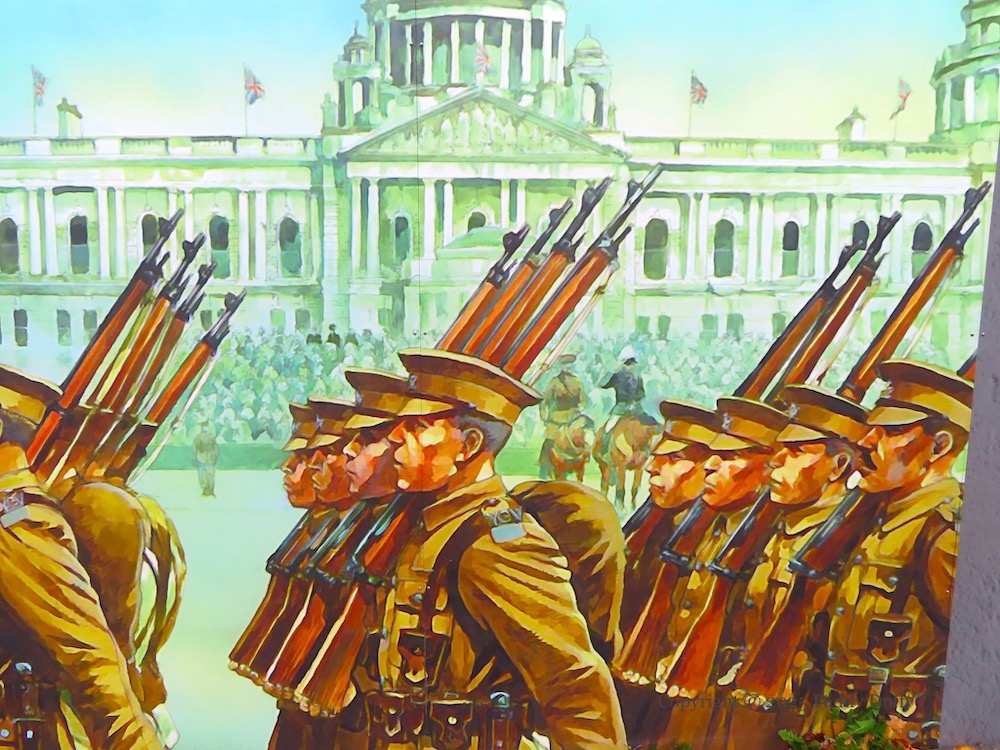
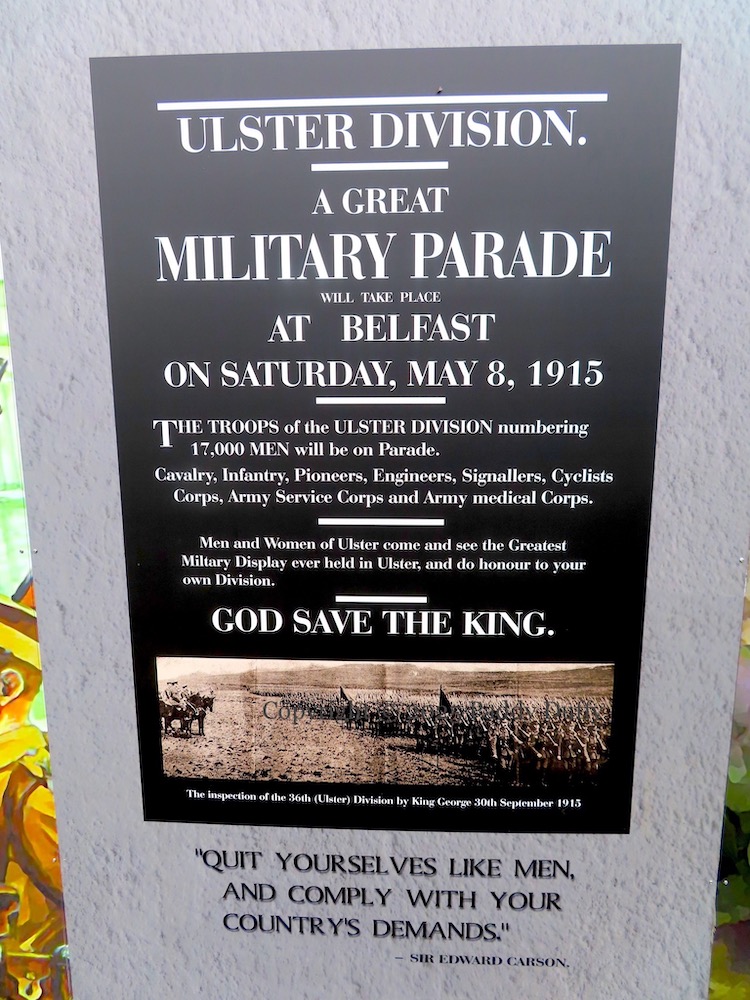
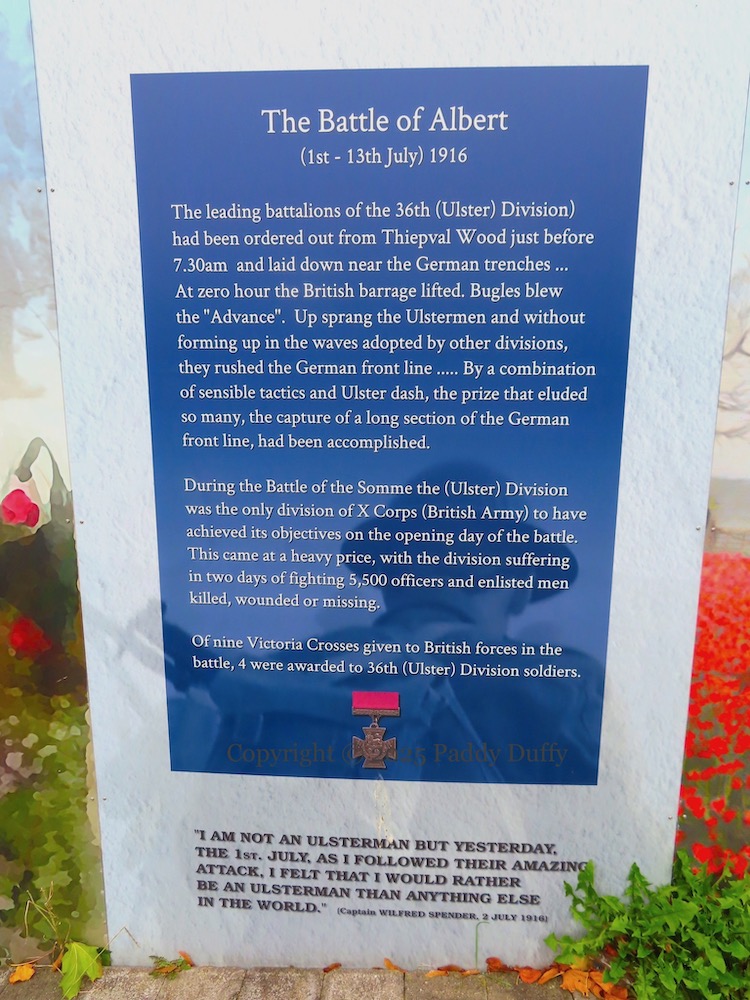
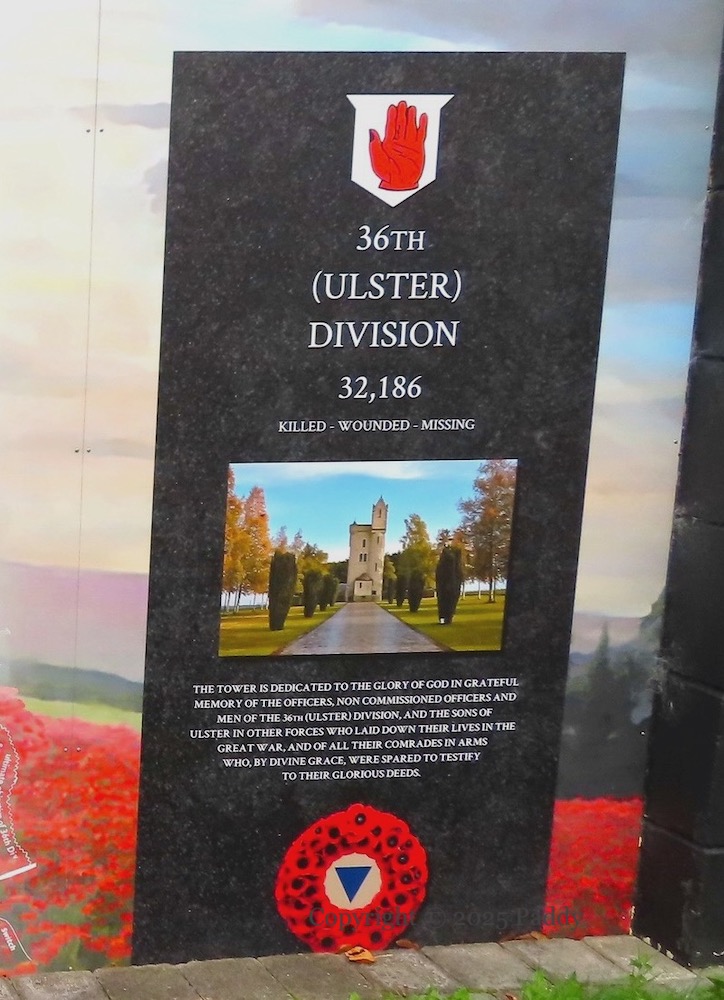
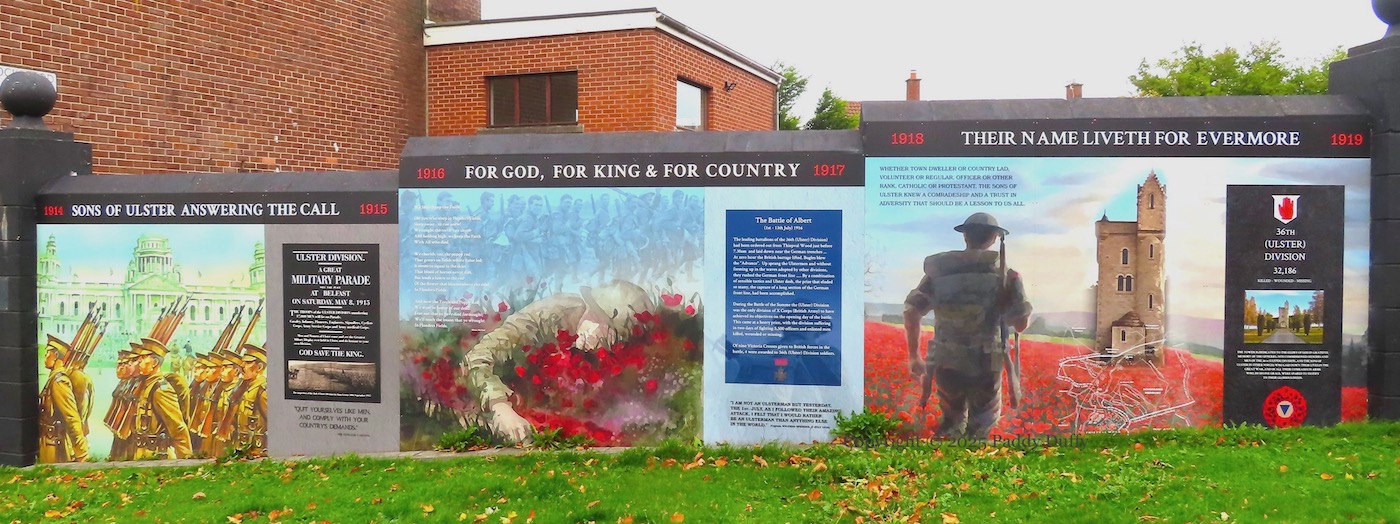
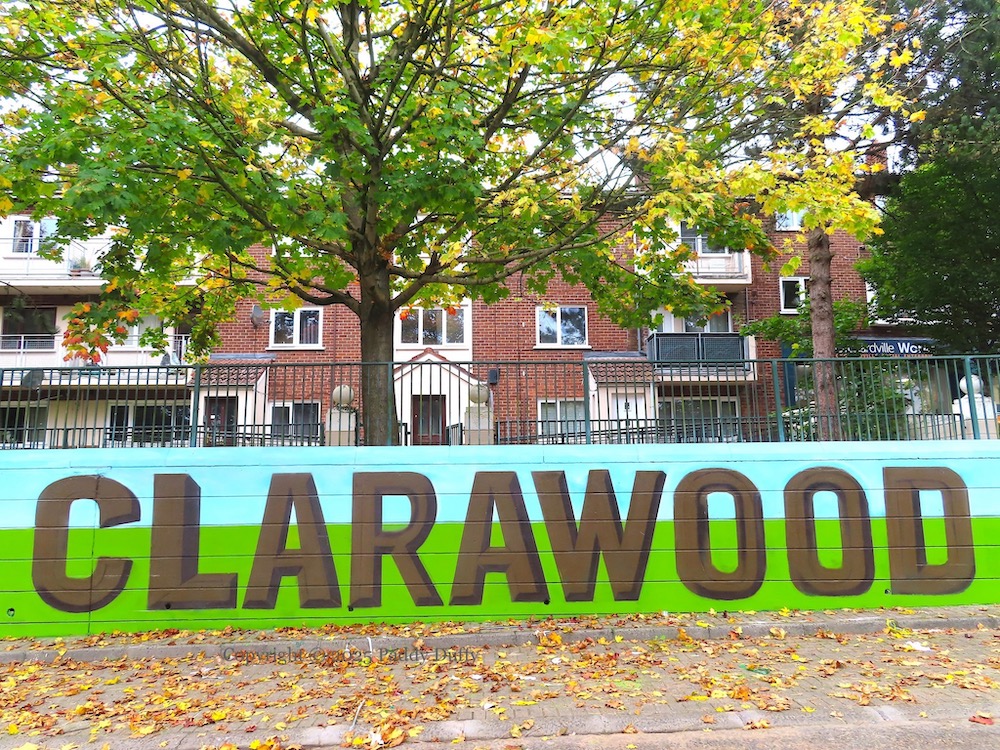
This entry provides close-ups of the WWI memorial display in Clarawood, east Belfast, and complements the images and text presented in 2023’s Spared To Testify To Their Glorious Deeds.
The three vertical panels with text read as follows:
“Ulster Division – a great military parade will take place on Saturday, May 8, 1915. The troops of the Ulster Division numbering 17,000 men will be on Parade. Cavalry, Infantry, Pioneers, Engineers, Signallers, Cyclists Cors, Army Service Corps and Army medical Corps. Men and Women of Ulster come and see the Greatest Military Display ever held in Ulster, and do honour to your own Division. God save the King.” (There is video of the May parade on Facebook and NI Screen. The photograph of George V inspecting the troops in Aldershot on September 30th, 1915, can be seen here.)
“The Battle Of Albert (1st – 13th July) 1916. The leading battalions of the 36th (Ulster) Division) [sic] had been ordered out from Thiepval Wood just before 7.30am and laid down near the German trenches … At zero hour the British barrage lifted. Bugles blew the “Advance”. Up sprang the Ulstermen and without forming up in the waves adopted by other divisions, they rushed the German front line … By a combination of sensible tactics and Ulster dash, the prize that eluded so many, the capture of a long section of the German front line, had been accomplished. During the Battle Of The Somme the (Ulster) [sic] Division was the only division of X Corps (British Army) to have achieved its objectives on the opening day of the battle. This came at a heavy price, with the division suffering in two days of fighting 5,500 officers and enlisted men killed, wounded or missing. Of nine Victoria Crosses given to British forces in the battle, 4 were awarded to 36th (Ulster) Division soldiers. ‘I am not an Ulsterman but yesterday, the 1st July, as I followed their amazing attack, I felt that I would rather be an Ulsterman than anything else in the world.’ – Captain Wilfred [sic Wilfrid] Spender, 2 July 1916.”
“36th (Ulster) Division 32,186 killed, wounded, missing. The tower is dedicated to the glory of God in grateful memory of the officers, non-commissioned officers and men of the 36th (Ulster) Division, and the sons of Ulster in other forces who laid down their lives in the Great War, and of all their comrades in arms who, by divine grace, were spared to testify to their glorious deeds.”
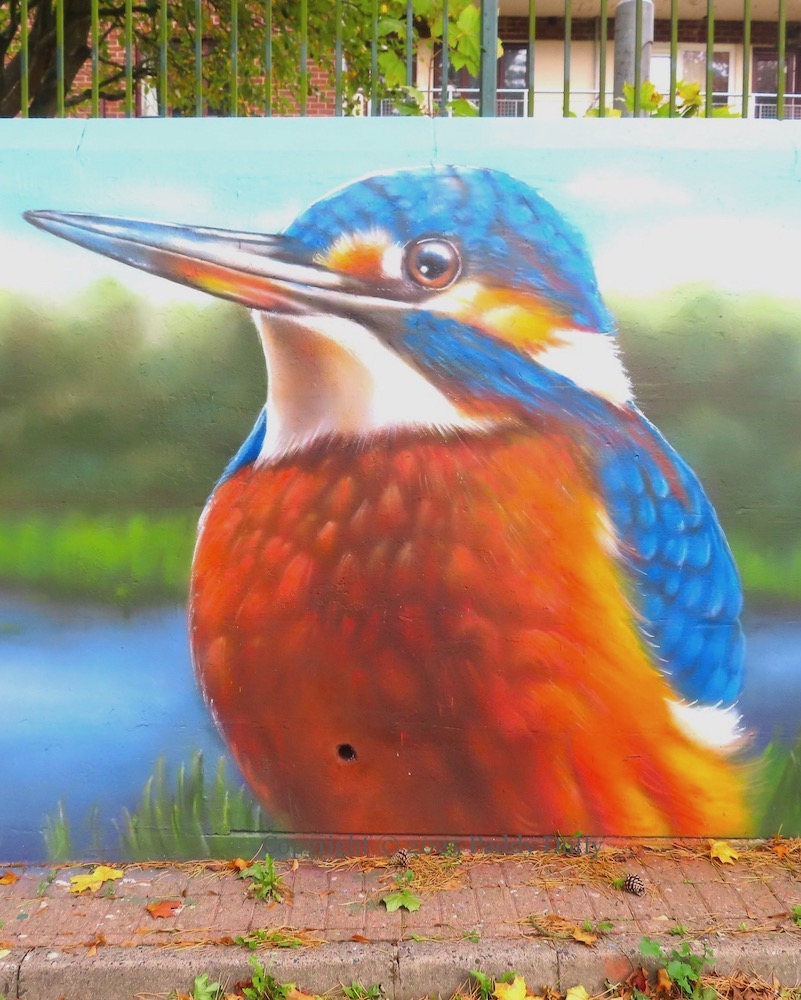
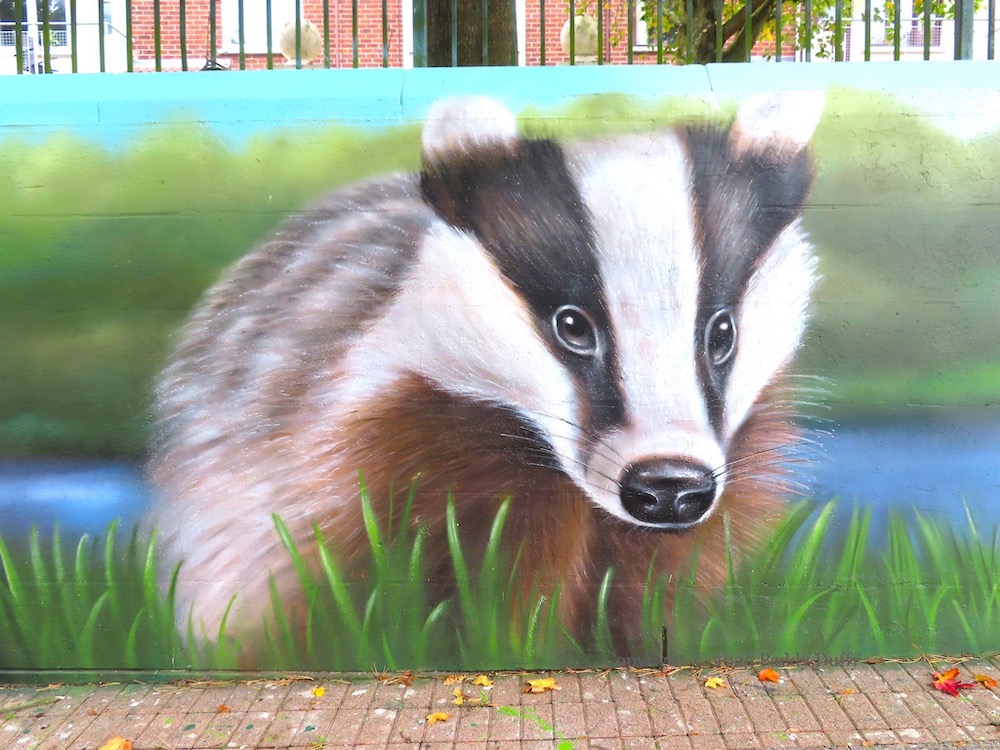
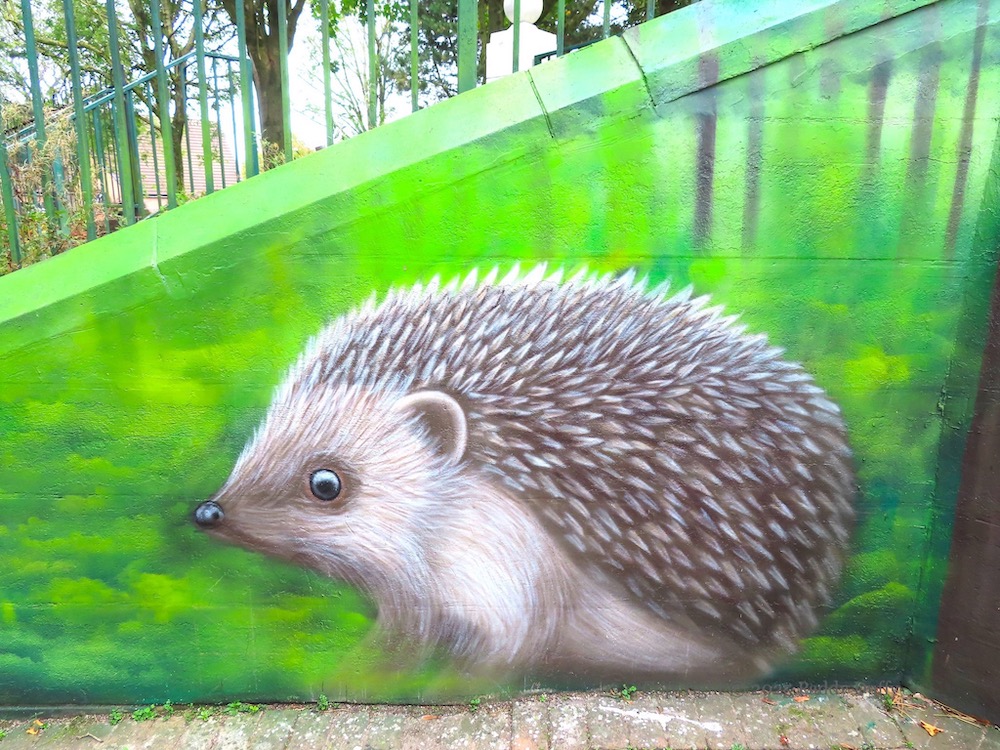
Here are a kingfisher, heron, badger, owl, squirrel, fox, and hedgehog by Glen Molloy (ig) in Knockwood Park, Clarawood, east Belfast. The closest place one might be able to see any of these creatures – particularly herons – is in the Marsh-Wiggle pond, along the Connswater (East Side Greenways).
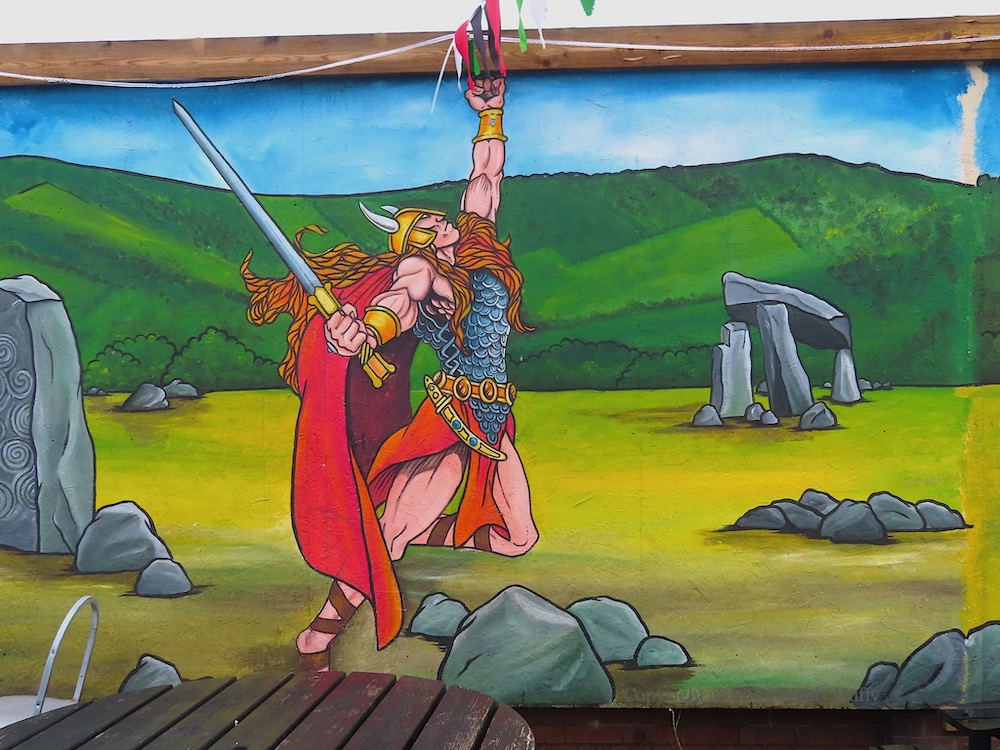
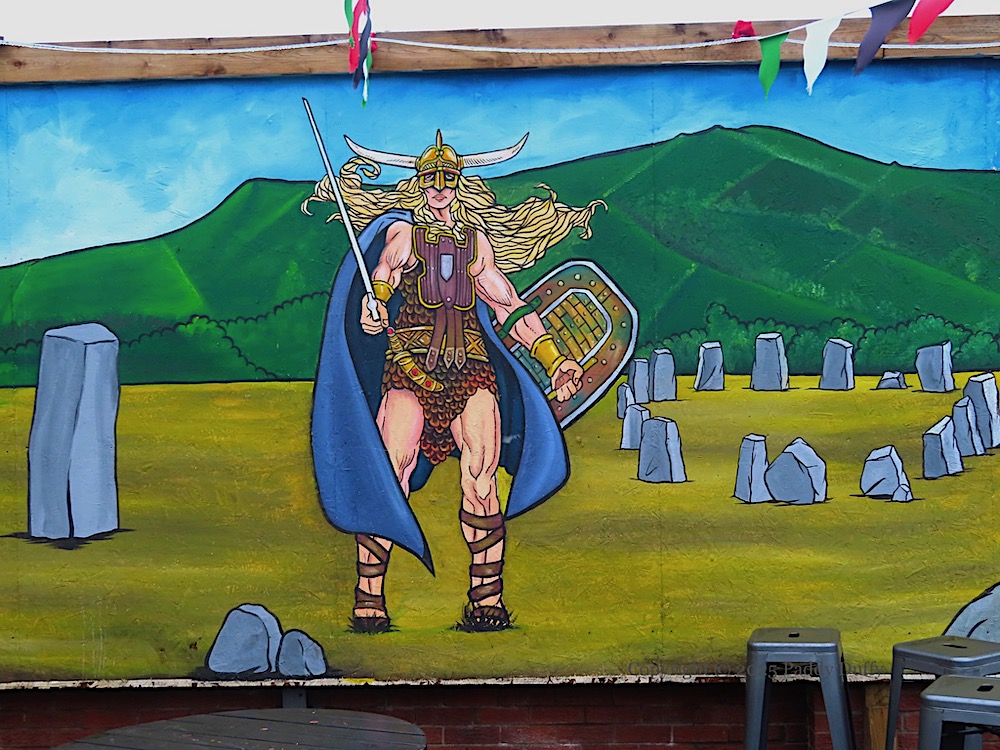
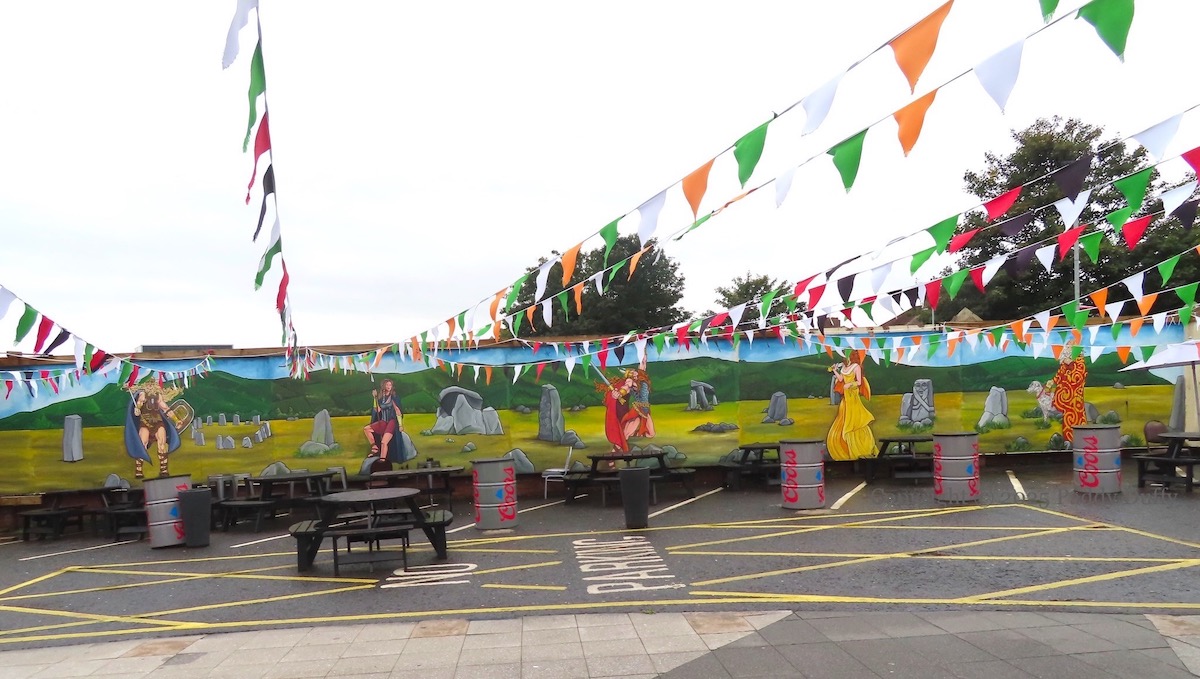
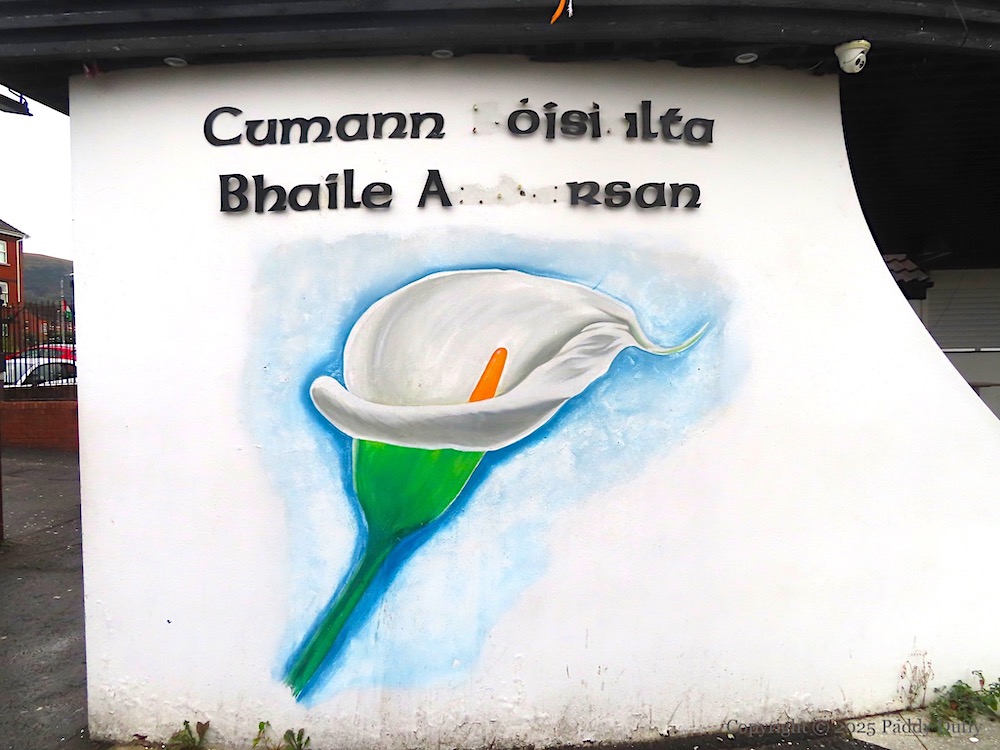
Here are five mythological figures placed against a backdrop of Celtic Ireland, including standing stones, a dolmen, a stone circle, and the Janus figure on Boa Island (WP), from the wall of the PD/Cumann Sóısıalta Bhaıle Andarsan.
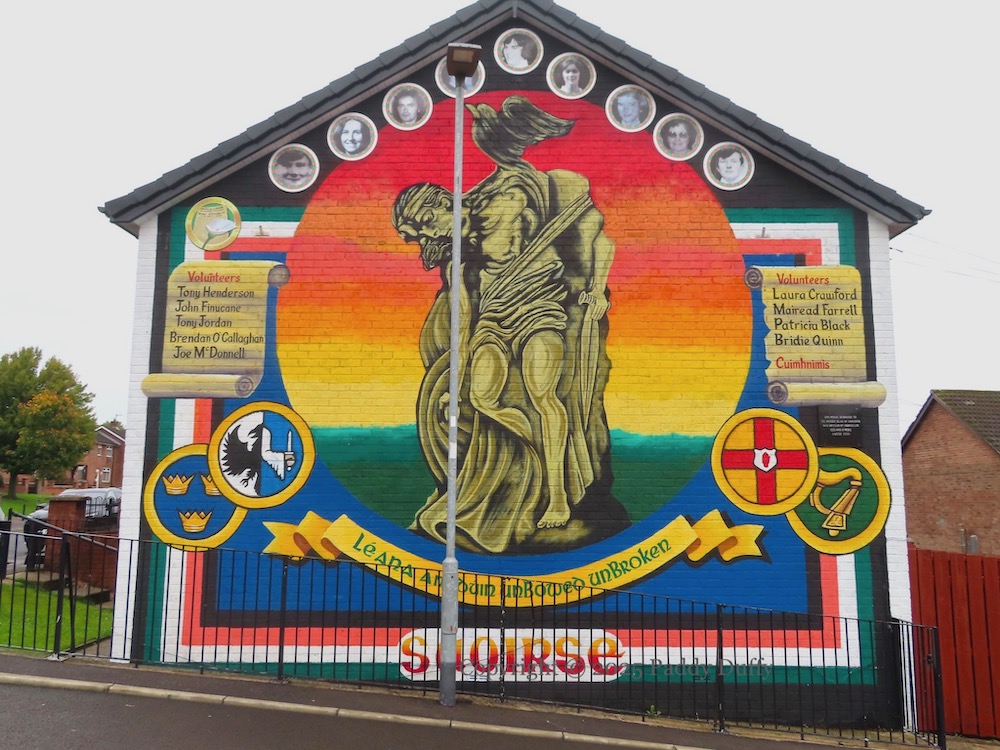
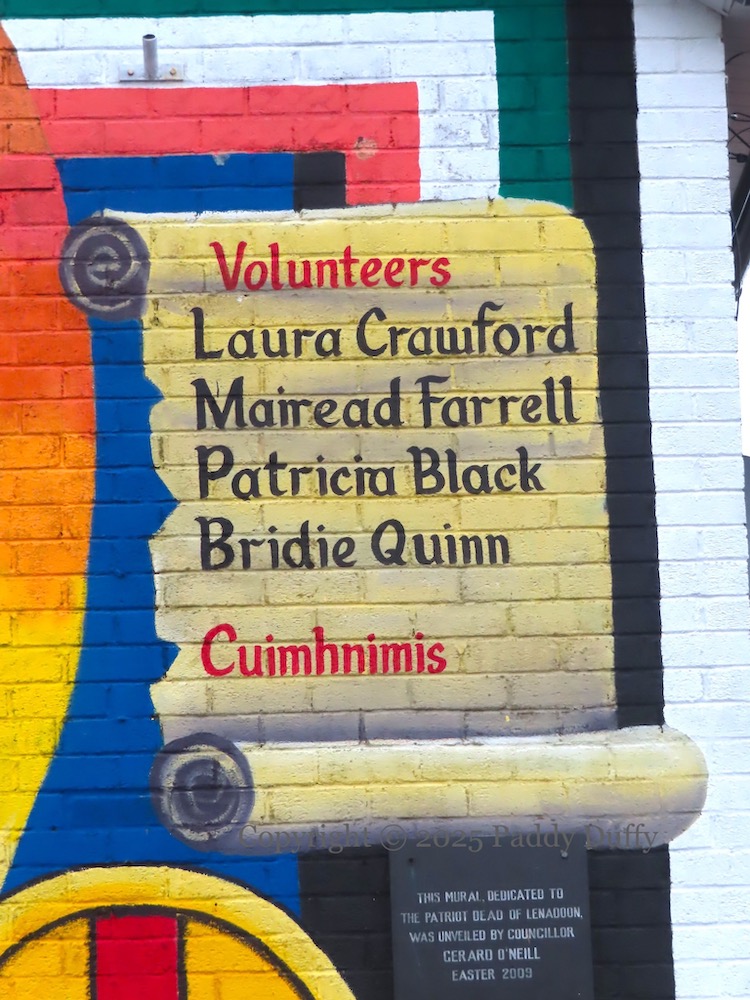
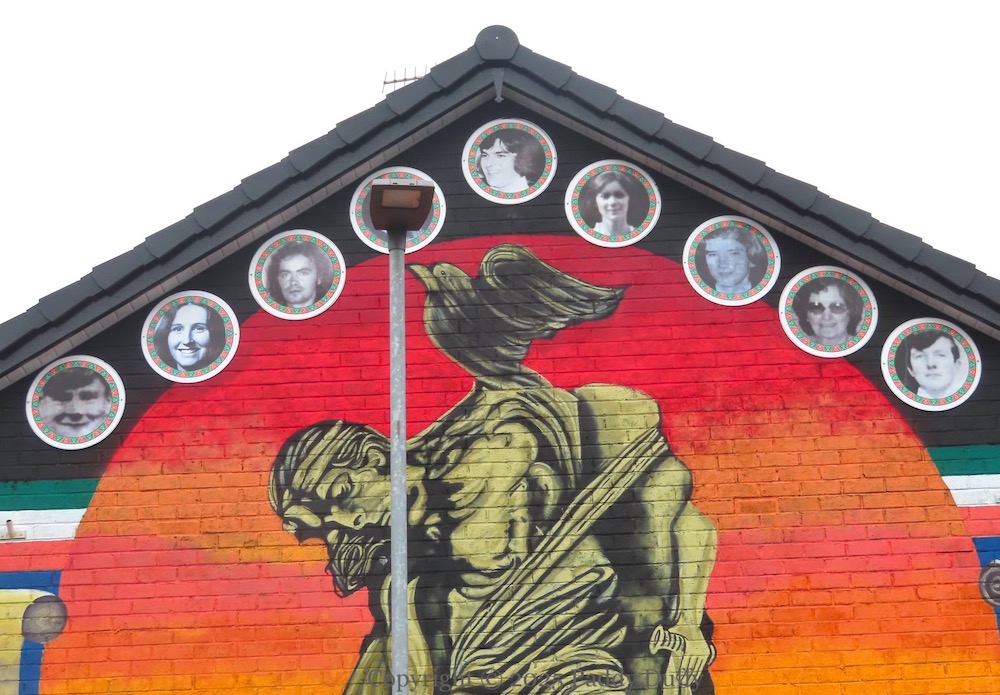
Oliver Sheppard’s statue of Cú Chulaınn dying – see the Cú Chulaınn Visual History page – memorialises nine IRA volunteers from the Lenadoon area, whose names are listed on the scrolls to each side and whose portraits appear in the apex: Tony Henderson, John Finucane, Brendan O’Callaghan, Joe McDonnell, Laura Crawford, Maıréad Farrell, Patricia Black, Bridie Quinn. Below the statue are the shields of the four provinces and the words “Léana An Dúın – unbowed, unbroken” and “saoırse” [freedom].
The mural dates back to 1996 (see T00160) and was repainted in 2009 (see M05134) and c. 2014 (see M11028, which includes a close-up of the plaque added in 2009.) In this version, nothing has changed in the composition of the mural and the photographic portraits and the Easter Rising centenary board have been retained.
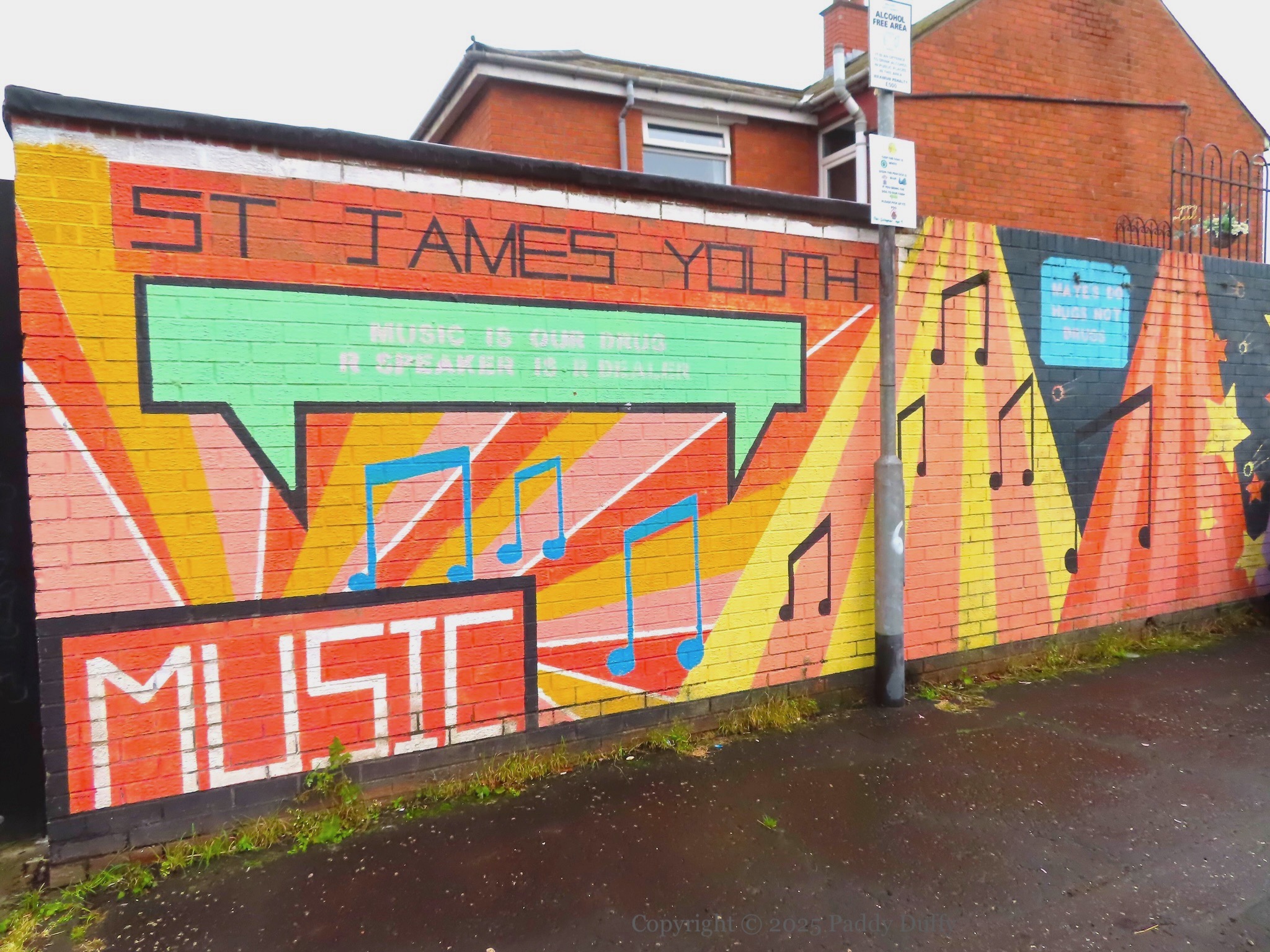
St James’s Community Farm/Feırm Phobaıl Naomh Séamus (web | Fb) started in 2015 with a dozen hens; it is now home to 38 animals, produces vegetables and eggs, and collects cans for recycling.
Belfast Media recently profiled the farm (in print) and is producing a series of short videos about the farm: one | two | three (on youtube).



















 Paddy Duffy Collection