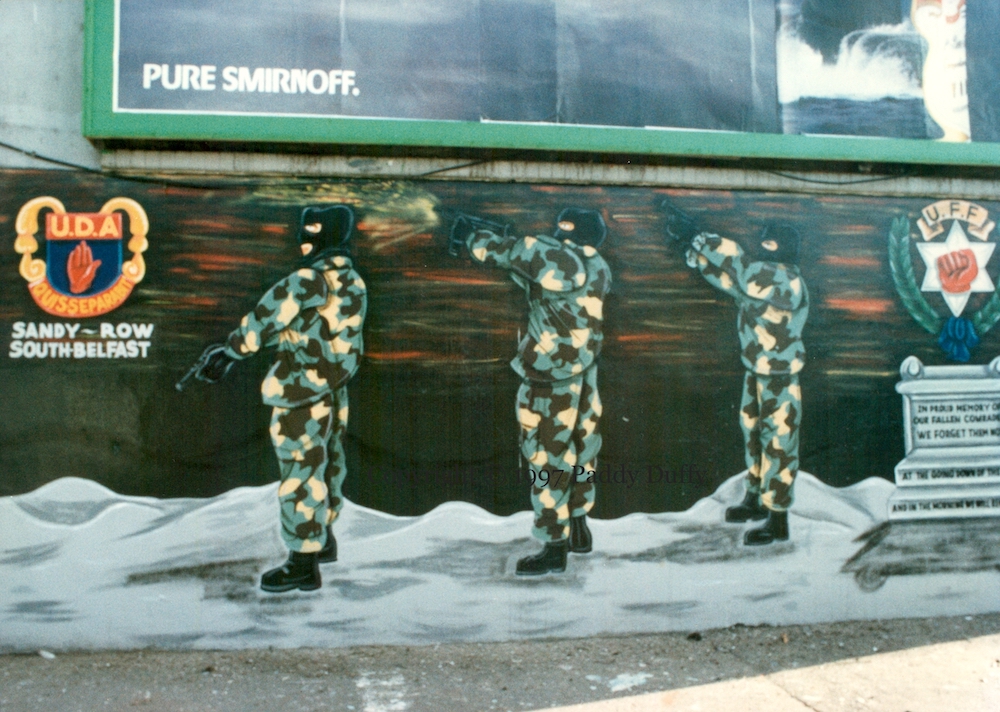
“Sandy Row South Belfast” UDA/UFF volunteers in balaclavas and camo gear fire a funeral volley “in proud memory of our fallen comrades. We forget them not – at the going down of the sun and in the morning we will remember them.”
The orange lily makes a rare appearance in a paramilitary mural. The hooded gunmen are from the UFF/UDA. Volunteer Stephen “Benson” Kingsberry is remembered in the panel on the left of the house. He died from consuming tainted ecstasy (perhaps distributed by the UVF).
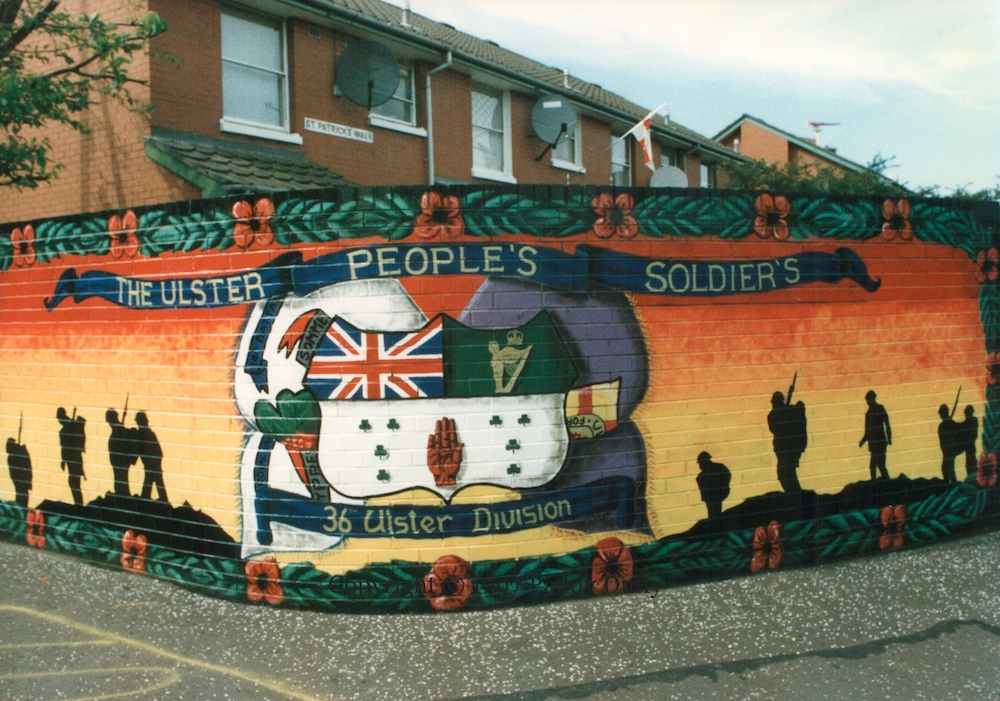
The UVF’s William Millar (here given as “Miller”) was ambushed, along with Bobby Morton, by the RUC on the 16th of March 1983 – Millar died and Morton was injured (Long Kesh Inside Out). His death is put in parallel with the WWI service of William McFadzean, who won the VC for throwing himself on a fallen box of grenades on the first day of the Battle Of The Somme. The McFadzean family home (Rubicon) is only half a mile away from this mural.
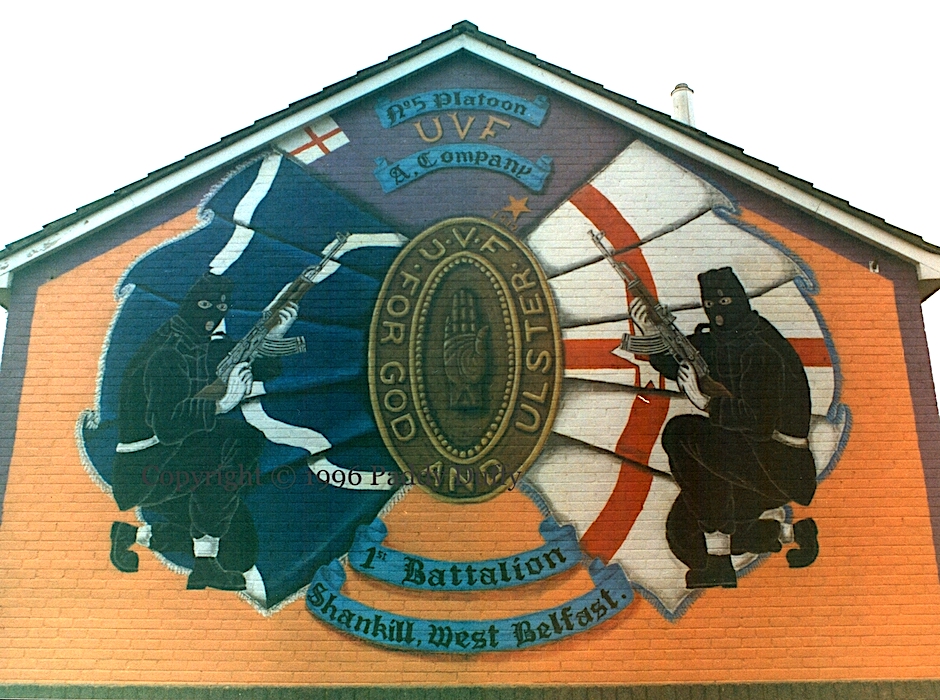
“No 5 platoon, A company, 1st battalion, Shankill, west Belfast”. Hooded gunmen crouch in front of a St Andrew’s Saltire and an Ulster Banner, with a UVF flag on top.
In Aboriginal cultures, “Dreamings” are the stories – in words or in paintings – of the creation and persistence of the Aboriginal peoples and lands, and their inter-relation. They belong to the person or tribe who told the story; it’s not know how this image came to be painted in Belfast’s New Lodge, or whether it is an authentic dreaming.
It shows two slender figures in black – one female, one male – looking upward at a jagged red circle/sun, all three of them contained in an inverted egg-like shape, itself surrounded (above) by a field of stars (including a small Plough) and (below) a variety of snake-like shapes and other designs.
The Catalan Countries include (in Spain) Catalonia, parts of Valencia, and the Balearic islands, plus Andorra, and (in France) the Roussillon region. In the separatist flag – the “Estelada” – the white star stands for freedom and the blue triangle stands for the sky of humanity (Vexillology), on top of the four red bars of the Senyera (WP).
“Saoırse” [freedom]. Both male and female prisoners of war are represented in this mural: by the male and female faces — the male above the silhouette of Long Kesh, the female behind bars (presumably of Armagh prison) – and by the (formerly astrological) symbols for male (Mars) and female (Venus). The mural is signed (top left): “G[erard Mo Chara] Kelly 95″.
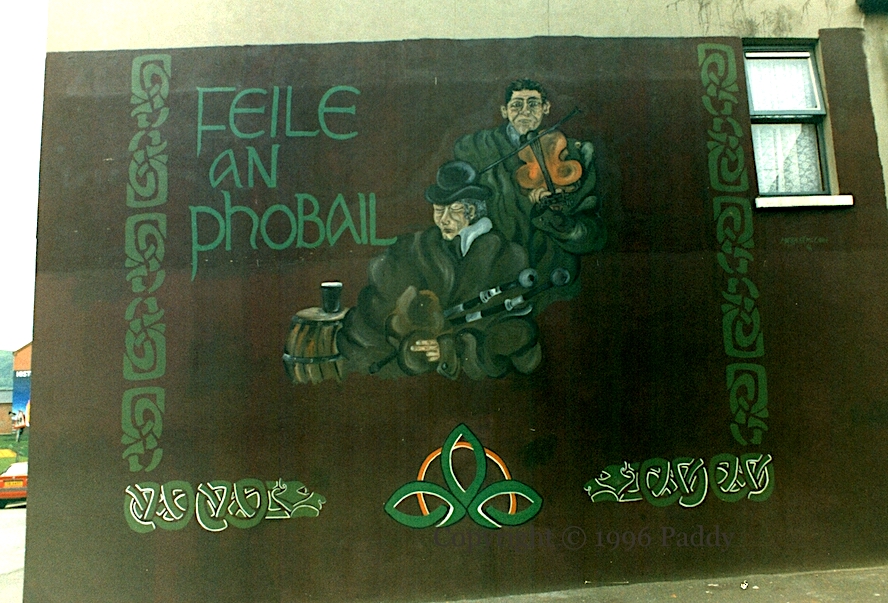
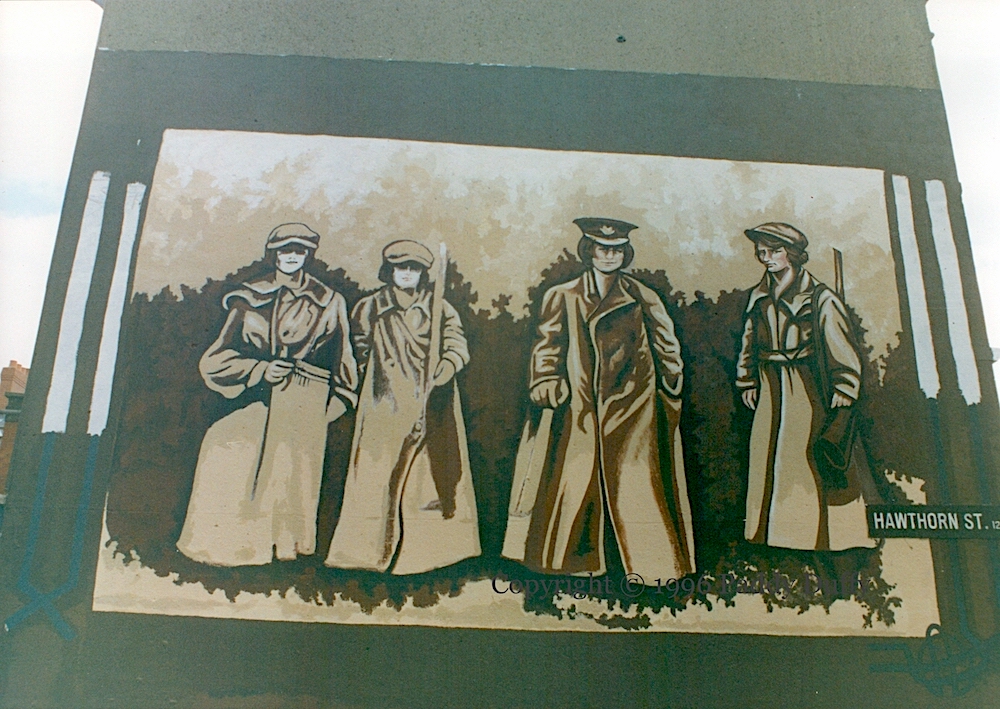
Some of the programme from the 1996 festival is available in the ‘Extraordinary Women’ collection at the Linenhall Library. 1996 was also the first year of Féıle FM (“Triple FM”) (The Can).
Painted by Margaret McCann in Hawthorn Street, west Belfast
Text would later be added along the bottom reading, “This mural is dedicated to the Women of Cumann Na mBan, Óglaıgh Na hÉıreann & Sınn Féın.” Image “from R[uth] Taillon’s book The Women Of 1916.” Taillon is a Canadian who moved to Belfast in 1980 and has been doing work with the women’s movement in the north and on women’s history – see NVTv.




 Paddy Duffy Collection