Volunteers in simplified clothing fire a funeral volley over an unseen coffin. The mural was later made more complex – see Slán Go Fóıll in the Peter Moloney Collection.
For the side wall, see Long Kesh in the Peter Moloney Collection.
Words from Padraıg Mac Pıaraıs’s poem Mıse Éıre are included alongside the portraits of the seven signatories to the 1916 Proclamation. It includes the line “Great is my glory, I who bore brave Cú Chulaınn” and Cú Chulaınn is pictured on the right, in the death pose made famous by Oliver Sheppard in a statue installed in the GPO in 1935 – see Cú Chulaınn’s Visual History page.
Mıse Éıre: Sıne mé ná an Chaılleach Bhéarra. Mór mo ghlóır: Mé a rug Cú Chulaınn cróga. Mór mo náır: Mo chlann féın a dhíol a máthaır. [Mór mo phıan: Bıthnaımhde do mo shíorchıapadh.] [Mór mo bhrón: D’éag an dream ınar chuıreas dóchas.] Mıse Éıre: Uaıgní mé ná an Chaılleach Bhéarra.
Painted by Mo Chara Kelly in Norglen Gardens, west Belfast
“In proud memory of those who gave their lives for Ireland’s freedom” (and out of sight to the left) “Also to all civilians murdered by the British crown forces” (and out of sight to the right) “Also to all civilians murdered by pro-British elements”. The Celtic cross bears three republican flags: Tricolour, Sunburst, and Starry Plough.
The volunteers (and one Sınn Féın member) listed are (on the left) “Martin Forsythe, Martin Skillen, Gerard Fennell, Terence O’Neill, John Dempsey” and (on the right) “Sean McDermott, Tom Magill, Sean Savage, Kevin McCracken, Paul Best”.
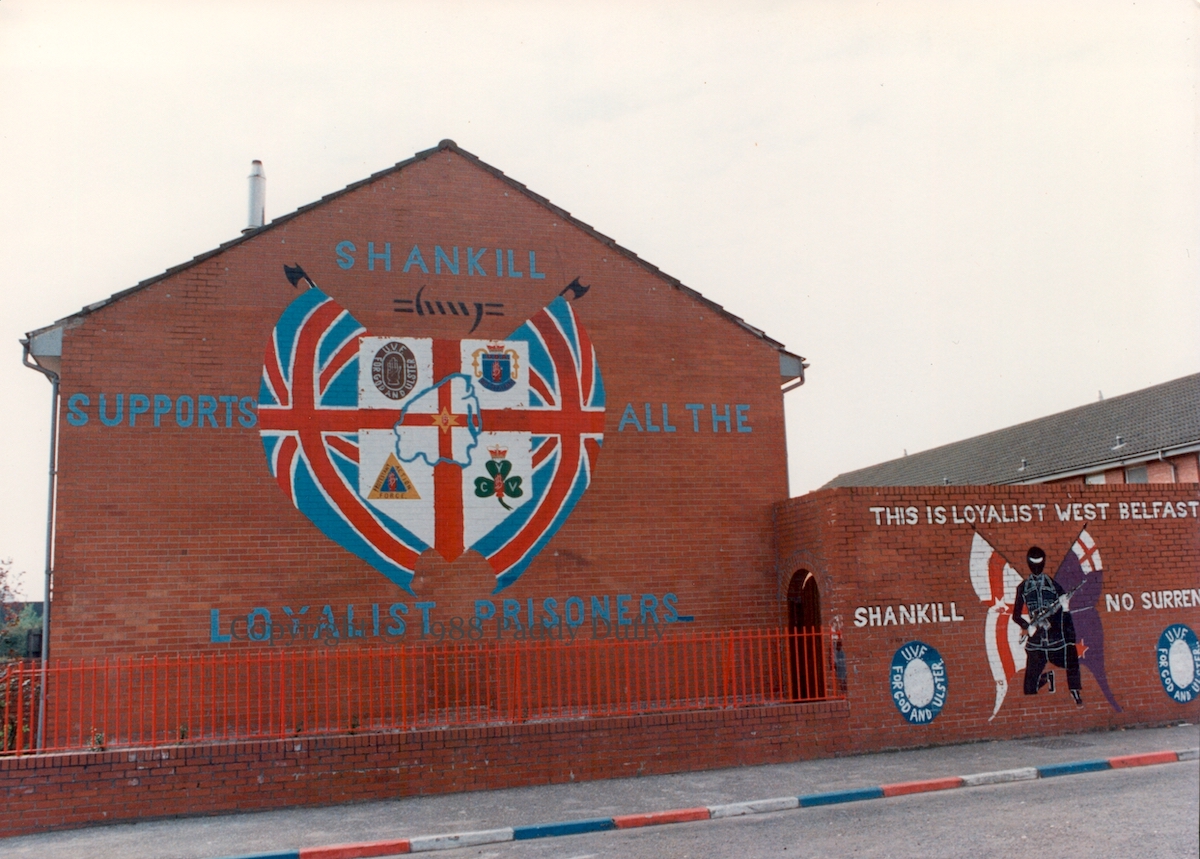
“West Belfast Brigade UDA C Company”. UDA/UDF/LPA/UFF mural on the Shankill. (For a similar quartet of names and explanation of “UDF”, see Sans Peur.)
The title “First Ulster Defence Assoc.” is an attempt to tie together the defenders of Derry in 1688 (300th anniversary) with the modern Ulster Defence Association. This is an early attempt to give the UDA historical roots, beyond the Shankill and Woodvale Defence Associations. To this end, the group would adopt Cú Chulaınn (beginning in 1992 – see the Visual History page) and (beginning in 2007 – see UDU-UFF-UDA) the 1893 Ulster Defence Union as ancestors.
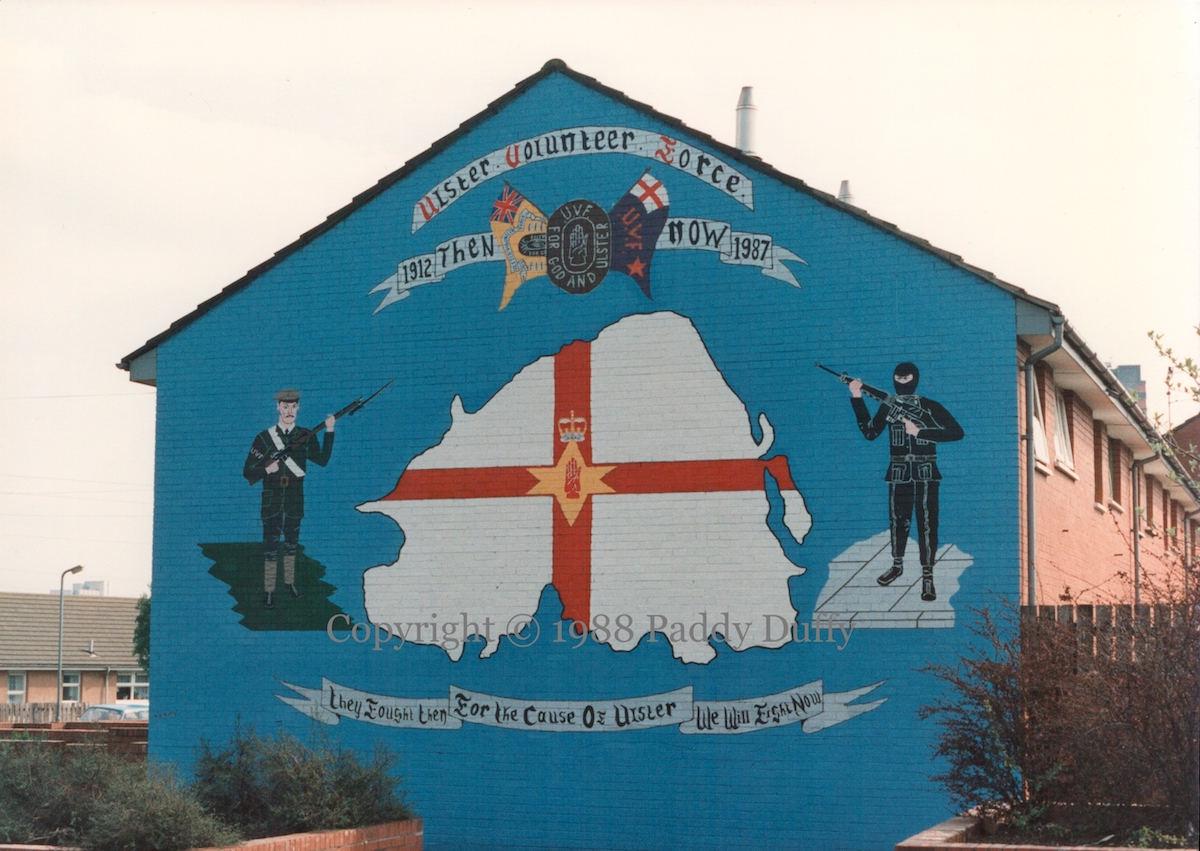
“They fought then for the cause of Ulster, we will fight now.” The 75th anniversary of the Ulster Volunteers is celebrated in this mural in Dover Place, west Belfast. On the left of the Northern Island is an Ulster Volunteer in period (1912) garb standing on a patch of ground, on the right, a modern (1987) paramilitary in hood and fatigues standing on a city footpath. The Ulster Volunteers as such did not fight for Ulster – they instead joined the British Army and fought “for King and Empire” in WWI, after which Home Rule was applied only to 26 counties of Ireland and Northern Ireland was created and remained within the UK.
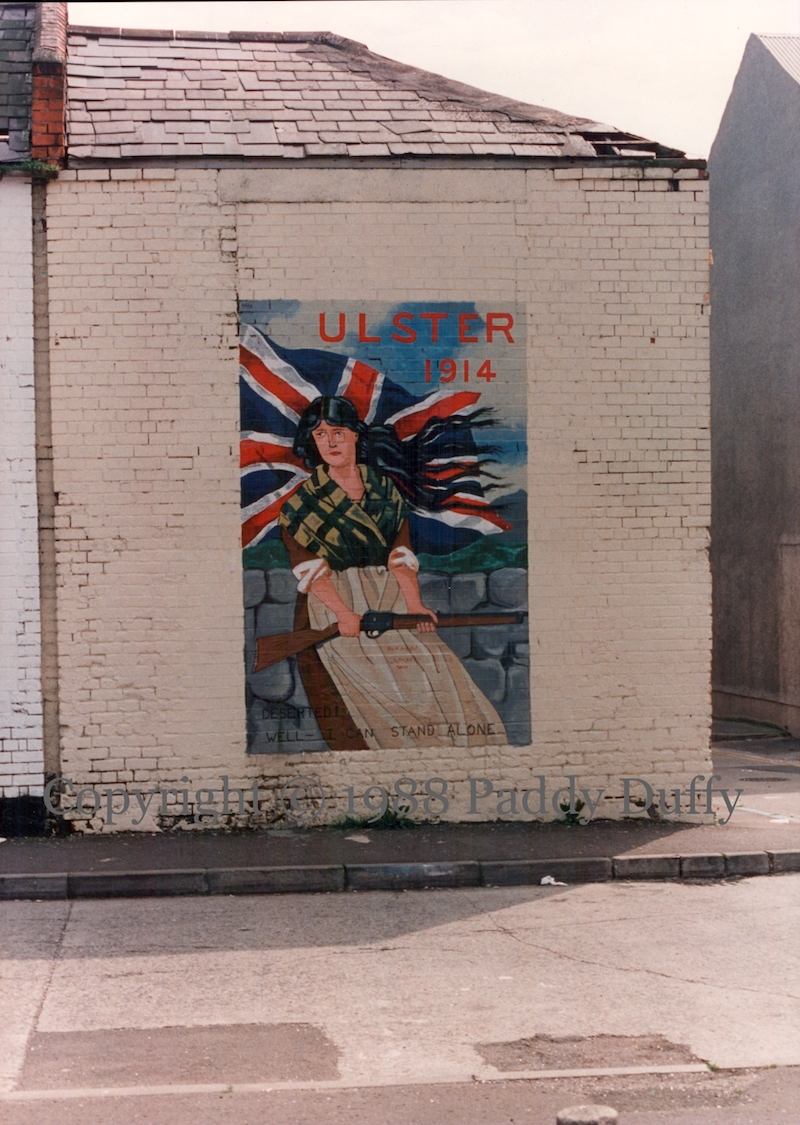
These two murals are side-by-side in Craven Street. On the right, a farmer’s wife defends the farm (the stone wall) in order to preserve it as part of the UK (the Union Flag) despite the threat of Home Rule; on the left, “in proud and loving memory” of three UVF volunteers assassinated by the IRA: Shankill Butcher Lenny Murphy, John Bingham, and William “Frenchie” Marchant. “Lest we forget.”
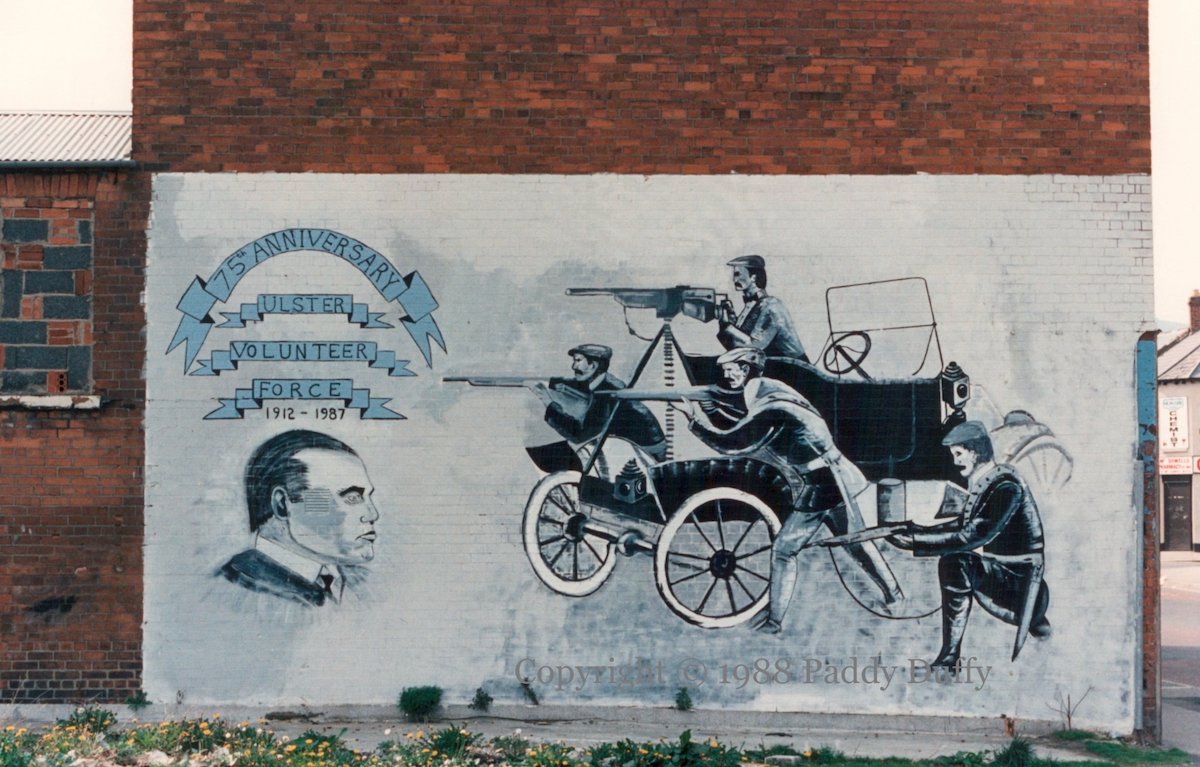
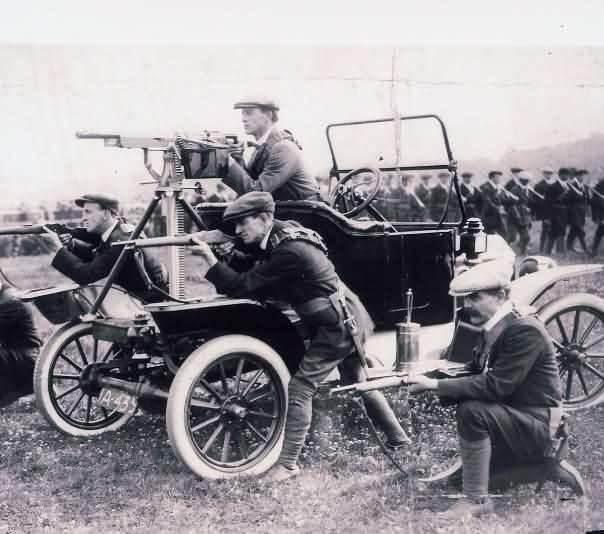
This mural celebrates the 75th anniversary of the Ulster Volunteers, 1912, with a portrait of Edward Carson and a rifle mounted on the back of a car (based on an image from 1914, included below). The Ulster Volunteers joined the Royal Irish Rifles as part of Kitchener’s Army in WWI, and when the war ended some of the survivors joined the northern RIC and the post-partition RUC, but at that point it is impossible to track them as a cohesive group and the only connection to the Ulster Volunteer Force of 1965 is the name.
Shankill Road (on the wall of the PUP offices, just west of ACT and the Bayardo memorial), west Belfast
These are three of the murals painted in Percy Place, west Belfast, painted by Alan Skillen in 1984. For a gallery of all eleven piece, see the street’s Visual History page.
The murals combined traditional PUL themes and iconography, such as King Billy and the monarchy, with the emblems and hooded gunmen of paramilitary groups.
The piece above is unusual in that it takes a familiar UDA device of four emblems in the quadrants of an Ulster Banner shield (see e.g. Sans Peur) but replaces three of them with the emblems of the UVF, PAF, and YCV. A crude outline of Northern Ireland has also been applied.
On the left of the lightning bolt are the soldiers of the 36th Ulster division (U.V.F.) R.I.R (Royal Irish Rifles) on the western front in 1916; on the right are “UVF prisoners of war, Long Kesh”.
A similar board was painted in the UVF compounds of Long Kesh. Of it, Billy Hutchinson (in his 2011 piece “Transcendental Art“) said, “My favourite mural was one inspired by the British anti-war poet, Siegfried Sassoon. Suicide In The Trenches depicts a UVF volunteer split down the middle by a bolt of lightning. Half of him depicts a 36th Ulster Division soldier under heavy fire in a rainsoaked WW1 trench. The other half shows a ’70s volunteer incarcerated behind barbed wire and over-shadowed by watch towers.” (The piece – W2021.1.8 in the Ulster Museum collection – includes the last verse from Sassoon’s Suicide In The Trenches.)
Craven Street, west Belfast. Hutchinson also describes the importance of the Orange Cross welfare organisation in selling prisoner art produced inside the prison. The door to the club is in black to the left of frame. Stevie McCrea of the RHC was killed in the Orange Cross in 1989 – see Stevie McCrea.
The death by hanging of African National Congress supporter Benjamin Moloise on 18 October, 1985, for the alleged murder of a South African policeman, drew international condemnation and led to widespread rioting in Johannesburg and Port Elizabeth. (ExecutedToday | Jet)
Moloise’s words, “tell the world, freedom is at hand”, originally appeared on the right of this ANC-IRA mural, paired with a phrase from Bobby Sands, “we aim to be free” on the left of the assault rifle and a zulu shield and spear. The quote and signature have been painted out due to paint-bombing. (There was (at least) one other paint-bombing of the mural – see the Peter Moloney Collection.)
The boards above the mural (“erected by Sınn Féın April 1986”) declare west Belfast an “apartheid free zone”/”ceantar saor ó apartheıd”. Note the “A/A” [anti-aparteid] emblem in bottom-left of the left-hand board.
“Beır bua” [seize victory] along the bottom is partly obscured by the skip.
Ascaıll Ard Na bhFeá/Beechmount Avenue, west Belfast





 Paddy Duffy Collection