For God, Ulster & Scotland

These three panels form a single installation at the top (Woodvale) end on the Shankill Road. The one above celebrates the ties between Belfast and the Stirling & District Campsie Club, a branch of one of the associated clubs of the Apprentice Boys Of Derry. It features the cannon “Roaring Meg” (“presented by the Fishmongers Company of London 1642″) which is used as the seal for the club, the club’s flag which includes a red hand of Ulster, the key to the gates, and the emblem and coat of arms of the Apprentice Boys.

“Formed on the 2nd May 1987 we have been at the forefront of loyalist culture in our area since then and were the first club in Scotland to have a Battle of the Somme Commemoration Parade. Since our inauguration we have formed many friendships with our brethren and bands from the province many of which are still active today. For many years the club has participated with Belfast Campsie Club at the closing of the gates parade in December. We have through the years had great affinity with the many bands from Belfast some who are unfortunately no longer with us. The club would like to thank the people of Belfast for their support and friendship through the years and to the people of the Shankill for giving us the privilege of this murals. No surrender.

The Campsie Club is the only Apprentice Boys Club to be named after one of the “Brave 13″. It is persumed presumed that Henry Campsie was the first man to shed blood in the Defence of Londonderry. Campsie was the inspiration behind the Shutting of the Gates and was severely wounded whilst leading his associates to secure the City Magazine and armoury. The emblem of the Roaring Meg was adopted as the Seal of the new club.”

The middle panel celebrates the Stirling Protestant Boys Flute Band and its association with the Shankill Road: “Stirling Protestant Boys Flute Band [Fb] were formed in February 2003 and to this day take part in parades across Scotland, England and Northern Ireland. The band has a great connection with our friends from Belfast, especially those from the Greater Shankill area. In November 2012 Stirling Protestant Boys were presented with the battle honours of the Young Citizen Volunteers and the 36th (Ulster) Division. The band would like to thank the people of the Shankill Road for their continued support.”

The third celebrates the Apprentice Boys contains a long description of the Shutting Of The Gates in December 1688 and the Siege Of Derry, which was ended with the breaking of the boom of the river Foyle in July 1689.

Click image to enlarge
Copyright © 2022 Paddy Duffy
T01419 T01420 T01421 [T01422]
The Woodvale Blitz

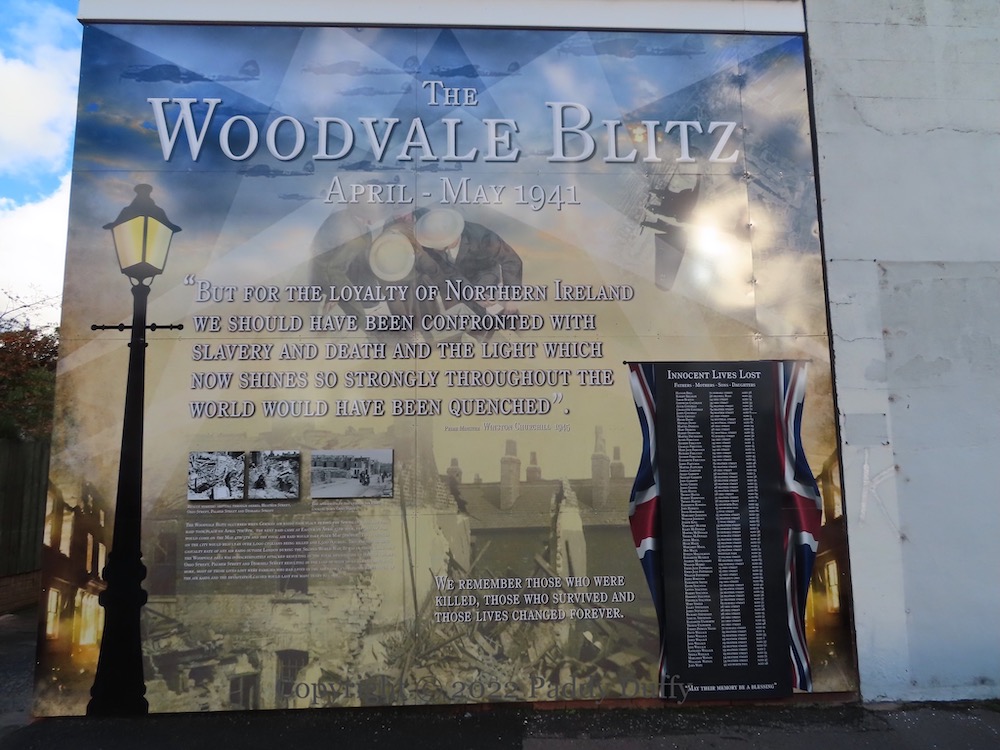
“The Woodvale Blitz occurred when German air raids took place during the spring of 1941. The first raid took place on April 7th/8th, the next raid came at Easter on April 15th/16th, the 3rd air raid would come on the May 4th/5th and the final air raid would take place May 5th/6th. These attacks on the city would result in over 1,000 civilians being killed and 1,5000 injured. This was the highest casualty rate of any air raids outside London during the Second World War. It was in these streets that the Woodvale area was indiscriminately attacked resulting in the total devastation of Heather Street, Ohio Street, Palmer Street and Disraeli Street resulting in the loss of many lives injuring 100’s more, most of those lives lost were families who had lived in the area for generations. The effects of the air raids and the devastation caused would last for many years to come.” The names of 79 victims are given on the right (see close-up below).

“The Woodvale Blitz April-May 1941. ‘But for the loyalty of Northern Ireland we should have been confronted with slavery and death and the light which now shines so strongly throughout the world would have been quenched’ – Prime Minister Winston Churchill 1945. We remember those who were killed, those who survived and those lives changed forever.”

Enfield Street, west Belfast

Click image to enlarge
Copyright © 2022 Paddy Duffy
T01417 [T01418]

Invictus

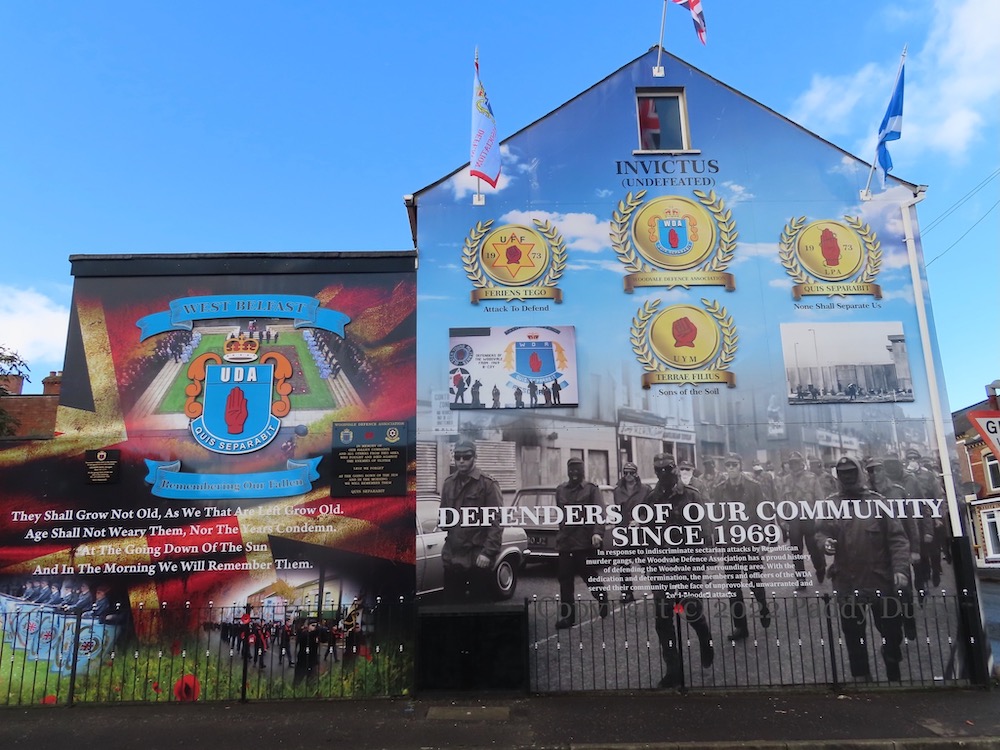
This printed display celebrates the creation of the Woodvale Defence Association as “Defenders of our community since 1969” which in 1971 merged with other associations to form the UDA, whose youth wing is the UYM (lower middle, “terrae filius” = “sons of the soil”) and which uses “UFF” (upper left, “feriens ego” = “attack to defend”) as a cover for military operation. The final emblem is of the LPA (Loyalist Prisoners’ Association, “quis separabit” = “none shall separate us”). The mural replaced by this one is in the bottom left, while the bottom right contains an image of Long Kesh in 1979. The main photograph is of a 1972 march on the Shankill.

On the side-wall, lines from Laurence Binyon’s poem For The Fallen of WWI are used: “They shall grow not old, as we that are left grow old/Age shall not weary them, nor the years condemn. At the going down of the sun/And in the morning we shall remember them.”

Both pieces are a combination of printed poster and attached boards.

Disraeli Street, Belfast

Click image to enlarge
Copyright © 2022 Paddy Duffy
[T01413] [T01414] [T01415] T01416

S Company, C Company

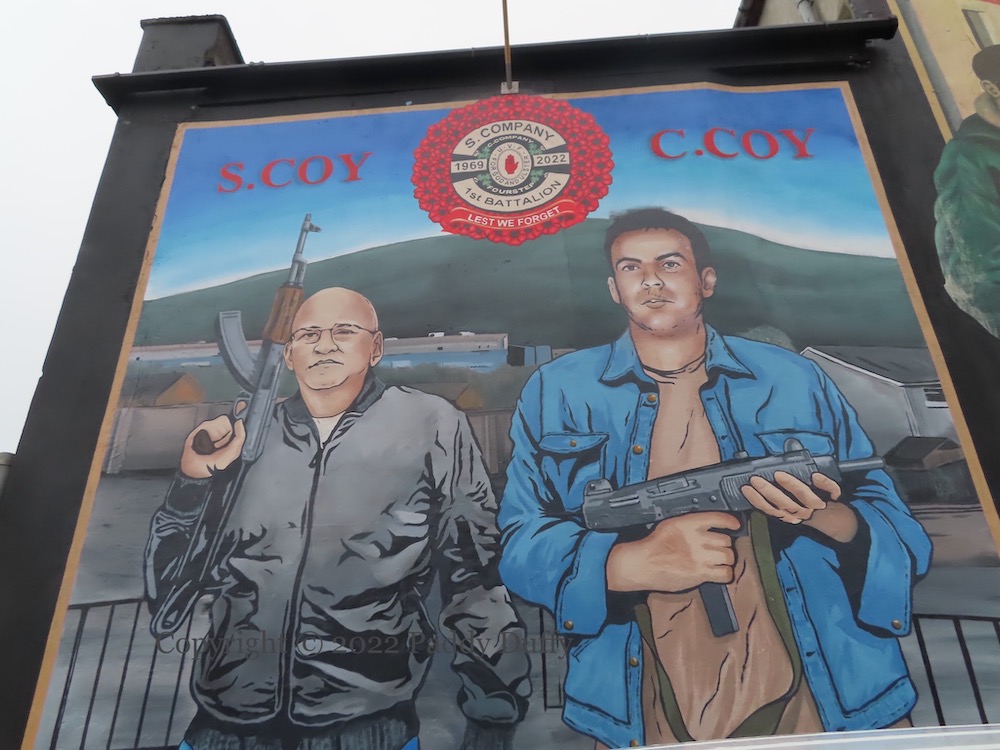
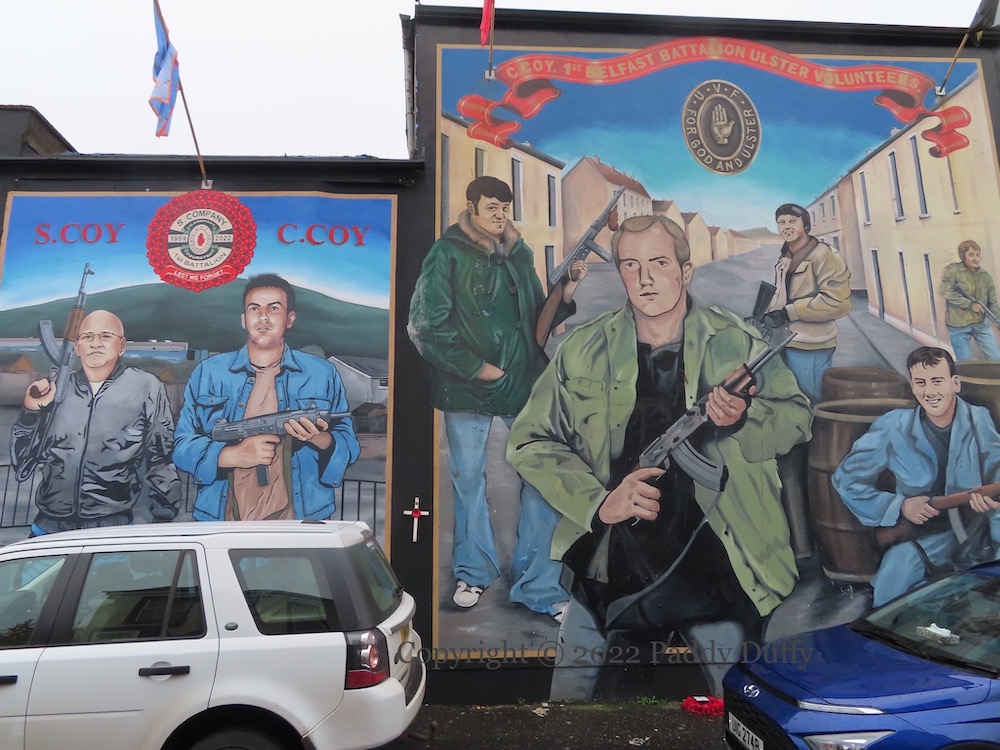
Joe Coggle and Paul McClelland were arrested as they sat with weapons in a car on the Falls Road in 1991; they were jailed for 18 years (Independent) but released under the Agreement. The Sunday World also report that the pair were involved in the killing of David Braniff in 1989. Both UVF men are said to be deceased; Coggle died in September.

Coggle had previously served 18 months for running over and killing Elizabeth Masterson in Beechmount in 1986 and her descendants objected to the mural (Irish News | BBC).

S Company was a predecessor to C Company; it existed from 1969 to 1974, when C Company was formed (see M08105 for an older S Coy – C Coy mural in Ballygomartin). A previous UVF uzi can be seen in M01186.

For the mural of five volunteers to the right (in the wide shot), see C Coy Street.

Click image to enlarge
Copyright © 2022 Paddy Duffy
[T01410] T01411 T01412

Where Is The Integrity In Murder?

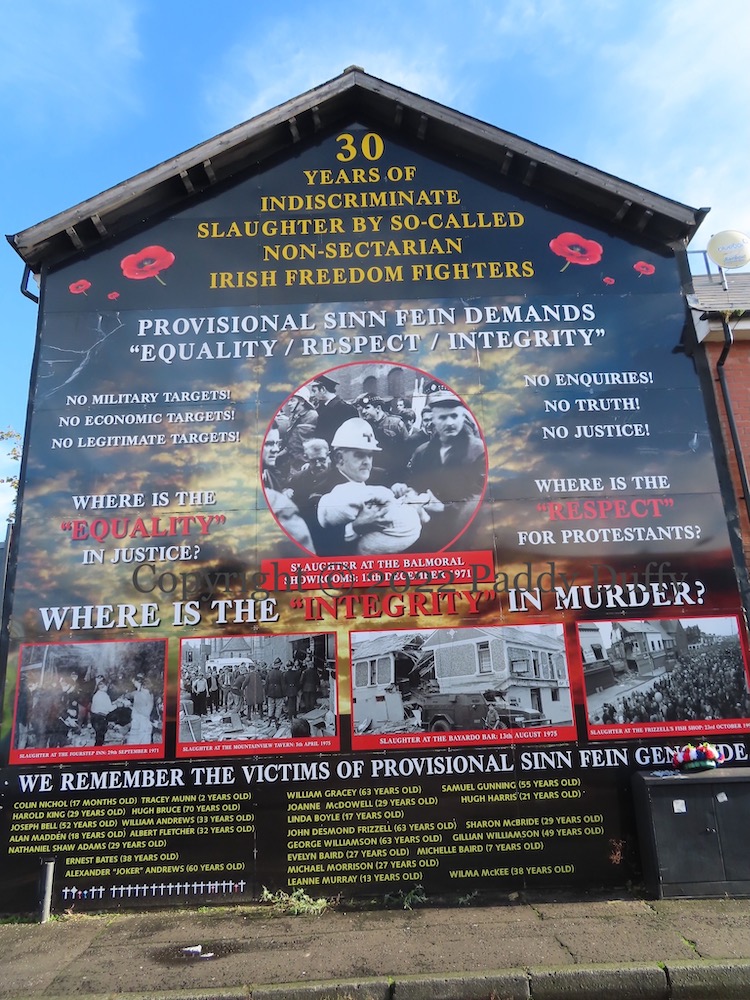
Twenty-five victims of five “Shankill atrocities” – at the Four Step Inn, the Balmoral Furniture Store, Mountainview Bar, Bayardo Bar, and (from the 1990s) Frizzell’s fish shop – are remembered in an updated board in Dundee Street. The central image remains 17-month-old Colin Nichol in the arms of ambulance man Bob Scott.

(See the Peter Moloney Collection for the previous version. Before that, there was a painted version on Bellevue Street: Where Is Our Truth?)

“30 years of indiscriminate slaughter by so-called non-sectarian Irish freedom fighters. Provisional Sinn Fein demands “equality/respect/integrity”. No military targets! No economic targets! No legitimate targets! No enquiries! No truth! No justice! Where is the “equality” in justice? Where is the “respect” for Protestants? Where is the “integrity” in murder? We remember the victims of Provisional Sinn Fein genocide.”

Click image to enlarge
Copyright © 2022 Paddy Duffy
T01354

Welcome To The Shankill Road

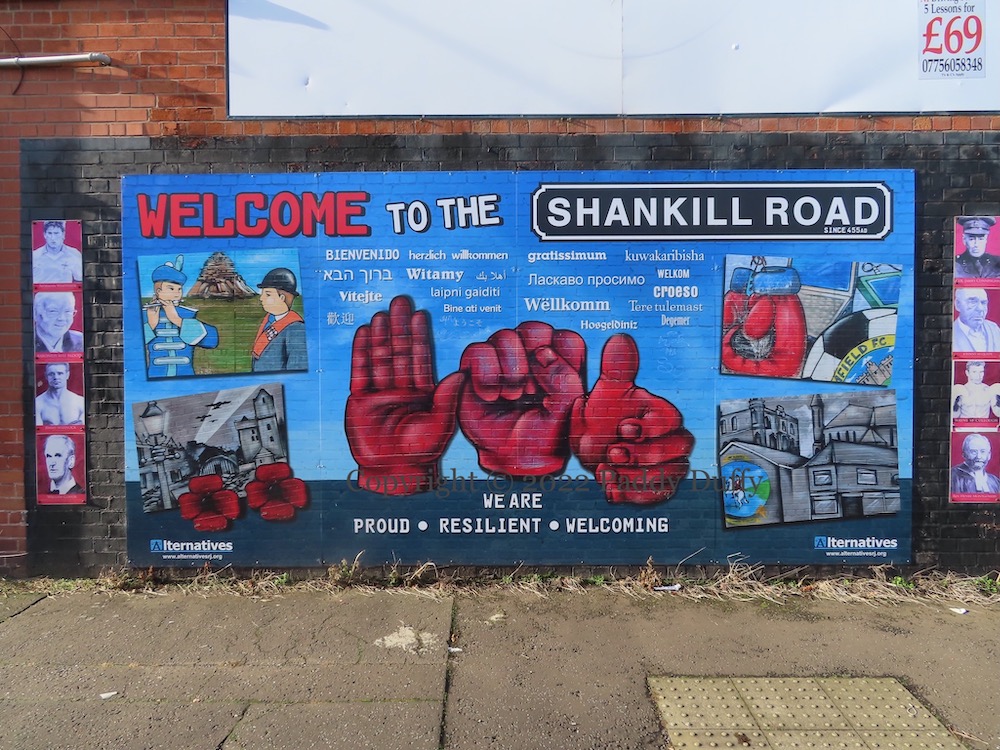
The mural is a version of the old Beverley Street ‘welcome’ mural (by Blaze FX), with the same four panels (parades/bonfire, blitz, sports, murals) and the same three hands. But instead of “Proud, Defiant, Welcoming” we now have “Proud, Resilient, Welcoming”. (I Am Not Resilient in the lower Shankill complains that the word is used to justify neglect and/or maltreatment.)

It escaped no one’s notice that, although the number of languages expressing a greeting is now much greater than the original ten, Irish is not included among them. Also Ulstèr Scots. (Also French, for some reason. Polish is included – “Witamy”). (See similarly “No Irish” in the lower Shankill estate but also All Flags Are Welcome in Divis, which omitted the Union Flag.)

The claim that the Shankill area dates back to AD 455 is used in The Original Belfast. The claim was made by the Greater Shankill Partnership.

Despite the appearance of bricks, the main panel is not in fact a mural but a board.

Gardiner Street. For the previous mural, see Welcome To The Shankill. Held over from the old mural are the two strips of ‘famous faces’ on the left and right.

Images of the July 10th launch from sponsors Alternatives.

Click image to enlarge
Copyright © 2022 Paddy Duffy
T01348

The Greater Shankill

London street artist Dan Kitchener’s (web | ig) piece “Hope” features a Tokyo landscapes behind a geisha. “The wall is dedicated to Sandra – サンドラ. Sandra McCurry worked and owned Mikala’s Kitchen on The Shankill Road, Sandra worked tirelessly for the local community and sadly passed away” (Belfast Walking Tours Fb).

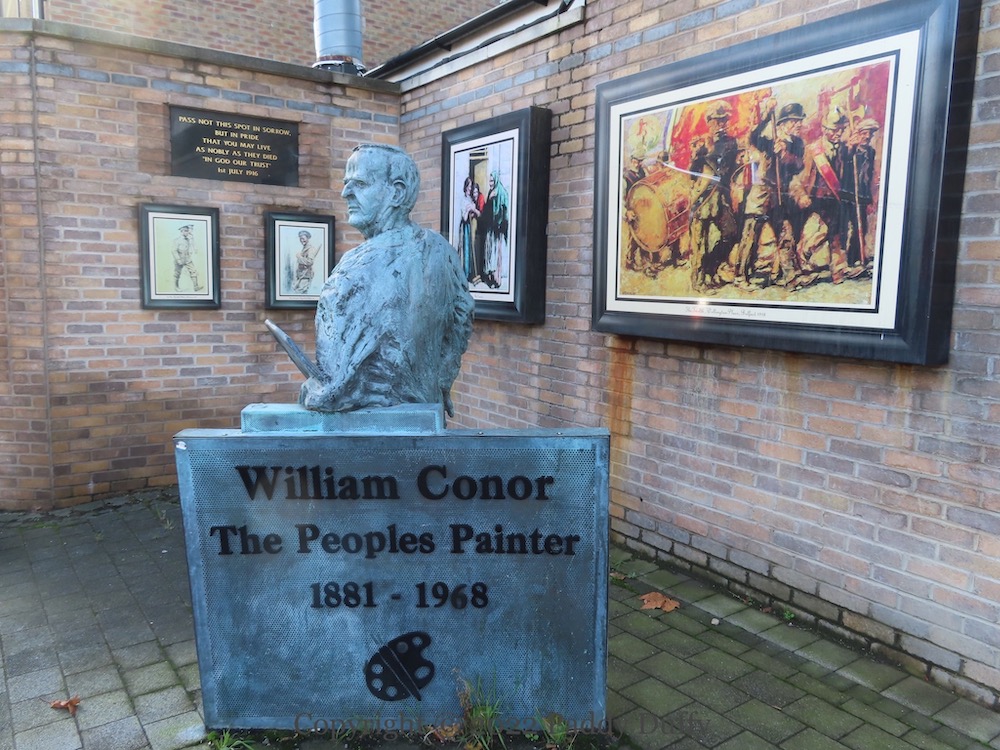
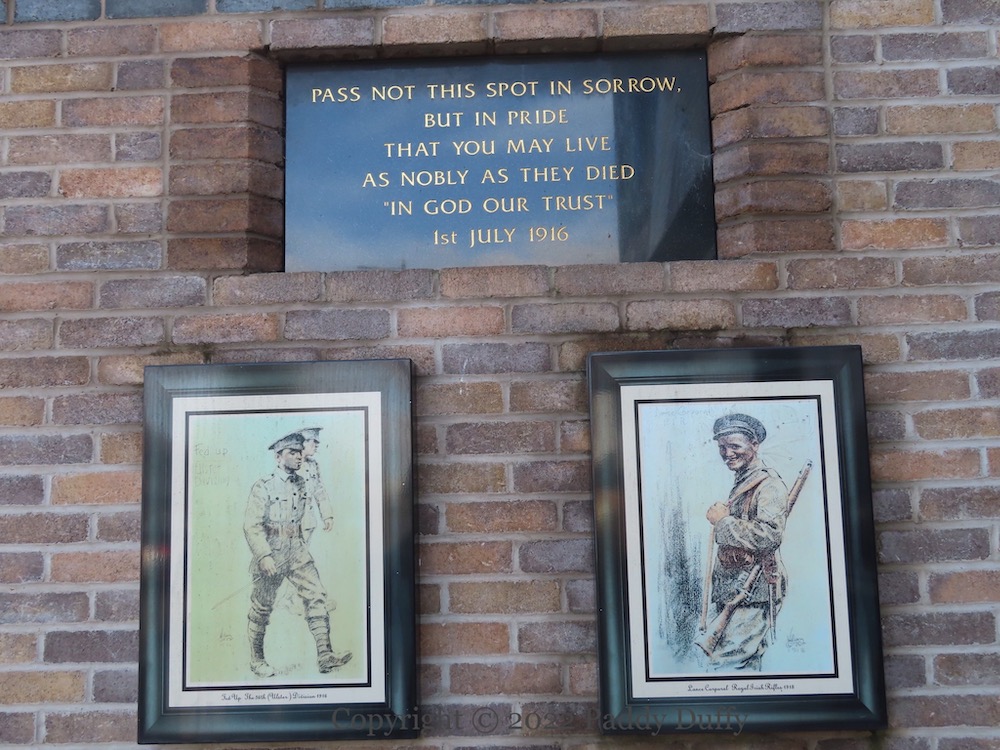
The geisha has (bizarrely) been situated above “Conor’s Corner”, where William Conor has been rendered in bronze by sculptor Holger Lönze and placed among a number of Conor’s paintings. (For images of the sculpture in progress, see Lönze’s site and the project’s Facebook page.) Connor (later Conor) was born in the Old Lodge area of Belfast (in 1881) close to the location of the new bronze statue shown in these images, which is at the corner of Northumberland Street and Shankill Road, replacing the UVF/Shankill Protestant Boys mural (see M02457).

The info board describes his methods in capturing the Belfast street scenes for which he is most famous: “Conor was developing a spontaneous drawing technique by recording quick impressions, and it soon became a habit for him to go out into the streets with a newspaper, which contained loose leaves from his sketchbook. When he saw anything of interest he leant against a lap post or wall, took out his newspaper as though he were simply reading the sports results and sketched away.”

For more info, see the project’s web site. For images of many of Conor’s paintings, see ArtNet.

Click image to enlarge
Copyright © 2022 Paddy Duffy
T01350 T01351 [T01352] T01353

The Ghosts Of The Martyrs

“In proud and loving memory of all local volunteers, prisoners of war, republican activists and the unsung heroes who died of natural causes having served the cause of Irish republicanism [“sean óglach” on the individual plaques]. Together in unity you formed a bond which gave true meaning to the undefeated risen people. Your deeds of bravery and resistance will never be forgotten by the people of greater St. James’s. In your honour the quest for Irish freedom continues.” With the famous “our steps will be onward” quote from Máıre Drumm at an anti-internment rally in Dunville Park on 10th August, 1975 (RN). Coıste Cuımhneacháın Lár Na bhFál/Ard Na bhFeá [Memorial committee of mid-Falls/Beechmount]. For some more of the plaques, see The Unsung Heroes.

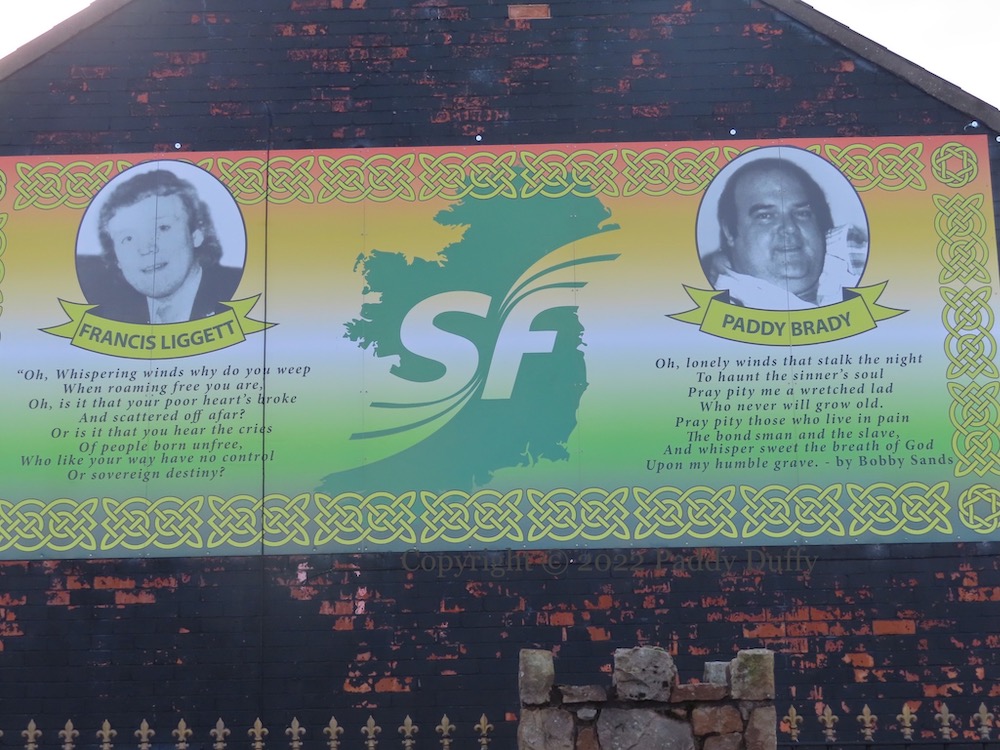
The board on the gable to the side shows Francis Liggett and Paddy Brady. IRA volunteer Francis Liggett was shot dead by the British Army during an attempted armed robbery at Royal Victoria Hospital, Falls Road in 1973 (Sutton) while local Sınn Féın member Paddy Brady was shot by the UFF while at work in 1984 (Sutton | An Phoblacht). They are commemorated in the St James memorial garden with the board shown above, featuring two verses from Bobby Sands’s poem Weeping Winds: Oh, Whispering [Whistling, in the original] winds why do you weep/When roaming free you are,
Oh! Is it that your poor heart’s broke/And scattered off afar?
Or is it that you bear the cries/Of people born unfree,
Who like your way have no control/Or sovereign destiny?
Oh! Lonely winds that stalk [walk] the night/To haunt the sinner’s soul/
Pray pity me a wretched lad/Who never will grow old.
Pray pity those who lie in pain/The bondsman and the slave
And whisper sweet the breath of God/Upon my humble grave.

The board is similar in design to the painted one it replaces, except that Éıre was at the centre rather than the “SF” logo.

Click image to enlarge
Copyright © 2022 Paddy Duffy
T01344 T01345 [T01346] T01347

Don Patricio

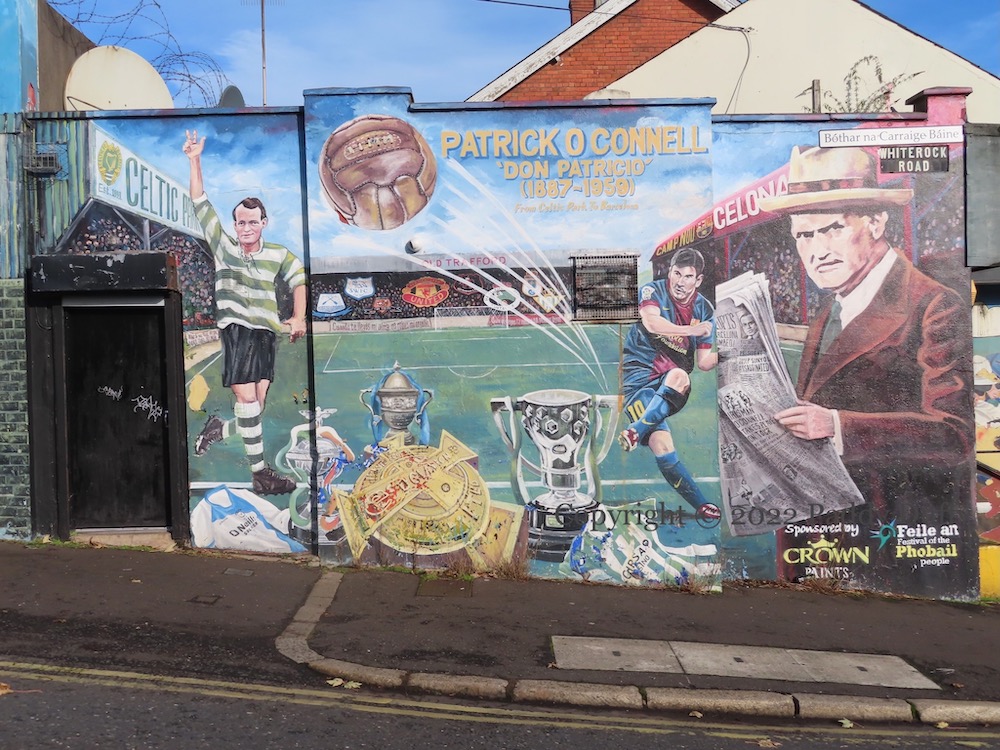
As a player, the Dublin-born Patrick O’Connell started with Belfast Celtic before moving on to various English and Scottish clubs, including a period at Manchester United at the time of WWI. He then went on to manage a string of Spanish clubs. As manager (“Don Patricio”) of Barcelona during the Spanish civil war, he accompanied the club on their tour of Mexico and the United States. The money from the tour saved the club from bankruptcy but 12 of the 16 players went into exile in Mexico and France. (WP) Barcelona returns to the US this month (2015-07) for games against the LA Galaxy, Manchester United, and Chelsea. (FCBarcelona)

The newspaper in the mural above crams all of this news onto one page: “Civil war erupts in Spain – Barcelona bombed”, “Football suspended – President [of FC Barcelona] Josep Sunyol assassinated” [by Franco’s troops] (WP); “Irishman O’Connell takes players on tour – FC Barcelona saved from extinction”; “Funds lodged in Switzerland”. In the bottom left-hand corner of the newspaper is Robert Capa’s famous photograph of ‘The Falling Soldier’, purporting to show a Republican soldier at the very moment he is struck by a bullet and dies. The image is now thought to have been staged (WP).

The image on which the mural is based can be seen in this Irish Times article on O’Connell.

The player on the right is Lionel Messi. The Argentinian forward is shown in front of the Spanish League cup, which Barcelona won in the year the mural was painted (2014-2015) with a goal from “La Pulga” (“the flea”) – Messi is 5’7″ but four-time world player of the year.

The stands of three football stadiums are shown in the background: Belfast Celtic’s Celtic Park (“Paradise”), Manchester United’s Old Trafford, and Barcelona’s Camp Nou. The Old Trafford stands bear the emblems of the teams Patrick O’Connell played for and managed: Liffey Wanderers (whose shirt is also featured, on the left), Sheffield Wednesday, Hull City (The Tigers), Manchester United, Dumbarton, Real Racing Club de Santander, Real Oviedo, and Real Betis Balompié (also shirt on the right).

Whiterock Road, Belfast

Click image to enlarge
Copyright © 2022 Paddy Duffy
T01343

Remembering The Hunger Strikers

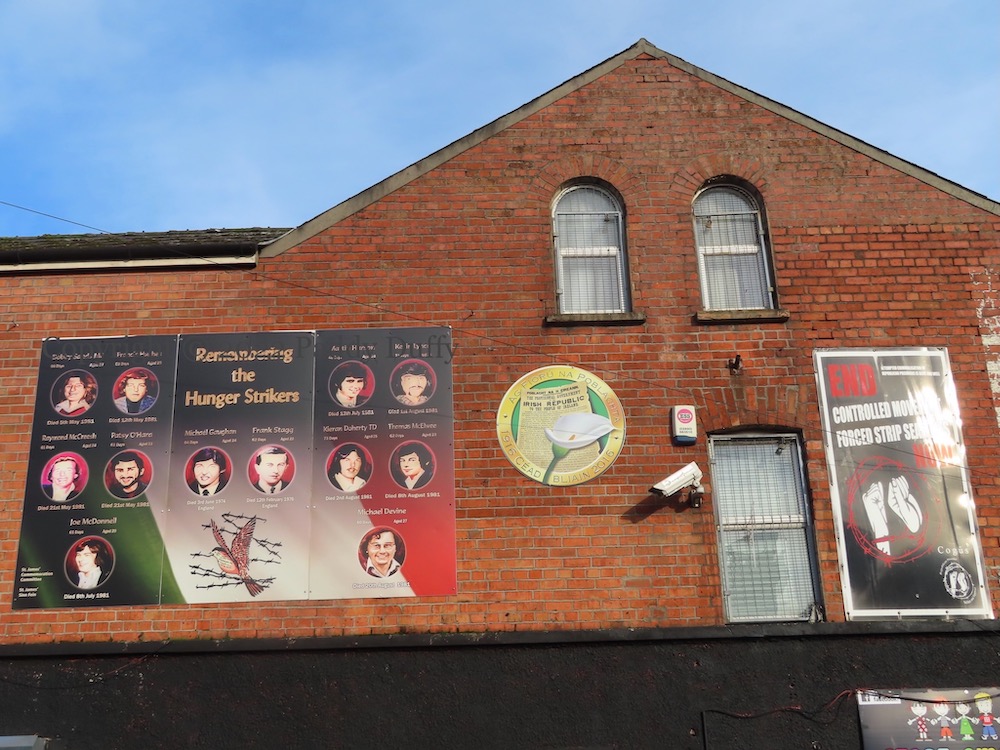
The six weeks from July 8th to August 20th 1981 saw the death of six hunger strikers – McDonnell, Hurson, Lynch, Doherty, McElwee, and Devine – adding to the four who began in March and died in May. All ten, along with Michael Gaughan and Frank Stagg from 1974 and 1976, are remembered in this recent board in Rockmore Road.

To the left is a 1916 centenary board “Ag fíorú na poblachta”/“Realising the republic” – also seen in South Link and in Rockmount Street.

On the far left is a board from Republican Network For Unity (RNU)’s Cogús committee in support of “Attempted criminalisation of republican prisoners is alive and well”, “Republican prisoner welfare and support”: “End controlled movement, forced strip searches. now.”

Click image to enlarge
Copyright © 2022 Paddy Duffy
T01340 [T01338] [T01339]