Victoria Crosses Of The 36th (Ulster) Division

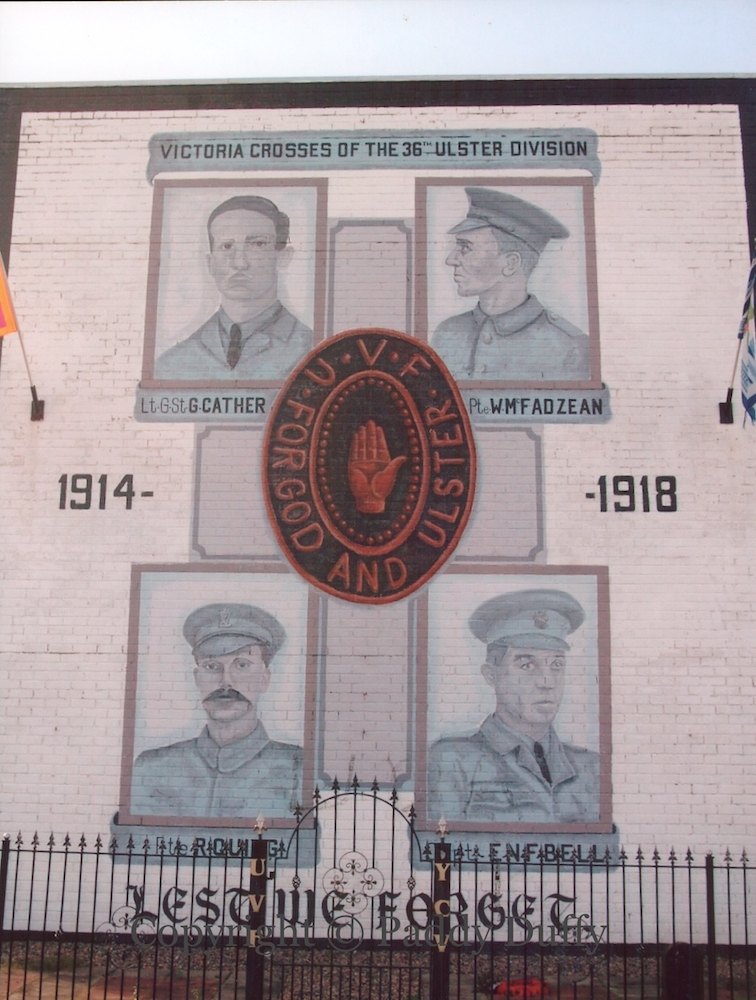
Four VC recipients from the 36th (Ulster) Division in WWI are honoured in a mural in Cappagh Gardens: G[eoffrey] St. G[eorge] S[hillington] Cather, W[illiam] F[rederick] MacFadzean, R[obert] Quigg, and E[ric] N[orman] F[rankland] Bell.

Cappagh Gardens, Castlereagh

Click image to enlarge
Copyright © 2008/2009/2010/2011/2012 Paddy Duffy
T00640
David Ervine

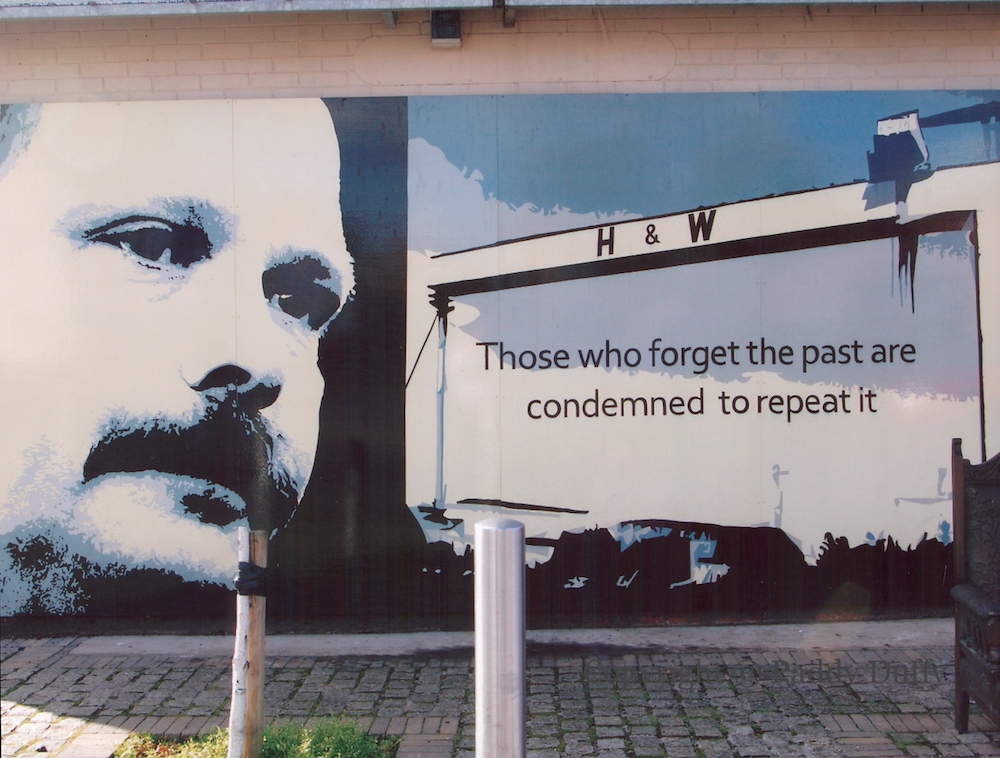
“Those who forget the past are condemned to repeat it.” This is a 2008 work by Ross Wilson commemorating David Ervine (WP) in Montrose Street South, Belfast, the area he came from. The inclusion of one of the Harland & Wolff cranes reflects his connection to working-class politics in east Belfast.

Montrose Street South, east Belfast

Click image to enlarge
Copyright © 2011/2012 Paddy Duffy
T00621

Understanding

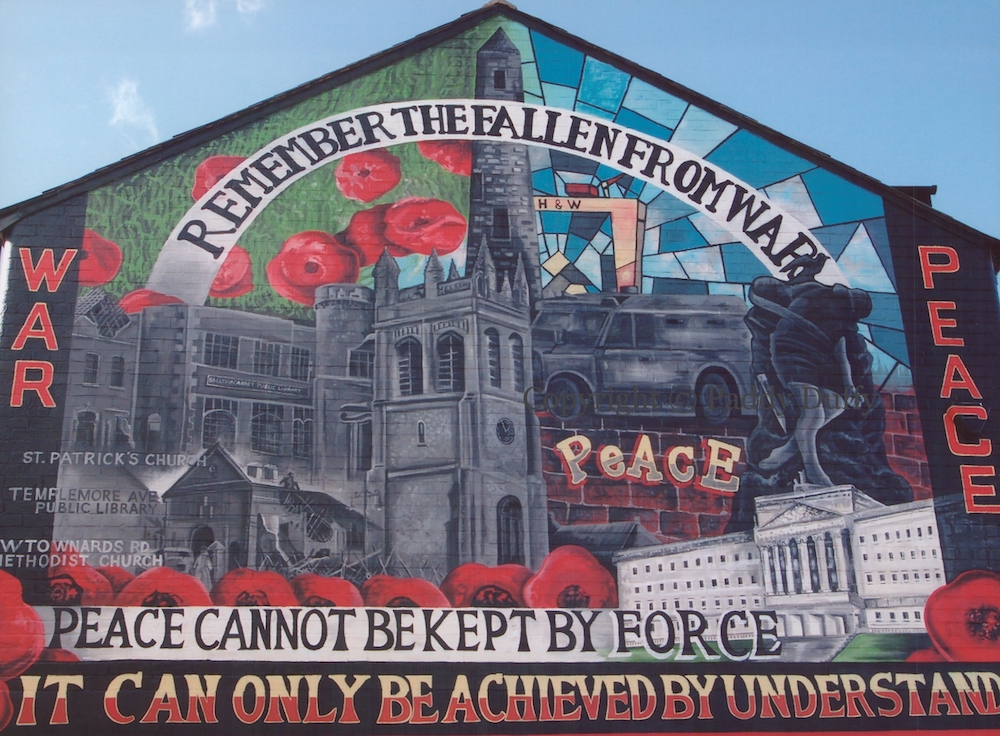
The mural above is on the Newtownards Road at Lendrick Street and shows a bombed-out Ballymacarrett library, St. Patrick’s church (the church itself is visible in the lower right-hand corner) – both were hit by the blitz in 1942 – a police land rover (perhaps representing the “fallen” during the Troubles), and Cuchulainn (perhaps representing the IRA, though Cuchulainn is also a UDA icon – see the bottom of the Visual History page on Cú Chulaınn), and Stormont (representing … peace???). Poppies in a field and a H&W crane against stained glass provide a background.

We are supposed to remember the dead because (perhaps) their deaths were unnecessary and misguided as means to peace, at least according to the saying along the bottom (sometimes attributed to Einstein): “Peace cannot be kept by force; it can only be achieved by understanding” – understanding of the Nazis during the blitz, it seems, and of loyalists and republicans during the Troubles. (If you have a better interpretation, please leave a comment.)

The mural was imitated on the hoarding around An Chultúrlann on the Falls Road during its renovation (shown below): the left hand side of the side was replaced with images of the Falls library and Bobby Sands mural and Divis tower, and Cú Chulaınn on the right was placed in front of the GPO, and the poppies were joined by lilies, and the words translated into Irish. The message here seems clearer, lamenting the CNR dead and calling for understanding of the CNR community (sc. by Britain and the Orange state) though the poppies below include the dead of WWI.

Click image to enlarge
Copyright © 2011/2012 Paddy Duffy
T00620

No More

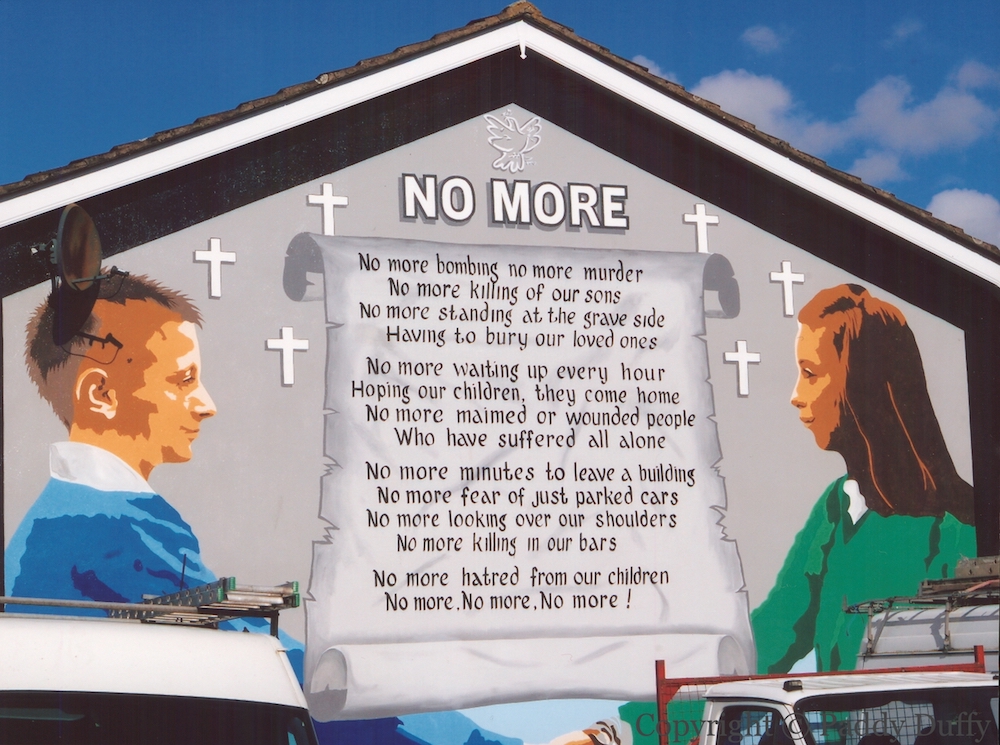
A boy in blue and girl in green, from opposite communities in east Belfast, shake hands against the backdrop of the Harland & Wolff cranes. The poem “No More” in the middle of the mural is by community worker Jim Wilson, whose grandson Dylan is shown on the left. A smaller version of this mural, without the poem, is in the CNR Short Strand’s Edgar Street – see No More.

“No more bombing, no more murder
No more killing of our sons
No more standing at the grave side
Having to bury our loved ones
No more waking up every hour
Hoping our children, they come home
No more maimed or wounded people
Who have suffered all alone
No more minutes to leave a building
No more fear of just parked cars
No more looking over our shoulders
No more killing in our bars
No more hatred from our children
No more. No more. No more!”

By Dee Craig in Kenilworth Place, PUL east Belfast

Click image to enlarge
Copyright © 2011/2012 Paddy Duffy
T00619

God, Give Us Men!

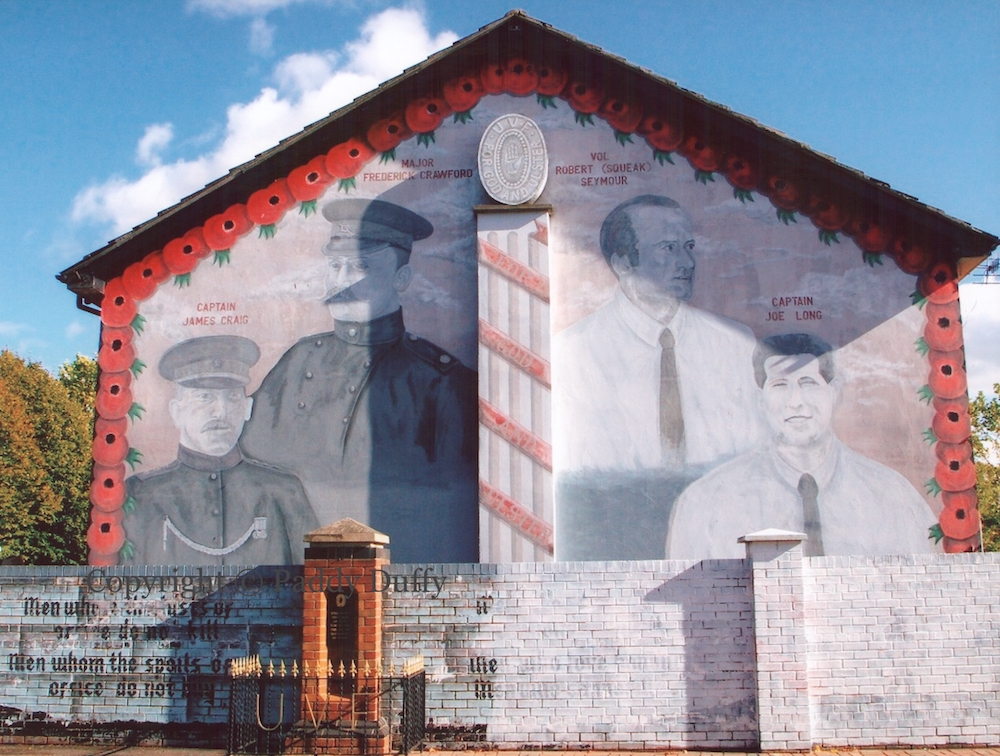
“Men whom the lusts of office do not kill/Men whom the spoils of office do not buy/Men who possess opinions and will/Men who love honour; men who cannot lie” – part of a poem by Josiah Gilbert Holland.

The men on the left of the mural are Captain James Craig (who fought in the Second Boer War before becoming a unionist leader, organiser of the the Ulster Volunteers, and first Prime Minister Of Northern Ireland) and Major Frederick Crawford, who fought in both Boer Wars and organised the Larne gunrunning.

The four others, listed both on the plaque in front of the mural and on the stone in the memorial garden (constructed in 2003) are UVF volunteers Robert Seymour, shot dead by the PIRA; James Cordner and Joseph Long, who were killed in a premature explosion, and Robert Bennett, killed by the British Army during a riot. (Seymour and Long are on the right of the mural.)

Fraser Pass, Ballymacarrett, east Belfast

Click image to enlarge
Copyright © 2011 Paddy Duffy
T00617

The United Kingdom

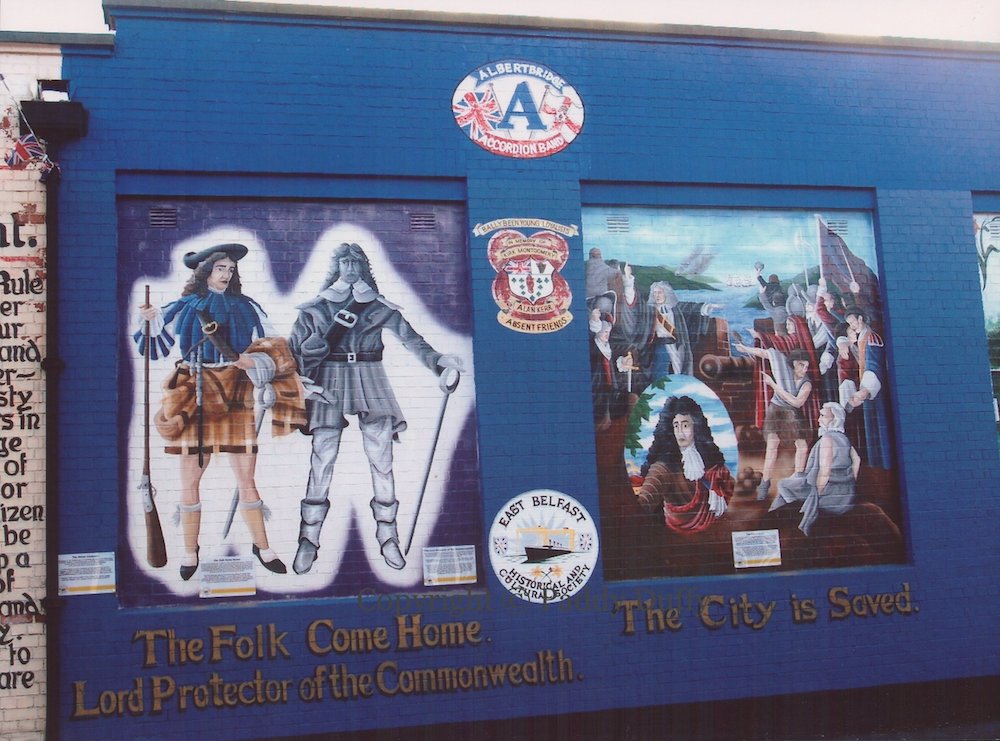
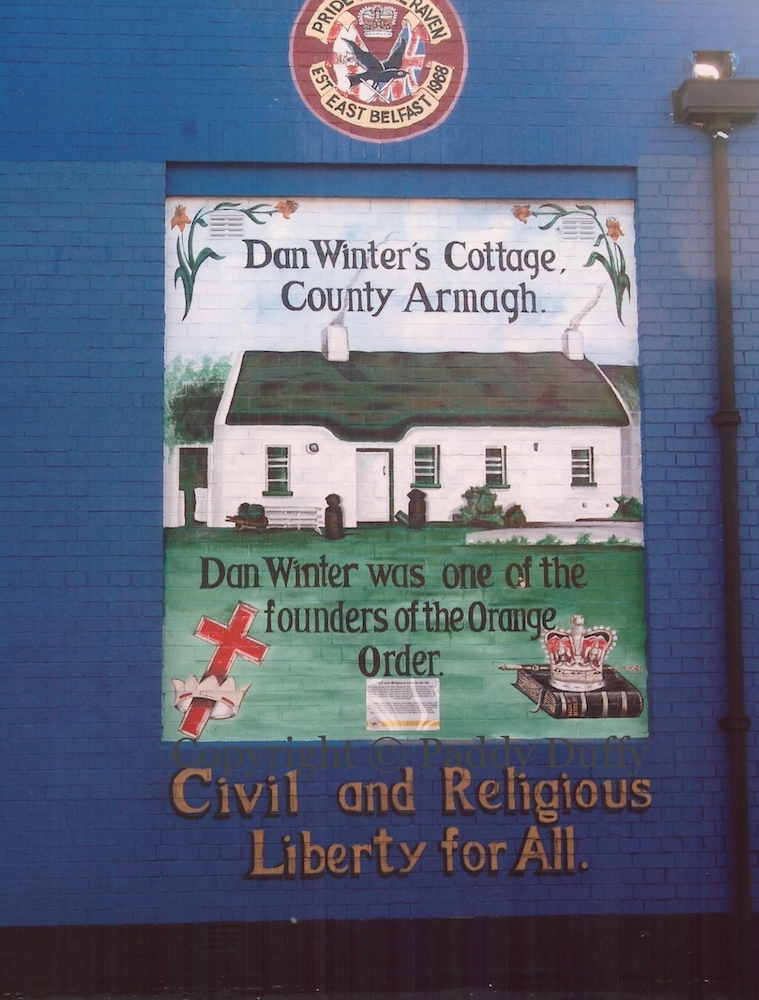
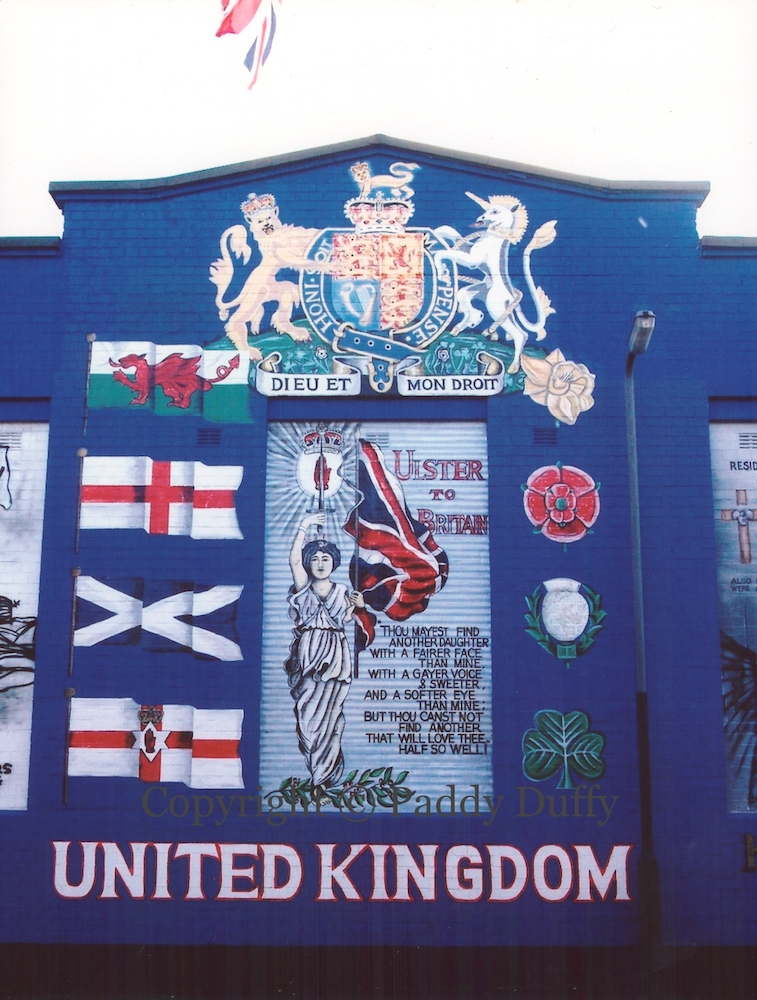
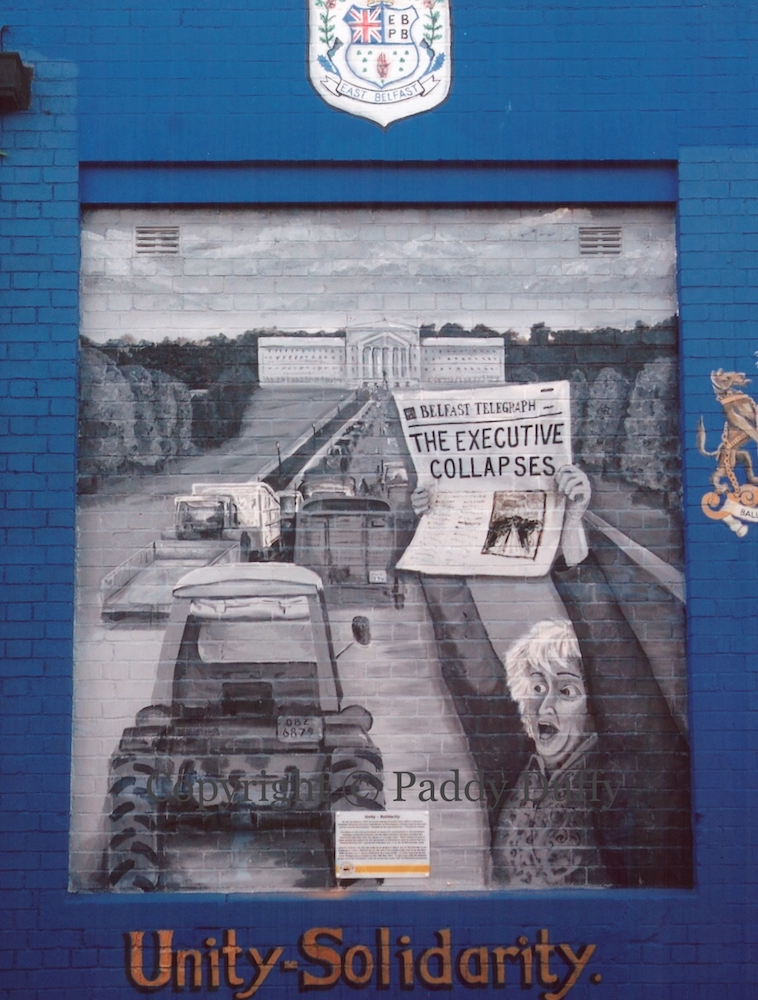
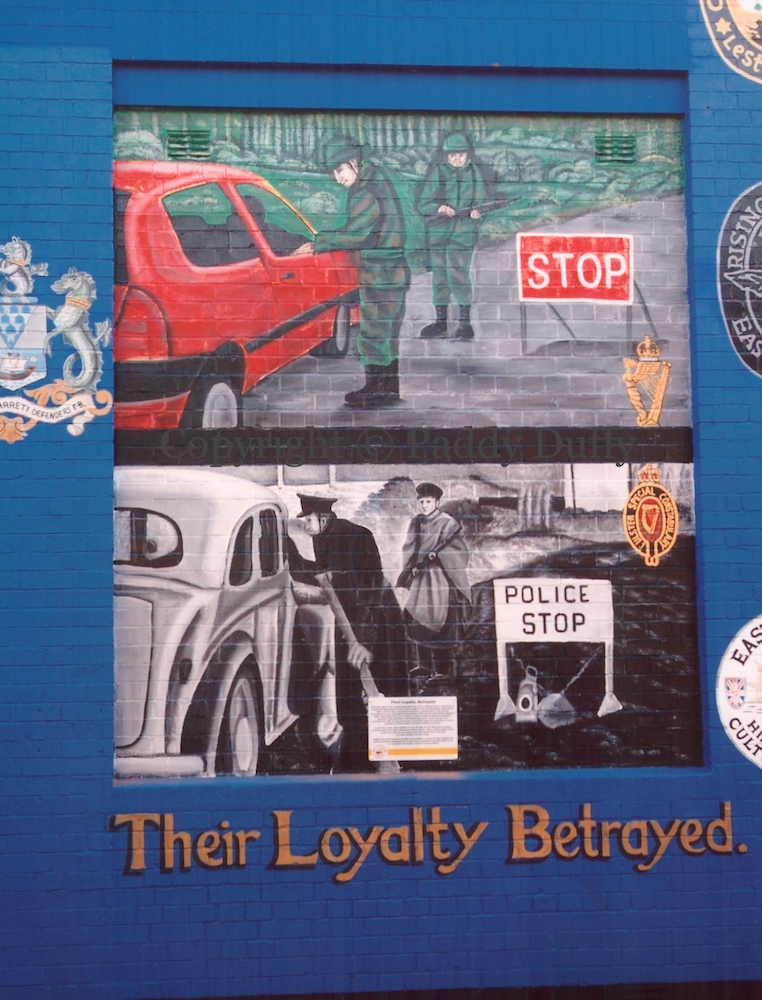
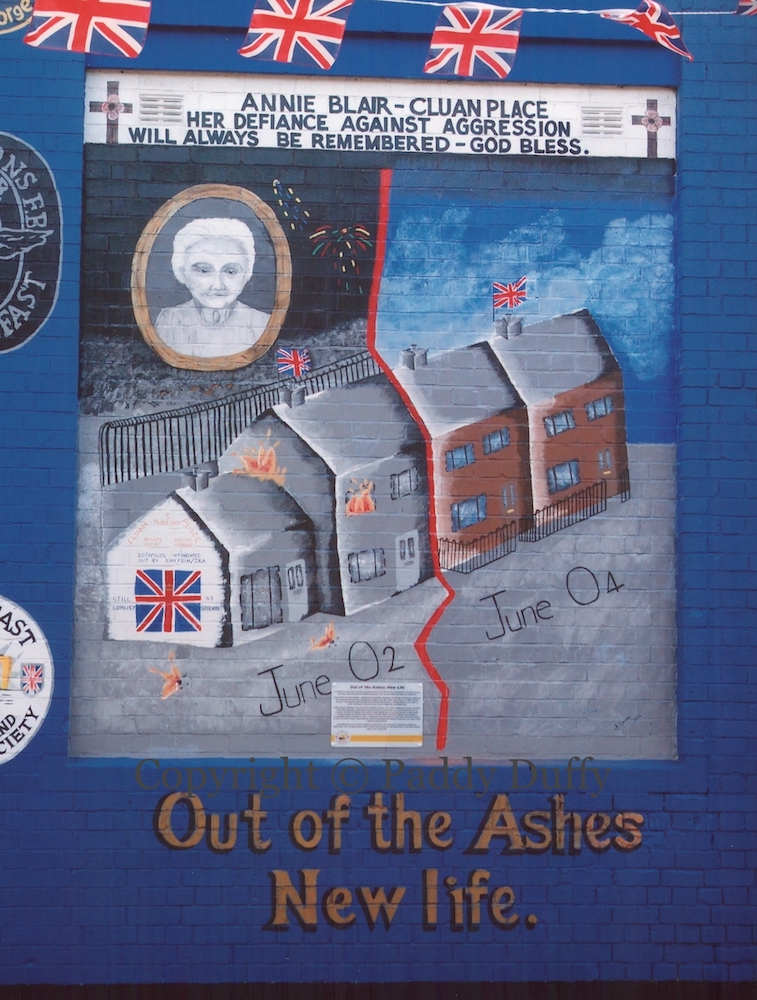
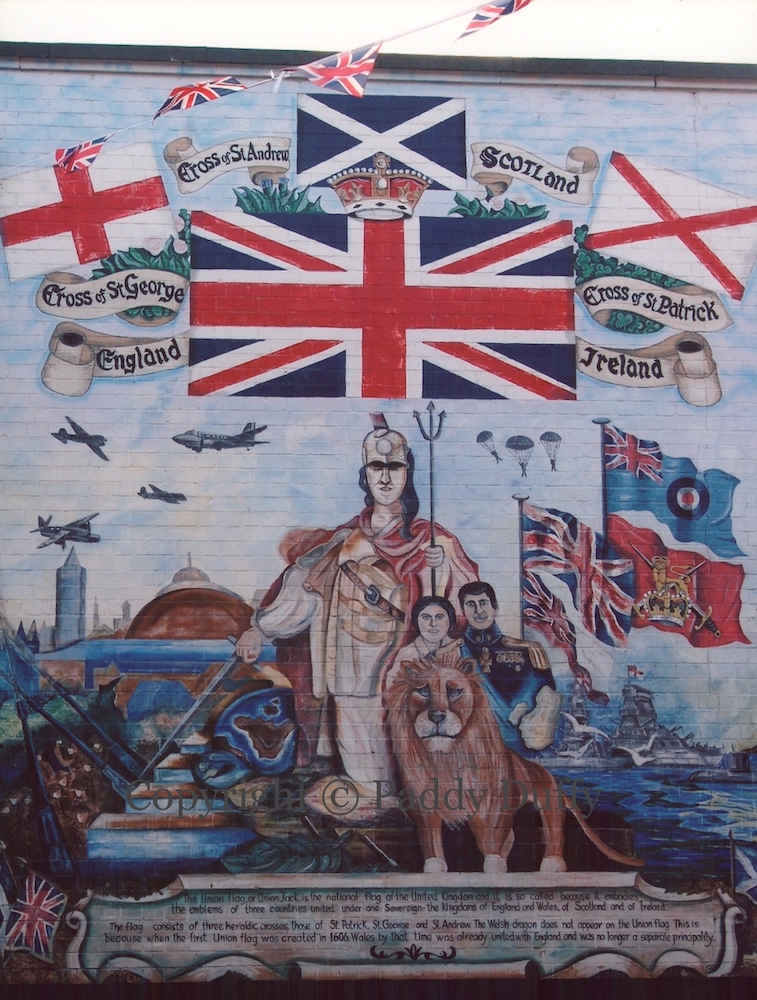
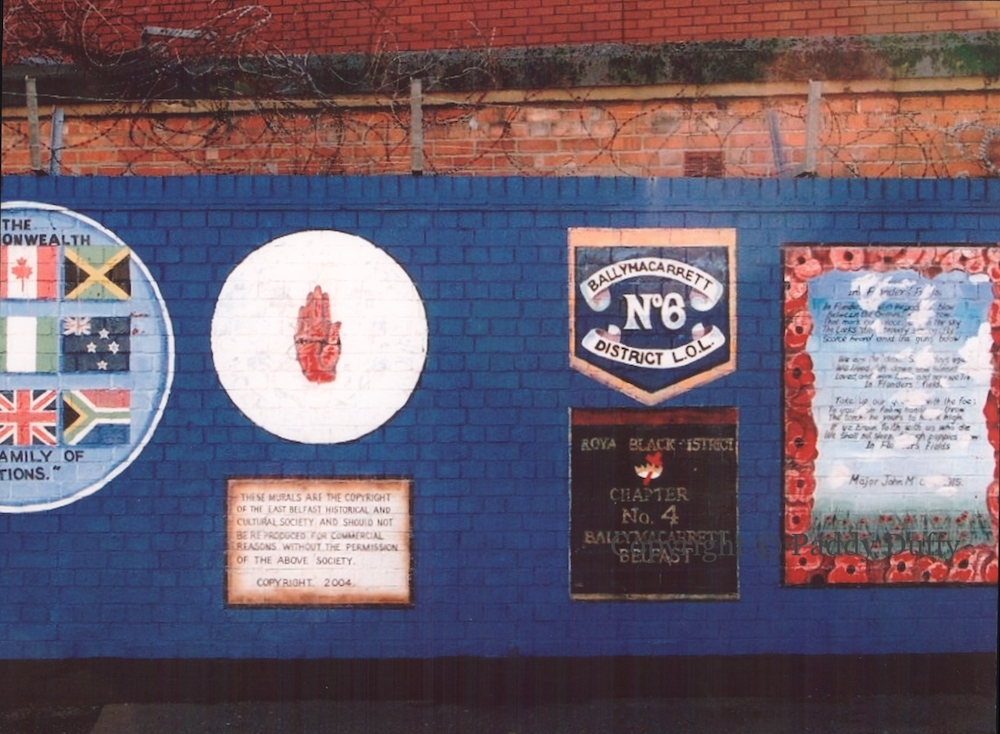
In 2004 the East Belfast Historical And Cultural Society sponsored a series of 14 murals in Thorndyke Street charting Protestant history from Cromwell to Cluan Place. From left to right, these are:

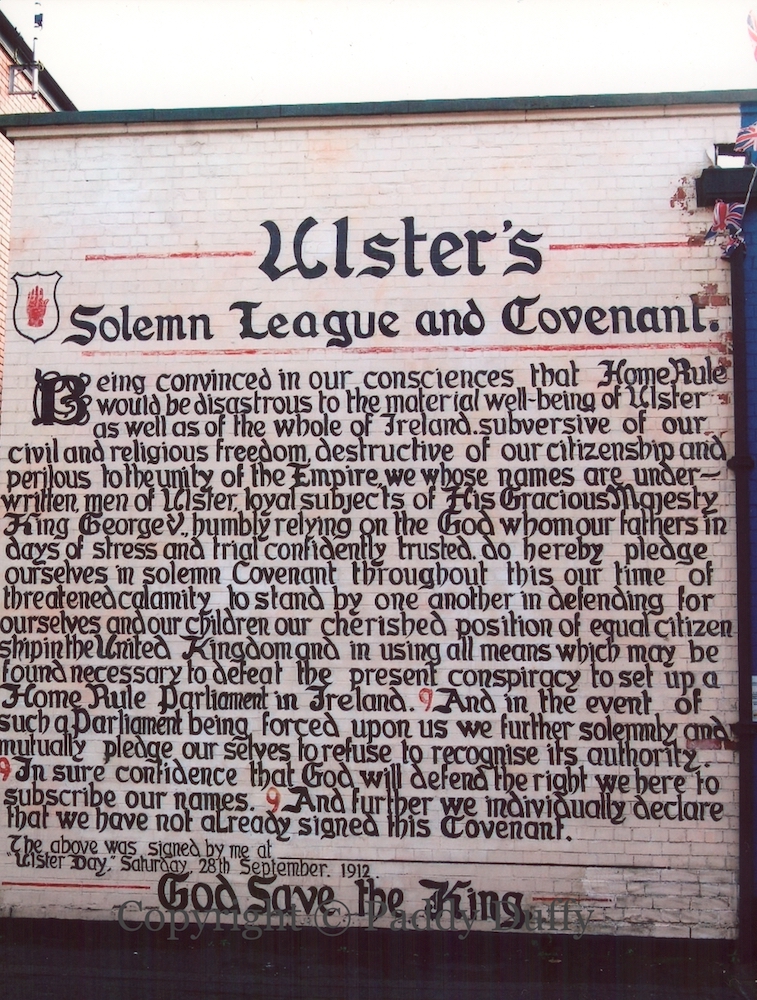
  • The Covenant
  • “The Folk Come Home. Lord Protector of the Commonwealth” (Cromwell)
  • “The City Is Saved” (Siege Of Derry)
  • “Civil And Religious Liberty For All.” “Dan Winter’s cottage, County Armagh. Dan Winter was one of the founders of the Orange Order”
  • “Better The Grave Than Slavery.” “How is freedom measured? By the effort which it costs to retain. Freedom!” (WW1)
  • “Their Sacrifice, Our Freedom.” “As we scrambled over the trench ladders, the YCV flag appeared. Jim Maultsaid” (WWI)
  • “United Kingdom”
  • “Hitler Attacks Belfast”
  • “Defending The Community” (Paramilitaries)
  • “Unity – Solidarity” (Sunningdale Agreement)
  • “Their Loyalty Betrayed” (UDR/B Specials)
  • “Out Of The Ashes, New Life.” “Annie Blair – Cluan Place. Her defiance against aggression will always be remembered – God bless”
  • Britannia. “The Union flag, or Union Jack, is the national flag of the United Kingdom and it is so called because it embodies the emblems of three countries united under one sovereign – the Kingdoms of England and Wales, of Scotland and of Ireland. The flag consists of three heraldic crosses, those of St Patrick, St George and St Andrew. The Welsh dragon does not appear on the Union flag. This is because when the first Union flag was created in 1606, Wales by that time was already united with England and was no longer a separate principality.”
  • Commonwealth/Sponsors

The murals were launched in 2004 and information panels were added in 2005.

Click image to enlarge
Copyright © 2012 Paddy Duffy
T00587 T00600 T00593 [T00604] T00594 T00589 [T00607]
T00588 [T00608]
T00596 [T00595] T00597 [T00606] T00598 T00599 [T00605] T00590 [T00603] T00591 [T00592] [T00602]
T00601

Understand The Past

“Understand the past – and build a better future le chéıle Catholic, Protestant and Dissenter.” “The past” in this case is the Battle Of St Matthew’s (“Chath Naomh Máıtıú”), one of the formative events of the Provisional IRA (“Óglaıgh Na hÉıreann”) (WP).

The “better future” is symbolised by the dove and the absence of a weapon in the arms of the central figures – compare to this Derry mural from 1985. The mural was unveiled as part of the commemorative events to mark the 40th anniversary of the Battle.

Mountpottinger Road, Short Strand, east Belfast

Click image to enlarge
Copyright © 2011 Paddy Duffy
T00575

Sean Martin

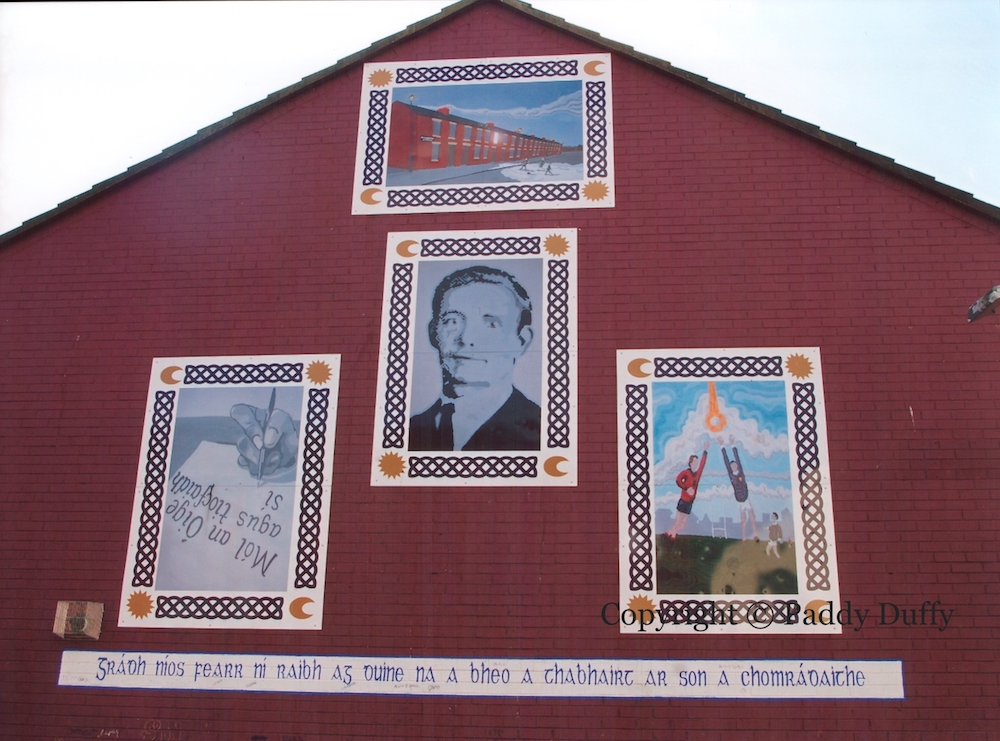
IRA Volunteer Sean Martin is at the centre of these panels in the Short Strand. The image in the apex of the house depicts his death in nearby Anderson Street (which no longer exists; roughly where Arran Street is).

milltowncemetery.com (link now dead) reports that Sean Martin “was killed in April 1940 during a lecture on arms and a Millis hand grenade in a small terrace house in Anderson Street. In the course of the lecture Sean, who was giving the instruction, had dismantled the grenade, and was putting it together again. The detonator which he was using was thought to have been a dud one. In demonstrating how to throw the grenade, he pulled out the pin and released the lever. Hearing the hissing sound of the fuse he realised that the detonator was live and that the grenade was about to explode. He rushed to the window with the intention of throwing it out on to the street, but some children were playing outside. In the few seconds left to him, Sean had to make that terrible choice; shouting to the others to get out of the house – he pulled the grenade into himself with his two hands and leaned over the kitchen table with the grenade covered by his whole body. The device exploded and blew him right across the kitchen, killing him instantly. All the others escaped uninjured.”

The Irish at the bottom reads “Grádh níos fearr ní raıbh ag duıne na a bheo a thabhaırt ar son a chomrádaıthe” – “A greater love no person has than to give his life for his comrades” (John 15:13)

Belfast Forum has some pictures of Anderson Street; according to the accompanying conversation, the Martins (might have) lived at no. 29. Sean Martin’s CLG/GAA club was named after Martin.

Beechfield Street, Short Strand, east Belfast

Click image to enlarge
Copyright © 2011 Paddy Duffy
T00574

Mickey Devine

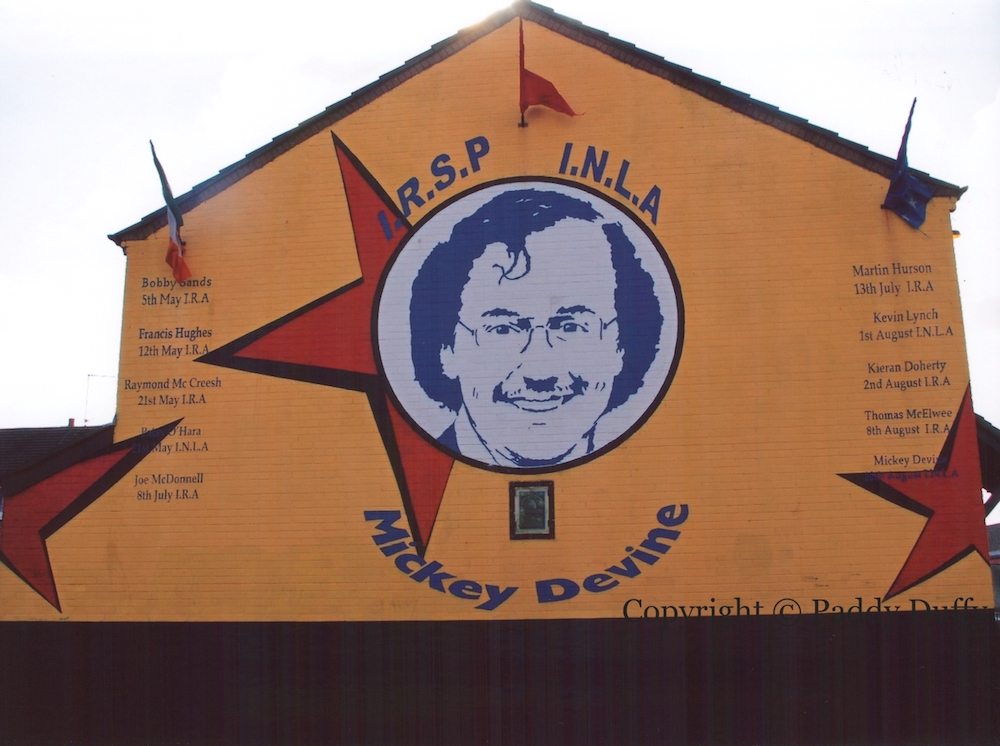
The mural is to Mickey Devine, with a smaller (and much older) plaque to Patsy O’Hara (the plaque was previously information about Devine). Both were INLA volunteers and both died in the 1981 hunger strike, along with Kevin Lynch; Liam McCloskey was taken off the strike by his family after 55 days.

For the Patsy O’Hara plaque, see the Peter Moloney Collection.

Chemical Street, Short Strand, east Belfast

Click image to enlarge
Copyright © 2011 Paddy Duffy
T00572

Place Of Pride

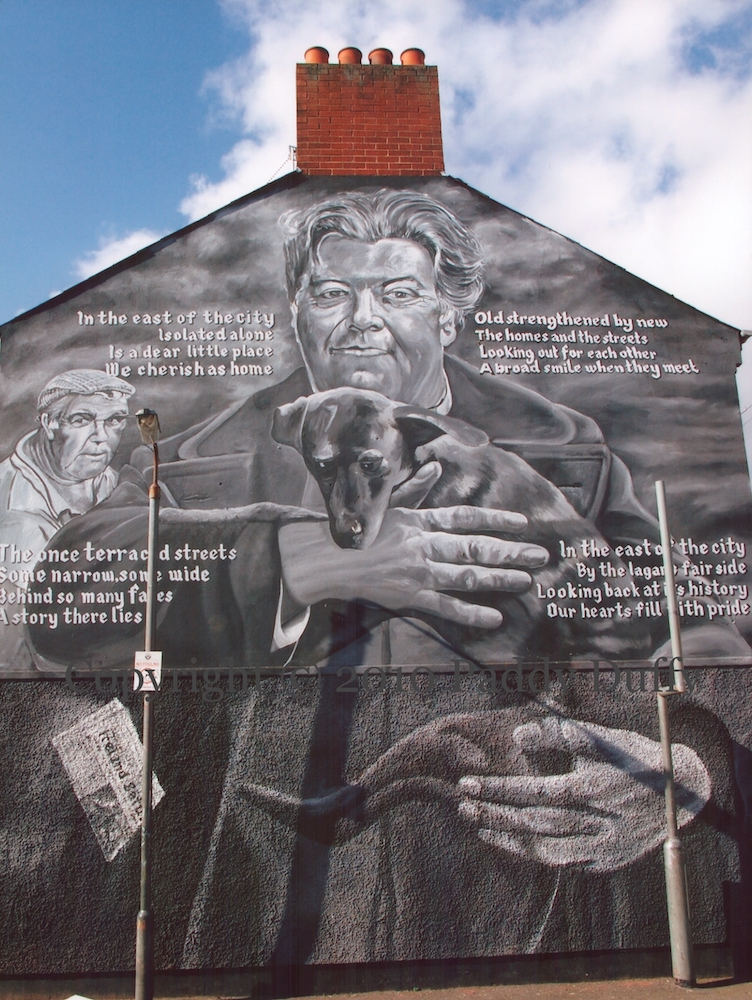
An owner, with Ireland’s Saturday Night (which ceased publication in 2008) tucked in his coat pocket, shows off his greyhound.

The words of the poem read,

“In the east of the city, isolated alone, is a dear little place we like to call home.

Old strengthened by new, the homes and the streets, looking out for each other, a broad smile when they meet

The once terraced streets, some narrow, some wide, behind so many faces a story there lies

In the east of the city by the Lagan’s fair side, looking back at its history our hearts fill with pride.”

Edgar Street, Short Strand, east Belfast

Click image to enlarge
Copyright © 2010 Paddy Duffy
T00529 [T00573]