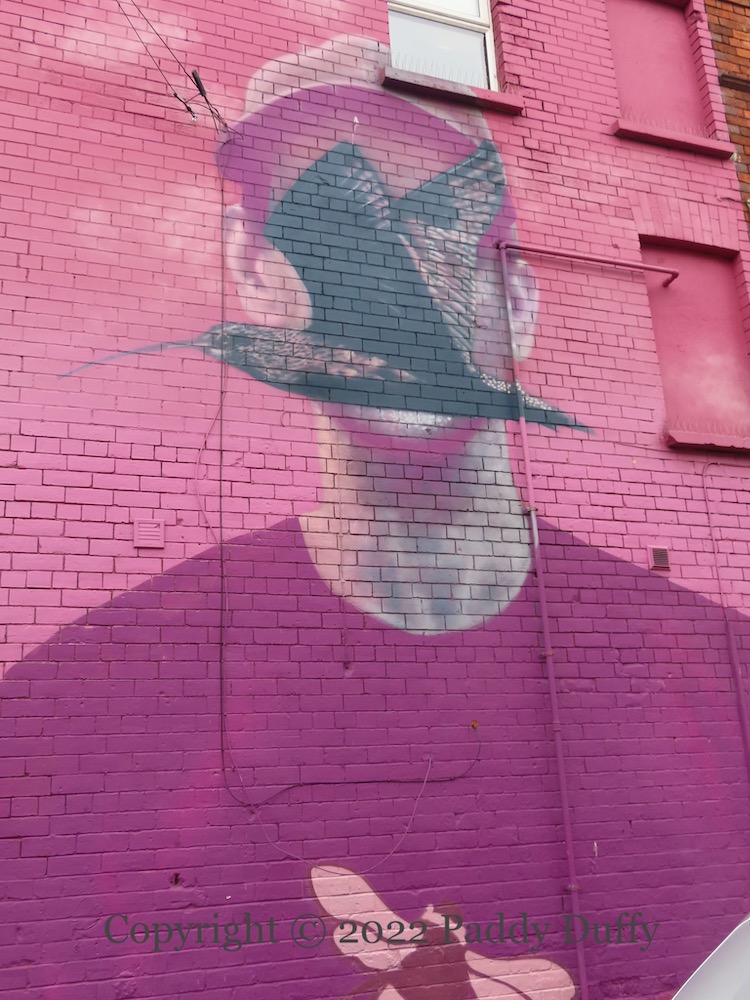
Magritte’s Man In A Bowler Hat is updated for the modern era as part of a 2021 campaign by UK Youth 4 Nature (web).
By emic (ig) in Farnham Street, Belfast.
Click image to enlarge
Copyright © 2022 Paddy Duffy
T01489
Magritte’s Man In A Bowler Hat is updated for the modern era as part of a 2021 campaign by UK Youth 4 Nature (web).
By emic (ig) in Farnham Street, Belfast.
Click image to enlarge
Copyright © 2022 Paddy Duffy
T01489
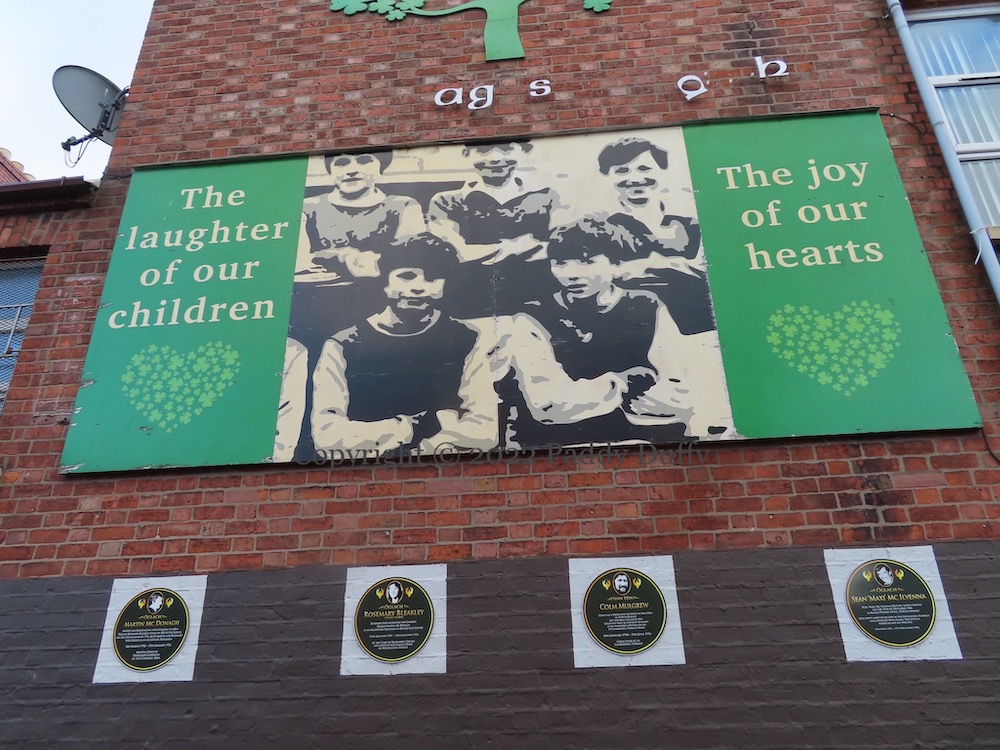
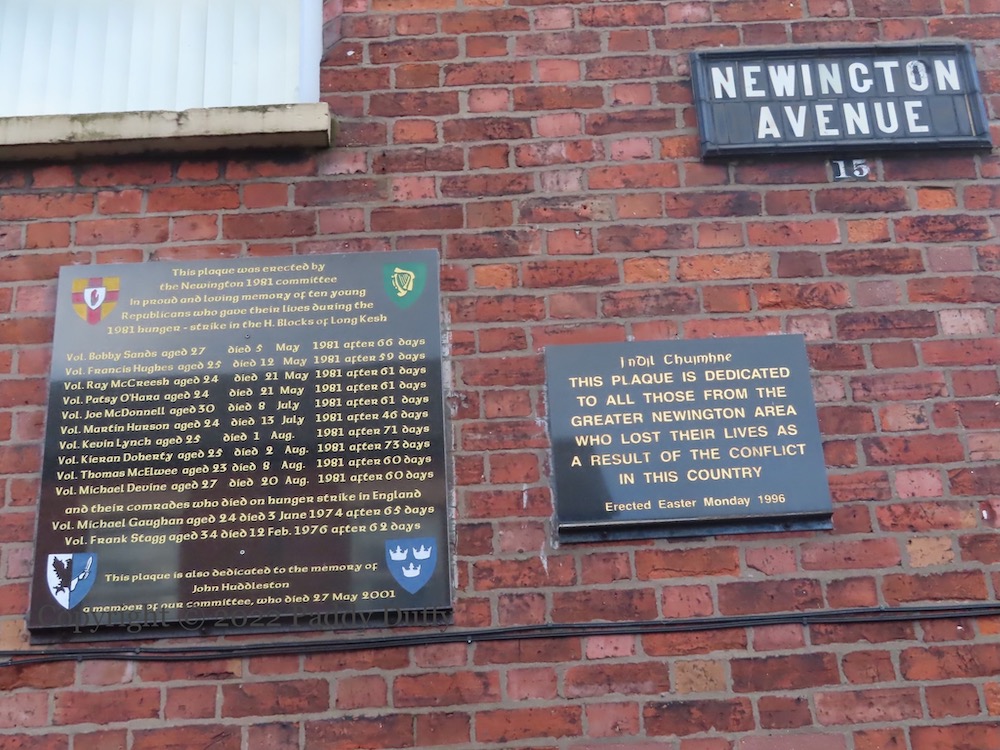
The Newington tribute to Bobby Sands and the other deceased hunger strikers of the 1970s and 80s (see previously: Mol An Óıge Agus Tıocfaıdh Sí) has been augmented with four plaques to republicans from the area who died in the Troubles: (l-r) Martin McDonagh, Rosemary Bleakley, Colm Mulgrew, and Sean ‘Maxi’ McIvenna.
Unbeknowst to her parents (Lost Lives), Bleakley had joined Cumann Na mBan at 18 and was four days short of her nineteenth birthday when she and McDonagh were killed in a premature bomb explosion in the North Street arcade (Victor Patterson image of the blast), along with civilians Ian Gallagher and Mary Dornan (Sutton); 20 others were injured (Fortnight). Bleakley was not buried in the republican plot (in Milltown) but coincidentally in the plot adjacent to Dornan (BBC).
Bleakley was portrayed in the old New Lodge Volunteers mural.
Newington Avenue, north Belfast
Click image to enlarge
Copyright © 2022 Paddy Duffy
T01458 T01459
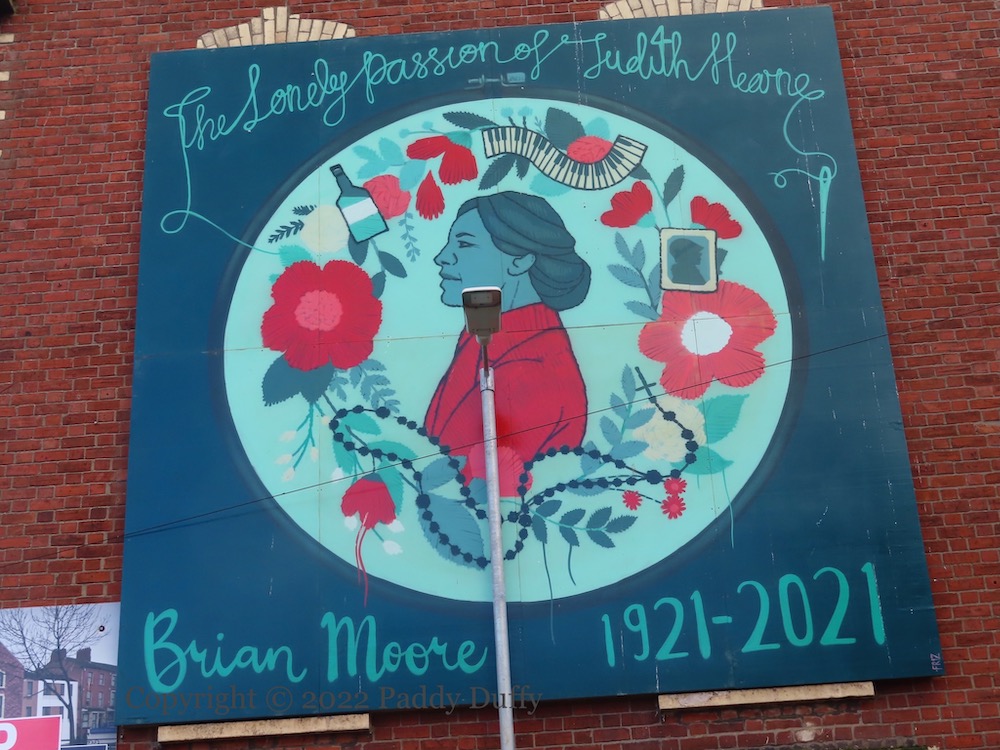
Novelist Brian Moore grew up on the Antrim Road and went to St Malachy’s, before emigrating to Canada in 1948. For the centenary of his birth in 1921, Paradosso Theatre adapted Moore’s best-known novel, (The Lonely Passion Of) Judith Hearne, for the stage and mounted this board in Duncairn Avenue, showing the elements of Judith’s life: the bottle, the beads, the aunt who raised her, the piano used for lessons, and her red coat.
The board by Friz (ig) replaces the anti-joy-riding mural “Where’s The Joy?”, the last to go of the three, the others having been in CNR west Belfast and PUL west Belfast.
Click image to enlarge
Copyright © 2022 Paddy Duffy
T01456 [T01457]

The (colour) RNU phoenix and the Craigavon 2 “Free The Innocent” tarp have been joined by a Cogús fist grasping a strand of barbed wire – Cogús (Fb) is (was?) the prisoners’ welfare arm of the RNU.
Northumberland Street, west Belfast
Click image to enlarge
Copyright © 2022 Paddy Duffy
T01455
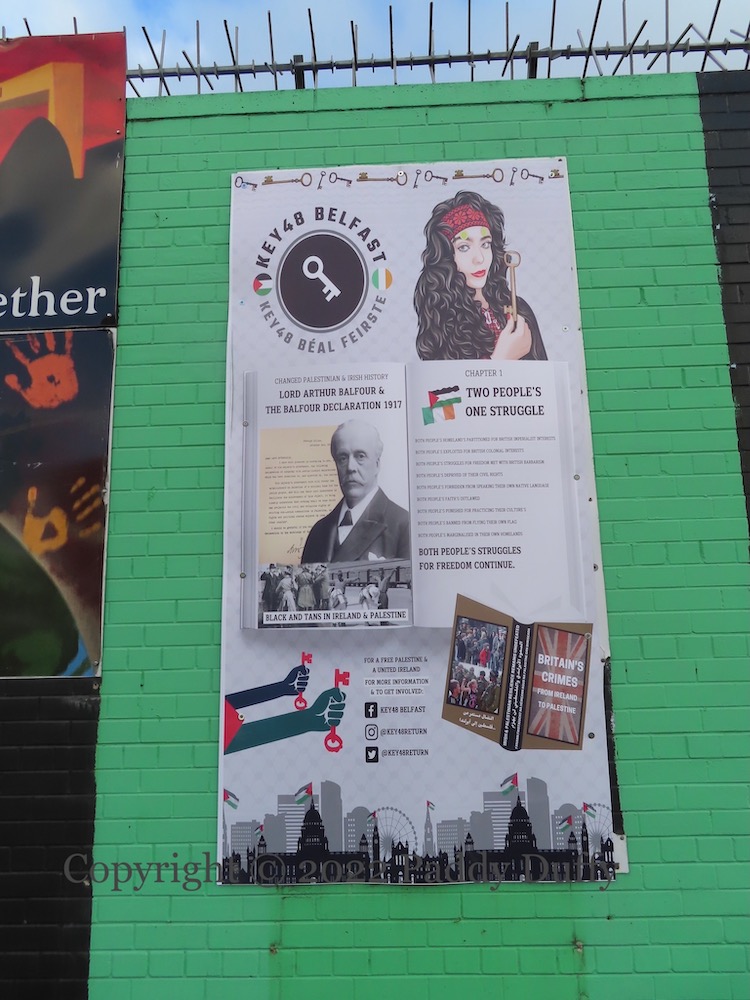
“Britain in Palestine & Ireland” The Balfour Declaration of November 1917 is seen as a pivotal moment in the history leading to the what is formally known as the State Of Israel, as it made the UK the first major government to endorse the idea of a homeland for Jews (WP).
This board on Northumberland Street draws parallels between Ireland and Palestine: homelands partitioned for British imperialist interests, struggles for freedom met with British barbarism … forbidden from speaking their native tongue, faiths outlawed … . About 650 former RIC members were recruited to the “British Gendarmarie” that would police what was called “Mandatory Palestine” (Palestine Studies | Irish History) after WWI.
The League Of Nations mandate putting the UK in change of the Palestinian territory was replaced (in 1947) by a UN plan for partition, which triggered an internal war between Jews and Arabs, and when the UK ended the mandate and evacuated from Palestine in May 1948, Israel declared independence and neighbouring Arab states entered the conflict. About 700,000 Arabs were displaced during the fighting. Key48 (tw) advocates for the right of return and uses as a symbol the keys that householders took with them when they fled.
Click image to enlarge
Copyright © 2022 Paddy Duffy
T01454
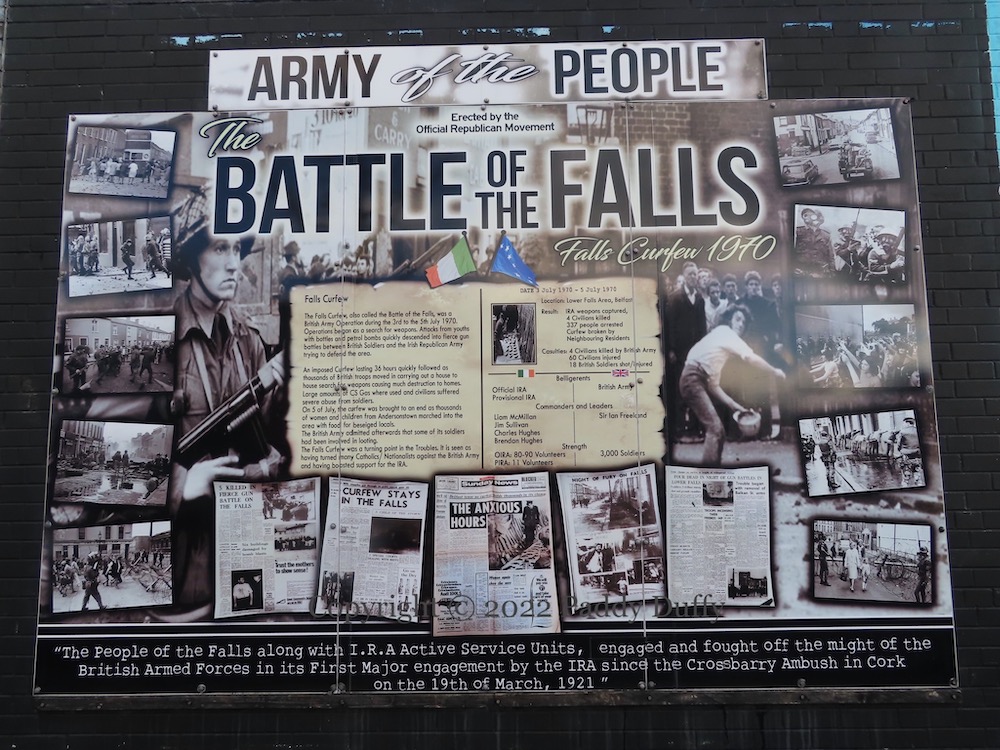
Four people were killed in the course of The Falls Curfew, the 36 hours from July 3rd to 5th in 1970 during which 3,000 houses on the lower Falls were cordoned off after a weapons search of the area devolved into a riot. The curfew ended with a march of women and children from Andersonstown bearing relief (represented in Falls Curfew 1970).
The information in the centre of the board includes an augmented version of the Wikipedia infobox on the event. Erected in the spot previously reserved by “the Official Republican Movement”.
Click image to enlarge
Copyright © 2022 Paddy Duffy
T01453

“In proud and loving memory of all local volunteers, prisoners of war, republican activists and the unsung heroes who died of natural causes having served the cause of Irish republicanism [“sean óglach” on the individual plaques]. Together in unity you formed a bond which gave true meaning to the undefeated risen people. Your deeds of bravery and resistance will never be forgotten by the people of greater St. James’s. In your honour the quest for Irish freedom continues.” With the famous “our steps will be onward” quote from Máıre Drumm at an anti-internment rally in Dunville Park on 10th August, 1975 (RN). Coıste Cuımhneacháın Lár Na bhFál/Ard Na bhFeá [Memorial committee of mid-Falls/Beechmount]. For some more of the plaques, see The Unsung Heroes.
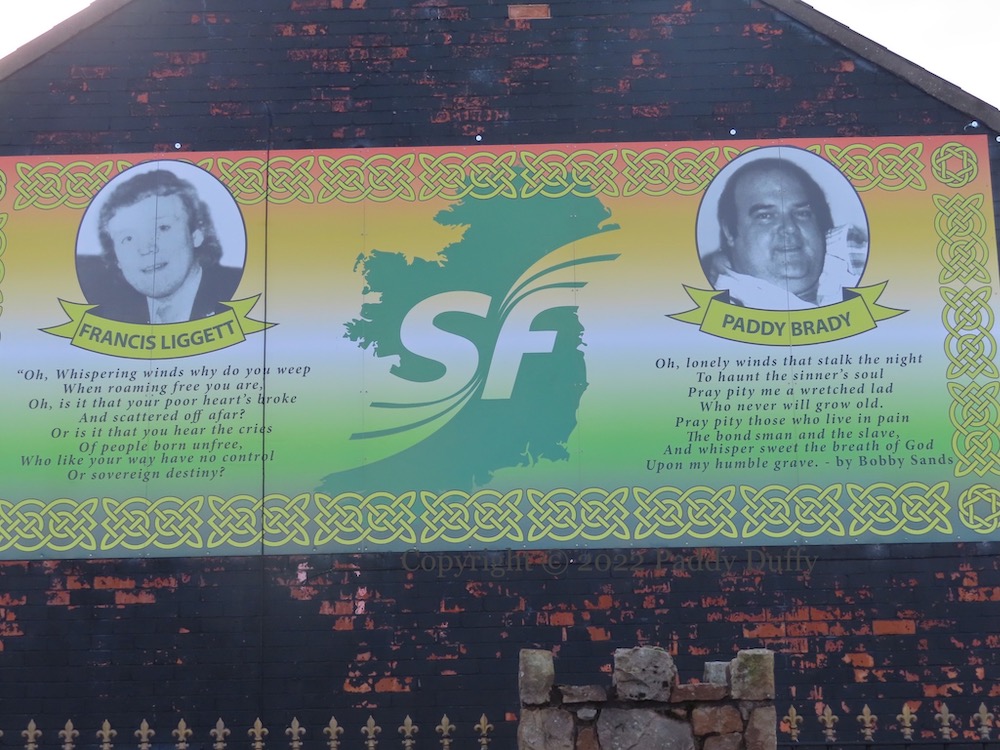
The board on the gable to the side shows Francis Liggett and Paddy Brady. IRA volunteer Francis Liggett was shot dead by the British Army during an attempted armed robbery at Royal Victoria Hospital, Falls Road in 1973 (Sutton) while local Sınn Féın member Paddy Brady was shot by the UFF while at work in 1984 (Sutton | An Phoblacht). They are commemorated in the St James memorial garden with the board shown above, featuring two verses from Bobby Sands’s poem Weeping Winds: Oh, Whispering [Whistling, in the original] winds why do you weep/When roaming free you are,
Oh! Is it that your poor heart’s broke/And scattered off afar?
Or is it that you bear the cries/Of people born unfree,
Who like your way have no control/Or sovereign destiny?
Oh! Lonely winds that stalk [walk] the night/To haunt the sinner’s soul/
Pray pity me a wretched lad/Who never will grow old.
Pray pity those who lie in pain/The bondsman and the slave
And whisper sweet the breath of God/Upon my humble grave.
The board is similar in design to the painted one it replaces, except that Éıre was at the centre rather than the “SF” logo.

Click image to enlarge
Copyright © 2022 Paddy Duffy
T01344 T01345 [T01346] T01347
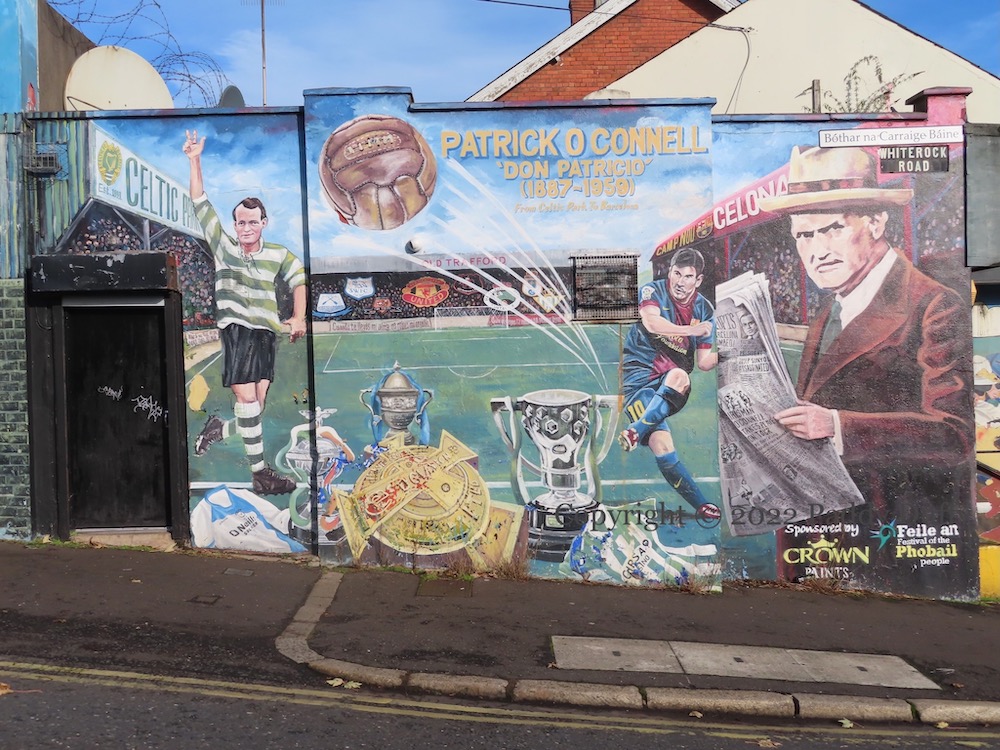
As a player, the Dublin-born Patrick O’Connell started with Belfast Celtic before moving on to various English and Scottish clubs, including a period at Manchester United at the time of WWI. He then went on to manage a string of Spanish clubs. As manager (“Don Patricio”) of Barcelona during the Spanish civil war, he accompanied the club on their tour of Mexico and the United States. The money from the tour saved the club from bankruptcy but 12 of the 16 players went into exile in Mexico and France. (WP) Barcelona returns to the US this month (2015-07) for games against the LA Galaxy, Manchester United, and Chelsea. (FCBarcelona)
The newspaper in the mural above crams all of this news onto one page: “Civil war erupts in Spain – Barcelona bombed”, “Football suspended – President [of FC Barcelona] Josep Sunyol assassinated” [by Franco’s troops] (WP); “Irishman O’Connell takes players on tour – FC Barcelona saved from extinction”; “Funds lodged in Switzerland”. In the bottom left-hand corner of the newspaper is Robert Capa’s famous photograph of ‘The Falling Soldier’, purporting to show a Republican soldier at the very moment he is struck by a bullet and dies. The image is now thought to have been staged (WP).
The image on which the mural is based can be seen in this Irish Times article on O’Connell.
The player on the right is Lionel Messi. The Argentinian forward is shown in front of the Spanish League cup, which Barcelona won in the year the mural was painted (2014-2015) with a goal from “La Pulga” (“the flea”) – Messi is 5’7″ but four-time world player of the year.
The stands of three football stadiums are shown in the background: Belfast Celtic’s Celtic Park (“Paradise”), Manchester United’s Old Trafford, and Barcelona’s Camp Nou. The Old Trafford stands bear the emblems of the teams Patrick O’Connell played for and managed: Liffey Wanderers (whose shirt is also featured, on the left), Sheffield Wednesday, Hull City (The Tigers), Manchester United, Dumbarton, Real Racing Club de Santander, Real Oviedo, and Real Betis Balompié (also shirt on the right).
Whiterock Road, Belfast
Click image to enlarge
Copyright © 2022 Paddy Duffy
T01343
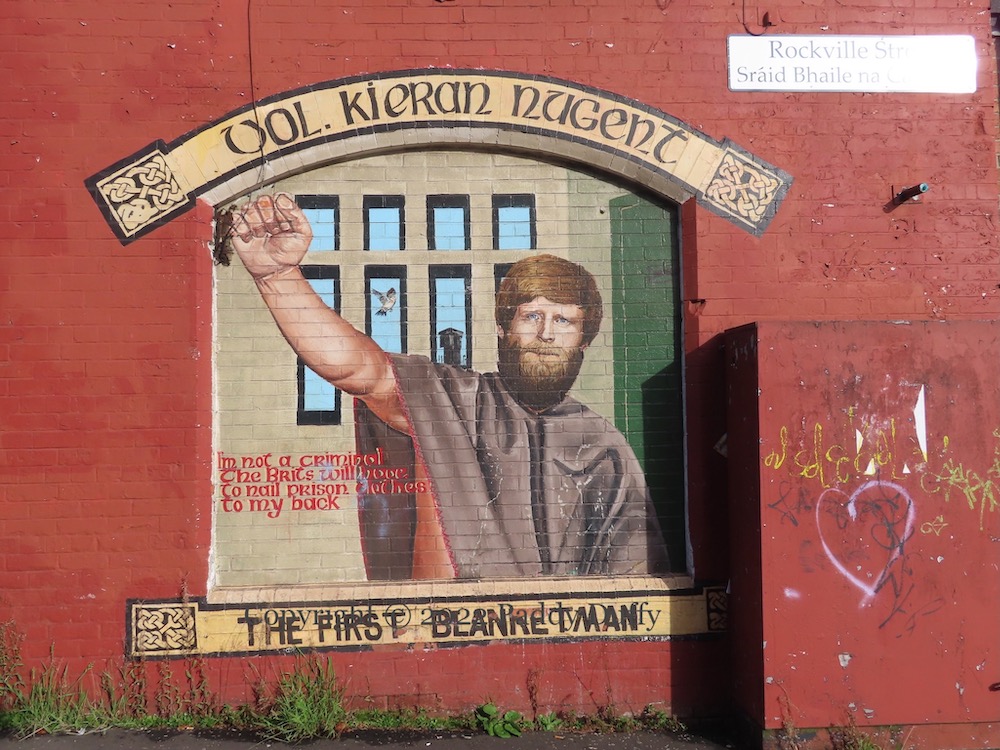
“The first blanketman”. IRA prisoner Kieran Nugent is reputed to have said – upon being imprisoned after the removal of Special Category status in 1976 – “I’m not a criminal – the Brits will have to nail prison clothes to my back.”
Rockville Street, west Belfast
Click image to enlarge
Copyright © 2022 Paddy Duffy
T01341 [T01342]
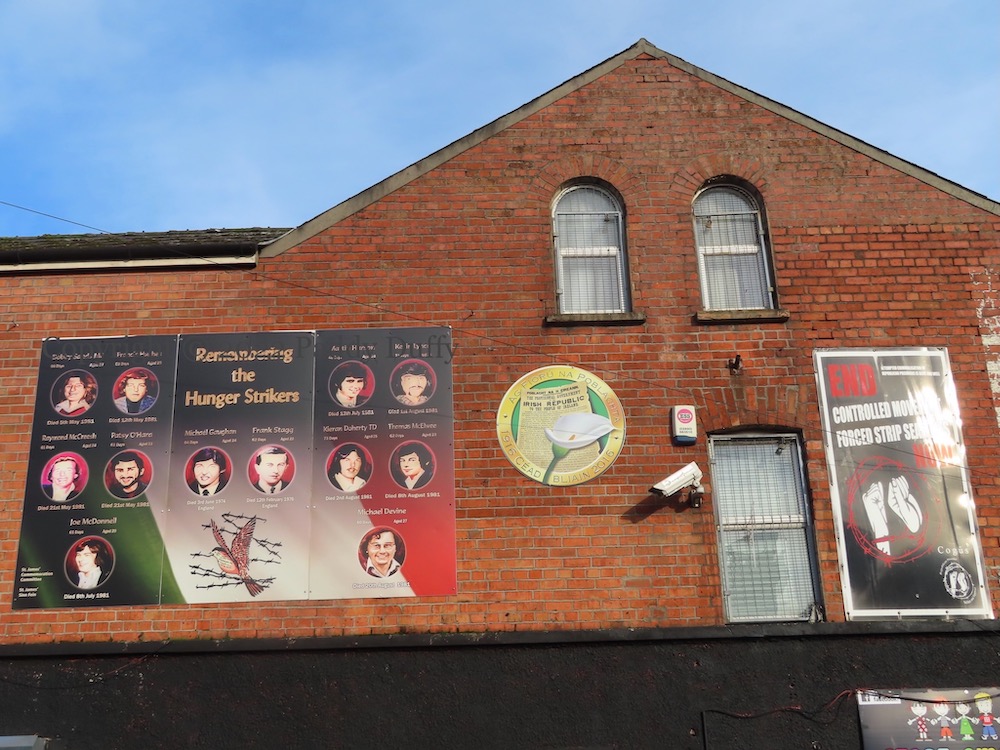
The six weeks from July 8th to August 20th 1981 saw the death of six hunger strikers – McDonnell, Hurson, Lynch, Doherty, McElwee, and Devine – adding to the four who began in March and died in May. All ten, along with Michael Gaughan and Frank Stagg from 1974 and 1976, are remembered in this recent board in Rockmore Road.
To the left is a 1916 centenary board “Ag fíorú na poblachta”/“Realising the republic” – also seen in South Link and in Rockmount Street.
On the far left is a board from Republican Network For Unity (RNU)’s Cogús committee in support of “Attempted criminalisation of republican prisoners is alive and well”, “Republican prisoner welfare and support”: “End controlled movement, forced strip searches. now.”
Click image to enlarge
Copyright © 2022 Paddy Duffy
T01340 [T01338] [T01339]
 Paddy Duffy Collection