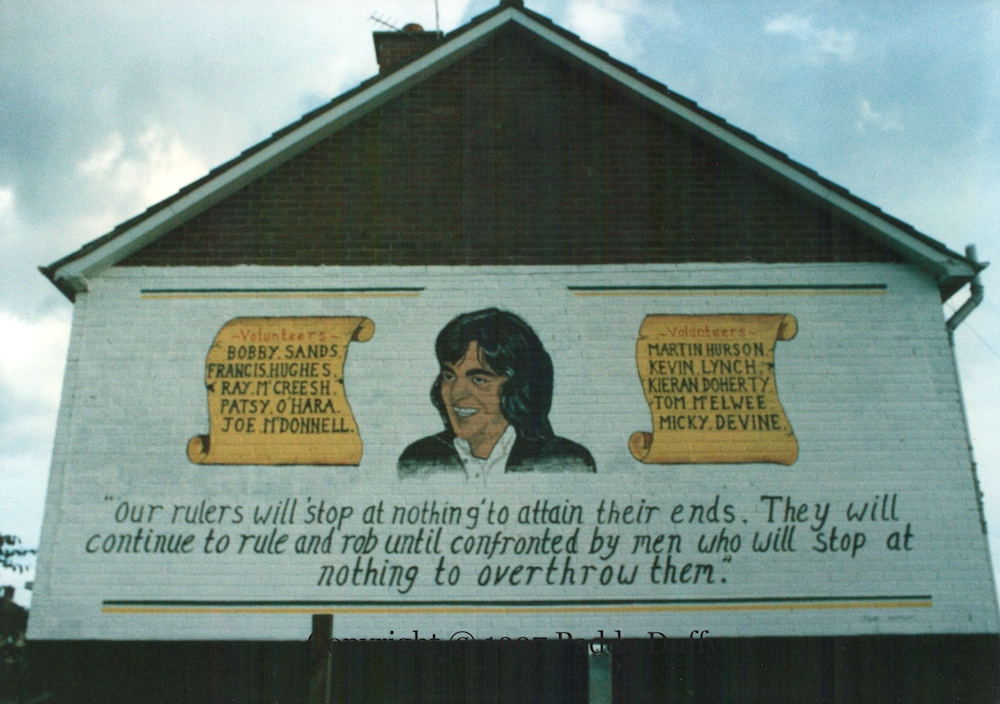
“Our rulers will stop at nothing to attain their ends. They will continue to rule and rob until confronted by men who will stop at nothing to overthrow them.” The quote is from James Connolly on Conscription. Local volunteer Joe McDonnell is portrayed between the names of the ten deceased 1981 hunger strikers.
“Old Labour 1969 – new Labour 1997 – nothing has changed!” Members of the Orange Order march with a large Union Flag on the backs of the RUC (with an Orange accent on their helmets) who are holding back the protesting local Catholic residents – particularly of the Garvaghy Road in Portadown and the Ormeau Road in Belfast.
The party in power (of the UK government) was the Labour party under Harold Wilson; in the general election of May 1st, 1997, Tony Blair’s Labour party regained power from the Conservatives. The mural hopes to pressure Labour into taking definitive action on the issue of parading – see (e.g.) Approved Parade Route, No Consent, No Parade and Not All Traditions Deserve Respect.
An Gorta Mór is the Great Famine, or the Great Hunger among those who point out that there was plenty of food in Ireland in the late 1840s, just not made available to peasants. Of a population around eight million, a million people died and a million more emigrated.
“They buried us without shroud or coffin” is a line from an unrelated Seamus Heaney poem Requiem For The Croppies.
A Robert Emmet mural was painted by Robbie Kane in 1953 (for the 150th anniversary of the 1803 rebellion and his execution) in Crumlin Street. This was one of a very few CNR murals painted prior to the Troubles, and nationalist symbols were formerly outlawed in the Flags And Emblems Act of 1954. (See Visual History 02.)
The original (which can be seen at Laochra Uladh) was accompanied by a Christian cross and the words “Hail Christ our king”. This 1997 version reproduces only the two medallions, showing a Celtic harp (left) and a dramatic portrait of Emmet waving his hat, from the mid-1800s (WP/LoC).
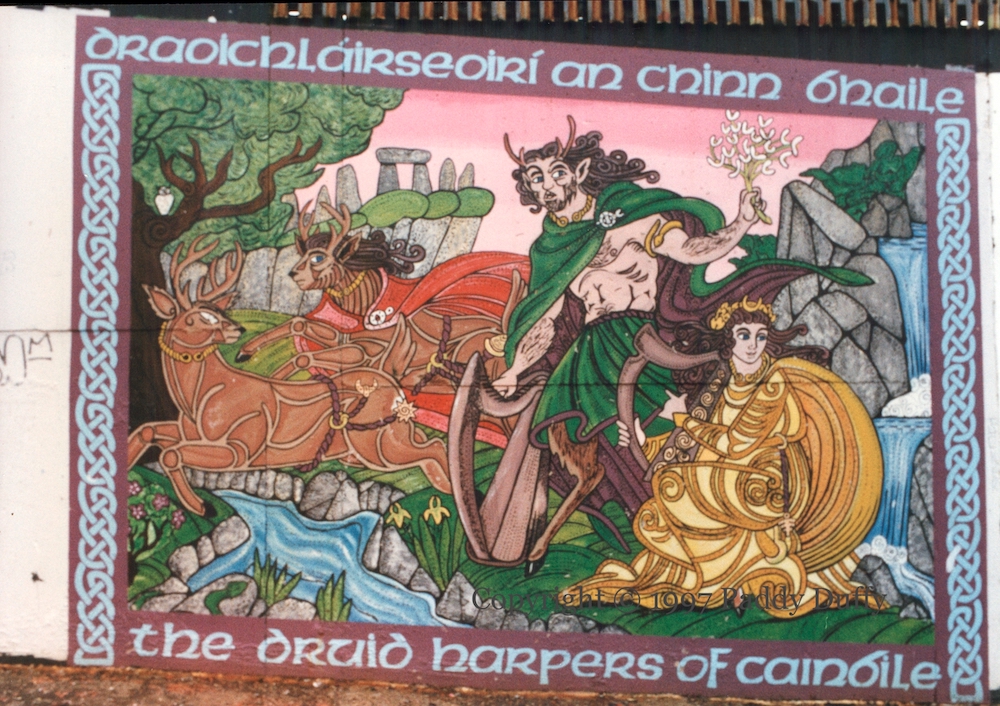
In Táın Bó Cúaılnge, the “sweet-mouth harpers of Caın Bıle” are also “druids, men of great cunning and great power of augury and magic.” They come to Medb and Aılıll to entertain them, carrying mistletoe by which they sing, but are mistaken as Ulster spies; the harpers turn themselves into deer to escape their pursuers, near the Lıa Mór (Great Stone) (Death Of Lethan).
This image of an RUC officer aiming a plastic-bullet gun is the central panel of a mural at the top of Springhill Avenue that would otherwise go unfinished.
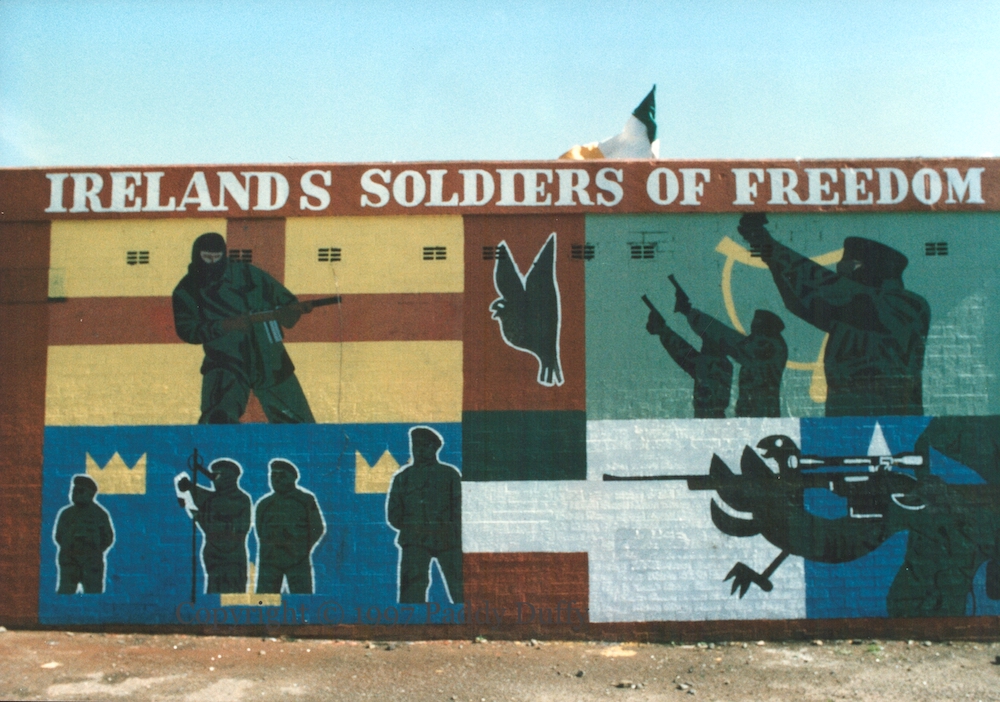
IRA volunteers are superimposed upon the flags of the four provinces. In the top left (Ulster) and bottom right (Connacht) they are aiming weapons (one with a sniper’s scope), while in the top right (Leinster) they are firing a funeral volley, and in the bottom left (Munster) are reading a statement at a microphone; in the middle are a lark and a Tricolour.
South Link, Andersonstown, west Belfast, replacing the even-more-heavily armed volunteers in Beıdh Ár Lá Lınn.
These two murals are side-by-side in Blythe Street.
On the left, a particularly violent rejection of the peace-process: “they arose in the dark days to defend our native land for God and Ulster”, “And when the Lord thy God shall deliver them before thee, though shalt smite them and utterly destroy them, thou shalt make no covenant with them nor show mercy unto them – Deuteronomy 7 verse 2”.
On the right, a UVF roll of honour: “In memory of fallen comrades. Lest we forget. John Hanna, Billy Millar, Noel Little, Bunter Davidson, Billy Stewart, Davy McNaught, Sammy Mehaffy, Dicky Richardson [later removed], Geordie Norris [later added]. Their duty demanding, their courage outstanding. Here lies a soldier, murdered by the enemies of Ulster.”
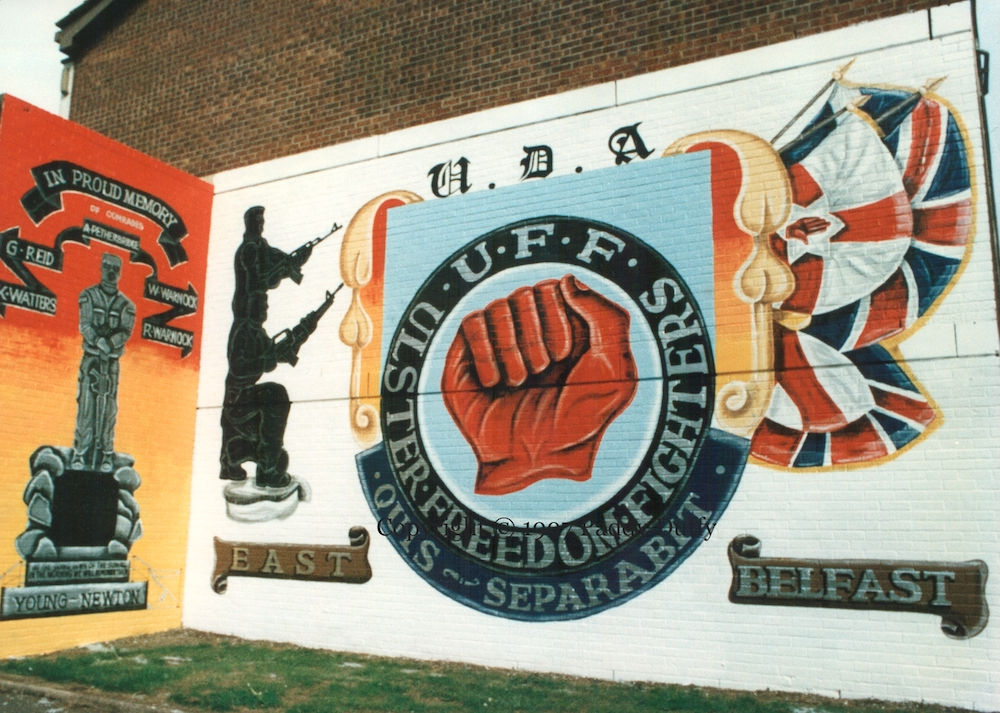
“In proud memory of comrades A. Petherbridge, G. Reid, K. Watters, W. Warnock, R. Warnock. [In memory of our fallen comrades. We forget them not. Terrae filius. East Belfast brigade UDA-UFF.] At the going down of the sun and in the morning we will remember them. Young Newton.” “UDA East Belfast. Ulster Freedom Fighters. Quis separabit.”
The fine condition of the murals suggests that the missing wording (on the plinth) has yet to be added. A very low wall to the right of frame reads “Formed to fight for the right to remain in the United Kingdom.”
All five of the named volunteers died in the early 1970s: Petherbridge 1973-02-07, Reid 1974-02-26, Watters 1974-02-17, W Warnock 1972-10-16, and R Warnock 1972-09-13. Young Newton was an east Belfast “tartan” gang (History Ireland) and then part of the UYM (WP).
According to the “SS RUC” officer on the left, the “approved Orange route” is over the bodies of Catholic residents. The 1996 parade on the Ormeau Road went ahead over the public protests and legal action of local residents (Irish Times). The 1997 parade was called off (youtube).
“June 20” (on the right of the mural) is the date that Mo Mowlam is reported to have decided to force the Drumcree march down Garvaghy Road – see Beware! Mowlam became (Labour) Secretary for Northern Ireland in May, 1997. She is represented here in the guise of Lady Justice, washing her hands of the parades issue in a bowl held by the newly-formed Parades Commission.