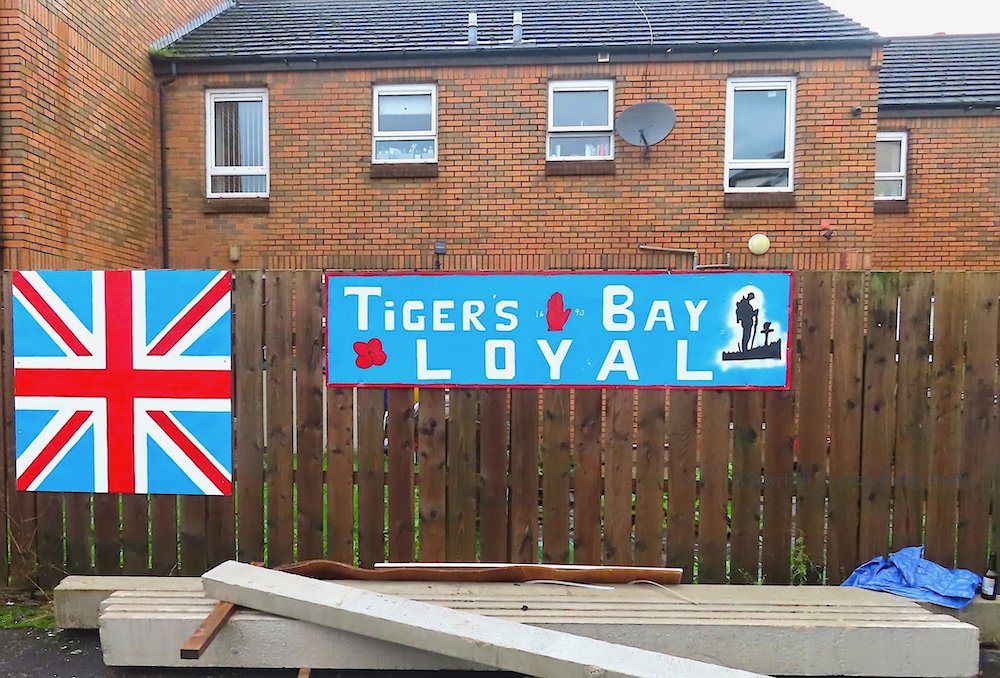
This pair of hand-painted (and stencilled) boards is next to the Mount Inn on North Queen Street. Tiger’s Bay is loyal to the memory of “1690” and the service of the 36th Division in WWI in 1916.
Greenmount Street, Tiger’s Bay, north Belfast
On the other side of the Mount, at the bottom of the old Lewis Street, are two more hand-painted boards from 2024 – see Friends Of The Somme.
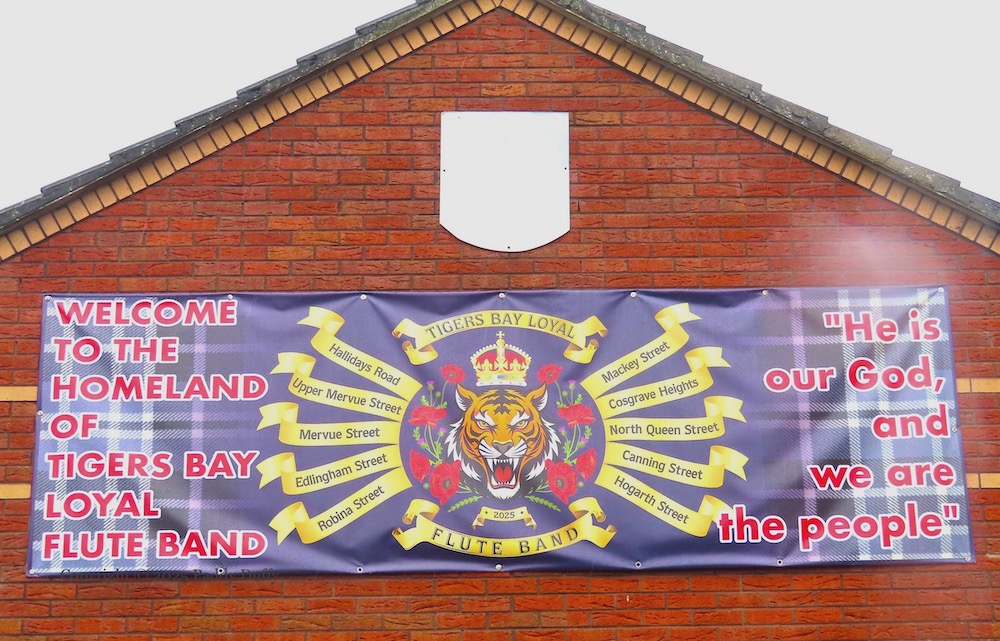
“Welcome to the homeland of Tiger’s Bay Loyal flute band. “He is our God, and we are the people.”” Tiger’s Bay Loyal [Fb] is a new flute band, formed in 2025.
Ten local streets are named around the central tiger: Robina Street, Edlingham Street, Mervue Street, Upper Mervue Street, Hallidays Road, Mackey Street, Cosgrave Heights, North Queen Street, Canning Street, Hogarth Street.
In case the large medallion celebrating Queen Elizabeth’s platinum jubilee (in 2022) was not a sufficient indicator, a small “Loyalist” has been added above the street-sign. In the last century, Glenrosa Street in Tiger’s Bay used to continue across Duncairn Gardens into the New Lodge as Glenrosa Street South.
At the other end of the street is a warning sign next to the bonfire site: “All taigs will be shot – TBH #1. If this boney goes, so does NLR [New Lodge Road]”
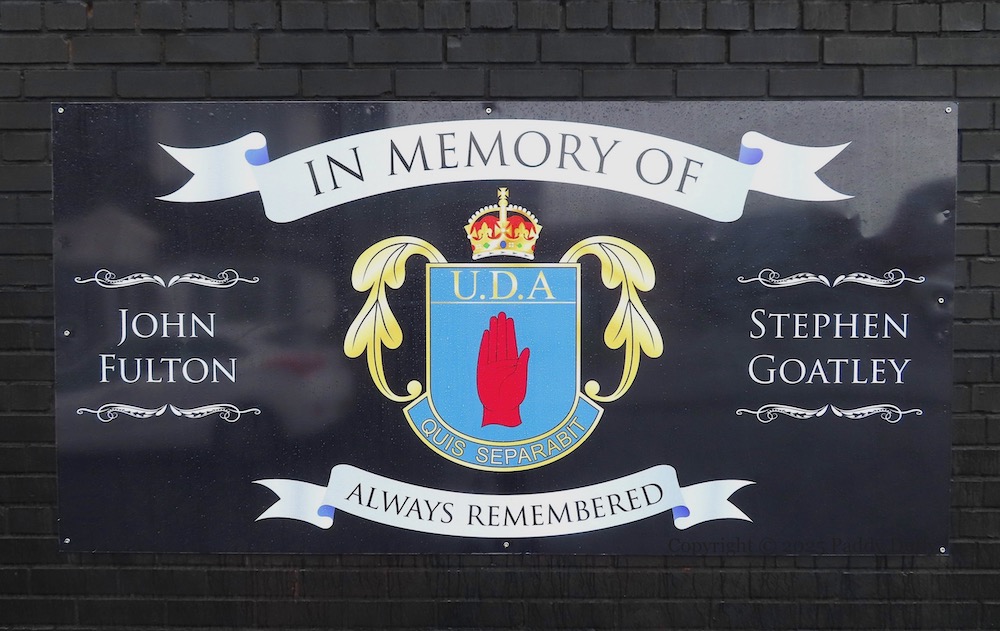
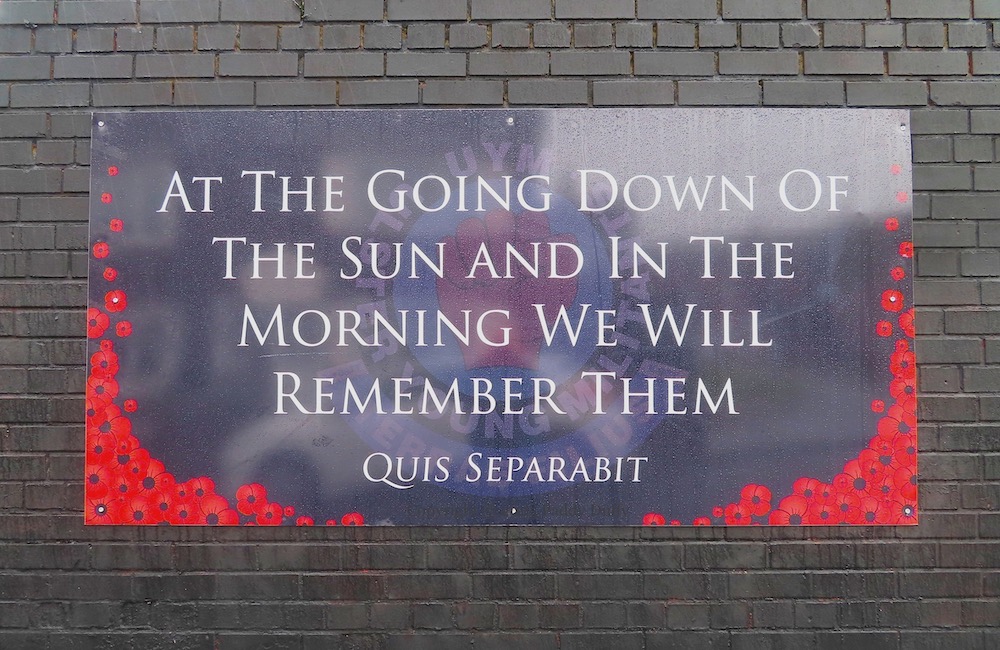
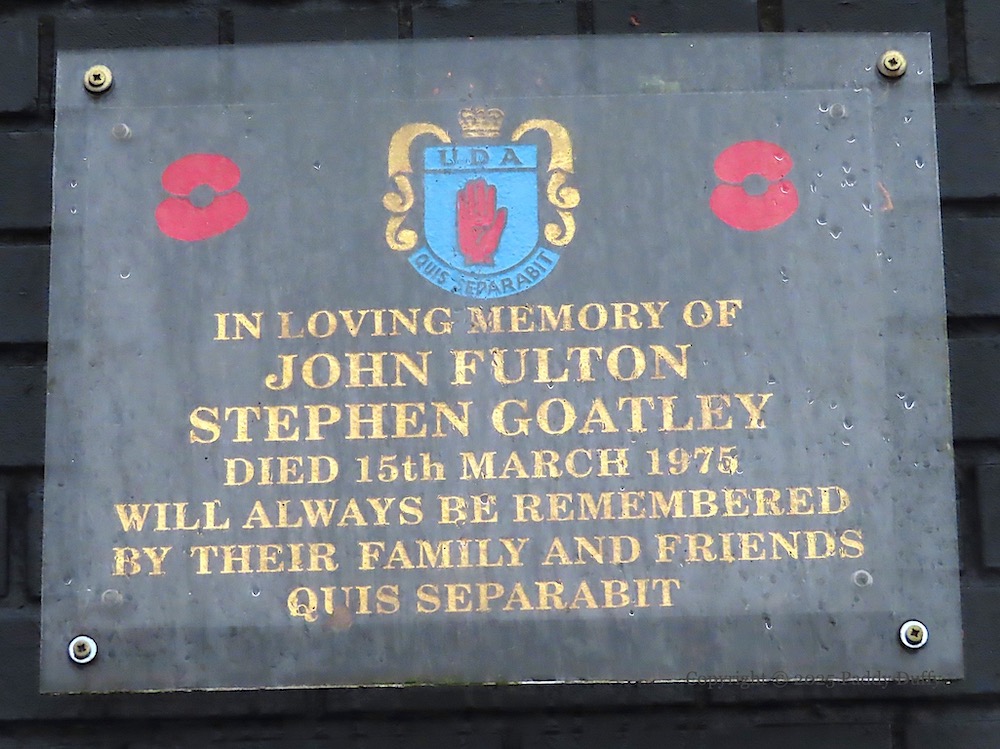
“In loving memory of John Fulton [and] Stephen Goatley, died 15th March 1975. Will always be remembered by their family and friends. Quis separabit.” UDA members John Fulton and were Stephen Goatley were killed together in the Alexandra Bar on York Road (close to the Mervue Street location of this memorial) in revenge for the stabbing of the UVF’s Joe Shaw in the North Star Bar, by the UVF as part of the UDA-UVF feud in 1975.
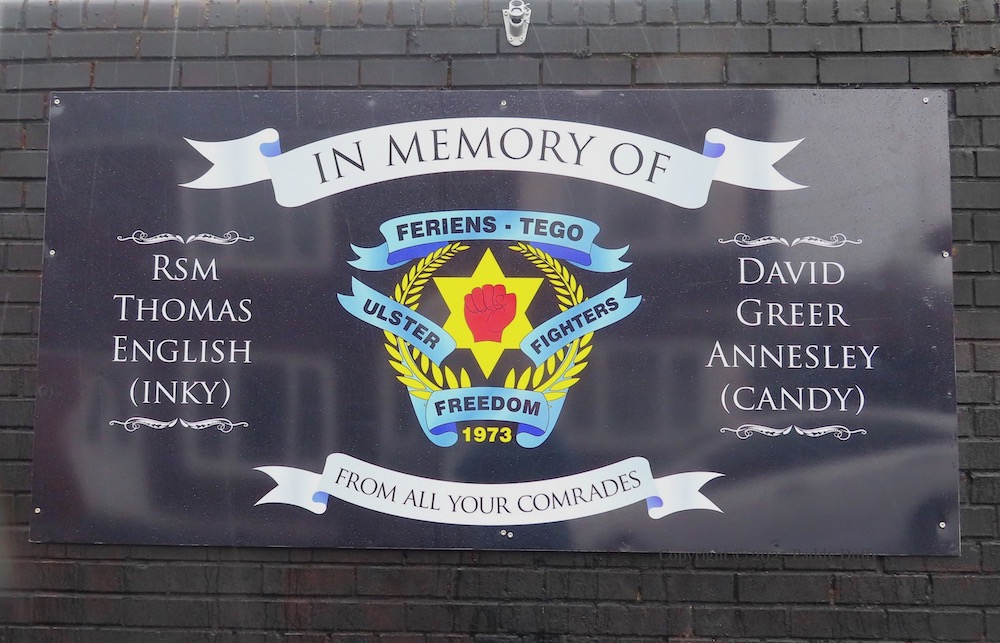
The two men named on the other board were also killed in a feud between the UDA and UVF, in 2000 – see Inky & Candy. “In loving memory Thomas (Inky) English & David (Candy) Greer Annesley. Together in the same old way/would be our dearest wish today./Silent memories true and tender/just to show we still remember.”
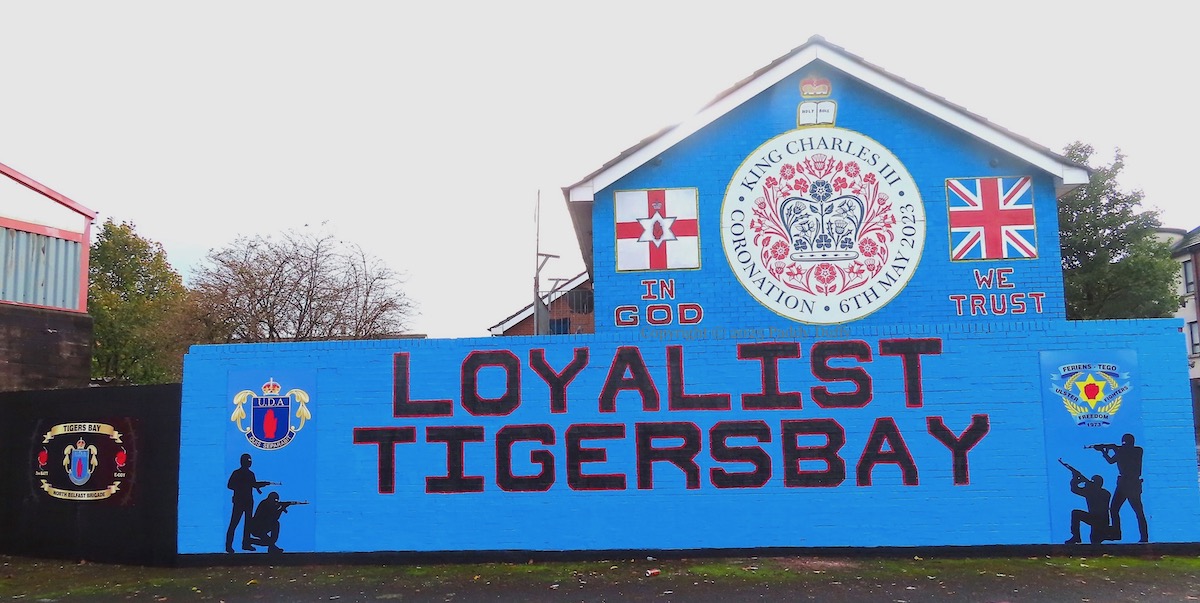
Stop The Boats has been painted out below the large “Loyalist Tiger’s Bay” and the entire wall painted in solid blue and book-ended by UDA and UFF boards showing silhouetted gunmen in active poses.
The side-wall, home to painted Orange Order symbols since 2017, has been painted black and a board (above) added to E company from Tiger’s Bay. (It’s possible “North Belfast brigade” and “3rd battalion” are the same thing.)
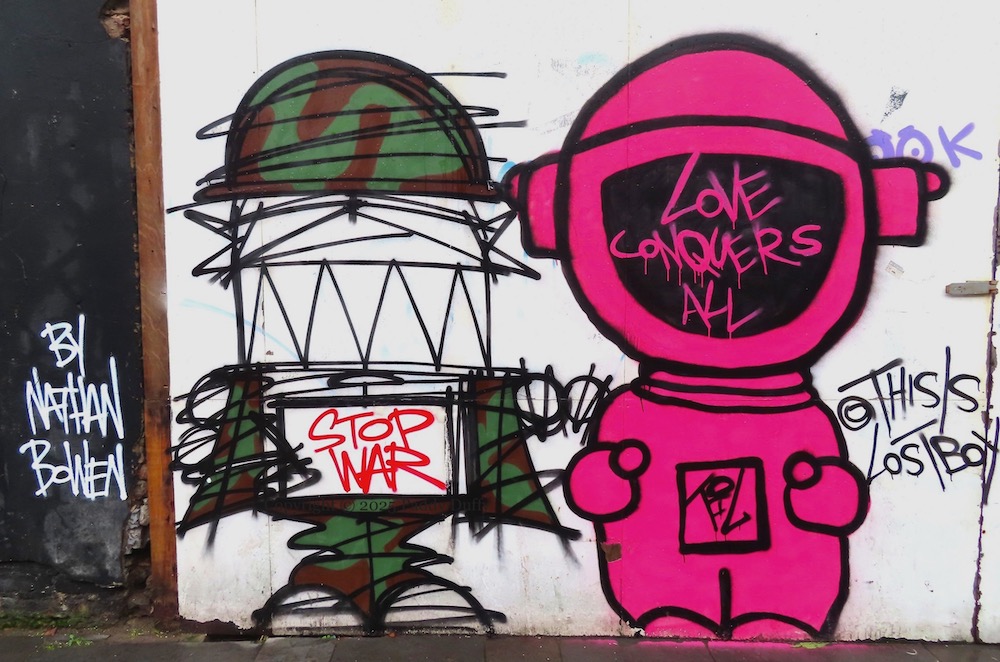
Two positive messages side-by-side in Castle Street: on the left, “Stop war” by Nathan Bowen (ig | web store) and on the right “Love conquers all” by ThisIsLostBoy (ig).
Here are three more by Bowen in Belfast: one | two | three
“This cross of thanks and remembrance was erected by the residents and children of the local area, Sunday 3rd November, 2024.” The small black plaques mounted on the cross commemorate a variety of units and individuals from the World Wars, Operation Banner, and the Iraq War, including the British Armed Forces, Royal Inniskillings, Royal Hussars, Women’s Auxiliary Air Force, Royal Irish Rifles, UDR, B Specials, Parachute Regiment, Royal Irish Regiment. In front are three plaques on stones, one marking QEII’s platinum jubilee, the middle one marking Northern Ireland’s centenary, and one on the right marking KCIII’s coronation.
The cross was officially launched on November 7th (Fb).
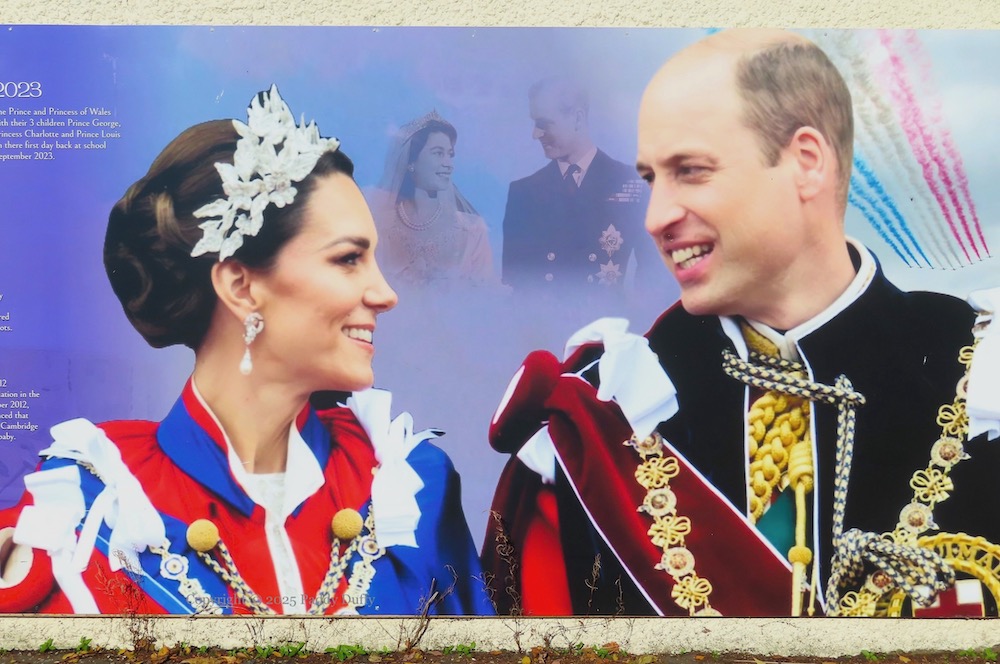
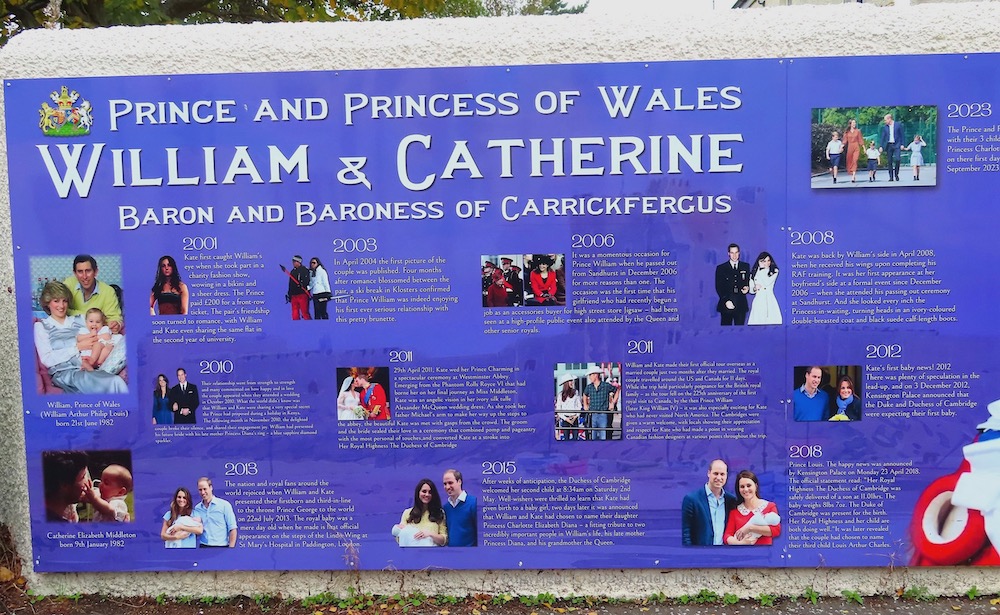
“William & Catherine, prince and princess of Wales, baron and baroness of [sic] Carrickfergus.” Prince William was granted the title of “Baron Carrickfergus” upon his marriage to Catherine Middleton in 2011; he was also made Earl Of Strathearn and Duke Of Cambridge (royal.uk). The couple visited Carrickfergus in 2022 (NI World), shortly after Charles acceded to the throne and William gained the title of Prince Of Wales.
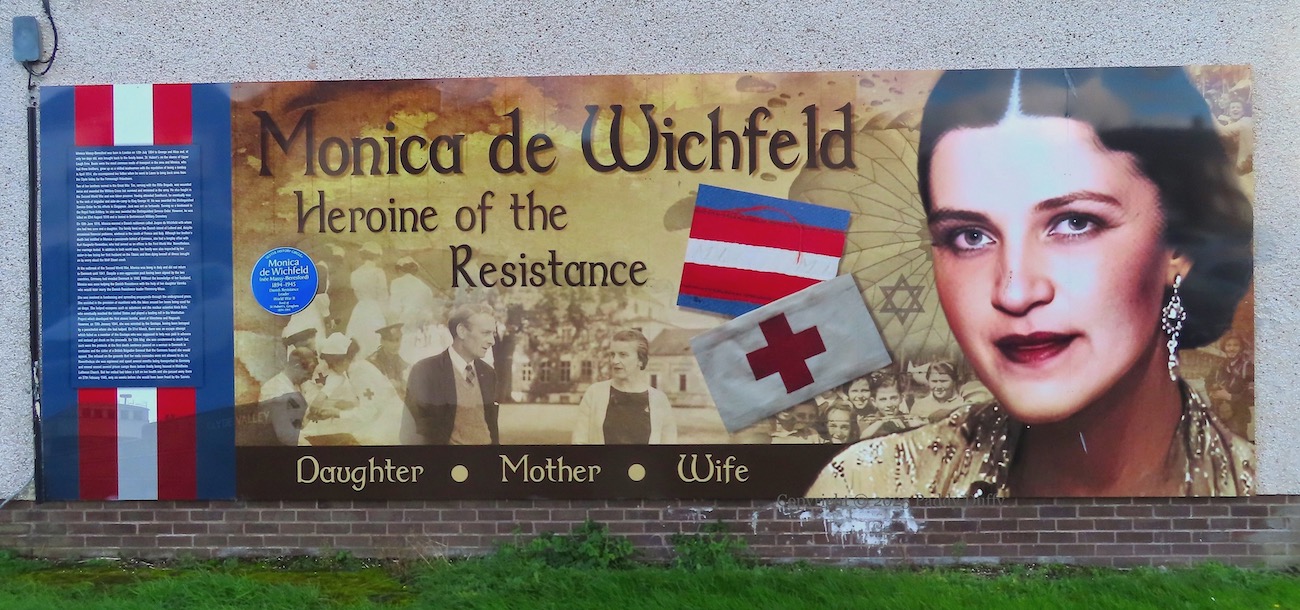
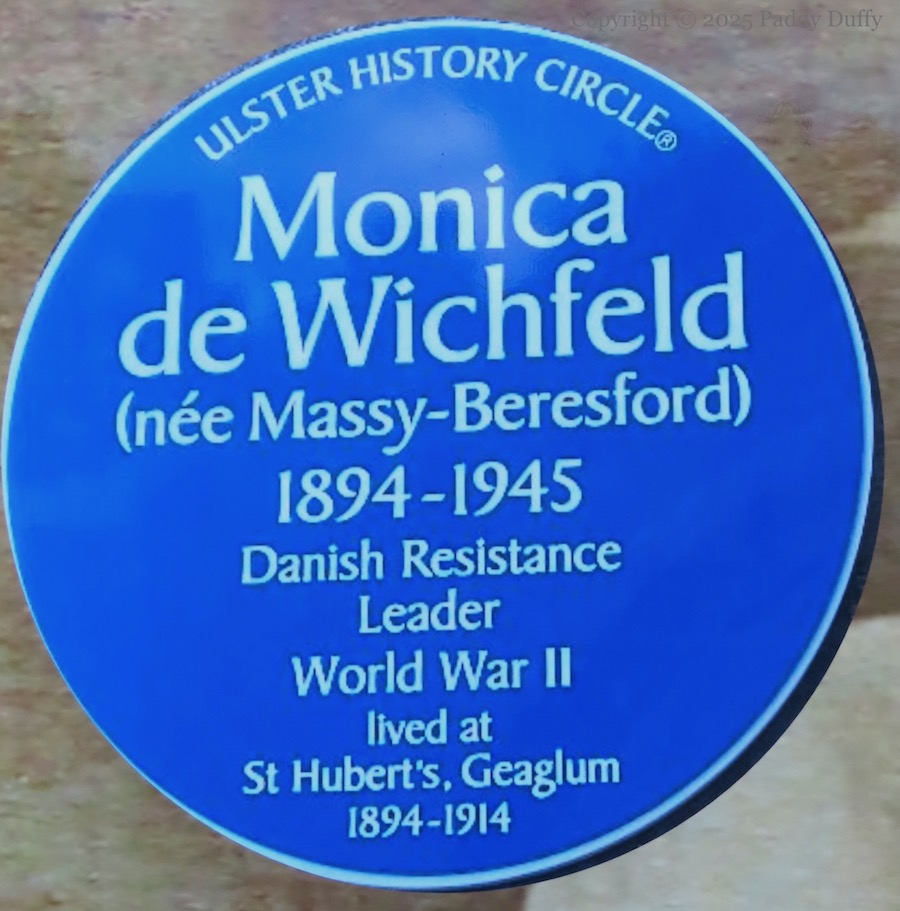
“Monica de Wichfeld, heroine of the resistance, daughter, mother, wife”. The blue plaque to Monica Massy-Beresford is at the Kinawley Holy Trinity church in Derrylin, Fermanagh, (Street View), near where she grew up. She moved to Denmark upon her marriage and had a long and varied career in the Danish resistance to the German occupation in WWII, raising money for the Communists, using her estate to shelter fleeing families and receive arms and train volunteers, and eventually heading the regional group on Lolland (WP).
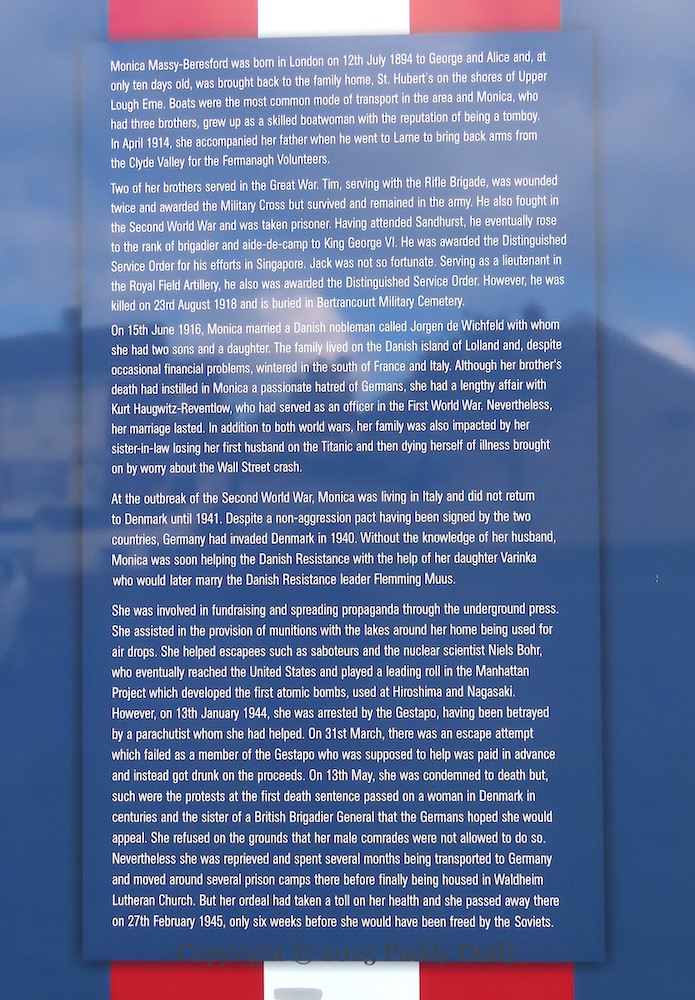
“Monica Massy-Beresford was born in London on 12th July 1894 to George and Alice and, at only ten years old, was brought back to the family home, St Hubert’s on the shores of Upper Lough Erne. Boats were the most common mode of transport in the area and Monica, who had three brothers, grew up as a skilled boatwoman with the reputation of being a tomboy. In April 1914, she accompanied her father when he went to Larne to bring back arms from the Clyde Valley for the Fermanagh Volunteers. … On 15th June 1916, Monica married a Danish nobleman called Jorgen de Wichfeld with whom she had two sons and a daughter. The family lived on the Danish island of Lolland and, despite occasional financial problems, wintered in the south of France and Italy. Although her brother’s death had instilled in Monica a passionate hatred of Germans, she had a lengthy affair with Kurt Huagwitz-Reventlow, who had served as an officer in the First World War. Nevertheless, her marriage lasted. … At the outbreak of the Second World War, Monica was living in Italy and did not return to Denmark until 1941. Despite a non-aggression pact having been signed by the two countries, Germany had invaded Denmark in 1940. Without the knowledge of her husband, Monica was soon helping the Danish Resistance with the help of her daughter Varinka who would later marry the Danish Resistance leader Flemming Muus. She was involved in fundraising and spreading propaganda through the underground press. She assisted in the provision of munitions with the lakes around her home being used for air drops. She helped escapees such as saboteurs and the nuclear physicist Niels Bohr, who eventually reached the United States and played a leading roll [role] in the Manhattan Project which developed the first atomic bombs, used at Hiroshima and Nagasaki. However, on 13th January 1944, she was arrested by the Gestapo, having been betrayed by a parachutist whom she had helped. On 31st March, these was an escape attempt which failed as a member of the Gestapo who was supposed to help was paid in advance and instead got drunk on the proceeds. On 13th May, she was condemned to death but, such were the protests at the first death sentence passed on a woman in Denmark in centuries and the sister of a British Brigadier General that the Germans hoped she would appeal. She refused on the grounds that her male comrades were not allowed to do so. Nevertheless she was reprieved and spent several months being transported to Germany and moved around several prison camps there before finally being housed in Waldheim Lutheran Church. But her ordeal had taken a toll on her health and she passed away there on 27th February 1945, only six weeks before she would have been freed by the Soviets.











 Paddy Duffy Collection