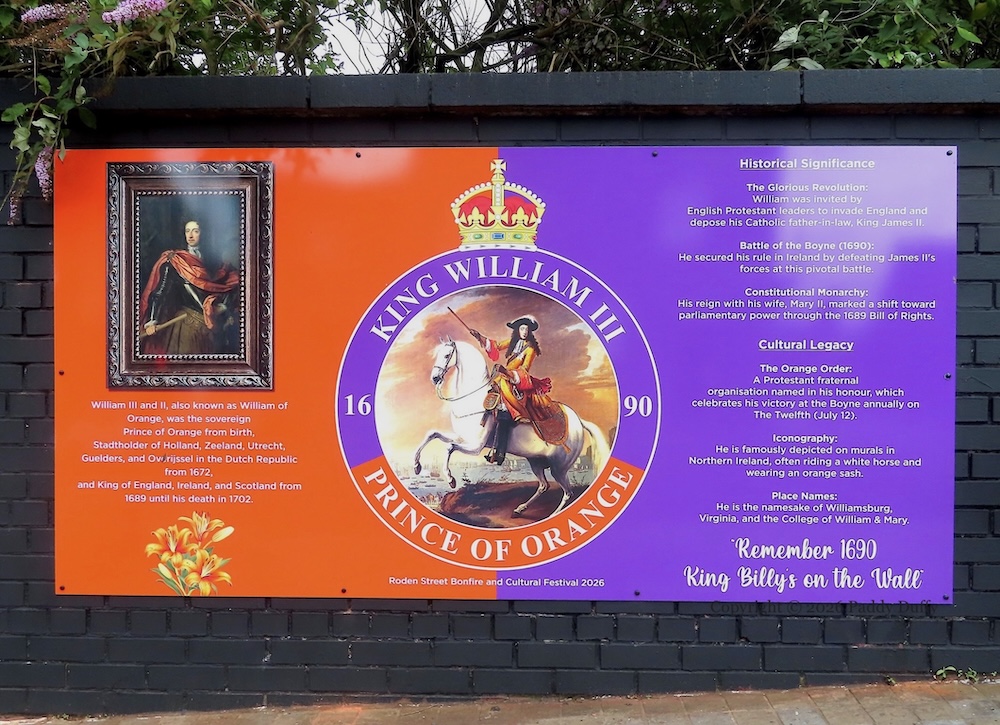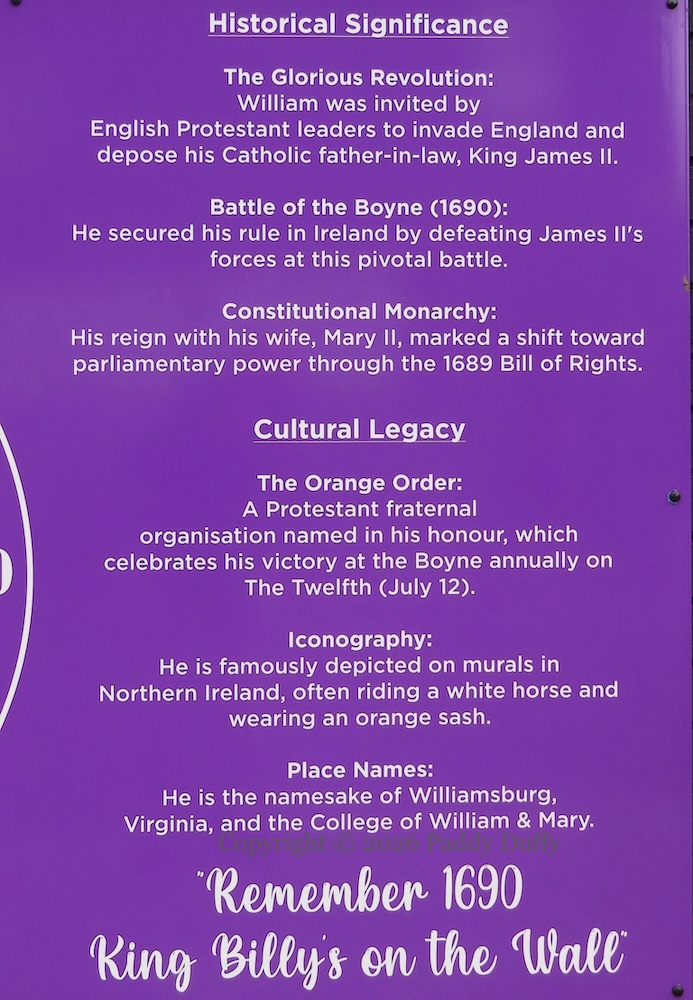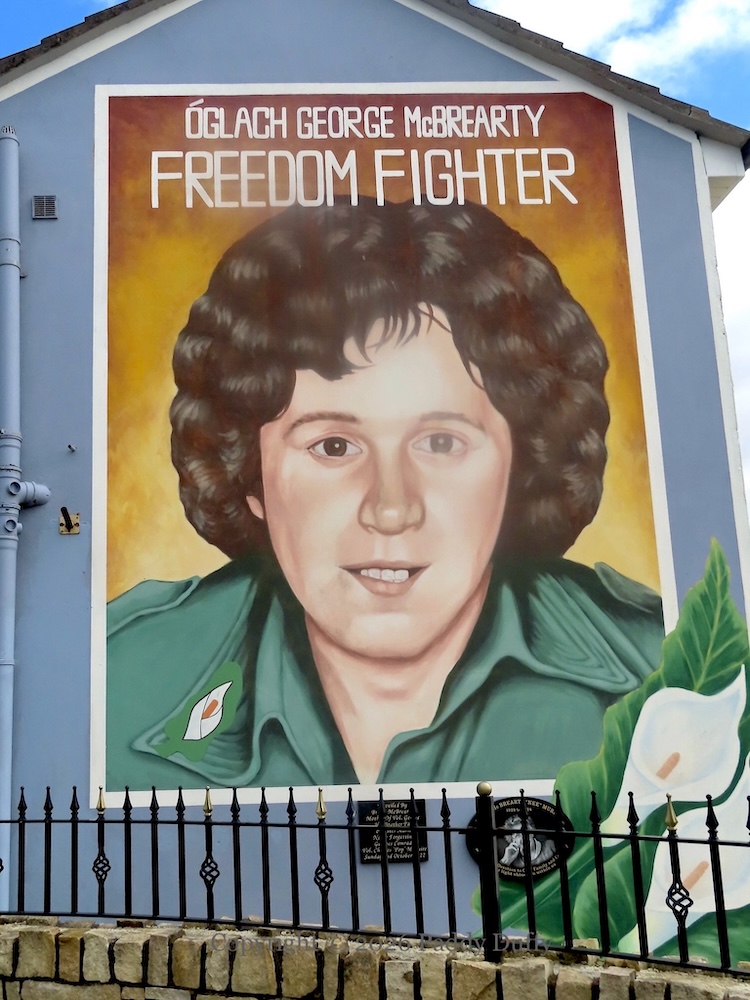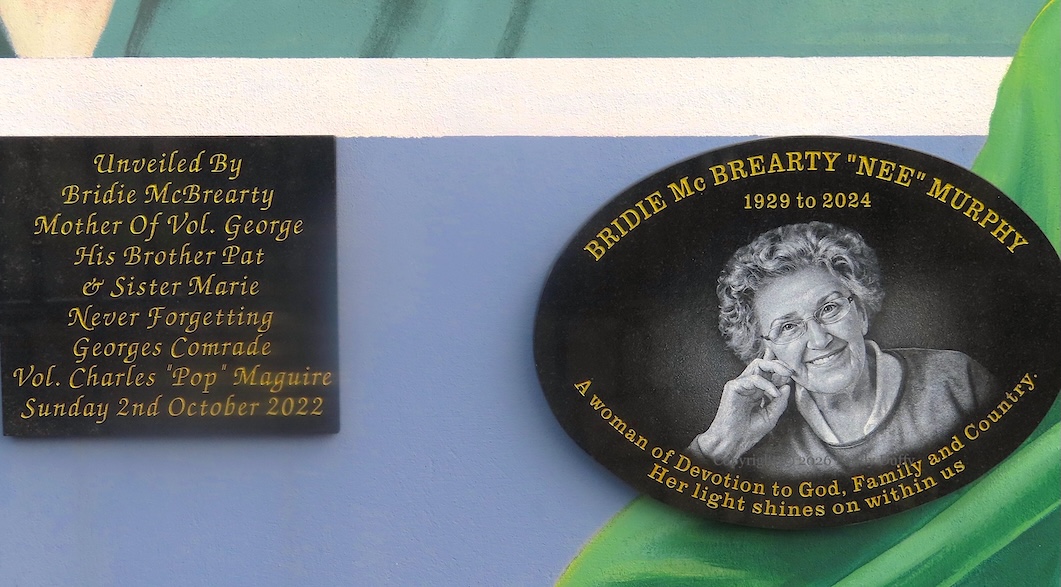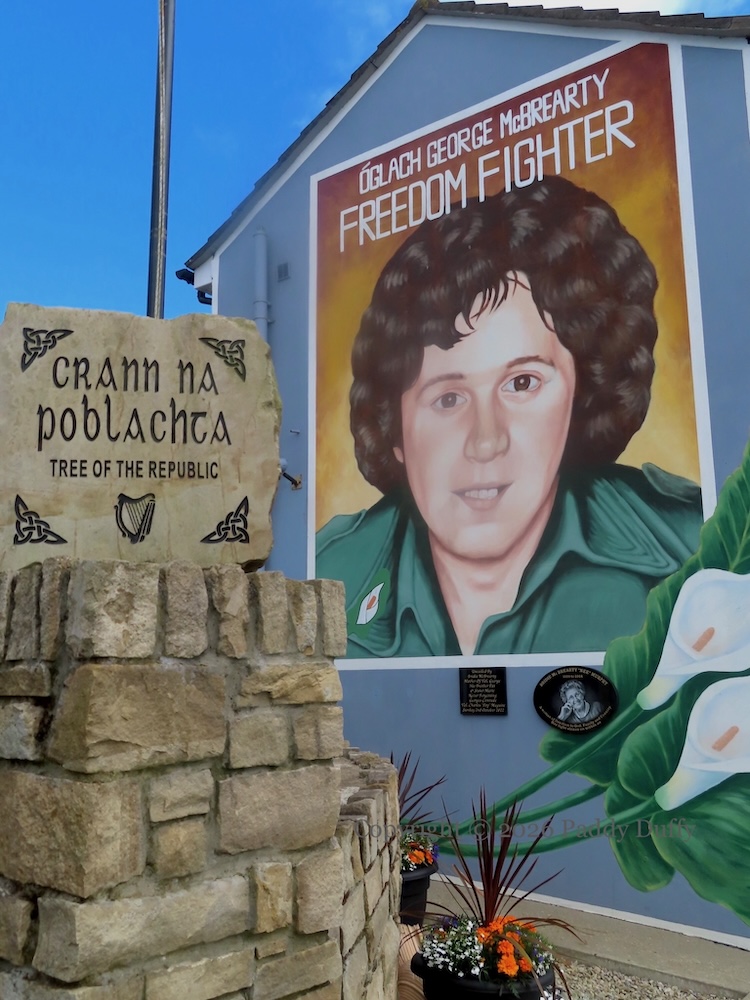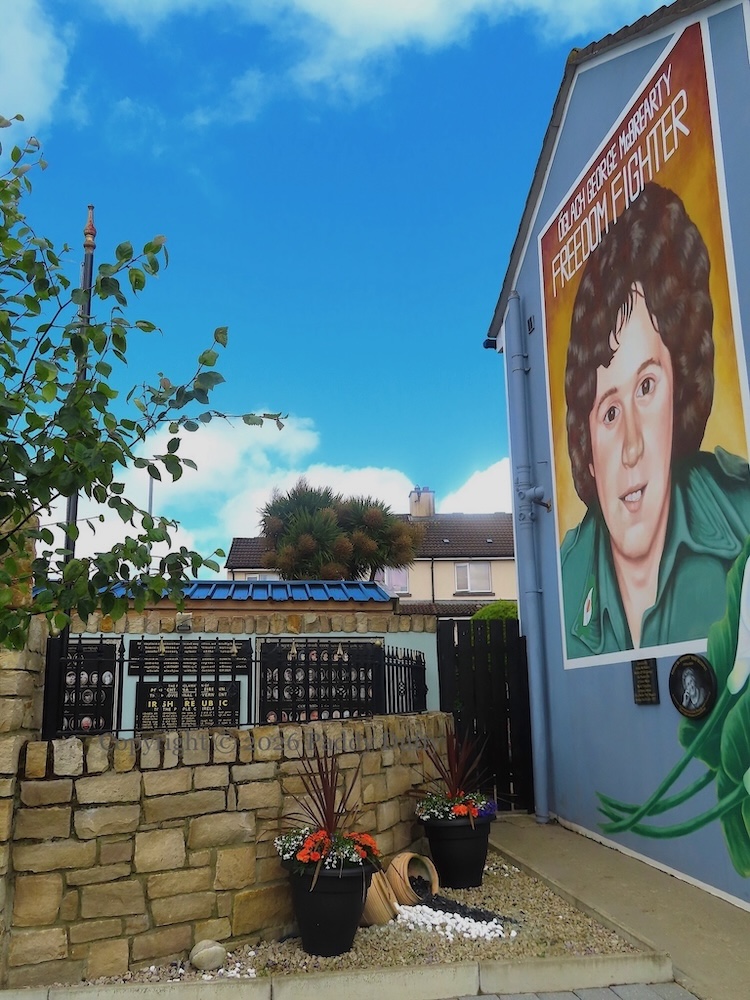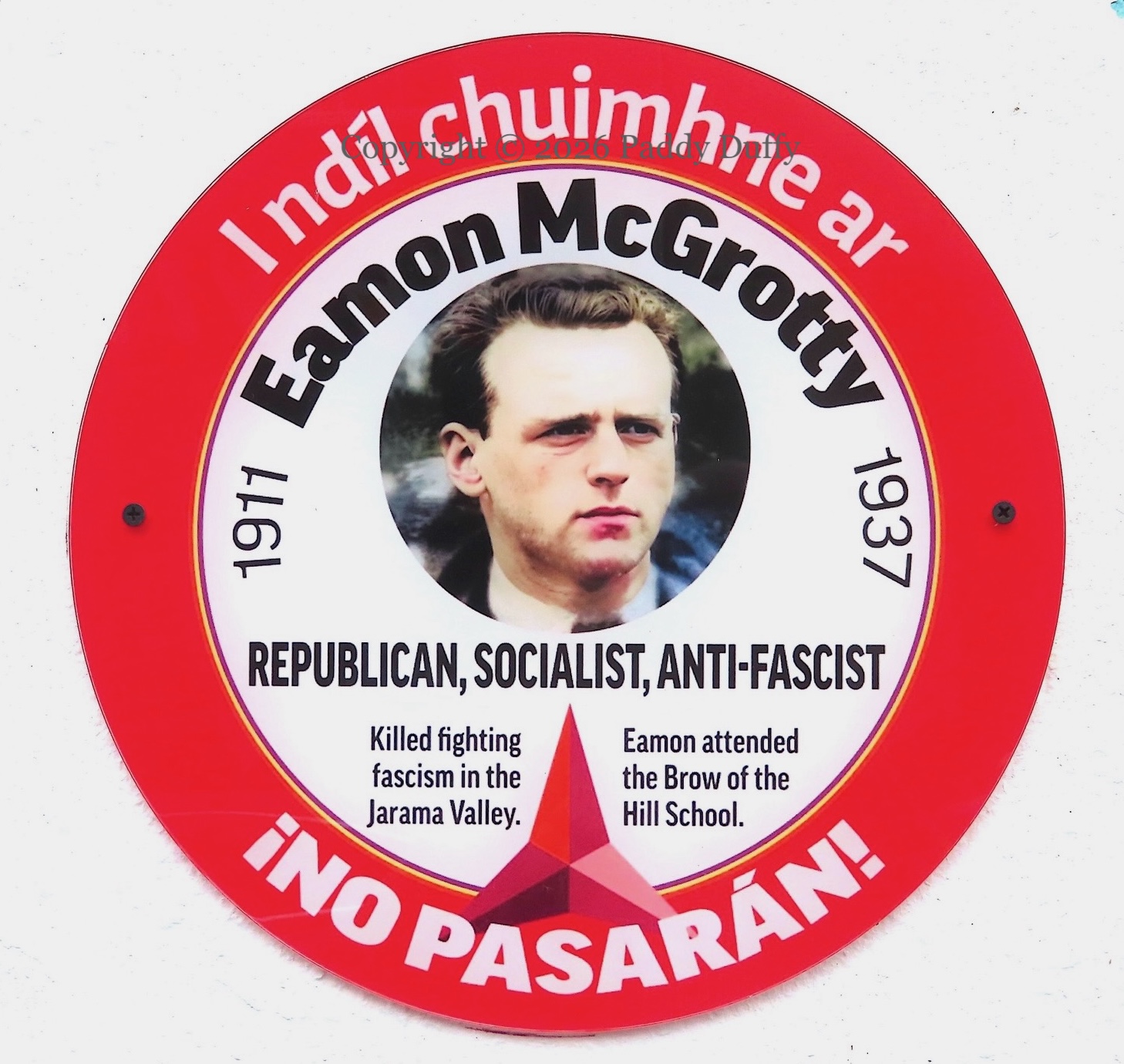
“Remembered with pride – Stevie McCrea, Village, south Belfast”. A plaque has been added below the large board describing Stevie McCrea’s life in Kilburn Street (seen in 2022’s Here Lies A Soldier, which includes the text on the board).
Also included below are close-ups of the plaques to McCrea and Sammy Mehaffy in Tavanagh Street, (seen together in Village UVF).
Here are three banners/posters spotted along the Falls Road during the Easter Rising parade on April 5th:
Above: “Sainsbury’s supports Israel! Don’t shop there. Easter Sat 4th [April, 2026].” For background see the post and reel on the BDS Belfast Fb page.
Below: “U.S. military not welcome in Ireland! Not in Shannon, not in Aldergrove.” For background, see Al-Jazeera | ShannonWatch. April 13th: a person was arrested for taking a hatchet to a C-120 Hercules (Democracy Now).
Last below: “PSNI target Catholics at much higher rate for stop-and-search. Source: PSNI stop-and-search data. Do not join the RUC/PSNI. Same aim, different name. IRSP [web] – the party of Connolly & Costello.” The data in question might be from the 2020-2021 period (PSNI | TheDetail) as the current (2025) data do not appear to report on sectional identification.
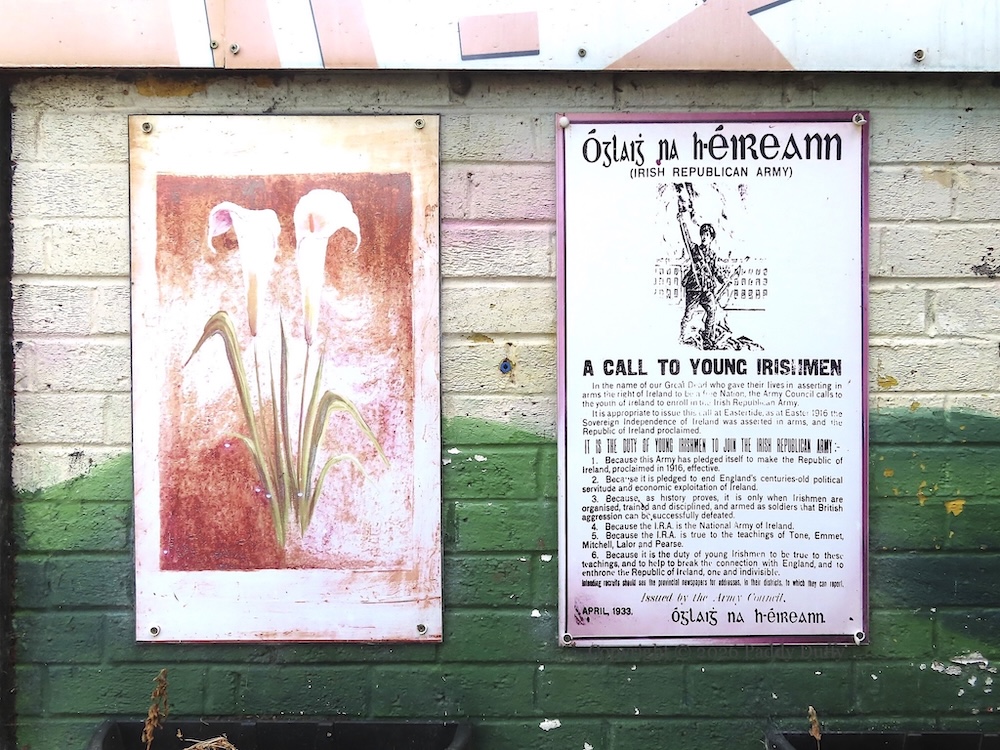
“100 years. Lıle na Cásca. Wear your Easter lily with pride. Tabhaır ómós do laochra na hÉıreann. [Pay respect to Ireland’s warriors]”
Shown here are Sınn Féın (web) and Lasaır Dhearg (web) invocations to commemorate the 1916 Easter Rising. The lily as a symbol of the 1916 Easter Rising was introduced by Cumann Na mBan in 1926 as a fund-raising device. For a history and vintage posters from across the century, see An Phoblacht.
This is a new information board below the Ballymurphy Massacre board at the Glenalina Road corner with the Whiterock Road.
The first panel (on the left) reads, “On Monday 9th of August 1971 Internment Without Trial was introduced by the British Government. The policy was directed and implemented by the British Army with the stated aim to “shock and stun the civilian population”. Between 9th and 11th of August 1971 eleven people were killed in the Ballymurphy area of west Belfast. All eleven were murdered by the British Army’s Parachute Regiment. All eleven were unarmed civilians. One of the dead was a parish priest and another the mother of eight children. Fifty-seven children were left without a parent. There was No proper criminal investigation. The Royal military police were assigned as sole investigators. Not one member of the British Army was held to account. It is believed that had justice been administered and those held to account charged, the events of Bloody Sunday would not have happened.”
The remaining panels give a day-by-day account of the eleven deaths, of Father Hugh Mullan, Frank Quinn, Noel Philips, Joan Connolly, Danny Teggart, Joseph Murphy, Eddie Doherty, Joseph Laverty, Joseph Corr, Paddy McCarthy, John McKerr.
The IRSP/RSYM will commemorate the Easter Rising with wreath-laying in Derry (IRSP Derry Fb | RSYM Fb) on Saturday and a parade in Belfast on Easter Sunday (IRSP Lower Falls Fb). These posters of the seven signatories to the Proclamation are on the Falls Road, at Waterford Street/Dunville Park, west Belfast.
Costello House, home of the IRSP and site of these two new boards, is named after Seamus Costello (b. 1939), who fought for the IRA during the Border Campaign and was interned in the Curragh for two years. He stayed with the Officials during the split, but was driven out in 1974 and formed the Irish Republican Socialist Party (IRSP) and the INLA. He was shot and killed in 1977 (WP).
Costello appears alongside one of his successors as INLA leader, Gino Gallagher, for whom see the recent Gino Gallagher, Chief Of Staff.
These two Saoradh (web) boards are at the roundabout on Camlough Road, Newry. The one above shows a vintage mural from nearby Carnagat Road that goes back to (at least) 1994 – the version painted in 2000 can be seen in the Peter Moloney Collection.
The other board reads “Salute the men and women of violence”, among whom are the seven signatories to the 1916 Proclamation, the IRA of the Troubles era – illustrated by Colman Doyle’s famous ?1973? (staged) photograph of a female IRA volunteer with AR-18 – and the post-Agreement groups (such as the New IRA) – illustrated by a home-made RPG (shown in Resistance).
This memorial board to Gino Gallagher was mounted the day before the thirtieth anniversary of his death in 1996, possibly by former colleagues (Irish Times | Republican News). On the 31st, a colour party paraded to Gallagher’s grave in Milltown (youtube).
“Gino Gallagher, chief of staff, 30th anniversary, 30th January 1996. Irish National Liberation Army/INLA. “Finally, as we lay this volunteer and comrade into the soft green soil of his native land, remember him each time you gaze into the stars and see there etched across the sky the plough and the stars!””
This memorial for Glen “Spacer” Branagh, launched on the twentieth anniversary of his death in 2021, is at the junction of Canning Street and Orchard Street, north Belfast.
For information and the earlier plaque on N Queen St, see Forever Young.