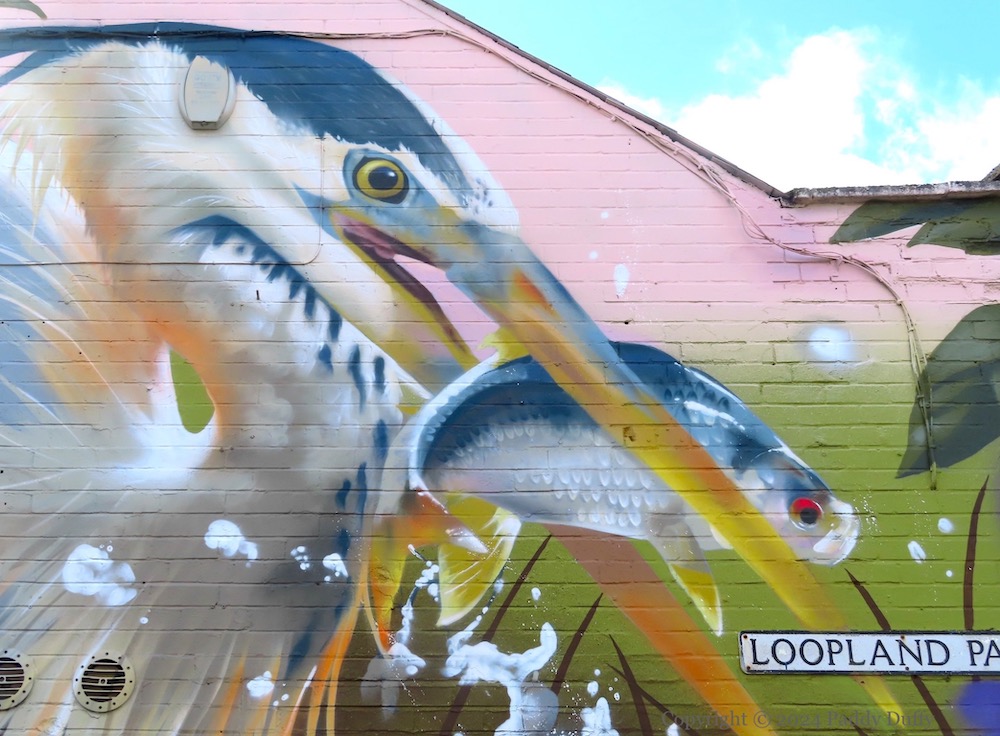
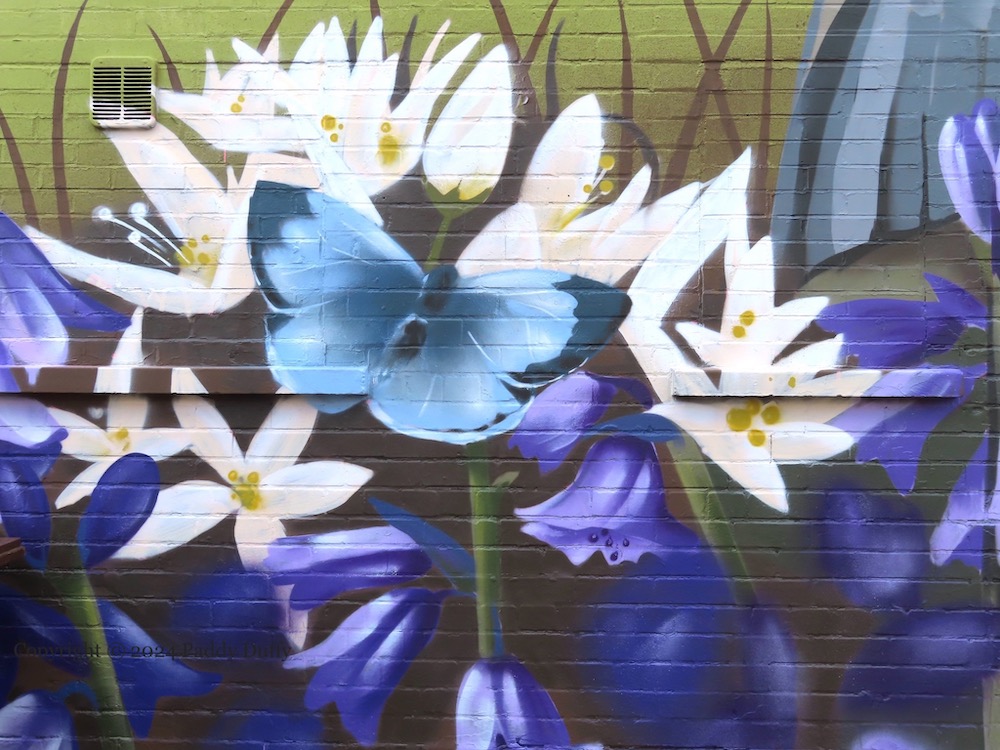
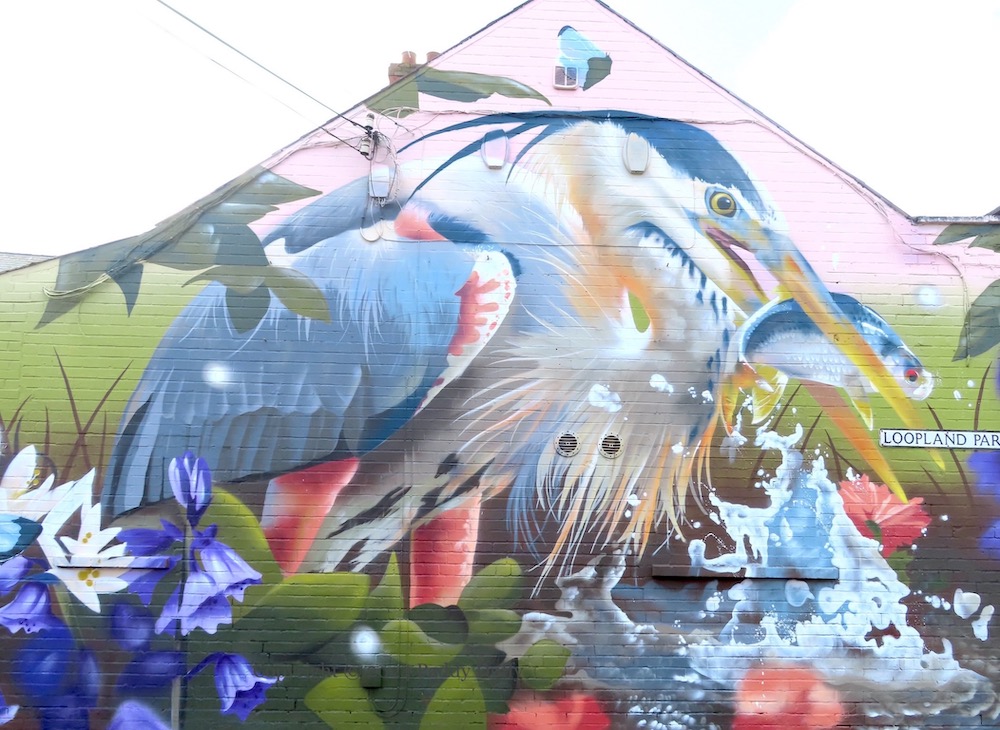
The grey heron is common throughout Ireland (Ulster Wildlife) including the walls of the Cregagh Road (the side of Haus Of Hair, site of Glen Molloy’s tribute to Carrie Fisher).
The work is by Sheffield artist Peachzz (ig), organised by Cregagh-Woodstock Traders (Fb) with support from Belfast City Council (web).
Here is a gallery of three waves of painting (24 pieces) from the Project 24 space (Spectator) on Queen’s Parade, Bangor. From top to bottom, the images are from late March, the bank holiday at the start of April, and mid April. (The wall was also painted in January – see Stop Ruining Art.)
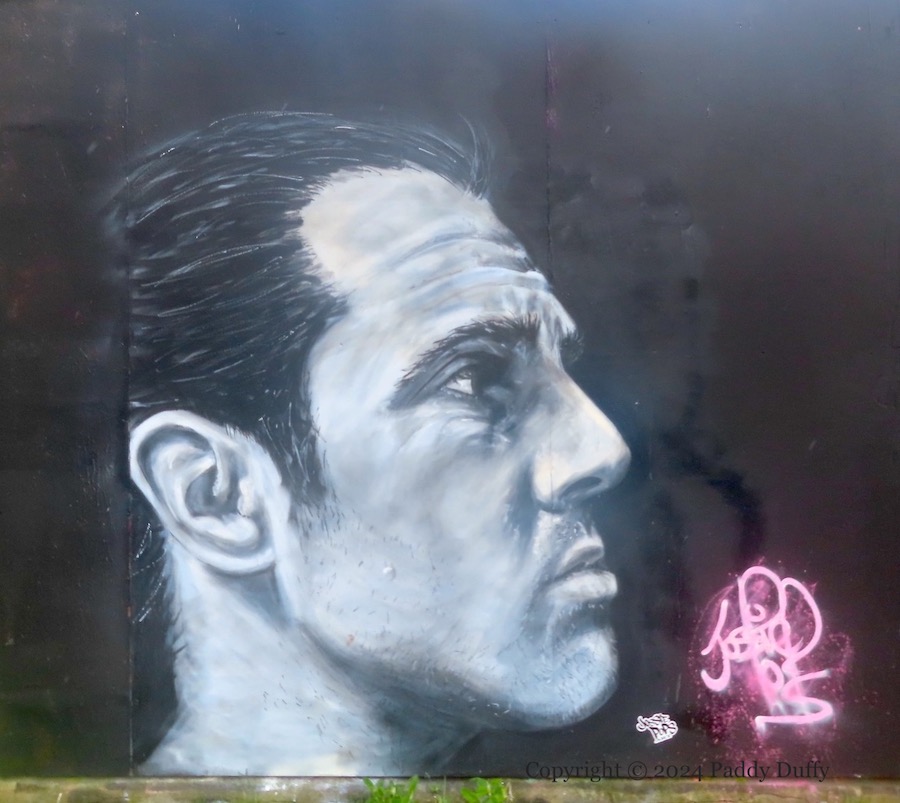
Above is a self-portrait by artist Jossie Pops (Johnny Hamilton) (ig) who also painted the portrait of actor Gerard Butler immediately below. Shortly, after, RickyDrewAPiccy added a piece between these two – a robot with the words “Don’t drink flat whites. Don’t wear massive coats. Don’t be a robot.” (Fb) – but it was quickly replaced by the Codo heads (under ‘April 7th’, below).
Queen Elizabeth II died, aged 96, on September 8th, 2022, and is now (according to this board) queen of the angels in heaven (Matthew 28:2), which perhaps allows her to send other angels to Earth (Matthew 24:31) to deliver messages to chosen people.
Also included (below) from the same street is a memorial tarp to British soldiers in the Great War and WWII, including Vickers machine guns, Spitfire aeroplanes, and a WWI tank (perhaps a Mark V (Tank Museum)).
Here are three pieces from the Drumcor Hill area of Enniskillen.
Above, “Enniskillen remembers the hunger strikers” – for the fortieth anniversary of the 1981 strike, against a background of sunburst and starry plough, in Loughview Drive.
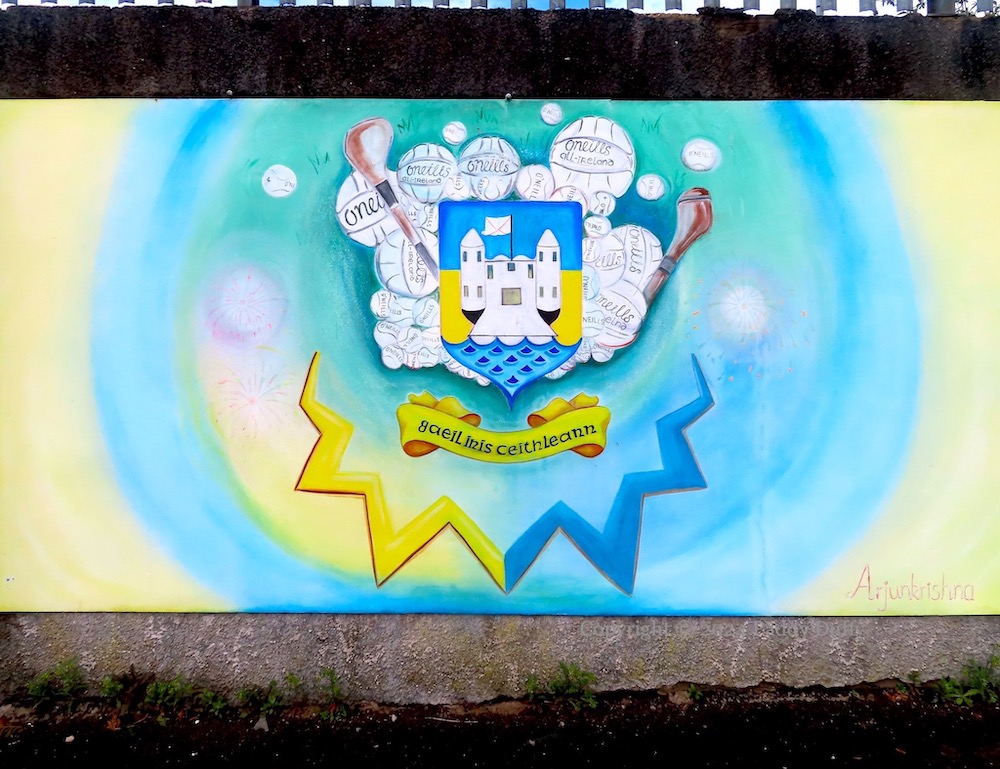
Below, the emblem of Gaeıl Inıs Ceıthleann/Enniskillen Gaels (web) on the wall outside their home field of Brewster Park.
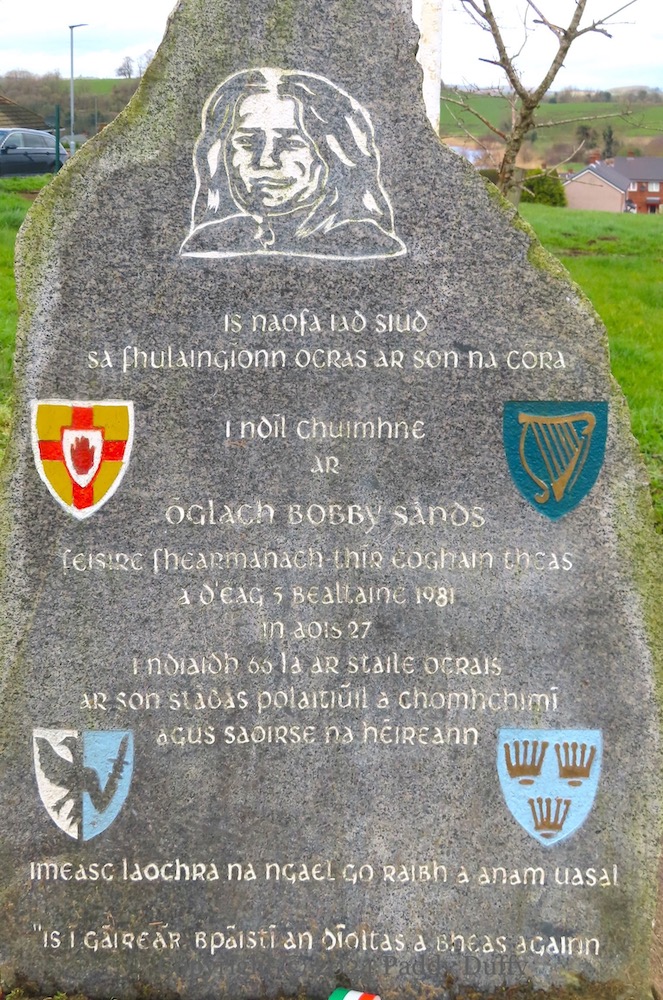
Finally, a memorial stone to Bobby Sands in Erne Drive. The inscription on the stone reads, “‘Is naofa ıad sıud sa fhulaıngíonn ocras ar son na córa.’ [= Holy are those who suffer hunger for the sake of justice/”Blessed are those who hunger for justice”] I ndíl [ndıl] chuımnhe ar Óglach Bobby Sands, feısıre [= M.P.] Fhearmanach-Thír Eoghaın Theas, a d’éag 5 Bealtaıne 1981 ın aoıs 27 ı ndıaıdh 66 lá ar staıle [staılc] ocraıs ar son stádas polaıtıúıl a chomhchımí agus saoırse na hÉıreann. I measc laochra na nGael go raıbh a anam uasal. ‘Is í gáıre ár bpáıstí an díoltas a bheas agaınn'”
For an alternative translation of Sands’s quote “Our revenge will be the laughter of our children”, see The Spirit Of Freedom in the Peter Moloney collection.
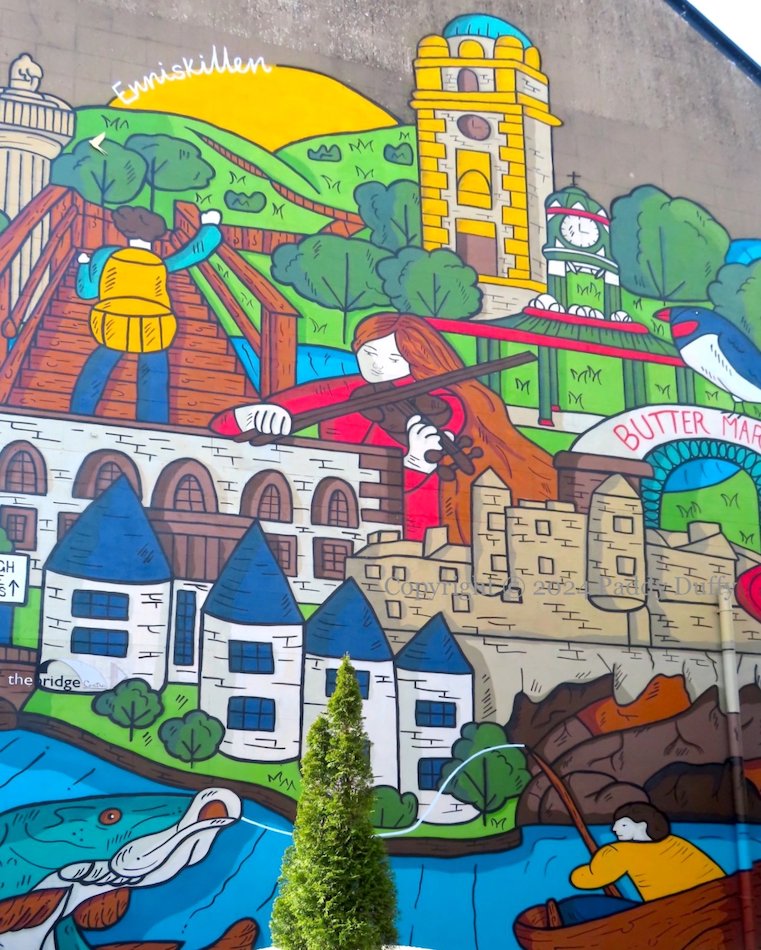
Landmarks of Enniskillen and Lough Erne are depicted in this “Enniskillen” mural by Danni Simpson (ig) and Karl Fenz (ig) for Experience Enniskillen (web).
Clockwise from the peaked roofs in the bottom left: Lough Erne resort, Enniskillen courthouse, Cole’s Monument, the Cuilcagh Boardwalk (which is featured in Stairway To Heaven), Enniskillen town hall, the bandstand at Cole’s Monument, the Butter Market, Enniskillen Castle, the red heart “selfie frame” in the Broadmeadow (Impartial Reporter), with Marble Arch Caves and fishing on Lough Erne (see also Pike Fishing In Enniskillen) at the bottom.
The piece is in East Street Bridge, on the side wall of Fermanagh Cottage Industries in front of the Presbyterian Church.
“Greater love hath no man than this: that a man lay down his life for his friends – John Ch. 15 v13”
This memorial plaque is “in memory of [LVF] Brigadier Billy Wright (King Rat)”. Wright was killed in the Maze in December 1987 by members of the INLA (neither the INLA or LVF were on ceasefire).
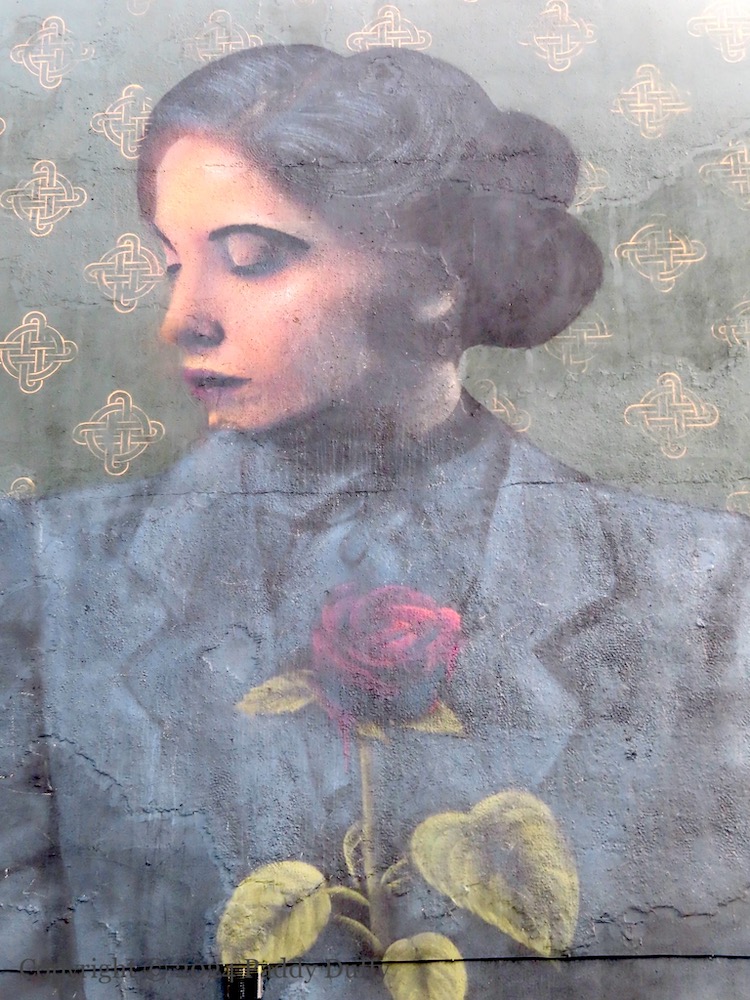
“A Róısín, ná bíodh brón ort fé’r éırigh dhuıt”/Róısín, be not sad about what has happened to you”. The song ‘Róısín Dubh’ [usually translated as ‘Dark Rosaleen’] is a love song to Ireland, in which the infatuated singer recounts the lengths he would go to on her behalf (song (youtube): Muıreann Nıc Amhlaoıbh | Caıtlín Maude | poem/lyrics in English: Mangan | Kinsella at WP).
This new piece in the New Lodge, north Belfast, was painted (presumably) by emic (ig), (presumably) under the same auspices as, and as a thematic complement to, the project we reported on in Communities In Transition. The lack of explicitly nationalist or republican signifiers is perhaps necessary if the piece is to be funded by Communities In Transition, while the cultural reference is perhaps necessary if the art is to survive on what has for the past dozen years been an anti-Agreement wall – see Damn Your Concessions, England and Unbowed, Unbroken. Another emic piece, in Creggan, Derry, has been marked with republican graffiti – see Stand Up And Speak Out. This very skilful piece walks a very fine line very precisely.
Here is a survey of PUL boards (from left to right) at the shops in the centre of the village of Moygashel, just south of Dungannon.
First is a British Army soldier in a firing position. Compare this board to Now Is The Time To Kneel in Clonduff, Castlereagh, which suggested that the time for soldiers to kneel was in mourning for Queen Elizabeth.
The subject of the second image is obscure. Vanguard as a political and activist group dissolved in 1977 (WP) and the name and emblem have been taken up by the Vanguard Bears, a Rangers supporters’ club (see e.g. Defending Our Traditions).
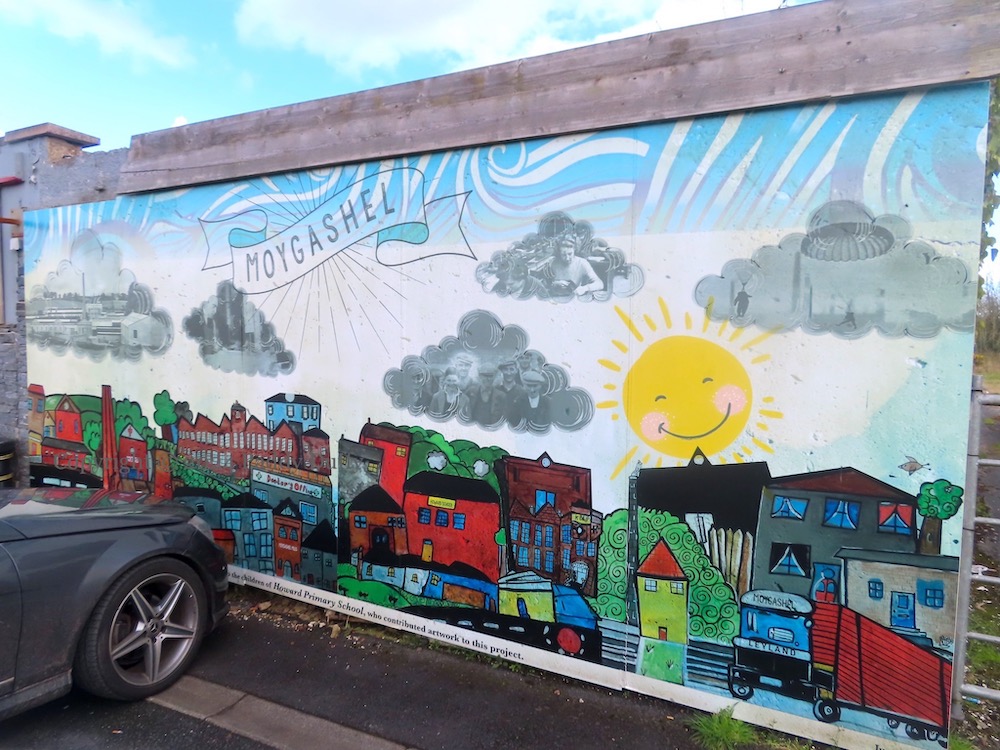
Third is a children’s mural, produced (in part) by children from Howard primary school.
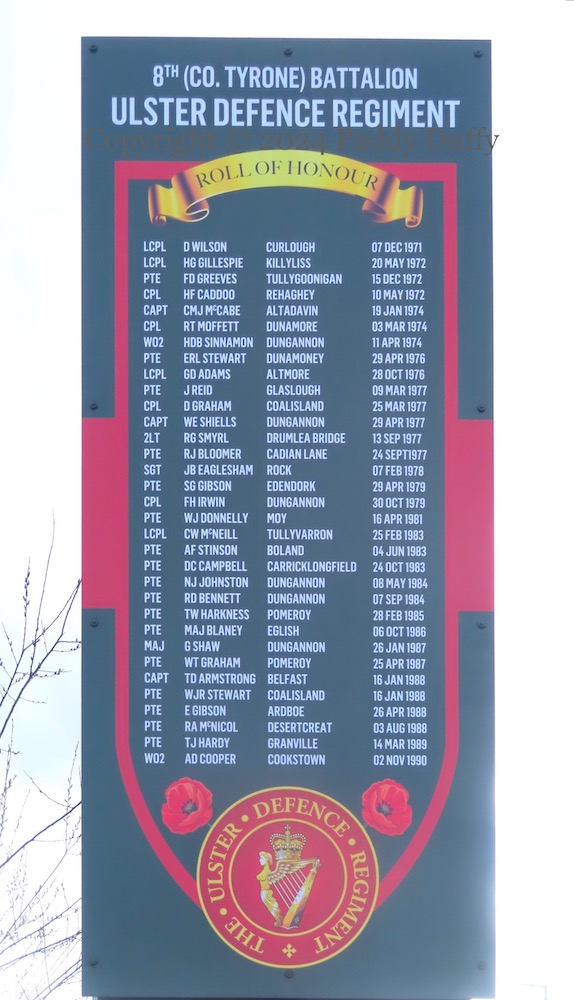
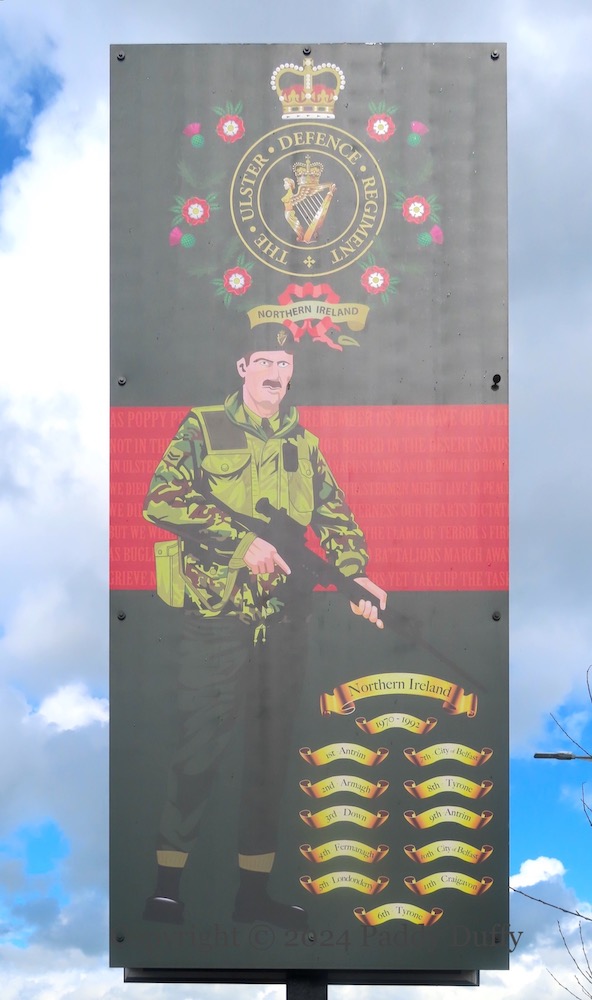
The ‘Time To Decide’ and UDR 8th (Co. Tyrone) battalion roll of honour were seen previously, alongside two others which are now absent, in Belfast Agreement Null & Void.
Beyond those is a tarp celebrating Queen Elizabeth II’s platinum jubilee, in 2022.
Finally, a Moygashel Youth Club (Fb) mural in disrepair.
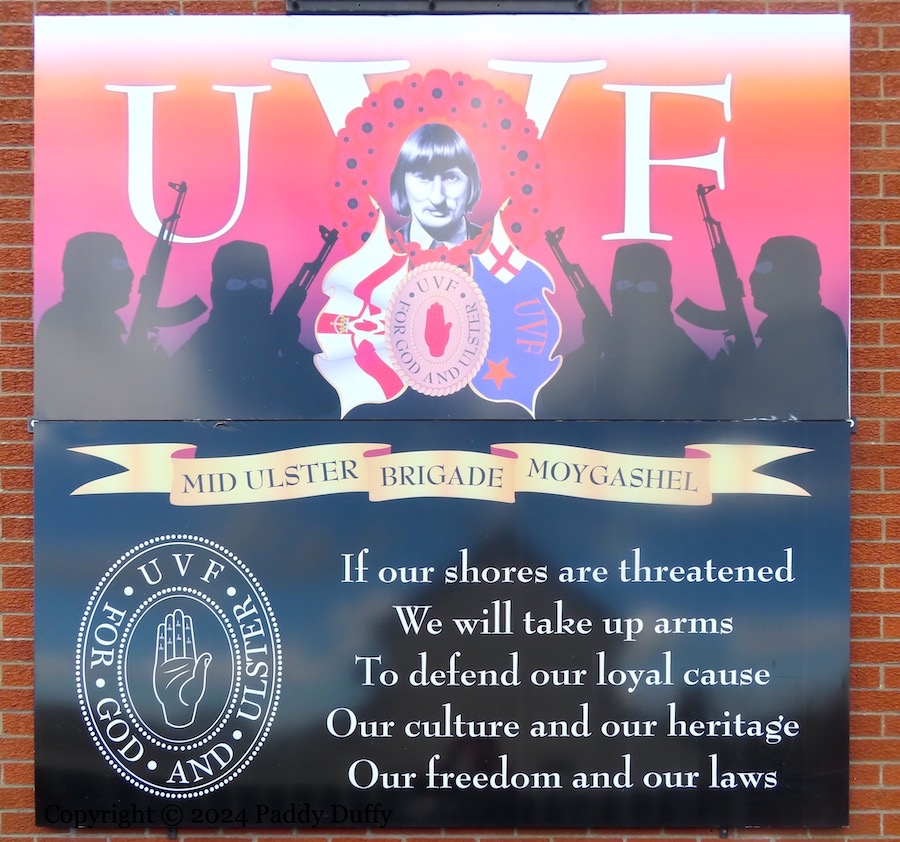
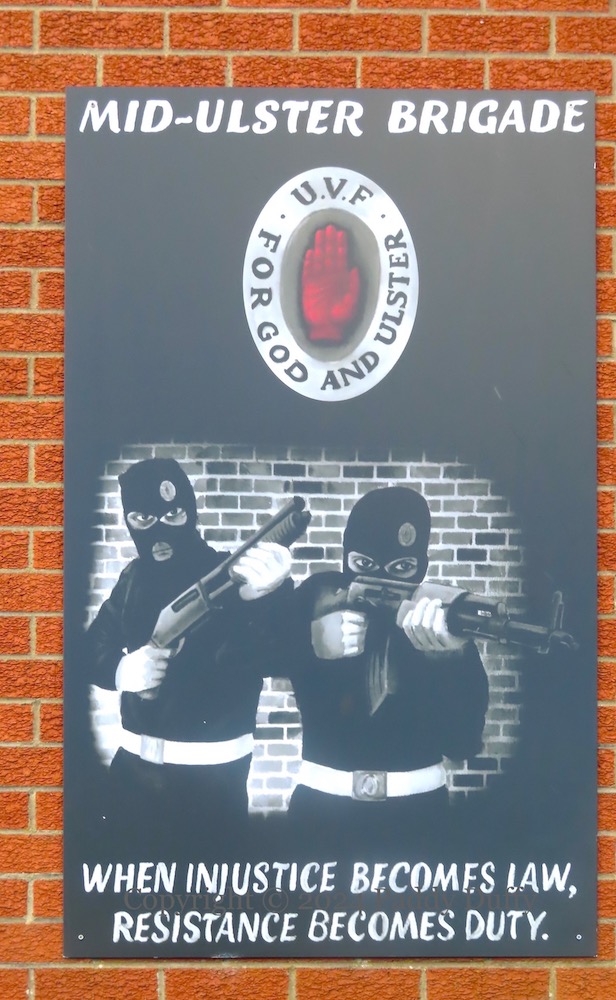
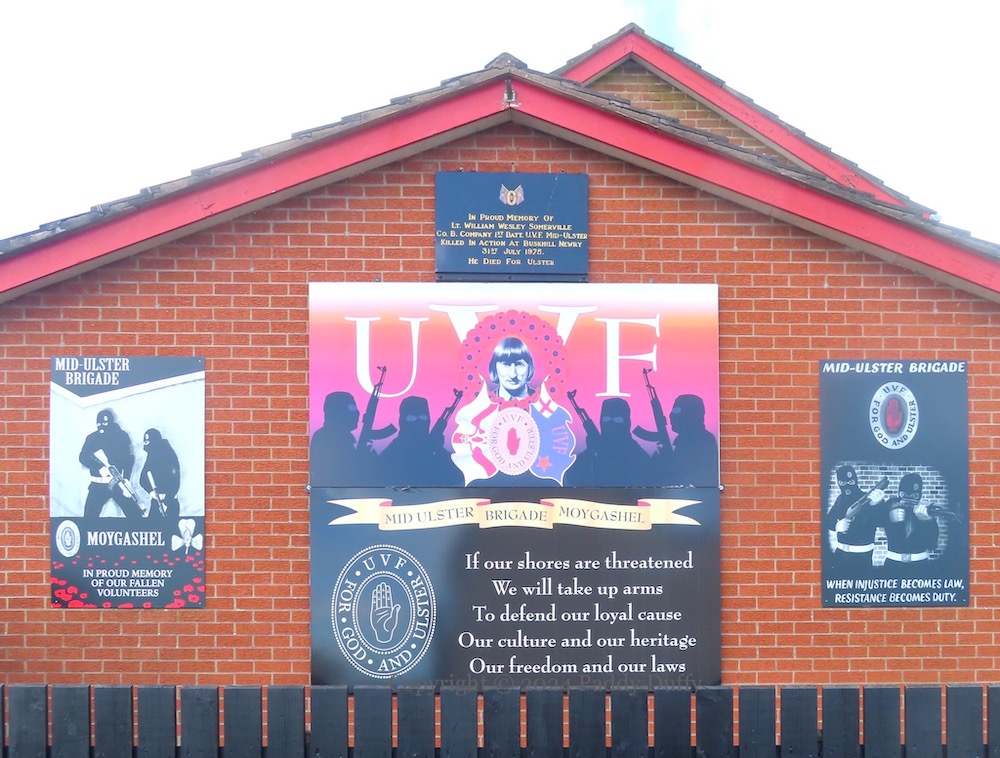
“If our shores are threatened/We will take up arms/To defend our loyal cause/Our culture and our heritage/Our freedoms and our laws.” Moygashel’s own (William) Wesley Somerville, a member of both the UVF and UDR, was killed by a bomb prematurely exploding as he placed it on the minibus of the Miami Showband in July of 1975. Three members of the band died, one of them Protestant, along with volunteers Somerville and Harris Boyle from Portadown (WP). “He died for Ulster” (on the plaque).
“Attach an item for every child murdered by the IDF in Palestine”. If the practice were followed in accordance with Al Jazeera’s track of casualties in Palestine, there would be roughly 16,500 teddy-bears and other soft toys on these railings at William Street/Anne Street in Dungannon.













 Paddy Duffy Collection