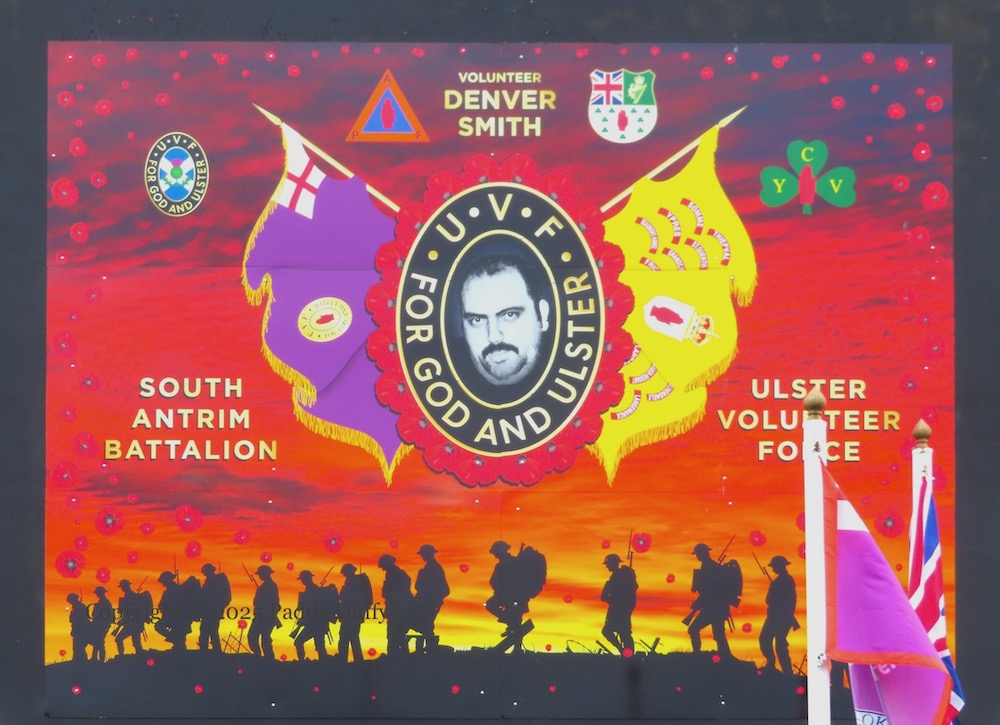
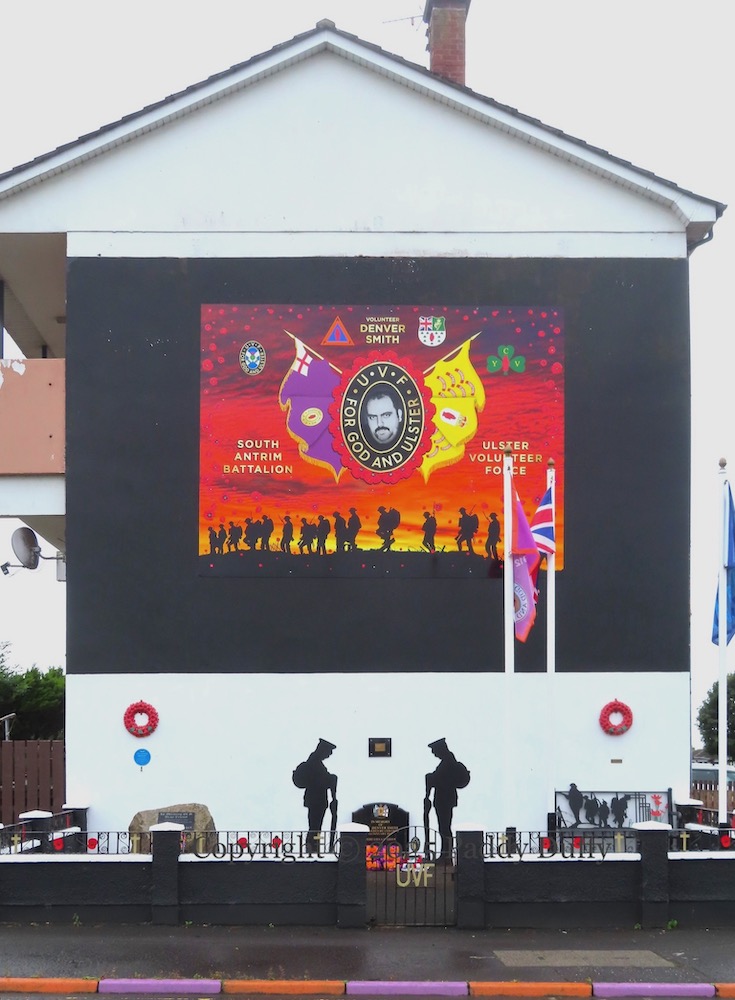
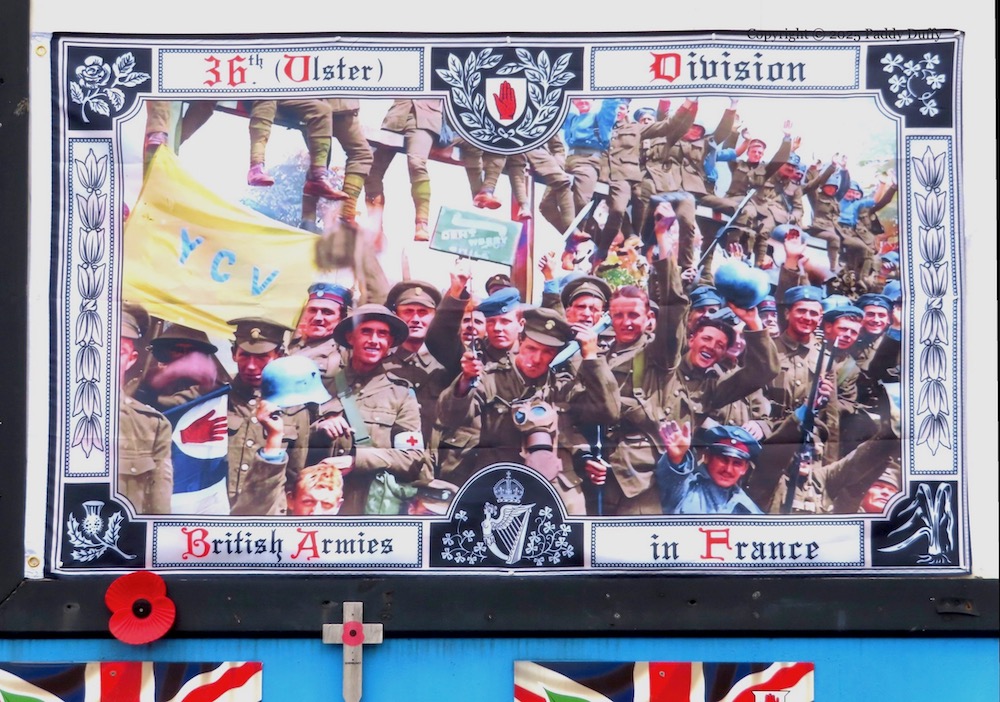
The Denver Smith mural in the Steeple, Antrim, has been replaced with the printed board (shown above and immediately below) which retains the same elements of the mural, including the WWI soldiers and the emblem of the 36th (Ulster) Division. (For information about Smith, see Here Lies A Soldier.)
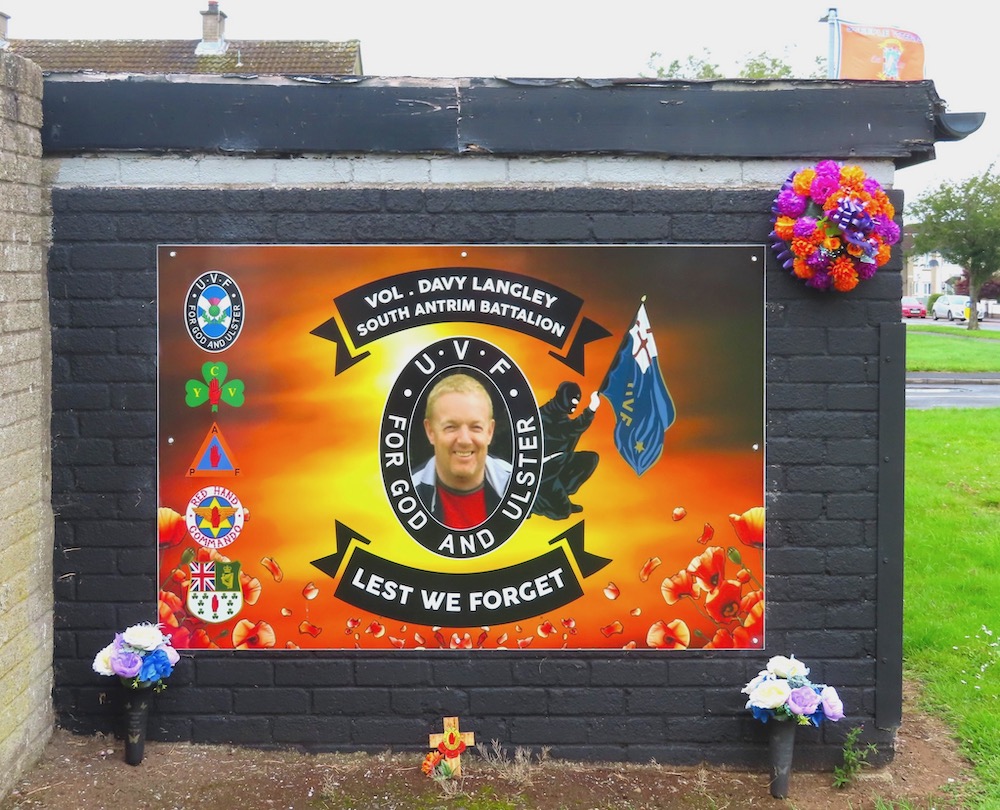
Memorial boards in the same style and palette have also been mounted on adjacent walls to two members of the modern Ulster Volunteer Force. To the left, Mark McCausland, who died in 2024 (Wray’s); the board in his memory replaces a UVF flag (seen in Pass Not This Spot In Sorrow). To the right, Davy Langley, who died in 2018 (Funeral Times); there was previously a mural to his memory in the same spot (see Ulster Volunteer Forces)
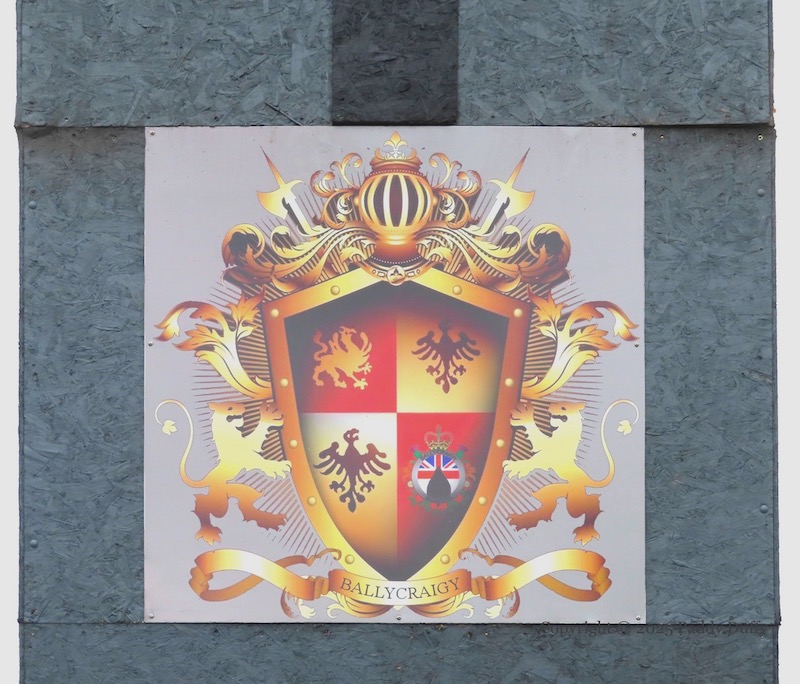
Preparations for Eleventh Night bonfires are underway in many estates, including Ballycraigy in Antrim which is getting help from an AI-generated Popeye. Ballycraigy used to boast the biggest Bonfire (see Lead The Way); you can keep track of this year’s build on the bonfire’s Facebook page.
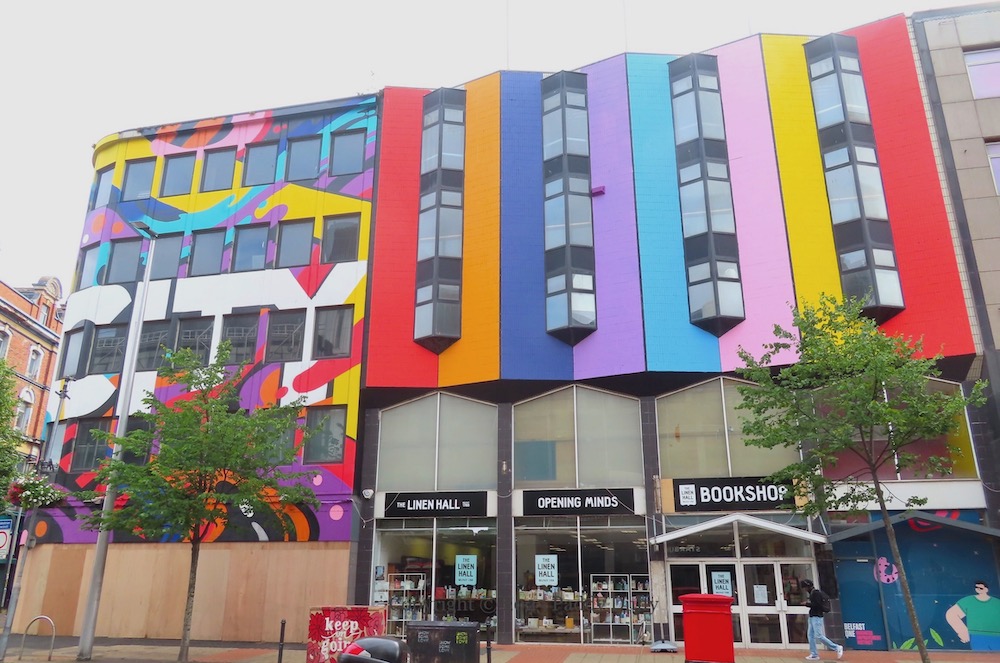
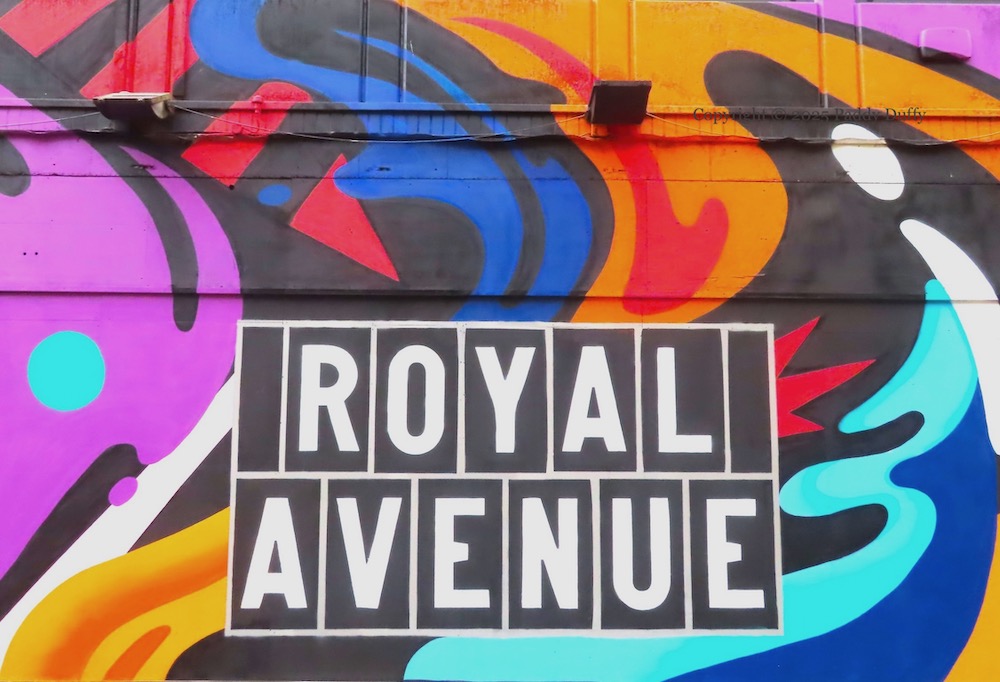
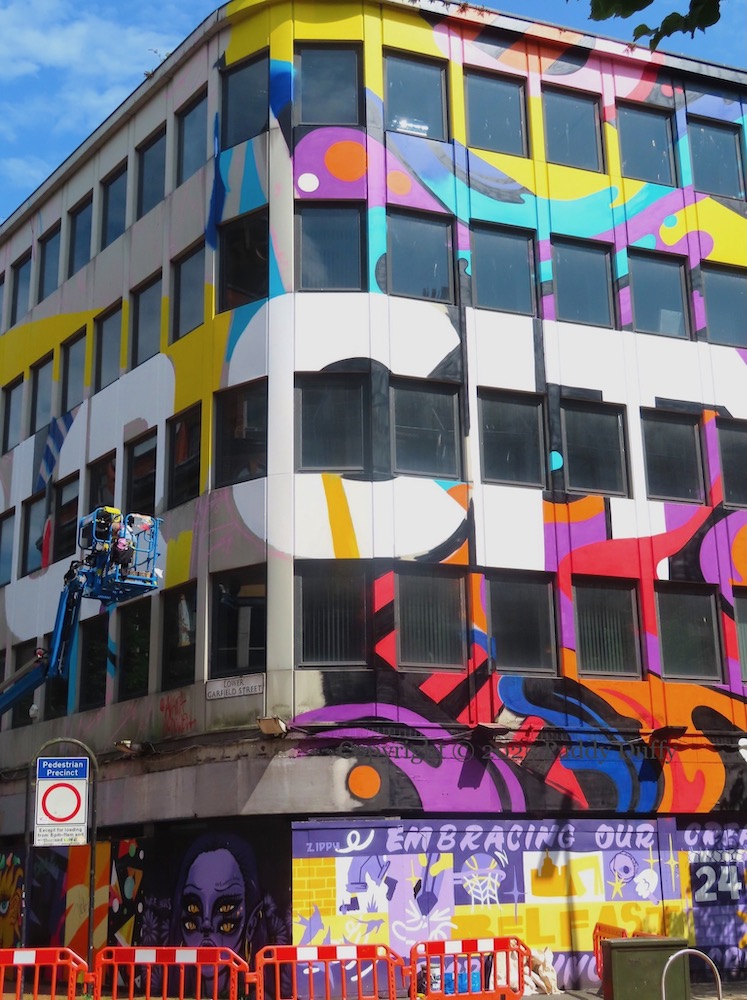
Leicester House (Future Belfast), at the junction of Royal Avenue and Lower Garfield Street, and the adjacent Hampden House (Future Belfast), on Royal Avenue. Both buildings (51-63 Royal Avenue) are vacant (the Leicester since 2016) and are part of the long-awaited Tribeca redevelopment – see 2019’s To Be Continued. In the meantime, the façades of the buildings have been given a facelift by Alana McDowell (ig). Below are three in-progress shots from June 20th.
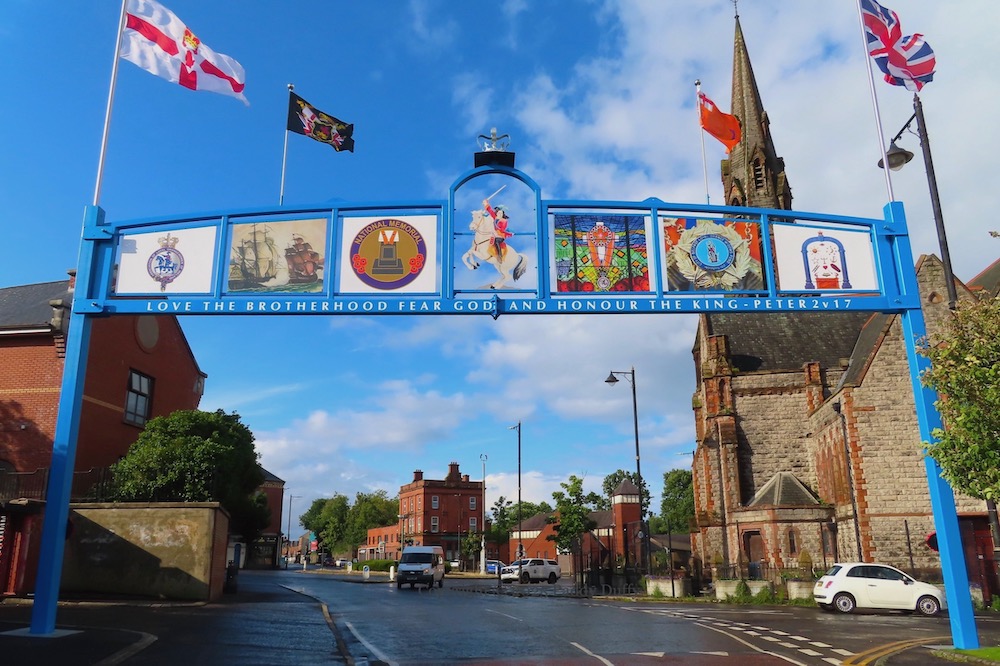
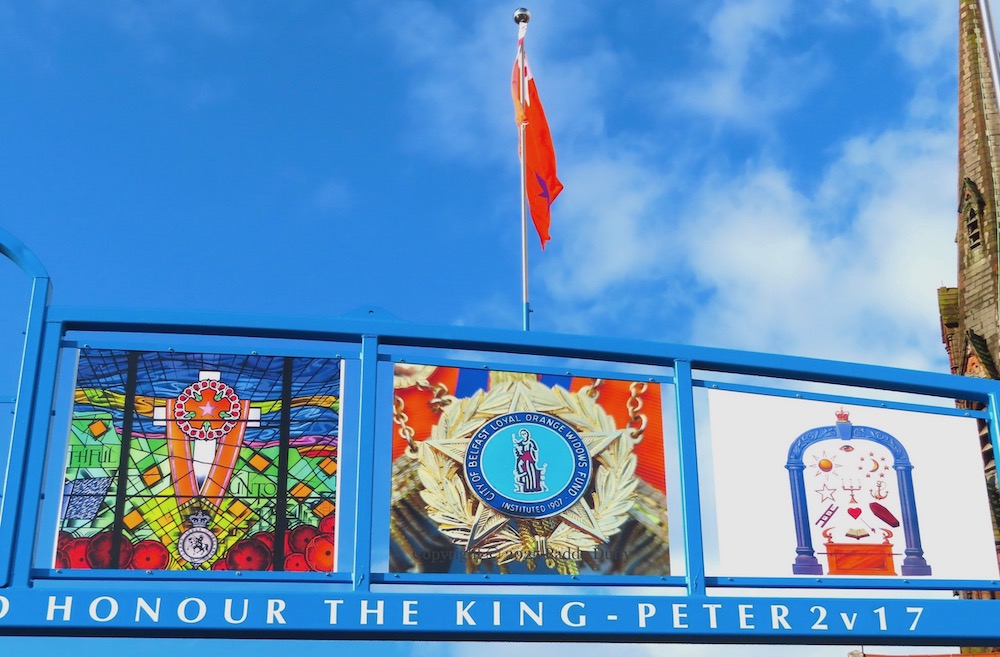
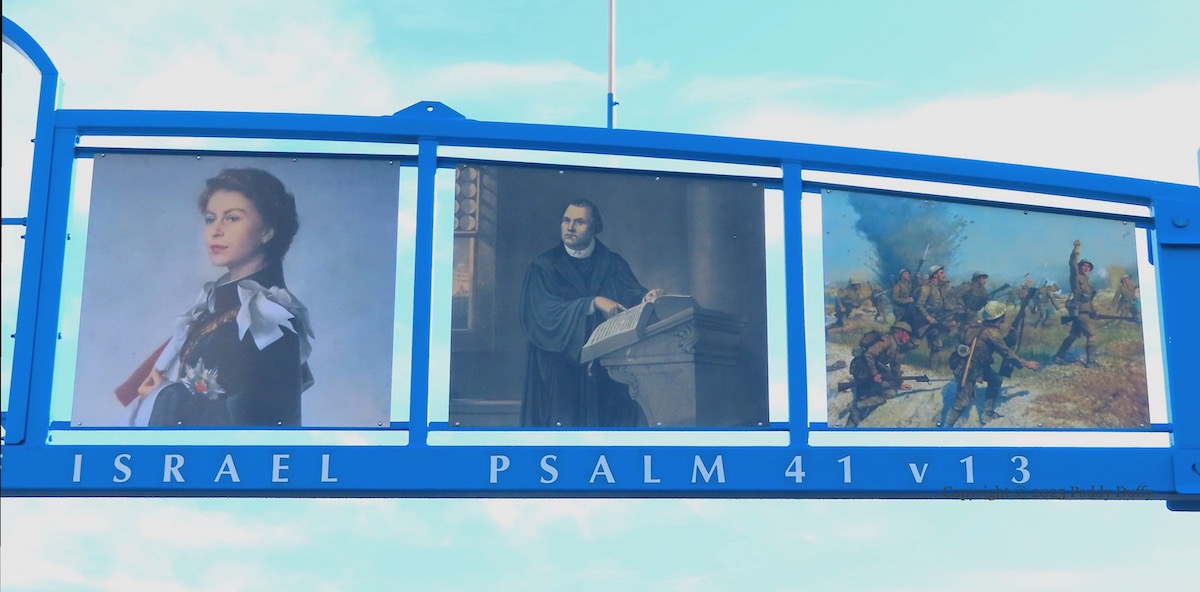
The Denmark Street arch (at the top of the lower Shankill estate and next to the Clifton Street Orange Hall) returns for the 2025 marching season.
For each of the 12 panels, see Upward. Each side of the arch features a quote from scripture: on the outside, “Blessed be the Lord God of Israel – Psalm 41 v. 13”, and on the estate side “Love the brotherhood, fear God, and honour the King – [1st] Peter 2 v. 17”
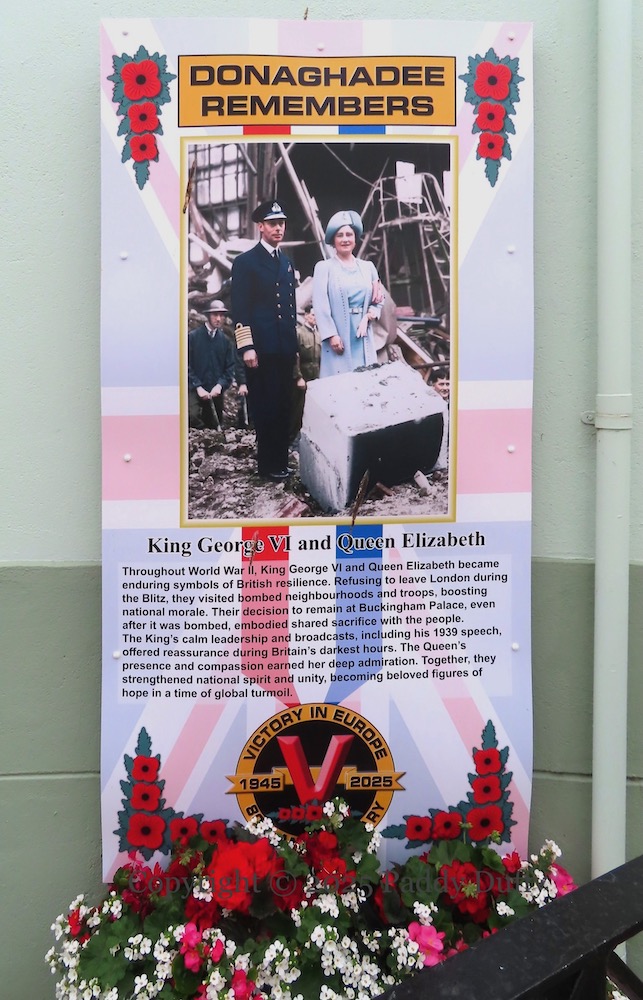
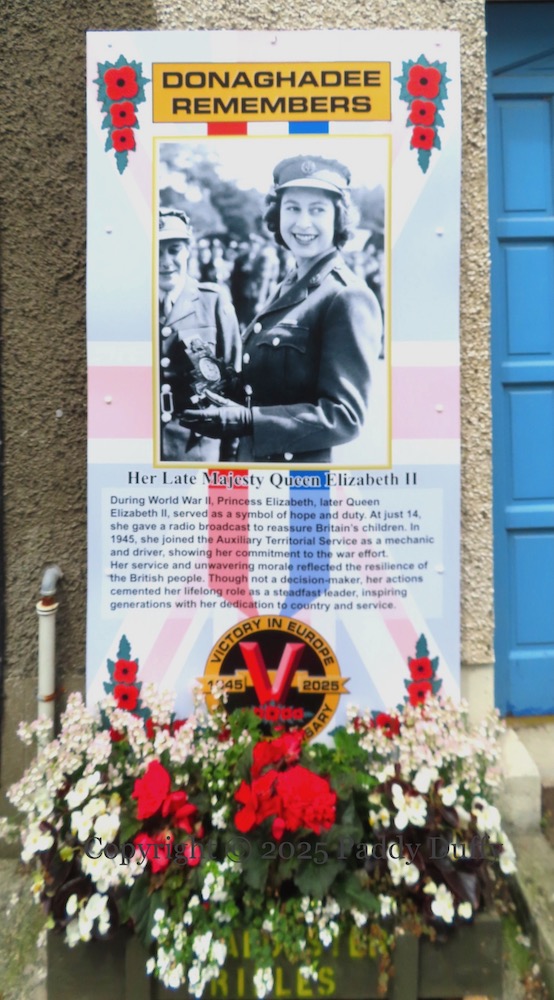
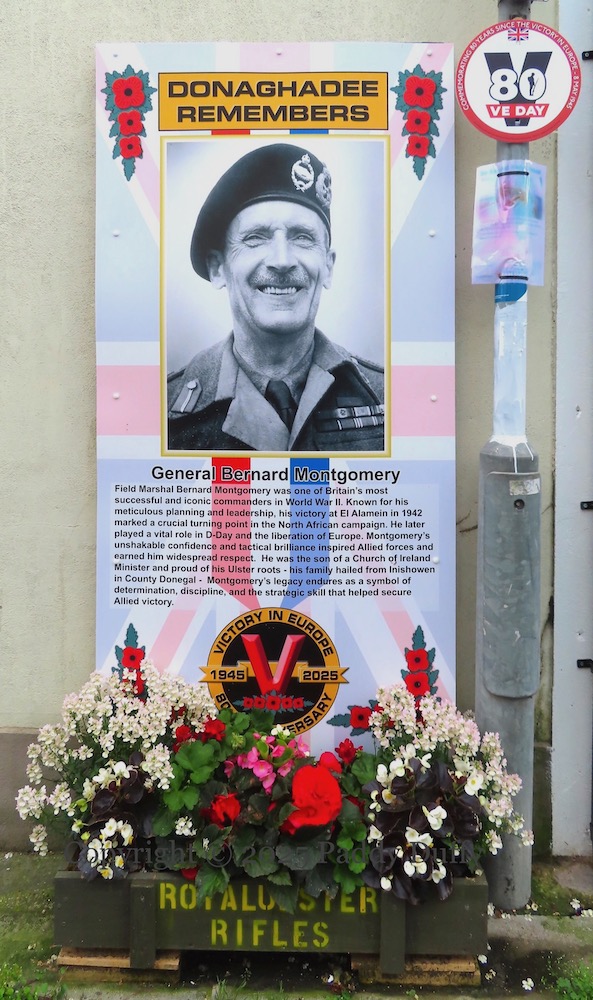
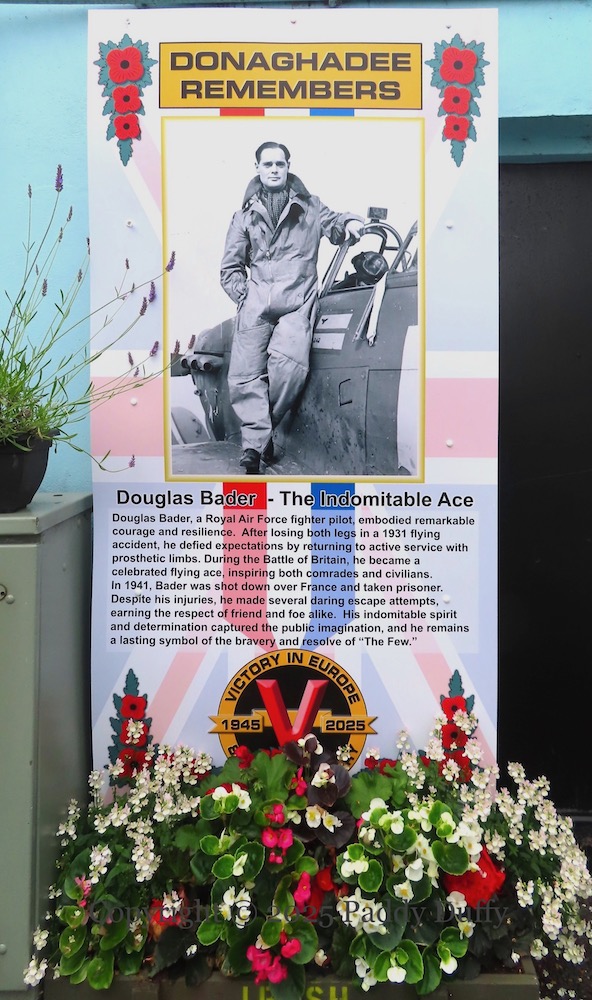
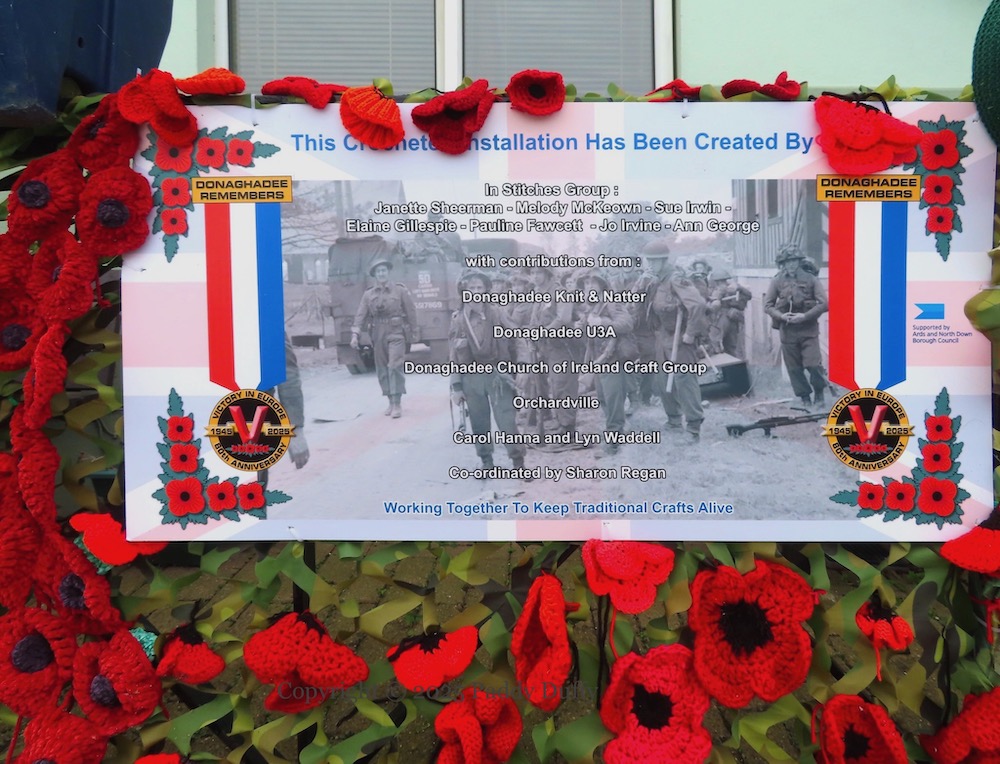
As part of the town’s VE Day celebrations, Donaghadee mounted a series of flower boxes, information boards, and crocheted poppies, along Hunter’s Lane (which runs between High Street and the Parade). Also included are small panels to twenty-three local soldiers who died during the War.
“Donaghadee Community Development Association [Fb], in collaboration with Donaghadee Community Partnership, Donaghadee Historical Society [Fb] and the In Stitches Group, is proud to present this floral and educational display in commemoration of the 80th anniversary of Victory in Europe. With support from Ards and North Down Borough Council, First Presbyterian Church, Abbeyfield, Wesley Housing and local residents, this project brings history to life in the heart of our town. / On 8th May 1945, the guns across Europe fell silent. After six years of devastating conflict, Nazi Germany surrendered unconditionally, marking the end of the Second World War in Europe. VE Day – Victory in Europe Day – was met with celebration, relief, and solemn reflection. Across the United Kingdom and the Commonwealth, crowds rejoiced, even as they grieved for the fallen and the irrevocable loss left in war’s wake. This display honours the 23 men and women from Donaghadee who gave their lives in service during World War II. We remember them with pride, gratitude, and sorrow. Through a series of commemorative panels, we also highlight the stories of eight wartime figures – from global leaders to everyday heroes – whose courage shaped history. / This is more than an remembrance. It is a space to reflect, to learn, and to give thanks. As we mark this significant anniversary, we commit ourselves anew to the values of peace, unity, and understanding. Let us remember – not only what was lost, but also what was won: the enduring freedom we enjoy today.”
The eight notable figures are: “Winston Churchill, the voice of defiance”, “King George VI and Queen Elizabeth”, “Her late majesty Queen Elizabeth II”, “Dame Vera Lynn, the forces’ sweetheart”, “Lt Col Blair Mayne, SAS trailblazer”, “Violette Szabo, the courageous spy”, “General Bernard Montgomery”, “Douglas Bader, the indomitable ace”.
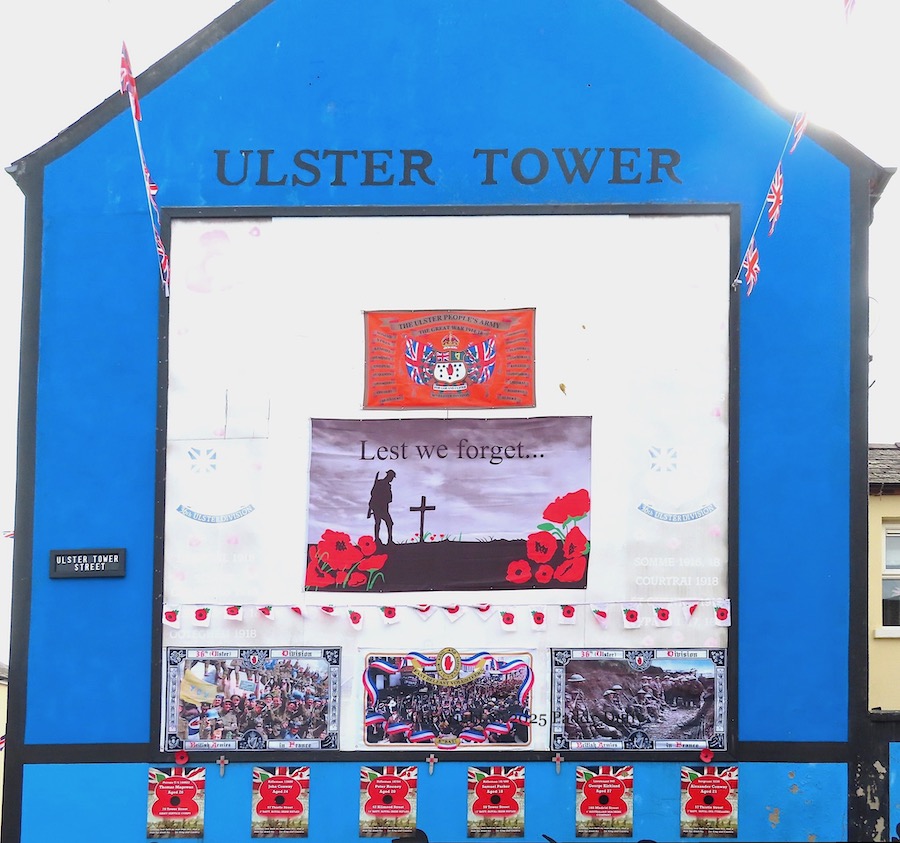
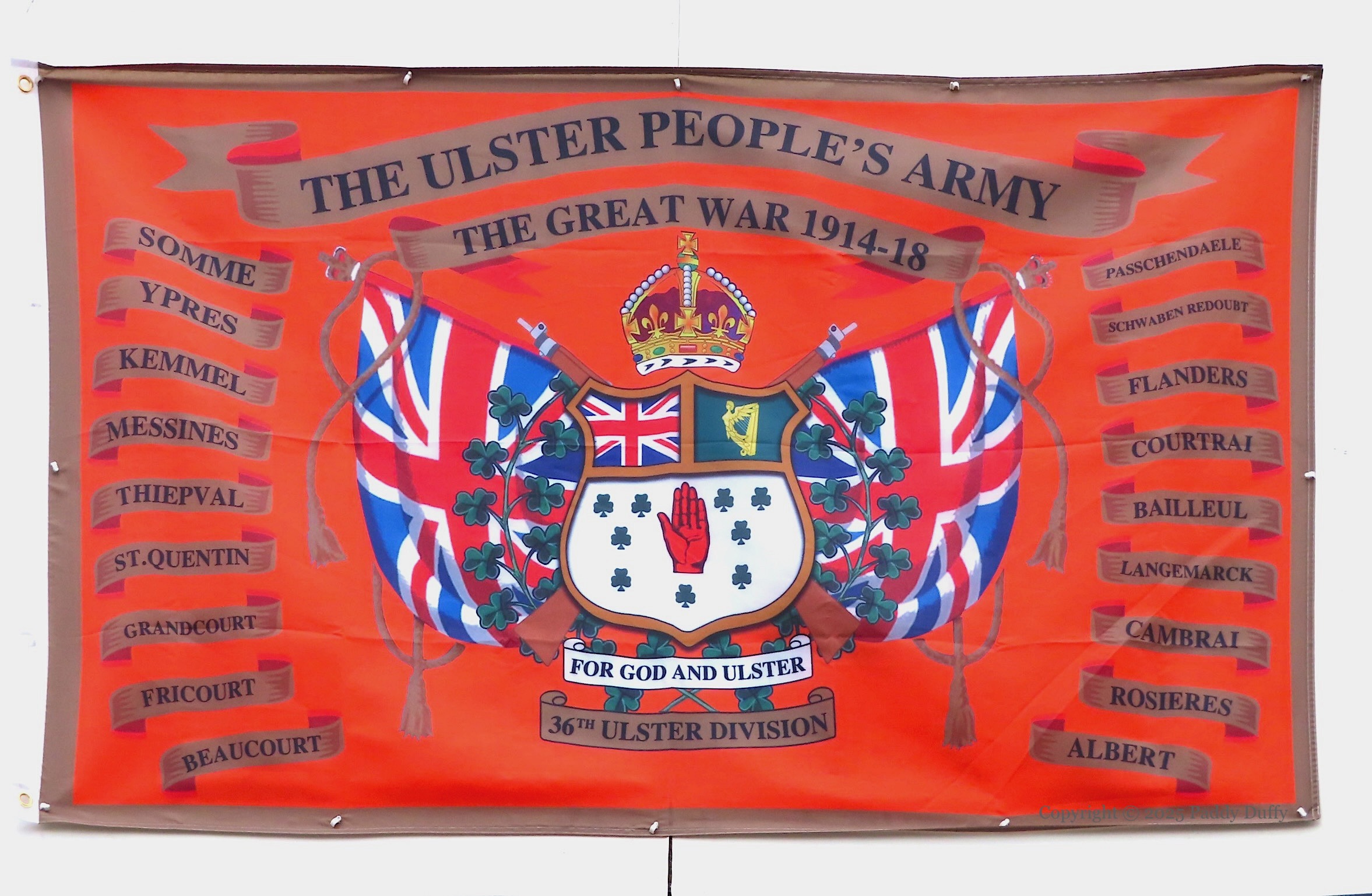
The image of the Ulster Tower at Thiepval in (Ulster) Tower Street, east Belfast, has now faded beyond recognition (see 2022 | 2016) and so been covered over with a variety of flags affixed to the wall.
First is “The Ulster People’s Army – the Great War 1914-18”, then a graveside mourner, and then three along the bottom, two from a series of “British Armies In France” showing images of the Royal Irish Rifles (with, unusually, the leek standing for Wales in the quartet of national flowers) and these two flanking a third showing the East Belfast regiment of the Ulster Volunteers transformed into the 8th battalion of the RIR (107th brigade, 36th Division), marching past a throng on their way to fight “for King and empire”.
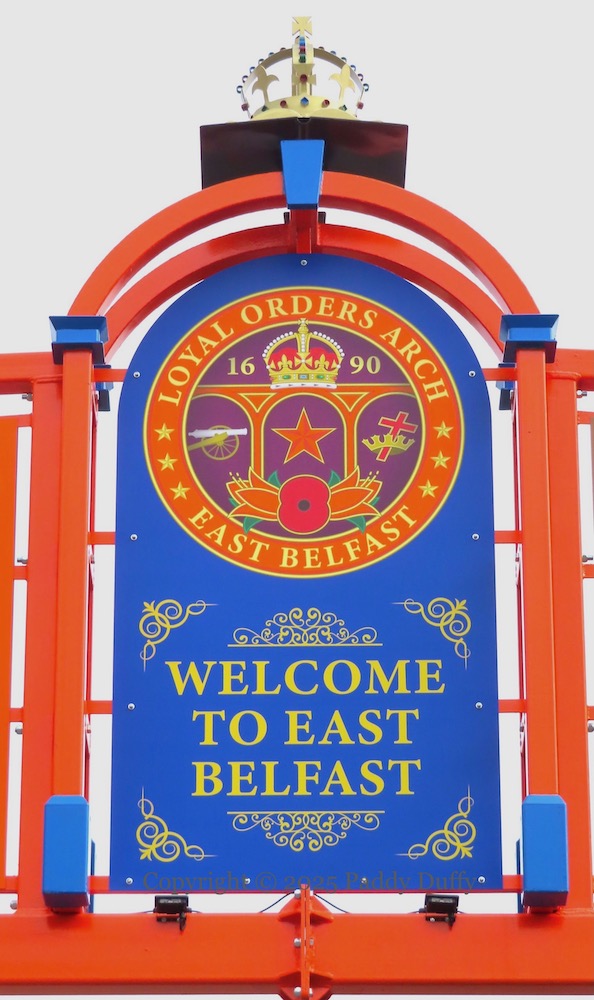
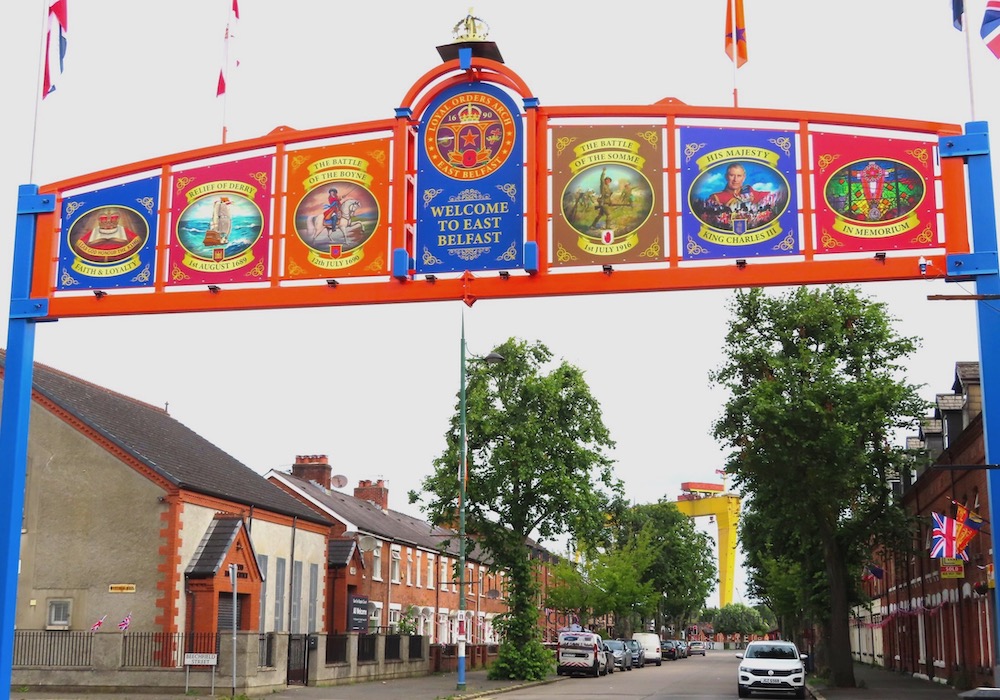
The News Letter reports that the new arch at the junction of Templemore Avenue and Beechfield Street is the first new arch in east Belfast for fifty years (News Letter). There was long ago an arch in Dee Street (Fb).
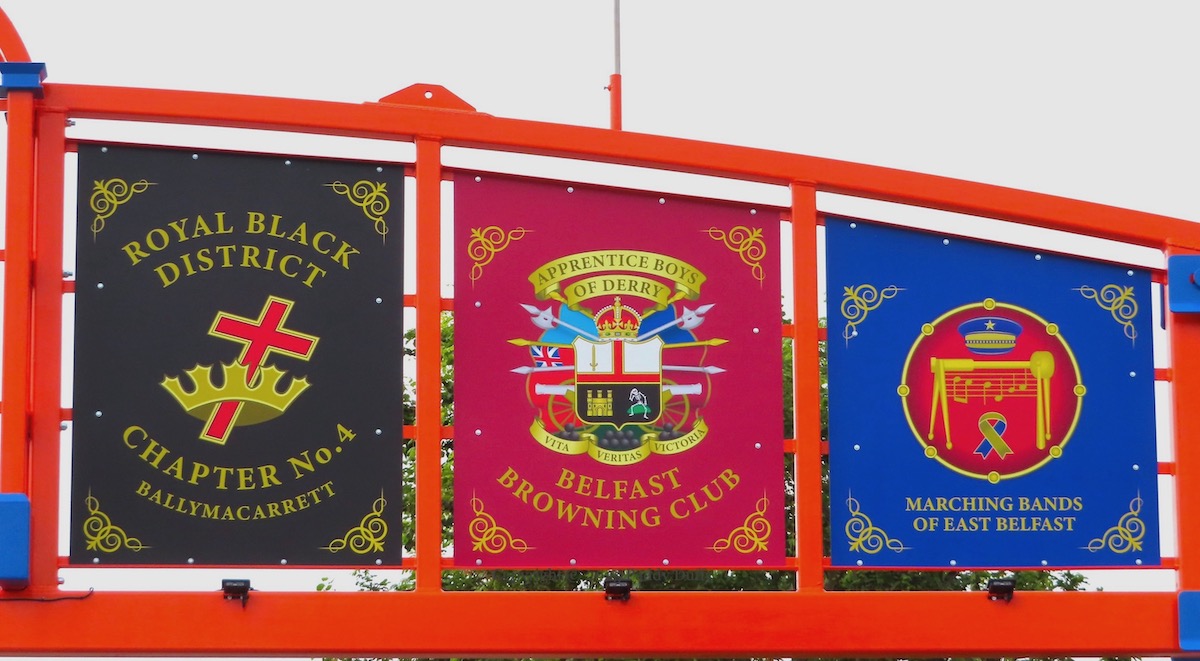
On the northern side are the emblems of local lodges – Ballymacarrett Junior District LOL No. 3, Royal Arch Purple District Chapter No. 6, Ballymacarrett District No. 2 Women’s LOL, Ballymacarrett District LOL No. 6, Royal Black District Chapter No. 4 Ballymacarrett, Apprentice Boys Of Derry Belfast Browning Club – as well as “Marching Bands of east Belfast”.
On the southern side, we see (l-r) “Faith & Loyalty”, the Relief Of Derry, the Battle Of The Boyne, JP Beadle’s painting of the 36th Division going over the top at the Battle Of The Somme, King Charles III, the stained-glass window in Schomberg House in memoriam (not: “in memorium”) murdered OO members.
The arch was officially dedicated on June 30th. Ballymacarrett Orange Hall is a bit further down Templemore Avenue, on Albertbridge Road.
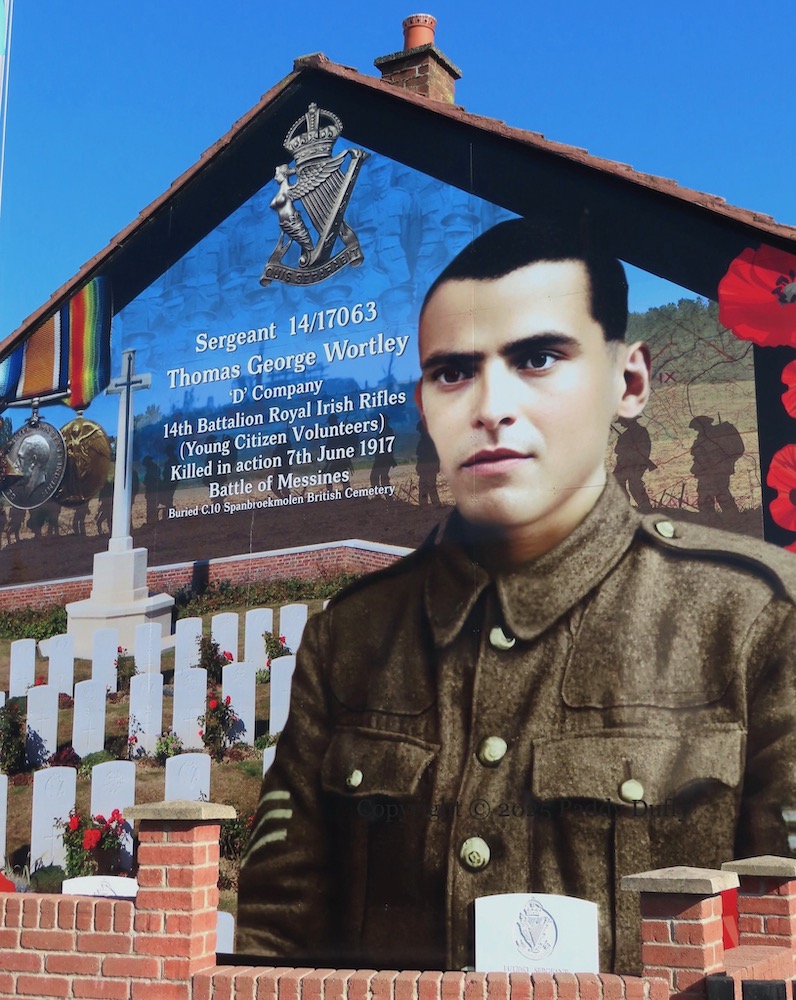
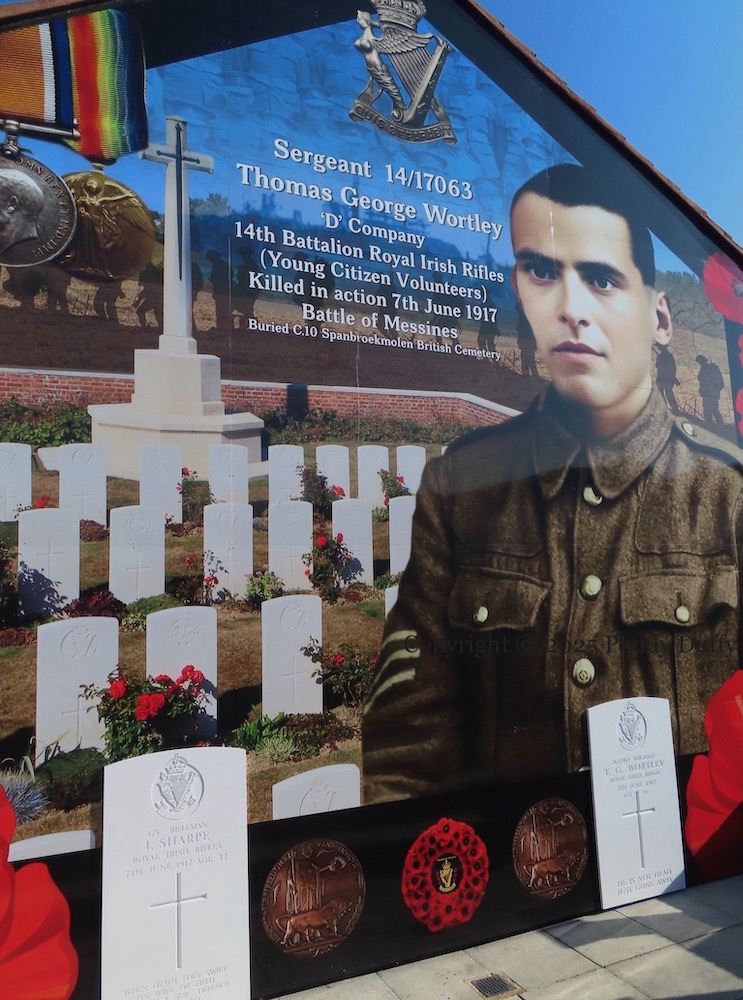
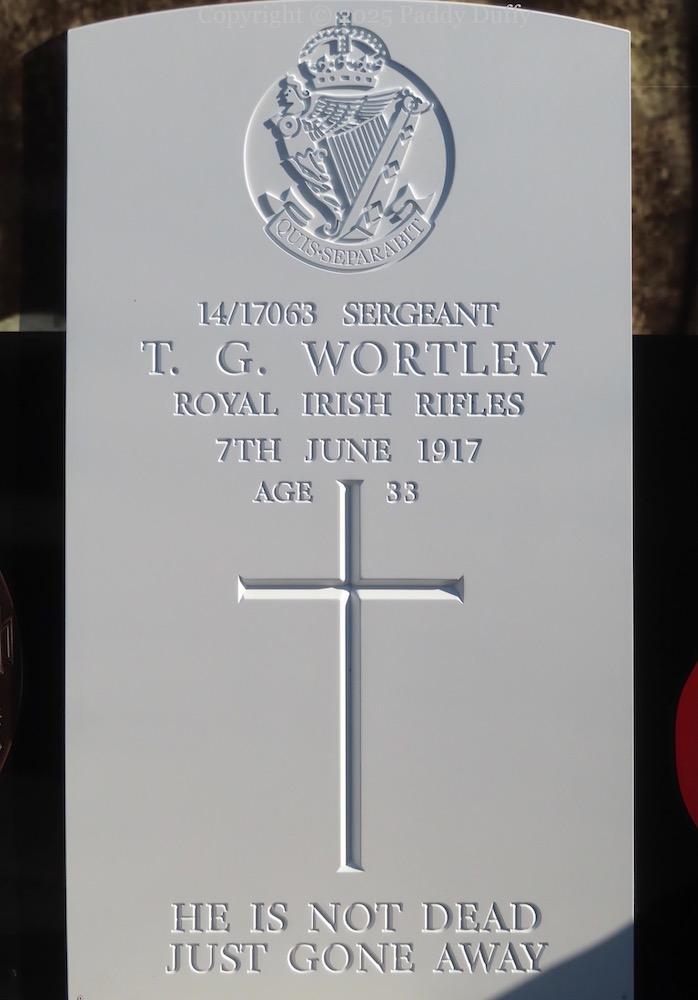
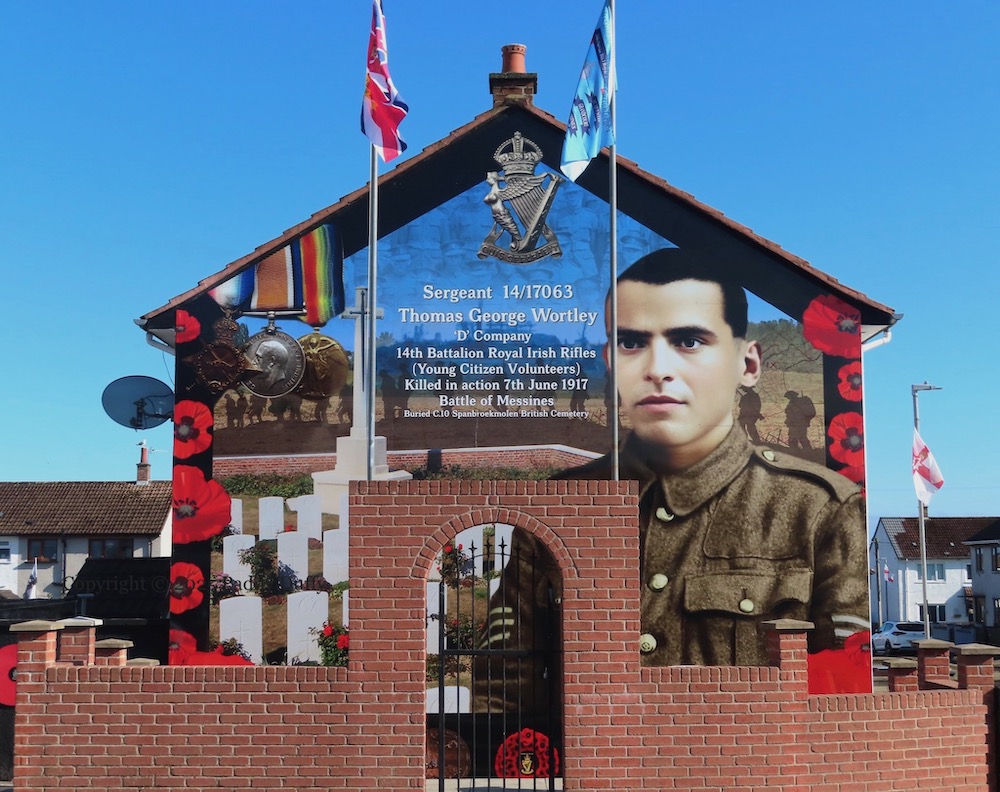
“Sergeant 14/17063 Thomas George Wortley ‘D’ Company 14th Battalion Royal Irish Rifles (Young Citizen Volunteers). Killed in action 7th June 1917 Battle of Messines. Buried C.10 Spanbroekmolen British Cemetery.”
Wortley was born in Carrickfergus and lived in Belfast. He (and James Sharpe, also from Carrick) was killed on the first day of the battle at Messines (findagrave) and buried in a small cemetery of British soldiers, many from the 36th (Ulster) Division, in Spanbroekmolen on the Ypres Salient in Flanders (WP) – shown in the mural. He is remembered in Carrickfergus with a parade each year on the date of his death (carrickfergusrollofhonour).
The medals in the top left are Pip, Squeak, and Wilfred (that is, the 1914 Star, for service in France or Belgium, the War (service) medal, and the Inter Allied Victory medal) (Identify Medals). The ‘Dead Man’s Penny’ memorial plaque (WP) appears next to the gravestones.
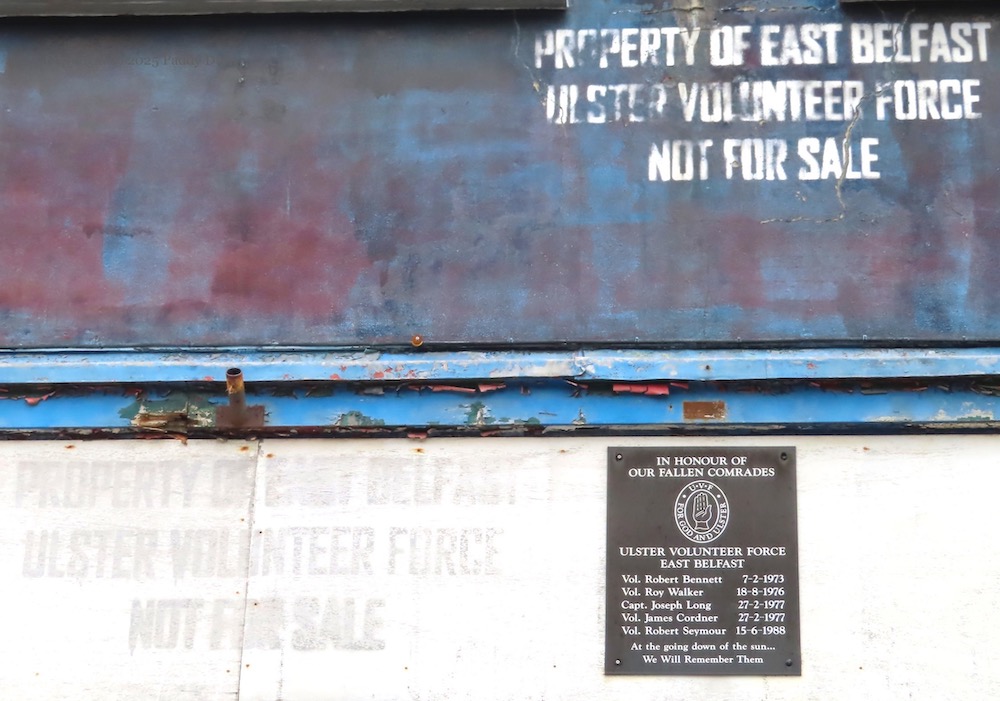
This notice is on the outside of the Belvoir Bar in east Belfast: “Property of east Belfast Ulster Volunteer Force – Not for sale” alongside a plaque to “fallen comrades” Robert Bennett, Roy Walker, Joseph Long, James Cordner, and Robert Seymour. It seems that the bar has been shuttered since 2011 (Belfast Telegraph | Irish Times).
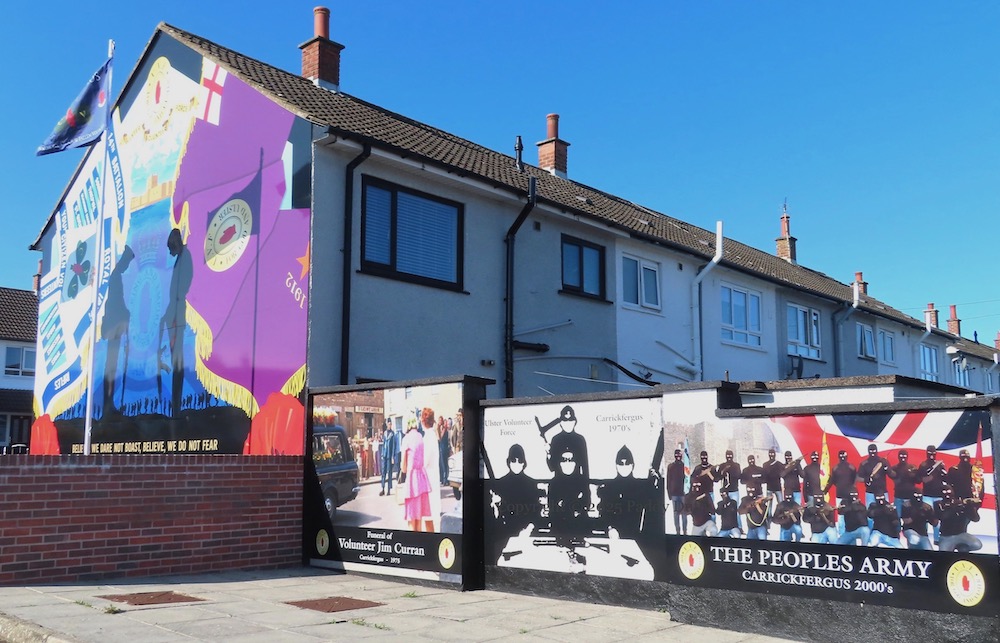
Rudyard Kipling’s 1912 poem ‘Ulster’ (Kipling Society) predicts destruction for Protestants under Home Rule and calls for violent resistance, even if it means sacrificing one’s own life: “Believe, we dare not boast/Believe, we do not fear/We stand to pay the cost/In all that men hold dear”.
As is well known, the Ulster Volunteers were founded and smuggled in weapons, but before they could be used, the Great War began and the Volunteers signed up for Kitchener’s Army – the flag on the left includes the battles in which the Central Antrim Regiment of the Royal Irish Rifles (as part of the 36th Division) participated, fighting “For King and Empire”.
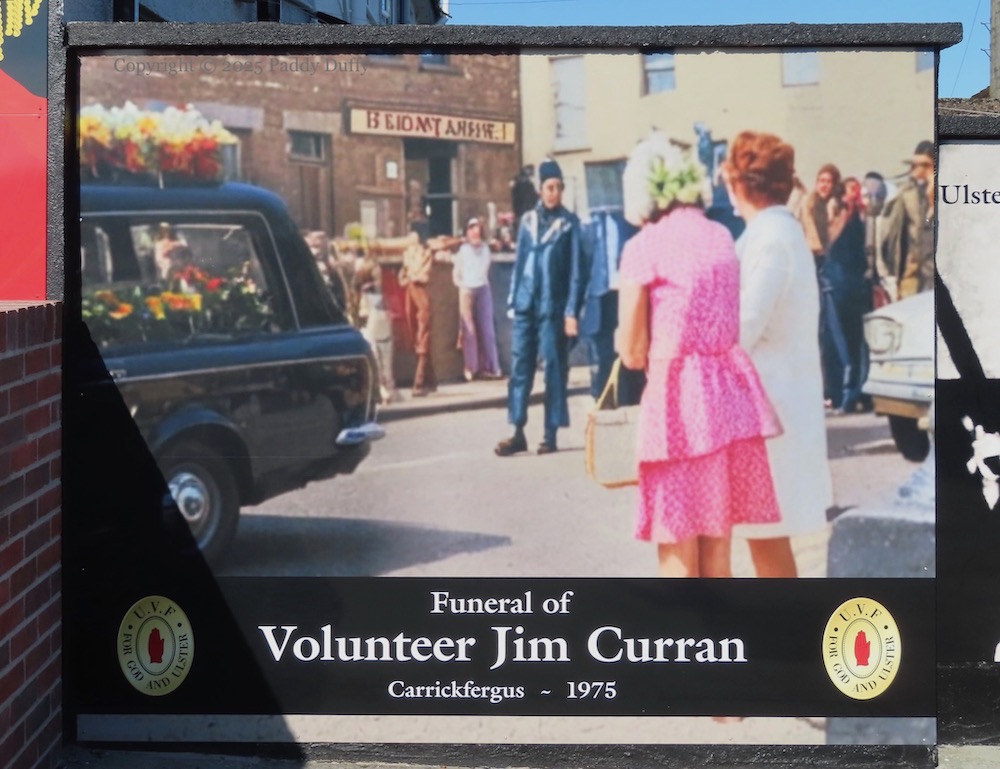
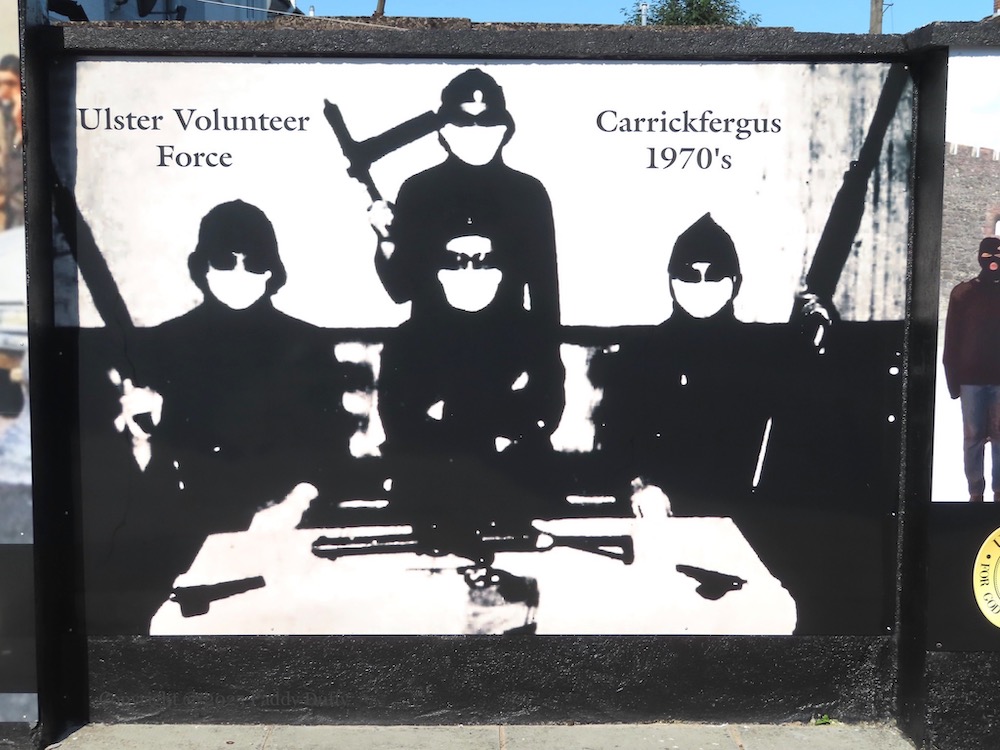
The graveside mourner on the right, the 1st East Antrim Battalion UVF, and all of the smaller panels on the right, belong to the Troubles era. There is no information about Jim Curran in 1975; the image of Curran’s funeral appears to be AI-generated.





























 Paddy Duffy Collection