James “Jim” Doherty was six years old when he was shot while playing in the front garden of his Turf Lodge home in 1972. Relatives For Justice and the family launched the board shown above at the entrance to the estate ten years ago – in October 2015 – in order to push for an inquiry into the death due to the insufficiency of the original investigation and the disappearance of the bullet taken from the body. (Belfast Media Group)
Michael Gaughan and Frank Stagg are presented along with the ten deceased 1981 hunger strikers on the cross-beam of a large wooden “H” at the top of Turf Lodge.
IRA volunteer Michael Gaughan died in Parkhurst prison in 1974 after 64 days on hunger strike. Gaughan’s coffin was draped with the Tricolour used to bury Terence McSwiney in 1920. He was force-fed seventeen times during the strike and his family alleged that he died from food stuck in a punctured lung. The practice was ended after Gaughan’s death.
Frank Stagg was on the Parkhurst hunger strike with Gaughan, and another in Long Lartin prison, and a third in Wakefield in December 1975. He died after 62 days on February 12th, 1976.
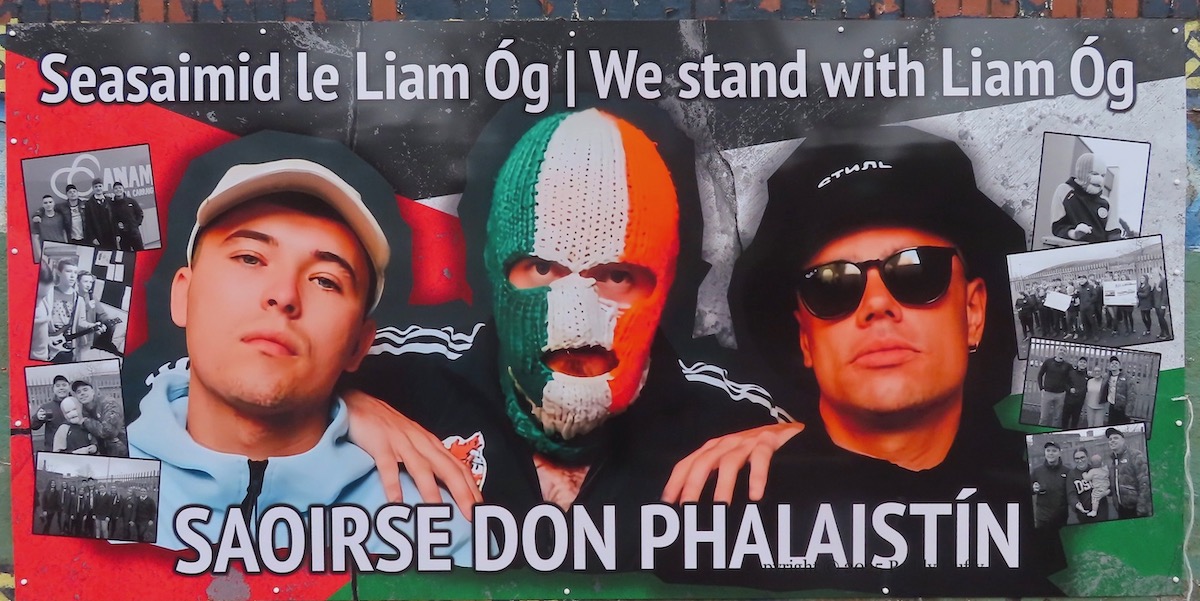
“We stand with Lıam Óg”, that is Lıam Óg Ó hAnnaıdh (on the left of the image above), a.k.a. Mo Chara, a member of the rap group Kneecap who appeared in court (in London) on Wednesday August 20th on “terrorism” charges and was bailed for a further month while the judge rules on a technical issue about whether the trial can go forward (BBC). (See previously The Magic Within and Seasaımıd Le Kneecap.)
The night before (the 19th) this board featuring images of the band-members and the band in its early days was unveiled on the Whiterock Road. (Video of the launch can be found on the Glór Na Móna instagram account.)
In the background is a Palestinian flag and “Saoırse don Phalaıstín” [Freedom for Palestine] is written along the bottom.
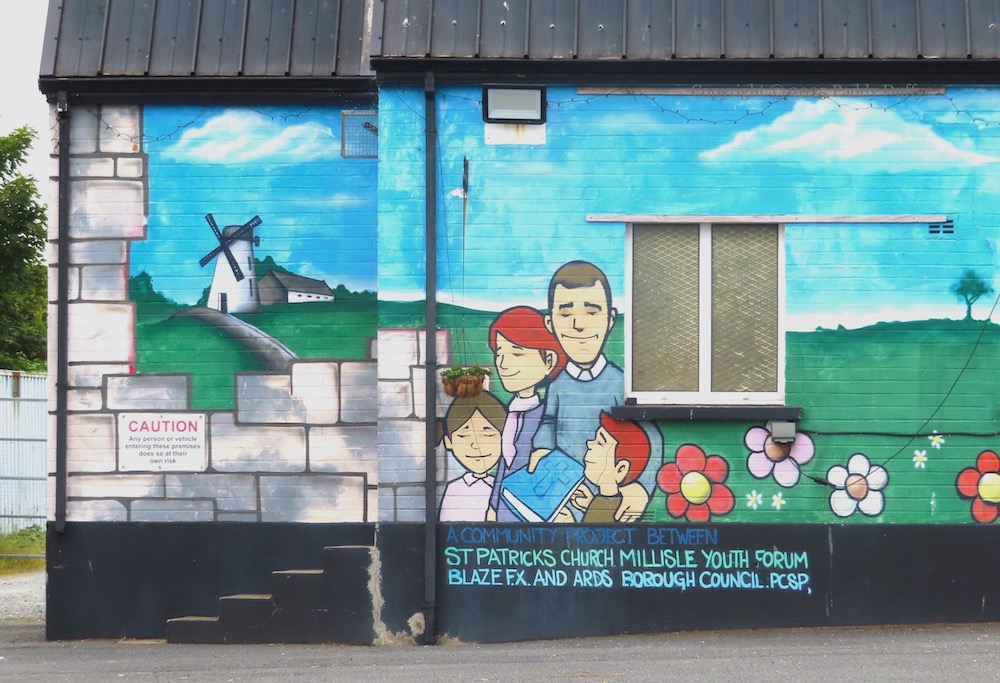
Ballycopeland windmill, about a mile from Millisle, was built around 1790 (Geograph) and has been restored and expanded with an interpretative centre; the centre and first floor of the mill are open to the public (Discover NI).
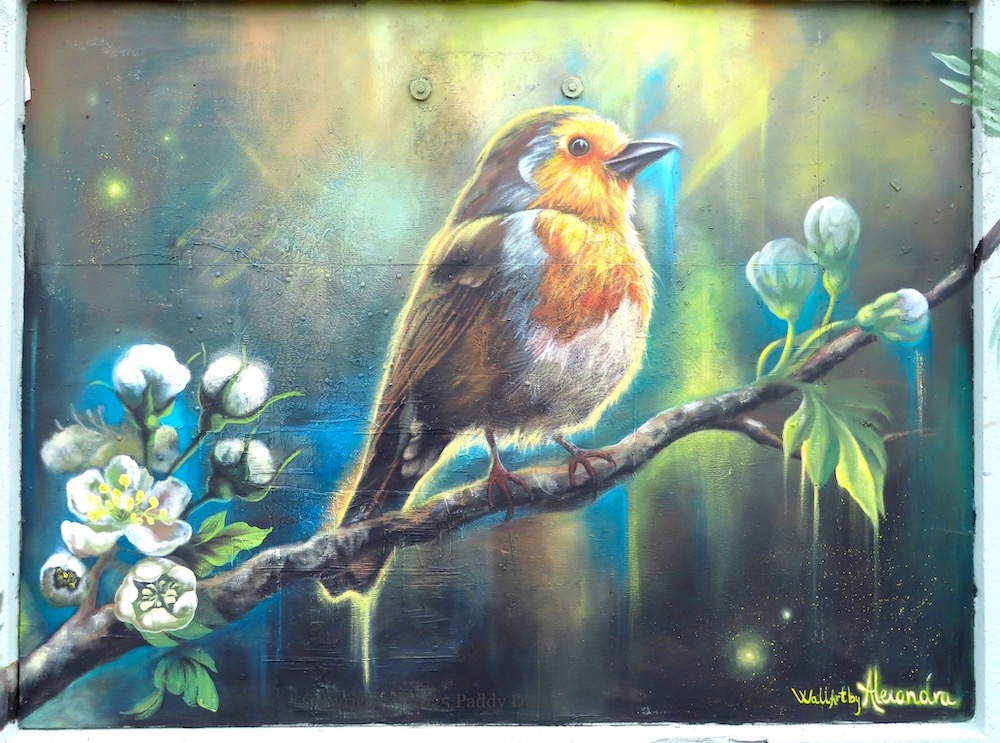
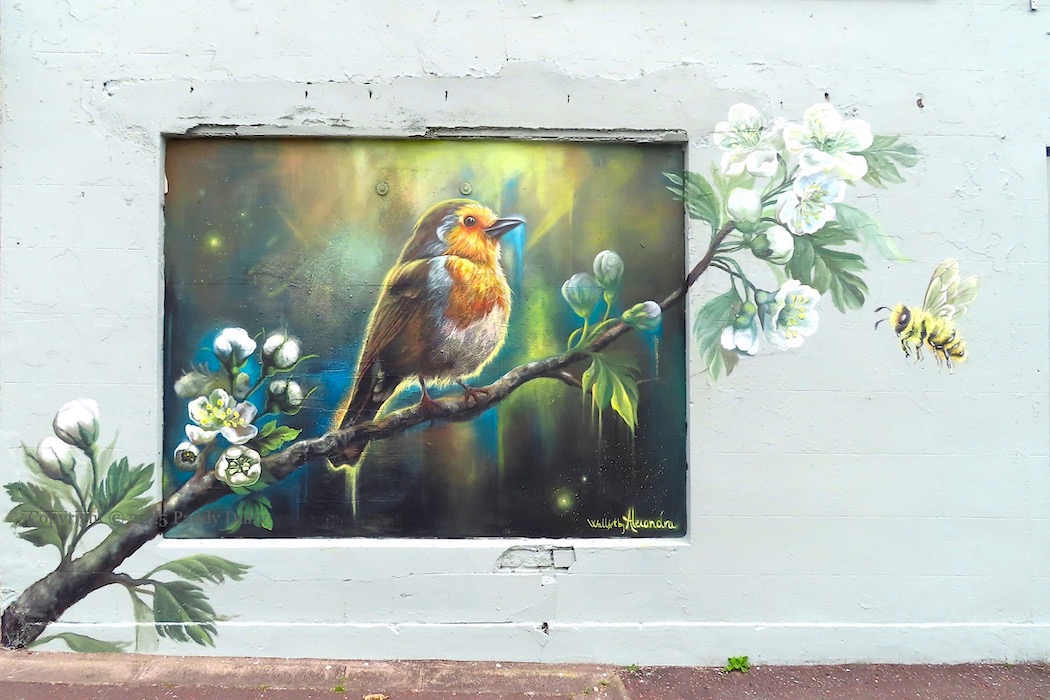
These paintings of the windmill and of a robin and bee are by Alexandra (ig) on two derelict buildings on Main Street, Millisle.
The streets of the West Winds estate in Newtownards are named after RAF aircraft: Lysander, Beaufort, Shackleton, Valetta, Sunderland, Catalina, Auster, Canberra, Lancaster, Dakota, Hampton, Stirling, Blenheim, Anson, and Halifax. (See 50 Years And Counting for a picture of the aircraft.)
The first units built in the estate, in 1970, were Canberra Gardens and Blenheim Drive, just off the Comber Road.
“English Electric Canberra – bomber, photo-reconnaissance, trainer, interdictor, radio countermeasures, drone & target tug … the world’s first jet bomber … first jet aircraft to make a nonstop transatlantic flight … world altitude record”
“Bristol Blenheim – light bomber, night bomber, aerial reconnaissance, heavy fighter, maritime patrol & trainer … the fastest light/medium bomber in the world”
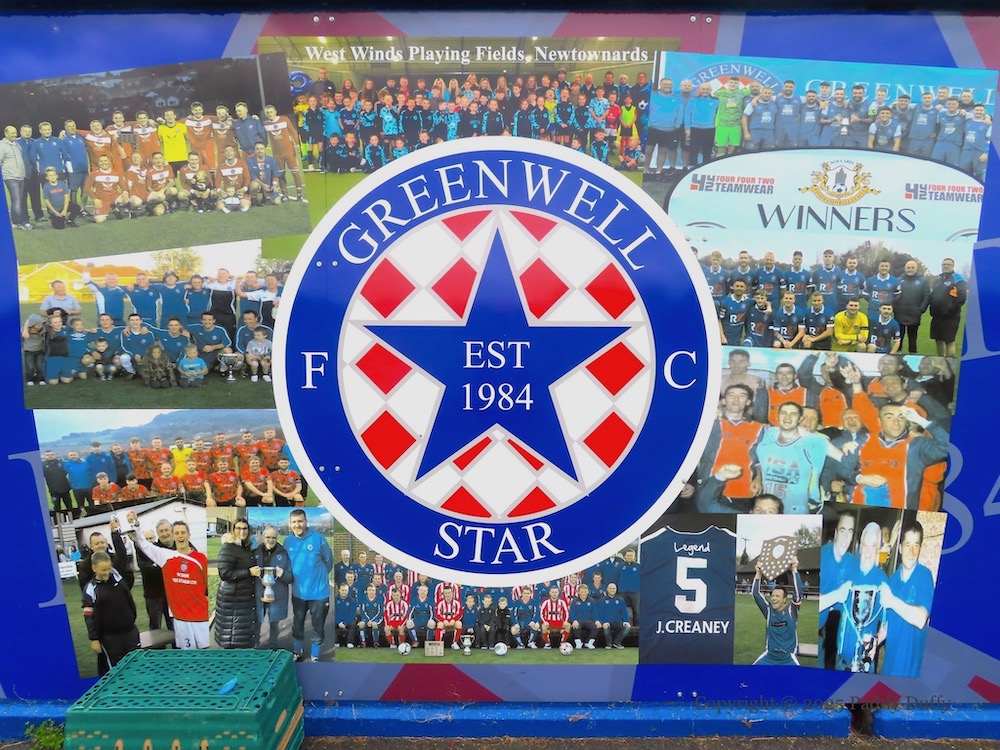
Also celebrated is flautist James Galway, whose parents lived in the estate for a time, and Greenwell Star (Fb) – “Bridging communities through football”. Club members were involved in painting over the UVF mural on the side of the club’s changing-rooms in March (Fb), in preparation for the new board being mounted in April.
West Winds Development Association and Newtownards Cultural Society with support from the Housing Executive (Newtownards Chronicle)
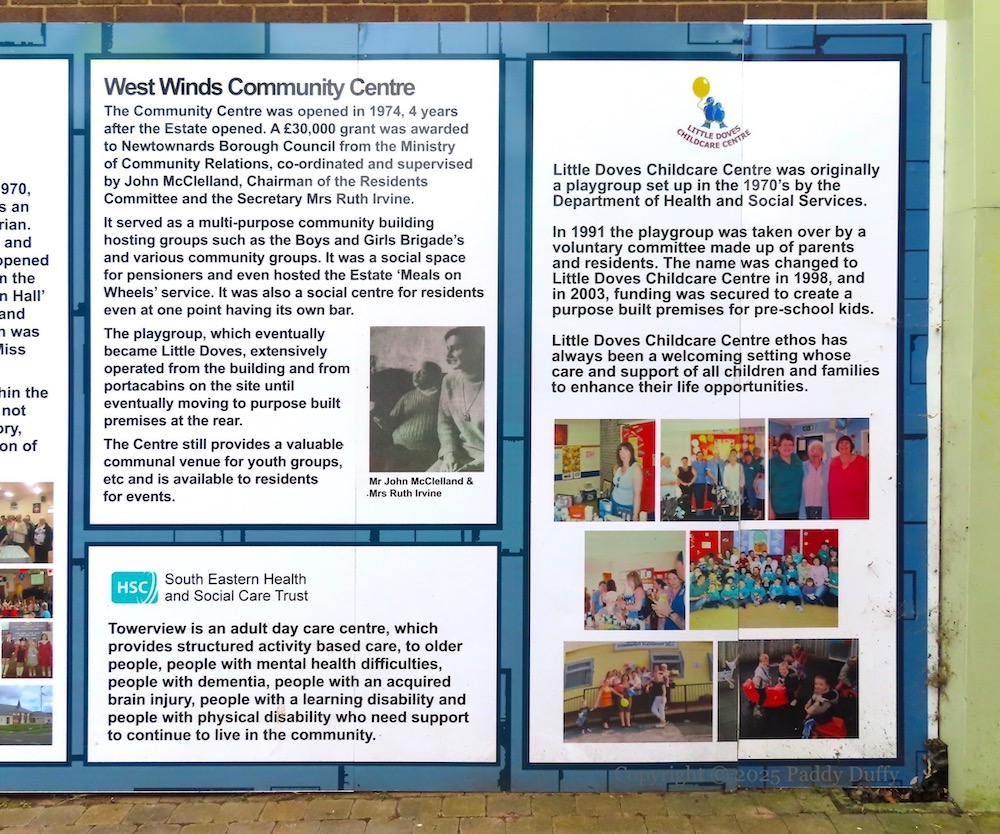
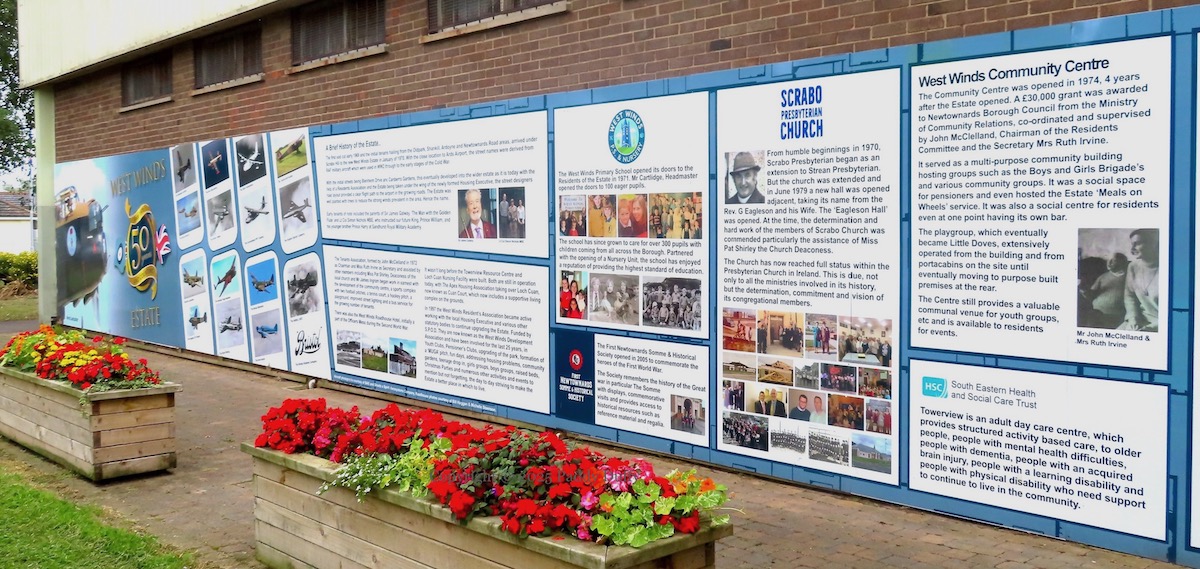
West Winds received its first residents back in 1970 but celebrations of the estate’s fiftieth anniversary were made impossible by the coronavirus lockdown (Supporting Communities). The long board shown here – official title “West Winds Through The Decades” – was launched in 2022 and recounts the development of the estate and the institutions that support it.
Here (from the Fb group 50 Years Of West Winds) is an image of the area before development, which began with Canberra Gardens and the houses along the bottom of Blenheim Drive. The streets are named after RAF aircraft, as illustrated by the second panel.
The third panel gives “A Brief History Of The Estate” (included below) while others describe West Winds primary school, First Newtownards Somme & Historical Society, Scrabo Presbyterian church, West Winds Community Centre, Towerview adult care, Little Doves childcare centre.
In Shackleton Walk, with support from the Housing Executive and West Winds Development Association (Fb).
“The first sod cut early 1969 and the initial tenants hailing from the Oldpark, Shankill, Ardoyne and Newtownards Road areas, arrived under Scrabo Hill to the new West Winds Estate in January of 1970. With the close location to Ards Airport, the street names were derived from RAF military aircraft which were used in WW2 through to the early stages of the Cold War. With the initial streets being Blenheim Drive and Canberra Gardens, this eventually developed into the wider estate as it is today with the help of a Residents’ Association and the Estate being taken under the wing of the newly formed Housing Executive, the street designers’ road layout provided a clear flight path to the airport in the growing roads. The Estate was planted with trees to reduce the strong winds prevalent in the area. Hence the name. Early tenants of note included the parents of Sir James Galway, ‘The Man with the Golden Flute’ and Lt Col Simon Nichols MBE, who instructed our future King, Prince William, and his younger brother Prince Harry at Sandhurst Royal Military Academy. The Tenants’ Association, formed by John McClelland in 1972 as Chairman and Miss Ruth Irvine as Secretary and assisted by other members including Miss Pat Shirley, Deaconess of the local church and Mr James Ingram began work in earnest with the development of the community centre, a sports complex with two football pitches, a tennis court, a hockey pitch, a playground, improved street lighting and a bus service for the growing number of tenants. There was also the West Winds Roadhouse Hotel, initially a part of the Officers’ Mess during the Second World War. It wasn’t long before the Towerview Resource Centre and Loch Cuan Nursing Facility were built. Both are still in operation today, with The Apex Housing Association taking over Loch Cuan, which now includes a supportive living complex on the grounds. In 1997 the West Winds Residents’ Association became active working with the local Housing Executive and various other statutory bodies to continue upgrading the Estate. Funded by SPOD [Small Pockets Of Deprivation] They are now now known as the West Winds Development Association and have been involved for the last 25 years, in Youth Clubs, Pensioners’ Clubs, upgrading of the park, formation of a ‘MUGA’ pitch, fun days, addressing housing problems, community gardens, teenage drop in, girls’ groups, boys’ groups, raised beds, Christmas Parties and numerous other activities and events to mention but not forgetting, the day to day striving to make the Estate a better place in which to live.”
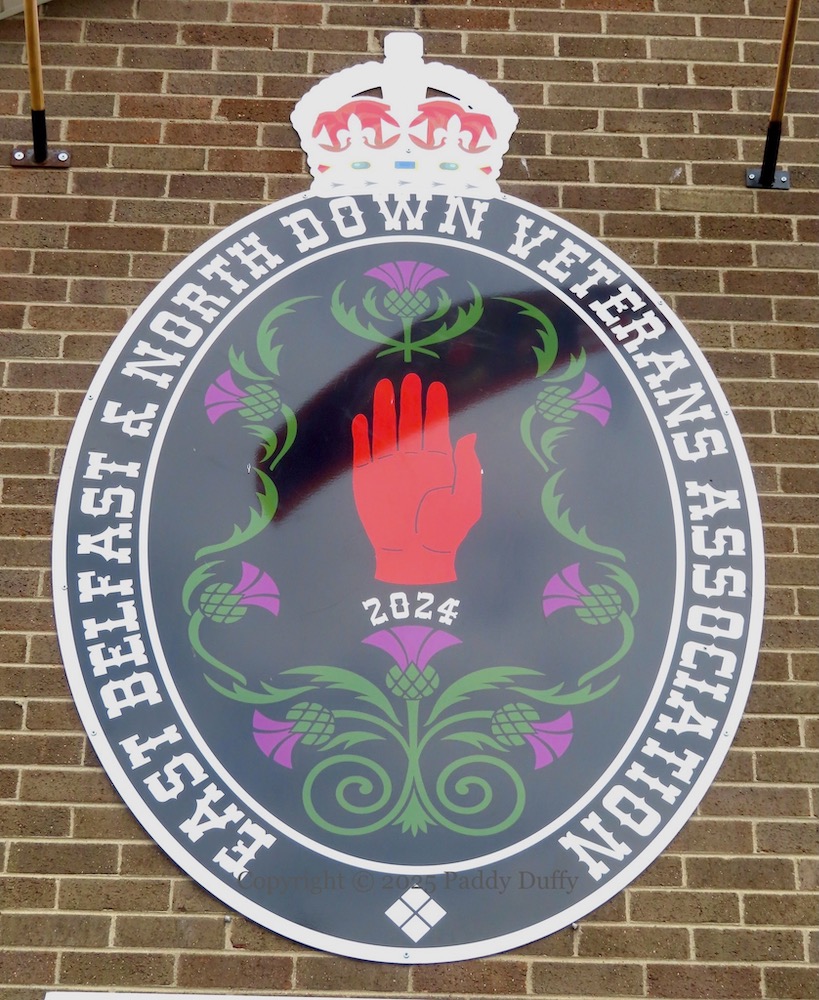
These two boards in the West Winds estate, Newtownards, were removed by the NIHE in May (BelTel) but restored in August (News Letter). One (above and immediately below) is from the First Newtownards Somme & Historical Society (old Fb page) and the other from the “East Belfast And North Down Veterans’ Association”, which does not appear to have an on-line presence.
The original NIHE statement cited in the BelTel piece mentions both the removal of paramilitary imagery and boards being placed on NIHE properties without permission. A meeting took place between the NIHE and the Somme Society which secured the return of the pieces (News Letter) and in August they were mounted again.
Blenheim Drive, Newtownards. Also included is the Society’s board on the Dakota Avenue shops.
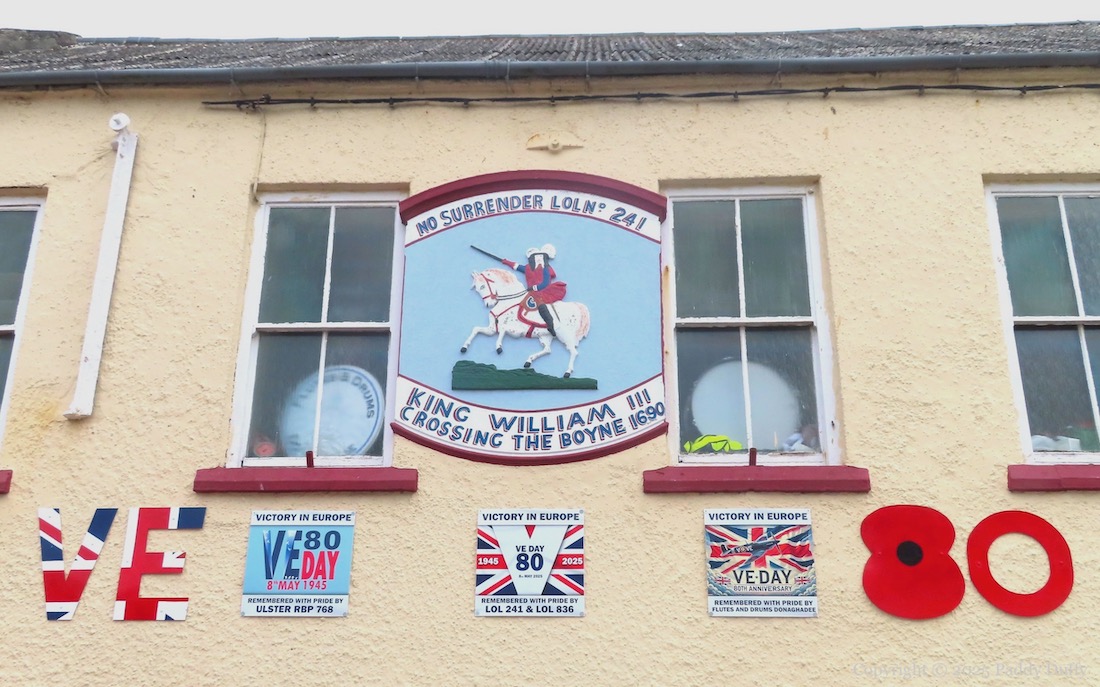
This image of King Billy crossing the Boyne in 1690 is on the No Surrender lodge (LOL 241) in Donaghadee. King William III’s victory in Ireland is celebrated annually on July 12th, with parades and gatherings of fraternal lodges and flute bands.
William’s victory is joined here by a number of small boards commemorating the 80th anniversary of Victory In Europe, on May 8th, 1945, “remembered with pride” by Orange lodges 241 and 836 (Brother Henry Ferguson Memorial), Royal Black Preceptory 768 (Ulster), and Flutes And Drums Donaghadee (Fb).
Manor Street, Donaghadee, replacing two Platinum Jubilee boards.
















 Paddy Duffy Collection