Simply The Best

Tina Turner’s cover (youtube) of Bonnie Tyler’s song “The Best” reached in the UK charts in 1989 and the phrase “simply the best” from the chorus would appear in a number of UDA murals over the years, beginning with this 1995 mural depicting hooded gunmen from the UDA/UFF’s second battalion C company.

Dover Place, west Belfast. This mural would be repainted in the Adair era to include a list of mass killings of Catholics.

Click image to enlarge
Copyright © 1995 Paddy Duffy
T00139c

Compromise Or Conflict

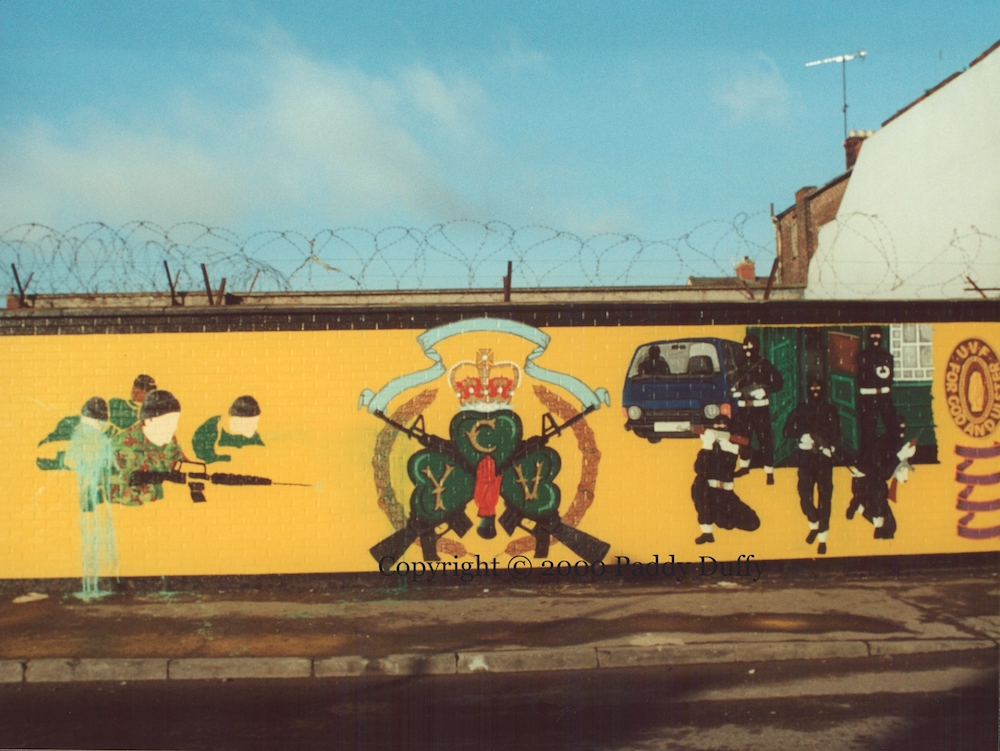
“Compromise” in “Compromise or conflict” hints at the potential of the peace process but loyalist muraling continues to present hooded gunmen (in this case from “1st battalion, west Belfast UVF”) engaged in physical-force activity. In the same vein, see Prepared For Peace, Ready For War.

The first appearance of Eddie The Trooper – a definite increase in the intensity of violent imagery – will be in 1996.

Later with a side-wall (to the right of image) that read simply “A. company / 1st battalion”

Dover Place, west Belfast

Click image to enlarge
Copyright © 1995 Paddy Duffy
T00133c

An tOcras Mór

This New Lodge mural shows people on the coast, near abandoned buildings, trying to grow crops during the period of the Great Hunger (1845-1852).

“An tOcras Mór” (a literal translation of “the great hunger/famine”) is usually (in Irish) “An Gorta Mór” or “An Drochshaol”.

The left-most and right-most figures are from Searching For Potatoes In A Stubble Field in the Illustrated London News. ILN images are a staple of Belfast muraling on the Great Hunger: see the Visual History page on the Great Hunger. (Here is a list, with links, of all of the illustrations of Ireland in ILN from the period 1845-1852.)

The two central figures, and the composition of the three women together, come from Millet’s The Gleaners. (Thanks to Jeryn Mayer for this pointer.)

Painted by “Farset Artists” – Jonny McKerr (later the street–artist JMK), Paul McCullough, Eamon Monaghan, and Dee Fitzsimons.

Click image to enlarge
Copyright © 1995 Paddy Duffy
T00181

Emigration

Irish people climb on-board ship in order to escape the Great Hunger. The mural is based on The Embarkation, Waterloo Docks Liverpool in the Illustrated London News. This is one of about nine murals painted in 1995 on the Great Hunger (Visual History).

Oakman Street, west Belfast

Click image to enlarge
Copyright © 1995 Paddy Duffy
T00180

Érıu

“Ardoyne Fleadh Cheoıl – meon an phobaıl a thógáıl tríd an chultúr” = “building community spirit through culture”.

“Eıre [Éire] (Éıru [Érıu]), a queen of the Tuatha Dé Danann, slain at the battle of Taıltean [Taılteann] (Telltown [Teltown], Co. Meath) 1698 BC.” Érıu is placed in a neolithic setting and is releasing a dove which flies off in a trail of stars. (In the repainted version, the date given is 698.)

Brompton Park, Ardoyne, Belfast

Here is the previous Ard Eoın Fleadh Cheoıl mural in this location.

Click image to enlarge
Copyright © 1995 Paddy Duffy (no date given)
T00157 [T00162]

An Gorta Mór

“When the potato crop failed causing the great hunger, people watched in despair as shiploads of food were escorted away by British troops …”. This mural combines an image from Illustrated London News (Bridget O’Donnel And Children) with five bodies faces drowning in the sea.

This is one of about nine murals painted in 1995 on the Great Hunger (Visual History).

Shaw’s Road/Rossnareen, west Belfast

Click image to enlarge
Copyright © 1995 Paddy Duffy (no date given)
T00159

The Great Hunger

A tearful eye beholds both the Great Hunger, which claimed one million lives, and, within the eye itself, the wave of emigration which took more than a million others away from Ireland.

This is one of about nine murals painted in 1995 on the Great Hunger (Visual History). The number “150” appears on the chimney and would last until 2008 and beyond.

There are two side-walls out of frame to the right, going around a corner. The first gives a list of the artists in Irish (“[Dón]al Ó Dalaıḋ, [Cıa]rán [Mac] Taírnan [sic], Brían Ó Lúaın, […]rán Ó hÉır, […]áın Mac Pháıl, [perhaps one more]” (Donal Daly, Ciaran McKernan, Brian O’Loan, […] O’Hare, […] McFall. Daly, McKernan, and O’Loan would paint the History Is Written By The Winners mural in 1996) and the second reads “Dedicated to those who died in the Great Hunger” with a Celtic cross and some knotwork.

There is also a plaque to local man Kieran Doherty, reading “Vol. Kieran Doherty T.D. Óglaıgh Na hÉıreann. Age 25. Commenced his hunger strike on May 22 and tragically died on Sunday afternoon 2 Aug 1981. Kieran was elected T.D. by the people of Cavan And Monaghan in their support of the prisoners’ campaign for political status.” This plaque would be retained when this wall became a memorial mural to Doherty in 2001.

Slemish Way, Andersonstown, west Belfast

Click image to enlarge
Copyright © 1995 Paddy Duffy
T00156 [T00208]

Weary People, What Reap Ye?

“Weary people, what reap ye? Golden corn for the stranger.
What sow ye? human corpses that wait for the avenger.
Fainting forms, hunger–stricken, what see you in the offing?
Stately ships to bear our food away, [amid the stranger’s scoffing].
There’s a proud array of soldiers — what do they round your door?
They guard our masters’ granaries from the thin hands of the poor. – Speranza”

The poetry is the first few lines of The Famine Year by “Speranza”, i.e. Lady Jane Wilde, mother of Oscar.

In the centre an aboriginal figure holds the flags of Ireland and of the Native Australians.

This is one of about nine murals painted in 1995 on the Great Hunger (Visual History).

“Painted by Síle Na Gıg & St James Youth Aug 95” in St James’s Crescent/Donegall Road, west Belfast.

Click image to enlarge
Copyright © 1995 Paddy Duffy
T00155 [T00206]

The Children Of Lear

In Irish mythology, the children of Lear were turned into singing swans for 900 years by their step-mother Aoıfe. They are then restored to human form but, being 900 years old, die immediately.

“Lır” (in Irish) is the genitive of (the Irish) “Lear” and the story is often referred to in Irish as “Clann Lır“; neither “Lear” nor “Lır” is pronounced like the English “(King) Lear”.

Painted at “Cáısc [Easter] 1995” by “Síle-Na-Gıg”.

Rockville Street, west Belfast

Click image to enlarge
Copyright © 1995 Paddy Duffy
T00154 [T00166]