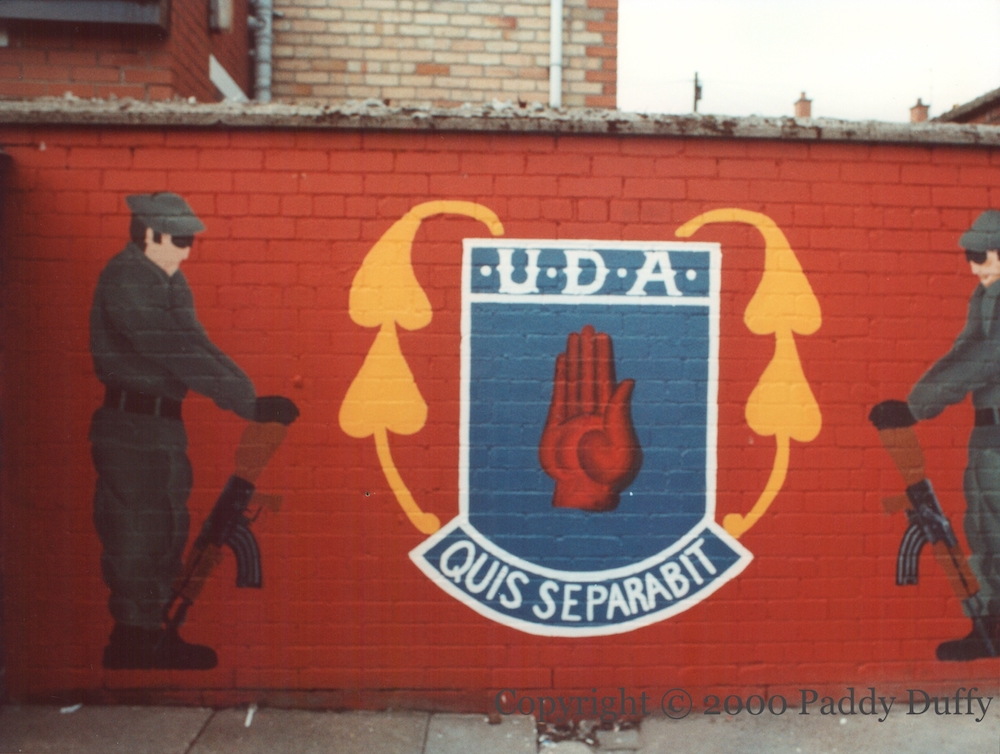
The Woodvale Defence Association (WDA) was the largest of the local associations which merged together in 1971 to form the Ulster Defence Association (UDA) and the WDA became B company of 2nd battalion (WP).
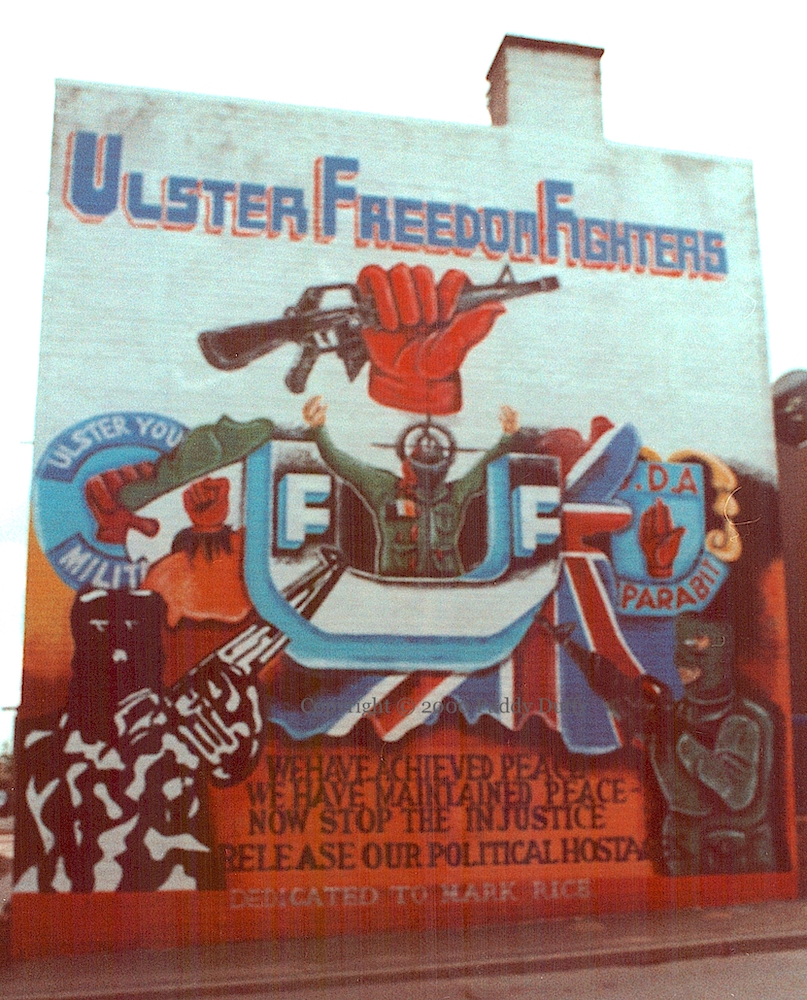
Both pieces are in Heather Street, Woodvale, west Belfast. Between the two are the words “Ulster Freedom Fighters” in large letters – see D00967.
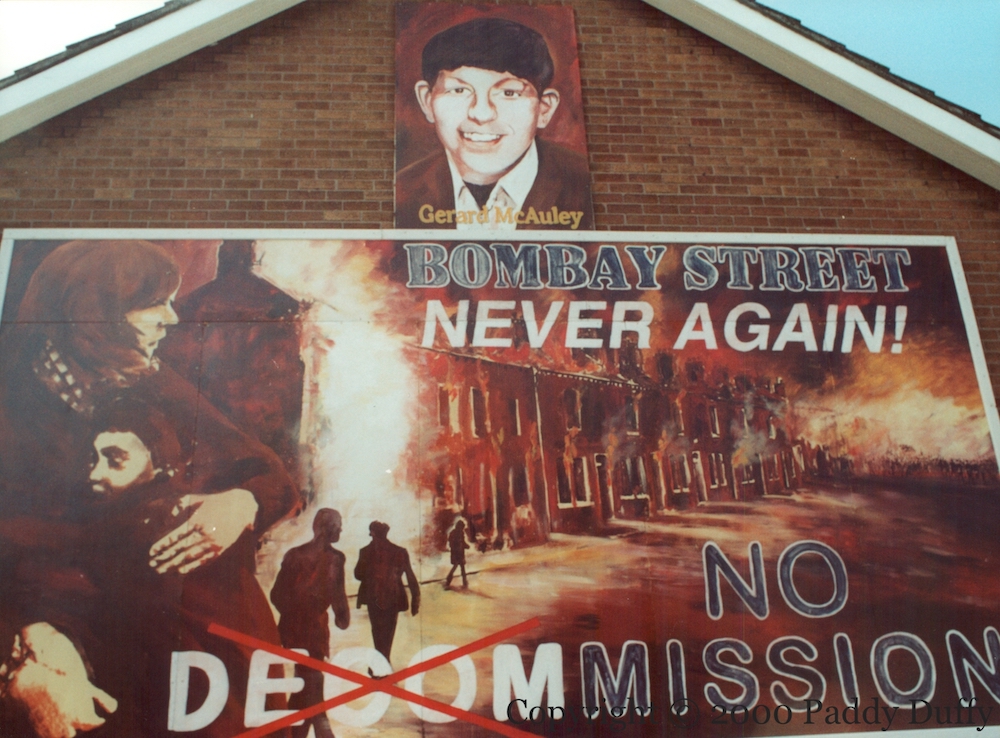
In August, 1969, families, mostly Catholic, were driven out and their homes burned in Bombay Street (and surrounding streets), between the Falls and Shankill (RTÉ news report). The defenselessness of the community then is reflected in the urging for “No decommission” in the present. Fıan Gerard McAuley (aged 15) was shot in nearby Waterville Street.
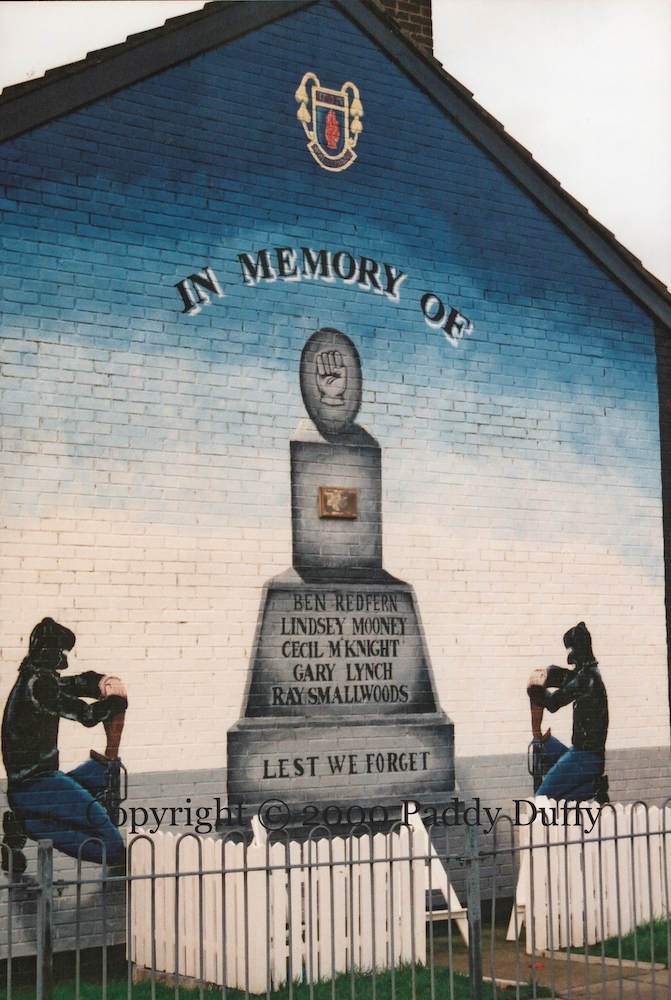
“In memory of Ben Redfern, Lindsay Mooney, Cecil McKnight, Gary Lynch, Ray Smallwoods, William Campbell. Lest we forget.” For Redfern and Lynch, see It’s Still Only Thursday; Smallwoods has a WP page; Campbell died in 2002 in a premature pipe-bomb explosion (Guardian).
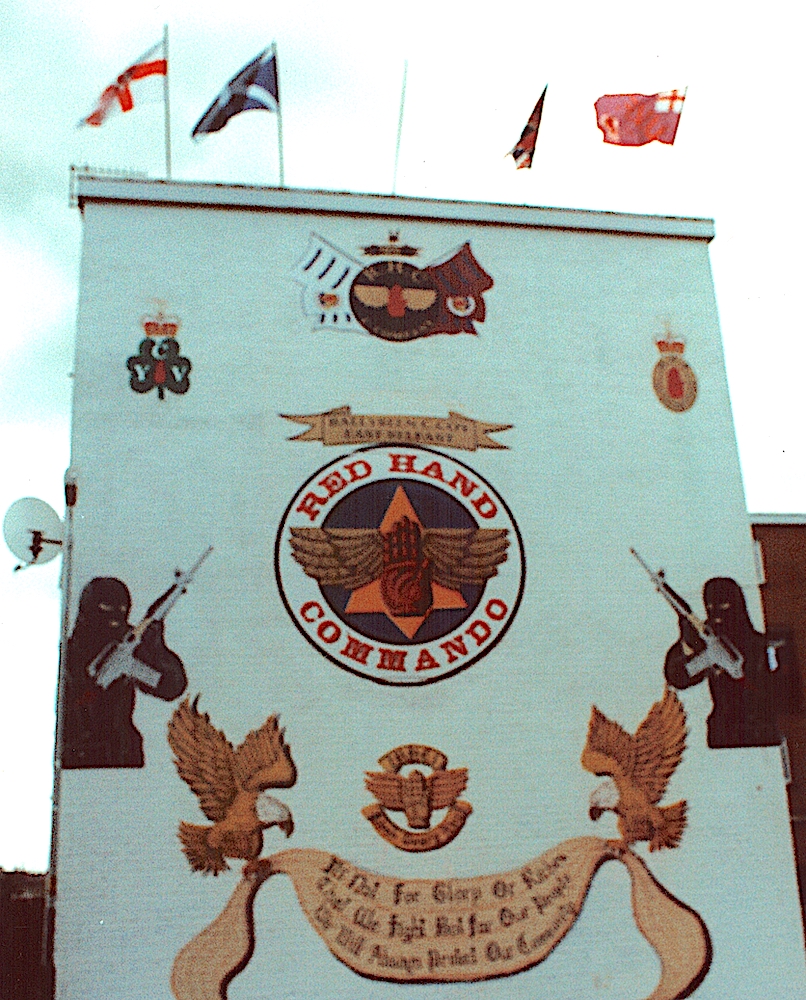
“Ballybeen C Coy East Belfast”, “Lamh dearg abu”, “It is not for glory or riches that we fight but for our people. We will always protect our community.” The first part of the quotation is based on the Declaration Of Arbroath (see also this RHC C Coy mural in east Belfast); “we will always protect our community” is original.
Upper Newtownards Road, Dundonald
(In some images of this mural, the top scroll says simply “Ballybeen”.)
Cú Chulaınn (or, as here, Cuchulainn) is usually shown dying, in the pose made famous by Oliver Sheppard in his statue that was installed in the General Post Office in Dublin in 1935. (See the Visual History page about Cú Chulaınn in murals.) Here, however, he is a living warrior (carrying a sword and a shield emblazoned with the crest of Northern Ireland) as an analogue to loyalist paramilitaries and prisoners of war (“LPOW” on the right).
“We have achieved peace, we have maintained peace – now stop the injustice: release our political hostages.” “Dedicated to Mark Rice”, a Tullycarnet resident who was jailed for 20 years for possession of an assault rifle used in the attack on Sean Graham bookmakers on the Ormeau Road in February 1992 (Relatives For Justice). To the left of centre, a red fist smashes through an Irish Tricolour; a Tricolour is also worn by the volunteer in the crosshairs.
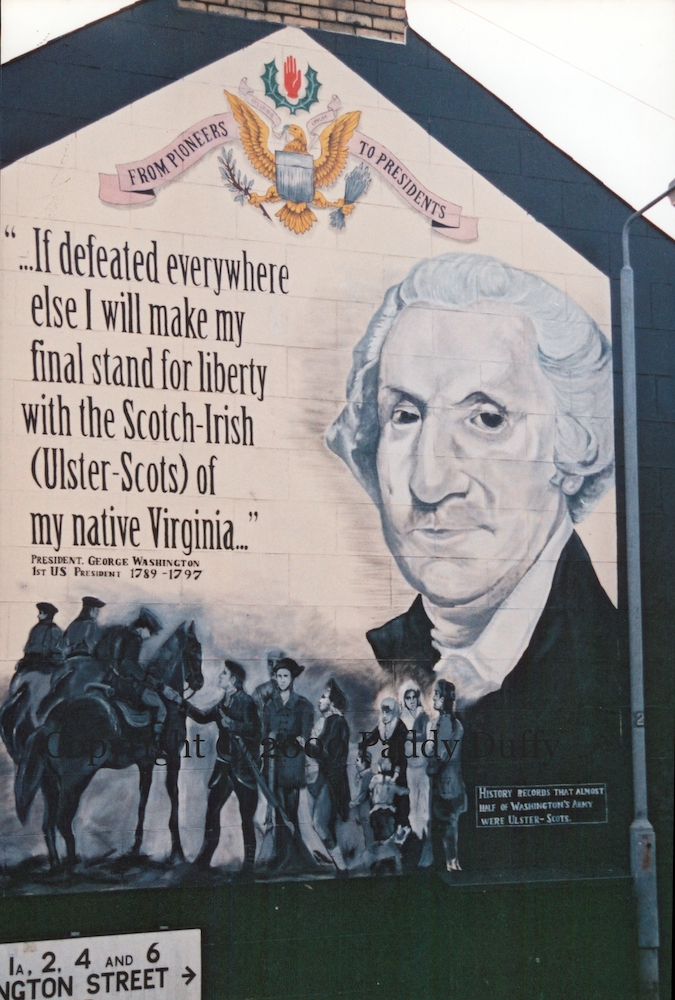
These are two of the first three murals painted in the series “From Pioneers To Presidents”, to Washington and Buchanan, in Ebrington Street Lower and Ebrington Street in the Waterside, Londonderry, along with one to Roosevelt in the Fountain.
George Washington commanded the Continental Army during the revolution and served as the first president of the United States beginning in 1789. His ancestry was English. The quote – “If defeated everywhere else I will make my final stand for liberty with the Scotch-Irish (Ulster-Scots) of my native Virginia” – is undocumented, the closest being this statement from McKinley.
The note in the corner reads “History records that almost half of Washington’s army were Ulster-Scots”; the basis for this claim might be General (Charles?) Lee’s report that “half the rebel Continental Army were from Ireland.” (See Chapter 2 of Bagenal, The American Irish and their Influence on Irish Politics.)
James Buchanan was “15th US president 1857-1861.” Buchanan’s father, also called James, was born in Ramelton, Co Donegal, and was living in Co Tyrone when he emigrated to the United States from Derry in 1783, (one of the “250,000 Ulster-Scots [who] emigrated to America in the 1700s”). James junior was born in 1791, the second of eleven children.
The confusion over the wording of the quote – “My Ulster blood is my most priceless [or simply: a priceless] heritage … [and I can never be too grateful to my grandparents from whom I derived it.]” – is matched by confusion over who said it (Buchanan junior or senior?); the source of the quote is unknown. Likewise we do not know where in Scotland the grandparents might have come from and perhaps the move to Ireland happened much earlier.
UDA mural in Avoniel Road showing two hooded gunmen kneel on a free-floating Northern Ireland. Avoniel Road and Dee Street would fall within the territory of 2nd battalion, east Belfast.
This mural is (probably) a companion to the Nelson McCausland book Patrick, Apostle Of Ulster: A Protestant View Of Patrick (Amazon), published in 1997. Here is a 2013 blog post by McCausland that perhaps gives a précis of the book and is in keep with the text in the panel out of shot to the left, which reads, “”All the exciting and glamourous features that tradition has added to Patrick must be removed if we wish to know what he was really like. And yet the historical Saint Patrick is more interesting and more worth studying than all these later gaudy traditions …” Bishop R[ichard]. P[atrick]. C[rosland]. Hanson”
With graffiti reading “had no feet” – a comment on the figure to the left.
A Visual History page details the various appearances of Eddie The Head in his guise as a Red Coat soldier-cum-UDA volunteers. In this Shankill Eddie, he carries an assault rifle and an Ulster Banner as he marches over the graves of “E[ddie] Copeland”, “S[ean] Kelly”, and “S[tephen] Larkin”. The three are IRA volunteers: Kelly, along with Thomas Begley, bombed Frizzell’s fish shop on the Shankill Road in 1993 – Kelly survived; Copeland was injured during an attack on Begley’s wake; Larkin made an attempt on the life of Johnny Adair in 1993.




 Paddy Duffy Collection