
The Siege Of Derry began in December 1688 when 13 apprentice boys shut the gates against the approaching army of Jacobite soldiers.
Hopewell Crescent, lower Shankill, west Belfast
Click image to enlarge
Copyright © 2000 Paddy Duffy
T00266
The Siege Of Derry began in December 1688 when 13 apprentice boys shut the gates against the approaching army of Jacobite soldiers.
Hopewell Crescent, lower Shankill, west Belfast
Click image to enlarge
Copyright © 2000 Paddy Duffy
T00266
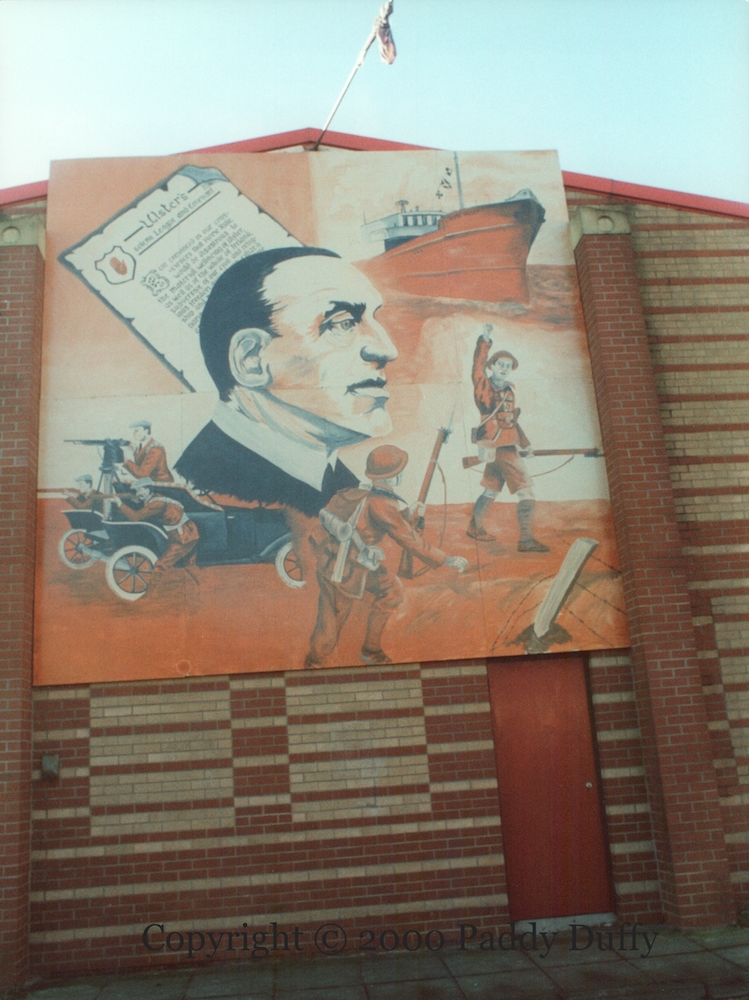
The Ulster Volunteers were formed in response to the Home Rule bill of April 1912 and the Covenant signed in September 1912, first by Edward Carson and then by almost half a million others. Guns were smuggled into Larne on the Clyde Valley in April 1914 but the advent of the World War saw the volunteers instead joining the British Army, specifically the 36th (Ulster) Division, and went over the top at the Somme.
Click image to enlarge
Copyright © 2000 Paddy Duffy (no date given)
T01189
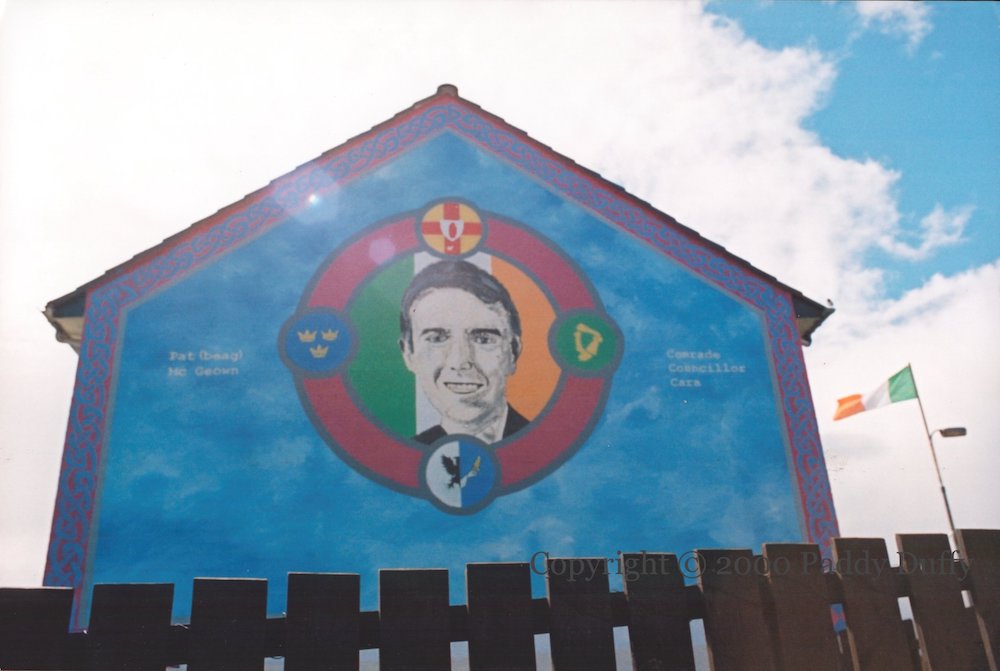
“Comrade, councillor, cara [friend].” Pat McGeown was a 1981 IRA hunger striker whose family intervened when he lapsed into a coma. After his release in 1985 he also worked for Sınn Féın and was elected to Belfast City Council in 1993. He died in 1996 of a heart attack. He is also remembered by a plaque on the Sınn Féın office on Falls Road.
Ballymurphy Road, west Belfast
Click image to enlarge
Copyright © 2000 Paddy Duffy
T00786
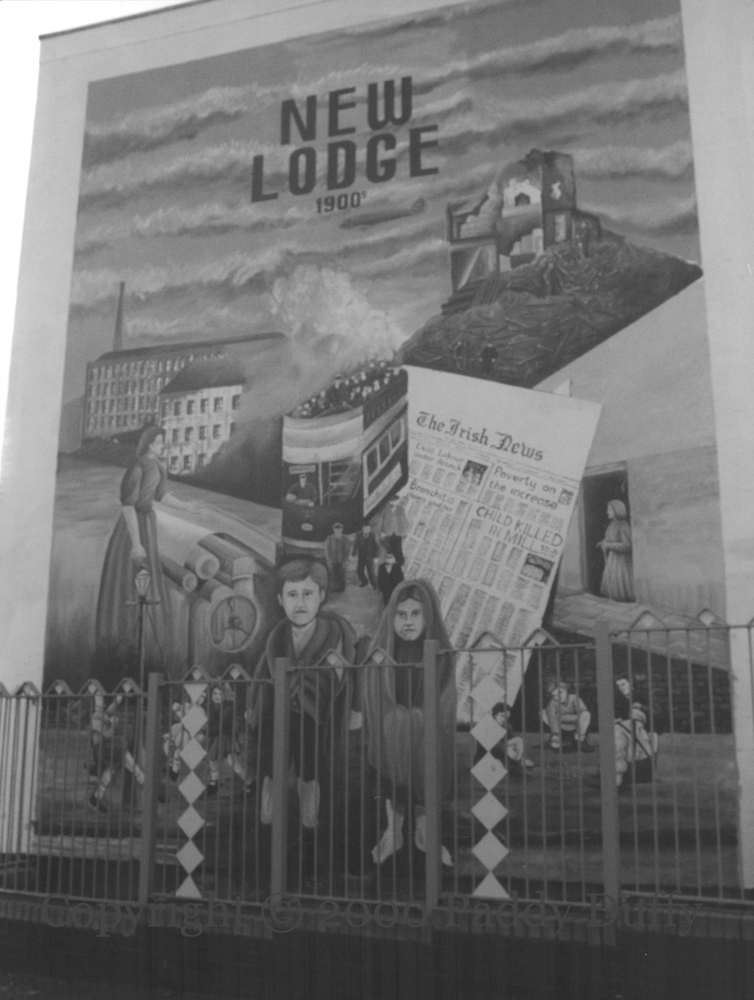
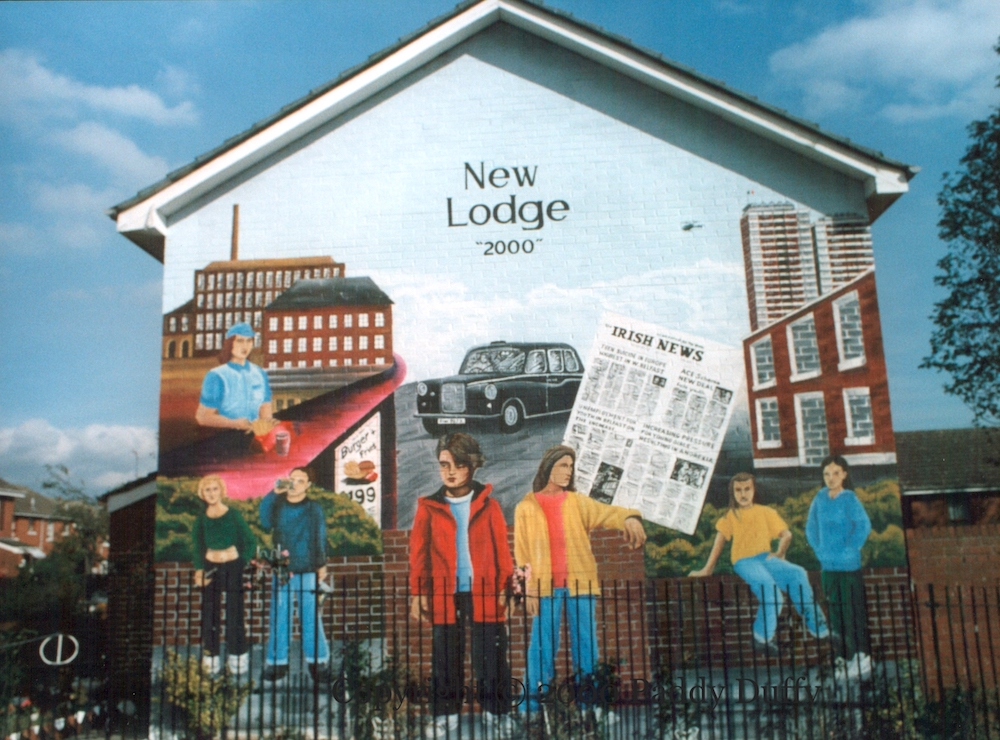
This pair of murals, on the New Lodge Road, Belfast, contrasts life for young people in the black-and-white “1900s” to life in colourful “2000”. Instead of working (and dying – in the headlines from the Irish News) in mills, they work in fast-food restaurants and drive black taxis (and suffer unemployment, suicide, and anorexia – again, in the newspaper), and instead of playing in the streets and wrapping themselves in blankets, they sit on walls and drink.
New Lodge Road, north Belfast
Click image to enlarge
Copyright © 2000 Paddy Duffy
T00353
T00348 [T00366]

There was originally a memorial to Bobby Sands and painted crests of the four provinces below this phoenix emerging from the flames – see M01001 from 1991. It was originally painted by Mo Chara Kelly in 1987.
Jasmine Way, Dunmurry
Click image to enlarge
Copyright © 2000 Paddy Duffy
T00362

“Our laughter will be the joy of our victory + [the] joy of the people; our revenge will be the liberation of all.” This is perhaps the only appearance of this quote from Bobby Sands’s hunger strike diary, from Thursday March 12th. In the background are the towers of Long Kesh; in the foreground is Sands’s funeral procession (RTÉ | youtube).
Jasmine Corner, Twinbrook, Dunmurry
Click image to enlarge
Copyright © 2000 Paddy Duffy
T00364 [T00352]

On the left, the Belfast/Good Friday Agreement establishes “The right to freedom from sectarian harassment” but, on the right, the Orange Reality involves “10 Catholics murdered as a result of Drumcree, 150 Catholic homes petrol bombed, 1350 Catholic families forced out, many dozens or pipe bombs, attacks on Catholic homes”. The left-hand panel shows the cover of the Agreement booklet that was sent to every household ahead of the vote, showing a family of four silhouetted against a sunset; the right-hand panel shows the same family, but the source of light is now burning houses.
Replaces Let’s Make It Work.
Dromara St, south Belfast
Click image to enlarge
Copyright © 2000 Paddy Duffy (no date given)
T00344

This is a complete version of Bobby Sands’s poem The Rhythm Of Time, along with the names and portraits of the ten deceased 1981 hunger strikers, and Michael Gaughan and Frank Stagg, who died on hunger strike in England.
Rockdale Street, west Belfast
Click image to enlarge
Copyright © 2000 Paddy Duffy
T00340 [T00360]
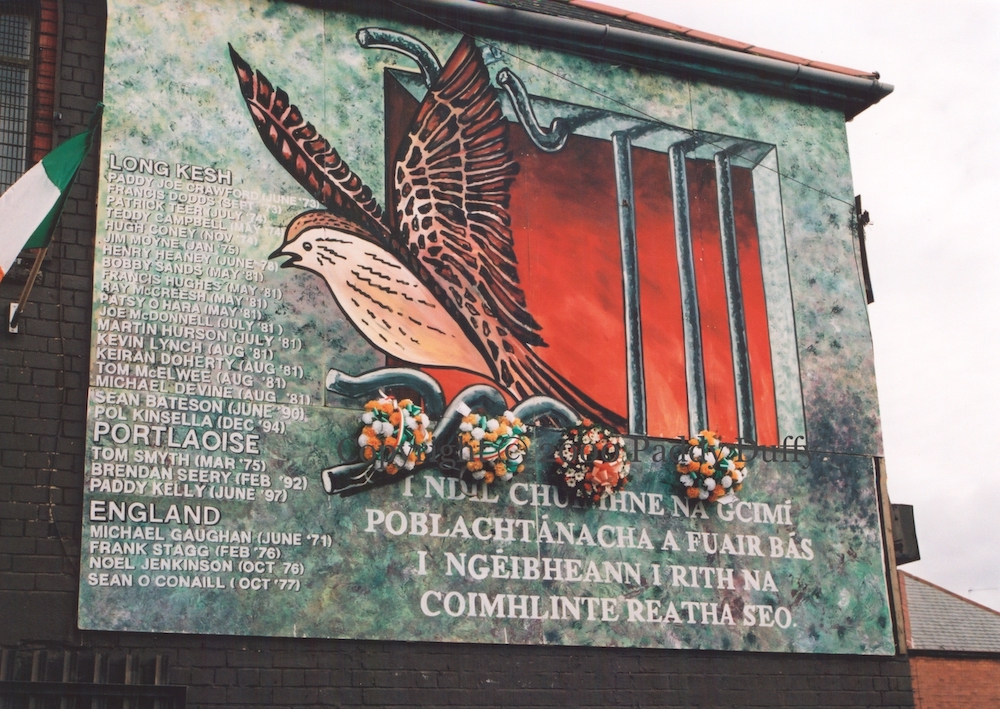
“I ndıl chuımhne na gcımí poblachtanacha a fuaır bas ı ngéıbheann ı rıth na coımhlınte reatha seo.” A lark bursts through prison bars of Long Kesh, Portlaoise, and prisons in England, in which republicans have died from the 70s to 90s.
Beechmount Avenue, west Belfast
Click image to enlarge
Copyright © 2000 Paddy Duffy (no date given)
T00339
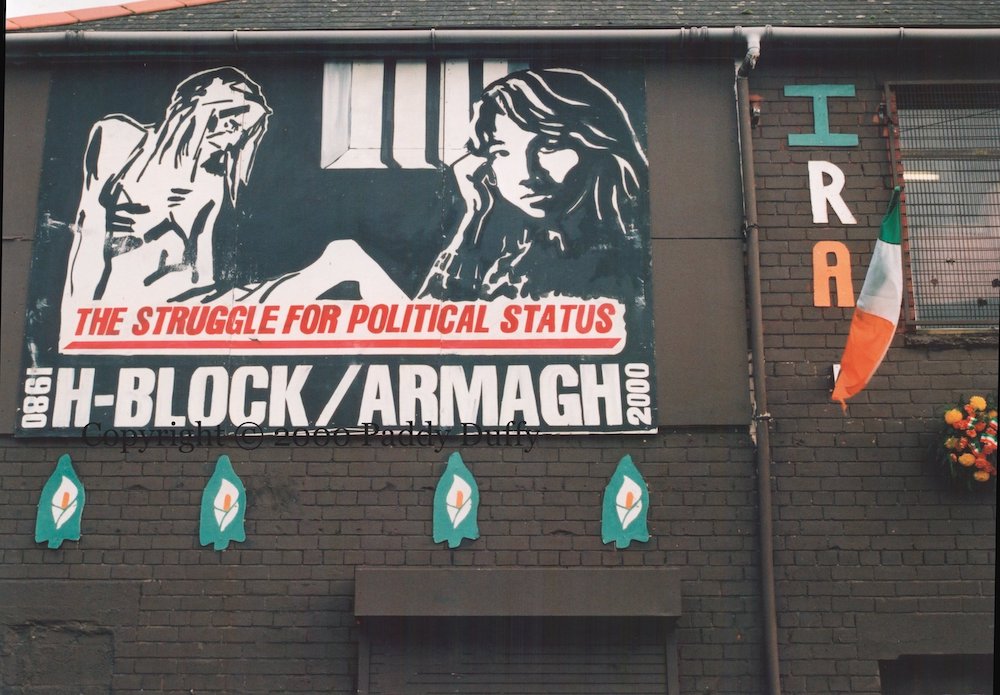
“The struggle for political status.” The twentieth anniversary of the hunger-strikes in Long Kesh and Armagh Women’s prison, 1980-2000, is commemorated. Seven men in Long Kesh and three women in Armagh went on strike, for fifty-three days and nineteen days, respectively.
The lilies are held over from the previous year – see The Final Salute.
Beechmount Avenue, west Belfast
Click image to enlarge
Copyright © 2000 Paddy Duffy (no date given)
T00338
 Paddy Duffy Collection