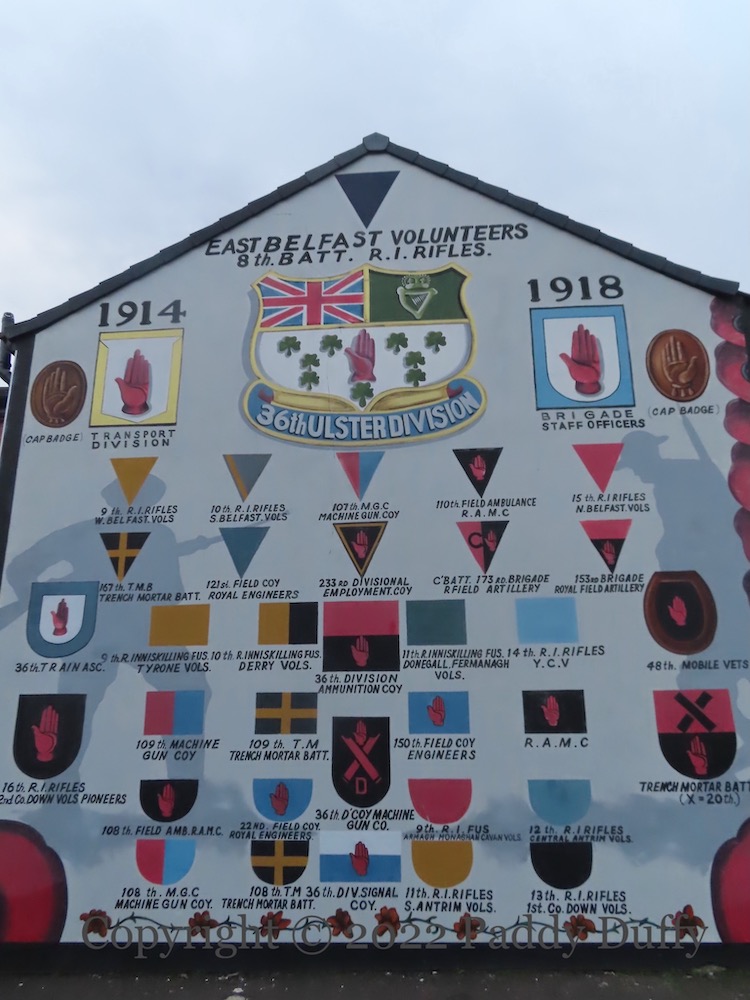
This mural and its accompanying plaques, at the mouth of Canada Street, commemorate WWI and celebrate the Victoria Crosses won by members of the 36th (Ulster) Division “For valour”: Cather, McFadzean, Bell, Quigg, Emerson, De Wind, Seaman, Knox, and Harvey. The main mural features insignia of more than thirty units of types ranging from machine gunners to vets.
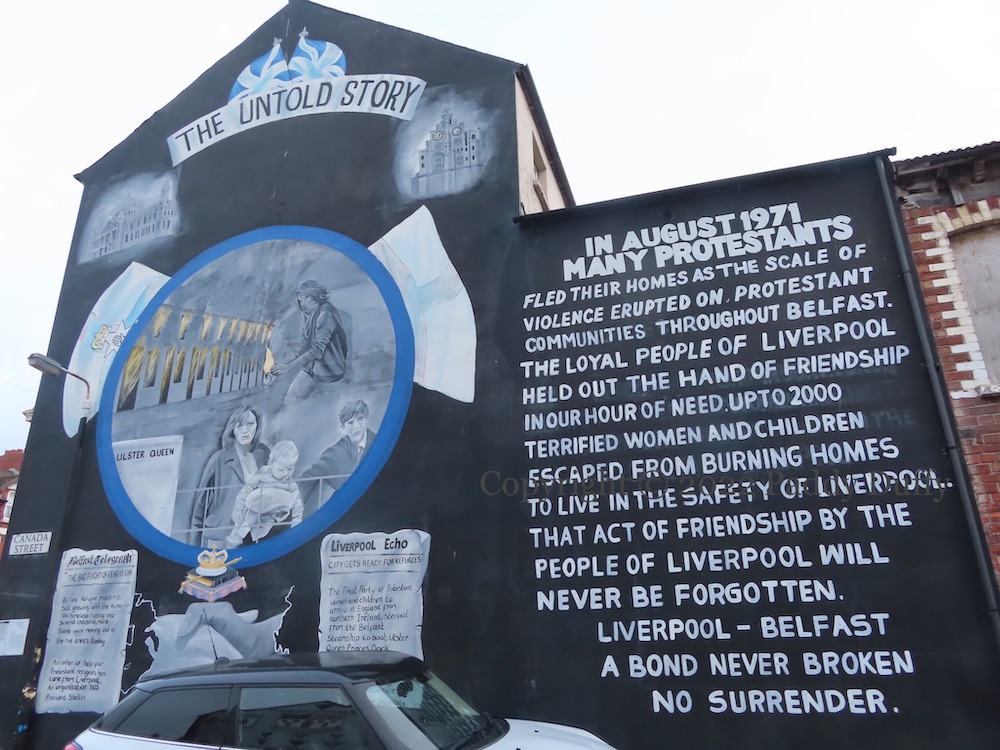
This mural depicts Protestant women and children on-board a steamer, the Ulster Queen, leaving Belfast because of rioting, and headed for Liverpool, where they were to be hosted by local Orange families. On the far left is a laminated letter of thanks to Elsie (Allen) Doyle, one of the organisers in Liverpool.
A very similar mural was in this spot several years ago (though not immediately prior to this one – the wall was blank), featuring three youngsters on the boat, rather than a mother and children. The panel to the right began “In August 1971 many Protestants fled their homes as the IRA launched a bitter sectarian attack on Protestant communities throughout Belfast.” (See M04069.)
Tommy Dickson ended his career (in 1965) with a partial season at Glentoran. Before that, however, he spent 16 seasons in the first team at Linfield, scoring 451 goals and leading the club to titles in the League Cup, Irish Cup, Gold Cup, Ulster Cup, City Cup, North-South Cup, and County Antrim Shield (shown at the top of the mural). (WP)
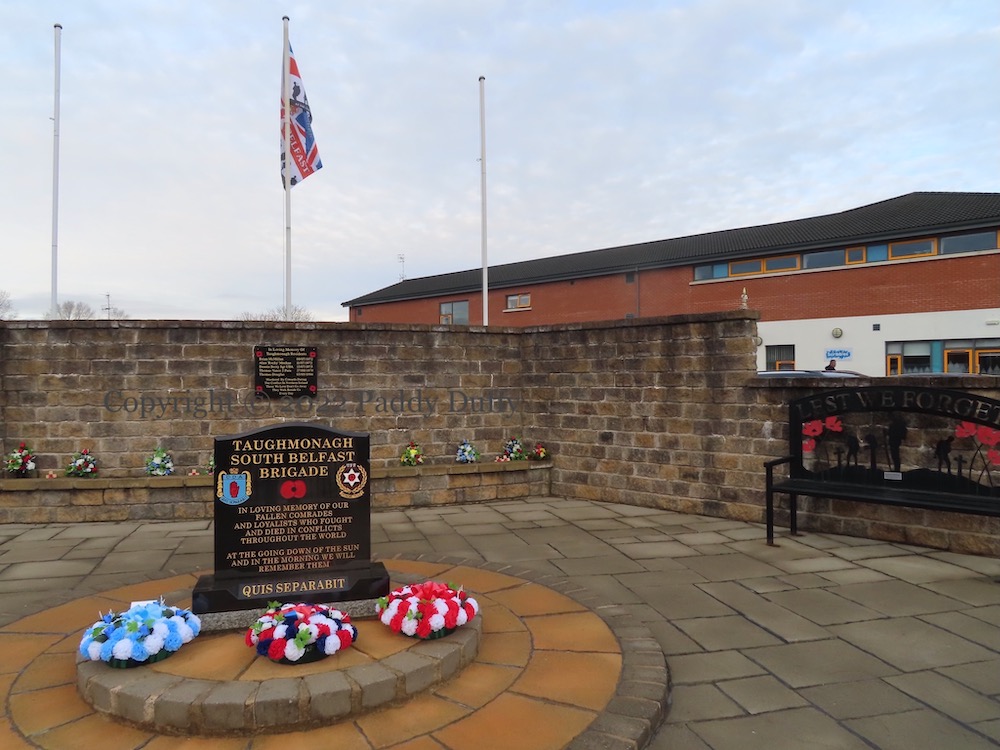
“In loving memory of Taughmonagh residents Brian McMillan, Alan ‘Rocky’ Meehan, Dennis Berrty (Sgt UDA), Thomas Vance (2 Para), Thomas Douglas. Murdered by cowards during the conflict in Northern Ireland. Those we love don’t go away, they walk beside us every day.”
McMillan and Meehan were civilians shot along with TA staff sergeant (and English Catholic) Joseph Flemming on July 9th, 1972.
Dennis Berry was shot by the UVF after leaving the UDA social club in Taughmonagh. According to Lost lives, “Reliable loyalist sources said the shooting was the result of a personal row rather than having any political or organisational basis.” (p. 441)
Thomas Vance died in the IRA’s 1979 ambush of the British Army at Narrow Water Castle, near Warrenpoint (WP), on the same day that Louis Mounbatten was killed. (Republican mural)
Thomas Douglas was shot while walking along the street. His family denied he was a leading loyalist and simply a member of the Orange Order (CAIN | Fb).
This plaque is in the UDA memorial garden in Taughmonagh at the corner of Finbank Gardens & Malfin Drive.
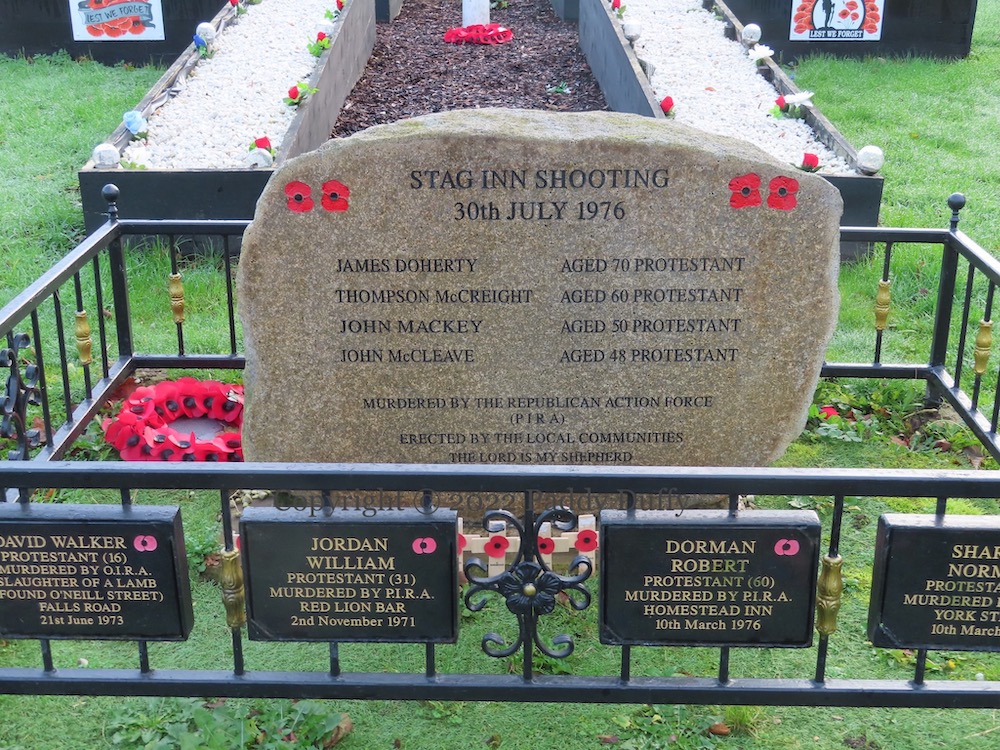
A long series of tit-for-tat shootings of pubs and clubs continued into the summer of 1976, with attacks on the Chlorane (June 5th), Walkers (June 25th), the Ramble (July 2nd), the Whitefort (July 29th), and then, on the 30th, The Stag at Shaws Bridge, Belfast, by the Republican Action Force (PIRA) (Sutton). John McCleave, John McKay, and James “Jimmy” Doherty died on the night of the attack, and Thompson McCreight died of his wounds nine days later. The memorial to them – “erected by the local communities” – is on Milltown Road, next to the Dreamscheme (web) mural.
“Cogús supports the republican prisoners”. Cogús (Fb) is (was?) the prisoners’ welfare arm of the RNU. The board above — using a vintage illustration going back to 1981’s I’ll Wear No Convict’s Uniform — replaced More Blacks, More Gays, More Irish on Pantridge Road, Dunmurry, joining the “Join RNU” and mental health boards shown below.
Above, a “Welcome to loyalist Seymour Hill” board with flags and poppies, and a (2021) tarp “Seymour Hill says no to the Irish Sea border”.
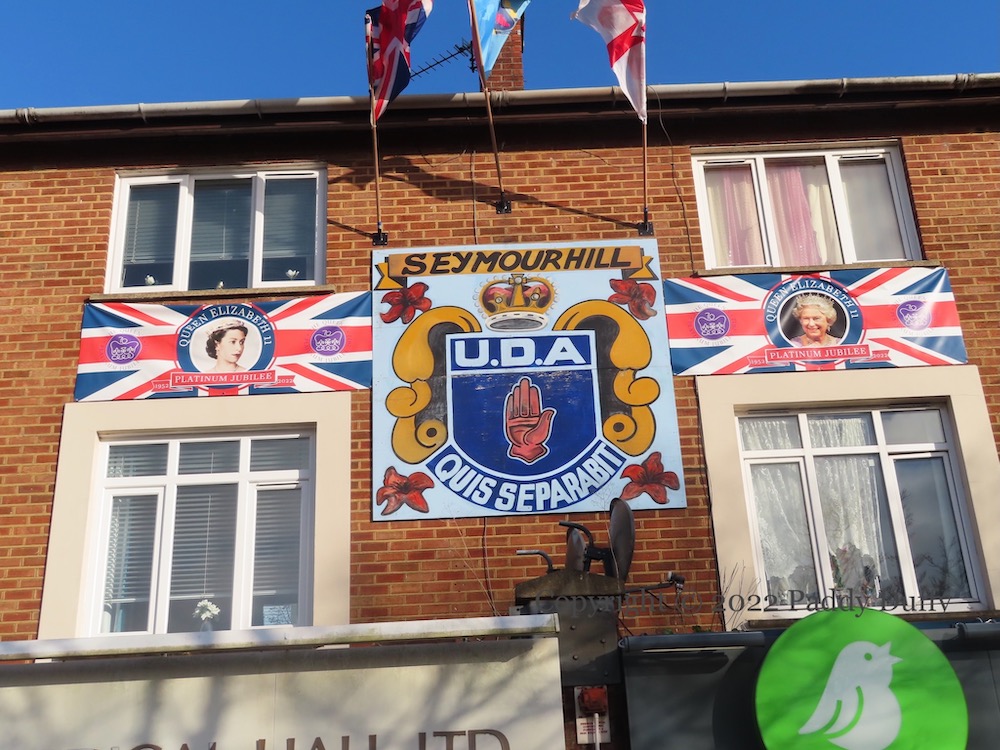
Below, Queen Elizabeth II 70th/platinum Jubilee banners remain on either side of the UDA board above the Seymour Hill shops, even after her death in September (previously there were two NI Centenary banners). There are orange lilies at the four corners of the UDA emblem.
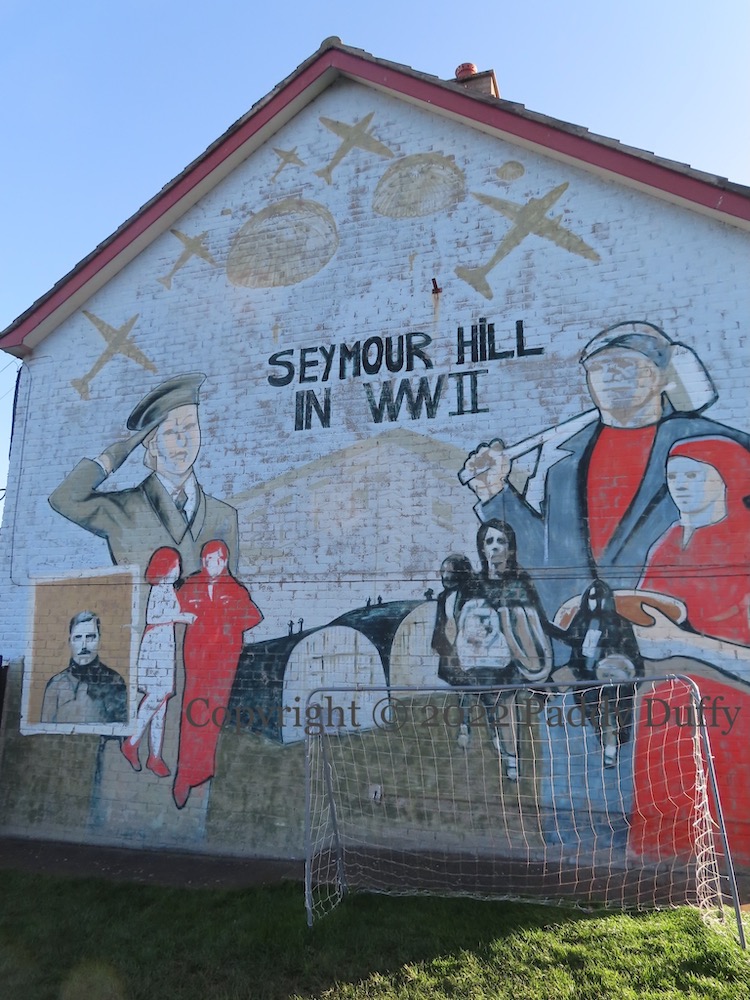
US forces were still segregated racially during WWII; “colored” soldiers (as they were then called) were housed in a camp at Ballybog Road (WW2NI) where Seymour Hill PS now is and just below Seymour Hill House which was used to house evacuees from Belfast after the blitz and which was formerly owned by the Charley family (Lisburn.com | Lord Belmont) – it is now administered by Radius (formerly the BIH Association).
The “framed” portrait on the left is of William “Billy” Harbinson, a member of the Royal Ulster Rifles who was a POW at Colditz (Lisburn.com | WW2NI); the photograph can be seen in the RUR museum.
There used to be a plaque on the wall which read, “This mural was dedicated by Col. Robin Charley on 1st July 2009 to the people from this area who contributed to the to the effort during World War II. Also our American allies who were based here and later contributed to the conflict.”
Painted by Tim McCarthy (“Verz” ig) for the Re-Imaging Programme; it replaced a UDA mural.
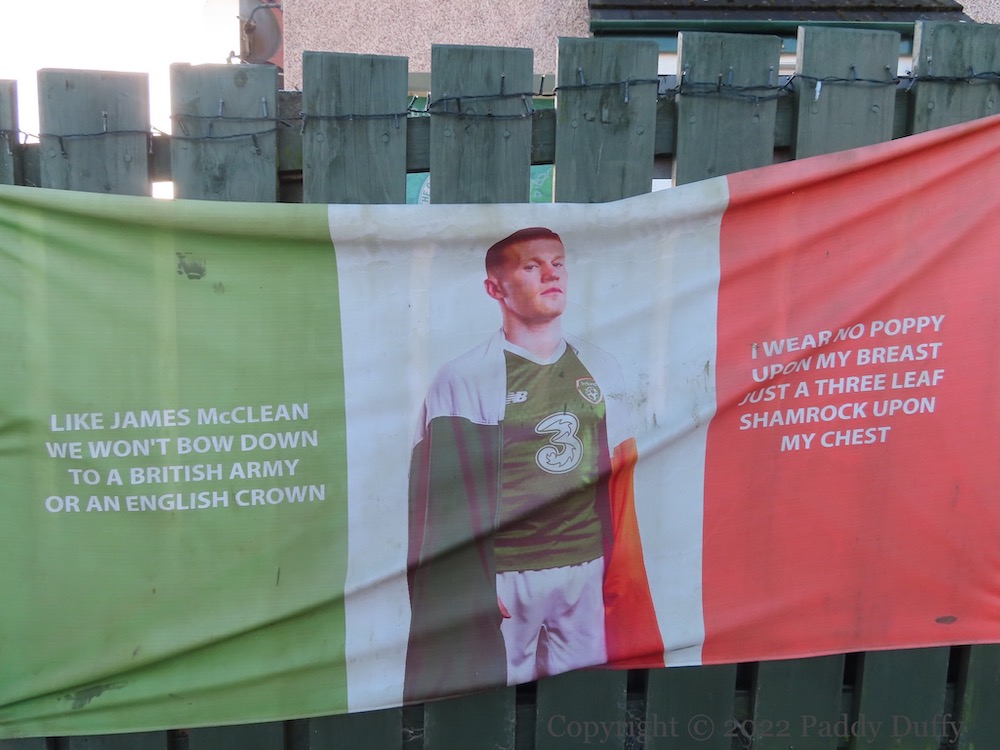
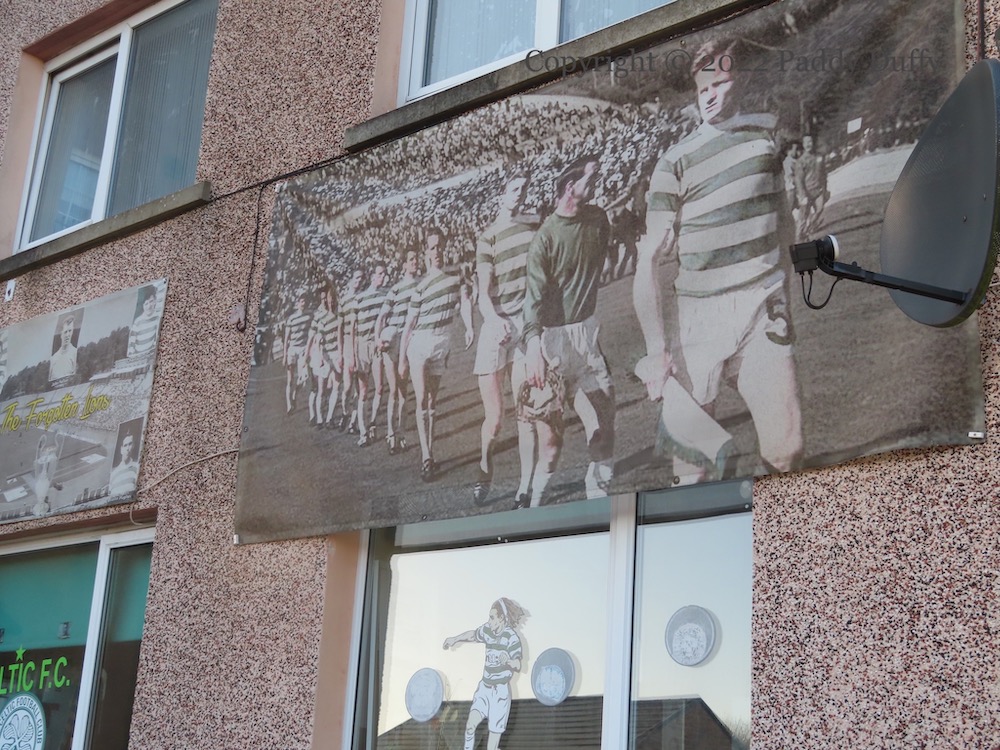
Here are two soccer-related images from Gardenmore Road, in Twinbrook. Above, James McClean in his Ireland strip – “Like James McClean we won’t bow down/To a British Army or and English crown.//I wear no poppy upon my breast/Just a three leaf shamrock upon my chest.” (though McClean is shown wearing the 2016-2018 jersey which featured a ball rather than an FAI shamrock).
The other three leaf shamrock familiar from soccer is that of Scottish team Glasgow Celtic, which is widely supported among the CNR community.
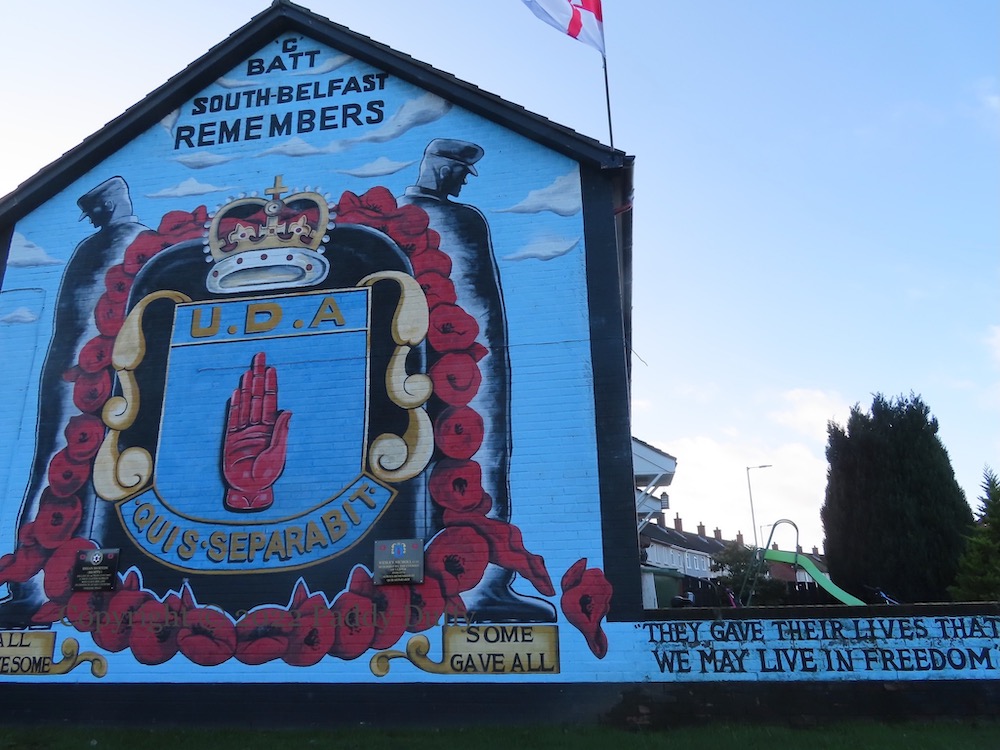
The old C Batt mural further up Hornbeam Road has long been painted over. It used the same line – “They gave their lives that we may live in freedom” – to remember Wesley Nicholl and Brian Morton. A plaque to Morton is now included on top of the new mural. “Brian Morton (Morty) killed in action 07/07/1997, a true Ulster patriot who gave his life in defence of his country. Feriens tego.” As with republican memorials, “active service” means that Morton was killed by a premature bomb exploding.