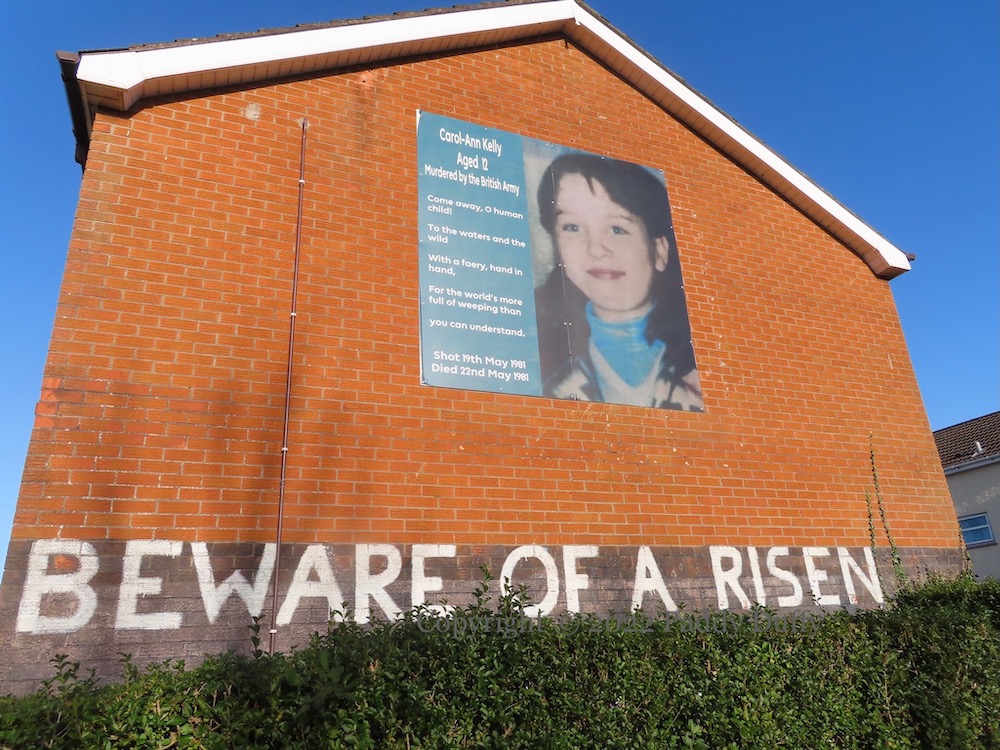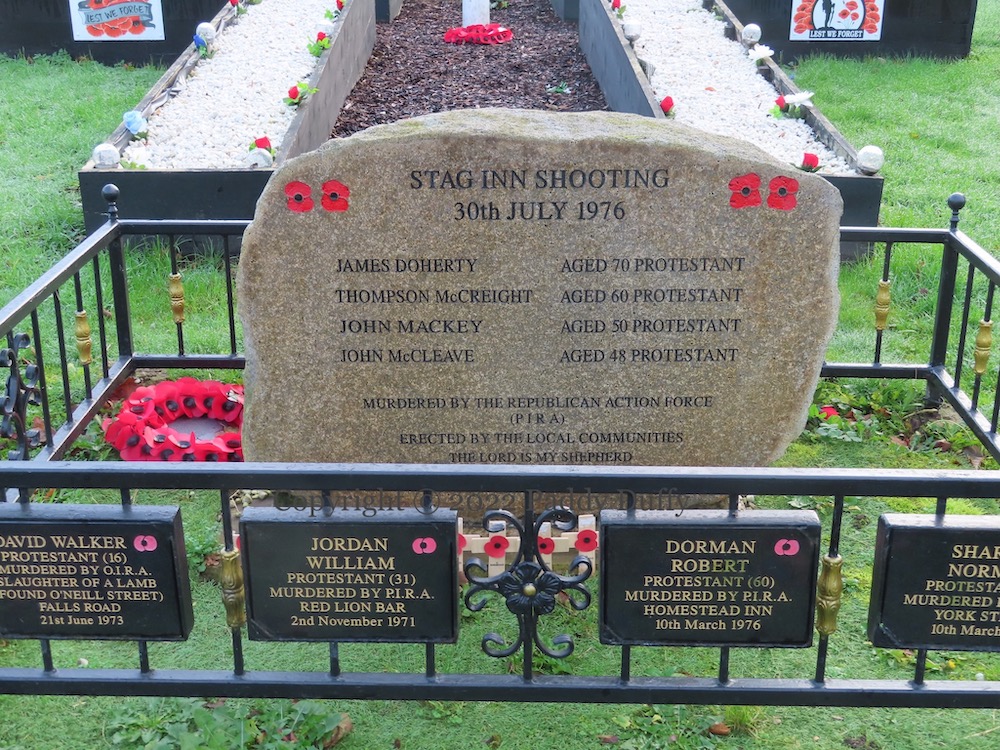
No Justice

Here is a gallery of images from the Falls Road/Glen Road junction (site of the old Andersonstown RUC barracks). The images top to bottom follow the wall from right (Glen Road) to left (Falls Road).

Above: a call for the release of Basque prisoners.

Below: Mervyn and Rosaleen McDonald were Catholics living in the mixed Longlands area of Newtownabbey when they were visited by “UFF loyalist assassins” and shot dead in front of their two young children. The killings are described in most detail in Jack Holland’s Too Long A Sacrifice, which contains an interview with the gunman and the claim that the unit had access to RUC files (p. 94).

Seamus Costello fought for the IRA during the Border Campaign and was interned in the Curragh for two years. He stayed with the Officials during the split, but was driven out in 1974 and formed the Irish Republican Socialist Party (IRSP) and the INLA. He was shot in 1977. (WP)

A large Fıanna banner.

Metalwork commemorating the deceased 1981 hunger strikers.

A Sınn Féın electoral banner.

Click image to enlarge
Copyright © 2022 Paddy Duffy
T01146 T01147 T01148 [T01149] T01152 T01151 T01150

Pearse Jordan

Pearse Jordan was unarmed when he was killed by the RUC on November 25th, 1992 but in this new Éıre Nua Flute Band board he leaves his prints on an assault rifle. (previous Éıre Nua board) His killing was ruled unlawful, and subsequent inquest insufficient, by the European Court Of Human Rights in 2001. The campaign for an inquest continues (An Phoblacht).

The words on the board – “Slan [sic] go foıll [sic] moh [sic] chara, just for a while/We’ll not have your craic, your jokes, or your smiles/But in years to come, your memory’s still true/A brave son of Ireland, we will not forget you” – are the chorus of The Ballad Of Pearse Jordan (words | sung by The Irish Brigade).

The board is in Hugo Street, which is also the site of his memorial plaque, just above the Evolution Of Our Revolution.

Click image to enlarge
Copyright © 2022 Paddy Duffy
T01145

The Evolution Of Our Revolution

A history of nationalism/republicanism from left to right: a pair of Easter lilies, four generations of rifles, and then a switch to a ballot paper with a check in favour of “unity” and a road named “Unity Way”: “From bullet to ballot: the evolution of our revolution. 1916 – 2016”

This mural is on the north side of Hugo Street – the south side remains exclusively éırígí.

Hugo Street, west Belfast

Click image to enlarge
Copyright © 2022 Paddy Duffy
T01144

Staff Captain Joe McCann

Joe McCann was IRA/OIRA OC in the Markets area of Belfast. He was famously photographed among burning buildings in Inglis’s bakery, during protests against the introduction on internment, crouched beneath a Starry Plough and holding an M1. (For more, see Battle Of The Markets, which features the same photograph.) For McCann’s death the following year (on April 15th, 1972) see Joe McCann.

This new board replaces a tarp in the same location: see On The Brink Of Sectarian Disaster.

Click image to enlarge
Copyright © 2022 Paddy Duffy
T01143

Floreat Ultona

“May Ulster flourish” as the newly created Northern Ireland under “Sir James Craig, 1st Viscount Craigavon, Prime Minister of Northern Ireland”. The Northern Ireland parliament was opened in 1921 and the coat of arms adopted in 1924 (WP); the Special Constabulary (including the B-Specials) had been formed prior to and in preparation for partition – the quote from Carson (also seen in an east Belfast mural) is from July 12th, 1920.

The text on the board is the same as at WP: “The Ulster Special Constabulary (USC; commonly called the “B-Specials” or “B Men”) was a quasi-military reserve special constable police force in what would later become Northern Ireland. It was set up in October 1920, shortly before the partition of Ireland. It was an armed corps, organised partially on military lines and called out in times of emergency, such as war or insurgency. It performed this role most notably in the early 1920s during the Irish War of Independence and the 1956-1962 IRA Border Campaign. During its existence, 95 USC members were killed in the line of duty. Most of these (72) were killed in conflict with the IRA in 1921 and 1922. Another 8 died during the Second World War, in air raids or IRA attacks. Of the remainder, most died in accidents but two former officers were killed during the Troubles in the 1980s. The Special Constabulary was disbanded in May 1970, after the Hunt Report, which advised re-shaping Northern Ireland’s security forces and demilitarizing the police. Its functions and membership were largely taken over by the Ulster Defence Regiment and the Royal Ulster Constabulary.”

This Belfast Live article (which has images from the launch) leads with the headline that this new board replaces a UVF mural, but there hasn’t been anything on this wall since a large “UDA” lettering in 1999. The adjacent wall, which has now been painted over, previously (in 2010) had a UVF flag which had been vandalised with “Jesus Christ Is Lord Of All’ graffiti by 2017.

Click image to enlarge
Copyright © 2022 Paddy Duffy
T01142

Help For Heroes

“Remember the fallen, care for the living”. Five boards arranged into a single piece in Ebor Street, south Belfast. The large bottom panel features a silhouette of a (staged) photograph taken in Basra (DailyMail) of a soldier on a stretcher giving the ‘thumbs up’ sign.

Ebor Street, Village, south Belfast

Click image to enlarge
Copyright © 2022 Paddy Duffy
T01139

Saint Patrick

The board on the left explains the composition of the Union flag as a combination of the saltire of Saint Andrew of Scotland, the cross of Saint George of England, and the saltire of Saint Patrick of Ireland. As the text notes, the saltire is much later than the saint: “The association with Saint Patrick dates from the 1780s, when the Order of Saint Patrick adopted it as an emblem. This was a chivalric order established in 1783 by George III. It is often suggested that it derives from the arms of the powerful FitzGerald dynasty [which dates to the 12th century].”

The text ends oddly: “The saltire has occasionally served unofficially to represent Northern Ireland and [has] been considered less contentious than other flags flown there.” Similar language is used on the symbols.com page for the Saltire.

The central board, shown above, shows a young Patrick (without the clerical garb in which he is often portrayed) against the backdrop of Slemish mountain, where Patrick is thought to have tended sheep as a young slave to a local chieftain, c. 401 AD and developed his Christian faith.

The board on the right shows a ship racing towards shore, superimposed over a 1659 map of Ulster by Blaeu. “The Red Hand Of Ulster: According to legend Ulster had at one time no rightful heir. It was agree that a boat race should take place and that whoever’s hand first touched the shore would become king. One contended, upon seeing that he was losing the race, cut off his hand and threw it ashore to win. O’Neill is said to have been the chieftain who cut his hand off to become the King of Ulster. The Red Hand is a key emblem of Ulster’s identity, an ancient and powerful symbol that is traditionally shown as a blood red hand.”

The colourings of the Saint Patrick profile are by children from the nearby Donegall Road Primary School.

The boards were unveiled on March 10th, 2016 by first minister Arlene Foster who remarked that the saint had become “very Gaelicised” and this — and the presence of Irish tricolours at parades — deterred unionists from celebrating “the patron saint of everybody in Northern Ireland” (Belfast Telegraph; also contains video of the launch). Anglicanism venerates saints but Presbyterianism does not, generally taking the “communion of saints” to refer to all members of the church.

Click image to enlarge
Copyright © 2022 Paddy Duffy
T01137 [T01138]

Warszawiacy Berlinowi

“From Warsaw to Berlin” — Polish airmen in England, in the 300 Mazovian bomber squadron, write a “dedication” on a bomb headed for Germany in August 1941. The plane added as a background is perhaps an Avro Lancaster, while the one in the middle ground (in the wide shot, below) is a Vickers Wellington. According to the information board (shown last, below) “many Polish servicemen remained in Great Britain and Ireland after the [Second World] war, laying the foundations for a large Polish community that now (in Northern Ireland) numbers over 30,000.”

Here is the original image (which has been coloured for the mural).

On the side-wall: The Ulster Tower at Thiepval “is dedicated to the glory of God in grateful memory of the officers, non-commissioned officers, and men of the 36th (Ulster) Division and of the sons of Ulster in other forces who laid down their lives in the Great War, and of all their comrades-in-arms who, by divine grace, were spared to testify to their glorious deeds.”

Click image to enlarge
Copyright © 2022 Paddy Duffy
T01134 T01135 [T01136]

Common Sense

UDA commander John McMichael was also secretary of the New Ulster Political Research Group (NUPRG), a think tank of the UDA/UFF. The group argued for an independent Northern Ireland (based in part on beliefs about a separate Ulster ethnic identity – see the Visual History page on Cú Chulaınn) in two documents, 1979’s Beyond the Religious Divide and 1987’s Common Sense (available at CAIN), promoting the philosophy of ‘Ulster nationalism’, depicted here by the free-floating Northern Ireland. McMichael ran unsuccessfully for the Belfast South seat after the murder of Robert Bradford (see To Bathe The Sharp Sword Of My Word In Heaven).

The side wall reads “Because loyalists have a past doesn’t mean they shouldn’t have a future. Quis separabit.” It previously had a McMichael quote – see We Must Share The Responsibility.

Click image to enlarge
Copyright © 2022 Paddy Duffy
T01140