
Two by Leo Boyd (web | ig | Fb) in Donegall Street. Above, a machine head is “lost in simulation”; below, an ice-cream land-rover with “That’s nice, dear” on the side.
Click image to enlarge
Copyright © 2022 Paddy Duffy
T01498

MTO (Fb) was in Belfast for Culture Night 2014 and painted a large piece entitled “Son of Protagoras”. The ancient biographer Diogenes Laertius reports that Protagoras was driven from Athens and his books burned because he wrote that it was impossible to know whether or not the gods existed. On Fb, MTO adds a description of the Northern Irish “peace” lines, perhaps suggesting that religious adherence continues to be an enemy of peace: in his painting, a dove has been pierced by arrows bearing the cross of the Knights of Malta and the Latin cross.
Click image to enlarge
Copyright © 2022 Paddy Duffy
T01496 [T01497]

Nell (l) and Elizabeth (r) Corr from 107 Ormeau Road joined Cumann Na mBan in 1915 and travelled to Dublin in 1916 (with Nora Connolly, Ina Connolly, Bridie Farrell, Lizie Allen, Kathleen Murphy, and another girl called O’Neill (Treason Felony)) to serve as messengers in the preparations for April’s Easter Rising. They were in Liberty Hall (shown in the detail above) on the morning of the rising before heading north. Brother George, on the other hand, died at the Somme as a soldier in the Australian infantry, while another brother, Charles, fought in WWI with the Canadian Expeditionary Force. They are pictured on the left-hand side of the mural. (BBC | BBC video)
Elizabeth’s account of Easter Sunday and Monday is available at the Bureau Of Military History.
Essex Grove, south Belfast.
Click image to enlarge
Copyright © 2022 Paddy Duffy
T01495 [T01494]
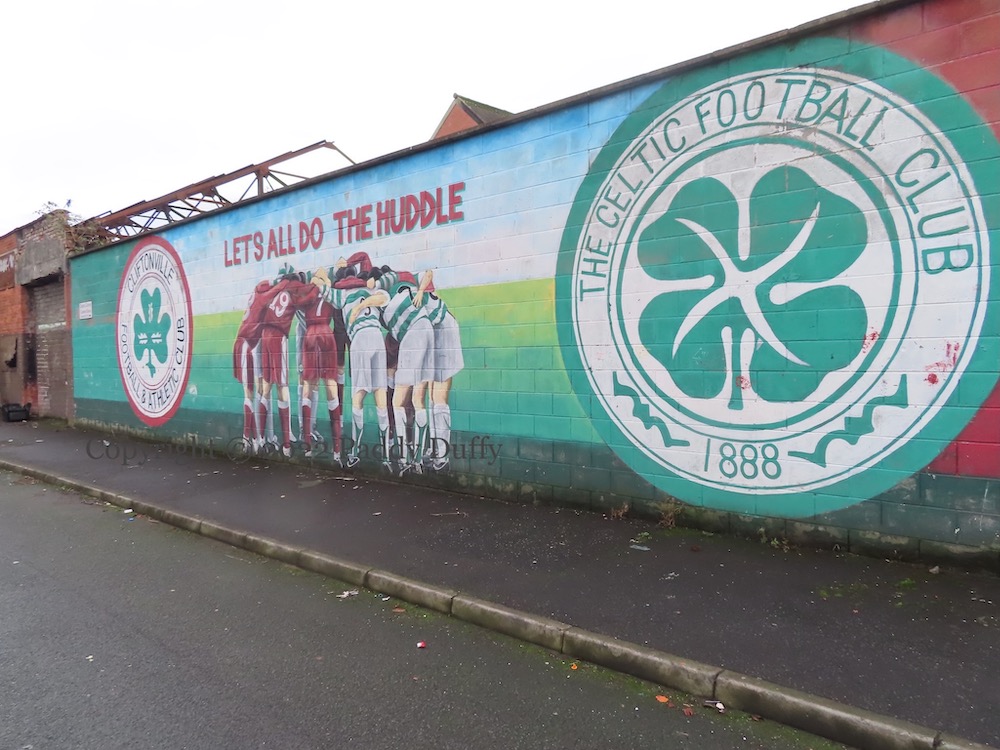
Players from Scottish football team Celtic and local team Cliftonville “do the huddle” together. The mural was painted in 2013 to celebrate the visit by Celtic to Solitude (Cliftonville’s home pitch) for a Champions League tie between the two teams.
A mural outside Solitude was also painted for the occasion – see The Red Army.
Essex Grove, south Belfast.
Click image to enlarge
Copyright © 2022 Paddy Duffy
T01493 [T01492]
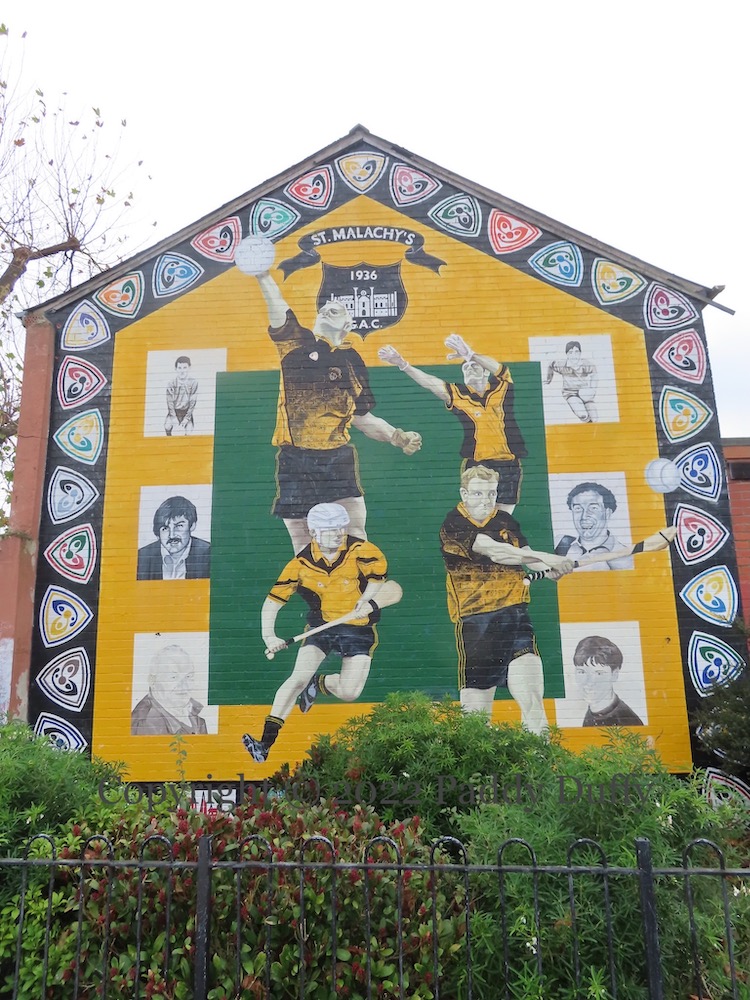
St Malachy’s (tw | Fb) is a junior (i.e. 2nd division/B-tier) GAA club established 1936 in the Markets area of south Belfast. It is not known who the six portraits are of (there were originally only the four at the corners – see M08137) or who the four players are. Get in touch if you have any information.
With sponsorship from Pulse, Belfast City Council, New Belfast Community Arts Initiative, the Housing Executive, and ?Brighten Belfast?
Shaftesbury Avenue, Belfast
Click image to enlarge
Copyright © 2022 Paddy Duffy
T01491
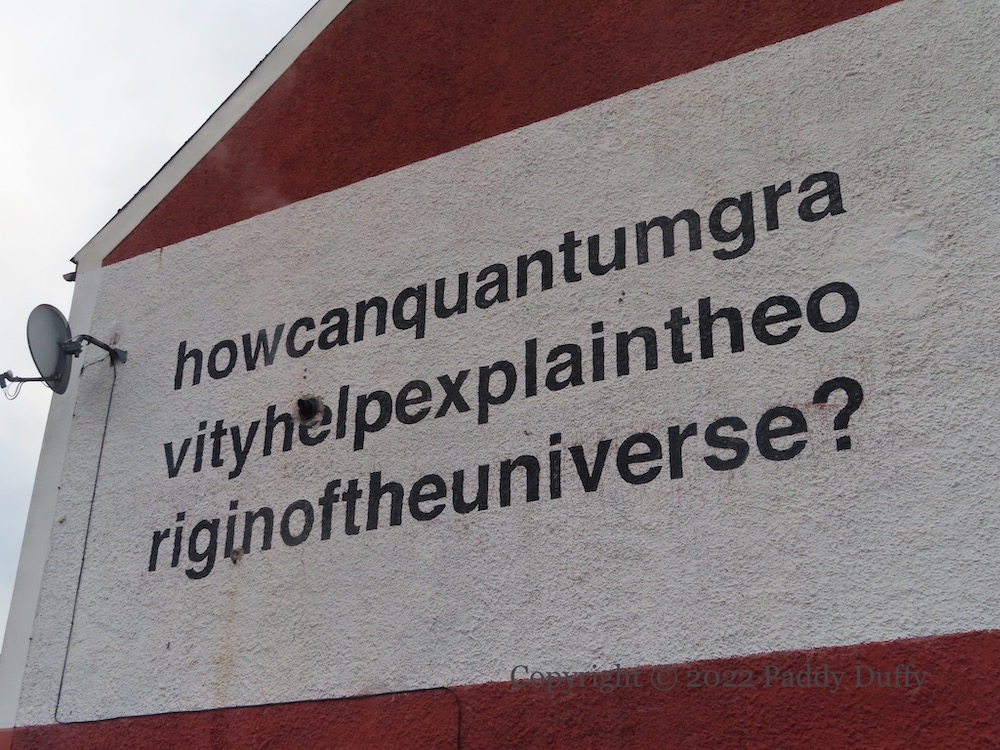
“How can quantum gravity help explain the origin of the universe?” asks artist Liam Gillick in Balfour Avenue, lower Ormeau, Belfast.
Click image to enlarge
Copyright © 2022 Paddy Duffy
T01490

The Lower Ormeau Cafe & Guesthouse (Fb | web), which opened in October 2017, added a mural in 2019 of the nearby Belfast Gasworks in Victorian times – the building still stands today, although it ceased to function as a gasworks in 1988.
Farnham Street, south Belfast
Click image to enlarge
Copyright © 2022 Paddy Duffy
T01487

The mural in Cluan Place goes back to (at least) 2002. It used to include the words “5 people shot, houses burned, houses bombed” but these have been painted out in this repainted version.
For Ian Ogle, see What Fire Does Not Destroy It Hardens.

Click image to enlarge
Copyright © 2022 Paddy Duffy
T01480 T01483

Photographs of a dozen atrocities are included on the right of this Derwent Street mural, ranging in time from the 1970 gun-battle around the nearby St Matthew’s church in 1970, in which Jimmy McCurrie and Bobby Neill were killed, to the October 1993 IRA bombing of Frizzell’s fish shop on the Shankill Road, in which Leanne Murray (shown on the left) was one of ten people, two of them children, to die. The others incidents portrayed are Bloody Friday, Darkley, Coleraine, Abercorn, Balmoral, Claudy, La Mon, Kingsmill, and Teebane.
This new computer-generated mural replaces the painted East Belfast Remembers, which had peeled away to a great extent.
“The slaughter of the innocent by the blood soaked hands of Sinn Fein/IRA never to be forgotten. The dead cannot cry out for justice. It is a duty of the living to do so for them. Is this the equality Sinn Fein/IRA asks for? No economic targets, no legitimate targets, no enquiries, no truth, no justice. Hold dear the memory of all the innocents murdered in our country in support of the Sinn Fein electorate. This memory extends to those not mentioned here who were murdered going about their daily lives at work, at prayer and in remembrance. Nothing was sacred in the futile question for a united Ireland.”

Derwent Street, east Belfast
Click image to enlarge
Copyright © 2022 Paddy Duffy
T01476 [T01477] [T01478] T01479
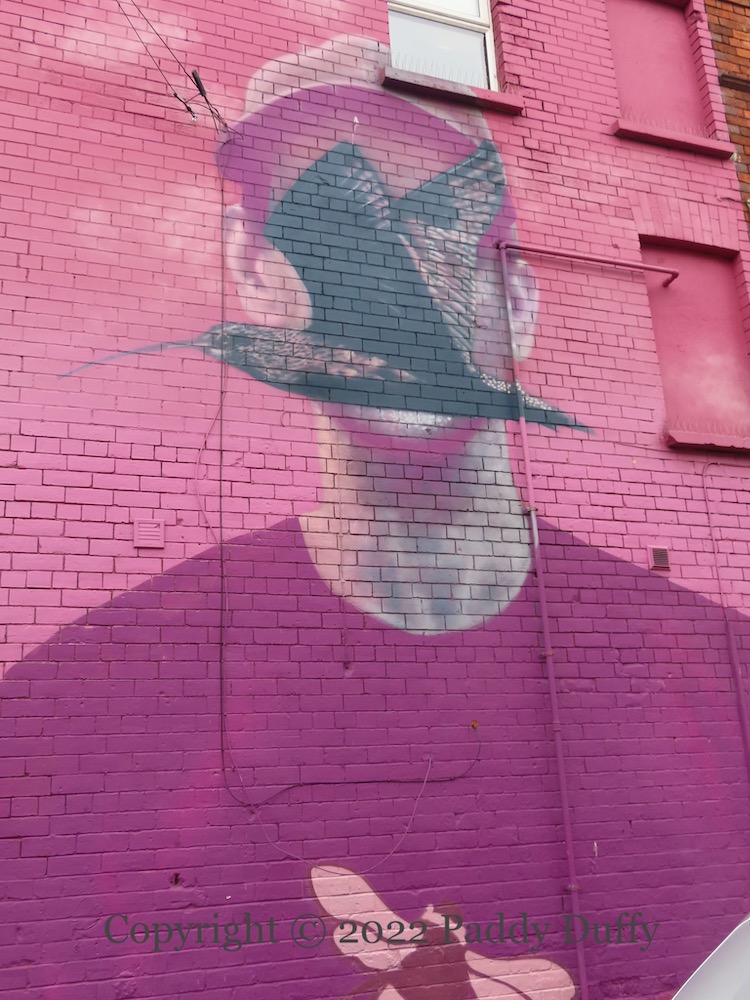
Magritte’s Man In A Bowler Hat is updated for the modern era as part of a 2021 campaign by UK Youth 4 Nature (web).
By emic (ig) in Farnham Street, Belfast.
Click image to enlarge
Copyright © 2022 Paddy Duffy
T01489
 Paddy Duffy Collection