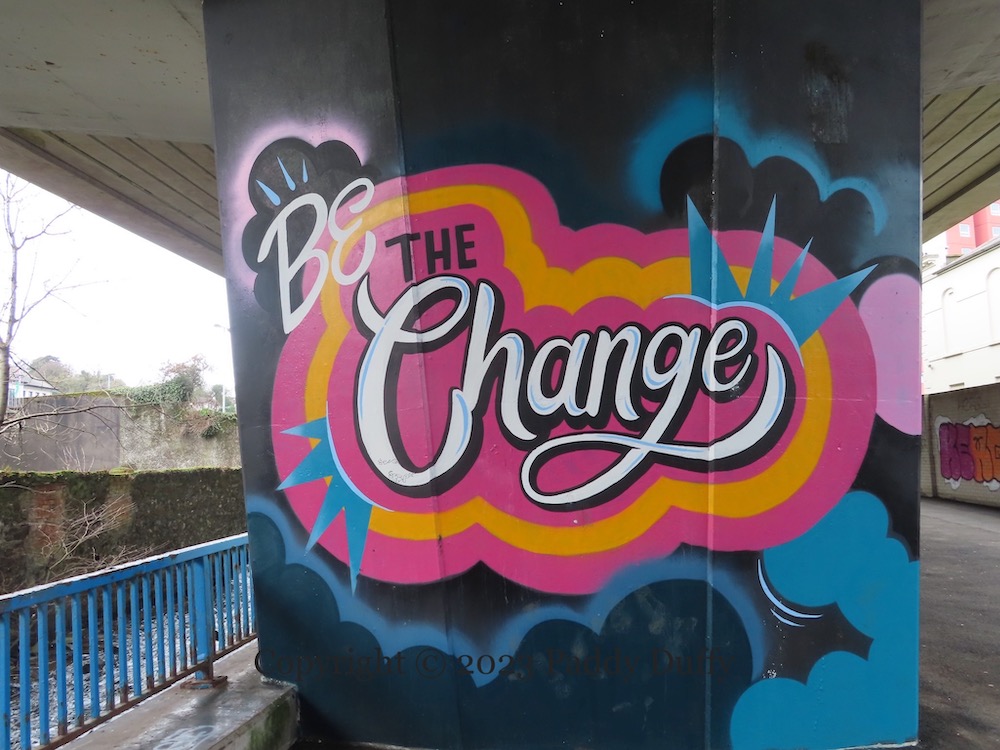
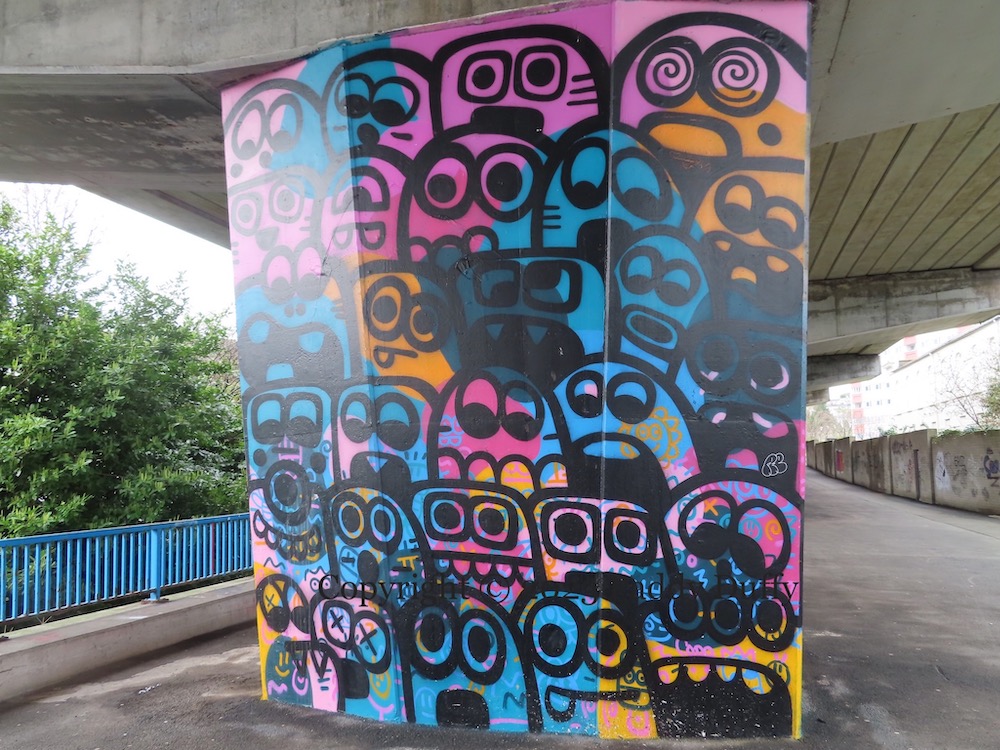
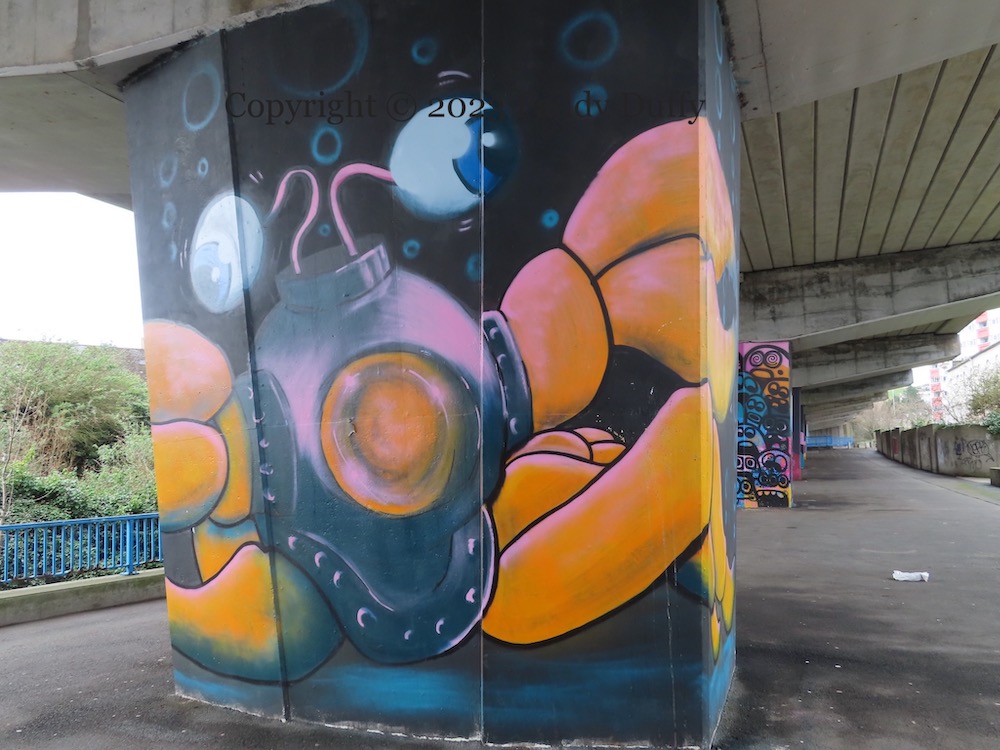
Harbour Highway underpass in Larne was re-painted in late October (2022) by (in order of appearance) Alana McDowell (ig), Rob Hilken (ig), emic (ig) (Lí Ban and/as otter, which was also the inspiration for iota’s piece in the town – see Shaped By Sea And Stone), Codo (ig), and FGB (ig).
With support from Seedheard Arts (ig) and Mid- & East Antrim council (ig).
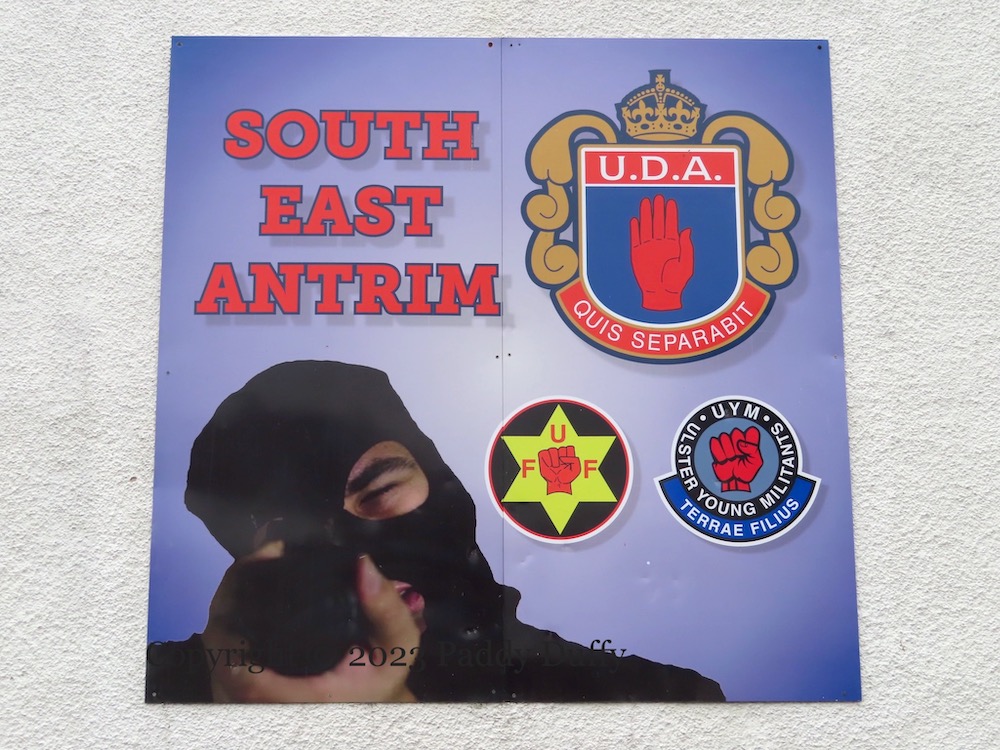
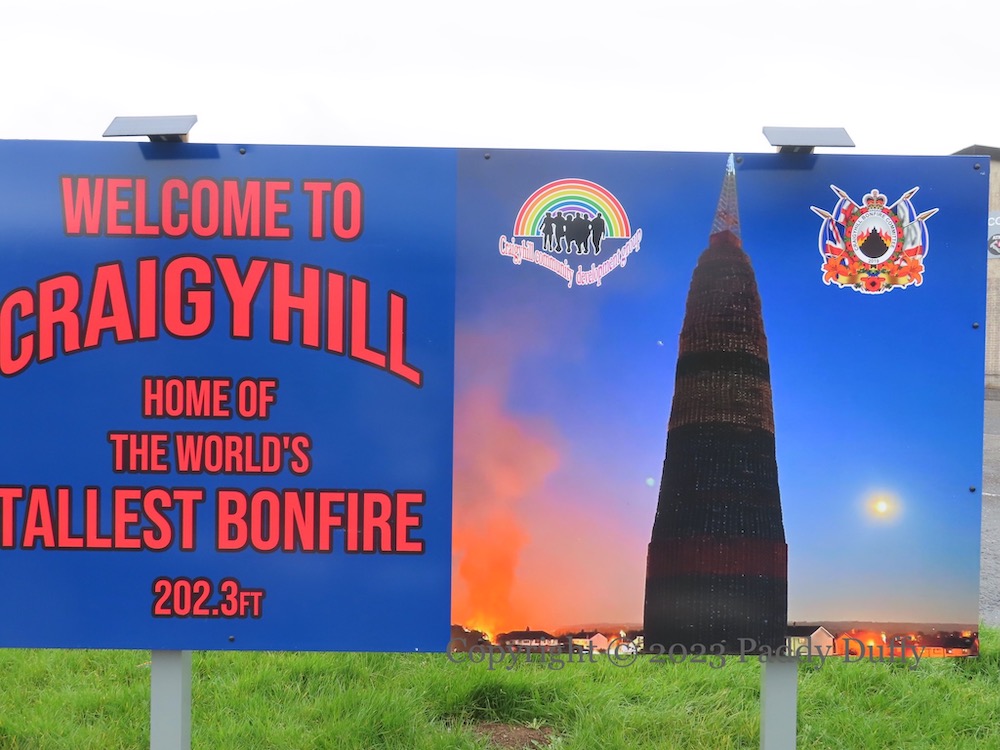
Bullets and bonfires in Craigyhill, Larne: the hooded gunman shown above is next to the boards shown in The Loyalist Executioner in Glenfarne Place, Craigyhill (Larne).
Both it and the second image (from the top of Cairngorm Drive) have been added since July, 2022. For the claim to be the “world’s tallest bonfire”, see Commonwealth Handling Equipment.
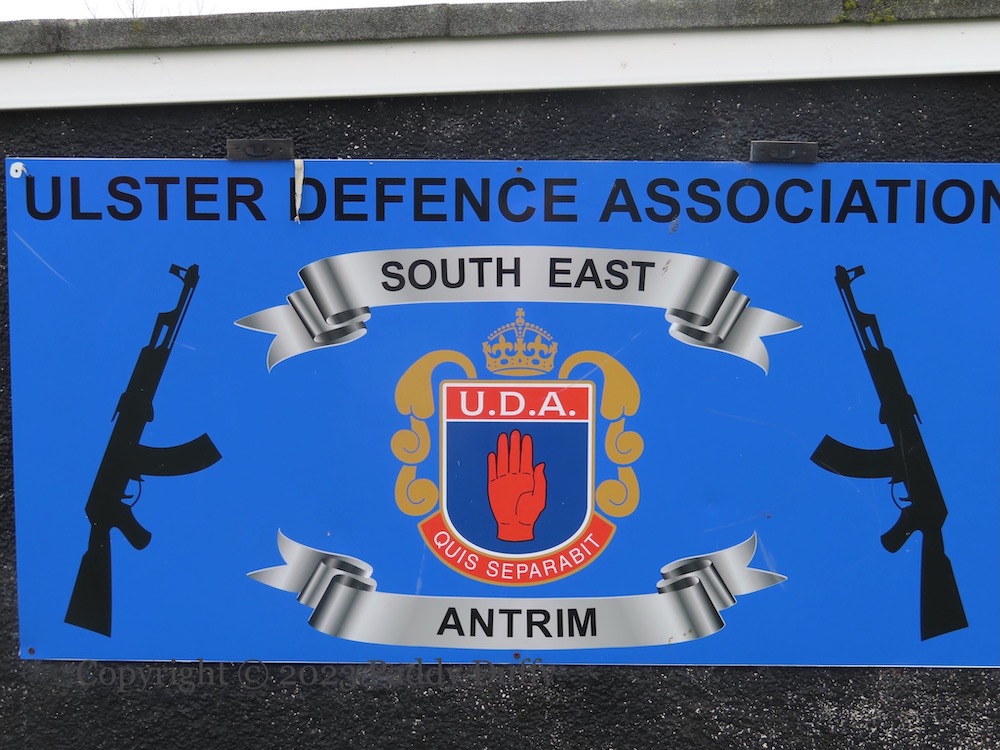
The image of a pair of assault rifles is in Fanad Drive.
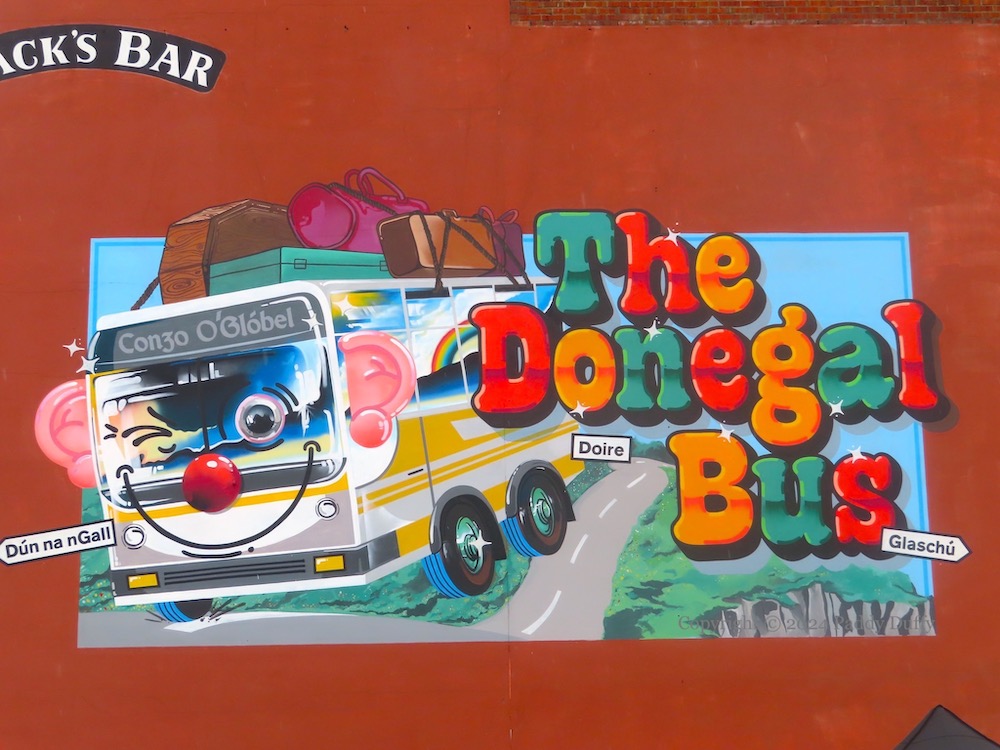
The Derry 2021 street art festival – rebranded as Roots Street Art – was affected by Covid lockdowns (Derry Journal) but several pieces were painted, including this one by the Glöbel Bros (Conzo Throb and Ciaran Glöbel, referring to emigration and economic migration between Dún Na nGall [Donegal], Doire [Derry], and Glaschú [Glasgow].
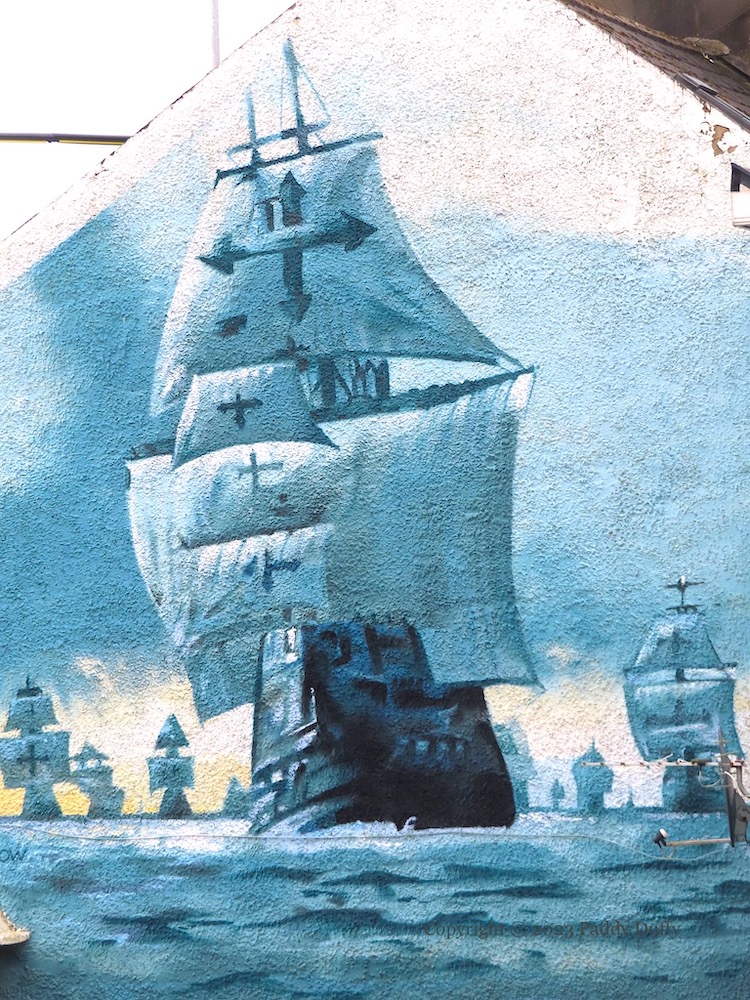
The Spanish galleass La Girona, one of the 130 ships that made up the armada that was unsuccessful against the English in 1588, docked at Killybegs, County Donegal, for repairs to her rudder (WP). When she departed, she got only as far as Lacada Point near Ballintoy, County Antrim, before sinking in a gale with the loss of roughly 1,300 lives and a substantial treasure that was recovered (in part) by Sorley Boy McDonell (portrayed in a Ballycastle mural) and (in part) by modern divers in 1968 (BBC).
Donegal Road, Killybegs, with a bonus image of the docks from the fish shop in Conlin Road.
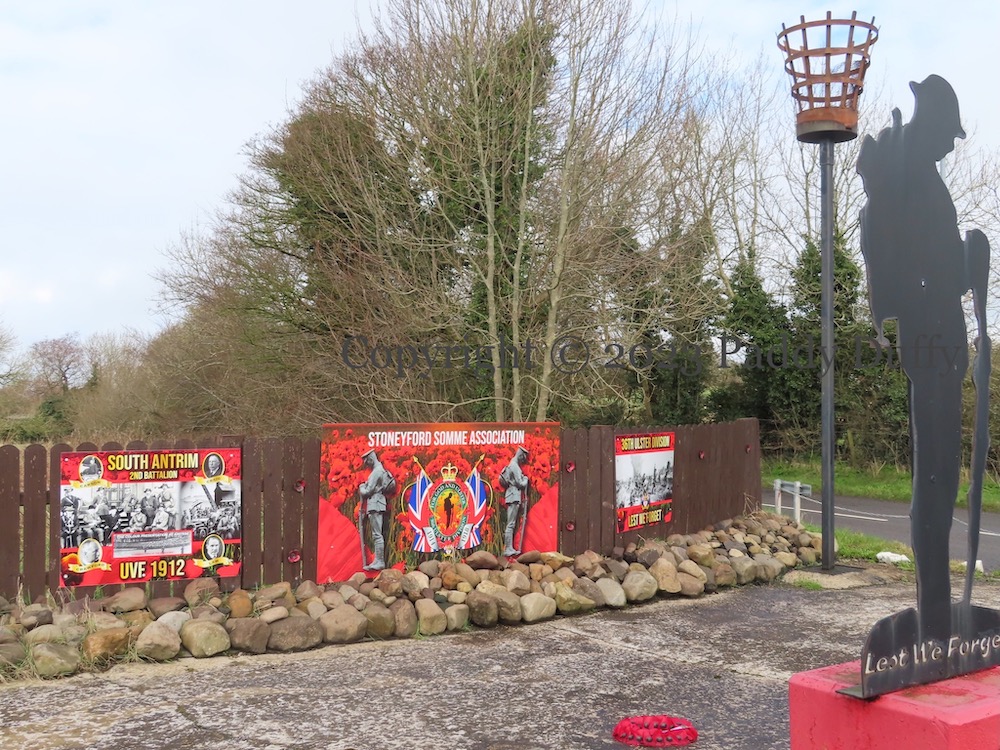
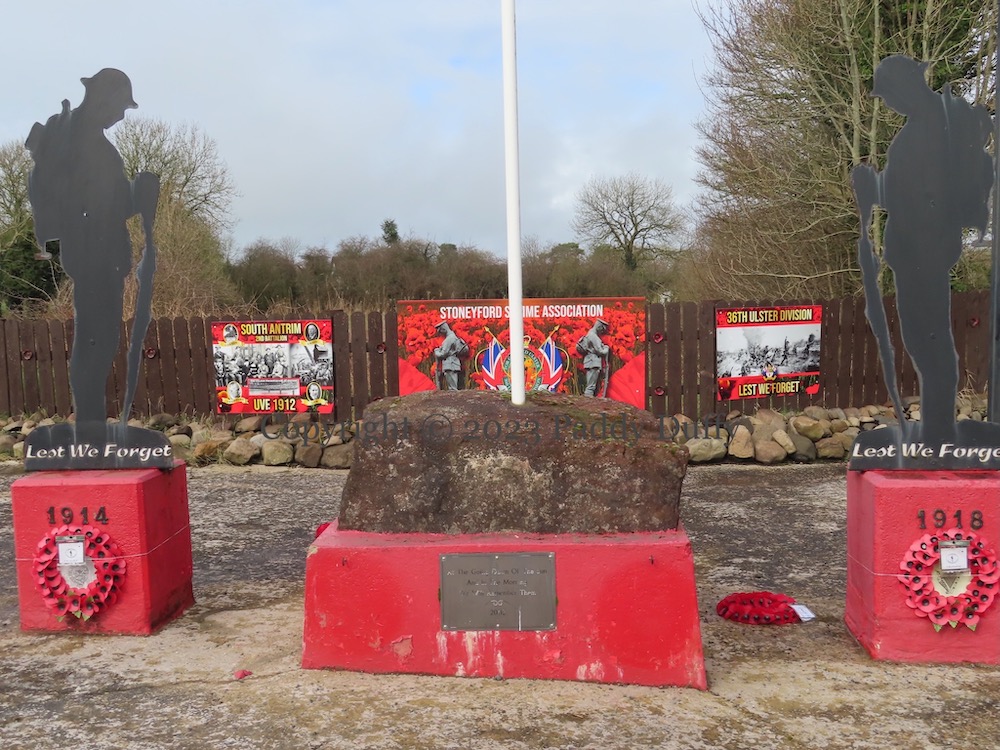
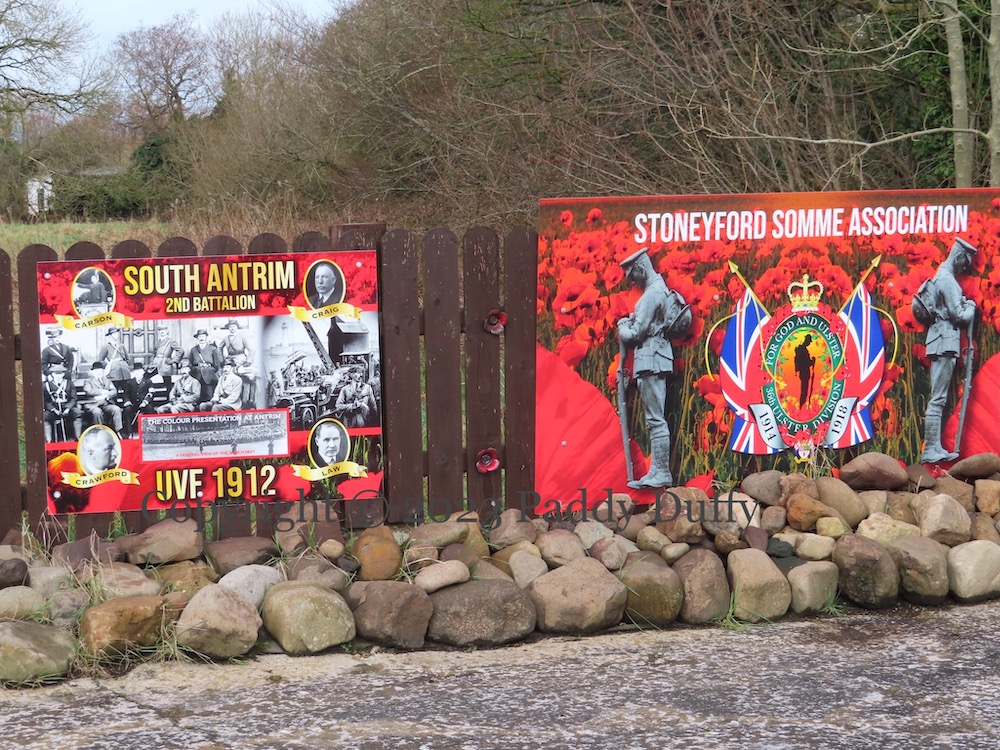
Boards have been added to the WWI memorial plaque in Stoneyford. On the right, the 36th Division go over the top in Beadle’s ‘Attack Of The Ulster Division’ (see Over The Top); the board on left more specifically commemorates the 2nd battalion of the South Antrim Ulster Volunteers, flanked by the leaders of the anti-Home Rule movement – Carson, Craig, Crawford, and Bonar Law.
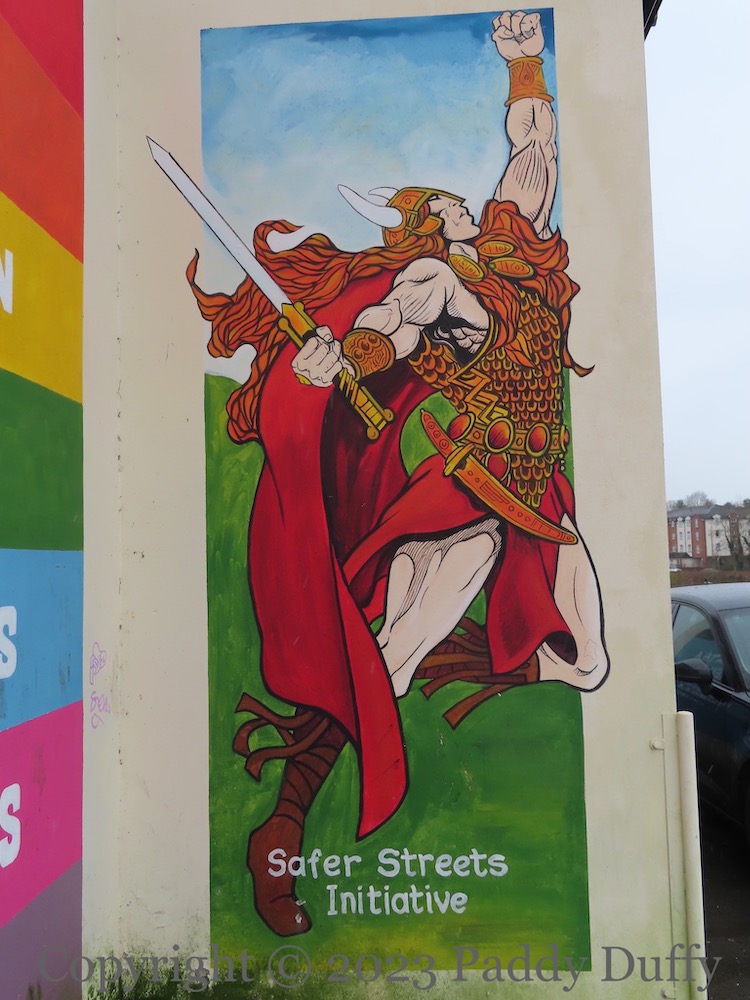
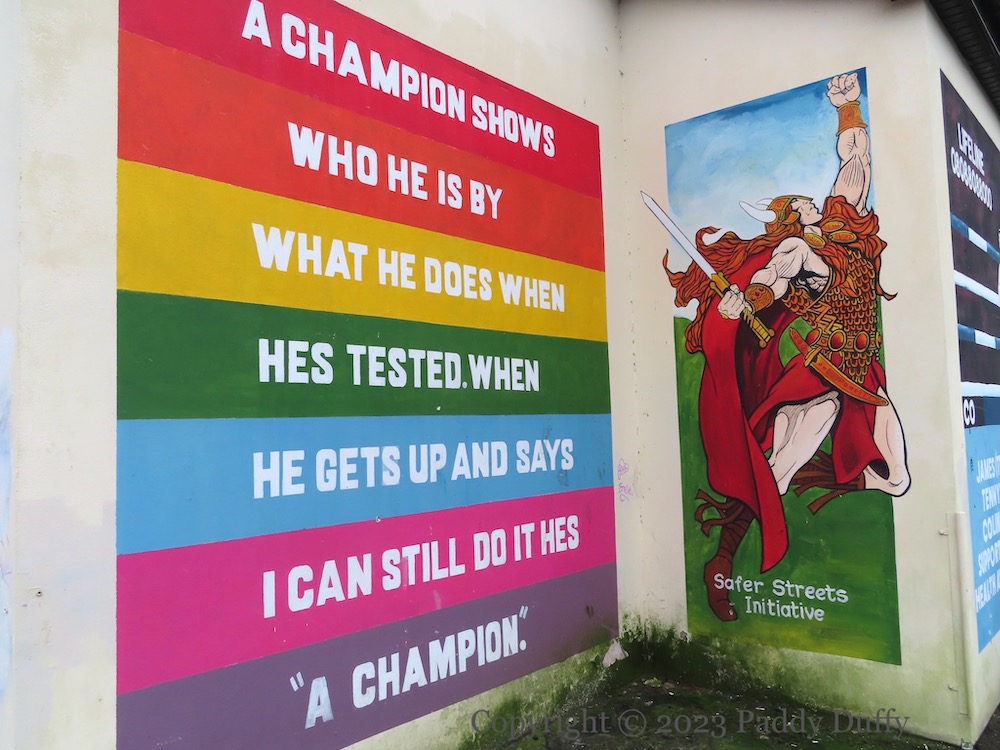
“A champion shows who he is by what he does when he’s tested. When he gets up and says “I can still do it”, he’s “a champion.” In Irish mythology, the Tuatha invade Ireland and battle the Fır Bolg. They are successful but their king Nuadha loses his arm and with it his kingship of the Tuatha. He had it replaced with an arm made of silver and regained his position. He is used here as an inspiration for those struggling with mental health, who are encouraged to call Lifeline or Aware.
(A history of Nuadha in murals is included in the Visual History page on Jim Fitzpatrick.)
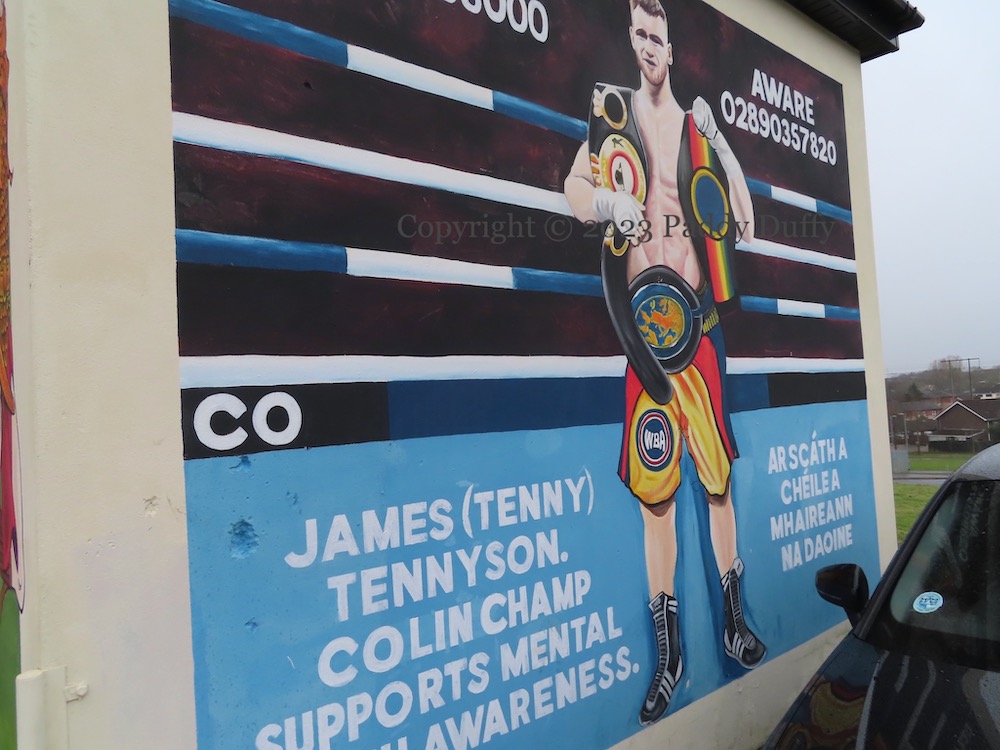
The modern-day hero accompanying Nuadha is boxer James “The Assassin” Tennyson, current Irish super-featherweight champion. There are also four mental health boards (shown below) around the corner from Urban Villages Colin Safer Streets Initiative with messages such as “Think, Talk, Feel – Positive”, “Everything that you are is enough”, “Learn from yesterday, live for today, hope for tomorrow”,
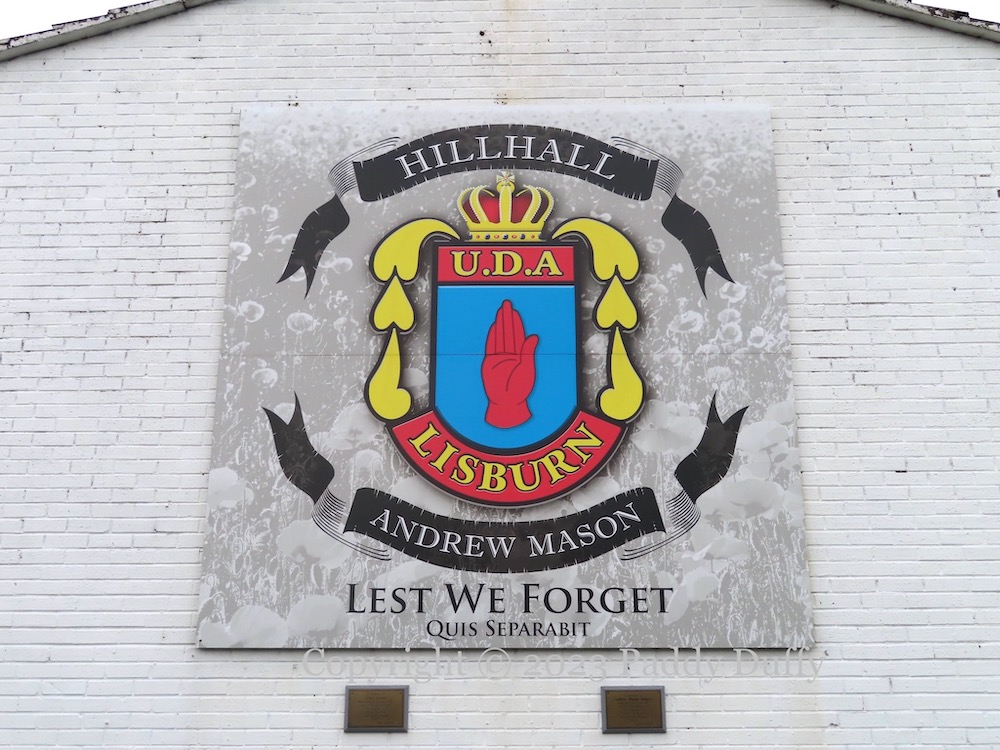
19-year-old Andrew “Macey” Mason was wearing his Hillhall band uniform and a UDA badge while en route to visit his girlfriend on April 19th, 1987, when he was set upon by two men near Carnlough on the Antrim coast. The gruesome details of the beatings and stabbings that followed are given in Lost Lives (#2827).
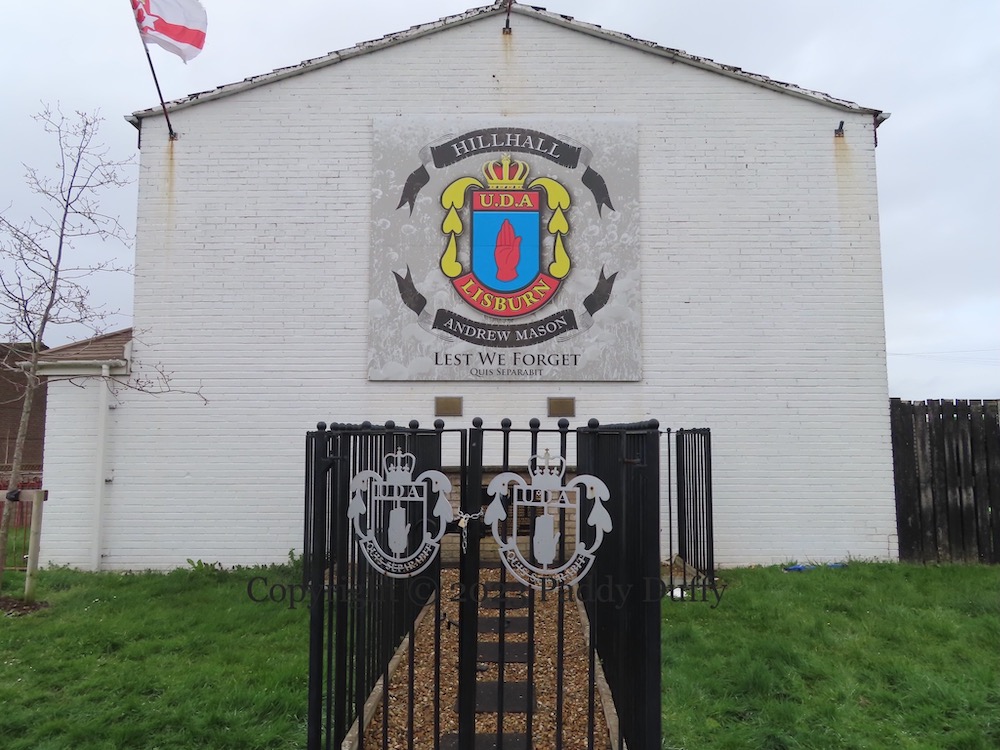
This is the second (see previously 2010 – M05938) memorial board to Mason in Hillhall. The memorial plaque (below) is a new version of the older plaque to John McMichael, Raymond Smallwood[s], Jim Guiney, and Mason.
Memorial boards to Queen Elizabeth have been added to the ‘our community transformation’ board and community garden in Old Warren.
An image of the old “You are now entering loyalist Old Warren” display that is shown in the ‘before’ side of the board above is included below. On the ‘after’ side are the youth centre, the new houses at the top of Drumbeg Drive, and the Lagan View enterprise centre. For a brief history of the area, see Through Your Eyes.
The previous board on this wall – a UDA B Company board – can be seen in C02674 and its predecessor in M05916.
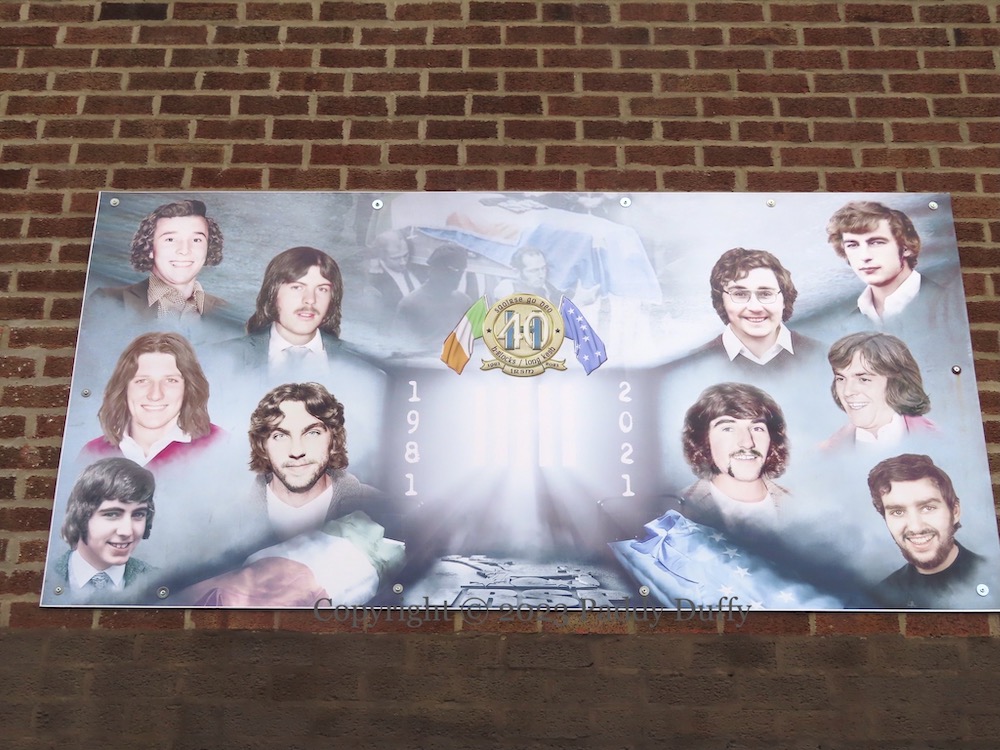
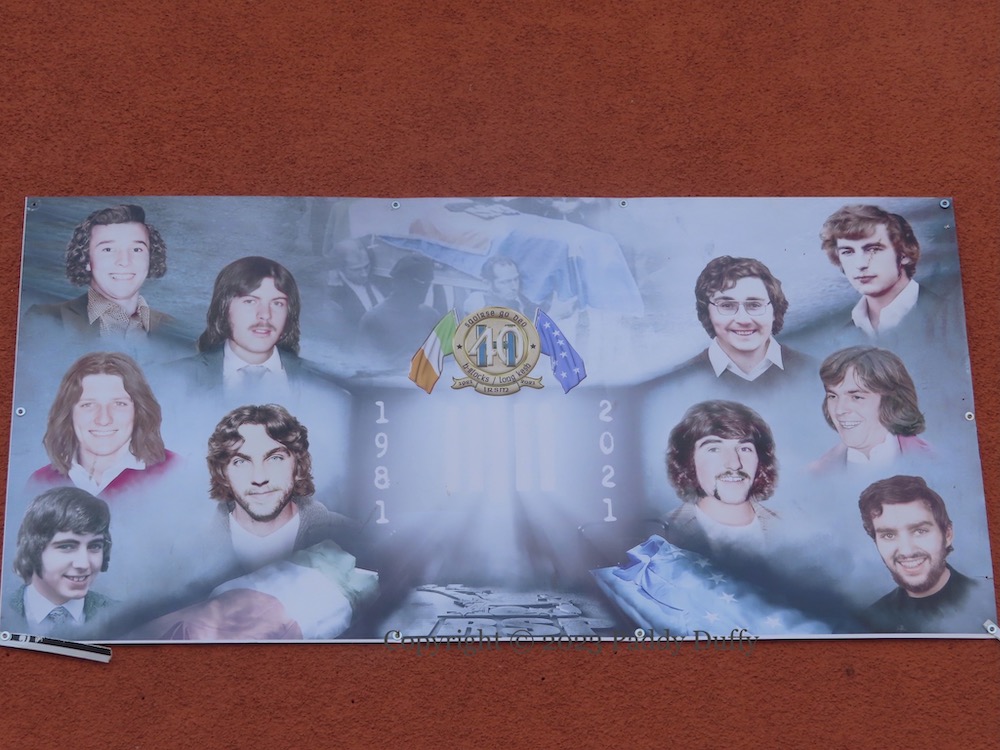
“Saoırse go deo.” INLA volunteer Kevin Lynch went on hunger strike on May 23rd, 1981. He would die 71 days later, on August 1st. His funeral is depicted in the top part of this IRSP/IRSM board commemorating the 40th anniversary of the 1981 hunger-strikes. The Tricolour (for the IRA) and Starry Plough (for the INLA) are used as blankets on the prison beds.
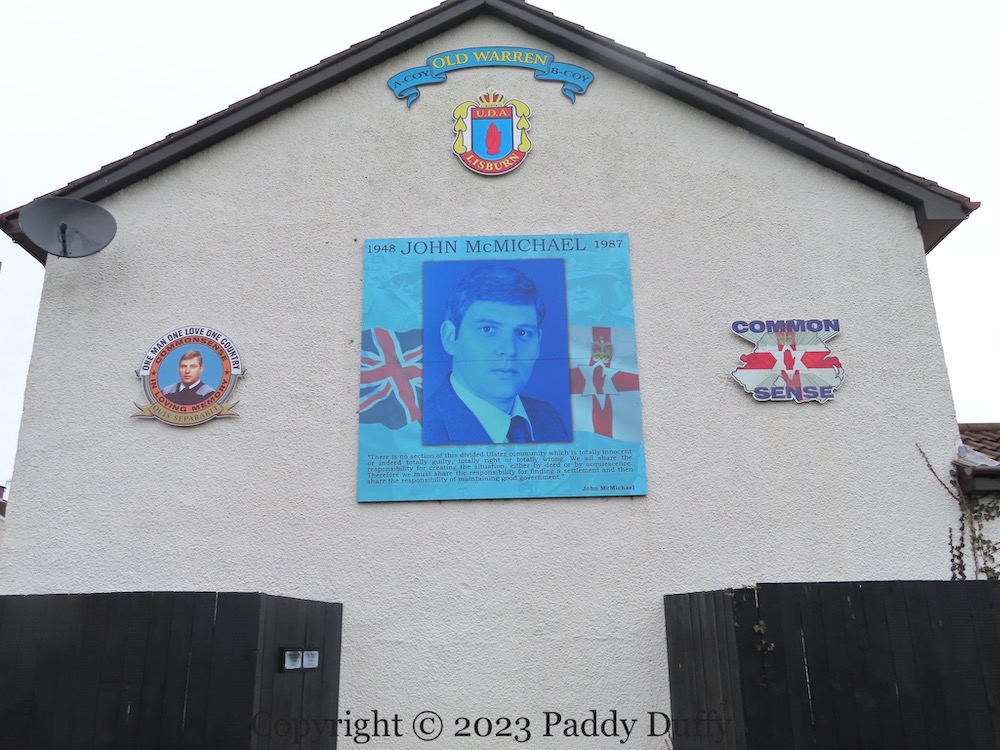
The South Belfast UDA/UFF commander John McMichael (1948-1987) was killed by an IRA car bomb. In addition to organising a team of assassins in the 70s and 80s, he founded a Political Research Group and wrote two documents proposing an independent Northern Ireland, 1979’s Beyond the Religious Divide and 1987’s Common Sense (available at CAIN), promoting the philosophy of ‘Ulster nationalism’. The quote on the board comes from the end of the Introduction to Common Sense:
“There is no section of this divided Ulster community which is totally innocent or indeed totally guilty, totally right or totally wrong. We all share the responsibility for creating the situation, either by deed or by acquiescence. Therefore we must share the responsibility for finding a settlement and then share the responsibility of maintaining good government.”
Above: “Old Warren A Coy/B Coy”. Right: “One man, one love, one country. Commonsense. In loving memory. Quis separabit.” around a portrait of McMichael. Left: “Common sense” with an Ulster Banner Northern Ireland.










 Paddy Duffy Collection