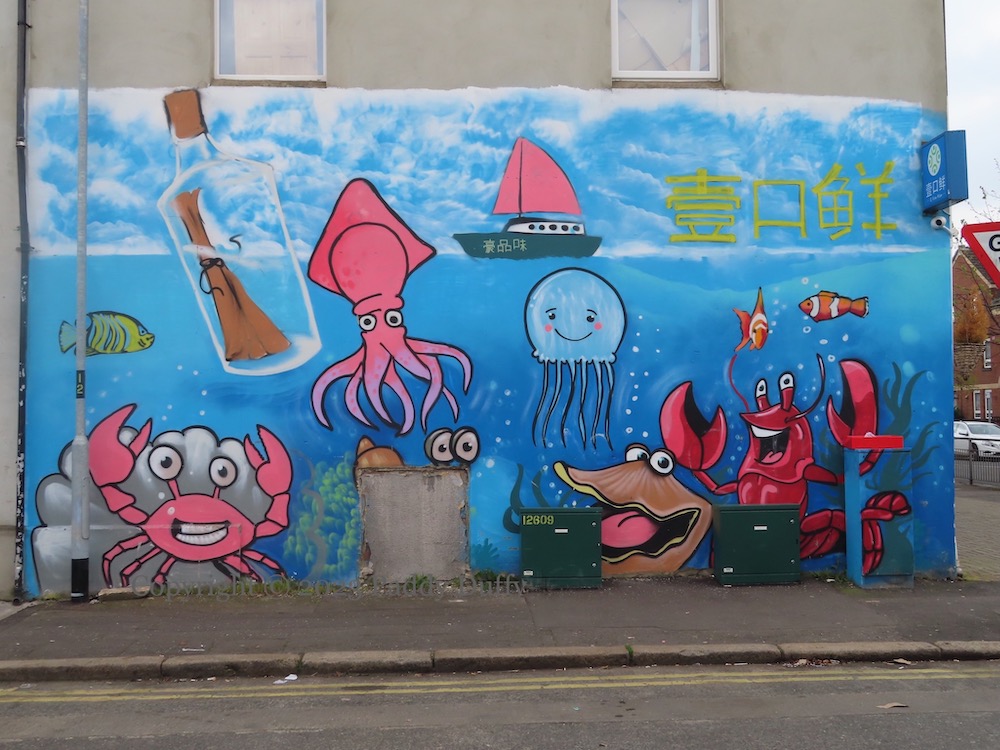
Happy sea creatures in blissful ignorance of their destinies as food. On the side of E Kou Xian (web) (lettering, top right) and the adjacent shop Hao Pin Wei (on the sailboat). Also in the street are Lee Foods and the Same Happy café. There is a QEII 70th jubilee mural on the side of the defunct Wai Kee restaurant.
Apsley Street in Donegall Pass, on the site of an old 36th Division board that went back at least to 1999.
“Ulster Special Constabulary 1920-1970. The Ulster Special Constabulary (USC; commonly called the “B-Specials” of “B Men”) was a quasi-military reserve special constable police force in what would later become Northern Ireland. It was set up in October 1920, shortly before the partition of Ireland. It was an armed corps, organised partially on military lines and called out in times of emergency, such as war or insurgency. It performed this role most notably in the early 1920s during the Irish War of Independence and the 1956-1962 IRA Border Campaign.
During its existence, 95 USC members were killed in the line of duty. Most of these (72) were killed in conflict with the IRA in 1921 and 1922. Another 8 died during the Second World War, in air raids or IRA attacks. Of the remainder, most died in accidents but two former officers were killed during the Troubles in the 1980s. [The WP page from which this text is drawn at this point goes on to talk about Catholic mistrust of the Specials.] The Special Constabulary was disbanded in May 1970, after the Hunt Report, which advised re-shaping Northern Ireland’s security forces [to attract more Catholic recruits] and demilitarizing the police. Its functions and membership were largely taken over by the Ulster Defence Regiment and the Royal Ulster Constabulary.
[Accompanying the small photograph:] At the Twelfth demonstration at Finaghy, Sir Edward Carson, the unionist leader, deploring the state of the county, advised the government: ‘If … you are yourself unable to protect us from the machinations of Sinn Fein … we will take the matter into our own hands. We will reorganise [the Ulster Volunteers]’.” [From a NewsLetter article ‘USC Helped Establish Peace In Early Years Of NI’]
Carson’s quote is also used in a Belfast UVF mural. As is noted there, the speech is probably from the 12th of July – Treason Felony | RTÉ – and concerns the reformation of the Ulster Volunteers as a force to protect Protestant interests in the north of Ireland in light of the proposal in the (fourth) Home Rule bill to create separate northern and southern states.
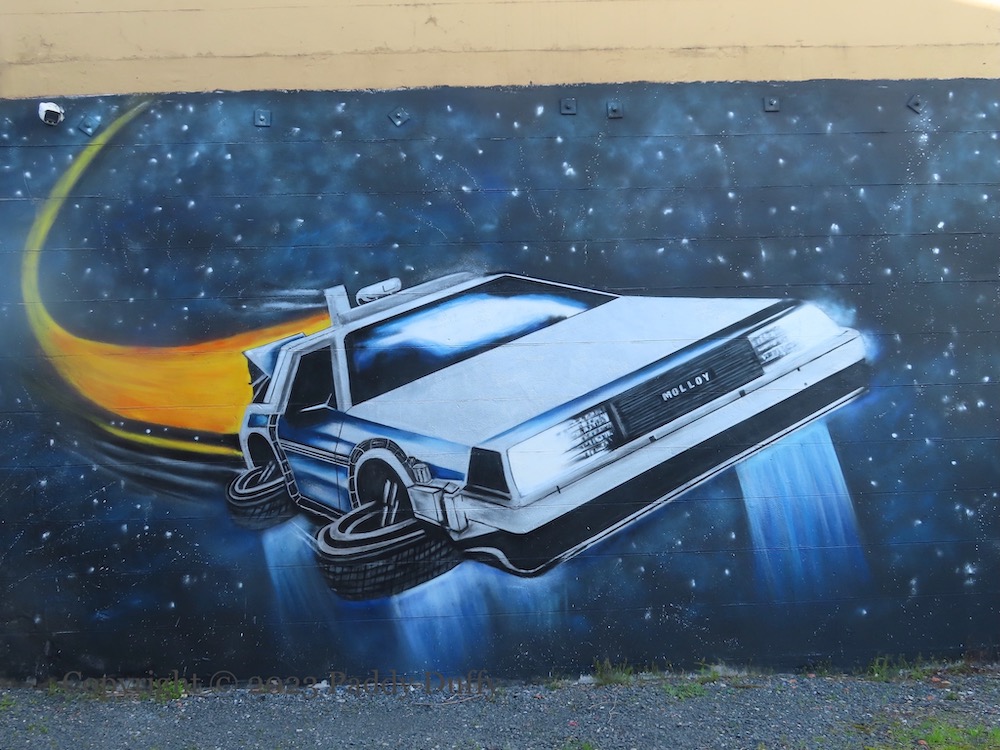
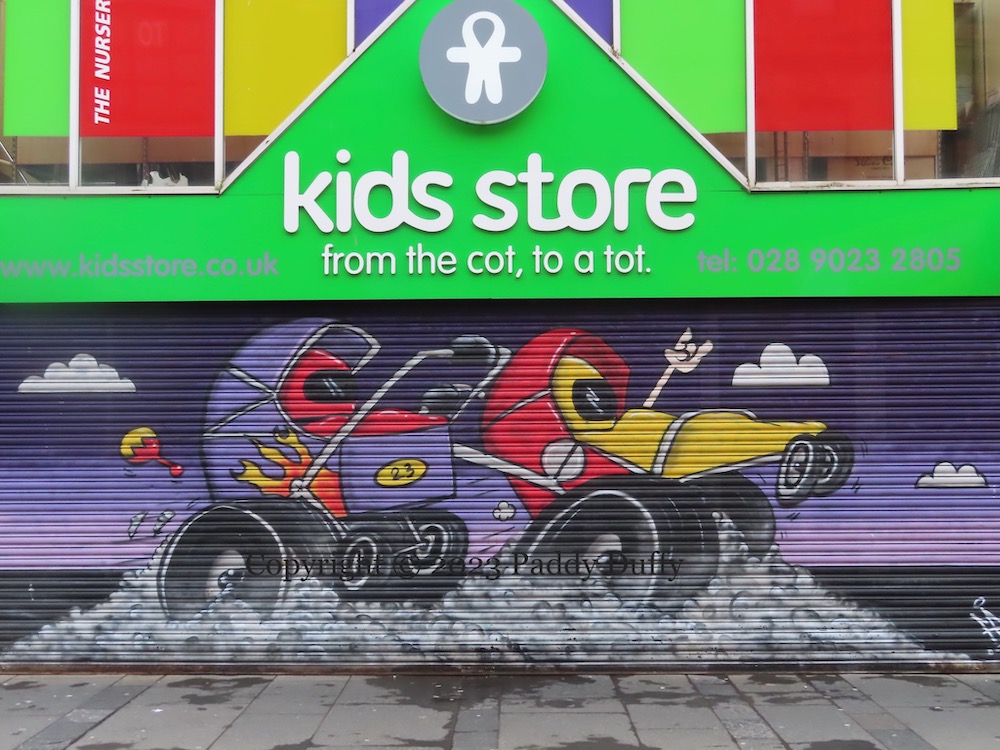
In the film Back To The Future, Doc Brown builds a time machine out of a DeLorean by adding a “flux capacitor”. In the second film in the series (IMDb), Doc and Marty take the DeLorean – now with a thruster and wheels that flip horizontally in order to act as jets – into the future (that is, 2015). The movie franchise has given a long life to a car that in practice was made – in Belfast – for only seven years (WP).
Street art by Glen Molloy in Corporation Street, Belfast.
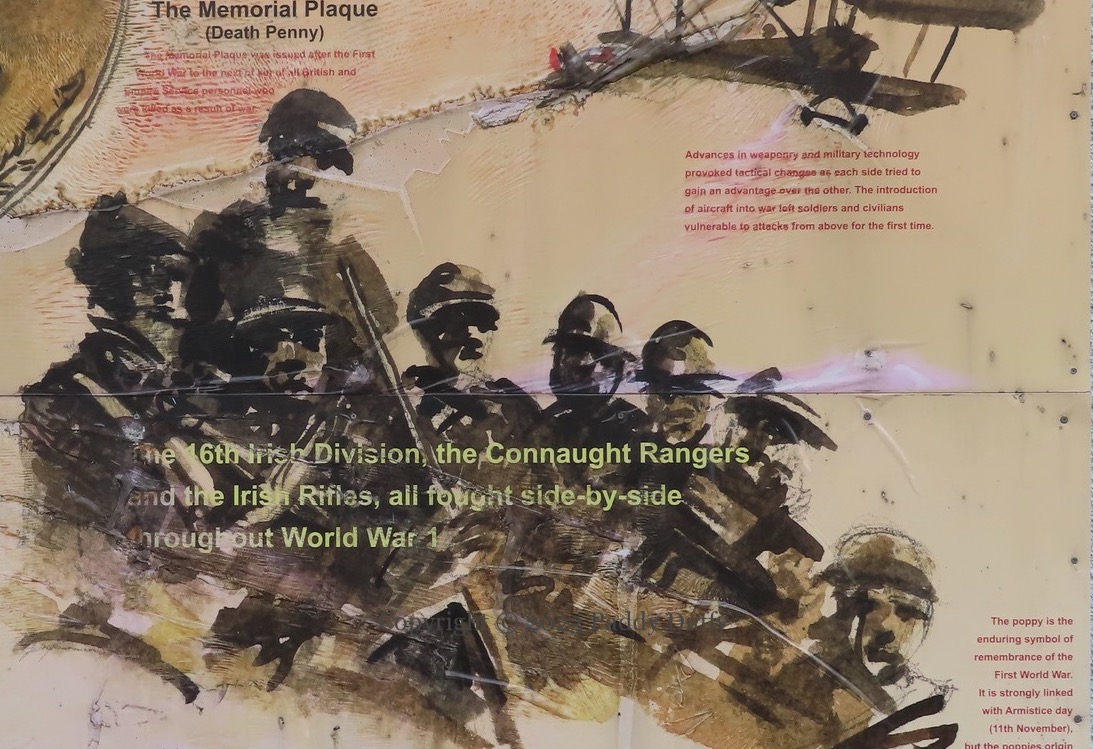
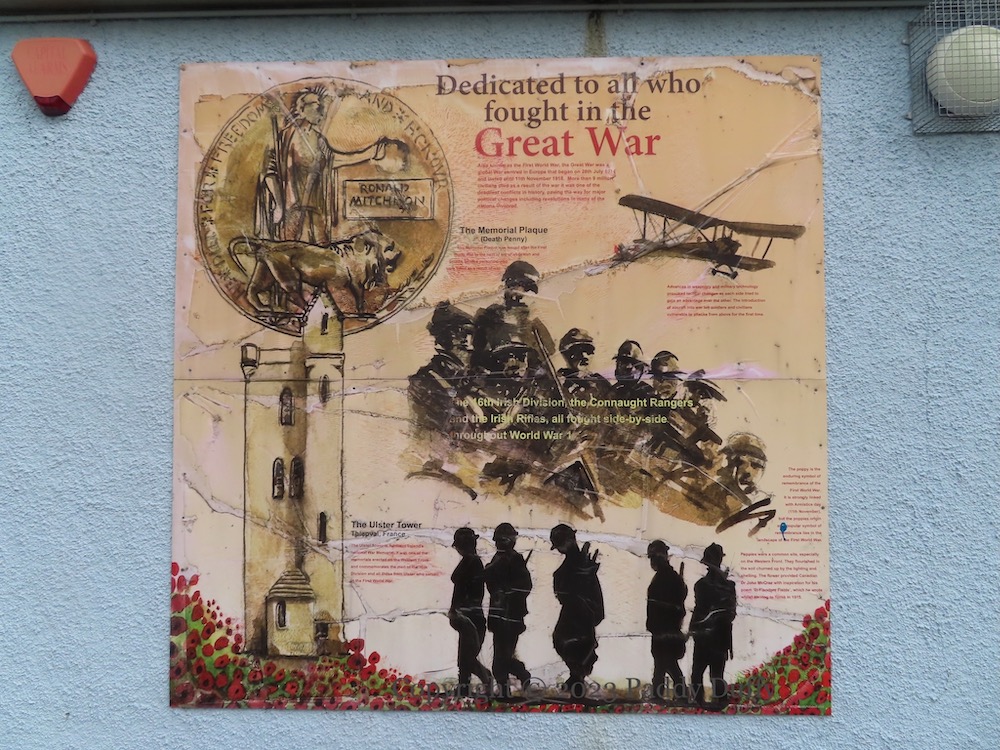
This board presents imagery and information about WWI, centrally including the statement (shown above) that “The 16th Irish Division, the Connaught Rangers [7th battalion] and the Irish Rifles [7th battalion], all fought side-by-side throughout World War I.”
The Ulster Tower on the left is familiar from many other murals and boards. In the top left, we see “The Memorial Plaque (Death Penny” which was also known as the “Dead Man’s Penny”. It was issued after the First World War to the next of kin of all British and Empire Service personnel who were killed as a result of the war. The “penny” was in fact five inches in diameter and cast in bronze. It showed Britannia with a trident and two dolphins swimming around her, and a lion on oak, along with the name of the deceased (here, Ronald Mitchison) without indication of rank. (Here is a close-up of a plaque from WP.)
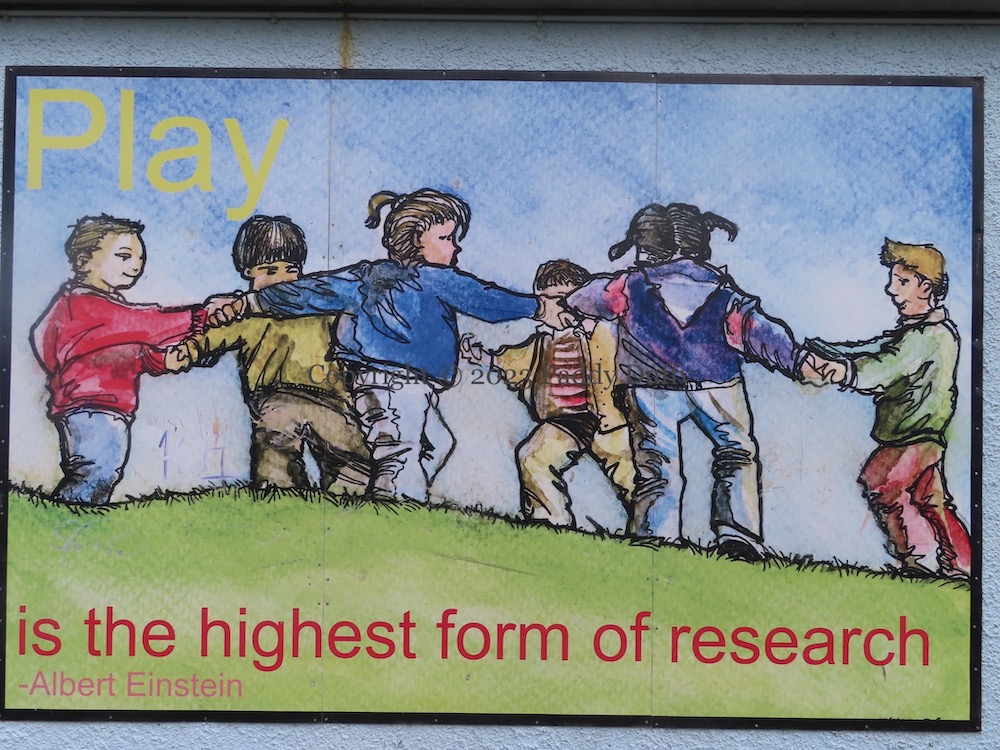
The second piece (mis-)attributes the quote “Play is the highest form of research” to Albert Einstein and shows children playing ring-a-ring-o’-roses. Painted by Ed Reynolds (steadyhanded.com).
Both boards are on the community centre in the lower Shankill estate.
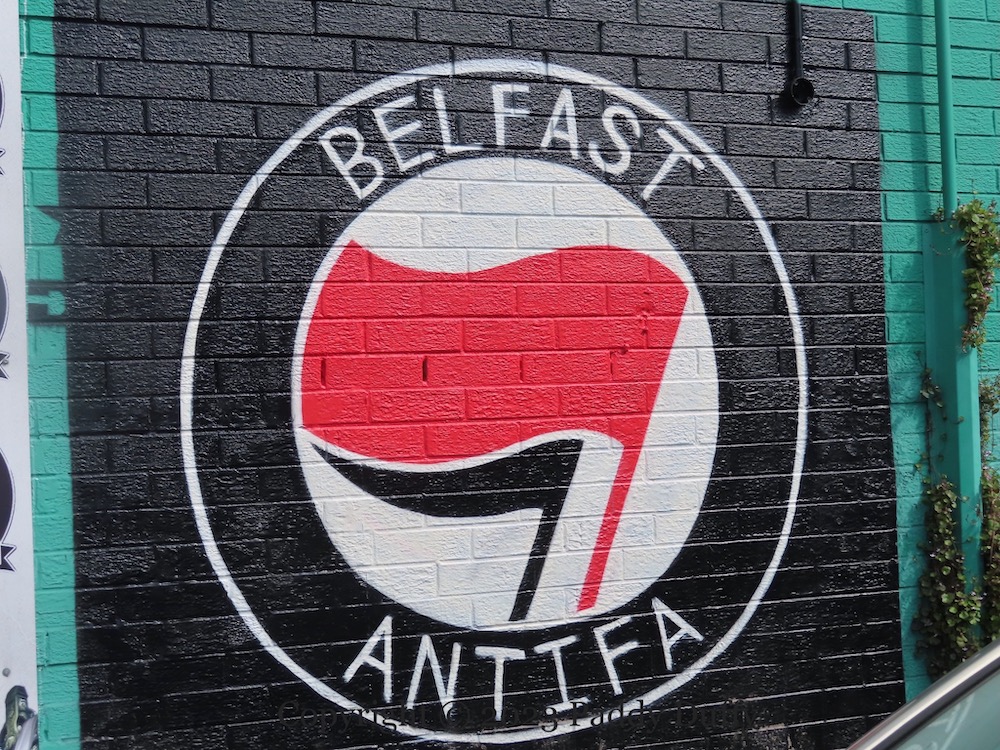
The purpose of the “do not use” graffiti in Braemar Street (seen in Remember The Hunger Strike) has at long last been made evident with this new Belfast antifa (Fb | tw) stencil.
The stencil is in Mount Vernon, which is also home to a series of metalworks – see They Sleep Beyond Ulster’s Foam. That title, as well as the title of this entry, comes from Binyon’s poem For The Fallen, the fourth stanza of which is often cited in memorial for the dead of the Great War: “They shall grow not old, as we that are left grow old; / Age shall not weary them, nor the years condemn. / At the going down of the sun and in the morning / We will remember them.”
The stencil is perhaps not only a memorial to the dead of WWI – the planes appear to be WWII models such as the Hurricane or Spitfire (as on the box below, and in A Miracle of Deliverance); most WWI planes were biplanes.
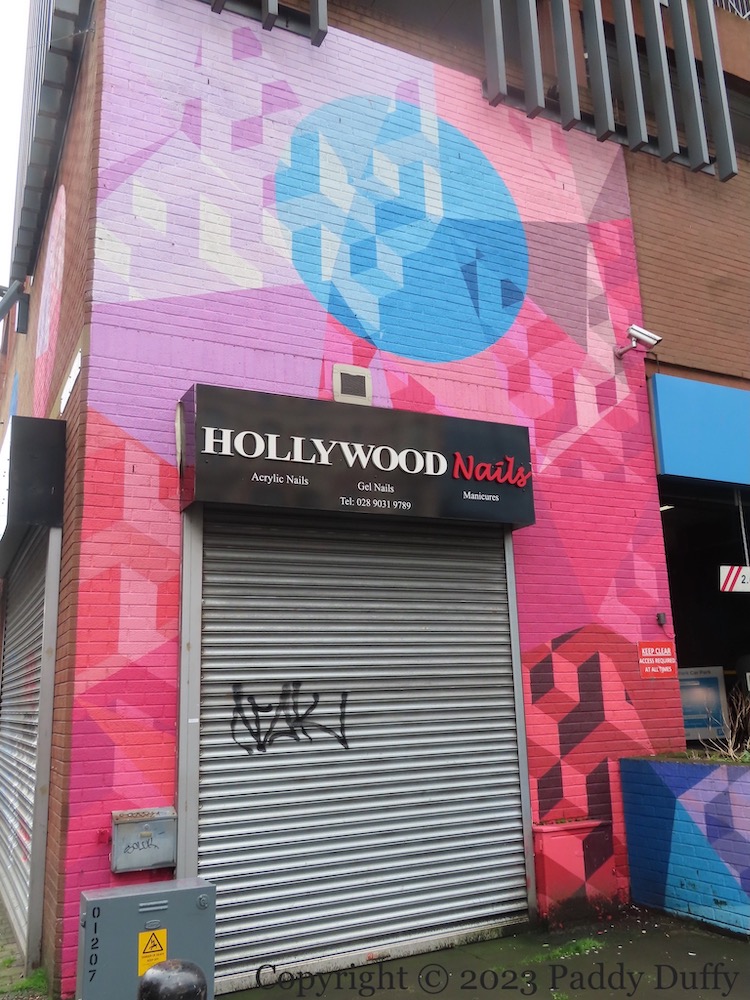
Street art by Rob Hilken (web | ig) in High Street and Church Lane, Belfast.
“My mural on the corner of Church Lane and High Street is inspired by the businesses in the immediate area. The circle forms represent sun and moon, the sun rising and setting at the beginning and end of the day and the moon illuminating the night sky. The colour palette evokes sunrise and sunset, and the glamour of the local nightlife. The local businesses include cafes serving food from morning until night, bars where people socialise until the early hours, as well as barbers, hairdressers, nail bars, piercing studios and tattooists for the image-conscious crowds that inhabit the area. The mural aims to add to the identity of the area as somewhere where people go to socialise as well as enhance their own image.”





 Paddy Duffy Collection