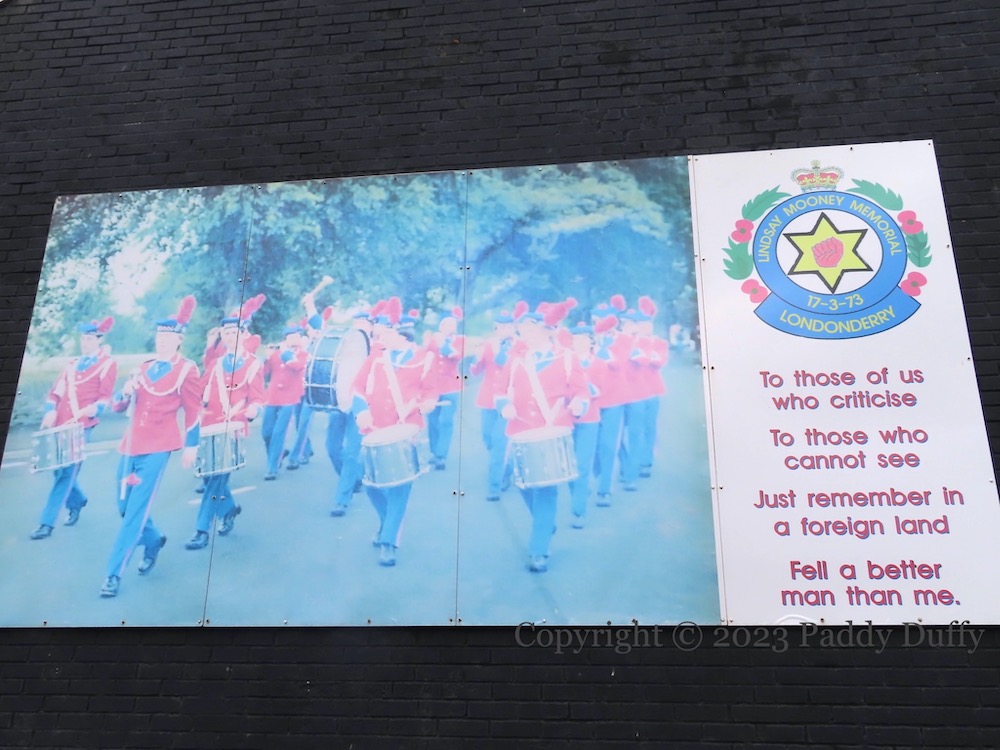
“S.L.M.M.F.B.” [Sergeant Lindsay Mooney Memorial flute band] “In glorious memory: Lindsay Mooney, Ben Redfern, Cecil McKnight, Gary Lynch, Ray Smallwoods, William Campbell. ‘At the going down of the sun and in the morning we will remember them.'”
The flute band was formed in 1973 after the St. Patrick’s day death of Lindsay Mooney, a UDA member killed by the premature explosion of a bomb near Lifford, County Donegal (Sutton). The band’s 50th anniversary march takes place on the 18th (Bands Forum), though it was not in operation between 1993 and 2013 and beyond (NI World). There are, however, videos on youtube of the band parading in 2021 and in 2022 and they will march for the 50th anniversary of the band later this year (2023) (youtube).
The mural was erected in 2021 in Lincoln Court, Londonderry, on the same wall as a former UDA memorial mural to the six but which had been blank since 2011.
“Queen Elizabeth II 1926-2022.” This memorial board in Stevenson Park, Londonderry, shows Queen Elizabeth around the time of her 1952 accession, perhaps by Dorothy Wilding (left and right) and (in the centre) a 2004 version of the 3-D portrait by Chris Levine and Rob Munday dubbed “Equanimity” (Sotheby’s).
There are Orange Order lodges in Ghana and Togo and there were previously lodges in South Africa and Nigeria (History Ireland | WP). A photo of the Ghanaian representative in the mural – Dennis Tette Tay – is included in this BBC article. The Canadian representative is perhaps from “Mohawk Loyal Orange Lodge No. 99” on the Mohawk Reservation at Desoronto, Ontario, Canada (Fb).
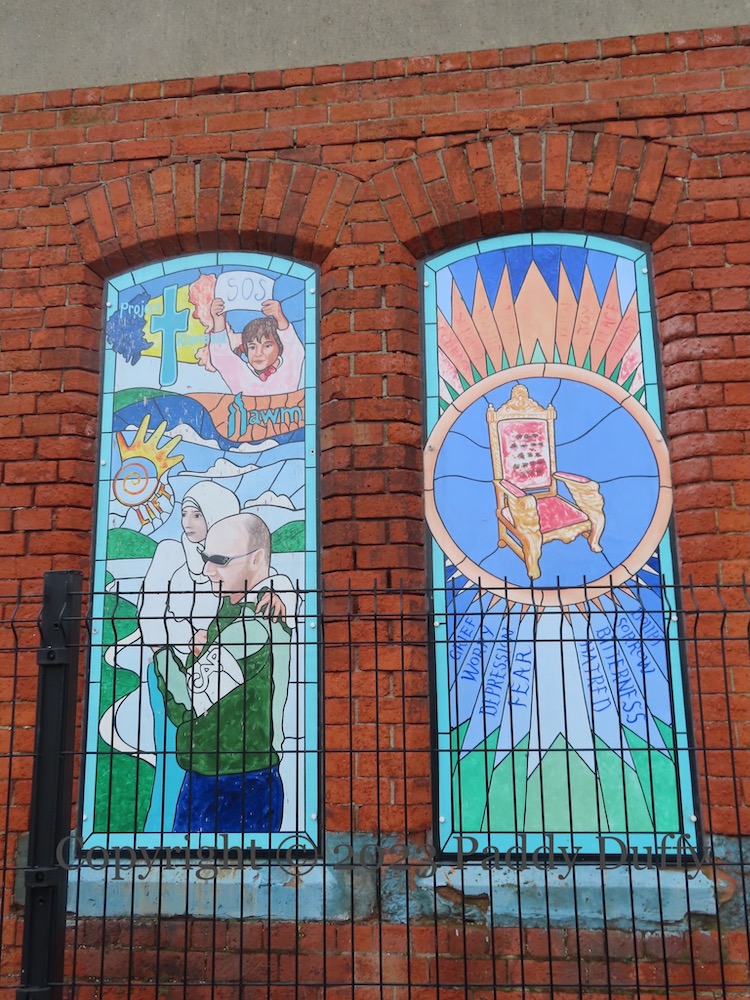
The Dome Of The Rock with its golden dome and octagonal walls (WP) provides a background to Palestinian protesters in this board expressing solidarity with Palestine (seen previously in 2021-11). Éıstıgí (Fb) is the youth division of Saoradh (web), and IRPWA (tw) is its prisoner-of-war organisation.
This is a printed board but even so the artwork is in a different style to what has been previously seen, with the two characters drawn in a cartoon/animation style.
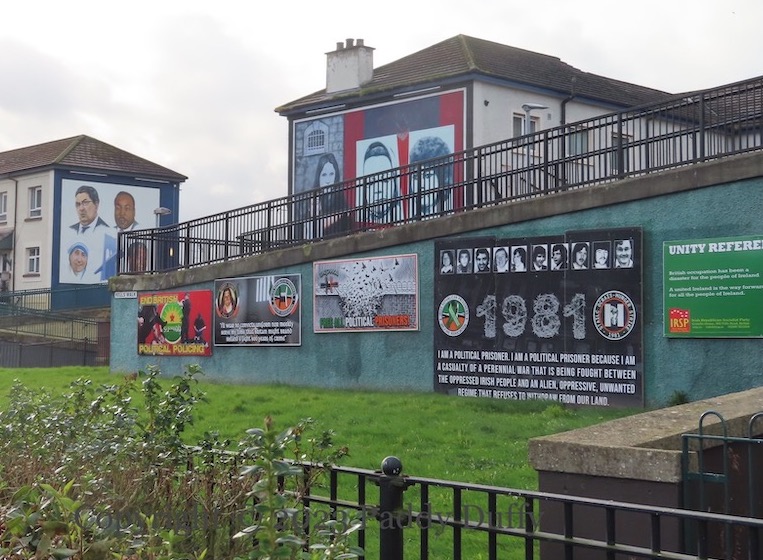
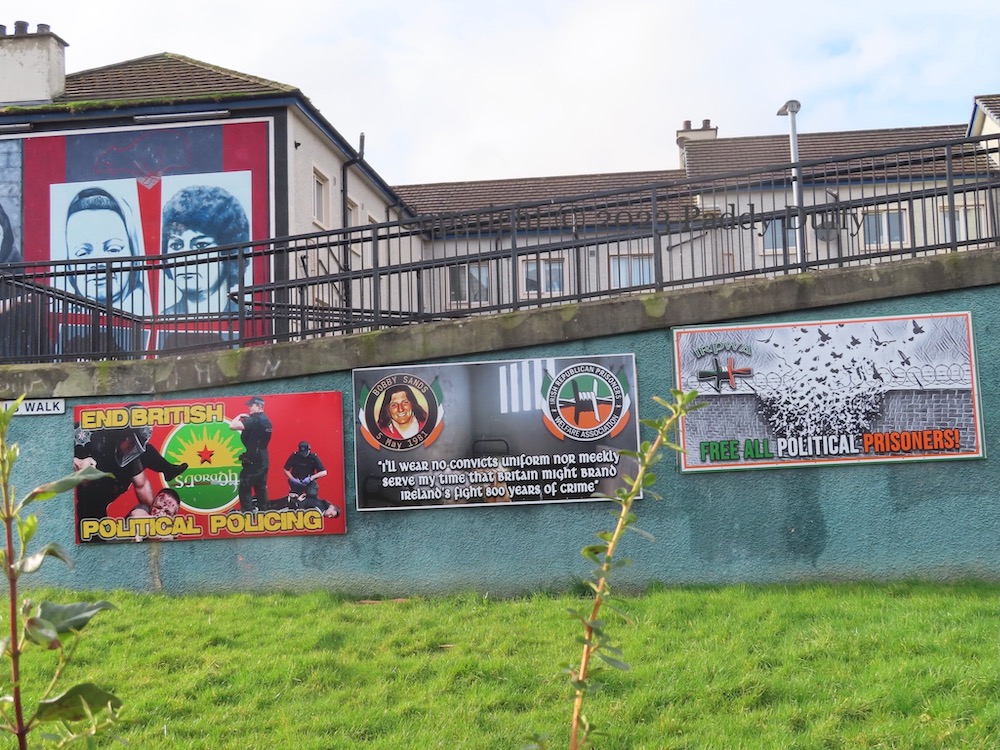
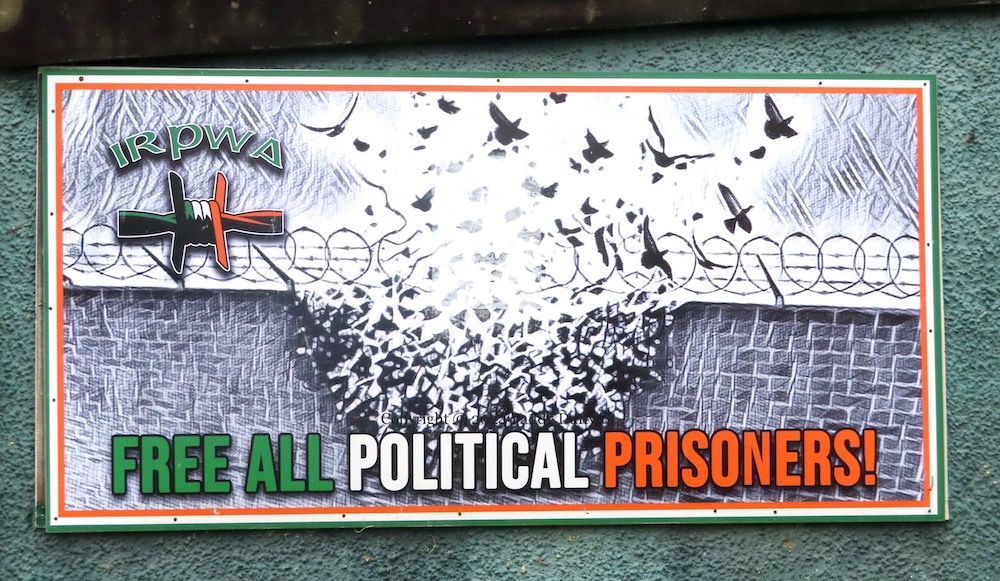
There are six small boards along Rossville Street, Derry.
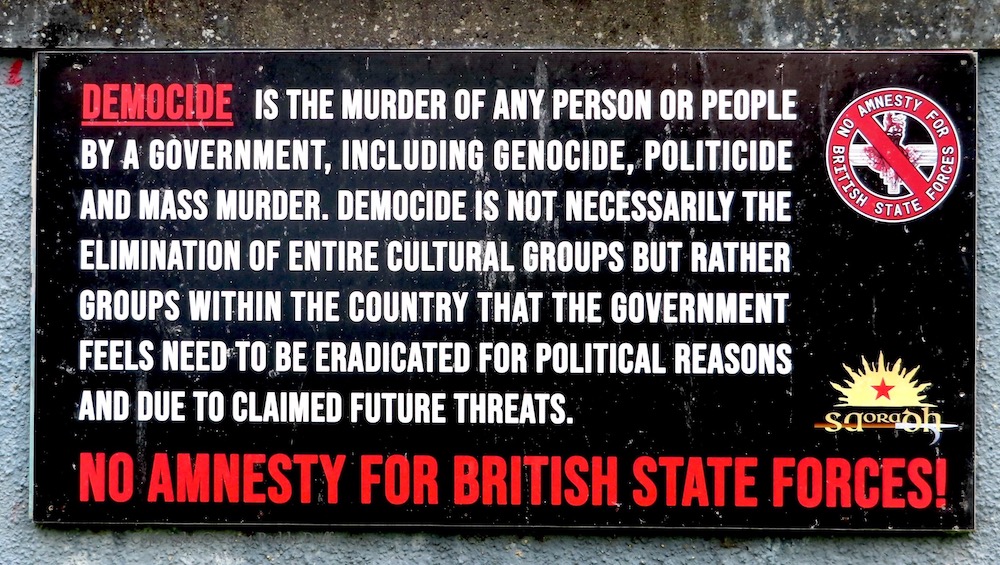
On the end wall (out of sight in the wide shots): “Democide is the murder of any person or people by a government, including genocide, politicide and mass murder. Democide is not necessarily the elimination of entire cultural groups but rather groups within the country that the government feels needs to be eradicated for political reasons and due to claimed future threats. No amnesty for British state forces.”
The [Sergeant] Lindsay Mooney Memorial Flute Band was formed in 1973 after the St. Patrick’s day death of Lindsay Mooney, a UDA member killed by the premature explosion of a bomb near Lifford, County Donegal (Sutton). The band dissolved in 1993 but commemorative nights are still held (NI World). It has presumably re-formed, as there are videos on youtube of the band parading in 2021 and in 2022 and they will march for the 50th anniversary of the band later this year (2023) (youtube).
The board above is in the Lincoln Court area of Londonderry, from where Mooney and the band both hailed. “To those of us who criticise, to those who cannot see, just remember in a foreign land fell a better man than me.”
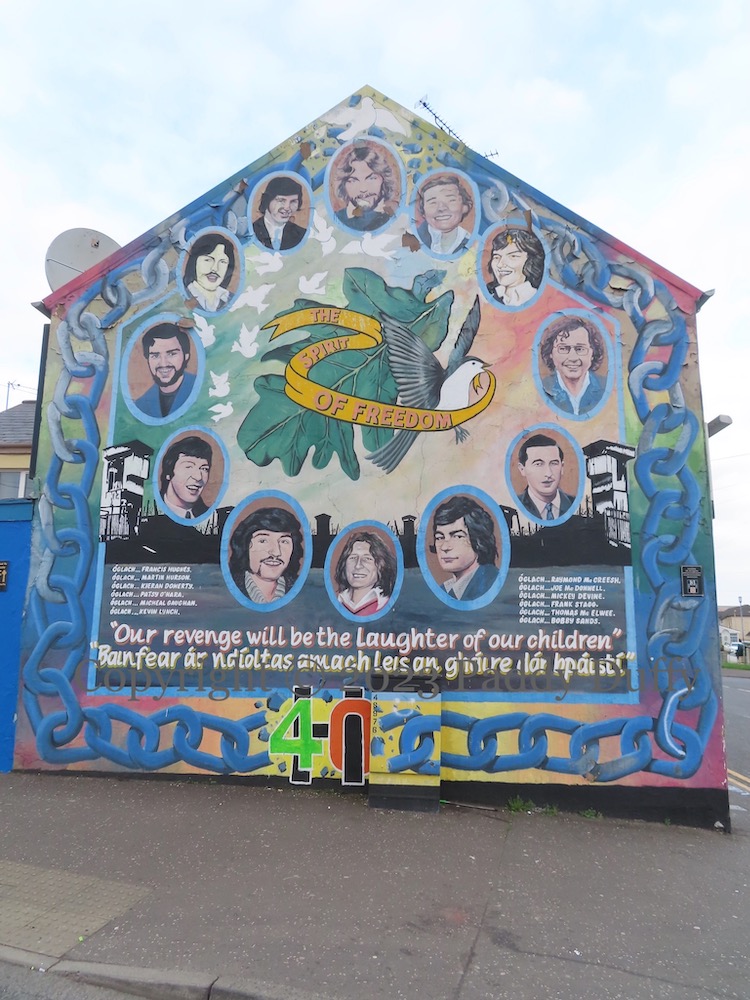
The plaque to the left reads, “This mural is dedicated to all those who tragically died on the streets of Derry during the hunger strike era. Suaımhneas Dé da nanamacha. 3rd October 2006.” The mural referred to is in fact the ‘crumbling cell’ mural (see M03350); the ‘Spirit Of Freedom’ mural was first painted in 2011 for the 30th anniversary (see X00999) – the 30th anniversary plaque remains, on the right of the mural but for the 40th anniversary of the 1981 hunger strike “40” replaced the “30” in the bottom border.
The mural features both the lark and the dove (Visual History).
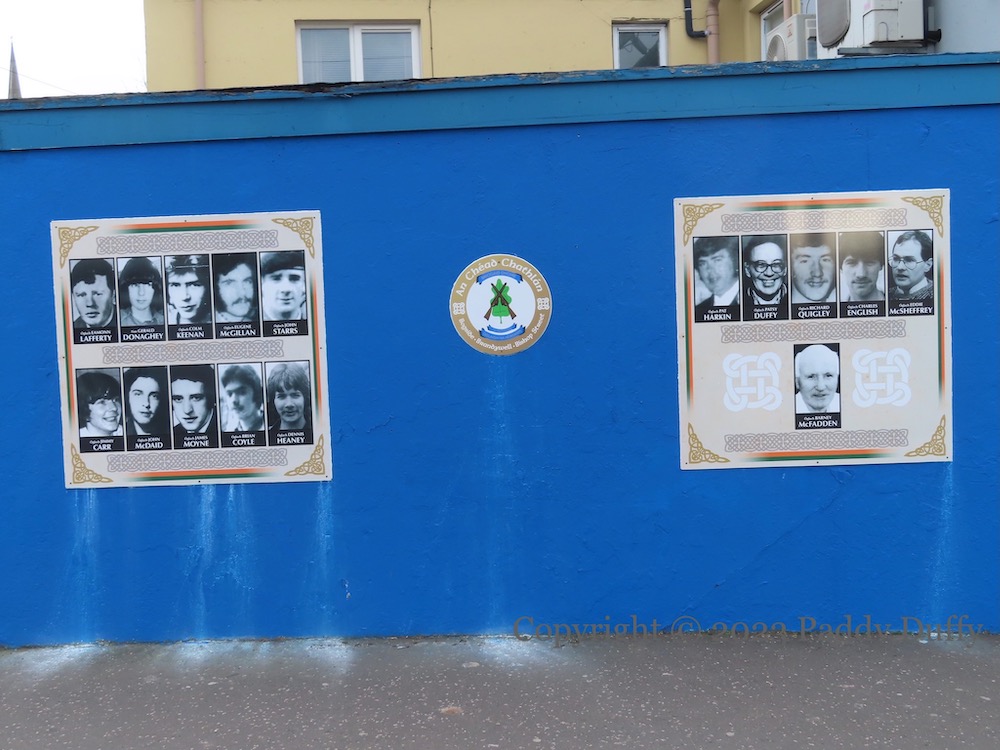
On the side wall, two new panels remember members of the IRA’s Derry brigade, replacing the single board seen in M07635.
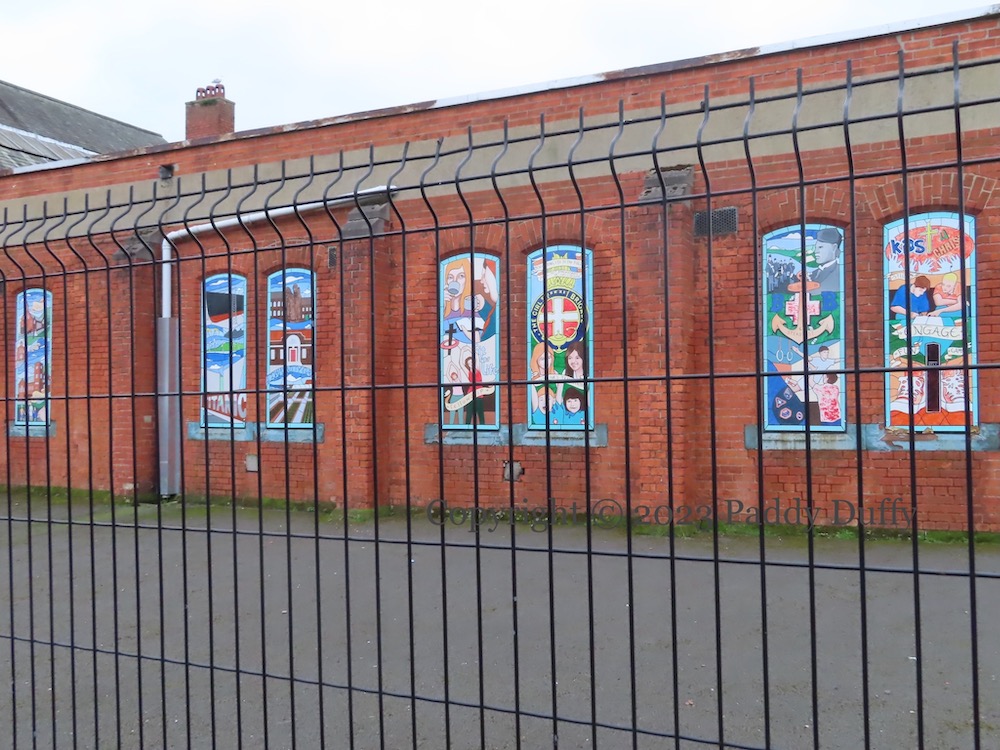
Ulster Tower in Thiepval, France, provides a background for 13 jigsaw pieces with partial images relating to the Great War, including a uniform with a Victoria Cross and badge of the 36th (Ulster) Division, the 10th (Irish) Division, the 16th (Irish) Division, and the Royal Irish Fusiliers (and a fourteenth piece for information).
Kilgreel Road, Antrim. The mural is more than a decade old and is bleached from the sun (the pinks were formerly brown); on the former site of The People’s Army (a UVF board).
“This artwork, commemorating the sacrifices made during the Great War and subsequent conflicts, was produced by the young people of Parkhall Youth & Community Club and was completed in 2010. It is part of a larger Re-imaging project undertaken by Parkhall Cultural Awareness Association & Parkhall Community Association. 14 jigsaw pieces are representated as that was the age of the youngest soldier to die on the Somme. The Royal Irish Fusiliers, who recruited in the Antrim area, served with the 10th Irish Division and 36th Ulster Division during World War I. The cap badge is surrounded with poppies. The poppy is an international symbol commemorating the sacrifices of members of the armed forces and of civilians specifically since the Great War. Birds were used extensively during World War I delivering important logistic message from the front line. HMS Antrim served in the Great War and survived. After the war she became the first ship to be fitted with an experimental sonar system in 1920. Her bell can presently be viewed in Antrim Civic Centre. The grounds of Shane’s Castle in Antrim were used as a training ground and a campsite for the 36th Ulster Division prior to their deployment to France. Of all bell tents and parachutes during the Great War 90% were made from Irish Linen. During the Great War a service man’s basic wage was one shilling a day (5 pence). The sound of the bugle was heard throughout each day in the trenches, starting with Reveille to rouse you from slumber. ‘Flowers of the Forest’, a powerful Scottish lament, is often played by a lone piper at services of Remembrance. “I am not an Ulsterman but yesterday, the 1st July, as I followed their amazing attack, I felt that I would rather be an Ulsterman than anything else in the world.” Extract from the speech by Captain Wilfred [Wilfrid] Spencer 2st July 1916. Men from the 36th Ulster Division received 9 Victoria Crosses. Women played a vital role in field hospitals during the Great War caring for the injured, from the front line. The flags of the 16th and 10th Irish Divisions. 36th Ulster division. The Ulster Tower is a memorial to the men of the 36th Ulster Division. It is situated near the entrance to Thiepval Wood, France.
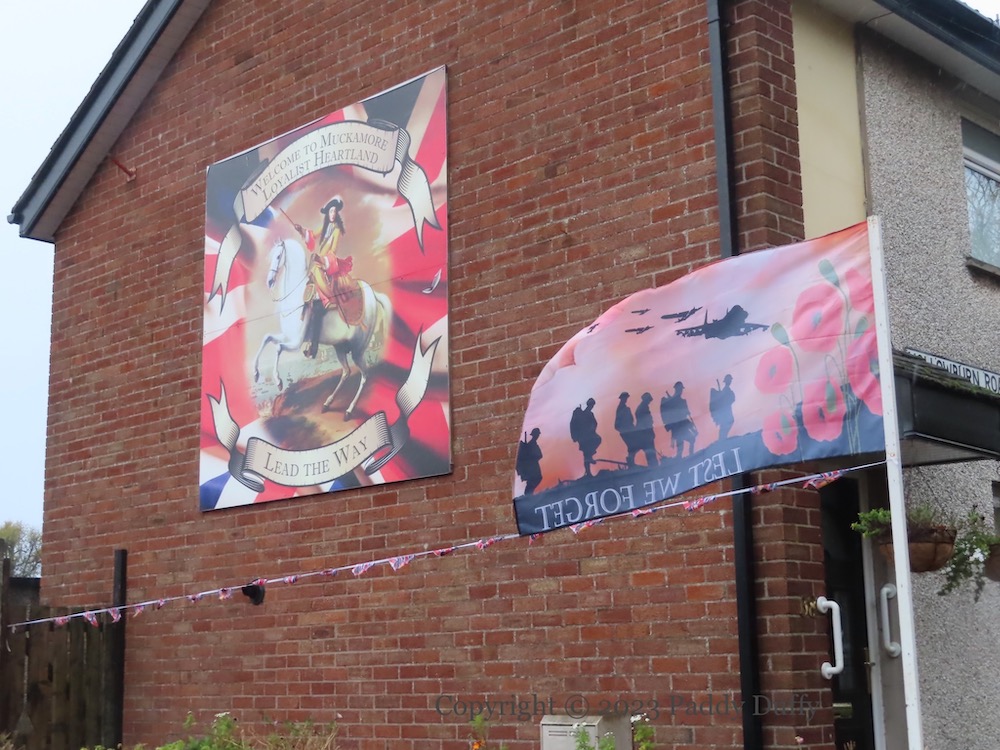
“Welcome to Muckamore, loyalist heartland – lead the way.” “In defence of our heritage and culture.”
In the Muckamore/Ballycraigy areas of Antrim the insignia of the LVF are still in place. “Lead the way” was the slogan of the LVF (see e.g. D01246 for a prominent instance in Ballycraigy). The organisation called a ceasefire and decommissioned some weapons in the years after the Agreement but persists in some form in Antrim (WP).
The Sons Of Ulster also used to use the slogan “Lead the way” (as described in J1947) but it is not present in the board shown in the recent (2022) Old Ulster’s Battle Cry.
The two boards below are on gables above Woodgreen, which is the site of the bonfire (ig) featured in the third image. They used to claim that it was the biggest bonfire (see C06695) but Craigyhill (in Larne) is more recently the tallest – see Commonwealth Handling Equipment.
There is also a memorial garden to Billy Wright in Ballycraigy – see M05203.








 Paddy Duffy Collection