The Earth Is Girdled With The Graves Of Our Dead

“O valiant hearts who to your glory came/Through dust of conflict and through battle flame//Tranquil you lie, your knightly virtue proved/Your memory hallowed [not “hollowed”] in the land you loved.” The hymn ‘O Valiant Hearts’ was a poem written during the first World War to commemorate the Allied dead, and was put to a variety of tunes during the 1920s, including arrangements by Vaughan Williams and Holst (WP); the most commonly sung tune, however, is that of Charles Harris (youtube, includes the full poem).

The memorial shown in the middle of the board is a Cross Of Sacrifice (see previously: One In Design And Intention) built on top of a German pill box at the centre of Tyne Cot cemetry, near Passchendaele, Belgium. The title of today’s post comes from remarks made by George V during a 1922 visit to the cemetery (History.org). The map in the background shows the area just south of Ypres (Canadian Soldiers).

The board is in Pim’s Avenue, Belfast, opposite the older YCV emblem shown below.

Click image to enlarge
Copyright © 2023 Paddy Duffy
T02927 [T02928] T02929

Repay Their Memory

“Willowfield Battalion.” The building on the corner of Willowfield Street and the Woodstock Road was demolished and rebuilt with a building whose gable wall is full of windows. As a result, the display of Somme-related boards (see 2017’s Faugh-A-Ballagh in the Seosamh Mac Coılle collection) has moved a short distance down the street to a gable that has been revealed by taking down two large trees. The panels remain as before, though a new version of the Somme board renders the information horizontally rather than vertically (above).

Above: “Never before was a debt owed to so few by so many. Generation after generation owe them everything. Lest we forget.” Winston Churchill’s line about the British Air Force in WWII, that “Never in the field of human conflict was so much owed by so many to so few (youtube)“, is echoed in a board about the battles at the Somme between July 1st and November 18th, 1916. “The few” in this case, however, number nearly half a million dead and more than 72,000 missing.

Immediately below: “Only by remembering these men, and others like them, can we ever repay their memory.” The board shows the nine Victoria Cross recipients from the 36th (Ulster) Division in World War I (from 1917 and 1918) – E[dmund] De WindE[rnest] SeamanC[ecil] L[eonard] KnoxN[orman] Harvey, (from 1916) G[eoffrey] St. G[eorge] S[hillington] CatherW[illiam] F[rederick] MacFadzeanE[ric] N[orman] F[rankland] BellR[obert] Quigg, and J[ames] S[amuel] Emerson. The illustrations come from Cyril Falls’s book The History Of The 36th (Ulster) Division (from Project Gutenberg).

Apex: “1st July 1916 nothing finer was done in the war. The splendid troops, drawn from those volunteers who had banded themselves together for another cause, now shed their blood like water for the liberty of the world.”

Willowfield Street, east Belfast

Click image to enlarge
Copyright © 2023 Paddy Duffy
T02924 T02925 T02922 T02923

Scottish Brigade

The hand-painted UVF Scottish Brigade mural (see Boab Kerr) in Beechfield Street/Tower Street has been replaced by this new printed board. The plaque to Kerr has been retained, but four names have been added – David Totten, Brian Milligan, Billy Inglis, and Jim Holt, who is now the most prominent. Holt died in February 2021 (ACT Fb).

Click image to enlarge
Copyright © 2023 Paddy Duffy
T02825 [T02826 ]

A Fighter For Our Freedom

“Sergeant John Kernohan. Service No. 7011935. The youngest of a family of ten, John enlisted with the Royal Ulster Rifles in 1932, then transferring to the Royal Inniskillen Fusiliers in 1942 serving King, Queen and Country for 22 years. The record of his service exhibits great variety, both in regimental affiliation and in location with a service record which was exemplary. John saw service in Hong Kong, Palestine, France, Belgium, India[,] Austria and Malaya, where with the R.A.S.C. for distinguished service was mentioned in dispatches, his name appe[a]ring in the London Gazette of May 1950 [May 19th, 1950, page 2489, “in recognition of gallant and distinguished services in Malaya during the period 1st July 1949 to 31st December 1949″; Royal Army Service Corps, Corporal Kerohan].”

The medals from left to right are: General Service – Palestine ribbon, 1939-1945 Star, War Medal, Burma Star, Defence Medal

Drumahoe Gardens, Millbrook, Larne

Click image to enlarge
Copyright © 2023 Paddy Duffy
T02798 T02799 [T02800] T02801 sign-link.ni

An Astounding Achievement

There’s a new King Charles III board in Boyne Square, Larne, of a similar sort to those we have seen in various other areas and using the same “lounging” image of Charles as in east Belfast, Carrickfergus, and the Caw (Londonderry) – though the quote is different: “My mother never ceased to pray for the best times for Northern Ireland and its people” (source unknown). The celebration of the 1914 gun-running that was on the wall previously (see Amazing Night In Larne) has been moved to the side wall, replacing King Billy.

“Operation Lion – a fascinating snapshot of an historical moment. The Larne gun-running was a major operation organised in Ireland by Major Frederick Crawford and Captain Wilfred [sic] Spender for the Ulster Unionist Council to equip the Ulster Volunteer Force. The operation involved the shipment of almost 25,000 rifles and between three and five million rounds of ammunition, with shipments landing in Larne, Donaghadee and Bangor in the early hours between Friday 24th and Saturday 25th April 1914.”

“Taking its name from the S.S. Clyde Valley that landed at Larne Harbour on 24th April 1914, Clyde Valley Defenders Flute Band were formed in 1995, with several of our founding members still marching with the band today. Following several years on the raod, the band were then renamed Clyde Valley Volunteers, before later being constituted as Clyde Valley Cultural & Musical Society (Clyde Valley Flute Band). The formation of Clyde Valley was much more than that of establishing a flute band. The band’s aim is to promote the Protestant culture through the teaching of music and history, whilst proudly remembering the sacrifices made by our forefathers. The Officers and Members of CLyde Valley Flute Band dedicate this mural to the role of the men and women in the Larne Gun-Running on 24th April 1914. They were Gunrunners.”

For the plaque and the Central Antrim Regiment see Central Antrim Regiment.

Click image to enlarge
Copyright © 2023 Paddy Duffy
T02812 [T02811] T02813 T02810 “falce marique potens” is the motto of Larne

Neither King Nor Nato

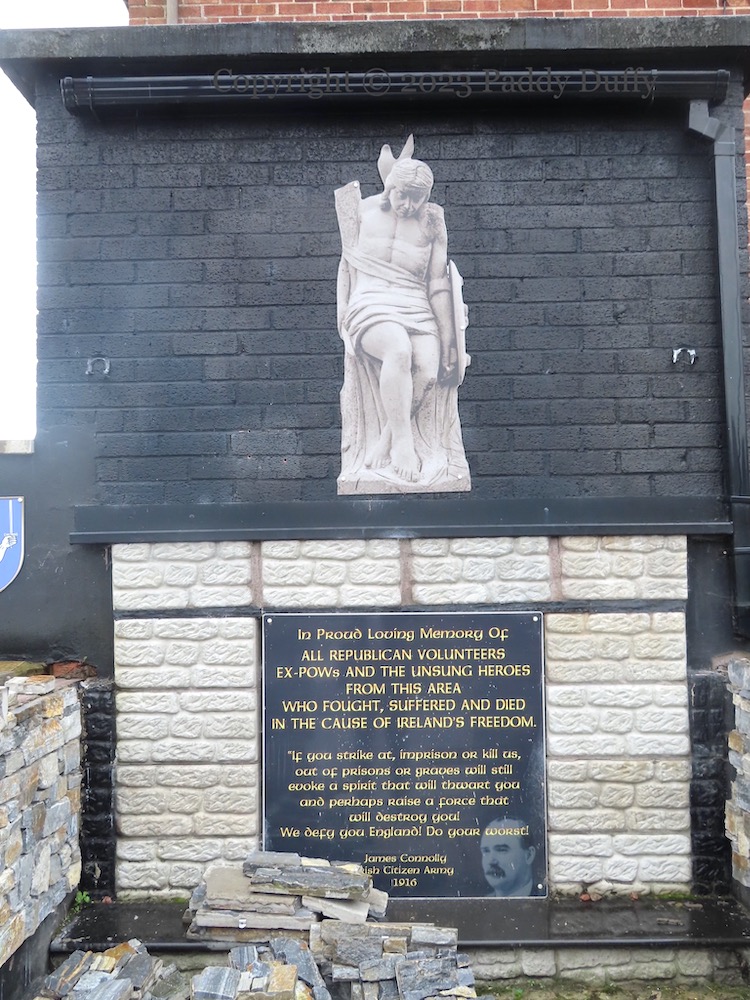
“Est 1913 Irish Citizen Army / Irish National Liberation Army Est. 1974”. The Irish Citizen Army was founded in Dublin in 1913 to protect striking workers from police violence. After taking part in the Easter Rising of 1916, however, the ICA did not participate in the War Of Independence and the Civil War. In 1974, some founding members considered reviving the “ICA” name to reflect the organisation’s “allegiance to the working class” while Costello (pictured on the right) suggested “National Liberation Army”, which was then amended to include “Irish” (History Ireland | WP | WP). MNI includes an “ICA-INLA” Starry Plough on the stairs into the New Lodge from 1989 (C00105).

The banner raised over the Liberty Hall headquarters of the ICA read “We serve neither king nor kaiser but Ireland” – the famous photograph is included in the post of the same name – but this has been updated. The Belfast version of the board, on Northumberland Street (above) and outside Costello House on the Falls Road (below), reads “nor Nato”.

Click image to enlarge
Copyright © 2023/2025 Paddy Duffy
T02781 T06510 james connolly

Our Most Gracious Sovereign

“In loving memory of our most gracious sovereign – Queen Elizabeth II 1926-2022. God save the Queen.” The platinum (70th) jubilee of Queen Elizabeth II, celebrated in June, 2022, was followed a short time later by her death, on September 8th. These two boards in Maldon Street, mark the two events.

Replaces a Ruby Murray board and the info board that went with the John Darren Sutton painting of King Billy in Tavanagh St.

Click image to enlarge
Copyright © 2023 Paddy Duffy
T02737

Shankill Boys

The “Shankill Boys” were the roughly 700 men of the West Belfast battalion of the Ulster Volunteers who were almost all killed at the Somme. (This board – or a previous copy of it – was previously in Carnan St.)

As with all of the Belfast battalions, West Belfast had a “USSF” [Ulster Special Service Force] – its emblem is in the top left of the second board, below. (See previously USSF and Carving Out A Place In History) The other emblem is that of the ‘Greengairs Thistle Flute Band’ (web). Although the background comes from WWI, the roll of honour lists modern-day volunteers from the UVF. Thomas Chapman, James McGregor, Robert McIntyre, William Hannah, and Robert Wadsworth are portrayed in Carnan Street – see C. Coy Street. The modern-day C Company, formed in 1974, is named after the Four Step Inn, which was bombed in September 1971 (see Four Step).

This pair of boards is next to the Vanguard Bears board in Sugarfield Street.

Click image to enlarge
Copyright © 2023 Paddy Duffy
T02724 T02725

Clós Ard An Lao

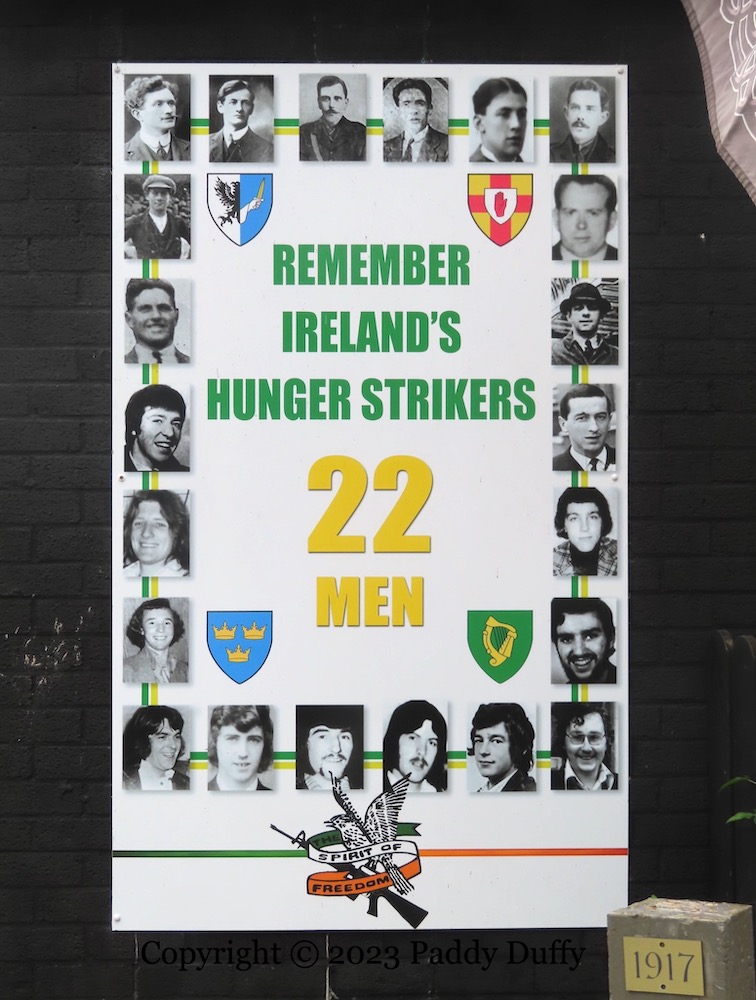
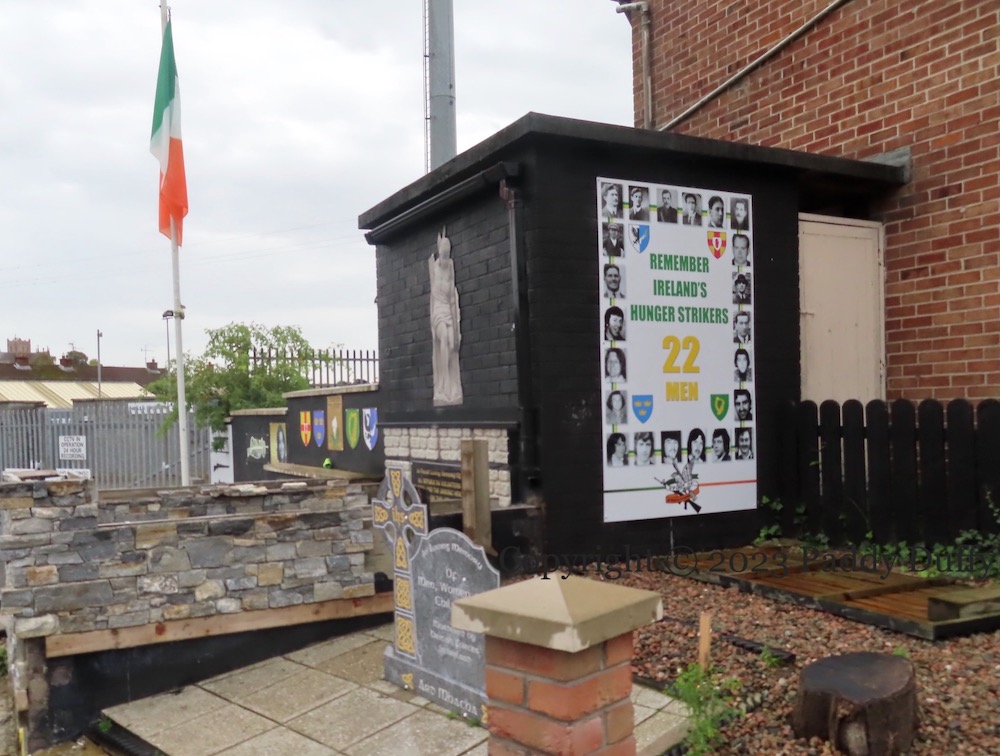
Here is a gallery of the murals and plaques in Clós Ard An Lao/Ardilea Close in the Machaıre Botháın/Marrowbone area of north Belfast. A full repertoire of republican events is commemorated – the United Irishmen, Great Hunger, the Rising, the Troubles, the (modern) hunger strikes. What is most striking is the significant presence of religious icons, such as the Sacred Heart in the glass cases in front of the two main murals (above and last below).

Click image to enlarge
Copyright © 2023 Paddy Duffy
T02709 T02713 T02712 T02716 T02717 T02715 T02714 T02710 [T02711]

We Will Reorganise

“Ulster Special Constabulary 1920-1970. The Ulster Special Constabulary (USC; commonly called the “B-Specials” of “B Men”) was a quasi-military reserve special constable police force in what would later become Northern Ireland. It was set up in October 1920, shortly before the partition of Ireland. It was an armed corps, organised partially on military lines and called out in times of emergency, such as war or insurgency. It performed this role most notably in the early 1920s during the Irish War of Independence and the 1956-1962 IRA Border Campaign.

During its existence, 95 USC members were killed in the line of duty. Most of these (72) were killed in conflict with the IRA in 1921 and 1922. Another 8 died during the Second World War, in air raids or IRA attacks. Of the remainder, most died in accidents but two former officers were killed during the Troubles in the 1980s. [The WP page from which this text is drawn at this point goes on to talk about Catholic mistrust of the Specials.] The Special Constabulary was disbanded in May 1970, after the Hunt Report, which advised re-shaping Northern Ireland’s security forces [to attract more Catholic recruits] and demilitarizing the police. Its functions and membership were largely taken over by the Ulster Defence Regiment and the Royal Ulster Constabulary.

[Accompanying the small photograph:] At the Twelfth demonstration at Finaghy, Sir Edward Carson, the unionist leader, deploring the state of the county, advised the government: ‘If … you are yourself unable to protect us from the machinations of Sinn Fein … we will take the matter into our own hands. We will reorganise [the Ulster Volunteers]’.” [From a NewsLetter article ‘USC Helped Establish Peace In Early Years Of NI’]

Carson’s quote is also used in a Belfast UVF mural. As is noted there, the speech is probably from the 12th of July – Treason Felony | RTÉ – and concerns the reformation of the Ulster Volunteers as a force to protect Protestant interests in the north of Ireland in light of the proposal in the (fourth) Home Rule bill to create separate northern and southern states.

Parkhall Road, Antrim

Click image to enlarge
Copyright © 2023 Paddy Duffy
T02584 [T02585]