An Astounding Achievement

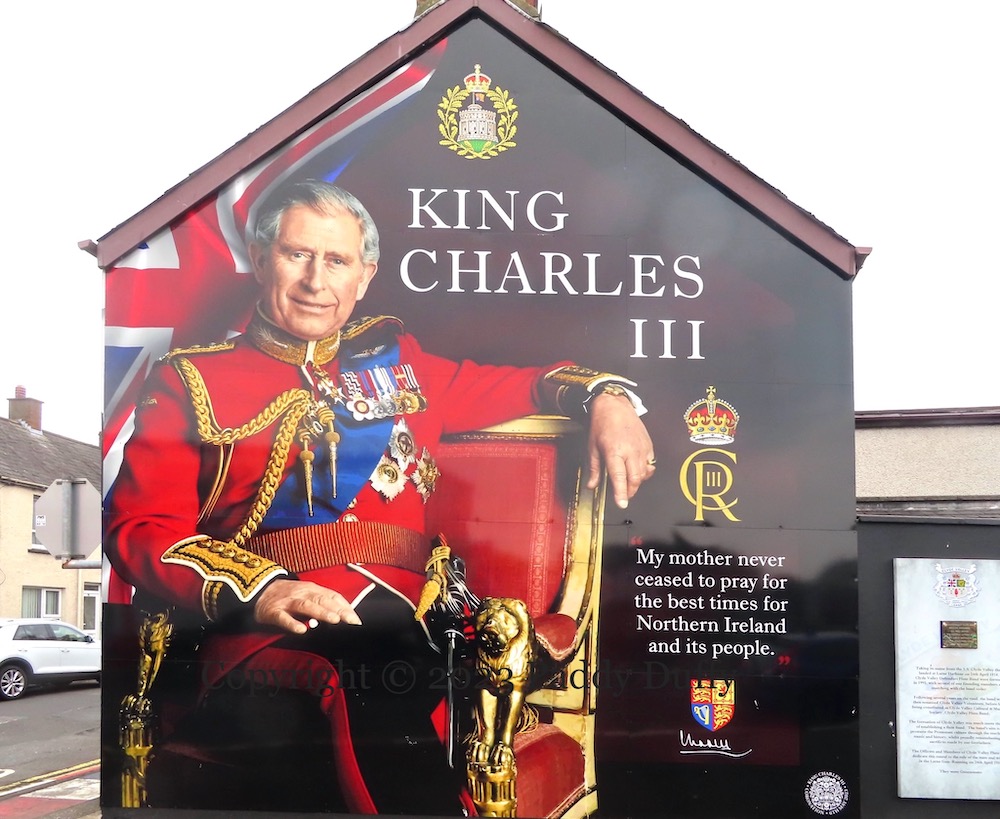
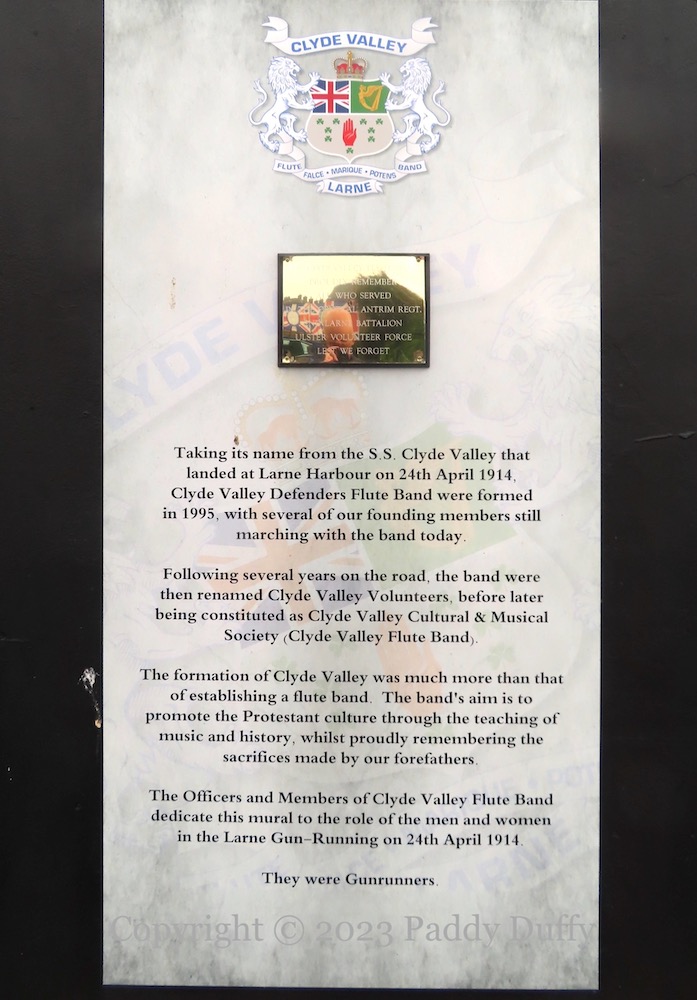
There’s a new King Charles III board in Boyne Square, Larne, of a similar sort to those we have seen in various other areas and using the same “lounging” image of Charles as in east Belfast, Carrickfergus, and the Caw (Londonderry) – though the quote is different: “My mother never ceased to pray for the best times for Northern Ireland and its people” (source unknown). The celebration of the 1914 gun-running that was on the wall previously (see Amazing Night In Larne) has been moved to the side wall, replacing King Billy.

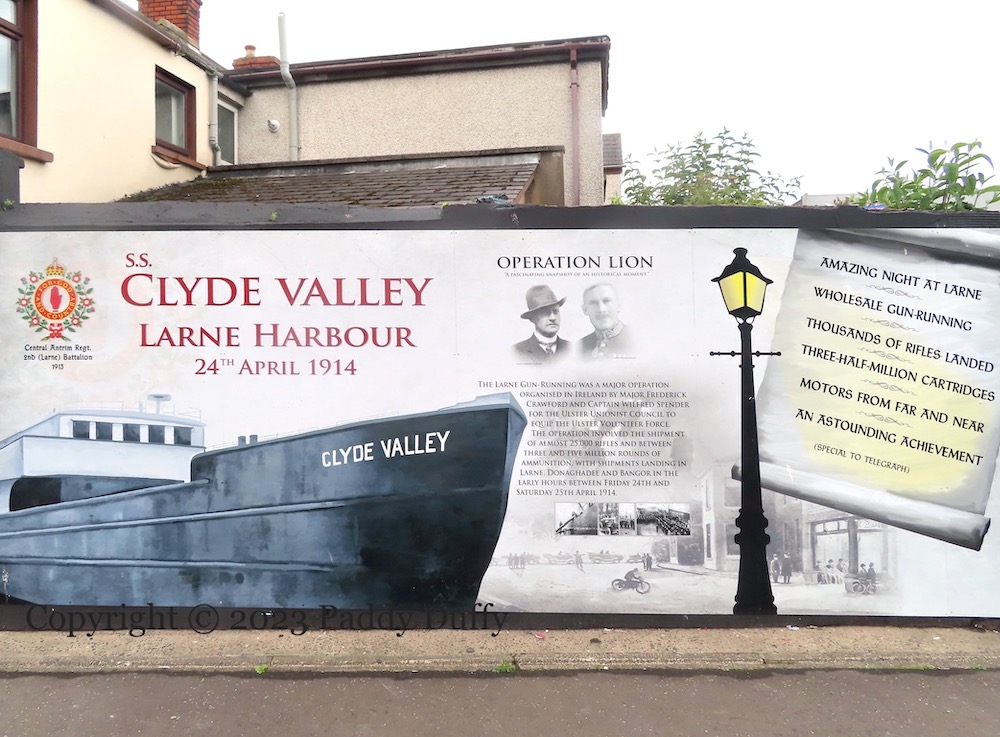
“Operation Lion – a fascinating snapshot of an historical moment. The Larne gun-running was a major operation organised in Ireland by Major Frederick Crawford and Captain Wilfred [sic] Spender for the Ulster Unionist Council to equip the Ulster Volunteer Force. The operation involved the shipment of almost 25,000 rifles and between three and five million rounds of ammunition, with shipments landing in Larne, Donaghadee and Bangor in the early hours between Friday 24th and Saturday 25th April 1914.”

“Taking its name from the S.S. Clyde Valley that landed at Larne Harbour on 24th April 1914, Clyde Valley Defenders Flute Band were formed in 1995, with several of our founding members still marching with the band today. Following several years on the raod, the band were then renamed Clyde Valley Volunteers, before later being constituted as Clyde Valley Cultural & Musical Society (Clyde Valley Flute Band). The formation of Clyde Valley was much more than that of establishing a flute band. The band’s aim is to promote the Protestant culture through the teaching of music and history, whilst proudly remembering the sacrifices made by our forefathers. The Officers and Members of CLyde Valley Flute Band dedicate this mural to the role of the men and women in the Larne Gun-Running on 24th April 1914. They were Gunrunners.”

For the plaque and the Central Antrim Regiment see Central Antrim Regiment.
Click image to enlarge
Copyright © 2023 Paddy Duffy
T02812 [T02811] T02813 T02810 “falce marique potens” is the motto of Larne

Neither King Nor Nato

“Est 1913 Irish Citizen Army / Irish National Liberation Army Est. 1974”. The Irish Citizen Army was founded in Dublin in 1913 to protect striking workers from police violence. After taking part in the Easter Rising of 1916, however, the ICA did not participate in the War Of Independence and the Civil War. In 1974, some founding members considered reviving the “ICA” name to reflect the organisation’s “allegiance to the working class” while Costello (pictured on the right) suggested “National Liberation Army”, which was then amended to include “Irish” (History Ireland | WP | WP). MNI includes an “ICA-INLA” Starry Plough on the stairs into the New Lodge from 1989 (C00105).

The banner raised over the Liberty Hall headquarters of the ICA read “We serve neither king nor kaiser but Ireland” – the famous photograph is included in the post of the same name – but this has been updated. The Belfast version of the board, on Northumberland Street (above) and outside Costello House on the Falls Road (below), reads “nor Nato”.

Click image to enlarge
Copyright © 2023/2025 Paddy Duffy
T02781 T06510 james connolly

Our Most Gracious Sovereign

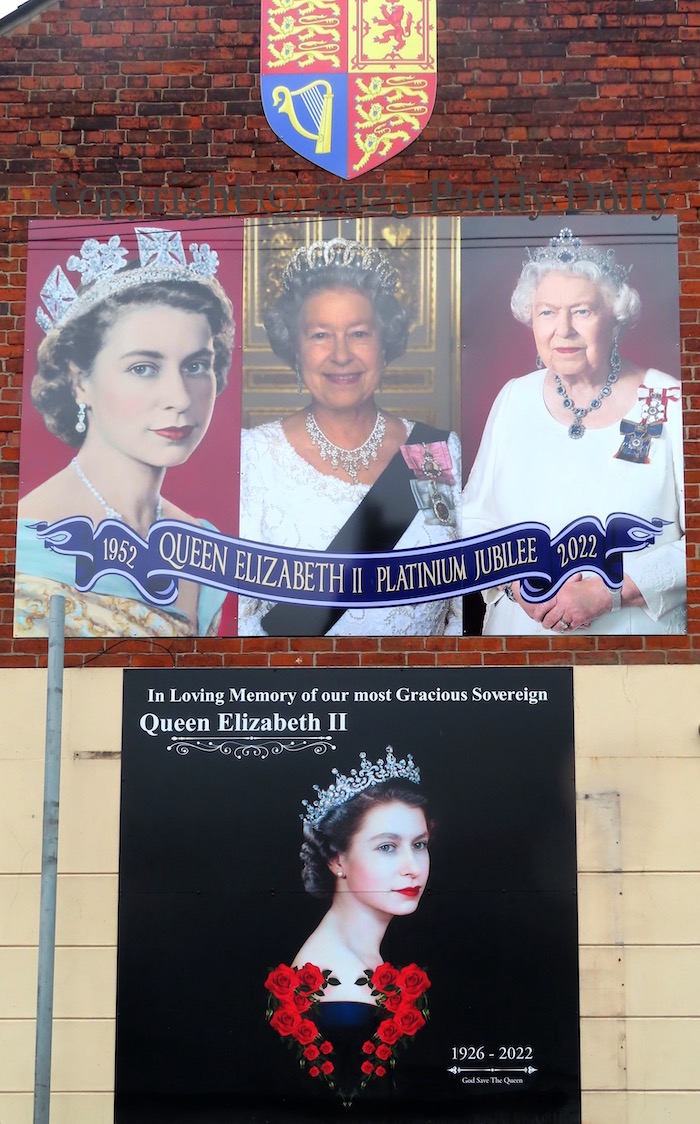
“In loving memory of our most gracious sovereign – Queen Elizabeth II 1926-2022. God save the Queen.” The platinum (70th) jubilee of Queen Elizabeth II, celebrated in June, 2022, was followed a short time later by her death, on September 8th. These two boards in Maldon Street, mark the two events.

Replaces a Ruby Murray board and the info board that went with the John Darren Sutton painting of King Billy in Tavanagh St.

Click image to enlarge
Copyright © 2023 Paddy Duffy
T02737

Shankill Boys

The “Shankill Boys” were the roughly 700 men of the West Belfast battalion of the Ulster Volunteers who were almost all killed at the Somme. (This board – or a previous copy of it – was previously in Carnan St.)

As with all of the Belfast battalions, West Belfast had a “USSF” [Ulster Special Service Force] – its emblem is in the top left of the second board, below. (See previously USSF and Carving Out A Place In History) The other emblem is that of the ‘Greengairs Thistle Flute Band’ (web). Although the background comes from WWI, the roll of honour lists modern-day volunteers from the UVF. Thomas Chapman, James McGregor, Robert McIntyre, William Hannah, and Robert Wadsworth are portrayed in Carnan Street – see C. Coy Street. The modern-day C Company, formed in 1974, is named after the Four Step Inn, which was bombed in September 1971 (see Four Step).

This pair of boards is next to the Vanguard Bears board in Sugarfield Street.

Click image to enlarge
Copyright © 2023 Paddy Duffy
T02724 T02725

Clós Ard An Lao

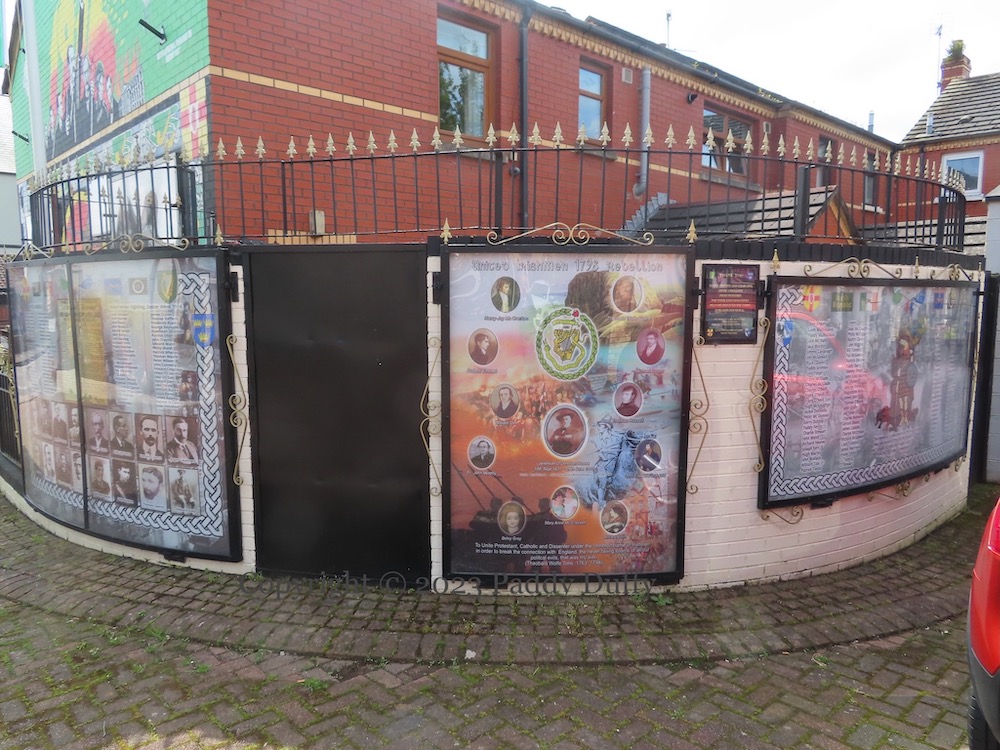
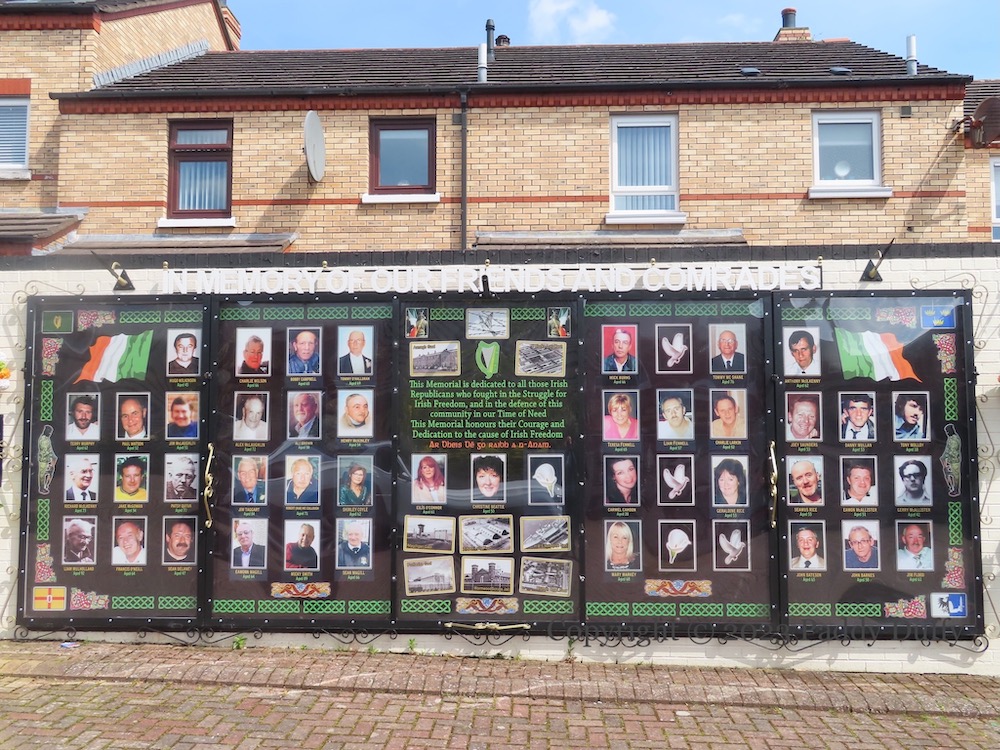
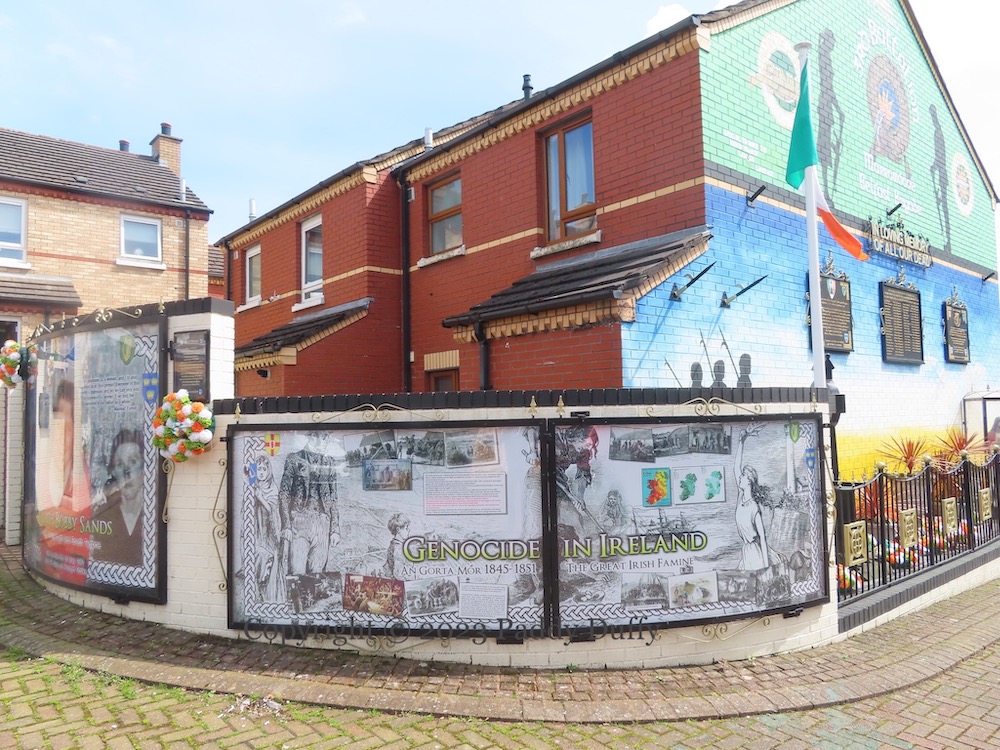
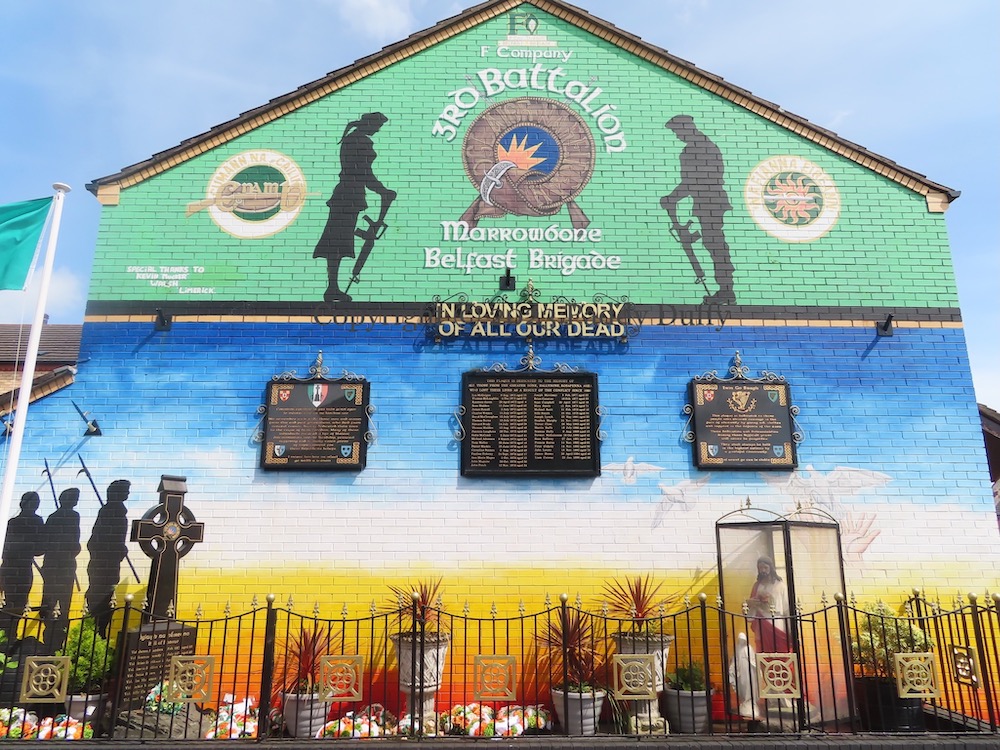
Here is a gallery of the murals and plaques in Clós Ard An Lao/Ardilea Close in the Machaıre Botháın/Marrowbone area of north Belfast. A full repertoire of republican events is commemorated – the United Irishmen, Great Hunger, the Rising, the Troubles, the (modern) hunger strikes. What is most striking is the significant presence of religious icons, such as the Sacred Heart in the glass cases in front of the two main murals (above and last below).

Click image to enlarge
Copyright © 2023 Paddy Duffy
T02709 T02713 T02712 T02716 T02717 T02715 T02714 T02710 [T02711]

We Will Reorganise

“Ulster Special Constabulary 1920-1970. The Ulster Special Constabulary (USC; commonly called the “B-Specials” of “B Men”) was a quasi-military reserve special constable police force in what would later become Northern Ireland. It was set up in October 1920, shortly before the partition of Ireland. It was an armed corps, organised partially on military lines and called out in times of emergency, such as war or insurgency. It performed this role most notably in the early 1920s during the Irish War of Independence and the 1956-1962 IRA Border Campaign.

During its existence, 95 USC members were killed in the line of duty. Most of these (72) were killed in conflict with the IRA in 1921 and 1922. Another 8 died during the Second World War, in air raids or IRA attacks. Of the remainder, most died in accidents but two former officers were killed during the Troubles in the 1980s. [The WP page from which this text is drawn at this point goes on to talk about Catholic mistrust of the Specials.] The Special Constabulary was disbanded in May 1970, after the Hunt Report, which advised re-shaping Northern Ireland’s security forces [to attract more Catholic recruits] and demilitarizing the police. Its functions and membership were largely taken over by the Ulster Defence Regiment and the Royal Ulster Constabulary.

[Accompanying the small photograph:] At the Twelfth demonstration at Finaghy, Sir Edward Carson, the unionist leader, deploring the state of the county, advised the government: ‘If … you are yourself unable to protect us from the machinations of Sinn Fein … we will take the matter into our own hands. We will reorganise [the Ulster Volunteers]’.” [From a NewsLetter article ‘USC Helped Establish Peace In Early Years Of NI’]

Carson’s quote is also used in a Belfast UVF mural. As is noted there, the speech is probably from the 12th of July – Treason Felony | RTÉ – and concerns the reformation of the Ulster Volunteers as a force to protect Protestant interests in the north of Ireland in light of the proposal in the (fourth) Home Rule bill to create separate northern and southern states.

Parkhall Road, Antrim

Click image to enlarge
Copyright © 2023 Paddy Duffy
T02584 [T02585]

The Passing Of Queen Elizabeth II

A traffic cone provides a makeshift flower holder in front of this board Clara Street board: “Grove Community Group [Baptist Church (web | Fb)] mourns the passing of Queen Elizabeth II 1926-2022″. Charter NI has images from last September of more bouquets and a piper at the board (tw).

Click image to enlarge
Copyright © 2023 Paddy Duffy
T02547

Harryville Says No

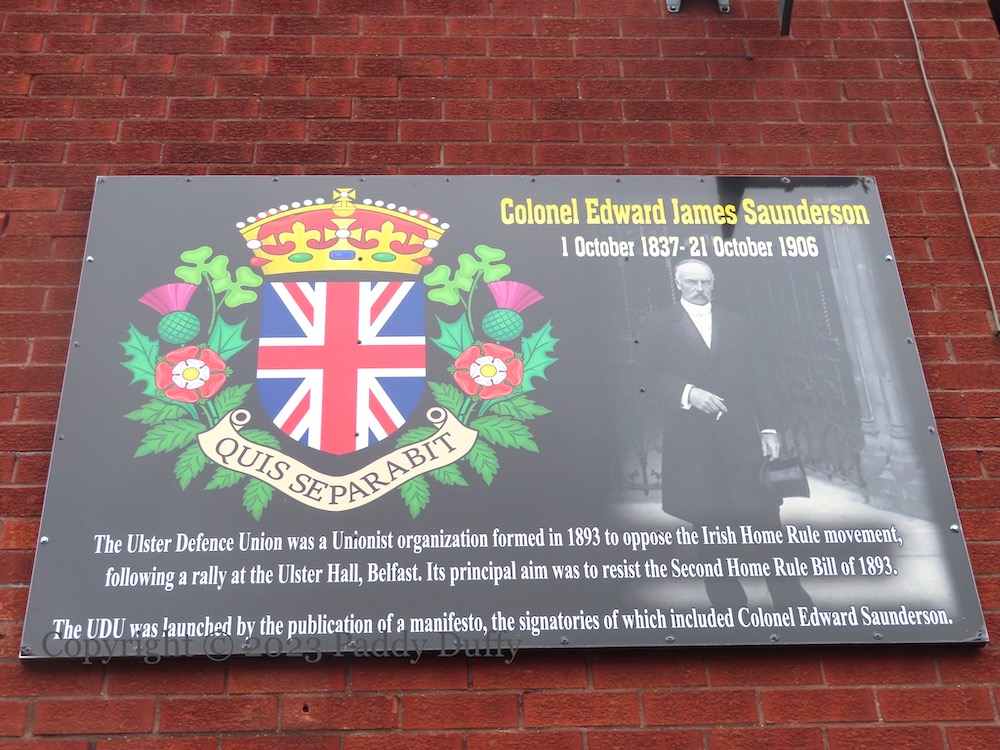
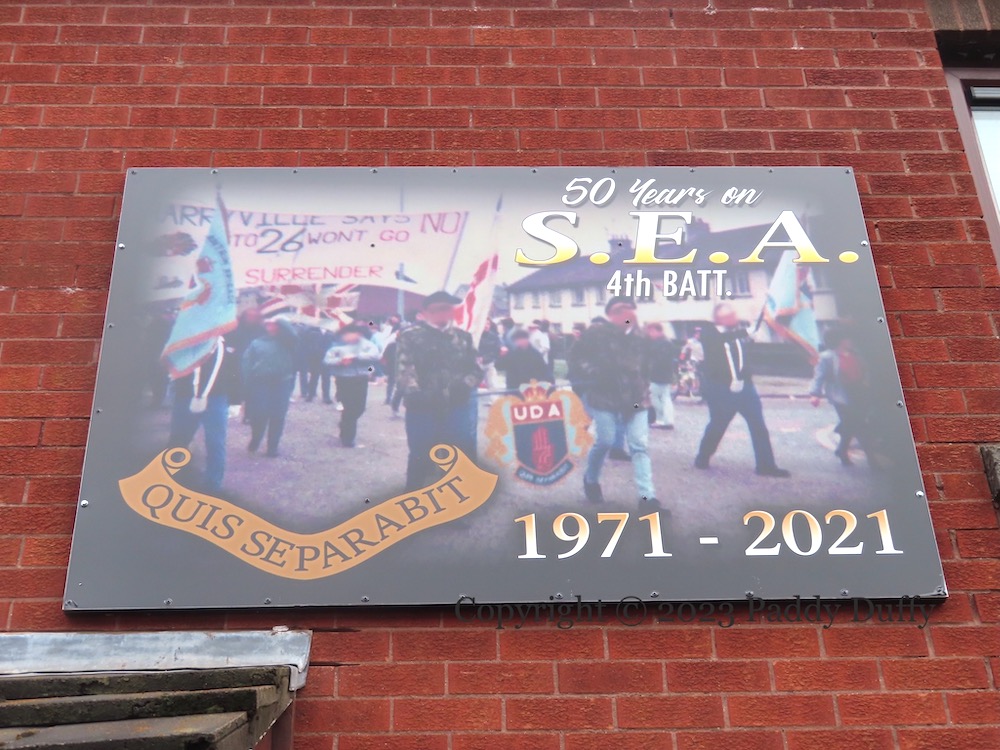
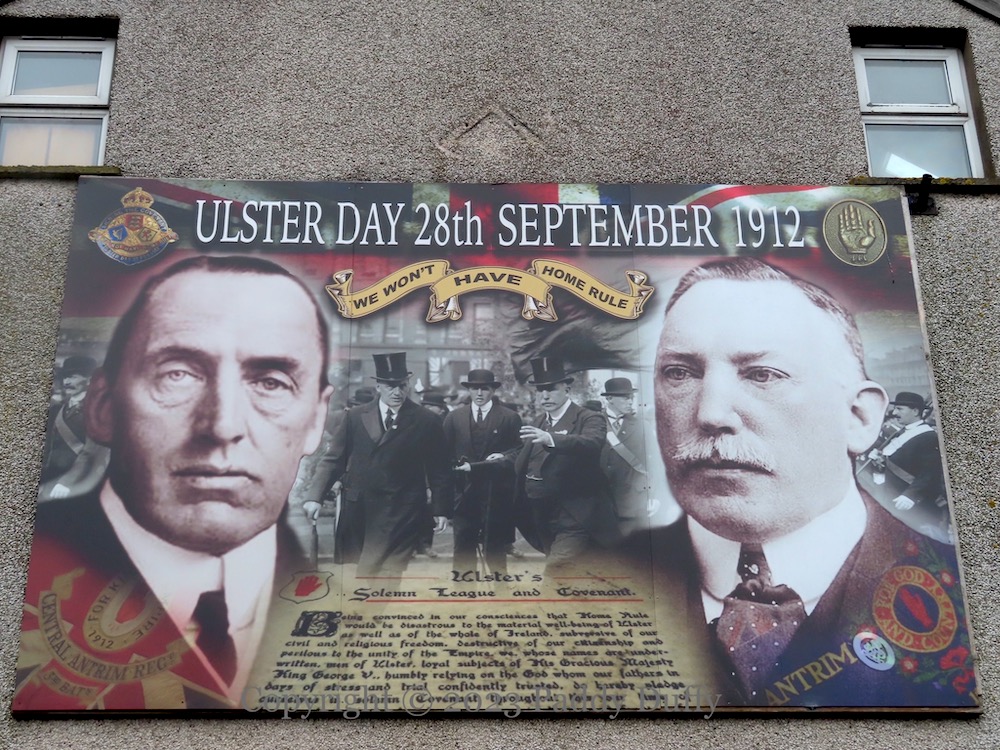
Here is a gallery of six boards from Harryville (four from Larne St/Larne Rd and two from Queen Street). The newest one is shown above; it celebrates Colonel Saunderson, a founder of the Ulster Defence Union, and organisation formed in 1893 to resist the second Home Rule bill. As mentioned on the board, the UDU initially met in Belfast in March and Saunderson was among the signatories of the UDU manifesto (see page 5 of the [Sydney] Freeman’s for 1893-04-29). For more on Saunderson, see Union Is Strength. The second bill was passed by the Commons but defeated in the Lords. The champions of resistence against the third Home Rule bill were Carson and Craig, shown in the penultimate image with the “Ulster Covenant” of September, 2012.

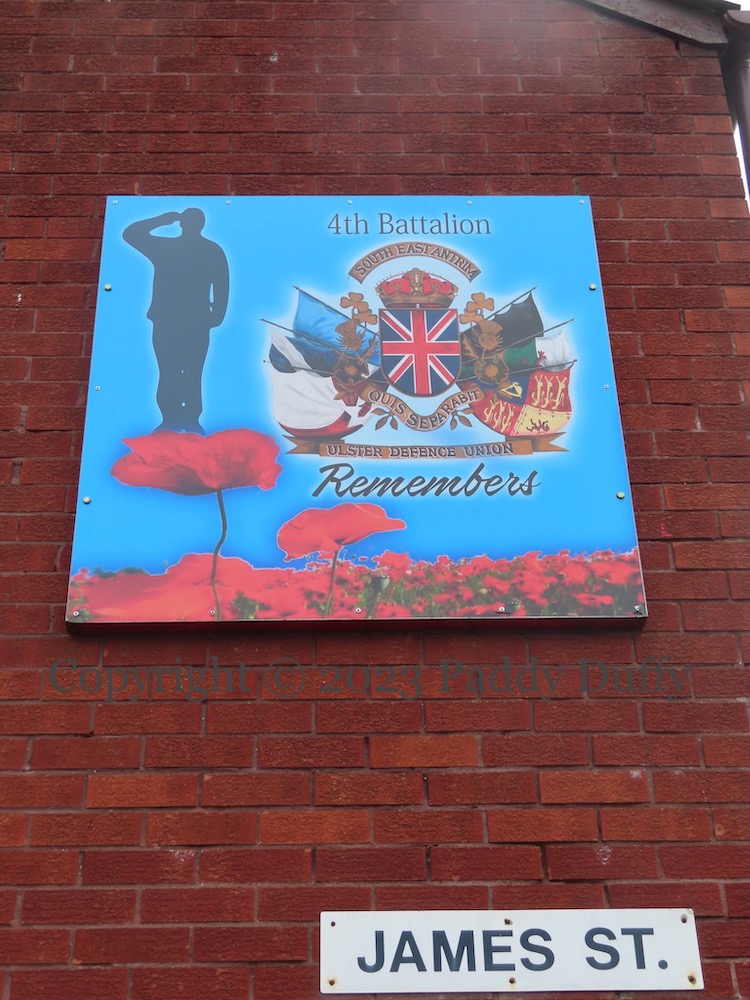
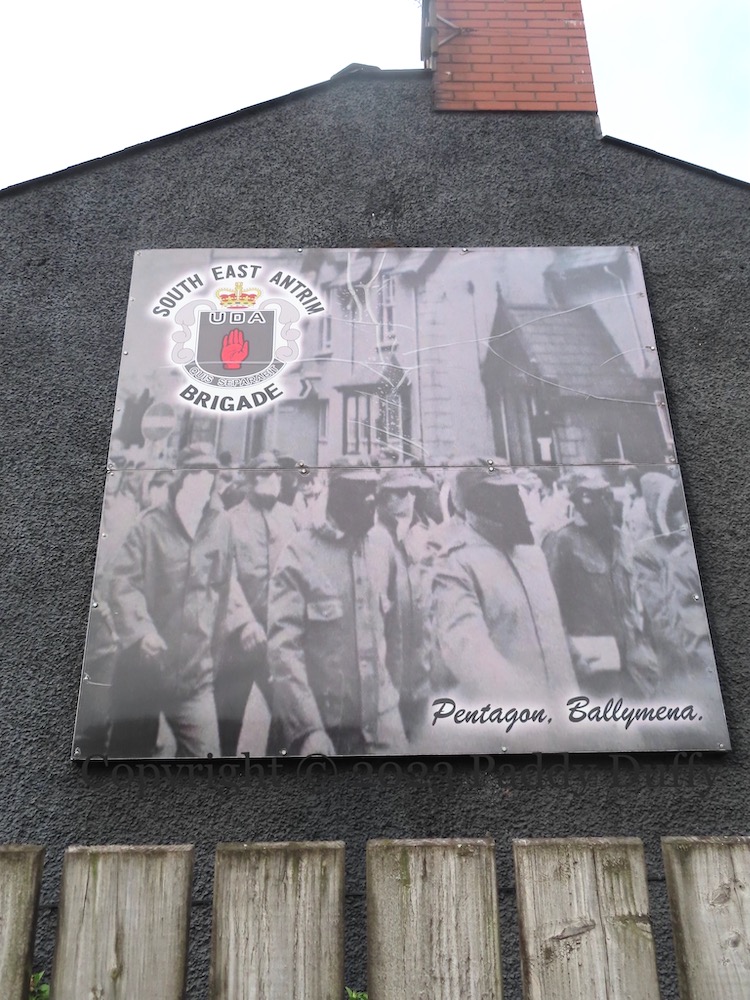
The name “Ulster Defence Union” is being used by some anti-Agreement factions of the UDA as a name for the organisation (starting in 2007 – see WDA on Peter’s site). The second board, just below, is a 4th Battalion South East Antrim UDA/UDU board. The UDA was formed in September 1971 and hence was 50 years old in 2021. The remaining two images show the UDA on parade at Harryville Bridge and in front of Pentagon House.

Click image to enlarge
Copyright © 2023 Paddy Duffy
T02497 T02496 [T02499] T02498 T02493 [T02494] T02495

Father Of The Protestant Reformation

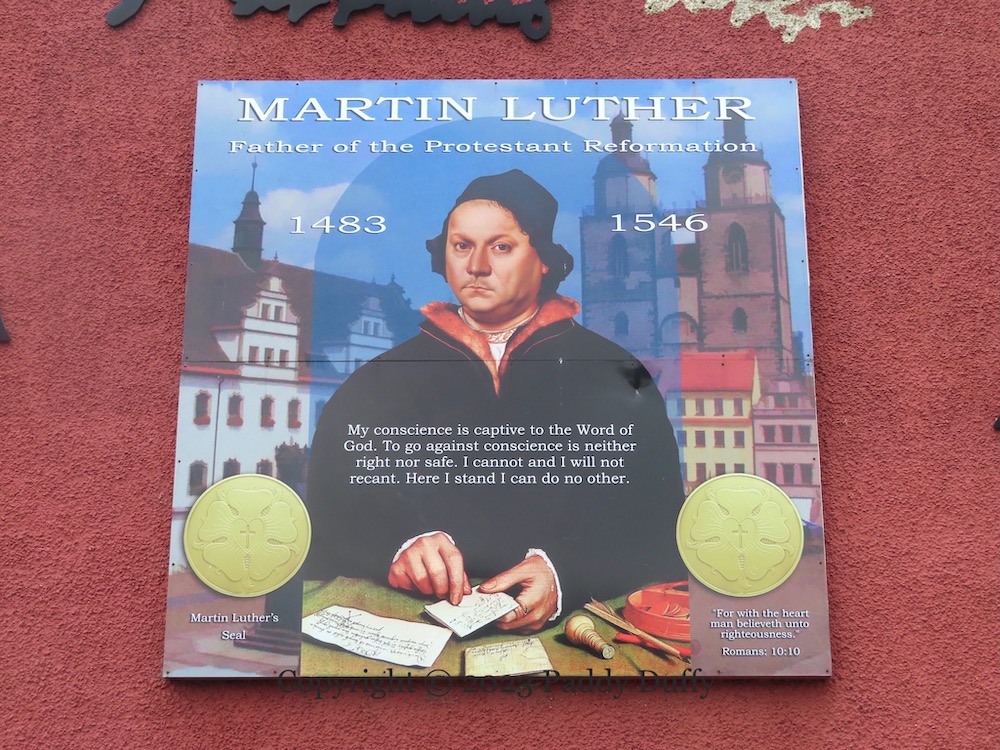
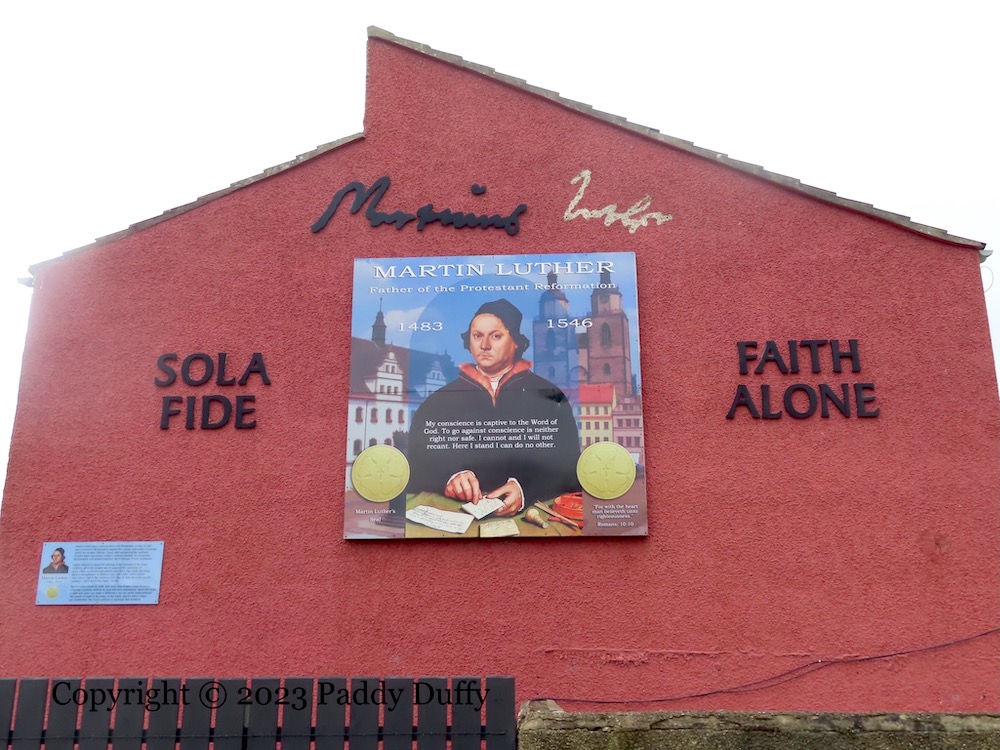
“My conscience is captive to the Word of God. To go against conscience is neither right nor safe. I cannot and I will not recant. Here I stand; I can do no other.” Luther’s last name has fallen off the wall above the main board in Waveney/Doury Road – the installation is about a decade old and replaced a South East Antrim UDA emblem (see Keresapa). Luther’s signature was also painted into the strained glass window of an old Martin Luther mural in the lower Shankill – see Here I Stand I Can Do No Other.

Martin Luther, Father of the Protestant Reformation, 1483-1546. “For with the heart man believeth unto righteousness – Romans 10:10”

Camberwell Way, Ballymena

Click image to enlarge
Copyright © 2023 Paddy Duffy
T02513 T02514 T02512
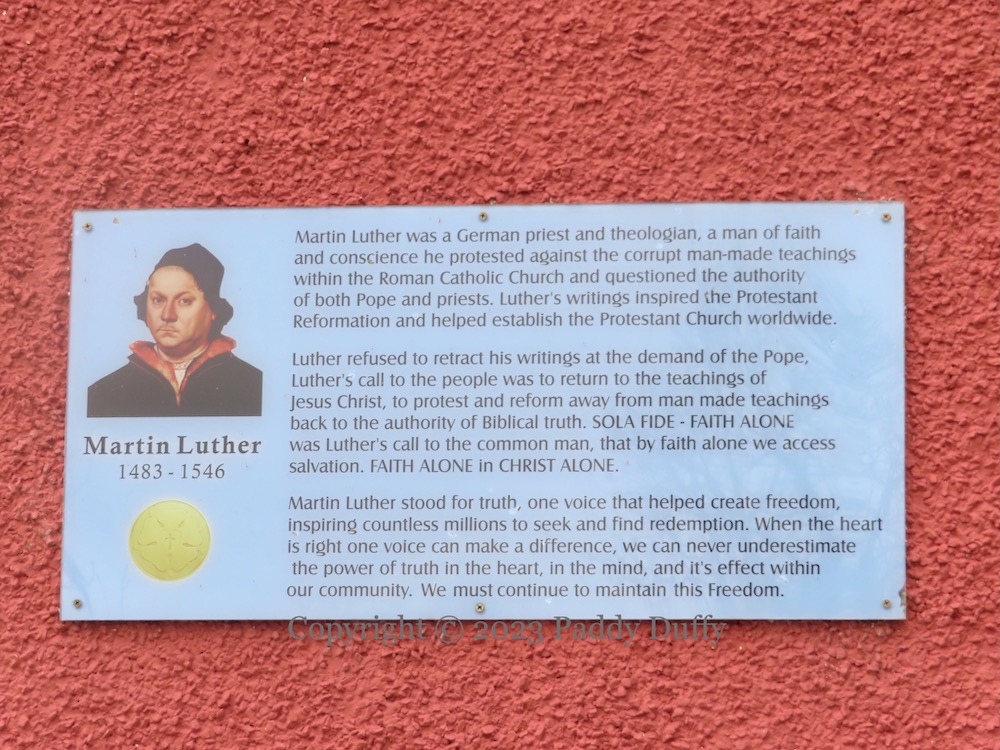
“Martin Luther was a German priest and theologian, a man of faith and conscience he protested against the corrupt man-made teachings within the Roman Catholic Church and questioned the authority of both Pope and priests. Luther’s writings inspired the Protestant Reformation and helped establish the Protestant Church worldwide. Luther refused to retract his writing at the demand of the Pope. Luther’s call to the people was to return to the teachings of Jesus Christ, to protest and reform away from man made teaching back to the authority of Biblical truth. SOLA FIDE – FAITH ALONE was Luther’s call to the common man, that by faith alone we access salvation. FAITH ALONE in CHRIST ALONE. Martin Luther stood for truth, one voice that helped create freedom, inspiring countless millions to seek and find redemption. When the heart is right one voice can make a difference, we can never underestimate the power of truth in the heart, in the mind, and it’s [sic] effect within our community. We must continue to maintain this freedom.”

Cú Chulaınn Please Protect These Things

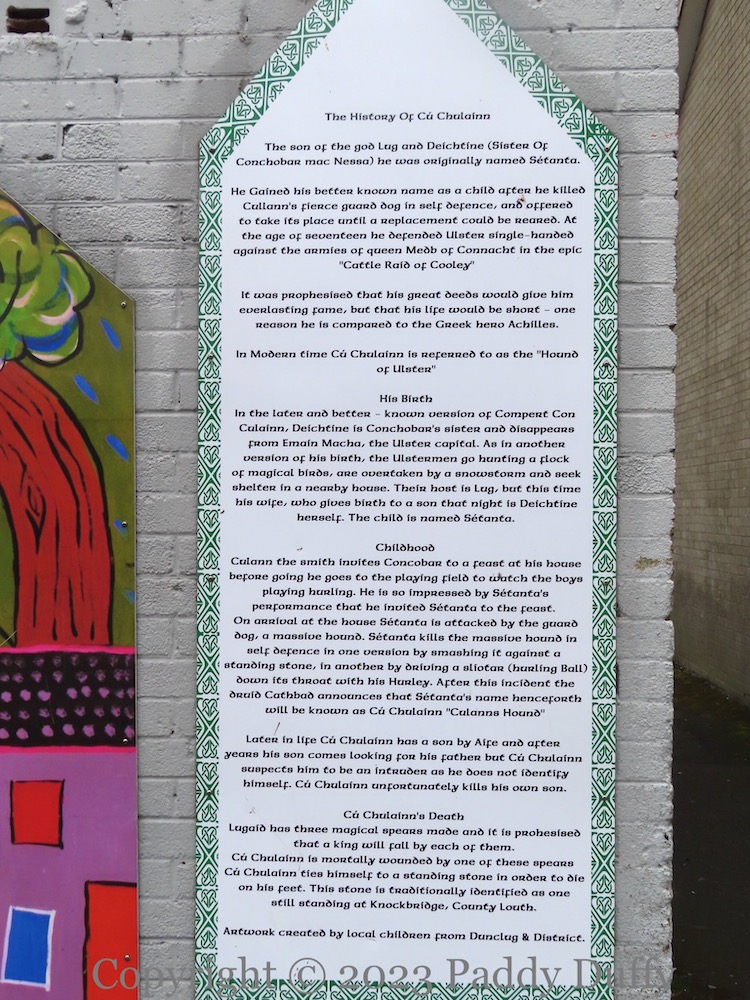
Cú Chulaınn is revered as a living god who might watch over children and their pets, homes, food, and toys in these devotional panels in Dunclug, Ballymena. As the info board says, “It was prophesied that his great deeds would give him everlasting fame.” Cú Chulaınn has his own Visual History page.

Dunclug Park, Ballymena.

Click image to enlarge
Copyright © 2023 Paddy Duffy
T02516r T02517