Duke Elliott

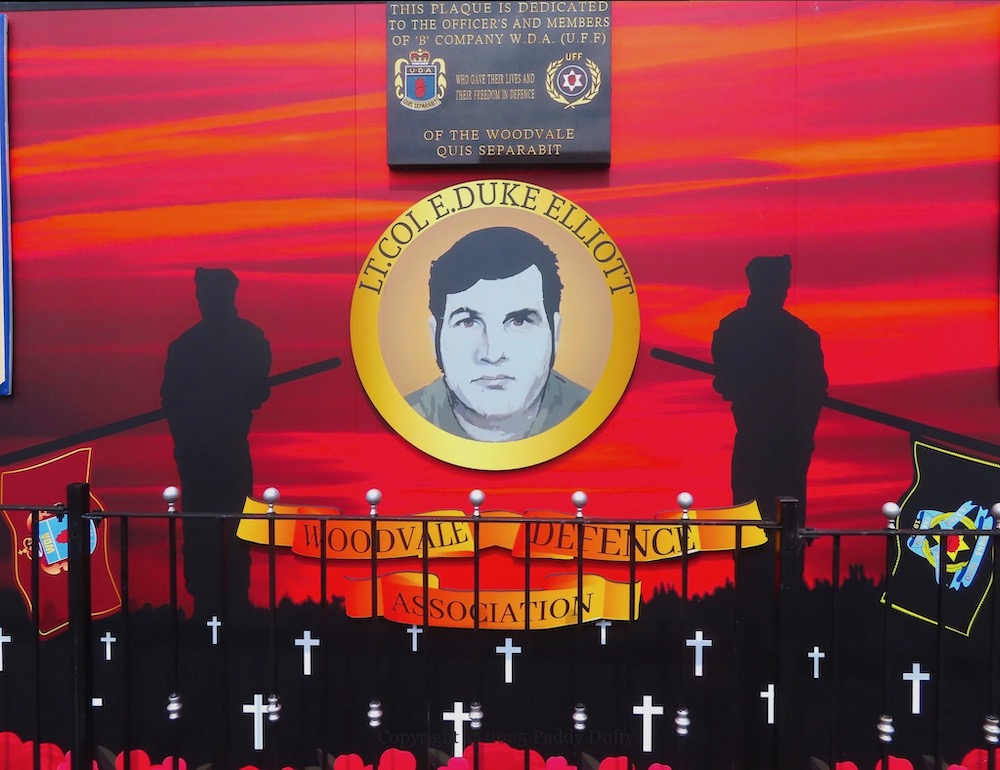
The previous tribute to Duke Elliott was installed in 2013 as the houses in Columbia Street were being rebuilt. Ernie “Duke” Elliott came from the Woodvale area (Leopold Street) and was a founder member of the Woodvale Defence Association in 1971, which was later folded into the UDA. He was also a Marxist. He was killed at age 28 in a pub brawl in December 1972 in a dispute over weapons (WP | Tele | Watching The Door).

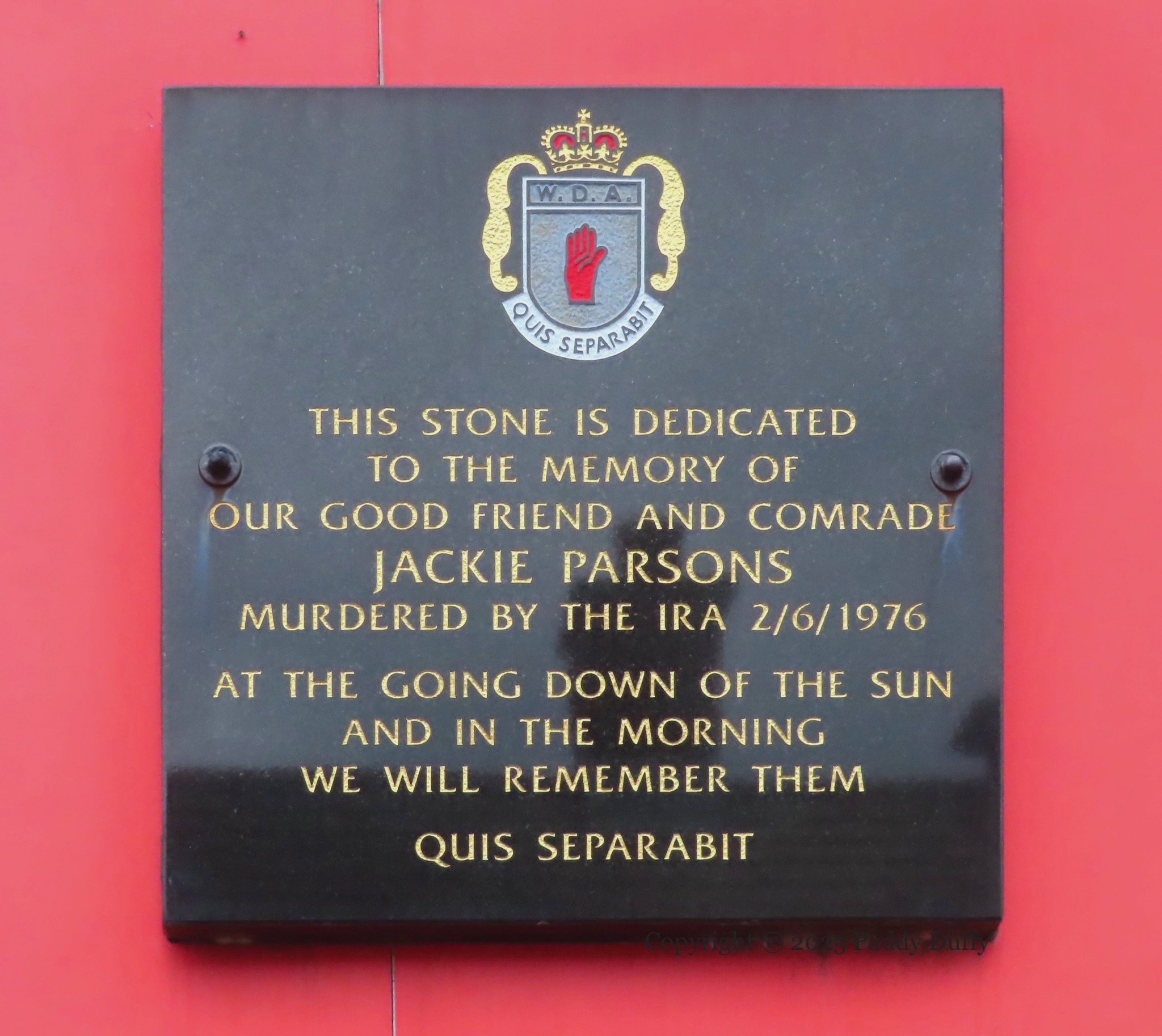
The plaque “dedicated to the officers and members of ‘B’ Company WDA (UFF)” has been retained. Also included is an image of the plaque that was added (c. 2022) to the main mural, commemorating Jackie Parsons.

Ohio Street, Woodvale, west Belfast

Buster Adams, Noel Clements, Tommy Aiken, Allistair Cousins, Billy Andrews, Irene Craig, Davy Armstrong, Drew Crawford, Fred Bailie, John Crossett, Wilbur Barnes, Tommy Dinsmore, Mark Barr, Jimmy Dowie, Sam Black, Tony Duff, Tommy Black, Ray Dummigan, Tommy Boyd, Tom Edgar, Davy Bryson, Ernie Elliot, Jimmy Carberry, Brian Faulkner // Billy Fenton, Tommy Hill, Hedgie Ferguson, Trevor Hill, Billy Gardner, Keek Holmes, Lewis Gilbert, Tommy Howells, Billy Graham, Bertie Howells, Travis Grey, Jim Hutchinson, Dennis Grey, Geordie Johnston, Geordie Hall, Tom Johnston, Jimmy Hall, Maurice Kavanagh, Stephen Hamilton, John Kennedy, Bobby Harvey, John Kiltie, Billy Higginson

Geordie King, Lee McKeag, Hugh Linton, Betty McMillan, Billy Little, Bob McMillan, Harry Lockhart, Robert McMillan, Rab Lockhart, Norman McMillan, Drew McAllister, George McMurray, William McBride, Jimmy Millar, Bobby McCade, Archie Millar, Tommy McCormick, Victor Moody, Joe McCann, Wesley Morrison, John McCrea, Graham Murdock // Jonny Nelson, Tommy Totten, Freddie Parkinson, Billy Thompson, David Parker, Phillip Thompson, Jackie Parsons, Mark Turner, Bobby Patterson, Jimmy Welshman, Ned Pollock, Lou West, Charlie Quinn, Stanley West, Ray Riley, Cecil Williamson, Jackie Robinson, Silver Wilson, George Selby, Tucker Yates, Sammy Swain, Sandy Wright
Click image to enlarge
Copyright © 2025 Paddy Duffy
T07032 T07024 T07033 T07034 T07035
T07025

1st Shankill Somme Association

“1st Shankill Somme Association [Fb] roll of honour. In memory of our esteemed past members. Lest we forget.” The Association celebrated its twenty-fifth anniversary in February of this year (2025) and celebrated with a march from the leisure centre up to the garden of reflection next to the Shankill graveyard (Fb). The new retrospective board above shows members of the Association at trips to various WWI landmarks across the years.

This board replaces the James Craig board seen in Because He Loves What Is Behind Him.

Also included is an image of the roll of honour to the left of the main memorial, which now has some new names and is topped by a tribute to Queen Elizabeth II. For Joe Coggle see S Company, C Company.

Click image to enlarge
Copyright © 2025 Paddy Duffy
T07027 [T07026] T07028

We Like Them Must Never Yield

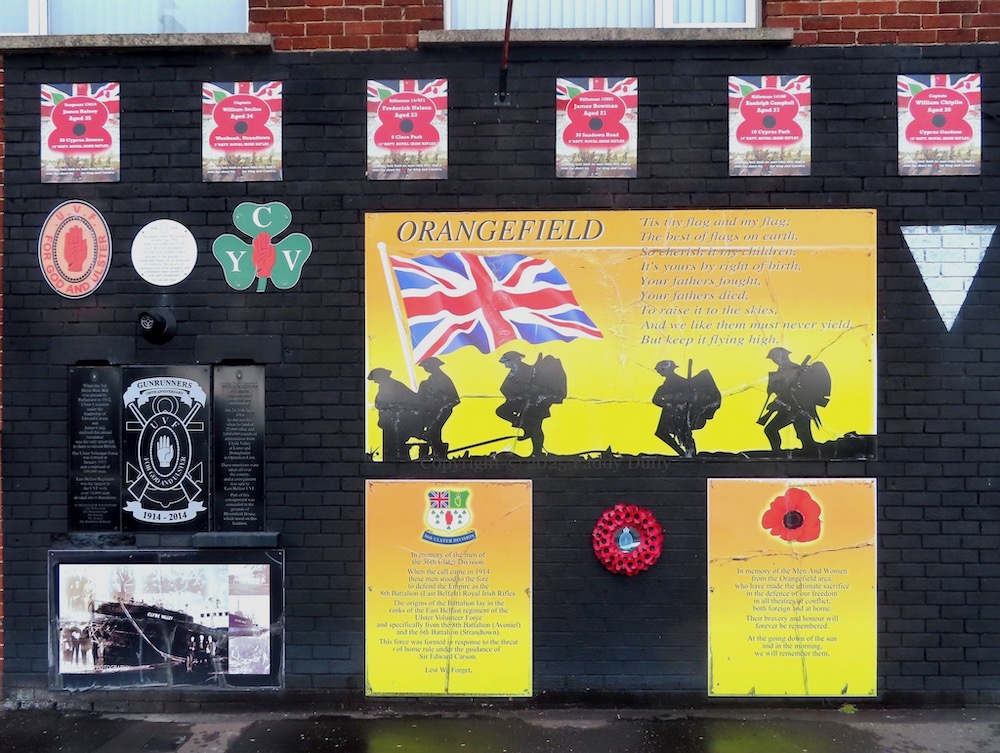
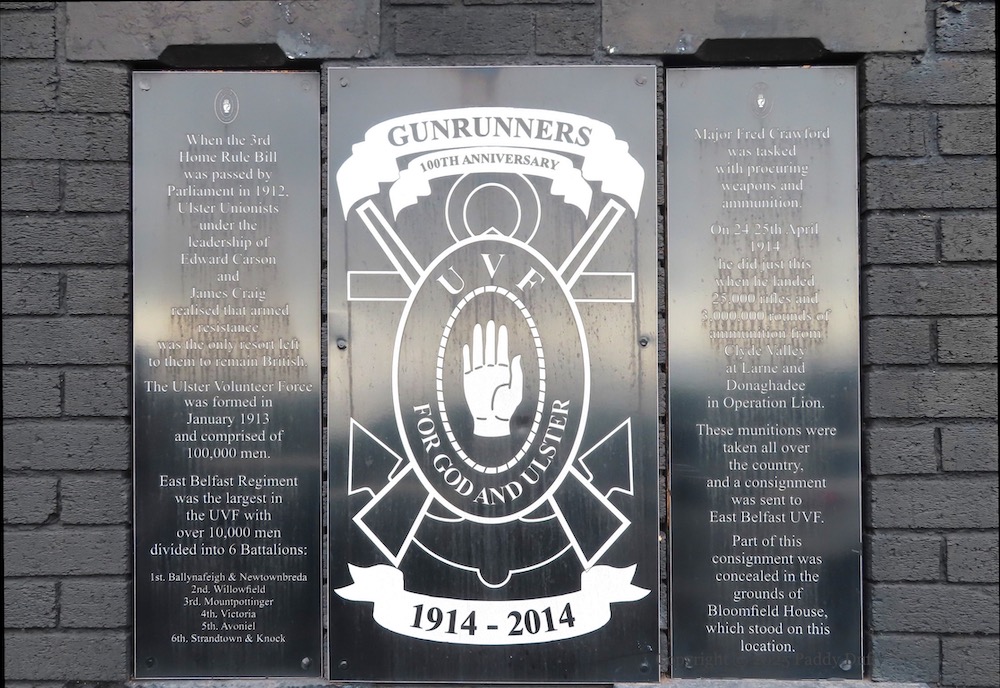
The image above shows a unified and wider view of the two pieces seen previously in Bloomfield House and In All Theatres Of Conflict: on the left, a board marking the centenary of the Ulster Volunteers’ ‘Larne Gun-Running’; on the right, a board commemorating the casualties from the 36th (Ulster) Division in WWI; above them both are small boards from the ‘Poppy Trail’ collection of deceased locals.

A close-up of the circular plaque above ‘Gunrunners’ can be seen in the Peter Moloney collection.

Click image to enlarge
Copyright © 2025 Paddy Duffy
T07021 T07022

The Great Seal Of The United States

Charles Thomson was born in Maghera in 1729 and moved to North America in 1739. He served as the secretary of the Continental Congress and signed the Declaration of Independence. He helped design both the front and back of the nation’s Great Seal in 1782. (WP)

He is honoured in his home town by the board shown here. Thomson’s design for the reverse of the seal – the all-seeing eye over an unfinished pyramid (WP) – appears in the eagle’s left-hand wing, and his preliminary sketch, with wing-tips pointed downward (WP), in the right-hand wing.

Meeting House Avenue, Maghera

See also: the Visual History page of Ulster-Scots Murals.

Text of the information panel: “The Final Design of the Great Seal – June 20, 1782. On June 13, 1782, Congress asked Charles Thomson to come up with a suitable design for America’s Great Seal. With the reports and drawings of the three committees before him, he set to work. Thomson had served the past eight years as the Secretary of the Continental Congress where he acquired a reputation for fairness, truth, and integrity. Well-versed in the classics, he was once a Latin master the Academy of Philadelphia. Although today he is not a well-known founder, Charles Thomson was at the heart of the American Revolution. Thomson incorporated symbolic elements from all three committees with ideas of his own to create a bold and elegant design. He made a sketch and wrote a description of his preliminary design. For the front of the Great Seal, Thomson drew an American bald eagle and for the centrepiece he a [sic] placed the shield upon the eagle’s breast. Thomson envisioned an eagle “on the wing and rising.” In the eagle’s right talon is an olive branch. In its left, a tightly drawn bundle of arrows. Thomson said these symbols represent “the power of peace and war.” In the eagle’s beak, he placed a scroll with the first committee’s motto: E Pluribus Unum ‘Out of Many, One’. For the crest above the eagle’s head, Thomson used the radiant constellation of thirteen stars suggested by the second committee. He described the light rays as “breaking through a cloud.” For the reverse side of the Great Seal, Thomson used Barton’s (third committee) suggestion: an unfinished pyramid with the eye of Providence in its zenith, but added a triangle around the eye (like the first committee did). He also created two new mottos: Novus Ordo Seclorum ‘A New Order of the Ages’ and Annuit Coeptis ‘Providence has Favoured Our Undertakings’. After consulting with William Baron, the position of the eagle was changed to “displayed” (wings spread with tips up) and the chevrons on the shield were changed to the vertical stripes we see today.”

Click image to enlarge
Copyright © 2025 Paddy Duffy
T07009 T07010

At The Going Down Of The Sun

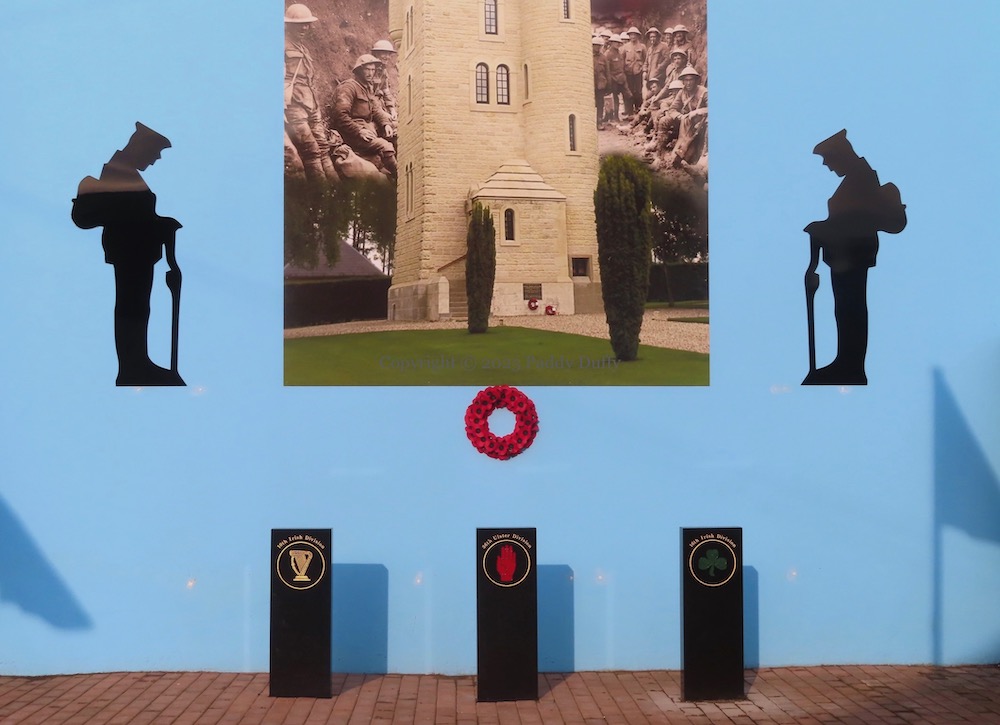
The memorial garden in Barrington Gardens at long last appears to be finished. The house on the corner of Donegall Road was knocked down in 2012 or 2013 and work began converting the waste ground into a memorial to local Great War casualties in late November 2023. See this entry for images from both November 2023 and October 2024.

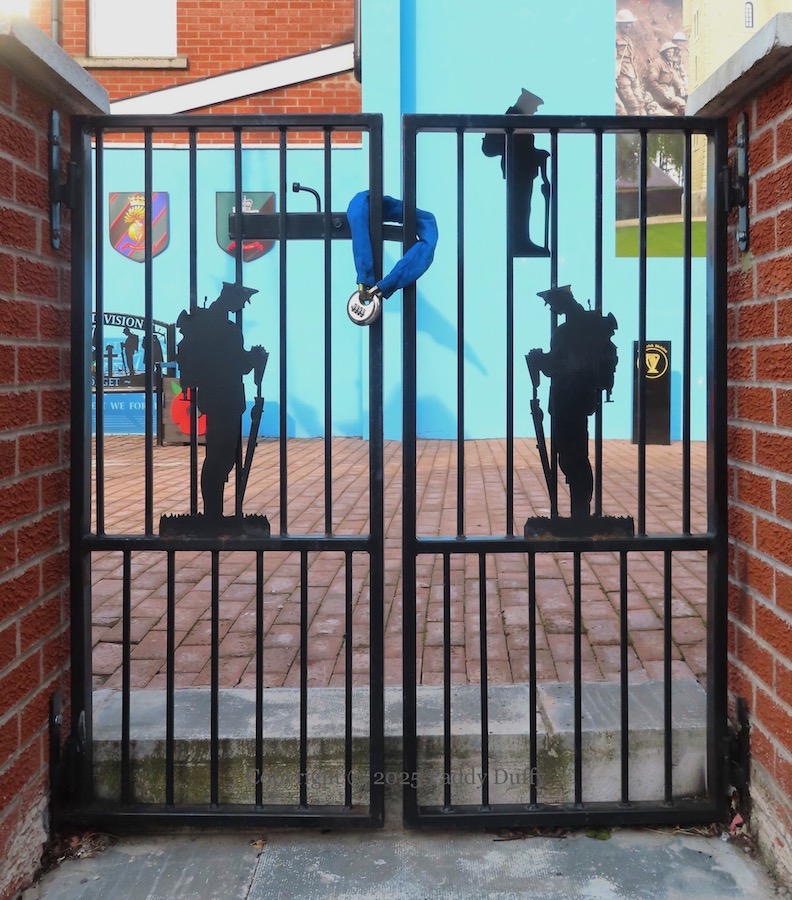
Since 2024, three pillars have been added below the main board, one each for the 10th (Irish) Division, 36th (Ulster) Division, and 16th (Irish Division) – for the service of the three divisions, see The Cost Of War, We Are The Dead, and (for the particular story of John Meeke and Willie Redmond) Comrades In Arms – and an iron bench to the 36th has been placed below the crests of the YCV, Inniskilling Fusiliers, Royal Irish Fusiliers, and the Royal Irish Rifles on the side-wall to the left.

Silhouetted graveside mourners appear on either side of the main board and in the gates to the garden

Click image to enlarge
Copyright © 2025 Paddy Duffy
T06959 T06960 T06961 T06958 T06962 T06963

Breaking The Siege

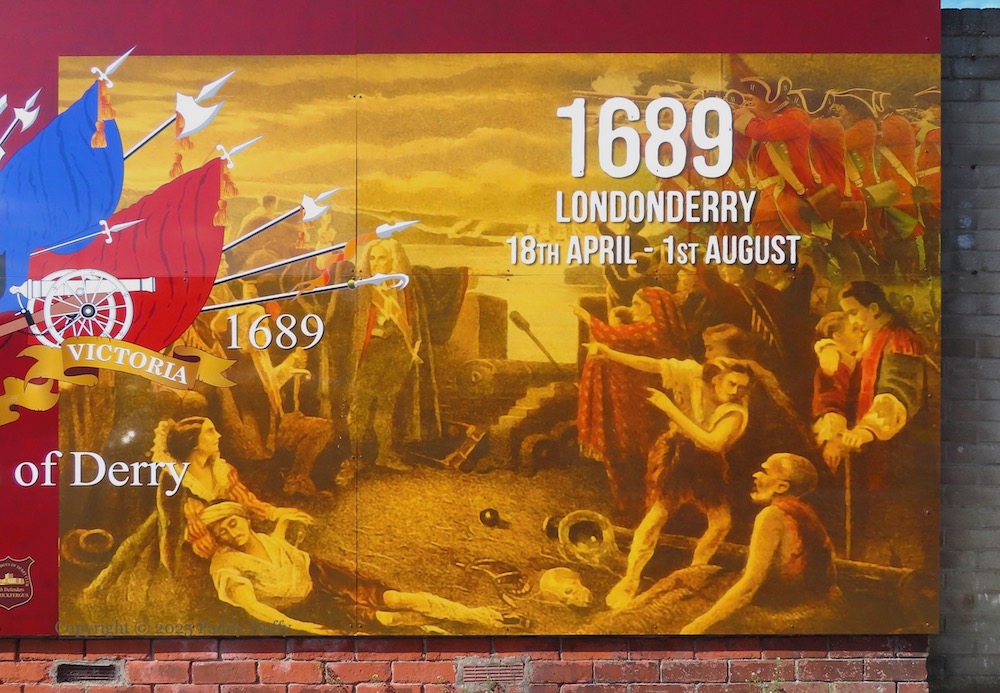
English forces under Kirke came to the aid of the besieged Protestants in Derry, “breaking the boom” across the Foyle and ending the siege at the end of July, 1689. The next wave of forces sailed for Belfast Lough, and together with the troops from Derry, set siege on August 20th to a garrison of Jacobite forces stationed in Carrickfergus castle, who soon began to run low on gunpowder, and surrendered. (WP | NIWorld)

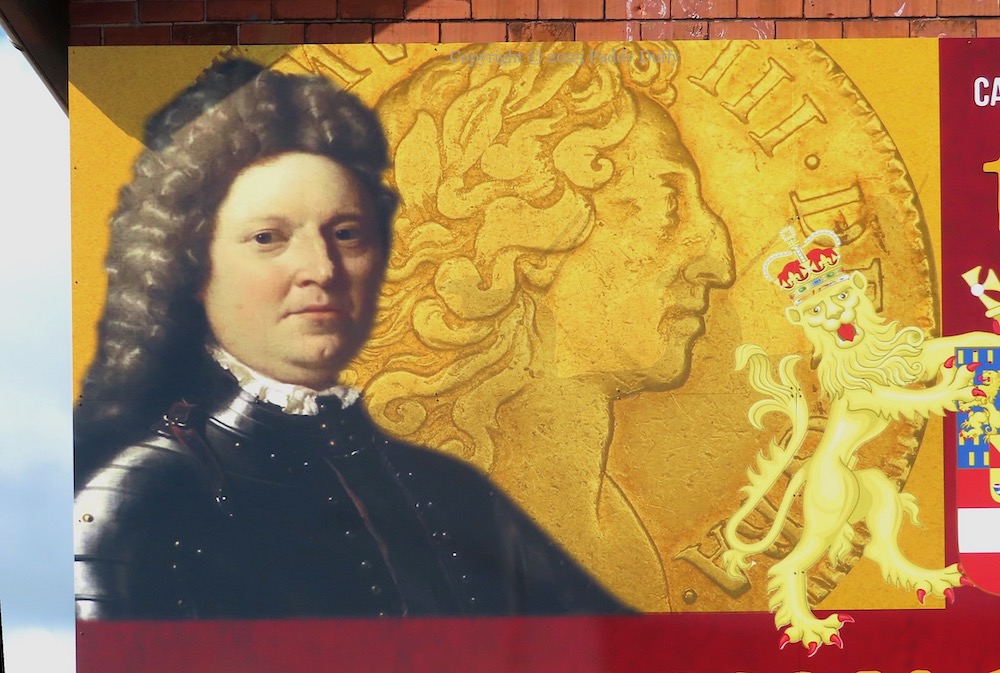
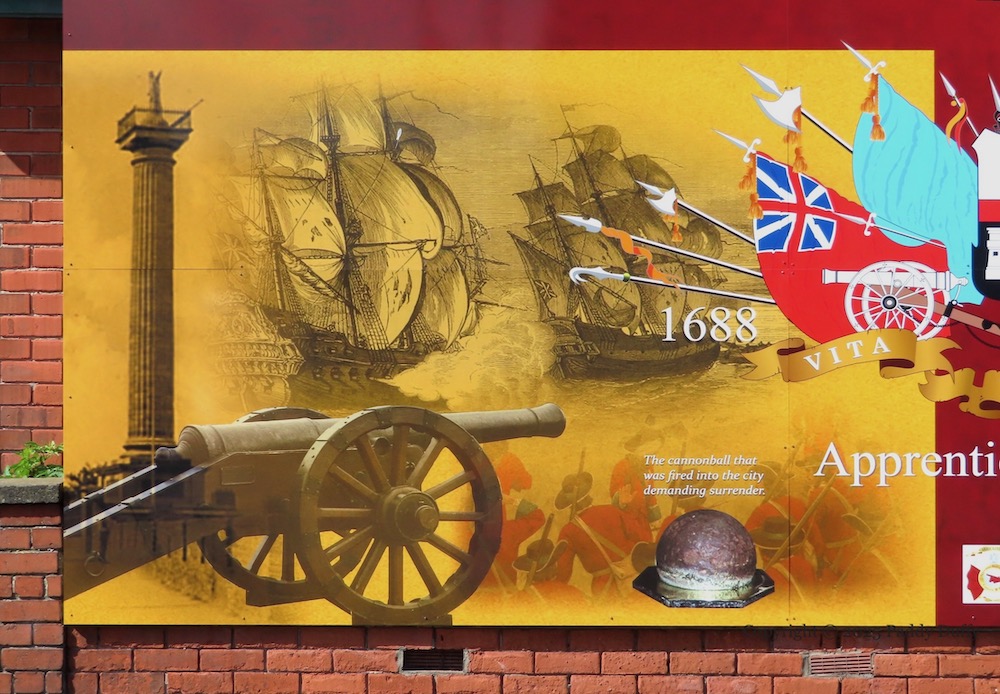
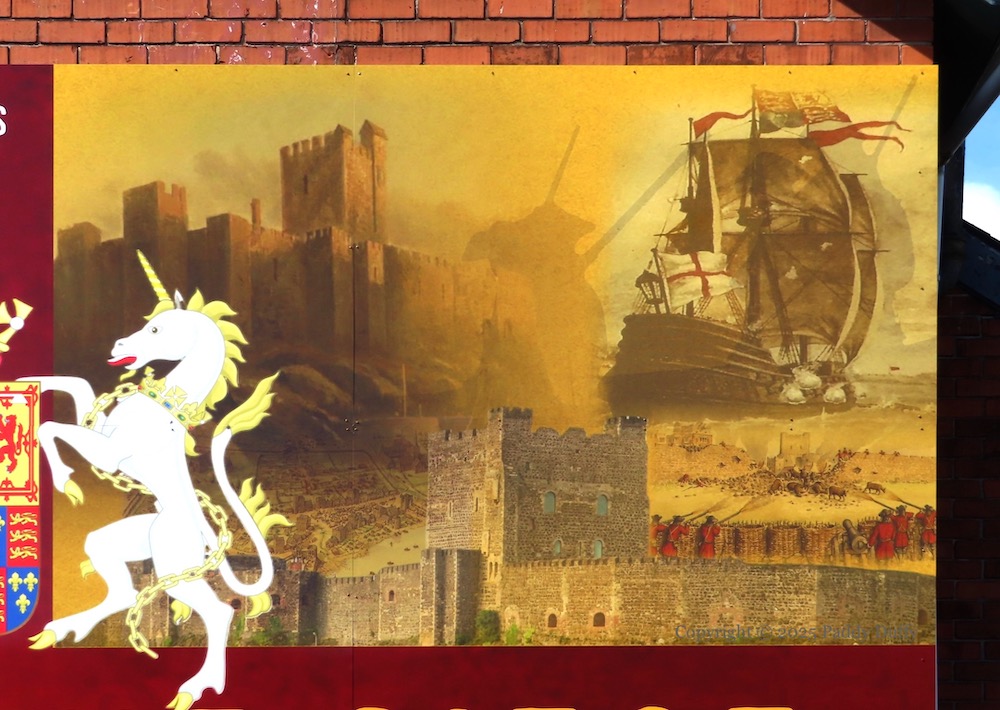
This new board in Davy’s Street, Carrickfergus, focuses mostly on the siege of Derry, though gives the dates of the Carrickfergus siege at the top. Schomberg appears in the top-left quadrant of the board – he would go on to die on at the Boyne in 1690; in the top-right is the Carrickfergus castle and the Mountjoy; in the bottom-left are Walker’s statue and the canon ‘Roaring Meg’; bottom-right is a painting of the Derry inhabitants celebrating the end of the siege; top-centre is the coat of arms of William and Mary; and bottom-centre is the Londonderry coat of arms.

Replaces a trio of small UVF boards.

Click image to enlarge
Copyright © 2025 Paddy Duffy
T06797 T06798 T06799 T06800 T06801 T06802 T06803

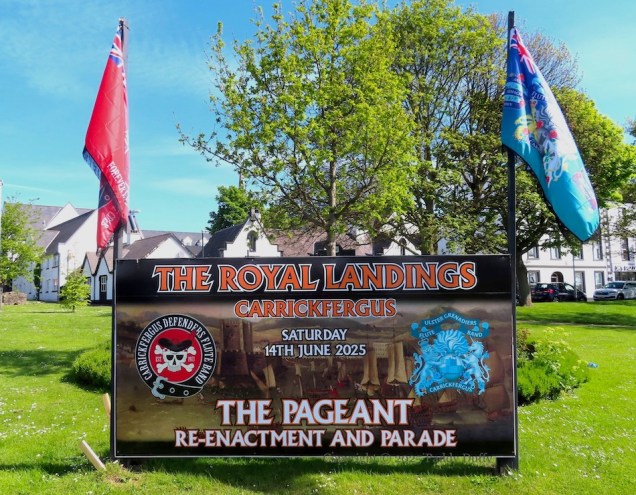
The Royal Landings

“The Royal Landing, Carrickfergus, Saturday 14th June 2025. The pageant, re-enactment, and parade.”

William III, statholder of Holland, landed at Torbay, England, in November, 1688 with 250+ ships and 30,000 men in order to overthrow the Catholic convert James II who had become king in 1685. As king of England, William was automatically made king of Ireland, but he and his forces had to go to Ireland to win the island from James and the forces loyal to him. Schomberg had already successfully besieged Carrickfergus in 1689, allowing William to land on June 14th, 1690. The image used as a background is Pocock’s oil painting of the landing, which is held by the National Maritime Museum.

The Royal Landing event involves a parade – involving the Carrickfergus Defenders flute band (Fb) and the Ulster Grenadiers flute band (Fb) – from Woodburn fields to the marina, where King Billy’s landing will be recreated (Fb).

See also: June 14th, 1690 in Newtownabbey

Click image to enlarge
Copyright © 2025 Paddy Duffy
T06

From D-Day To VE Day

39 Allied divisions – 12 of them British – participated in the Normandy Landings – officially “Operation Neptune” – that took place on June 6th, 1944; in planning for the operation, the original “D-Day” was June 5th, but bad weather postponed it until the following day, when 160,000 troops stormed the beaches of the Bay Of The Seine. By the end of August, Paris had been liberated, and by the following May, victory in Europe had been achieved. 2024 was the eightieth anniversary of D-Day and 2025 the eightieth anniversary of VE Day, on May 8th.

This D-Day board and VE Day mural are in Edlingham Street, Tiger’s Bay, north Belfast. Also included below is a WWI memorial electrical box in Mervue Street, though as can be seen from the board (immediately below) the ‘graveside mourner’ silhouette is becoming a generic symbol of lost UK forces.

Click image to enlarge
Copyright © 2025 Paddy Duffy
T06770 T06771 T06772 T06773

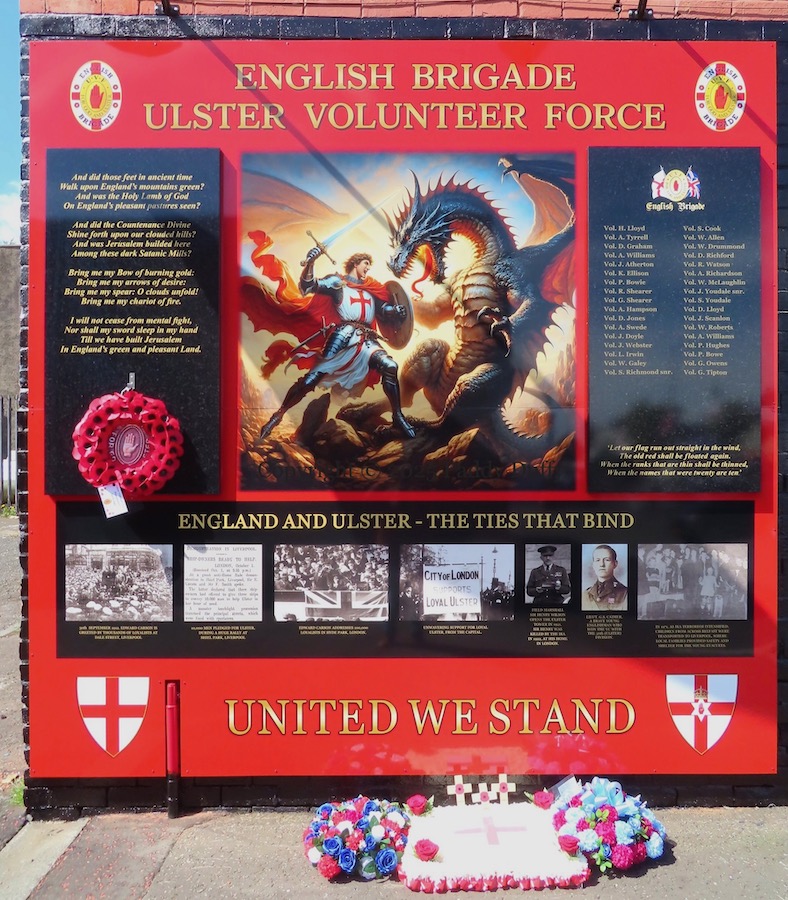
When The Ranks That Are Thin Shall Be Thinned

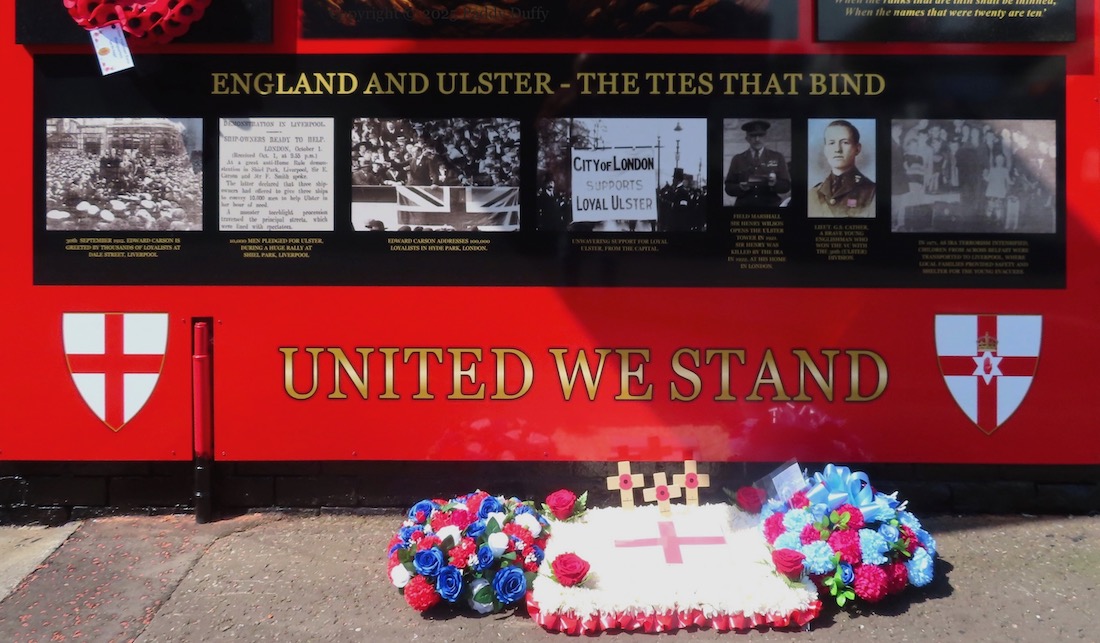
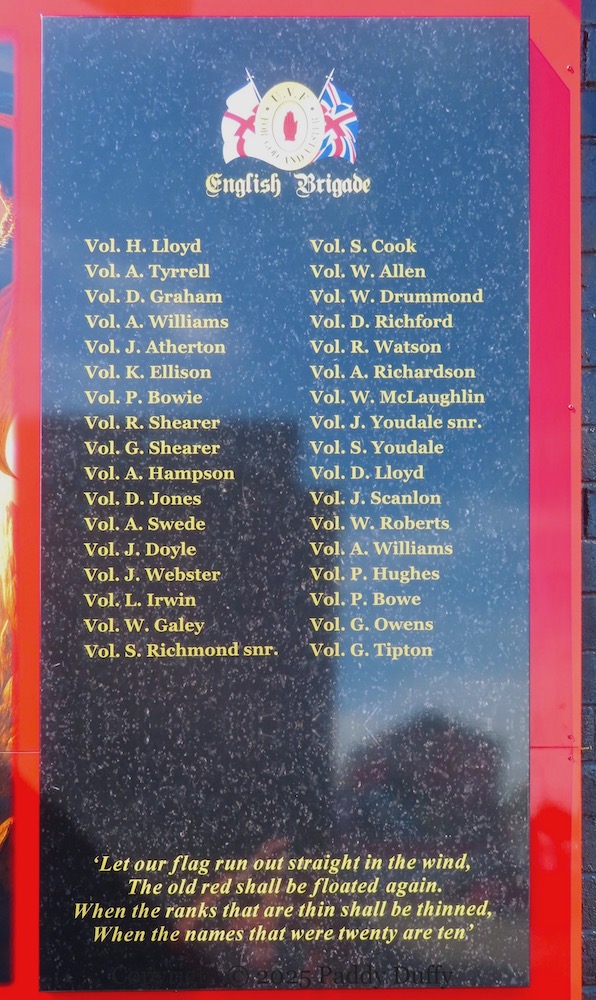
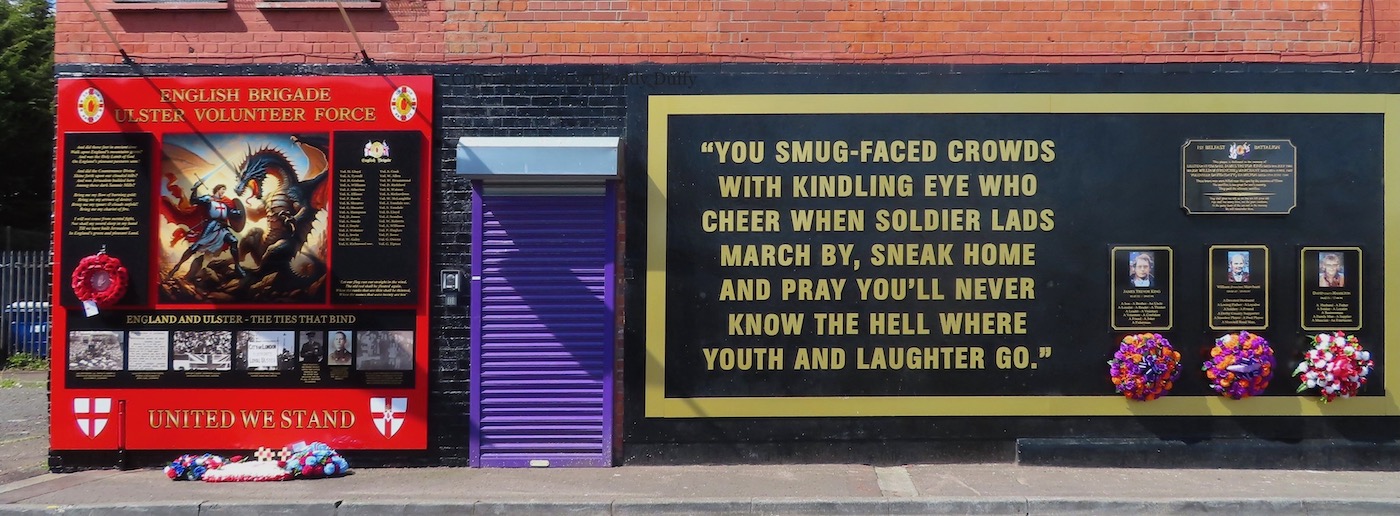
“English Brigade Ulster Volunteer Force.” “England and Ulster – the ties that bind.” “United we stand.”

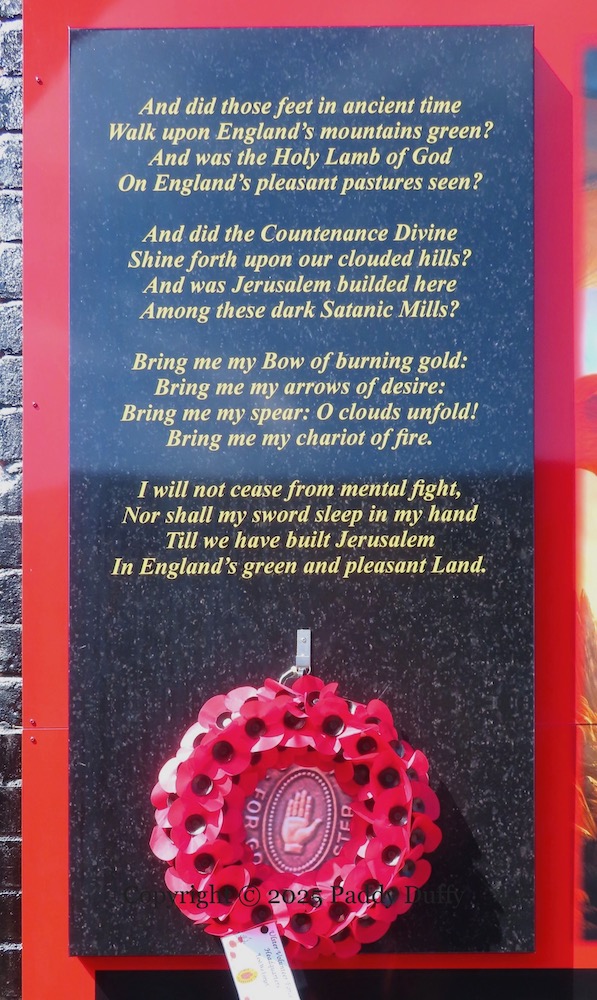
On the left are the words from William Blake’s poem, which also serve as the lyrics to the hymn Jerusalem.

“Let our flag run out straight in the wind/The old red shall be floated again./When the ranks that are thin shall be thinned/When the names that were twenty are ten.” [from Swinburne’s A Song In Time Of Order which was also used as a socialist song]

The images along the bottom illustrate the connection between Northern Ireland and England. From left to right: Edward Carson in Liverpool in 1912; 10,00 pledges from Liverpool men; Carson addressing 100,000 people in Hyde Park, London; a banner reading “City of London supports loyal Ulster”; “Field Marshall Sir Henry Wilson opens the Ulster Tower in 1921. Sir Henry was killed by the IRA in 1922 at his home in London”; GS Cather, VC winner with the Ulster Division; evacuees to Liverpool in 1973.

Spier’s Place, middle Shankill, west Belfast. For the memorial on the right (in the wide shot) see A Fisherman, An Entertainer, A Shankill Road Man.

Click image to enlarge
Copyright © 2025 Paddy Duffy
T06763 [T06764] T06767
T06765 T06766
T06768

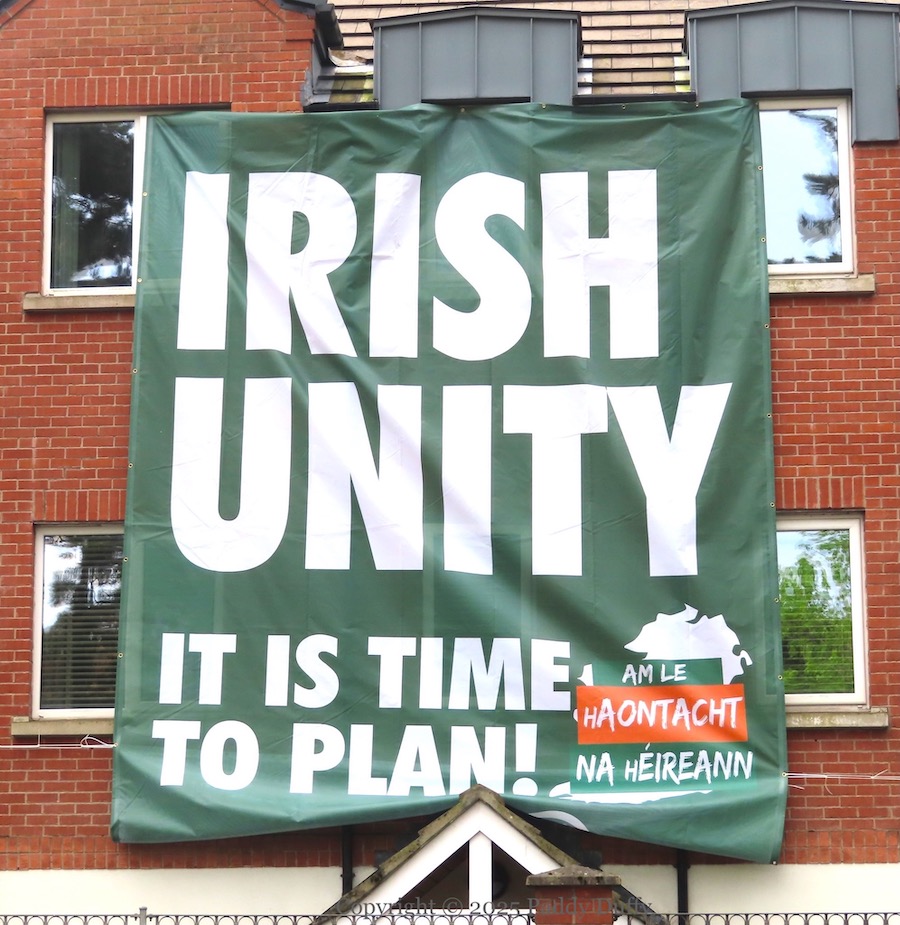
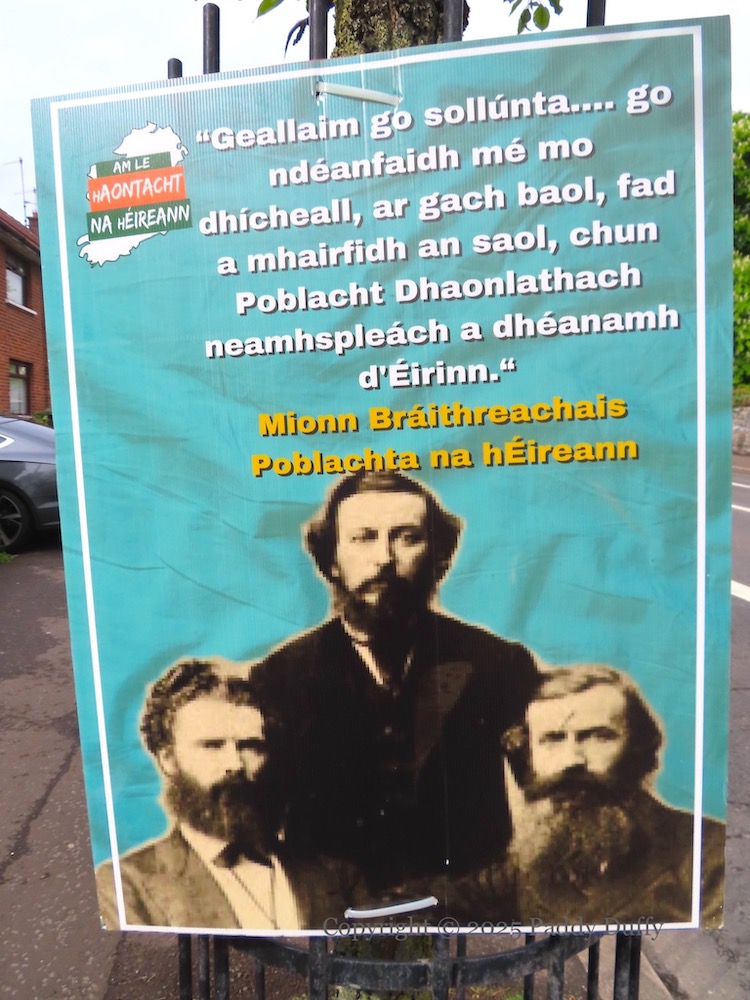
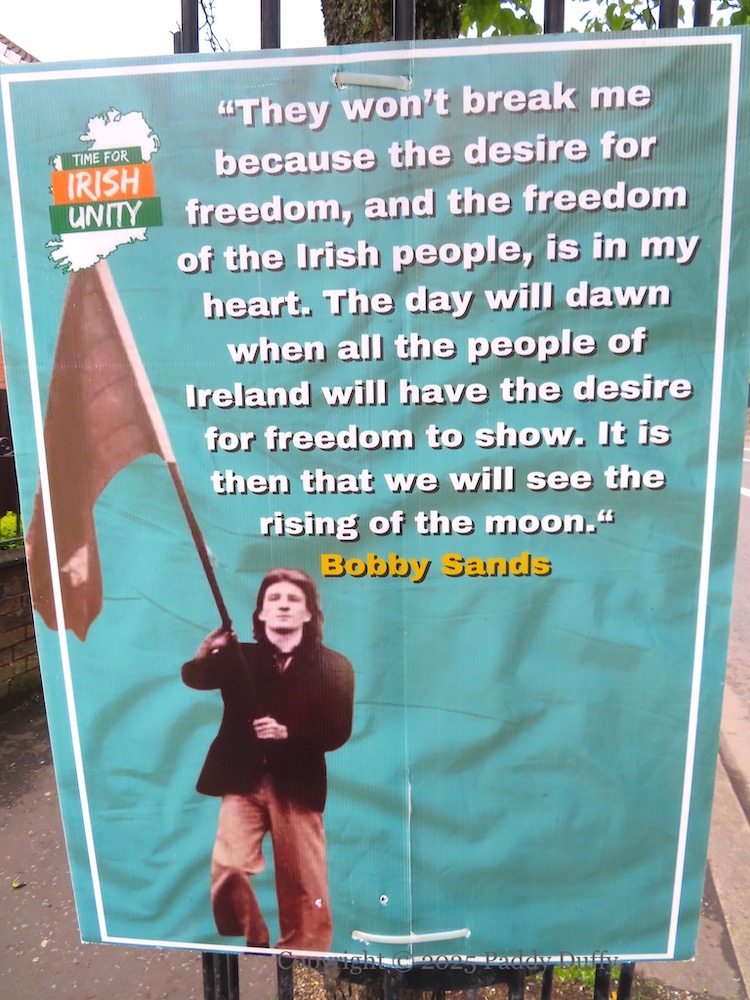
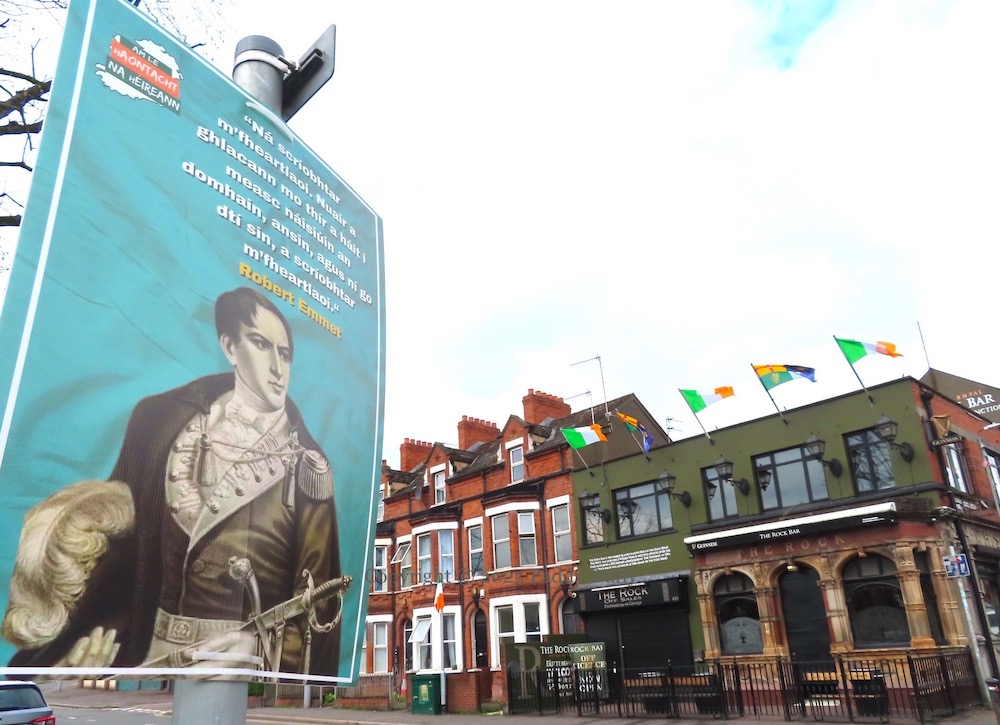
Am D’Aontacht

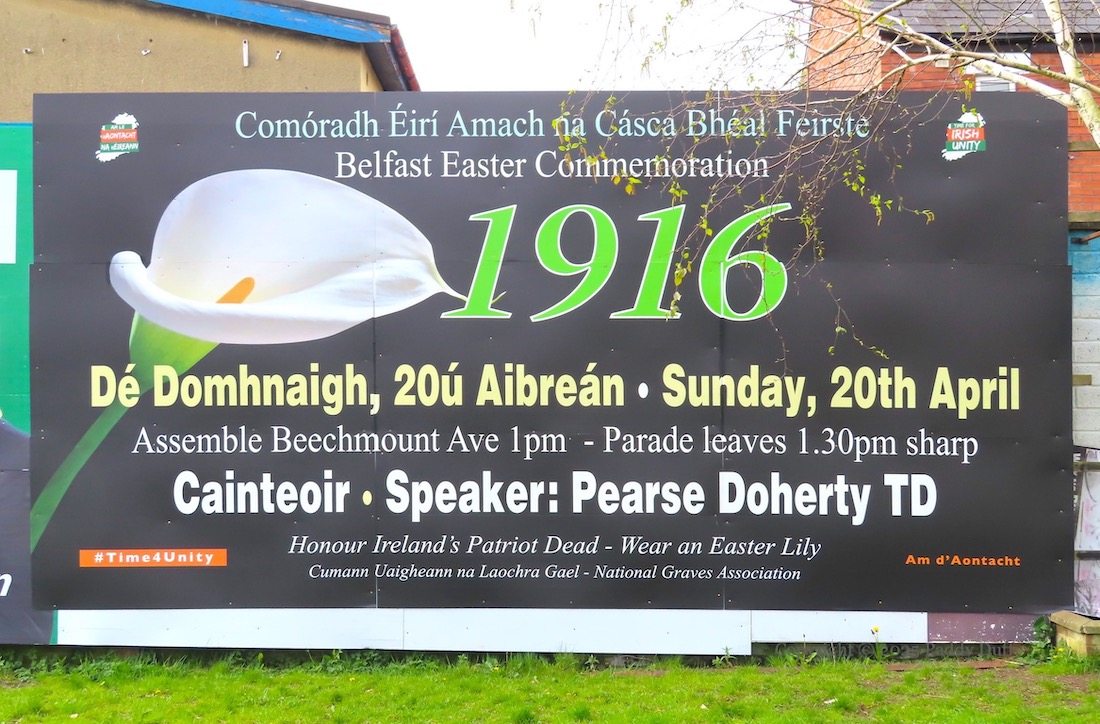
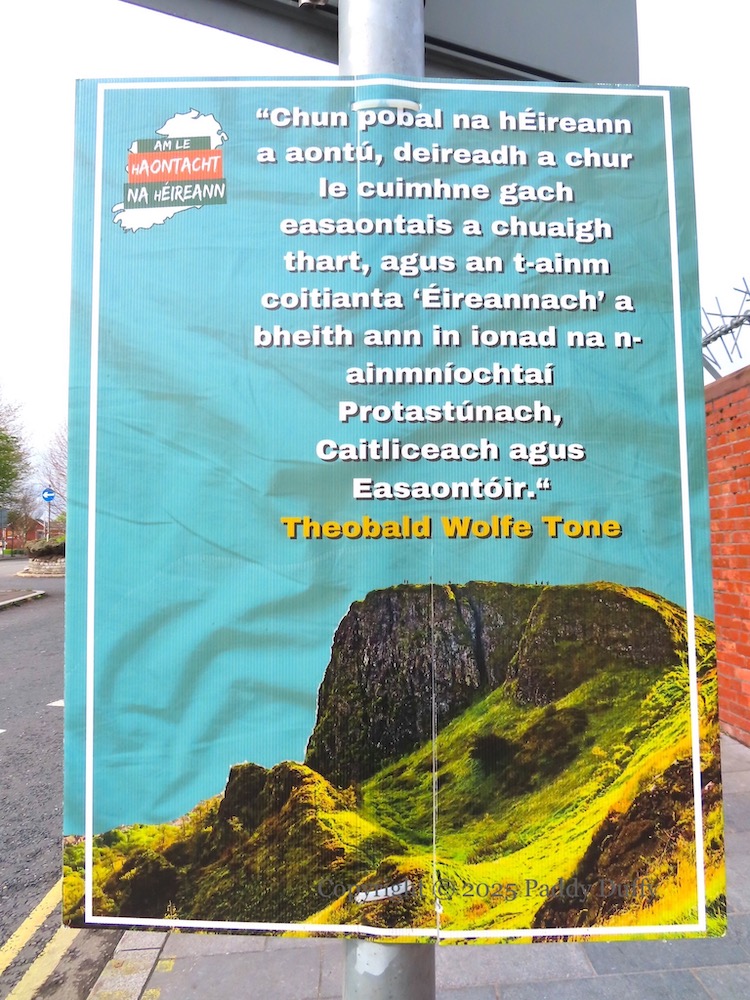
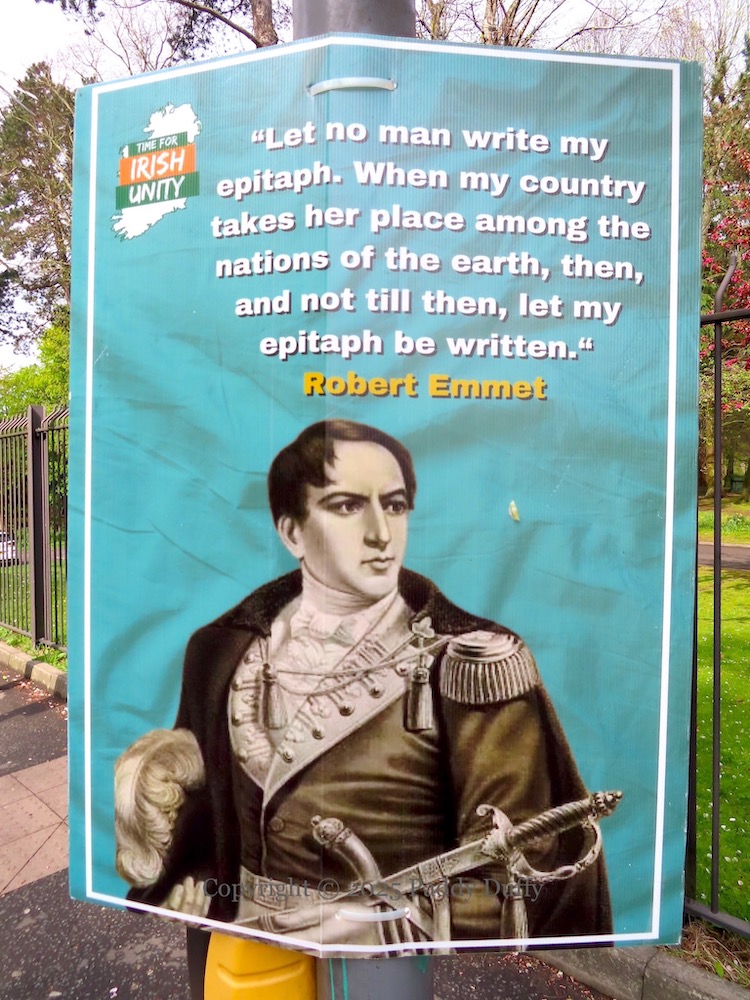
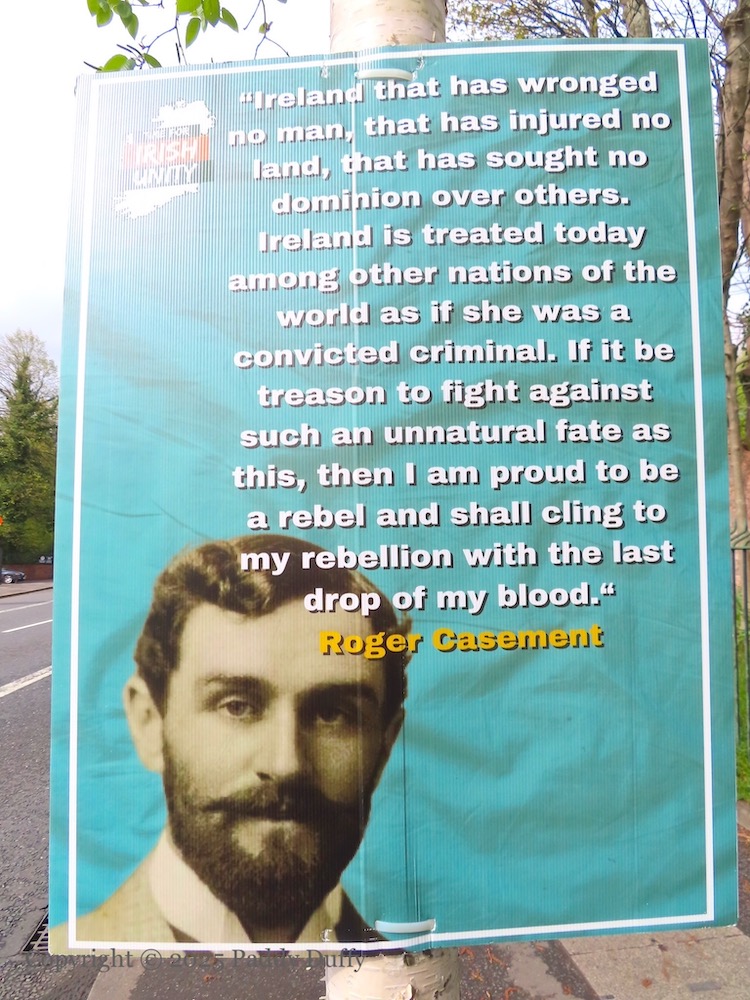
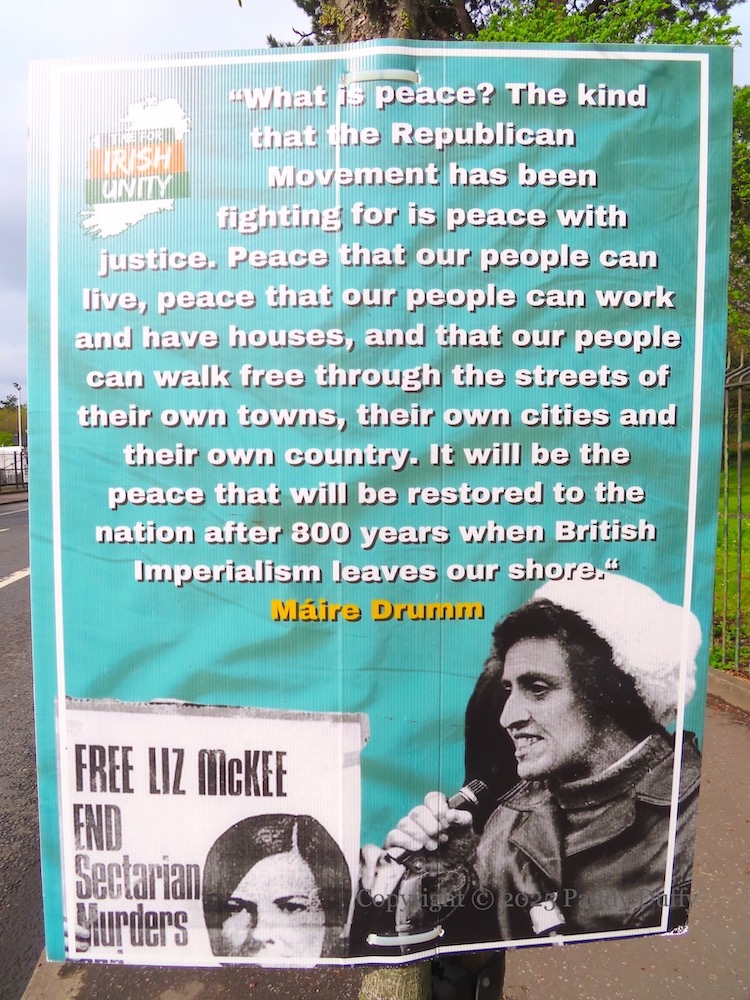
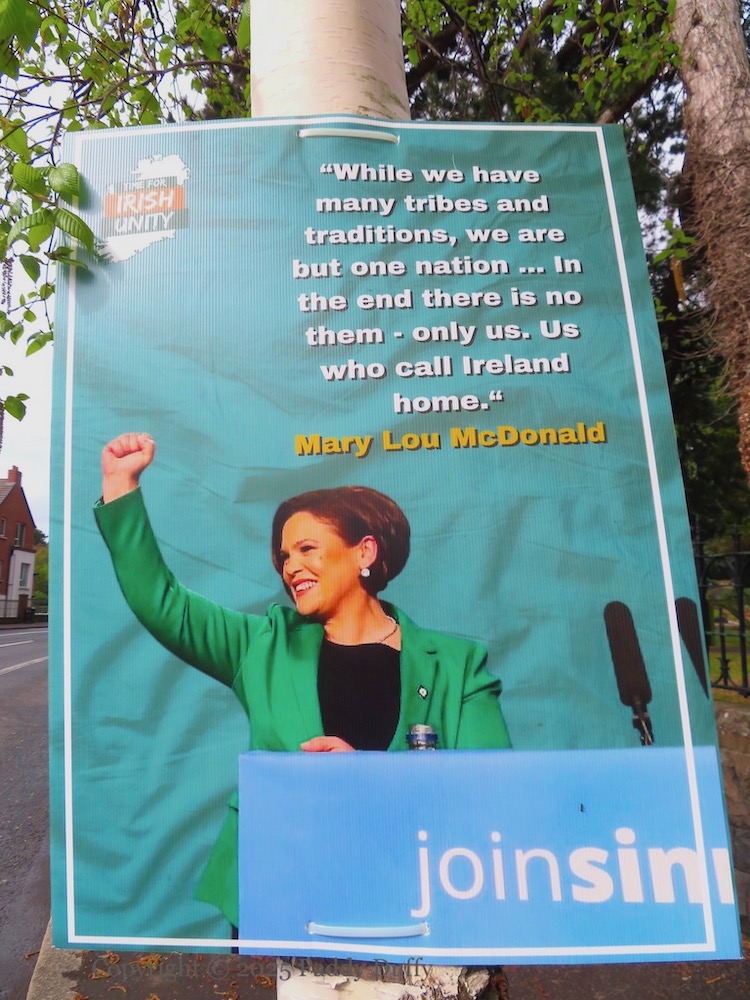
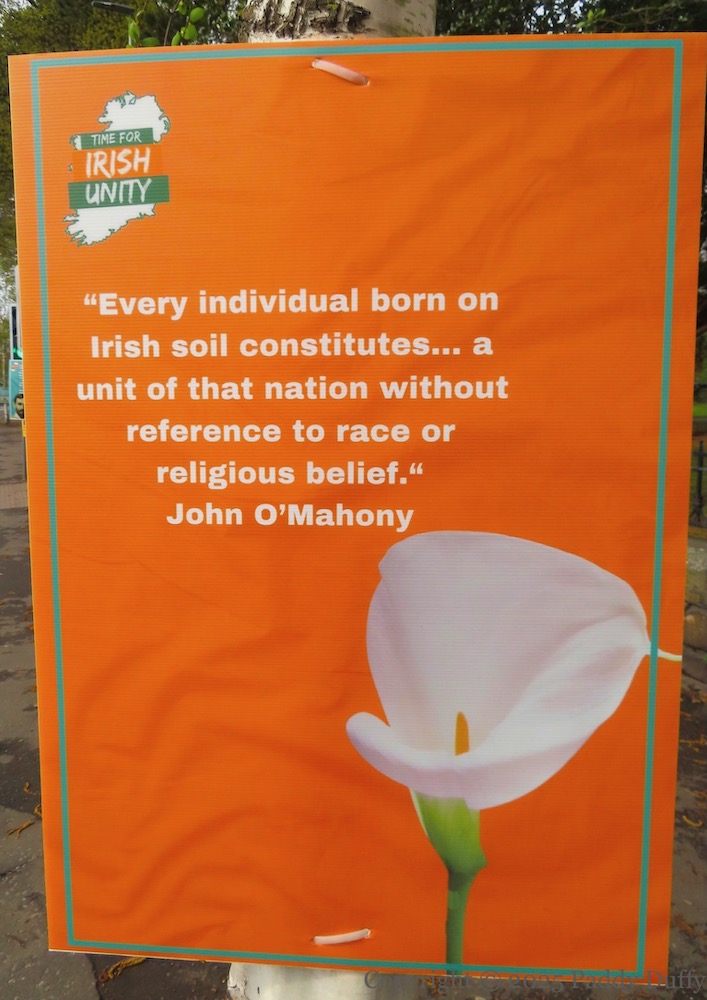
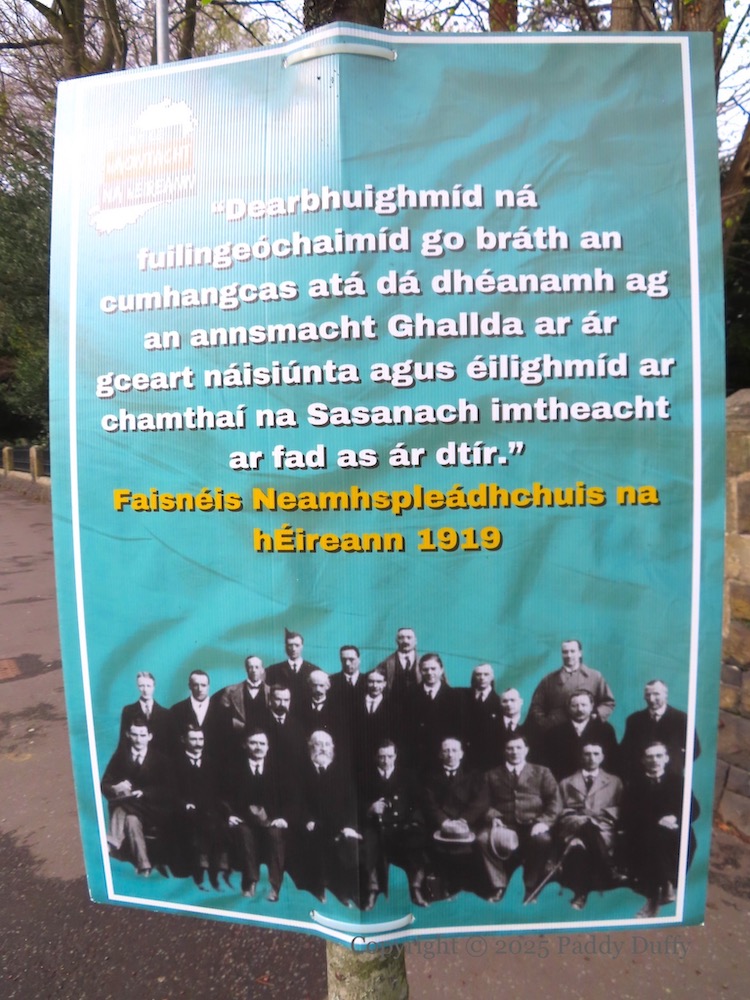
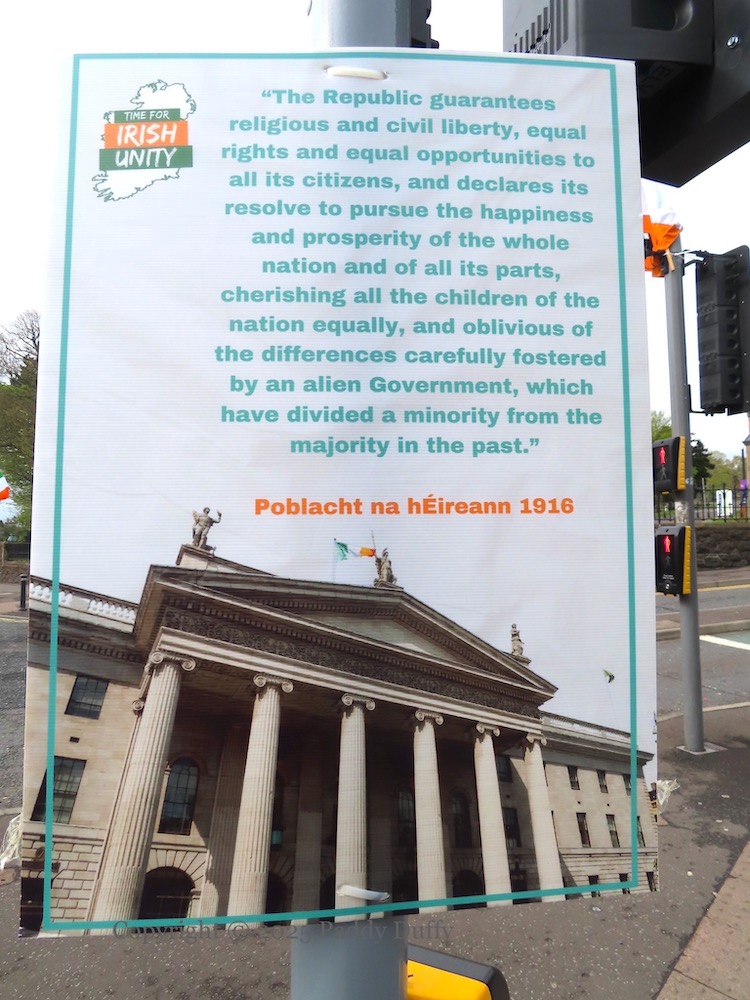
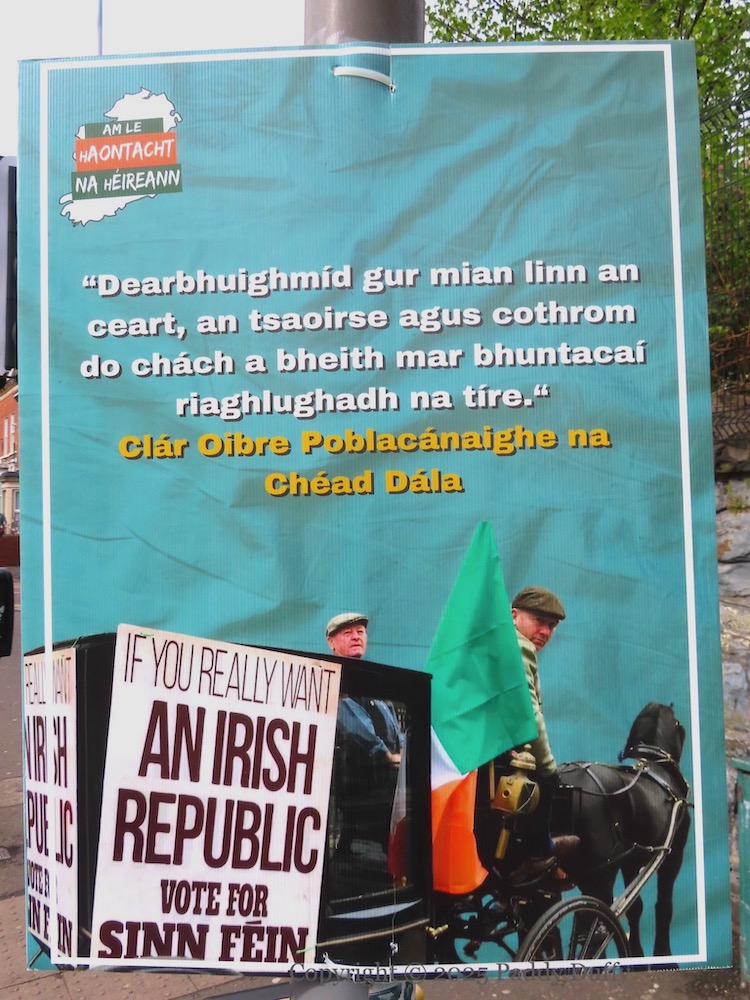
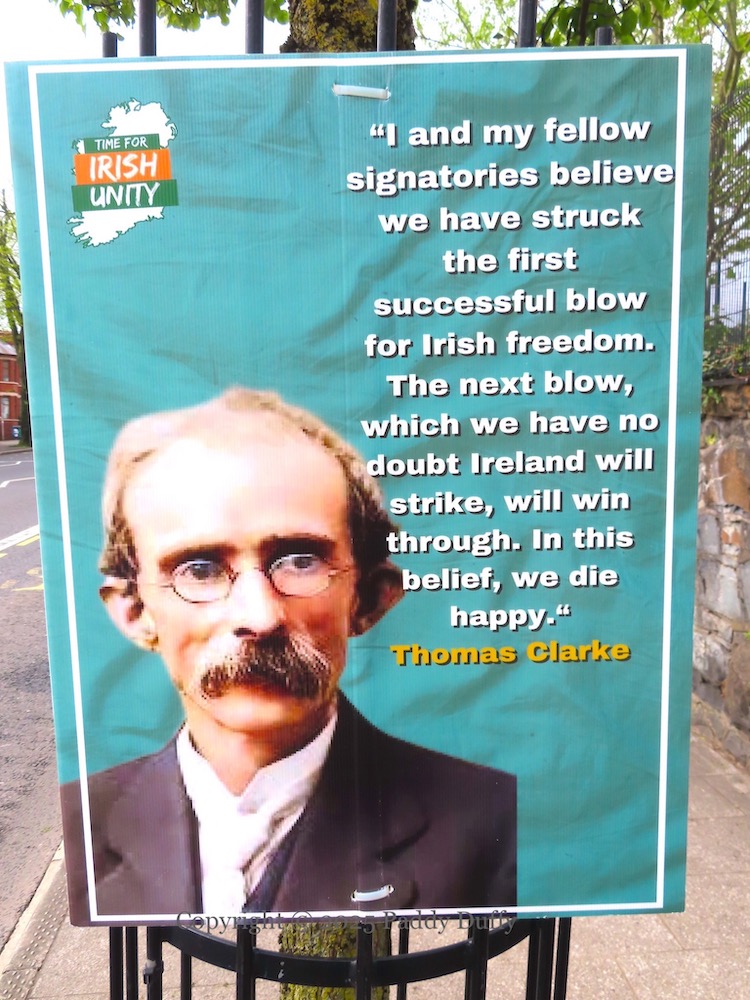
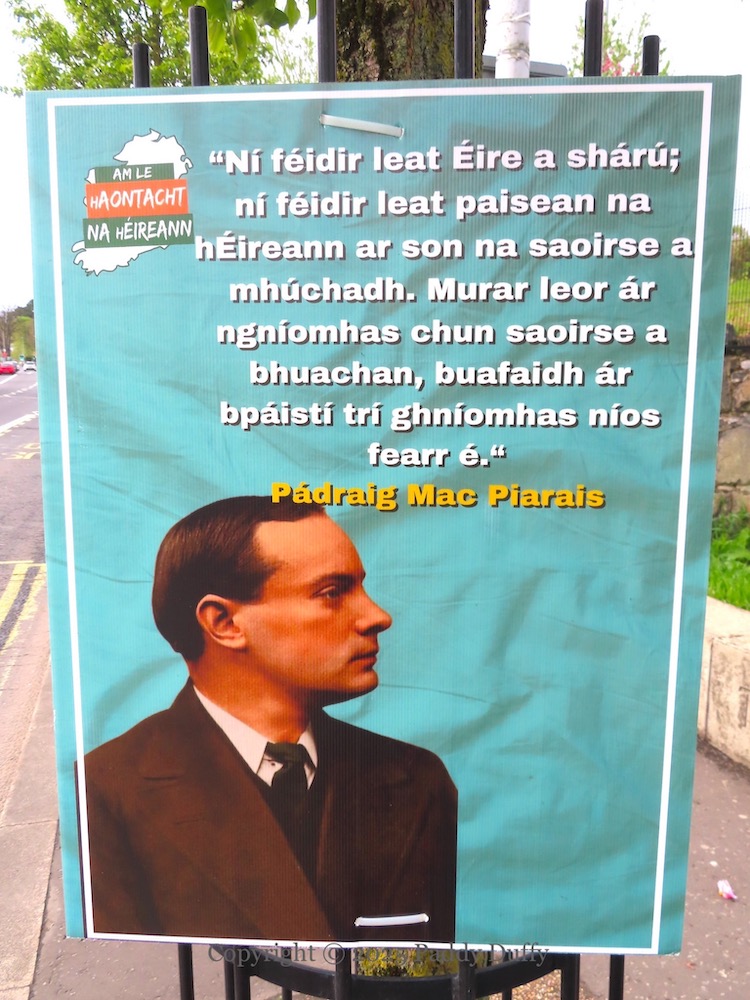
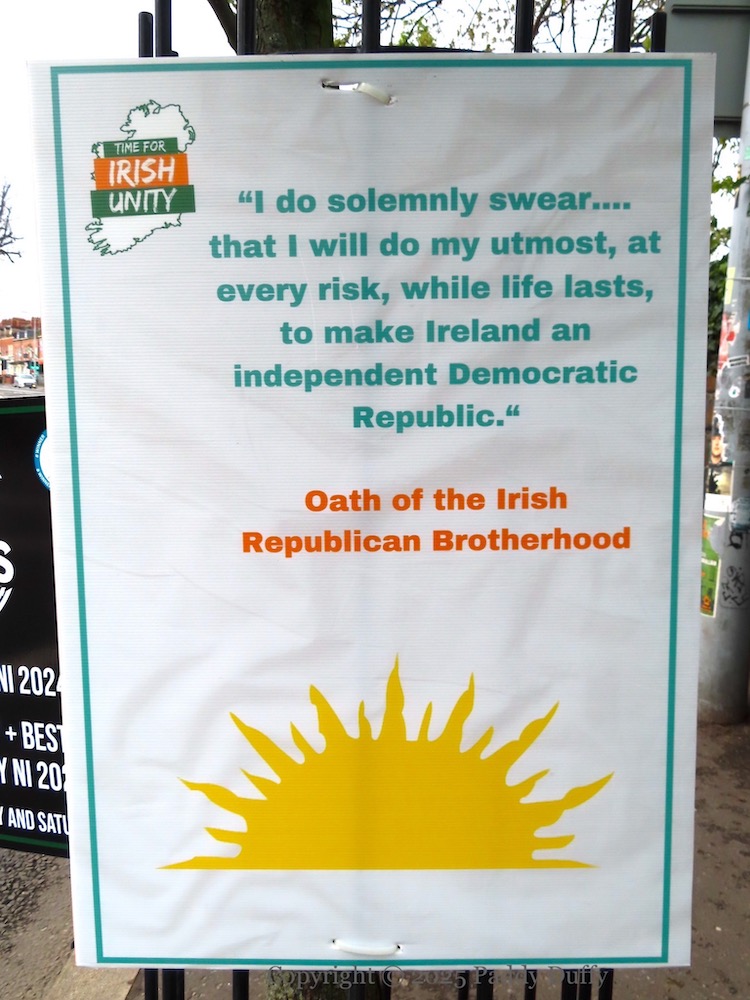
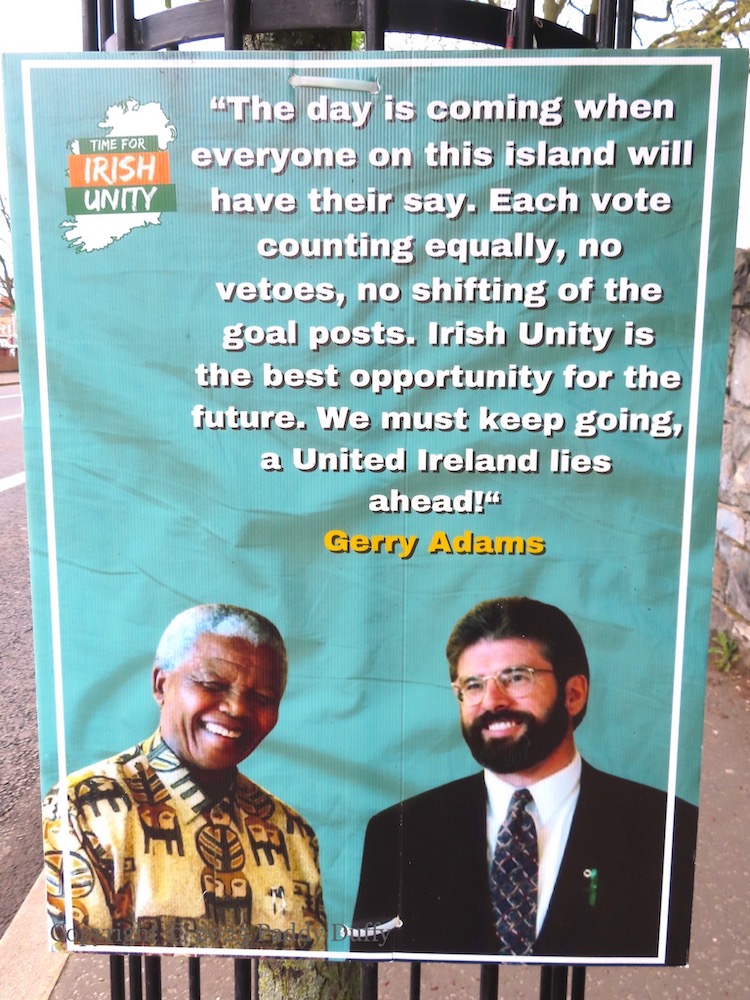
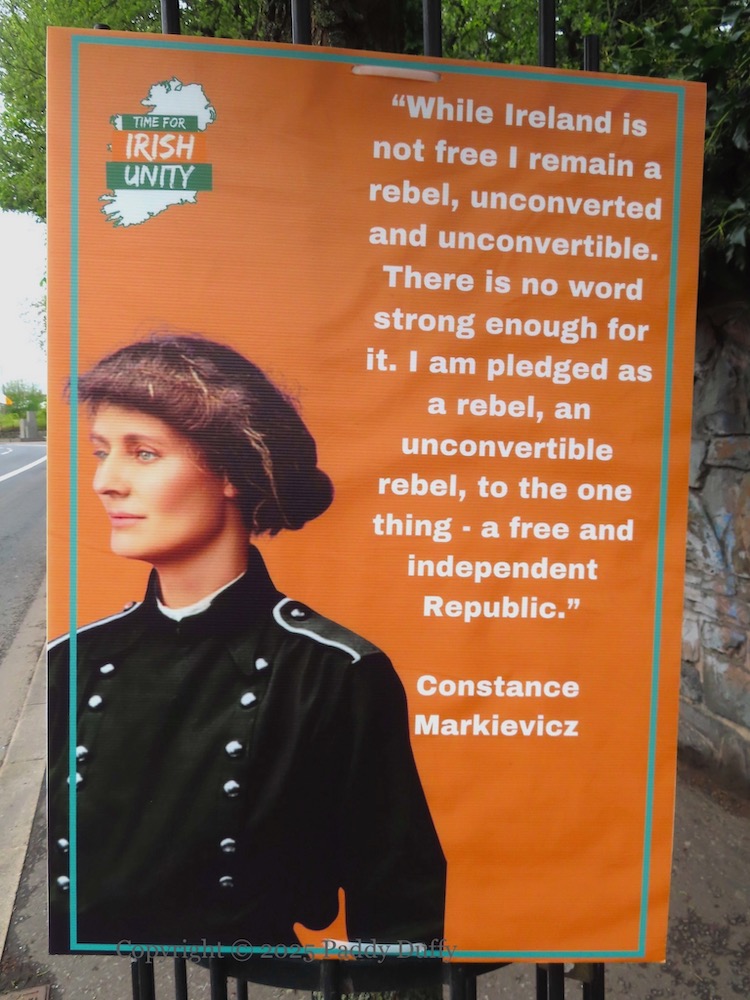
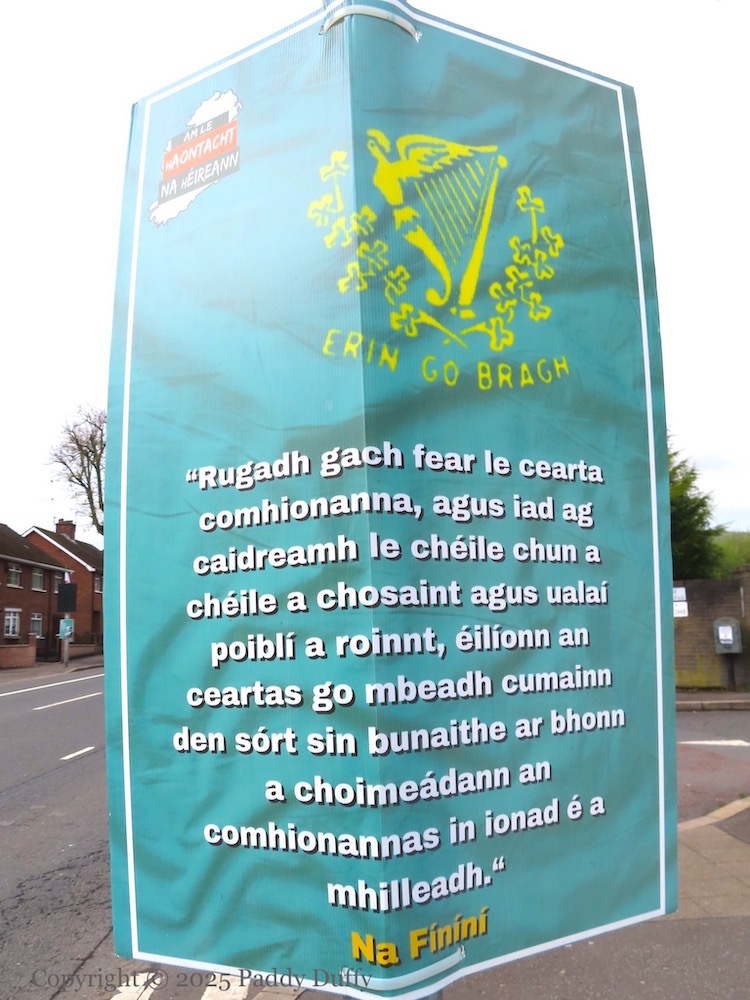
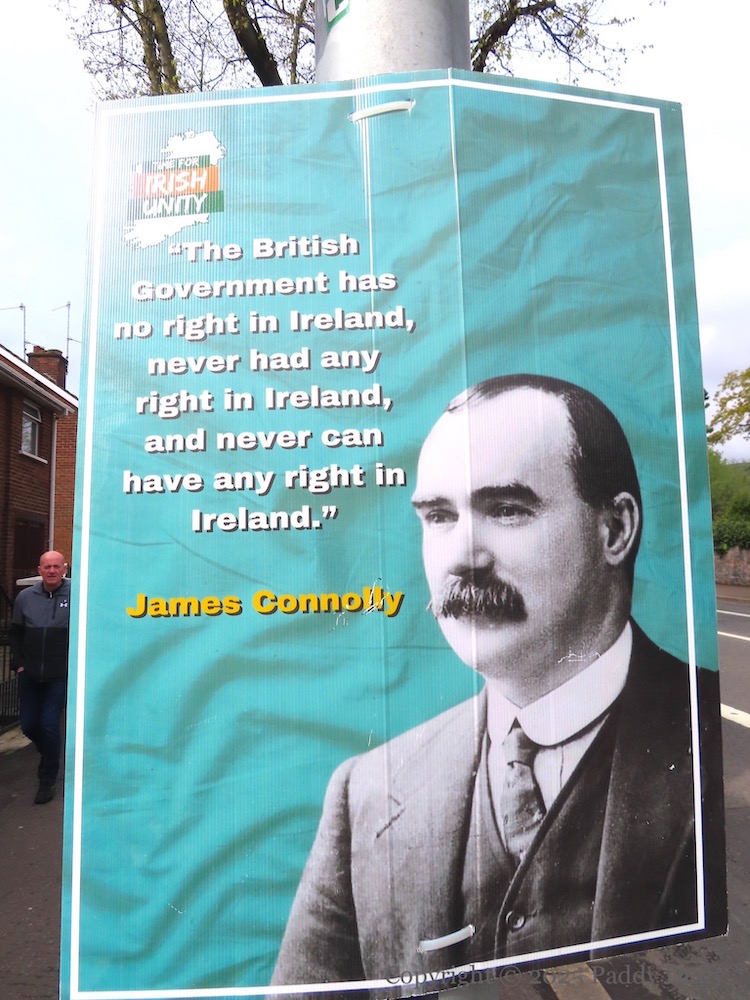
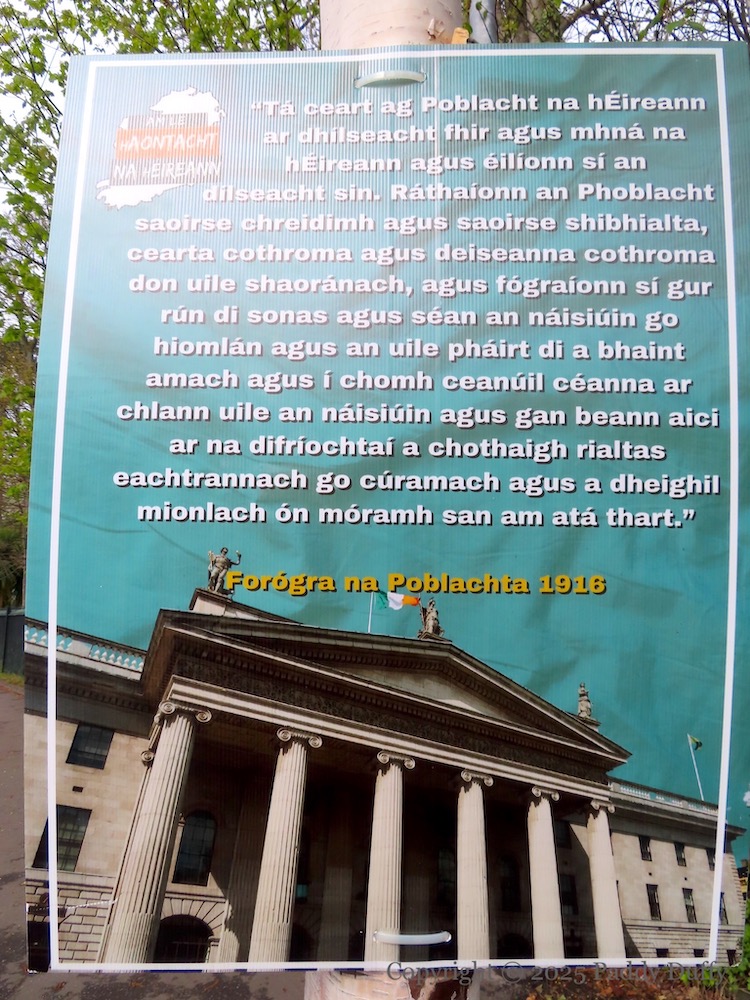
For Sunday’s parade (in Belfast) commemorating the Easter Rising of 1916, Sınn Féın lined the route with placards featuring quotations from republican heroes past and present: the first Dáıl, Wolfe Tone, Robert Emmet, James Fintan Lalor, Roger Casement, the Proclamation of 1916, William Allen, the Declaration Of Independence, James Larkin (as Gaeılge), Máıre Drumm, Rita O’Hare, Martin McGuinness, Mary Lou McDonald, Bobby Sands, O’Donovan Rossa, John O’Mahony, Seán Mac Dıarmada, James Connolly, Liam Lynch, Thomas Clarke, Pádraıg Mac Pıaraıs, Maıréad Farrell, the IRB, Michelle O’Neill, Gerry Adams, Constance Markievicz, Winifred Carney, Na Fíníní.

William Allen was one of the “Manchester Martyrs” – for a link to background and the photograph used on the placard see the Peter Moloney Collection.

All of the placards include the emblem of the “Time For Irish Unity/Am Le hAontacht Na hÉıreann” campaign.

The speaker in Belfast was Donegal Sınn Féın TD Pearse Doherty; party leader Mary Lou McDonald spoke in Carrickmore, Co Tyrone; Michelle O’Neill was in Coalisland and Dublin.

See also the new National Graves Association/Cumann Uaıgheann Na Laocradh Gaedheal mural in Beechmount: Cuımhnímıs.

A Saoradh parade takes place in Belfast this afternoon (Easter Monday) in Derry – see Wear Your Easter Lily With Pride.

Click image to enlarge
Copyright © 2025 Paddy Duffy
T06467 T06469 T06470 T06472 T06473 T06474 T06475 T06476 T06477 T06478 T06479 T06480 T06481 T06482 T06483 T06484 T06485 T06486 T06487 T06488 T06489 T06490 T06491 T06492 T06493 T06494 T06495 T06496 T06497 T06498 T06499 T06500 T06501 T06502 T06503 T06504 T06505 T06506 T06507 T06508 T06509 T06511 T06512