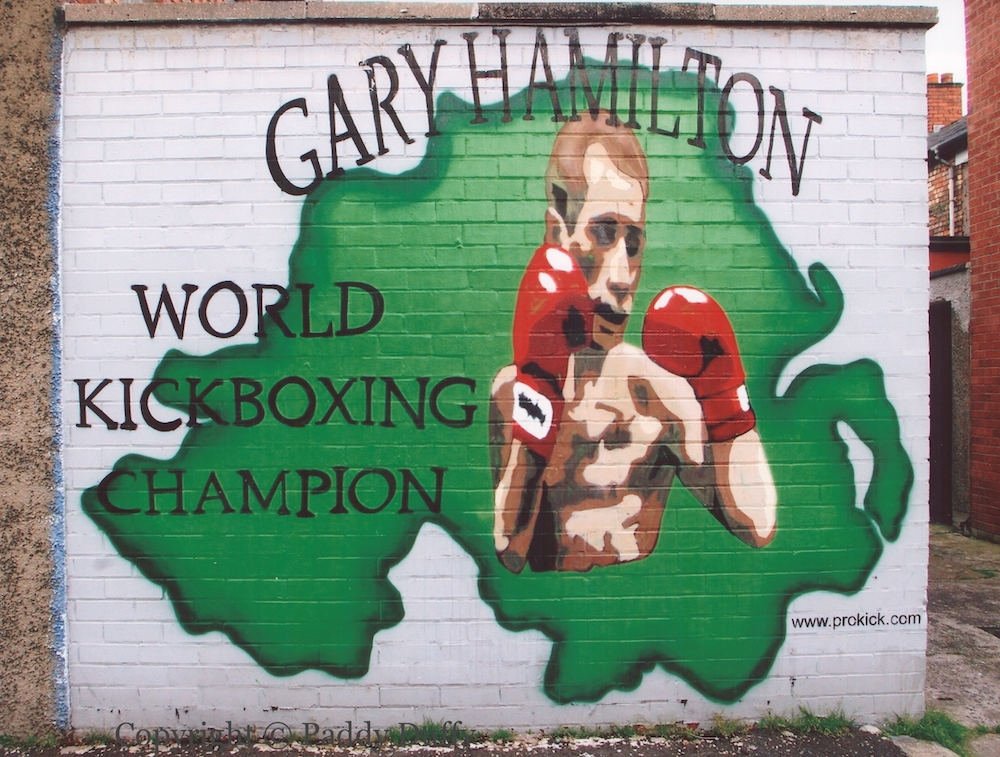
“Gary Hamilton – world kickboxing champion – www.prokick.com“. Hamilton held the featherweight full contact world title from 2002-2009 (WP). The Prokick gym is in east Belfast.
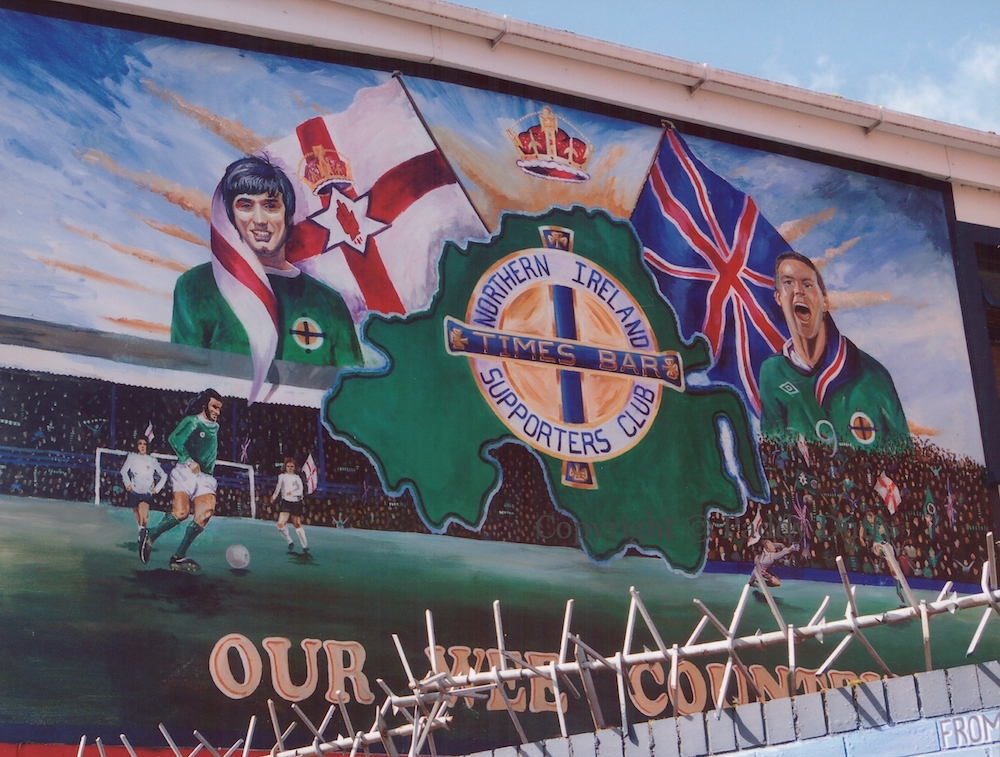
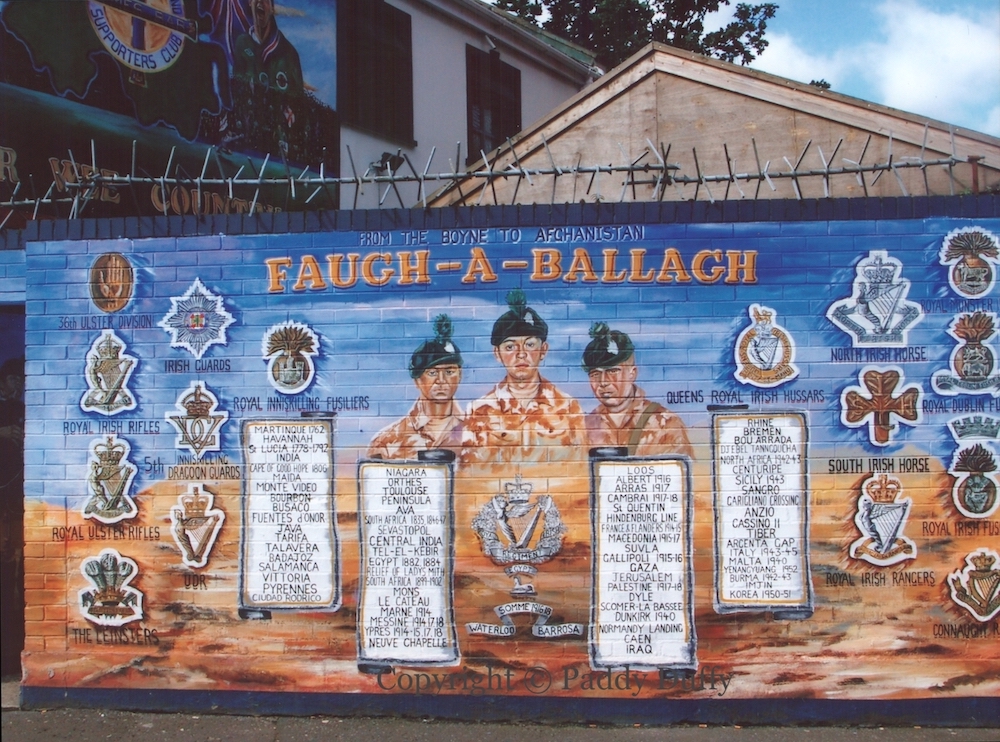
Here are two murals from the Times Bar in York Road, north Belfast.
First (above), a mural celebrating the Northern Ireland football team with the slogan “our wee country”. George Best is on the left and David Healy on the right.
Second, under the title “Faugh-A-Ballagh”, the motto of the Royal Irish Fusiliers (and more recently of the Royal Irish Regiment), a mural commemorating Irish and Northern Irish service in the British military. Robert Blair “Paddy” Mayne is featured on the left (WP). A plaque in the middle reads: In memory of Pte. F.G. Dolloghan, Parachute Regt. Killed at the Nijmegan Bridges, Holland, Sept. 1944. (WWII’s Operation Market Garden (WP))
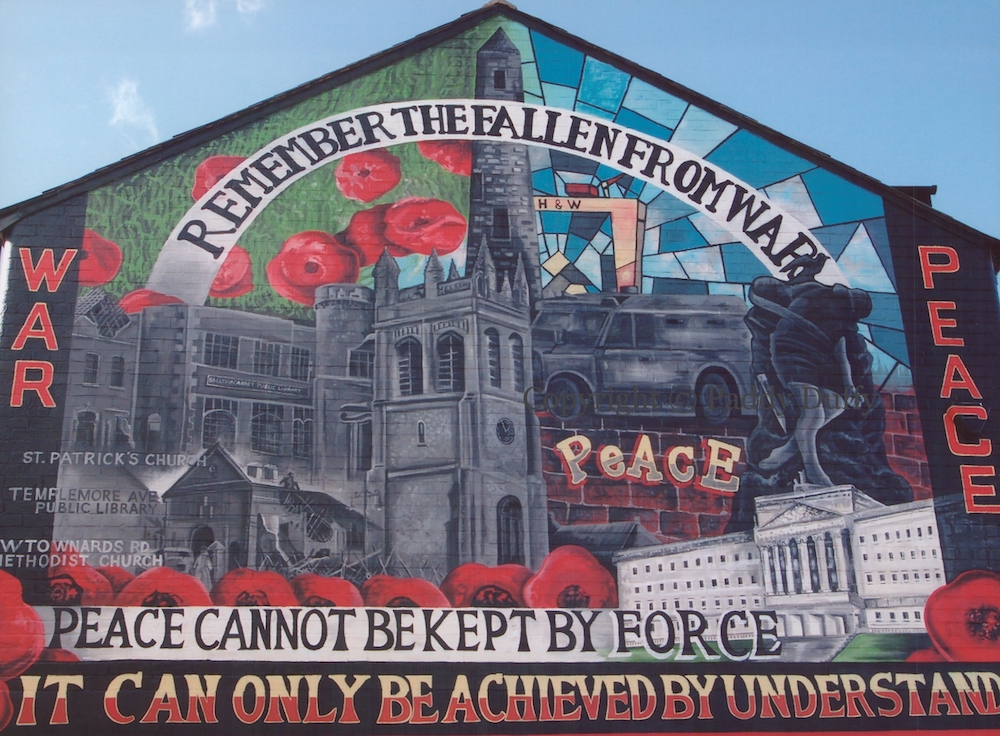
The mural above is on the Newtownards Road at Lendrick Street and shows a bombed-out Ballymacarrett library, St. Patrick’s church (the church itself is visible in the lower right-hand corner) – both were hit by the blitz in 1942 – a police land rover (perhaps representing the “fallen” during the Troubles), and Cuchulainn (perhaps representing the IRA, though Cuchulainn is also a UDA icon – see the bottom of the Visual History page on Cú Chulaınn), and Stormont (representing … peace???). Poppies in a field and a H&W crane against stained glass provide a background.
We are supposed to remember the dead because (perhaps) their deaths were unnecessary and misguided as means to peace, at least according to the saying along the bottom (sometimes attributed to Einstein): “Peace cannot be kept by force; it can only be achieved by understanding” – understanding of the Nazis during the blitz, it seems, and of loyalists and republicans during the Troubles. (If you have a better interpretation, please leave a comment.)
The mural was imitated on the hoarding around An Chultúrlann on the Falls Road during its renovation (shown below): the left hand side of the side was replaced with images of the Falls library and Bobby Sands mural and Divis tower, and Cú Chulaınn on the right was placed in front of the GPO, and the poppies were joined by lilies, and the words translated into Irish. The message here seems clearer, lamenting the CNR dead and calling for understanding of the CNR community (sc. by Britain and the Orange state) though the poppies below include the dead of WWI.
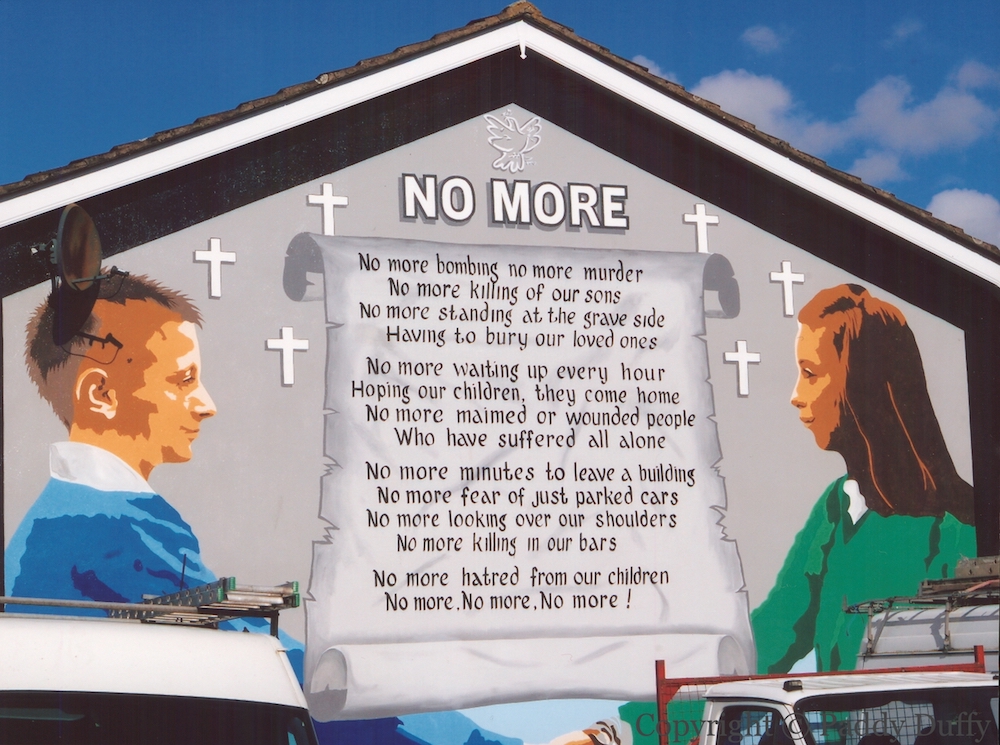
A boy in blue and girl in green, from opposite communities in east Belfast, shake hands against the backdrop of the Harland & Wolff cranes. The poem “No More” in the middle of the mural is by community worker Jim Wilson, whose grandson Dylan is shown on the left. A smaller version of this mural, without the poem, is in the CNR Short Strand’s Edgar Street – see No More.
“No more bombing, no more murder No more killing of our sons No more standing at the grave side Having to bury our loved ones No more waking up every hour Hoping our children, they come home No more maimed or wounded people Who have suffered all alone No more minutes to leave a building No more fear of just parked cars No more looking over our shoulders No more killing in our bars No more hatred from our children No more. No more. No more!”
By Dee Craig in Kenilworth Place, PUL east Belfast
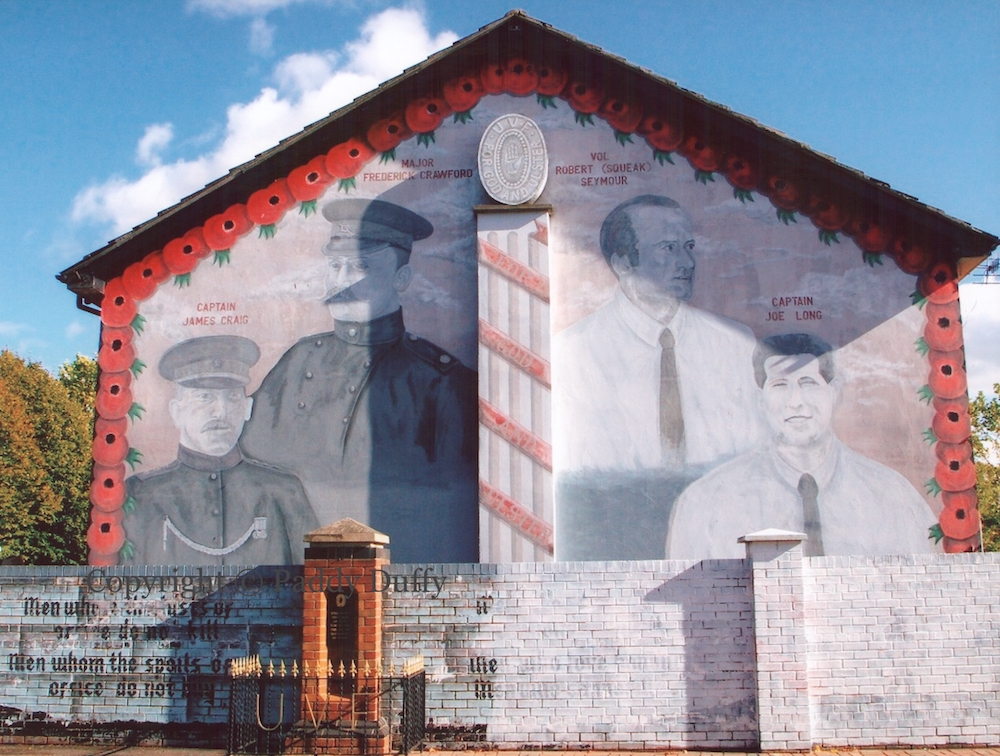
“Men whom the lusts of office do not kill/Men whom the spoils of office do not buy/Men who possess opinions and will/Men who love honour; men who cannot lie” – part of a poem by Josiah Gilbert Holland.
The men on the left of the mural are Captain James Craig (who fought in the Second Boer War before becoming a unionist leader, organiser of the the Ulster Volunteers, and first Prime Minister Of Northern Ireland) and Major Frederick Crawford, who fought in both Boer Wars and organised the Larne gunrunning.
The four others, listed both on the plaque in front of the mural and on the stone in the memorial garden (constructed in 2003) are UVF volunteers Robert Seymour, shot dead by the PIRA; James Cordner and Joseph Long, who were killed in a premature explosion, and Robert Bennett, killed by the British Army during a riot. (Seymour and Long are on the right of the mural.)
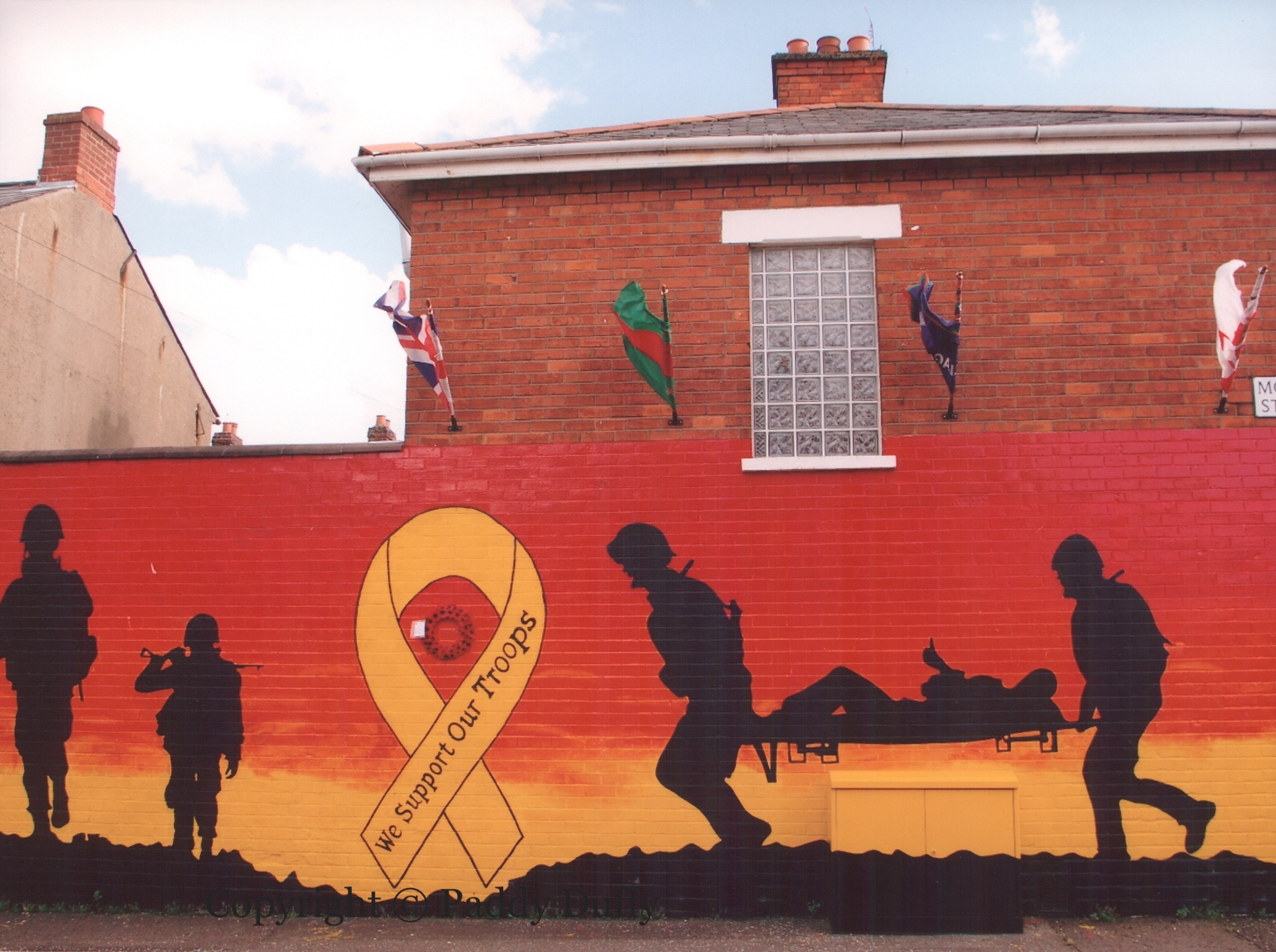
The photograph of a stretchered soldier giving a ‘thumbs up’ (shown below) was set up and photographed by Captain Ed Hodges of the King’s Royal Hussars in Basra, Iraq, in 2007 (Daily Mail). In silhouette (as shown here) it has become the icon of the Help For Heroes charity raising money for British forces.
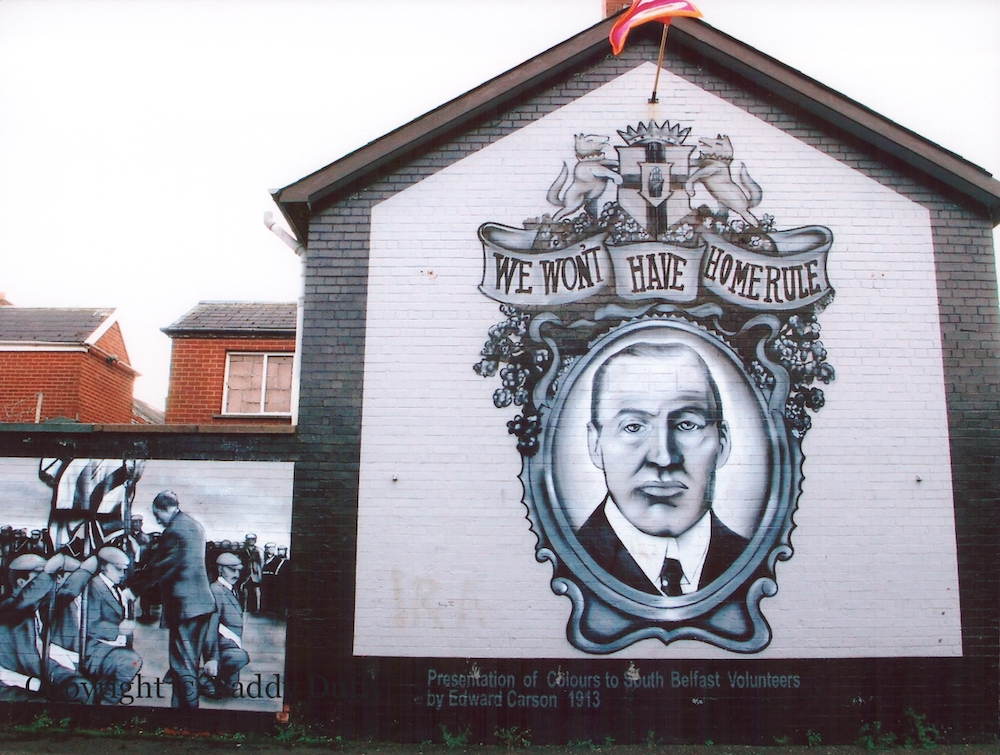
“Presentation of colours to South Belfast Volunteers by Edward Carson 1913.” According to the Digital Repository Of Ireland, however, the scene depicted is Carson and the Central Antrim Volunteers in 1914.
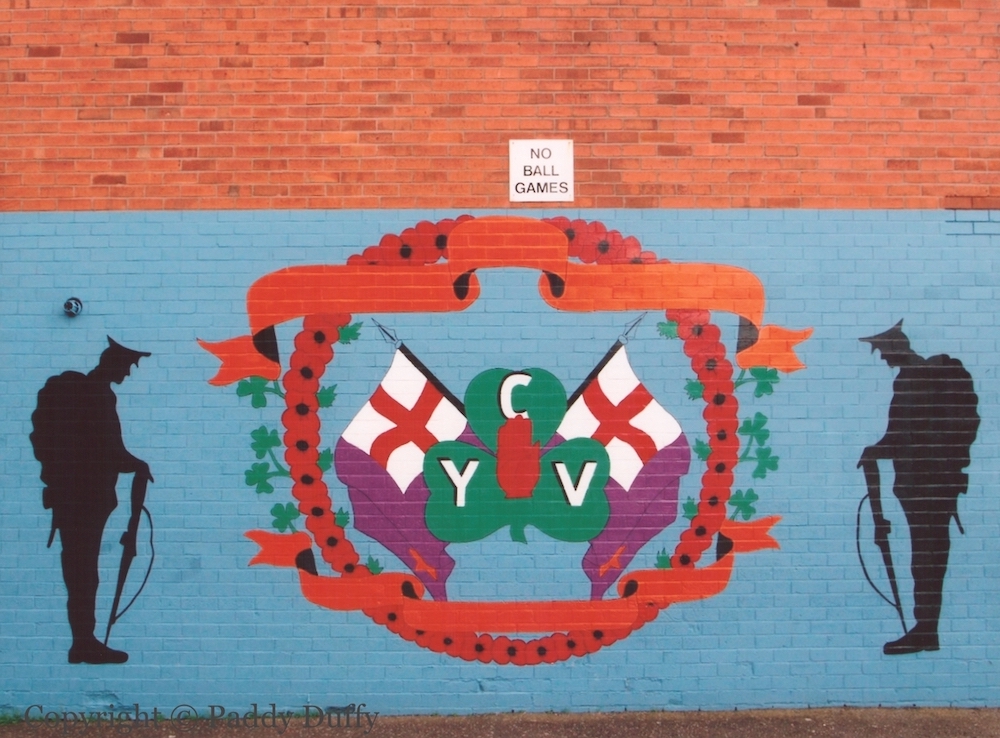
The shamrock in the wreath represents the Irish divisions of the British Army in WWI – the 36th, the 10th, and the 16th. The Young Citizen Volunteers formed the fourteenth battalion of the Royal Irish Rifles and so part of the 36th (Ulster) Division during the first world war.
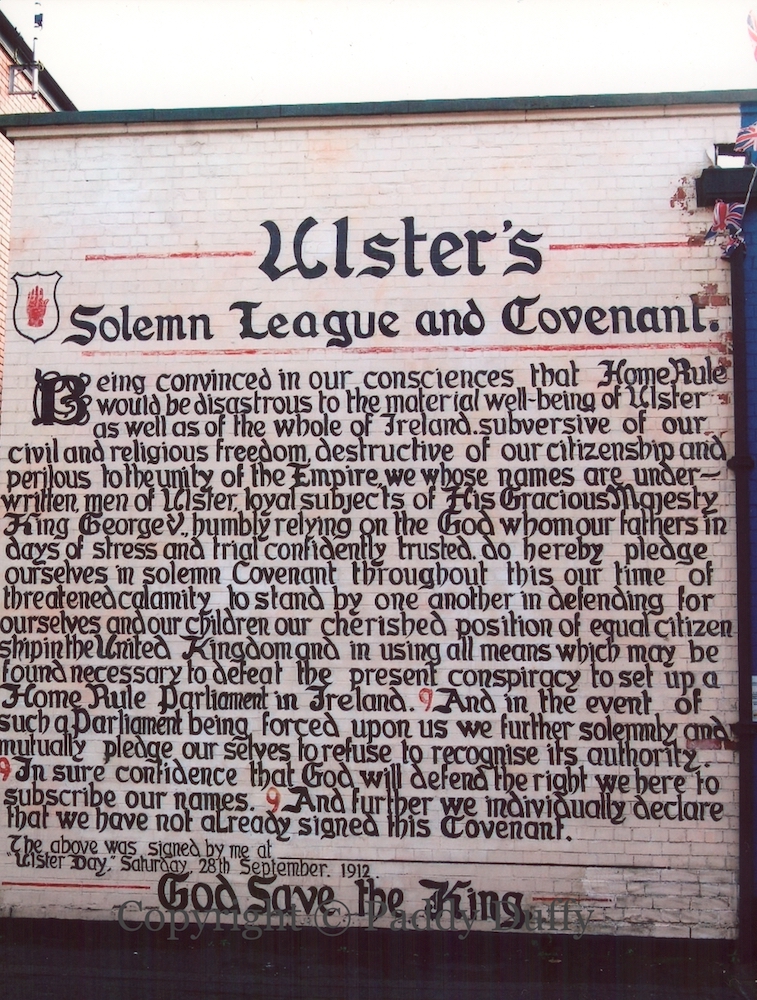
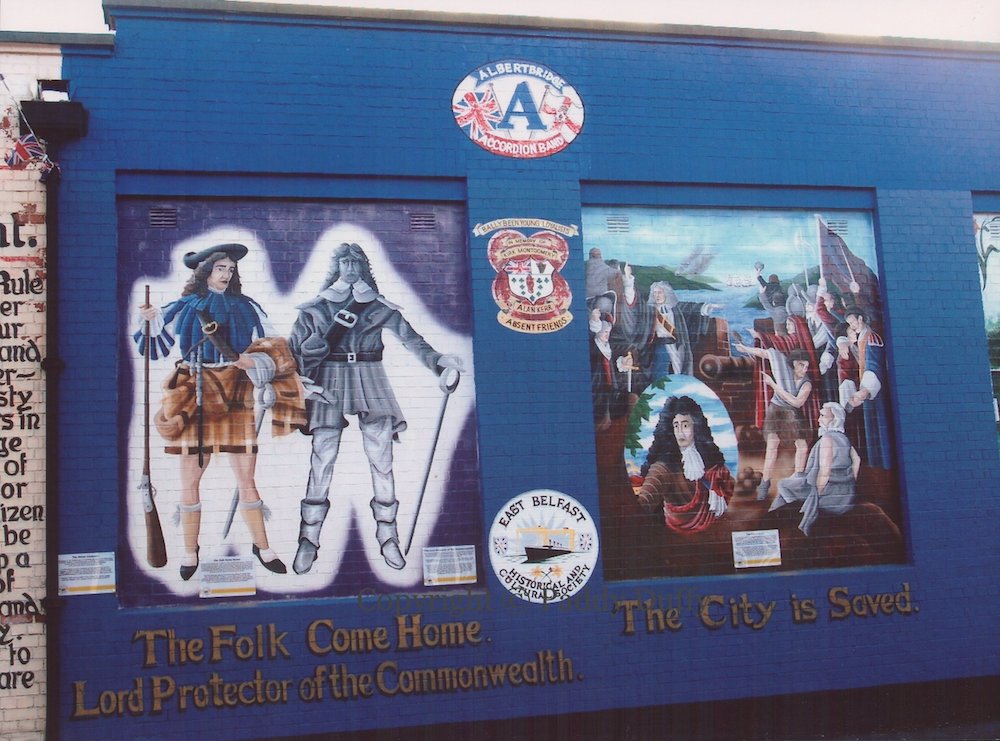
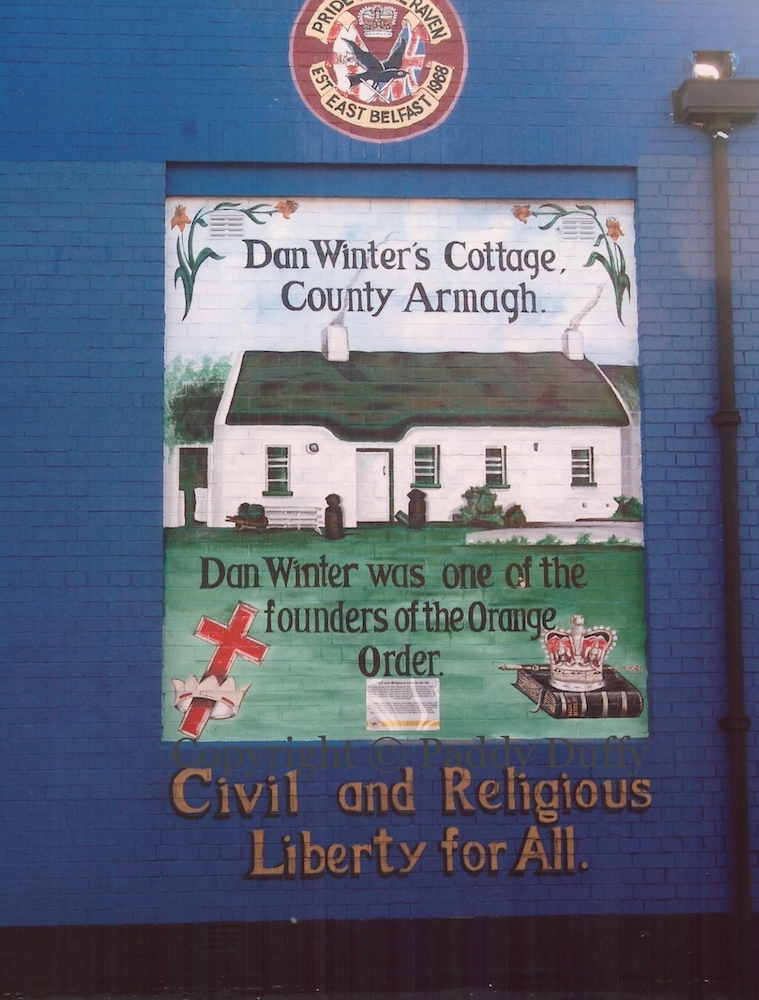
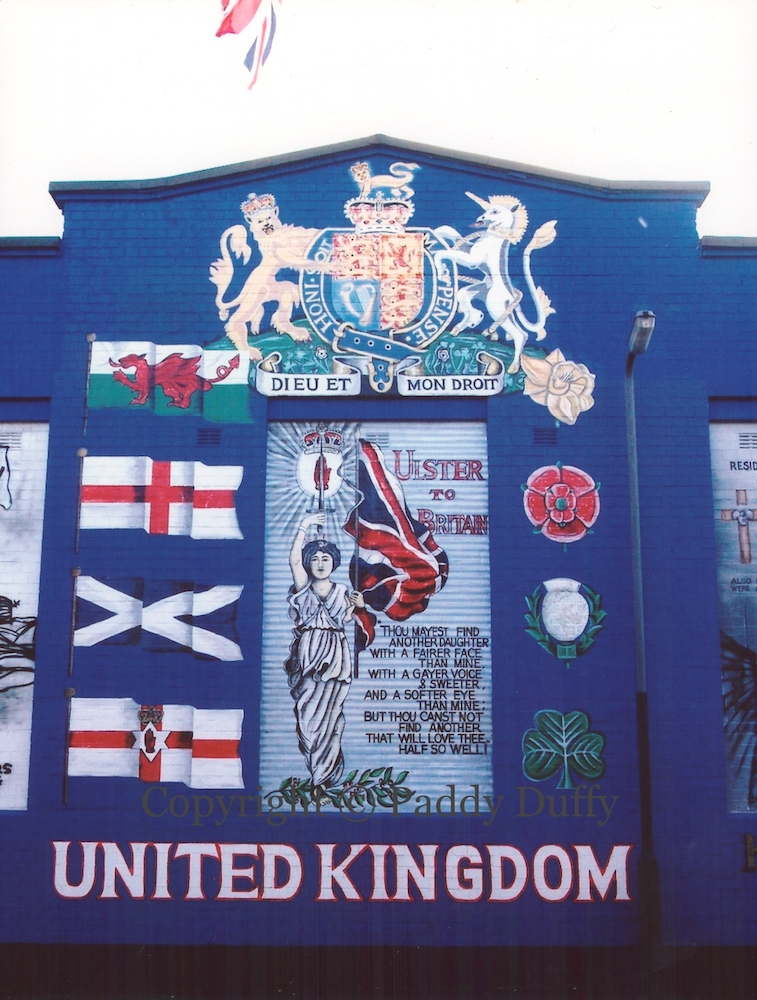
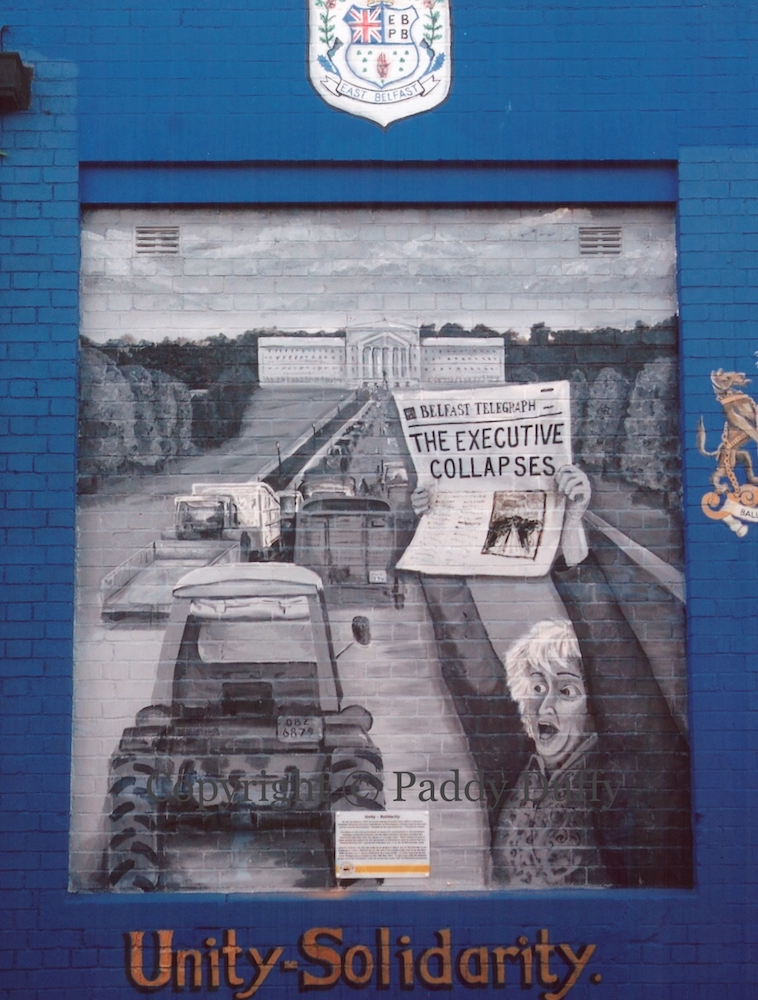
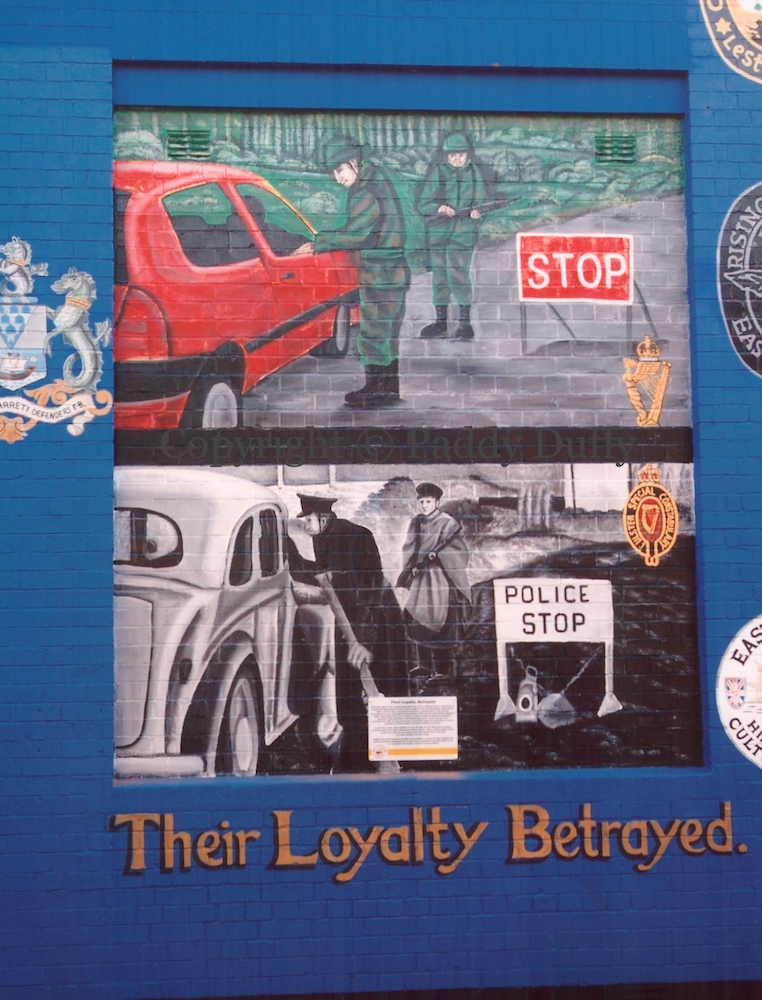
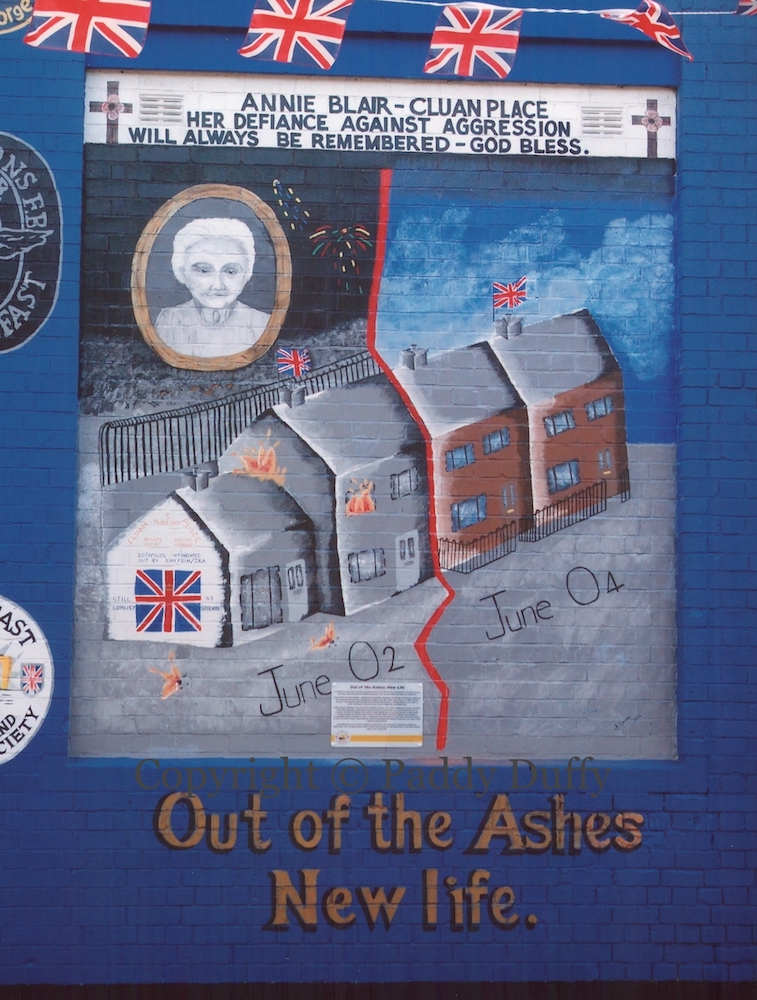
In 2004 the East Belfast Historical And Cultural Society sponsored a series of 14 murals in Thorndyke Street charting Protestant history from Cromwell to Cluan Place. From left to right, these are:
The Covenant
“The Folk Come Home. Lord Protector of the Commonwealth” (Cromwell)
“The City Is Saved” (Siege Of Derry)
“Civil And Religious Liberty For All.” “Dan Winter’s cottage, County Armagh. Dan Winter was one of the founders of the Orange Order”
“Better The Grave Than Slavery.” “How is freedom measured? By the effort which it costs to retain. Freedom!” (WW1)
“Their Sacrifice, Our Freedom.” “As we scrambled over the trench ladders, the YCV flag appeared. Jim Maultsaid” (WWI)
“United Kingdom”
“Hitler Attacks Belfast”
“Defending The Community” (Paramilitaries)
“Unity – Solidarity” (Sunningdale Agreement)
“Their Loyalty Betrayed” (UDR/B Specials)
“Out Of The Ashes, New Life.” “Annie Blair – Cluan Place. Her defiance against aggression will always be remembered – God bless”
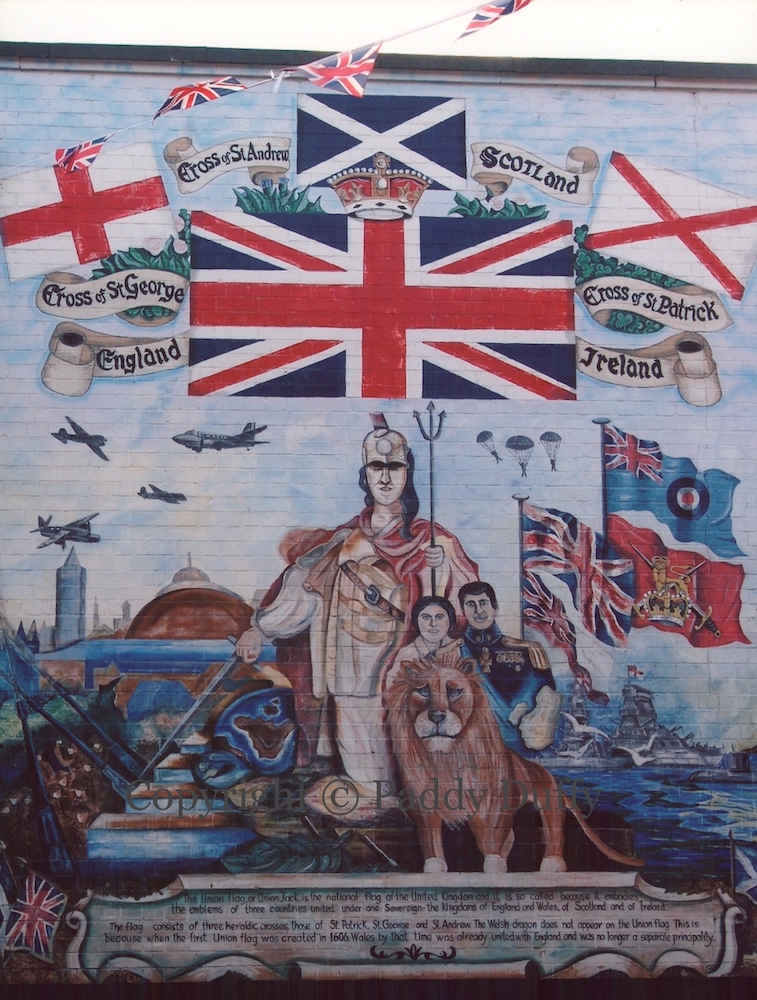
Britannia. “The Union flag, or Union Jack, is the national flag of the United Kingdom and it is so called because it embodies the emblems of three countries united under one sovereign – the Kingdoms of England and Wales, of Scotland and of Ireland. The flag consists of three heraldic crosses, those of St Patrick, St George and St Andrew. The Welsh dragon does not appear on the Union flag. This is because when the first Union flag was created in 1606, Wales by that time was already united with England and was no longer a separate principality.”
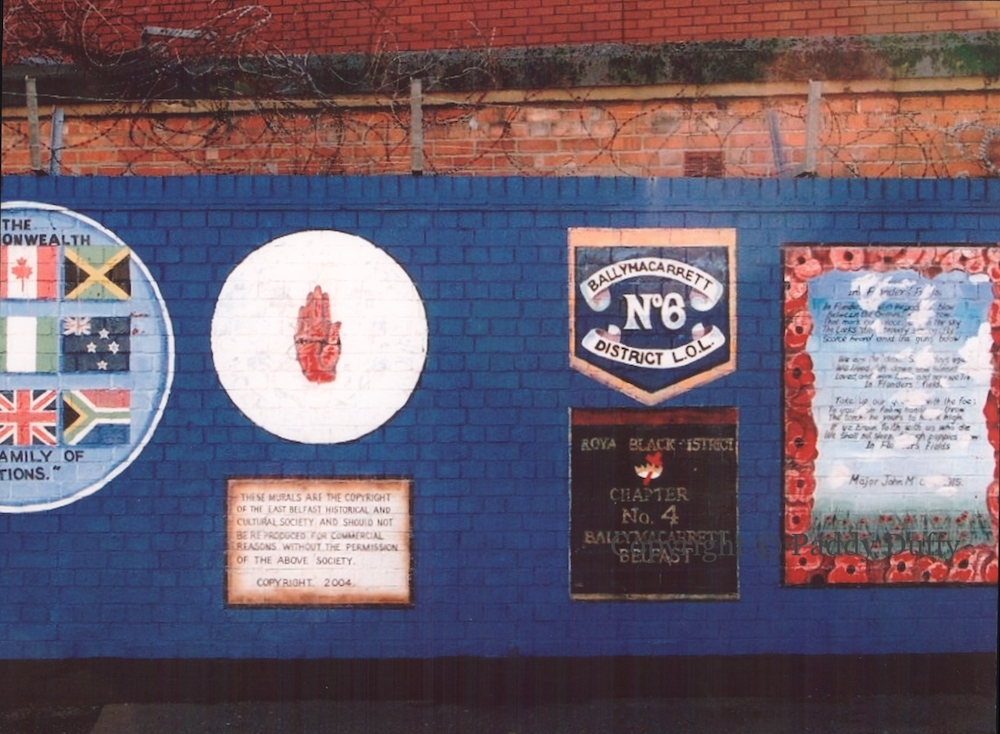
Commonwealth/Sponsors
The murals were launched in 2004 and information panels were added in 2005.
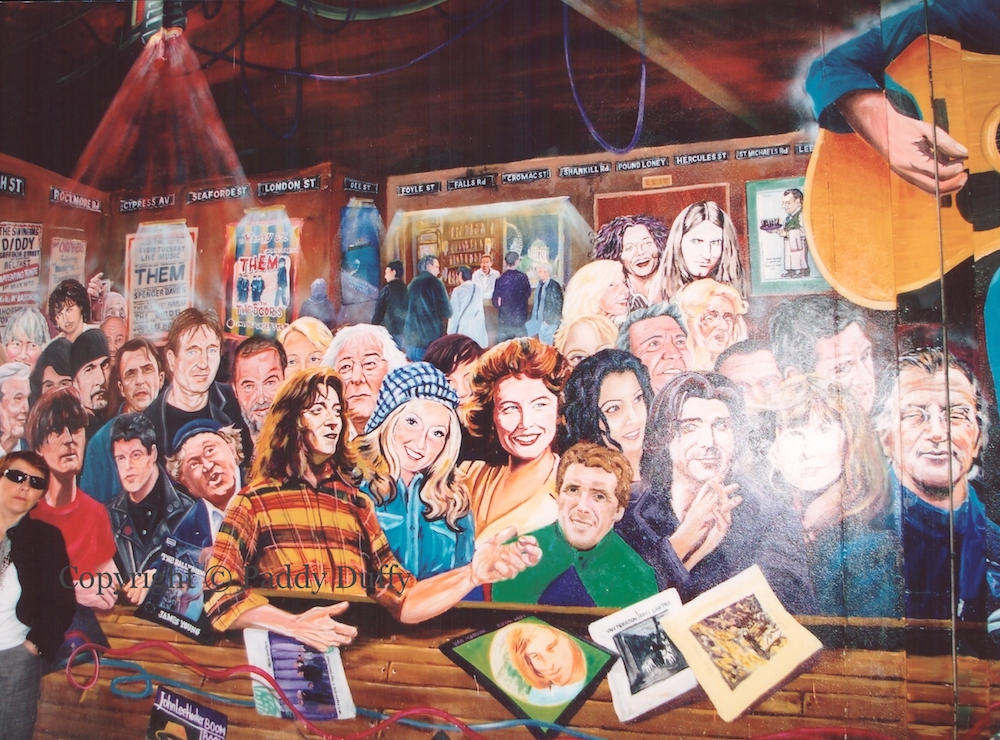
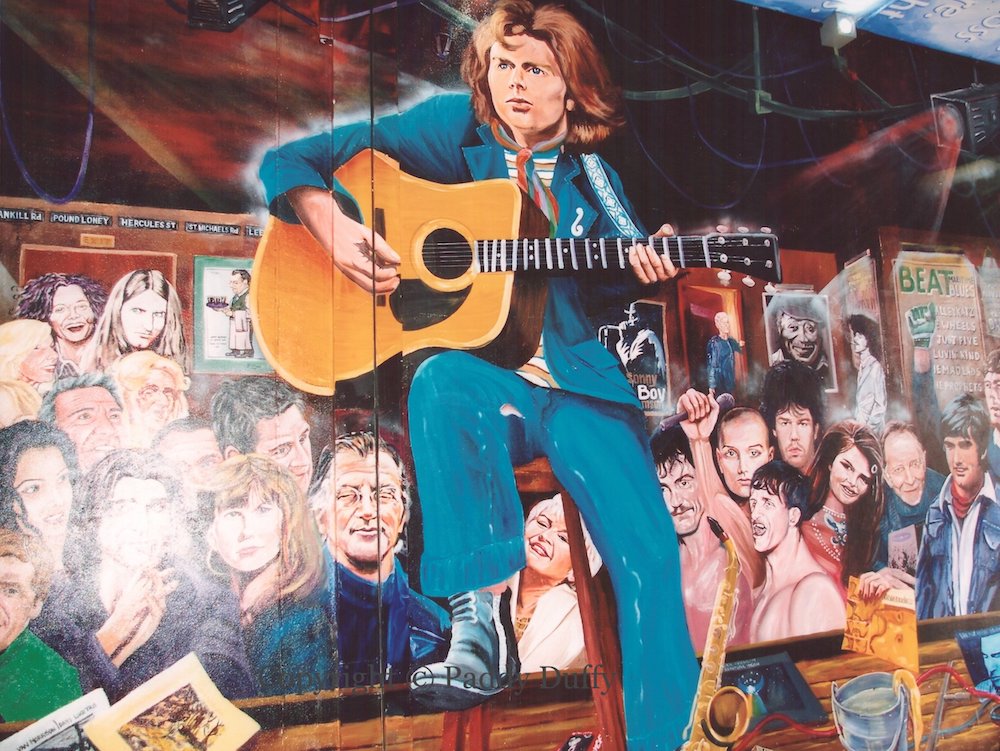
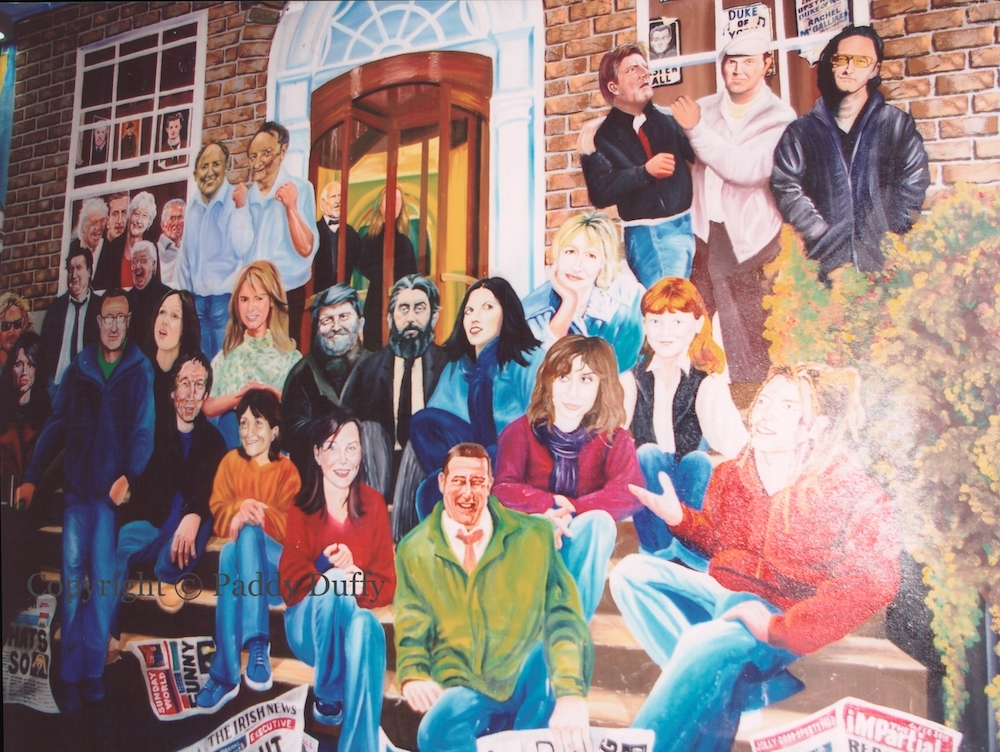
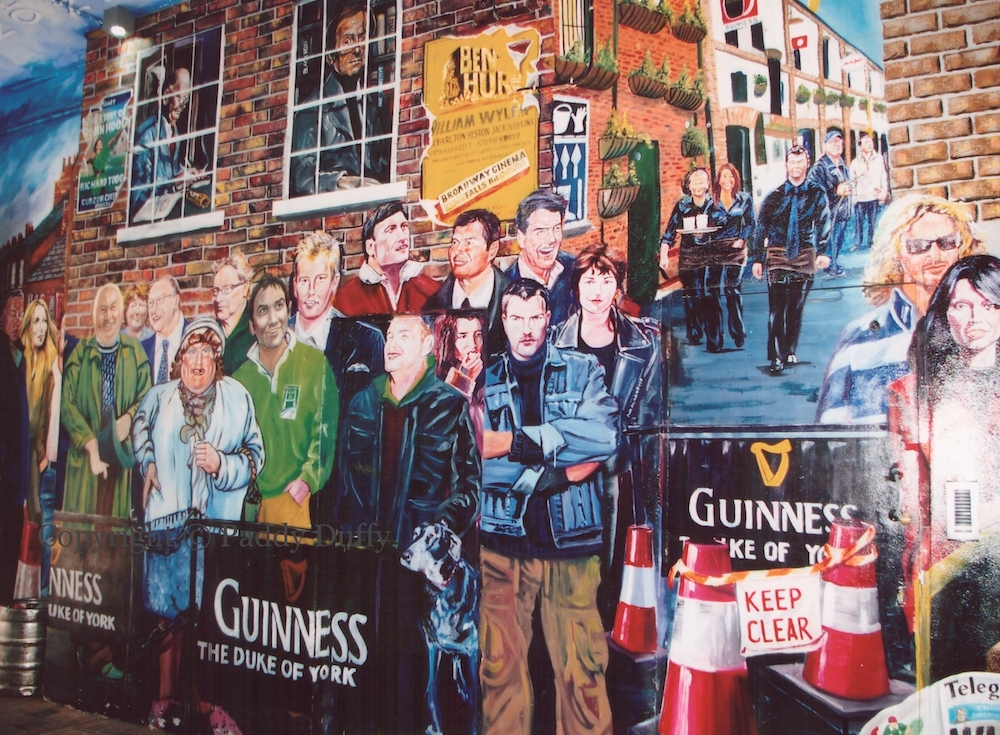
The entry-way to the courtyard of the Dark Horse is a dense gallery of famous faces from popular culture, both local and international.
Inside: David McWilliams, James Galway, Alex Higgins, Rab McCullough, Gary Lightbody, Barso, Joey Dunlop, Terri Hooley, Feargal Sharkey, John O’Neill, Big Jim McDowell, Mark O’Shea, The Edge, Sam Neill, Jimmy Reilly, James Young, Liam Neeson, Jimmy Nesbitt, Rory Gallagher, Seamus Heaney, Clodagh Rodgers, Ruby Murray, Tony McCoy, Katie Melua, Ann Marie, Geraldine Hughes, Cormac Neeson, Jackie Wright, Johnny Hero, Brian Kennedy, Darren, Juliet Turner, Dan Gordon, Gerry Anderson, Gloria Hunniford, Barry McGuigan, Sinead O’Connor, Rinty Monaghan, Gary Moore, Dana, Phil Coulter, Phil Lynott, George Best, Pat Jennings, Derek Bell, Jimmy Ellis, Bob Dylan, John Lennon, Neil Young, Willie Jack
Outside: Mark, Una Healey, Michael, Enya, Nick, Angela Feeney, CS Lewis, Dennis Taylor, May McFettridge, Paul Brady, Winston, Patrick Kielty, Brian Moore, Willie John McBride, Pearce Elliot, John Lynch, George Hamilton, Pierce Brosnan, Ciaran McMenamin, Maggie Cronin, Hammy, Lisa, Big William, Chris, Paddy, Eddie Irvine, Christine Bleakley, Brendan Behan, Derek Dougan, Patrick Kavanagh, Sir John Lavery, John McCormack, Danny Blanchflower, Mary Peters, Harry Gregg, Frank Carson, Martin O’Neill OBE, Dervla Kirwin, Stephen Rea, Hugh Russell, Wee John Caldwell, Nadine Coyle, Julie, Martin Lynch, Nee, Ronnie Drew, Dolores O’Riordan, Ciaran Hinds, Caron Keating, Kenneth Branagh, Alice, Liam Clancy, Duke Special, Bono