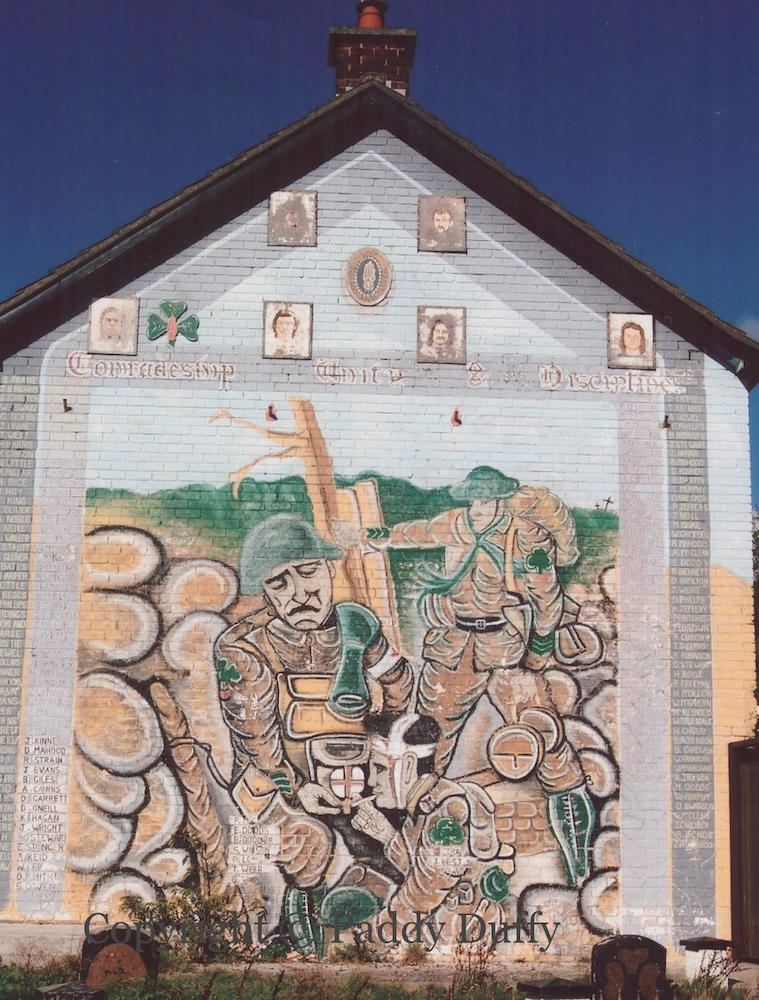
A mixture of modern and latter-day Ulster Volunteers: the names of WWI dead are listed on both sides, while six modern volunteers are portrayed above the central panel of soldiers in a trench. J1835 lists the men (in the previous version of the mural) as J. Shaw, T. Mawhinney, J. Cordner, C. Logan, S. McCrea, W. Millar.
“Demand dignity – end forced evictions. Justice, hope, homes, rights, security.” Dollar bills spew from the exhaust pipes of bulldozers driven by cigar-smoking financiers as they bear down on a chain of protesters in this Amnesty International board at the corner of Northumberland and Beverley Streets. “Join Amnesty and take action for human rights worldwide http://www.amnesty.org.uk/join”
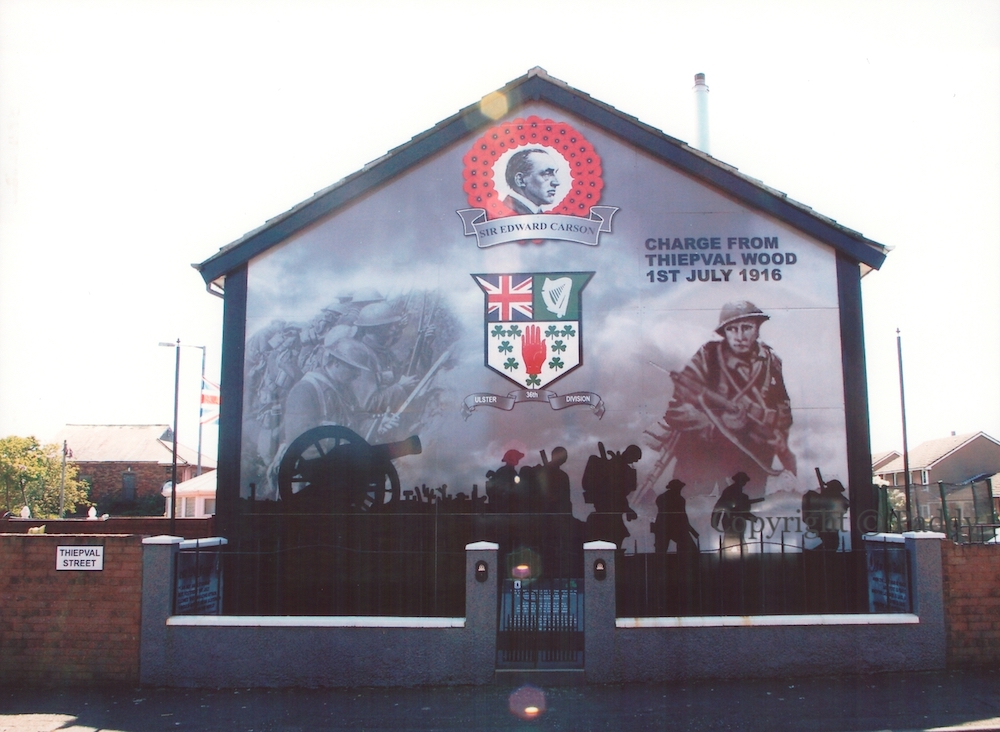
The nameplate on the lower corner of Northland Street now reads “Thiepval Street” and the Thiepval board above adorns the end wall (replacing an earlier mural to UVF A Company 5th platoon). On the other side of Conway Street is/was North Howard Walk where a plate now reads “Passchendaele Court“. The names are unofficial (as of November 15th, 2012). (See also “Somme Street”.)
The memorial stone is dedicated to the UVF company (and not to the WWI soldiers from the 36th (Ulster) Division who died in the charge from Thiepval Wood, July 1st, 1916): “This stone is dedicated to the memory of the fallen volunteers of No. 5 platoon A company 1st Belfast battalion Ulster Volunteer Force. ‘As poppy petals gently fall/Remember us who gave our all/Not in the mud of foreign lands/Nor buried in the desert sands//In Ulster field and farm and town/Fermanagh’s lanes and Drumlin’d Down/We died that violent death should cease/And Ulstermen might live in peace’ Lest we forget.”
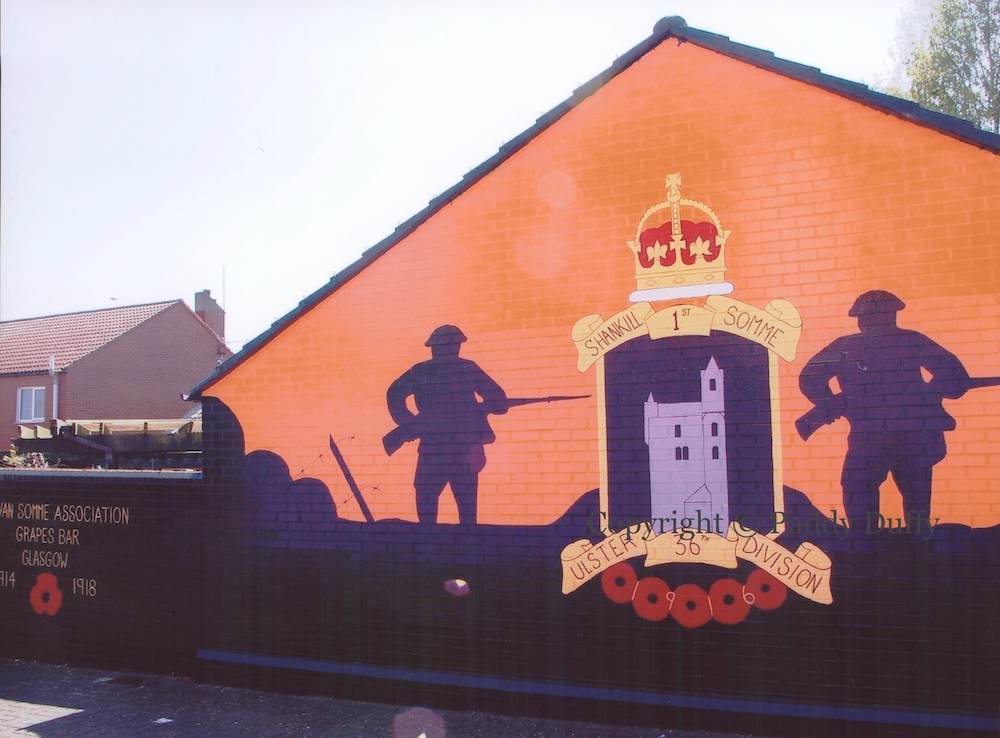
The Conway Walk mural was produced by the “Shankill 1st Somme [Association]” with support from the “Govan Somme Association, Grapes Bar, Glasgow”.
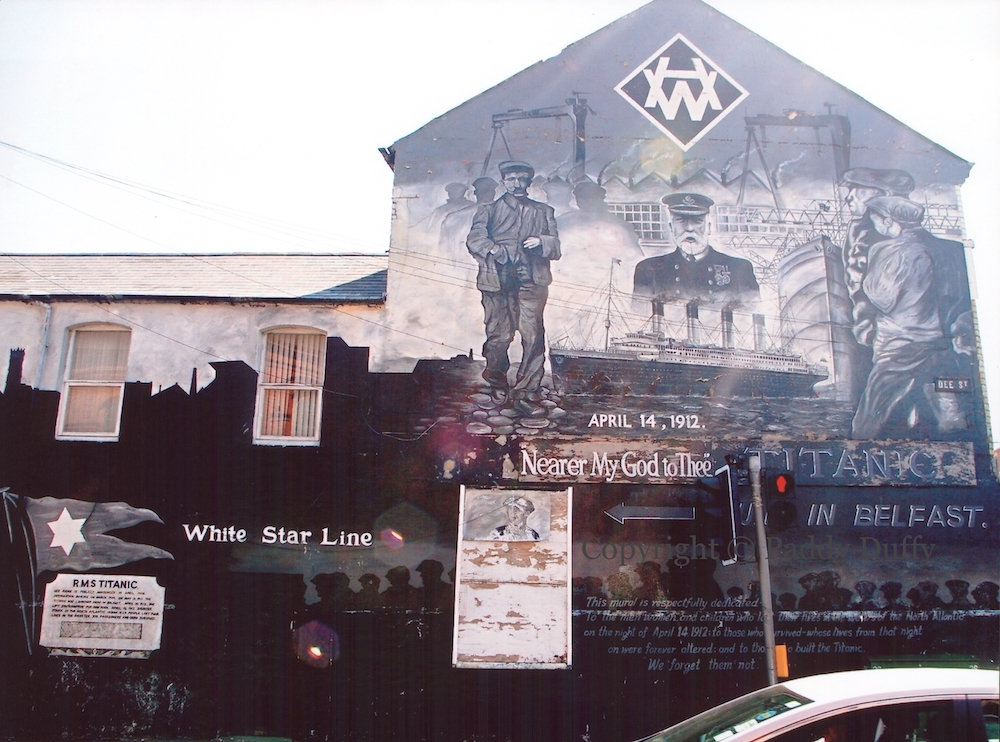
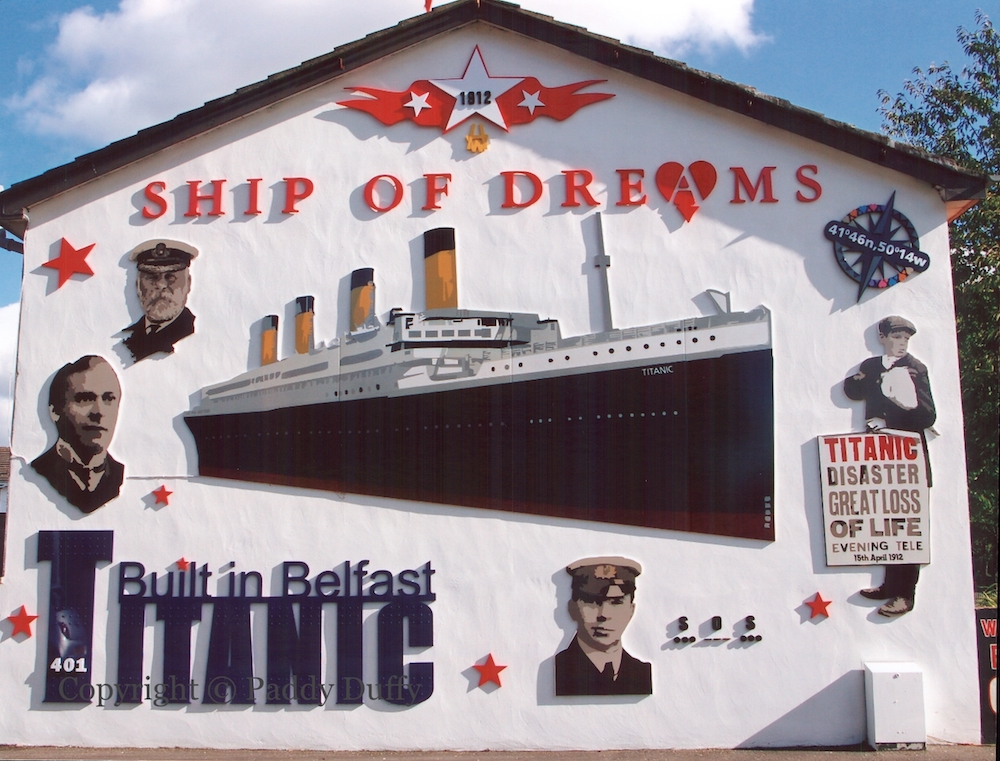
“Her name is publicly announced in April 1908. Designation begins in March 1909. On May 31. 1911, the Titanic was launched here in Belfast, April 10, 1912. She left Southampton for New York. April 14, 1912 disaster struck in the North Atlantic ocean, 1523 people lost their lives in the disaster, 705 passengers and crew survived.” “This mural is respectfully dedicated to the men, women and children who lost their lives in the waters of the North Atlantic on the night of April 14, 1912: to those who survived – whose lives from that night on were forever altered; and to those who built the Titanic [at Harland and Wolff]. We forget them not.”
Pictured in the centre of the mural is Captain Edward John “Ted” Smith.
“Built in Belfast.” The White Star Line ship Titanic sank in the Atlantic in the early morning of April 15th, 1912, a thousand miles from New York (the co-ordinates are given in the top right), having been launched from Belfast’s Harland & Wolff shipyard, which is near this mural in east Belfast.
The portraits are of Captain Edward Smith, architect Thomas Andrews, Jack Phillips (wireless officer), and paperboy Ned Parfett.
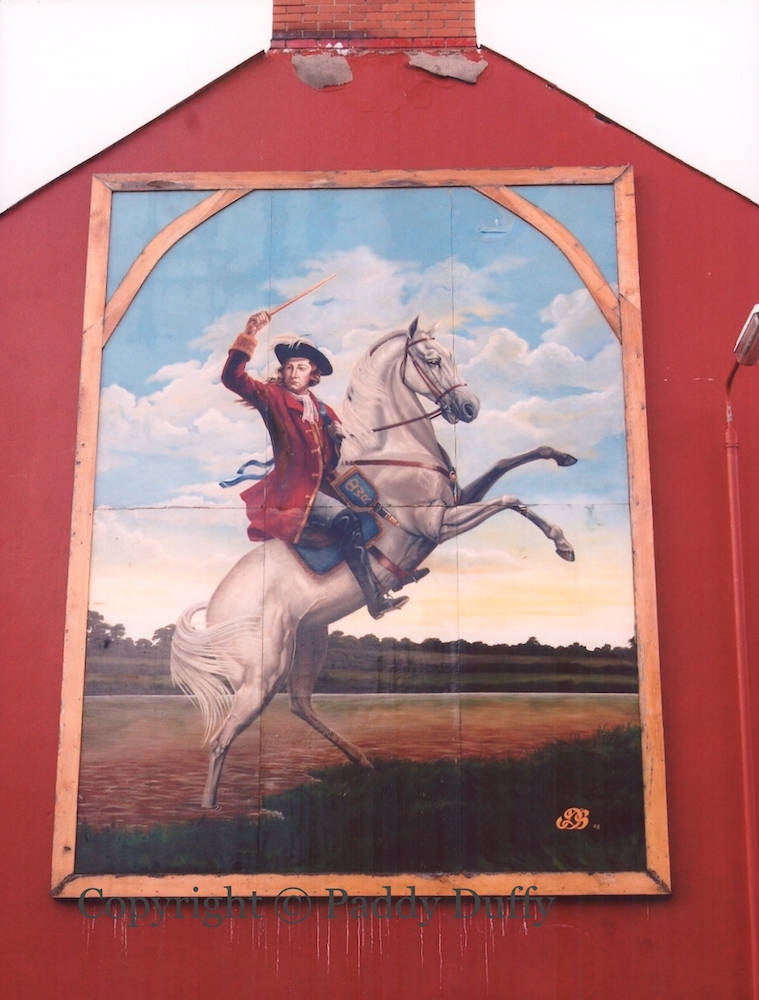
The Village Eddie is re-imaged with a painting of King Billy at the Boyne by John Darren Sutton.
“The first unionist mural was painted in 1908 on the Beersbridge Road in East Belfast by shipyard worker John McLean. It depicted King William at the Battle of the Boyne. This was the start of mural painting becoming a key element in the annual unionist celebration of the Battle of the Boyne, culminating in the Orange Order parades of July 12th. Murals, bunting, arches, painted flagstones, marked out the route of marches as well as adorning countless local areas. Between 1908 and the 1970s the vast bulk of unionist murals depicted King William at the Boyne. Other murals depicted the sinking of the Titanic, the 36th Ulster [sic] Division at the Battle of the Somme, and various royal weddings and anniversaries. Each unionist working class area vied with the neighbouring areas to have the best decorations for the Twelfth. As part of this rivalry, King William murals were painted and repainted year after year, with some surviving through six or more decades. The longest-surviving mural in the South Belfast area was in Rockland Street. It depicted King William on his white horse at the Battle of the Boyne. Painted first in the mid-1920s, it survived until the mid-1990s, when it became a victim first of the heat from an adjacent bonfire, and then of redevelopment. The King William murals began to fade from the walls in the 1970s, to be replaced with murals depicting flags and other inanimate emblems. Overall, the number of murals declined significantly in this decade. In the mid-1980s mural painting in unionist areas came under the control of loyalist paramilitary groups. From that point, the vast majority of murals in unionist areas depicted armed and hooded men. In recent years, the debate on mural painting inside and outside loyalist paramilitary organisations has led to the decline of the military iconography. This debate has led to many positive changes taking place throughout Northern Ireland and in January 2008 Greater Village Regeneration Trust secured funding through the Re-imaging Communities Programme to transform a number of areas within the village. This programme was established to help communities in both rural and urban areas to focus on positive ways of expressing their culture and identity and to encourage the creation of vibrant and attractive shared spaces. Thanks to the overwhelming support and participation of the local community in the Re-imaging process. Local organisations, community leaders, residents and young people have worked closely with artists to tackle the displays of redundant sectarian imagery and replacing these with positive expressions of wider cultural celebration.”
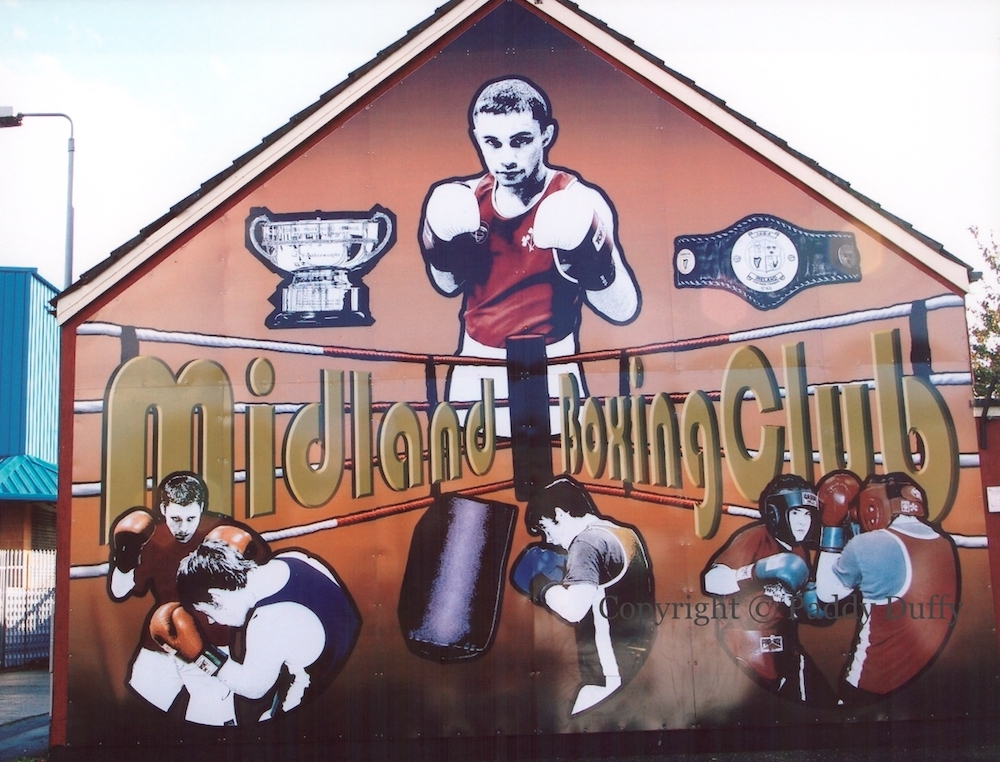
Carl ‘The Jackal’ Frampton is featured here in the apex of the ‘Midland Boxing Club’ board, alongside his Irish featherweight title. Frampton is managed and promoted by Barry McGuigan. Here is a 2013 video profile of Frampton by The Guardian. As he mentions in the video, Frampton (who is Protestant) married a Catholic, while McGuigan (who is Catholic, from Clones) married a Protestant.
The board is unusual in that it is tailored to the full size of the gable wall.
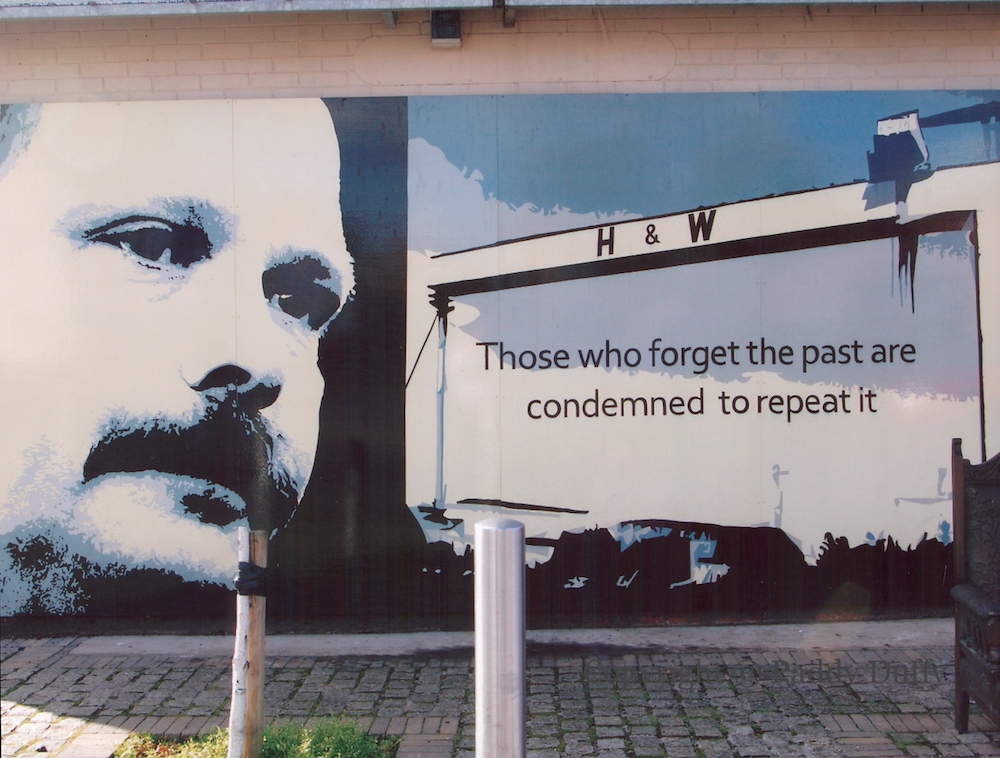
“Those who forget the past are condemned to repeat it.” This is a 2008 work by Ross Wilson commemorating David Ervine (WP) in Montrose Street South, Belfast, the area he came from. The inclusion of one of the Harland & Wolff cranes reflects his connection to working-class politics in east Belfast.
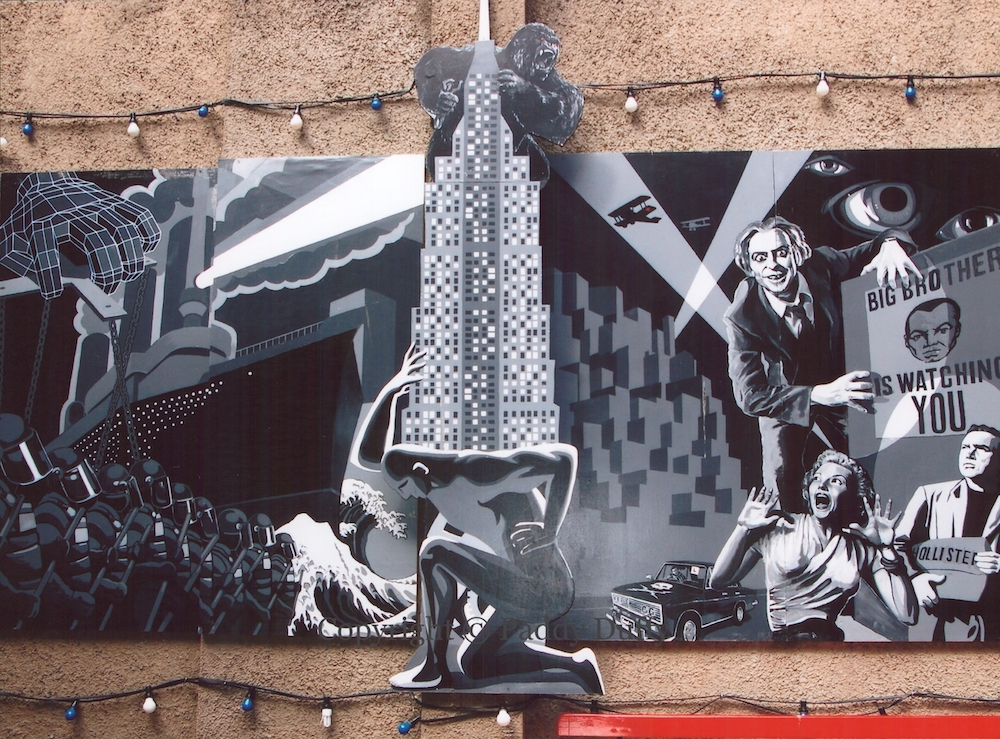
This is a 3-D/plane-breaking board/collage from the courtyard of the Duke Of York, featuring King Kong on the Empire State building (1933), Atlas (Metropolis 1927), a zombie (also from Metropolis?), riot police controlled by a puppet-master, Hokusai’s Great Wave Of Kanagawa 1830, WWI biplanes, a steamer/cruise-ship with searchlight and something that looks like the Giant’s causeway?? The car with L plates is from Death Proof.
Artists Ciaran Gallagher and Kathryn Bannister have a gallery of pictures of the piece being constructed and installed. The piece, they say, is inspired by “classics of the silver screen” and was part of Culture Night 2011.
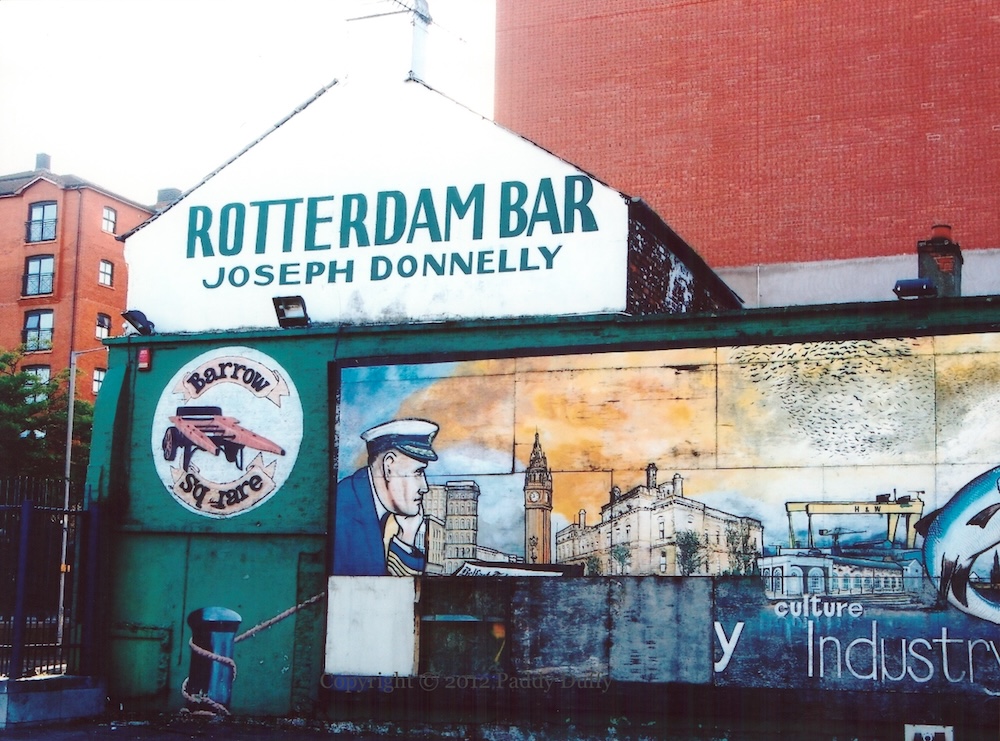
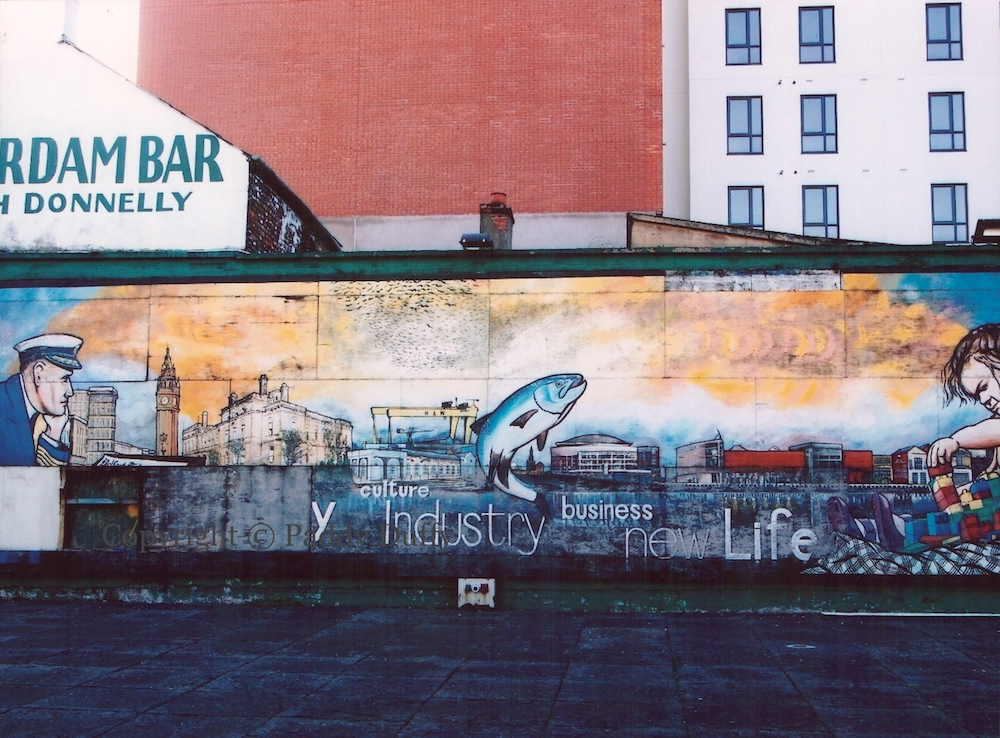
Barrow Square, in Sailortown between Clarendon dock and the Rotterdam bar, is named not for the carts used to unload and move goods along the docks, but for the Barrow Steam Navigation Company, which had a line of travel going between Belfast, Douglas (Isle Of Man), and Barrow (Cumbria, England), the peak of which appears to have been the 1890s (PaddleSteamers).
The mural, which was painted in 2004, features the “new life” coming to the broader docks area, though Sailortown itself has yet to see much investment. A Sailortown Regeneration Group (web) was formed in response to the closure of St Joseph’s in 2001. Both the Rotterdam and Pat’s are slated for demolition (BBC).

 Paddy Duffy Collection