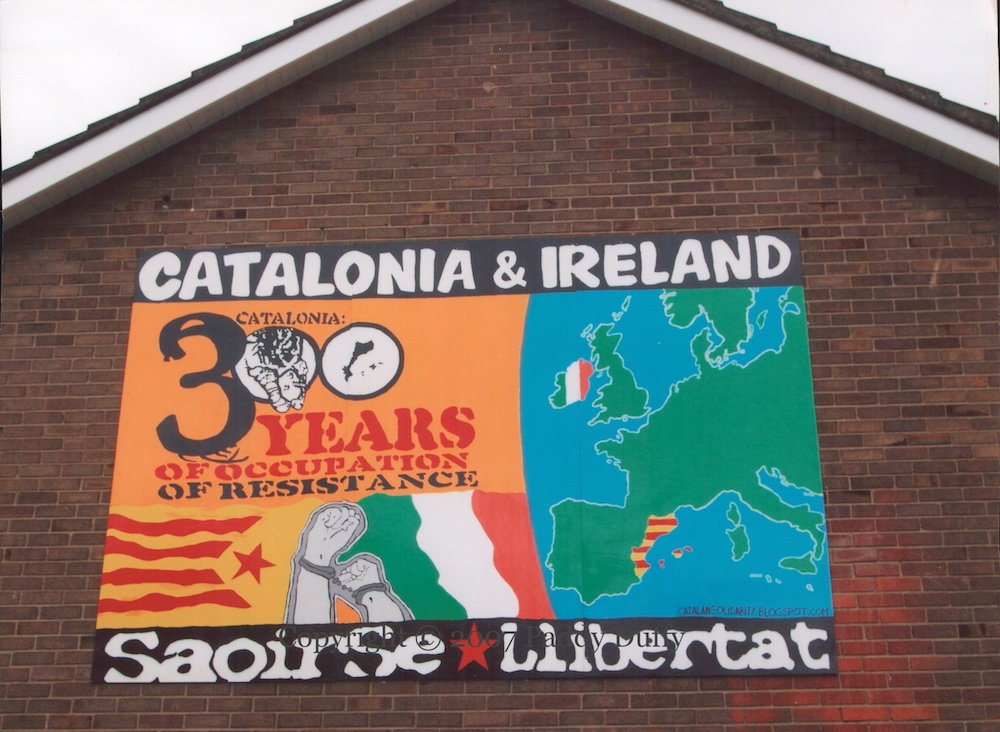
“Catalonia & Ireland – Saoırse • Llibertat”, “Catalonia – 300 years of occupation, of resistance.”
Centralised Spanish rule dates back to the Nueva Planta decrees (WP) made by Philip V (who is shown upside-down in the first zero) between 1707 and 1716. These formed a single Spanish nation and citizenry and ended various regional identities including Catalonian.
These paintings are on boards on the wall around the Cathedral Youth Club in the Fountain.
Above are two boards (on the side) showing the Apprentice Boys crying “No surrender!” and the breaking of the boom that ended the siege. A 2007 entry in the Peter Moloney Collection shows three additional panels to the right, also relating to Londonderry.
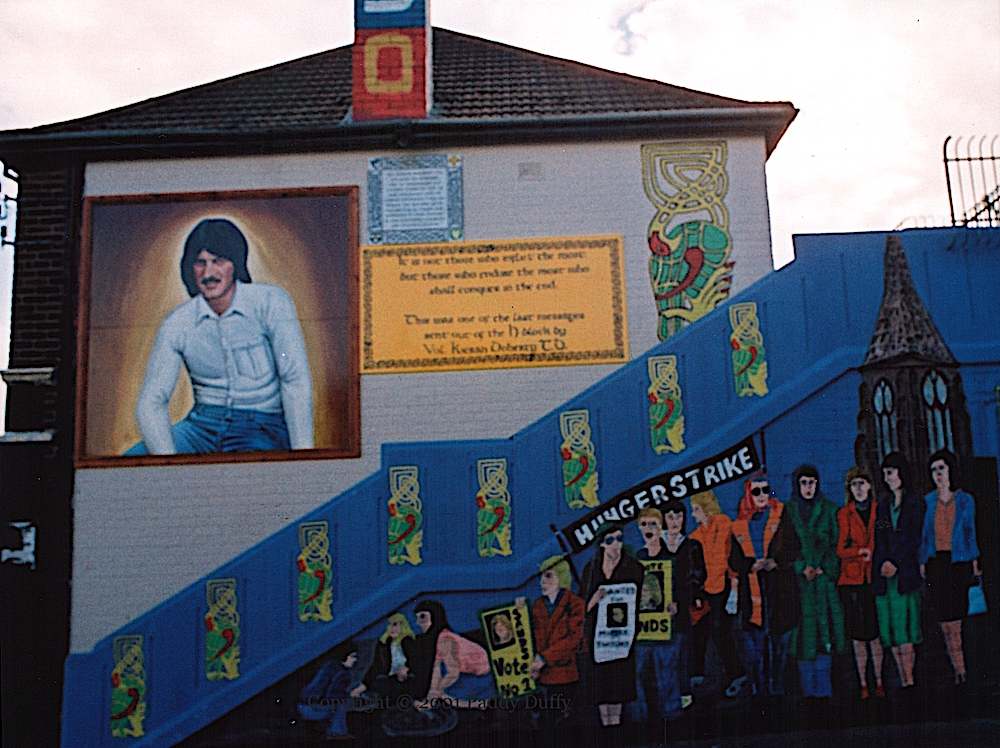
Kieran Doherty was elected TD (Teachta Dála) for Cavan-Monaghan three weeks into his 1981 hunger strike. He held the position for two months, until he died on August 2nd. The portraits, plaques, and mural of marchers are in his home area of Andersonstown. The words “It is not those who inflict the most, but those that can endure who shall conquer in the end” is an echo of Terence MacSwiney, whose hunger strike in 1920 lasted 74 days, one more than Doherty’s.
This board on the back of Free Derry Corner (Visual History) commemorates the thirtieth anniversary of the second hunger strike and the ten strikers who died.
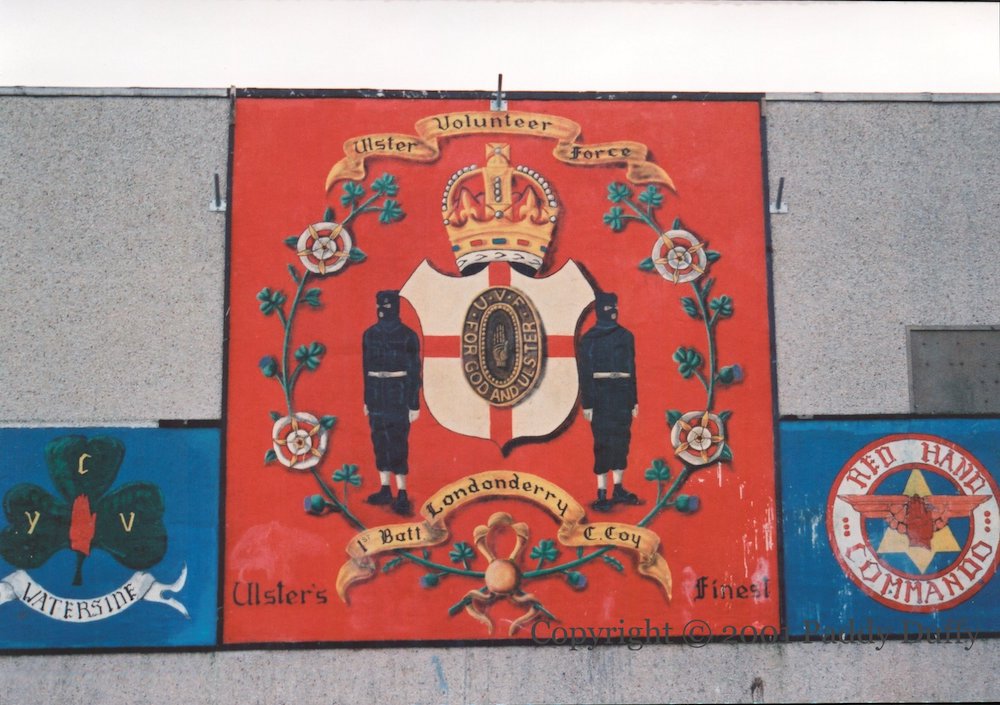
“Ulster’s finest – Londonderry UVF 1st battalion, C company”. Here is a trio of loyalist boards in Dennet Gardens, Londonderry with the insignia of the Young Citizen Volunteers, the Ulster Volunteer Force, and the Red Hand Commandos. The design of a garland of flowers containing a regimental insignia dates to the Ulster Volunteers of 1912; the masked volunteers standing to attention do not.
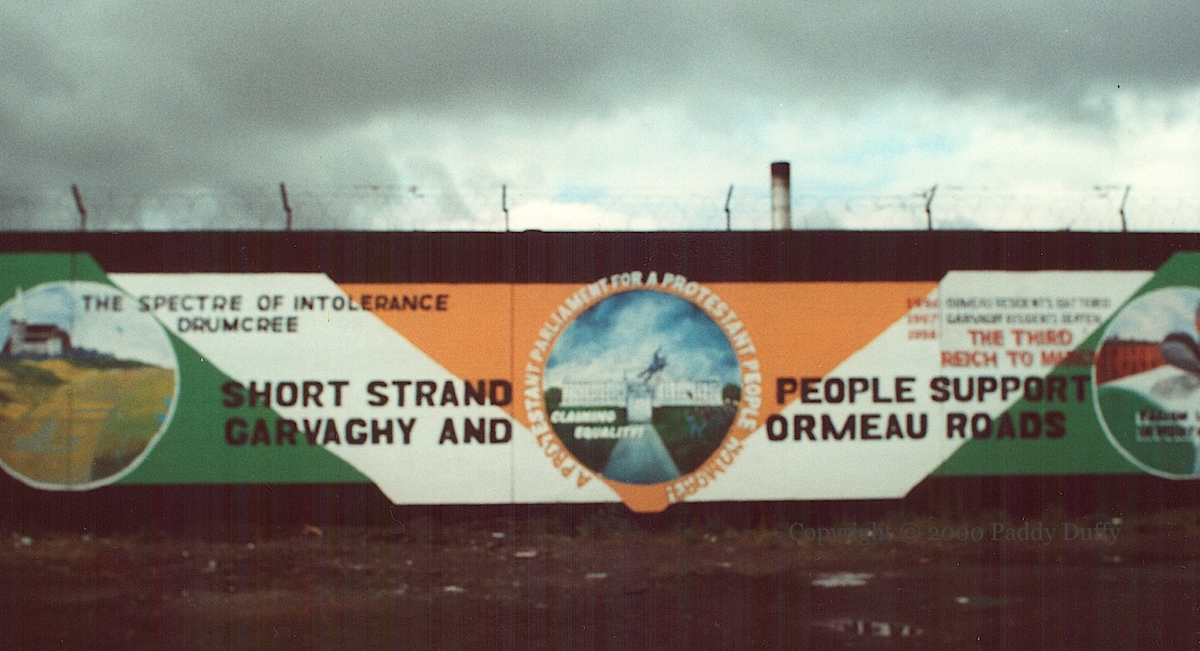
Northern Ireland’s first Prime Minister, James Craig, said in 1934, that Stormont was “carrying on a Protestant Government for a Protestant People” (NI Parliamentary Debates), though the phrase has now been transformed into the doubly alliterative “A Protestant parliament for a Protestant people”. In the centre of a long mural at the waste-ground at the top of Mountpottinger Road, people carrying Irish Tricolours tear down the statue to Northern Ireland’s most prominent leader, Sir Edward Carson, that stands outside Stormont, “claiming equality”.
The main issue that has tested the resolve of governments both local and national to the equality declared in the 1998 Belfast (Good Friday) Agreement is Orange Order parading through nationalist areas, such as the Garvaghy Road below Drumcree church in Portadown, and the Ormeau Road in south Belfast.
“Short Strand people support Garvaghy and Ormeau Roads.” On the left: The spectre of intolerance – Drumcree.” Centre: “A Protestant parliament for a Protestant people no more!” On the right “1996: Ormeau residents battered; 1997: Garvaghy residents beaten; 1998: The third reich to march.” and “Fascism lives! in Portadown”.
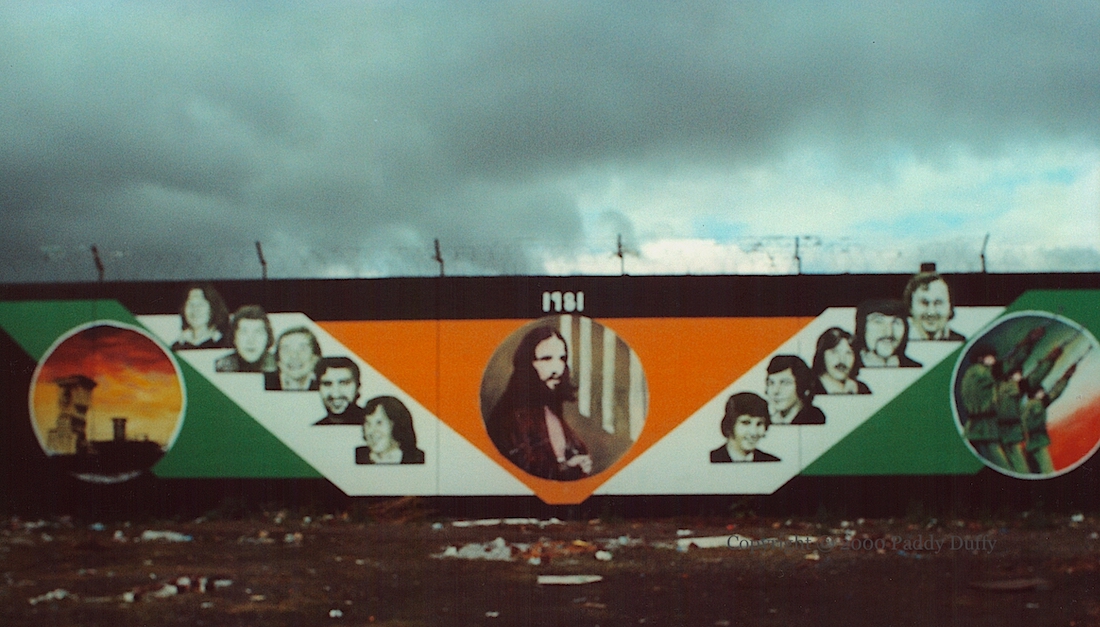
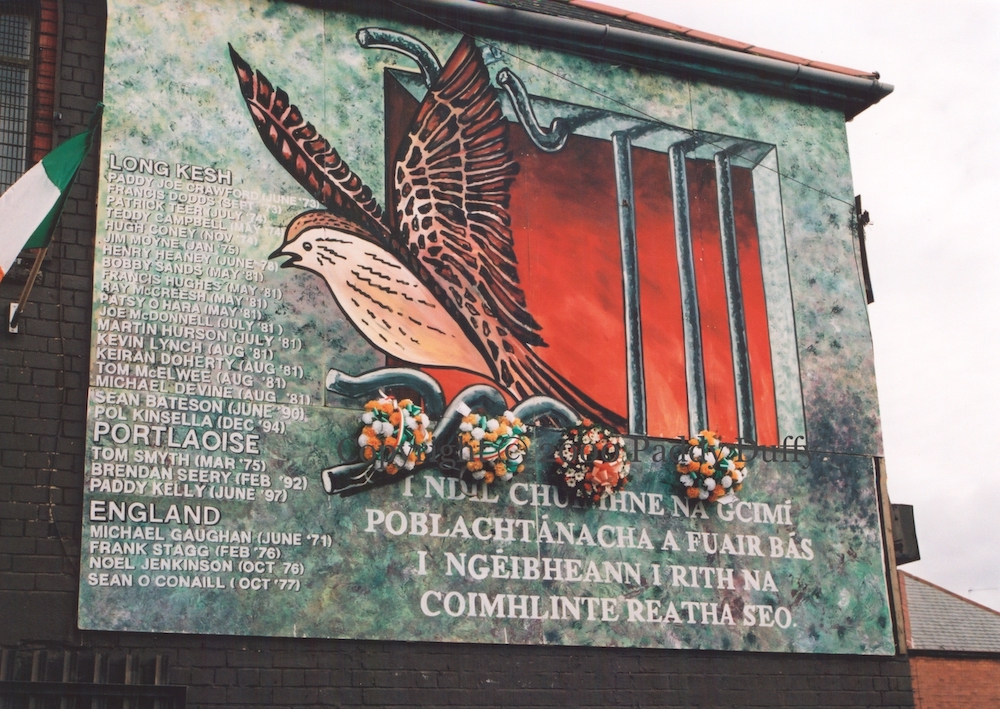
The piece is next to a hunger-strikers commemoration piece with ten portraits on shaped wooden boards against a painted background with blanket-man Hugh Rooney in the center. Between the two is a “spirit of freedom” lark and the names of the ten deceased 1981 strikers.
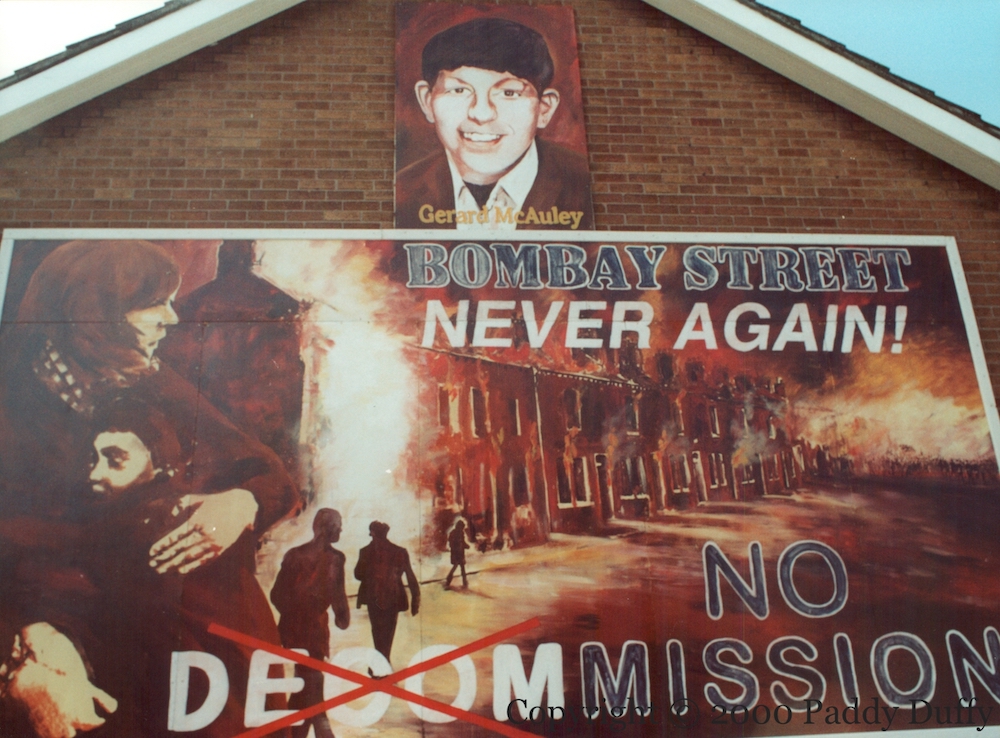
In August, 1969, families, mostly Catholic, were driven out and their homes burned in Bombay Street (and surrounding streets), between the Falls and Shankill (RTÉ news report). The defenselessness of the community then is reflected in the urging for “No decommission” in the present. Fıan Gerard McAuley (aged 15) was shot in nearby Waterville Street.
“4,000 years of Ulster-Scots history and heritage. Ulster & Scotland – shared language, shared literature, shared culture.” 400 years takes us back to the plantation; 4,000 years suggests an even deeper connection.
Ulster-Scots was included in the 1998 Good Friday Agreement (pdf) under the principle of support for “linguistic diversity”. This mural celebrating Ulster-Scots and ties between Northern Ireland and Scotland dates to 1999, with the crests of St Andrew and St Patrick on the left, and an Ulster Banner and Scottish lion rampant on the right.
“Dinnae houl yer wheest, houl yer ain!” [Don’t hold your tongue, hold your own!]
This is a complete version of Bobby Sands’s poem The Rhythm Of Time, along with the names and portraits of the ten deceased 1981 hunger strikers, and Michael Gaughan and Frank Stagg, who died on hunger strike in England.
“I ndıl chuımhne na gcımí poblachtanacha a fuaır bas ı ngéıbheann ı rıth na coımhlınte reatha seo.” A lark bursts through prison bars of Long Kesh, Portlaoise, and prisons in England, in which republicans have died from the 70s to 90s.








 Paddy Duffy Collection