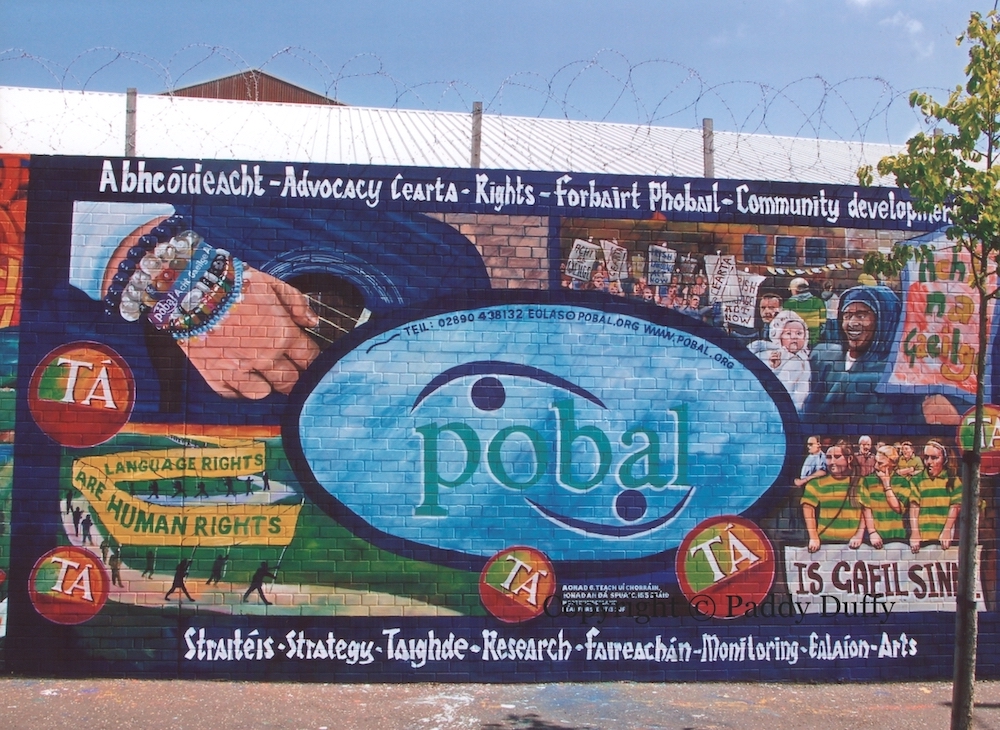
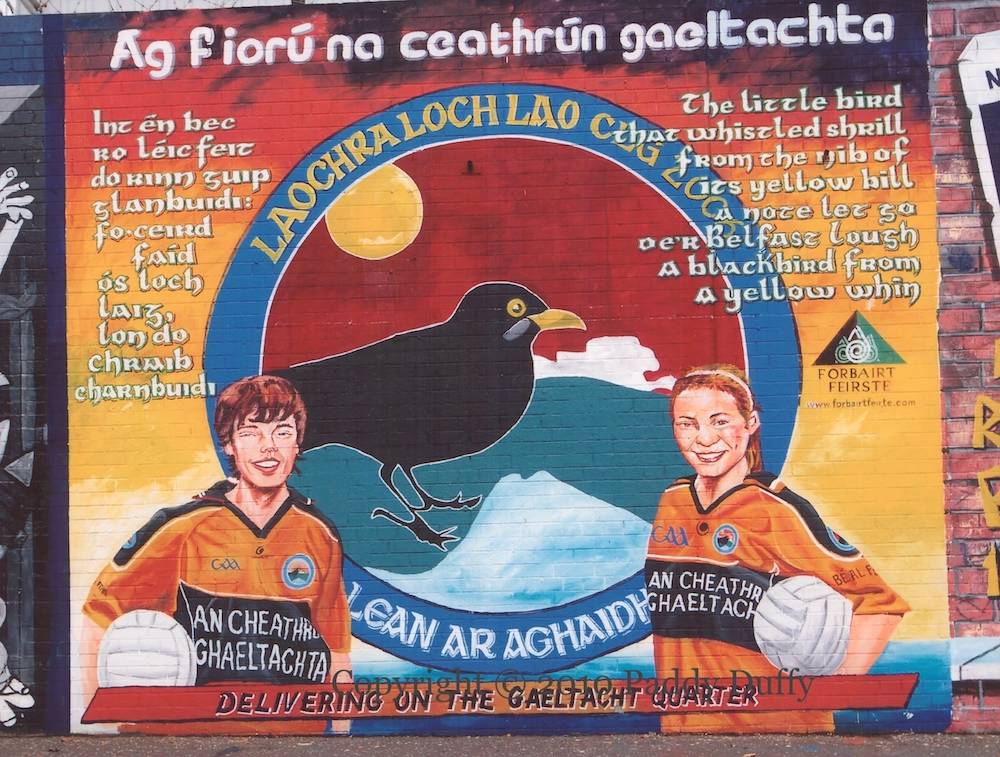
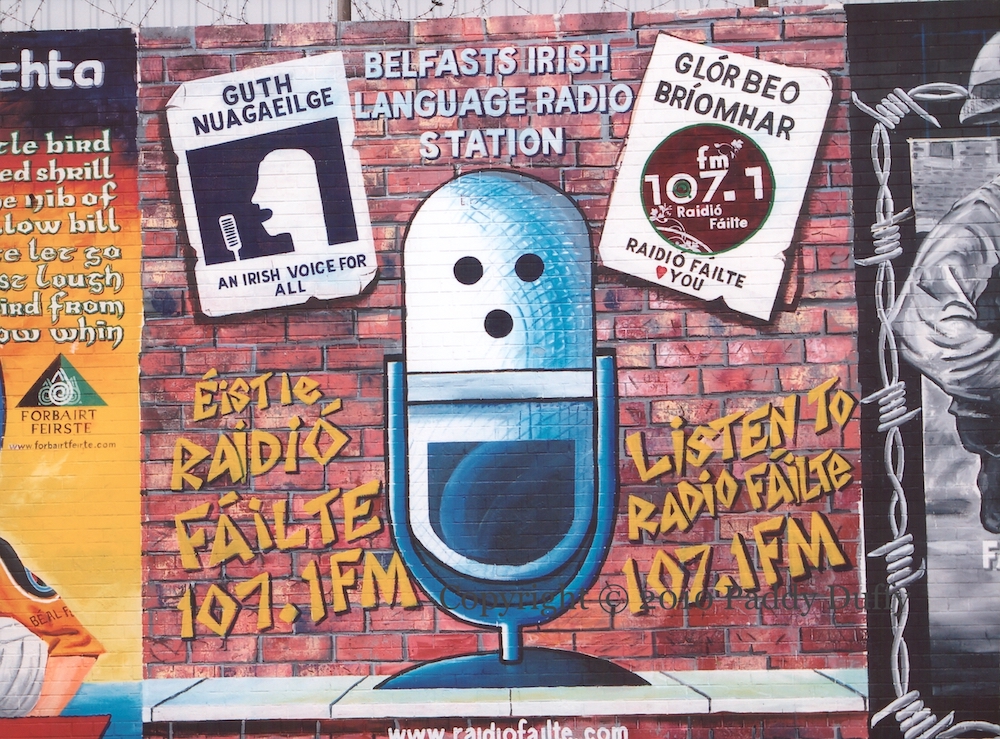
“Is Gaeıl sınne” [we are Irish-speakers]. Pobal promotes abhcóıdeachy/advocacy, cearta/rights, forbaırt phobaıl/community development, straıtéıs/strategy, taıghde/research, faıreachán/monitoring, ealaíon/arts, carried out in Teach Uí Chorráın in Ionad an Dá Spuaic [Twin Spires], and the “Tá” campaign for “acht na Gaeılge” an Irish-language act.
This anti-drugs mural in Tullycarnet — “Build a better future for our children – teach them to say No” — replaces a UDA mural – see Release The Political Hostages.
Painted by John Stewart in Granton Park, Tullycarnet, Dundonald
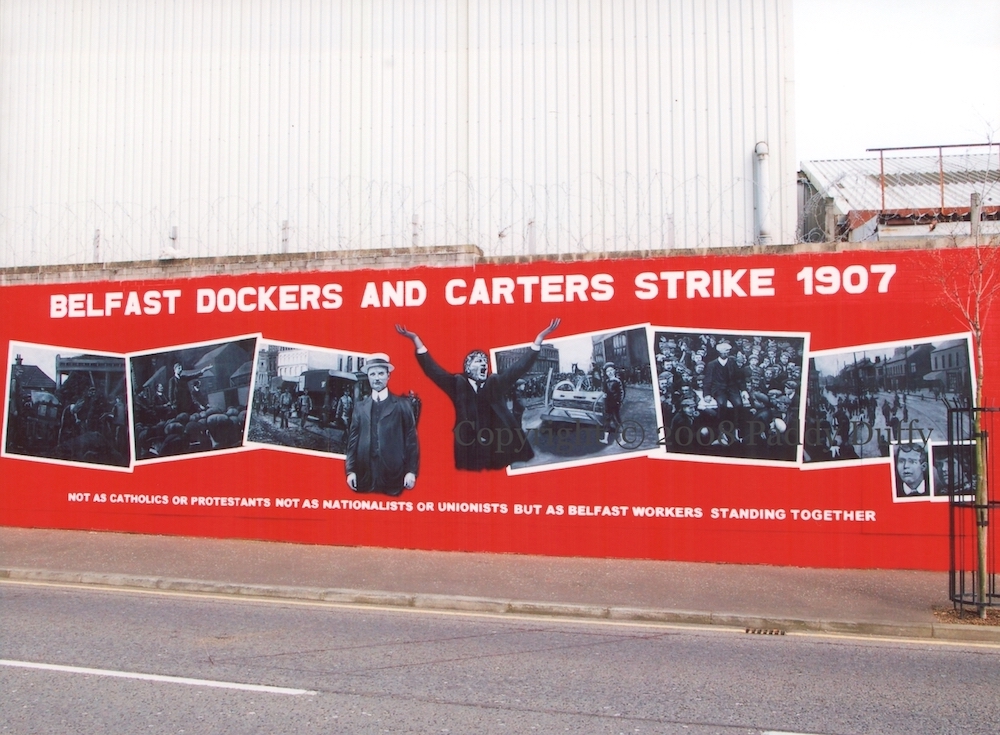
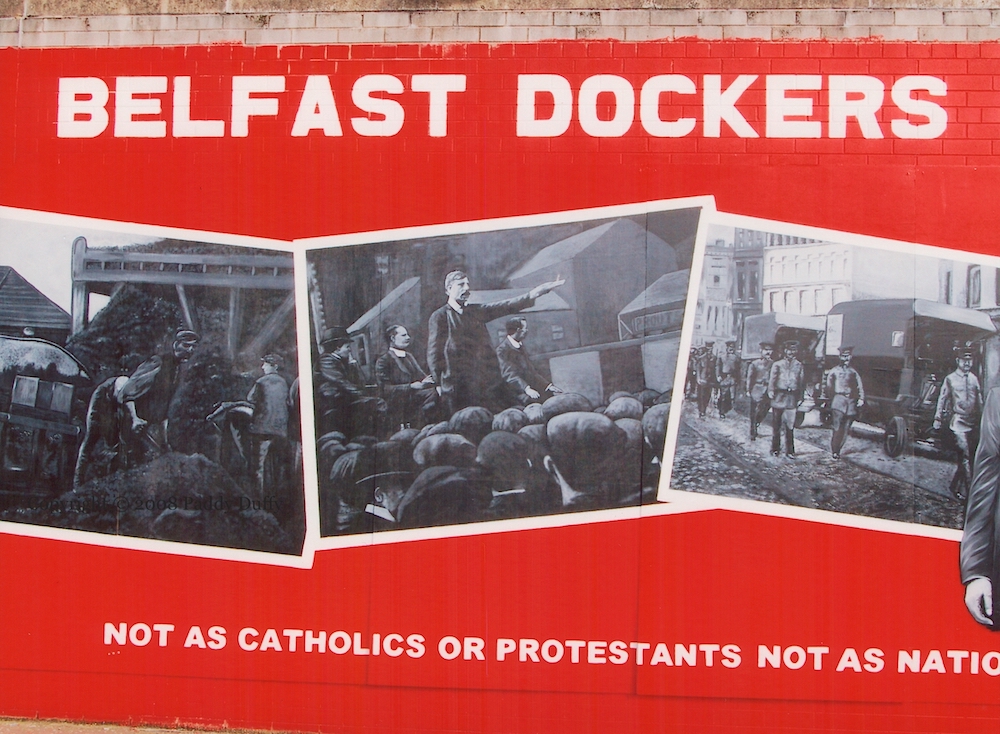
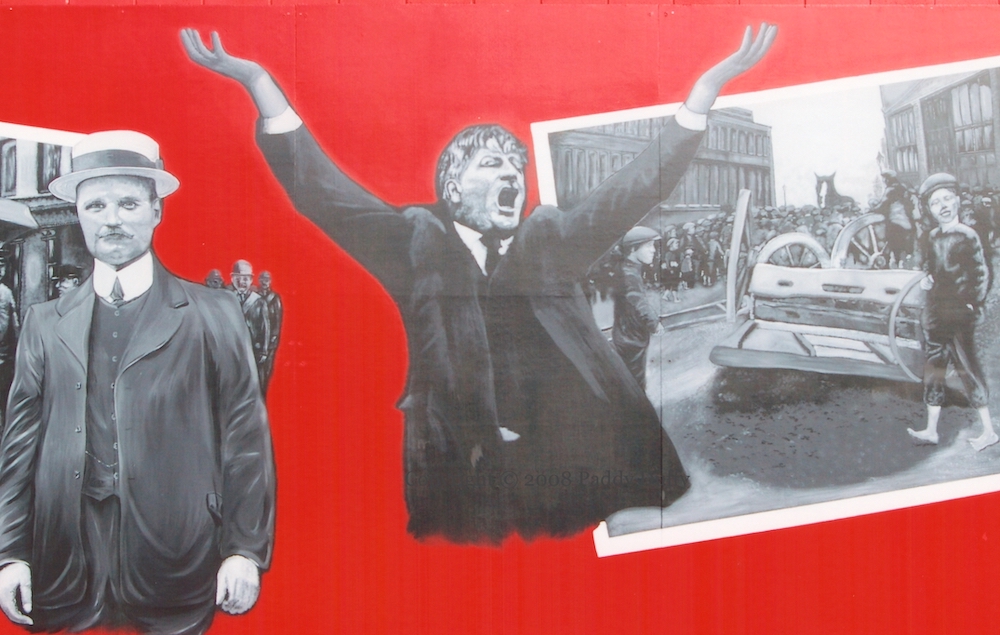
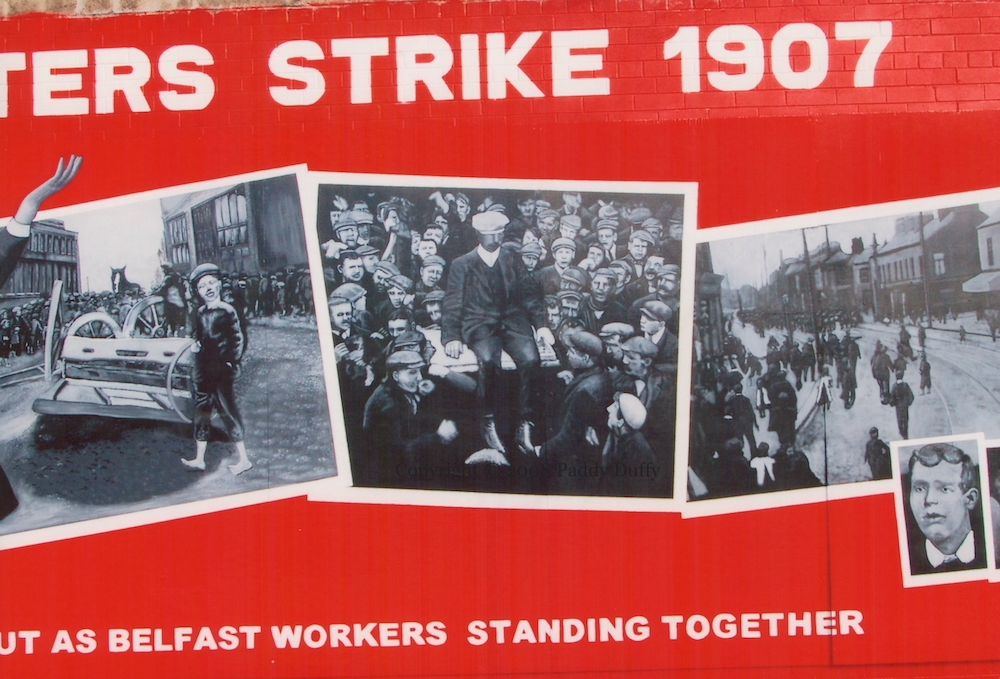
“Not as Catholics or Protestants, not as nationalists or unionists, but as Belfast workers standing together.” For the 100th anniversary of the strike by dockers and carters in Belfast, this large board was painted by Fra Maher and Rısteard Ó Murchú. It was launched on August 11th without the title across the top (youtube).
Leaders Boyd and Larkin are portrayed in the middle. The second panel shows speakers (including Larkin) on a platform (O’Hare); the third shows an RIC guard of blackleg workers – about 70% of the force mutinied and the fifth panel shows dismissed RIC constable William Barrett being carried through Belfast; the sixth shows the Cameron Highlanders being stoned by picketers (History Ireland). Margaret Lennon and Charles McMullan, two Catholic victims of British soldiers, shot during protests, are portrayed in the bottom right.
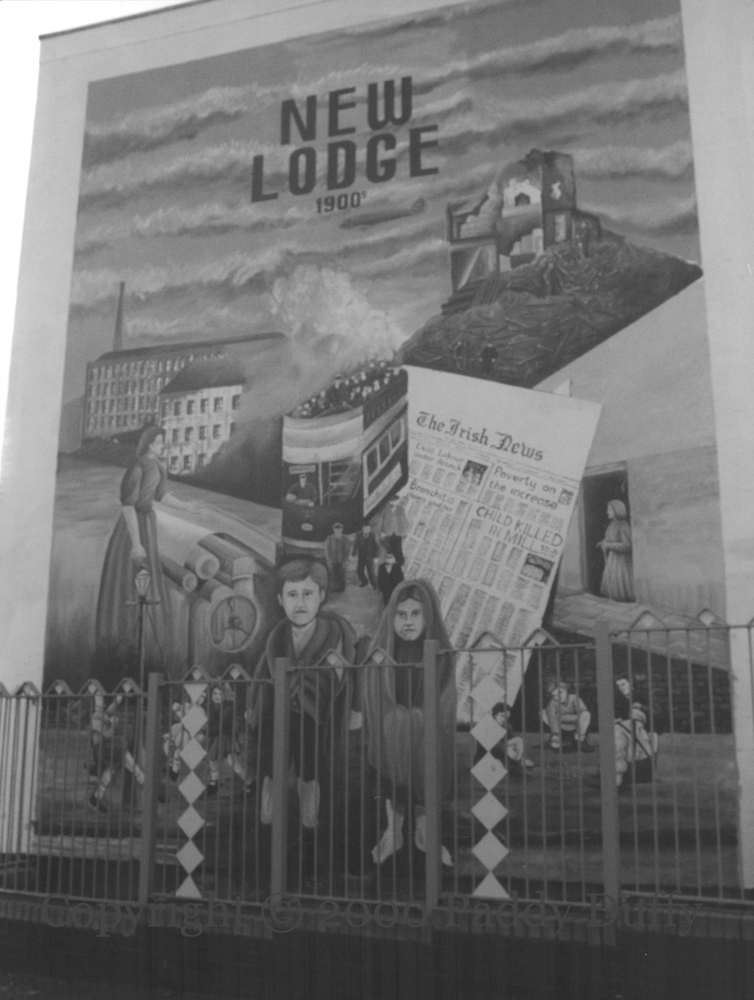
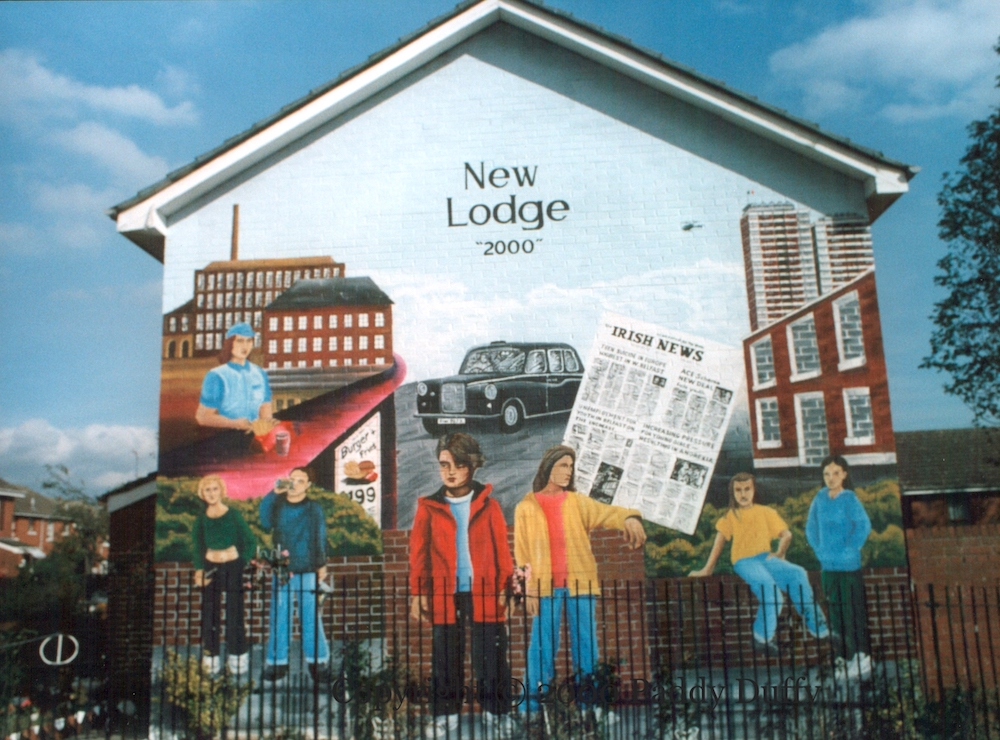
This pair of murals, on the New Lodge Road, Belfast, contrasts life for young people in the black-and-white “1900s” to life in colourful “2000”. Instead of working (and dying – in the headlines from the Irish News) in mills, they work in fast-food restaurants and drive black taxis (and suffer unemployment, suicide, and anorexia – again, in the newspaper), and instead of playing in the streets and wrapping themselves in blankets, they sit on walls and drink.
This is a fake mural, painted for the film The Most Fertile Man In Ireland (O’Connell 2005) which is set in Belfast. The mural doesn’t seem to have made the final cut but there’s another fake mural – Gloria Hunniford and Robert Emmet together in a frame of Celtic knot-work – at 7m40s, and another at 52m44s. You can play ‘spot the location’ for yourself by watching the film on youtube.
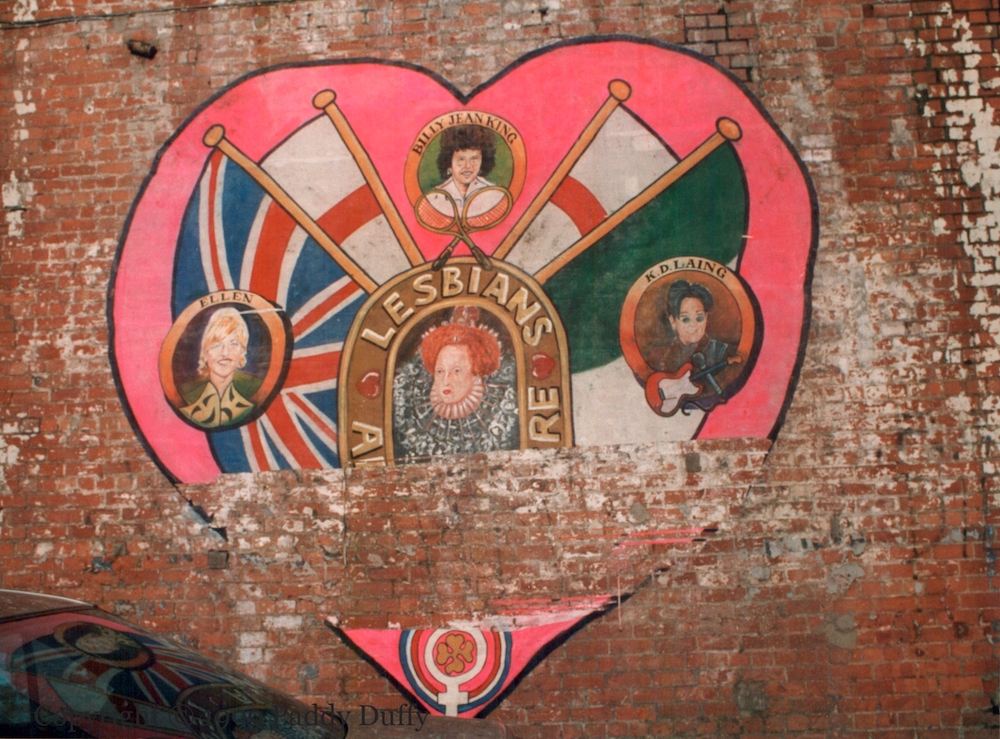
This one combines the Union Flag, Irish tricolour, Ulster Banner, and shape of the UVF emblem, with portraits of Ellen DeGeneres, Billy Jean King, KD Laing and Queen Elizabeth I.
“To be free of poverty is a human right.” October 17th, each year, is the United Nations’ International Day for the Eradication of Poverty. The mural shown above states that “12 of the 16 most deprived wards in Belfast are in W. Belfast”.
Mural by Andrea Redmond and Margaret McCann sponsored by W. Belfast Economic Forum and the Falls Women’s Centre, showing children of the world under a rainbow and between a dolmen and a ?parrot?.
Parading This mural demands that Orange Order marches have the consent of local residents in Derry, Garvaghy [Portadown], and lower Ormeau [south Belfast].
Parading was the central on-the-ground issue of the post-Agreement years (BBC). Resistance to Orange Order parades marching through CNR areas was led by local groups: in Derry, by the Bogside Residents’ Group, in Portadown, by the Garvaghy Road Residents’ Coalition, and in lower Ormeau by Lower Ormeau Residents Action Group. In each case, residents were appealing directly to the local lodges and to the police. (The Parades Commission would be established in 1998.)
In 1995, there was a three-day stand-off on the Gavraghy Road that resulted in a silent march without bands (CAIN). The police initially re-routed the 1996 march but reversed the decision at the last minute, citing the threat of loyalist violence, and forced residents off the street in order to accommodate the parade.
This is an in-progress image of a mural sponsored by and for the Upper Springfield Development Trust (web | until 1993 the Upper Springfield Development Forum) focusing on young people: “Mol an óıge agus tıocfaıdh sí.” (Praise youth/the young and it will flourish.”/”Youth responds to praise.”)
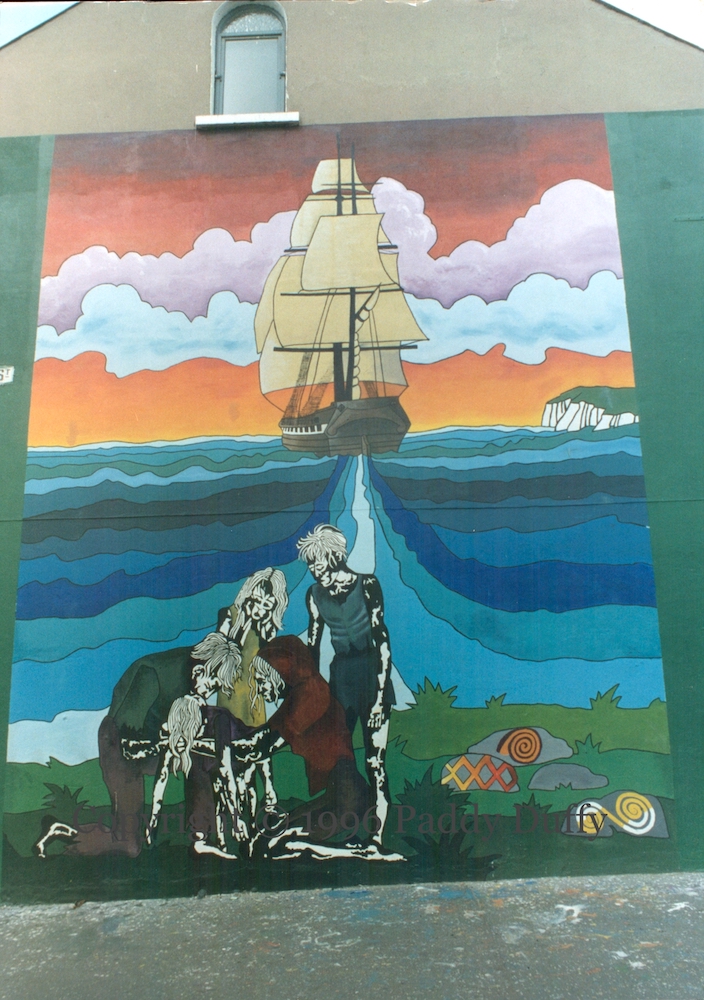
A million, and perhaps as many as 2 million – one in four Irish people – left Ireland between 1845 and 1855, many sailing on so-called “coffin ships” which had mortality rates of 30%. Another million died in the Great Hunger itself (Visual History), in most cases the proximate causes were fever and dysentery (WP | Irish Central).



 Paddy Duffy Collection