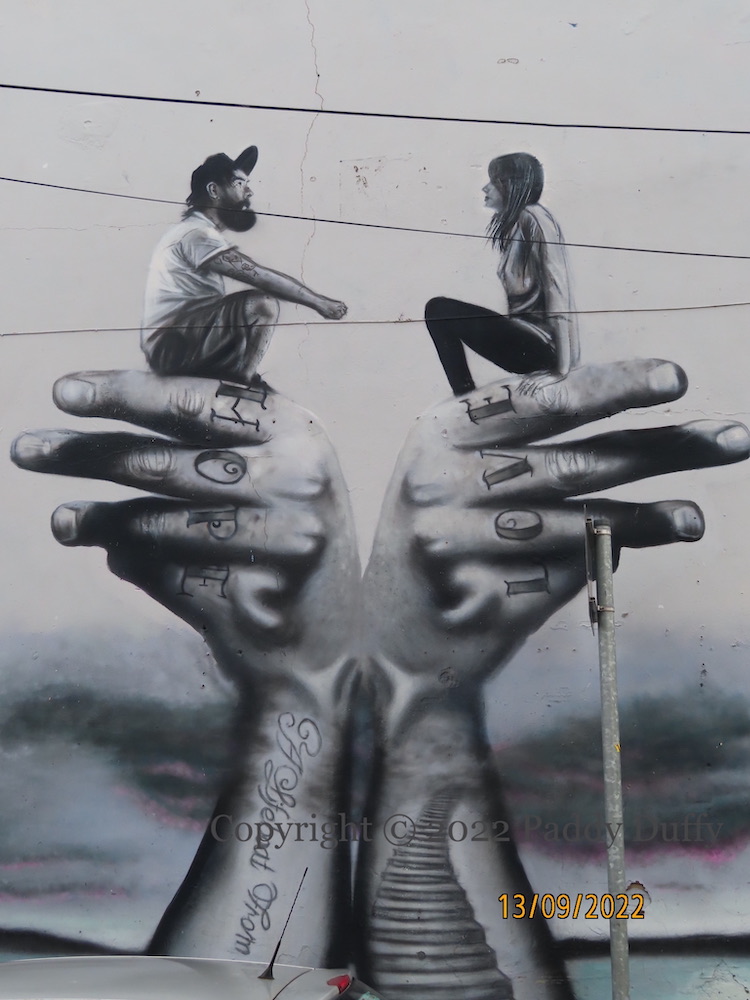
emic (Eoin McGinn Fb | Web |Tw) has been at work on the Falls Road painting a mural for the Suicide Awareness & Support Group. Two figures face each other, seated on the index fingers of hands tattooed with “hope” and “love”.
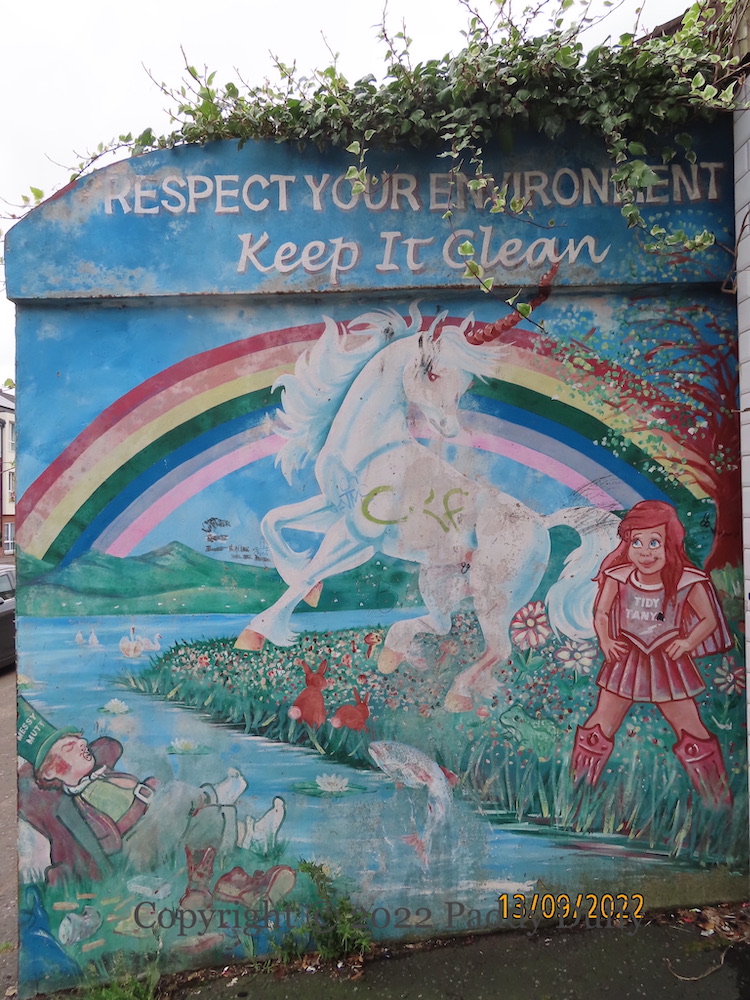
“Keep it clean.” “Tidy Tanya” in pink stands guard over the nature on the right side of the riverbank, protecting it from “Messy Mutt” who lies sleeping amongst rubbish on the left bank.
This environmentally-themed art goes back at least to 2011.
“Demand dignity – end forced evictions. Justice, hope, homes, rights, security.” Dollar bills spew from the exhaust pipes of bulldozers driven by cigar-smoking financiers as they bear down on a chain of protesters in this Amnesty International board at the corner of Northumberland and Beverley Streets. “Join Amnesty and take action for human rights worldwide http://www.amnesty.org.uk/join”
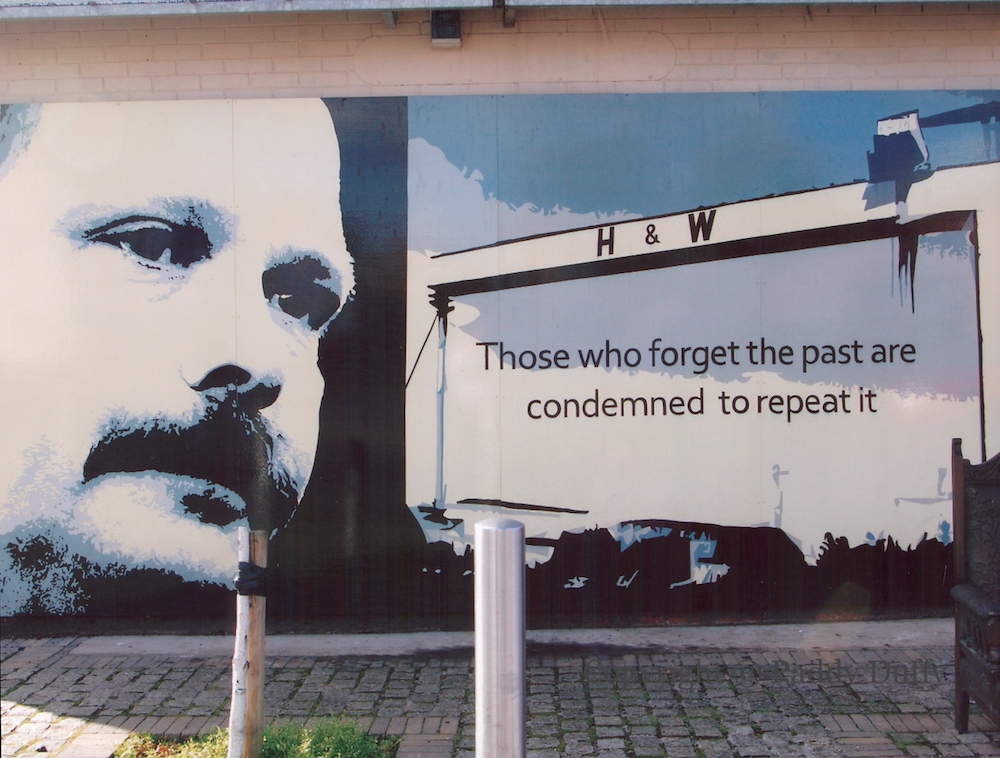
“Those who forget the past are condemned to repeat it.” This is a 2008 work by Ross Wilson commemorating David Ervine (WP) in Montrose Street South, Belfast, the area he came from. The inclusion of one of the Harland & Wolff cranes reflects his connection to working-class politics in east Belfast.
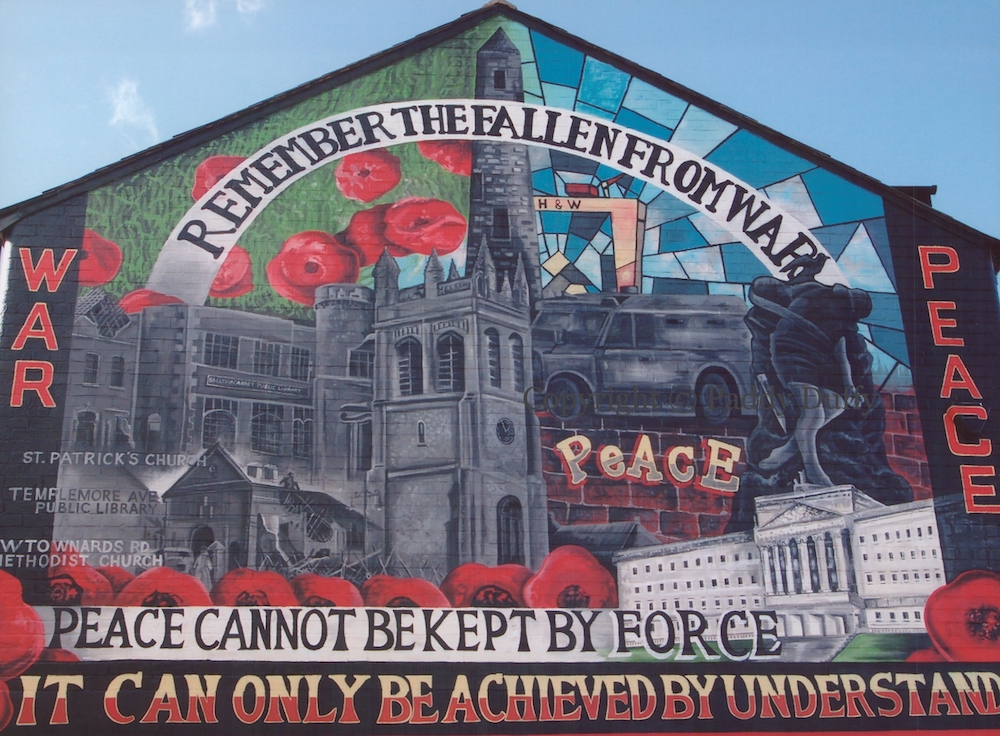
The mural above is on the Newtownards Road at Lendrick Street and shows a bombed-out Ballymacarrett library, St. Patrick’s church (the church itself is visible in the lower right-hand corner) – both were hit by the blitz in 1942 – a police land rover (perhaps representing the “fallen” during the Troubles), and Cuchulainn (perhaps representing the IRA, though Cuchulainn is also a UDA icon – see the bottom of the Visual History page on Cú Chulaınn), and Stormont (representing … peace???). Poppies in a field and a H&W crane against stained glass provide a background.
We are supposed to remember the dead because (perhaps) their deaths were unnecessary and misguided as means to peace, at least according to the saying along the bottom (sometimes attributed to Einstein): “Peace cannot be kept by force; it can only be achieved by understanding” – understanding of the Nazis during the blitz, it seems, and of loyalists and republicans during the Troubles. (If you have a better interpretation, please leave a comment.)
The mural was imitated on the hoarding around An Chultúrlann on the Falls Road during its renovation (shown below): the left hand side of the side was replaced with images of the Falls library and Bobby Sands mural and Divis tower, and Cú Chulaınn on the right was placed in front of the GPO, and the poppies were joined by lilies, and the words translated into Irish. The message here seems clearer, lamenting the CNR dead and calling for understanding of the CNR community (sc. by Britain and the Orange state) though the poppies below include the dead of WWI.
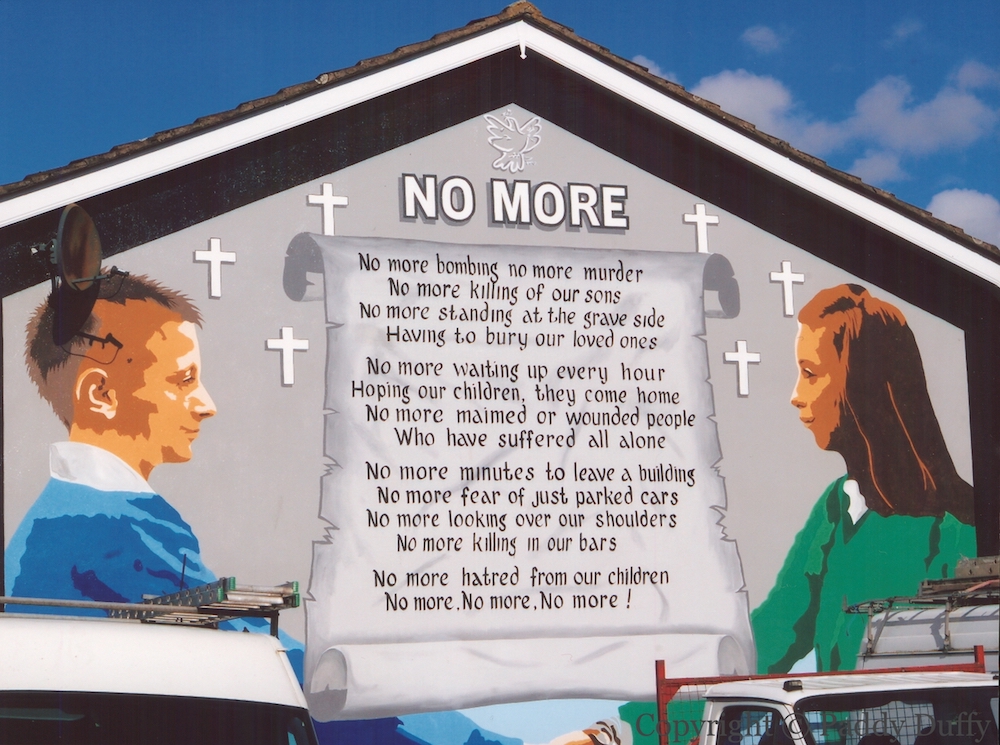
A boy in blue and girl in green, from opposite communities in east Belfast, shake hands against the backdrop of the Harland & Wolff cranes. The poem “No More” in the middle of the mural is by community worker Jim Wilson, whose grandson Dylan is shown on the left. A smaller version of this mural, without the poem, is in the CNR Short Strand’s Edgar Street – see No More.
“No more bombing, no more murder No more killing of our sons No more standing at the grave side Having to bury our loved ones No more waking up every hour Hoping our children, they come home No more maimed or wounded people Who have suffered all alone No more minutes to leave a building No more fear of just parked cars No more looking over our shoulders No more killing in our bars No more hatred from our children No more. No more. No more!”
By Dee Craig in Kenilworth Place, PUL east Belfast
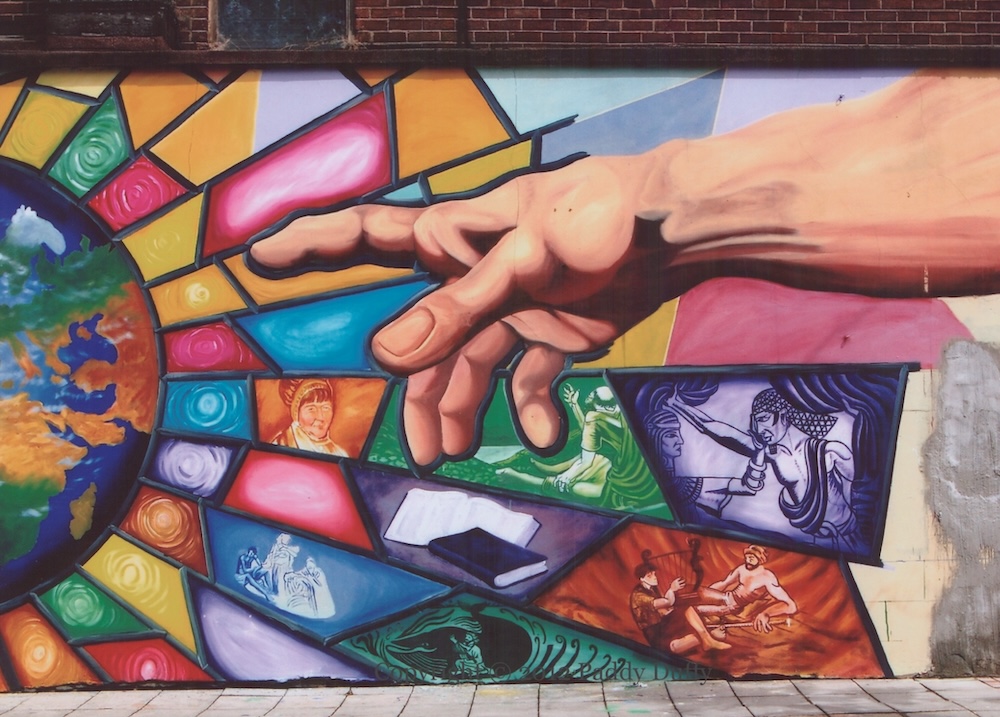
A biblically-themed mural is in progress in Bank Square, the open space outside Kelly’s Cellars. Included in the panels so far are various Bible stories such as Noah’s Ark, the burning bush, and the loaves and fishes.
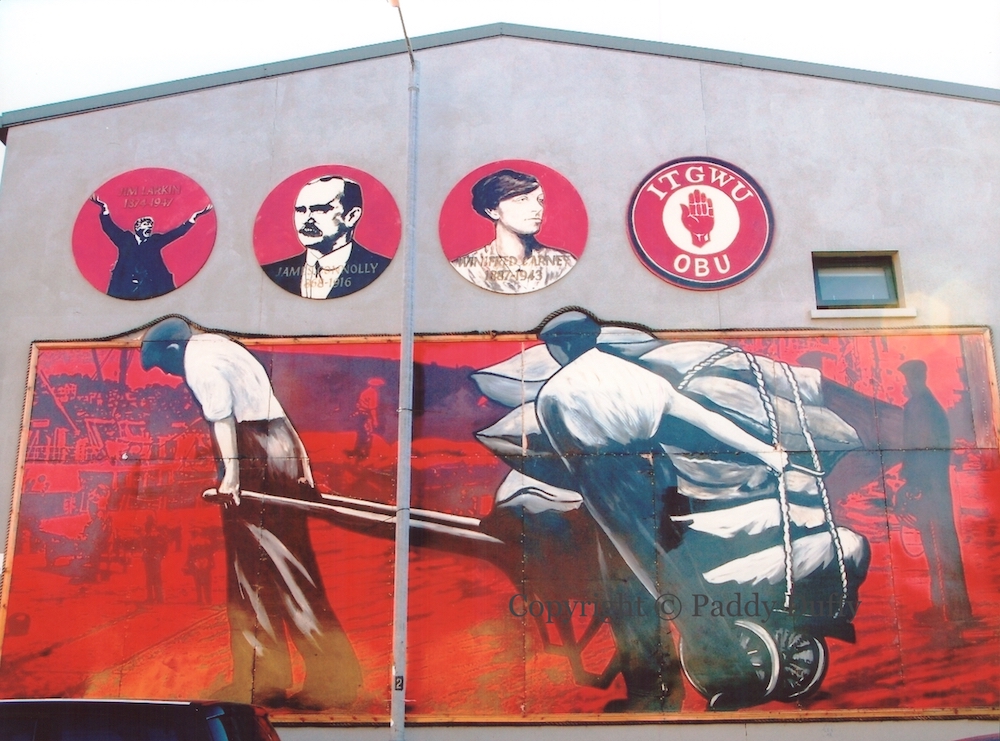
“Remembered with pride and affection our friends and fellow-dockers who were killed at work or suffered pain and premature death from unsafe and unhealthy working conditions in the port of Belfast. ‘On a ship’s dark deck a man is dead/wives, sisters, brothers, parents, shake heads and cry/as they knew not who to blame./An injustice has arrived/pain and anguish begins.’ Memories are everlasting. Ar dheıs Dé go raıbh siad. Erected by the Dockers Club and SHIP [Shared Heritage Interpretive Project] on International Workers Day, April 2007.” The plaque is on an exterior wall of the Dockers Club, adjacent to the mural. Above are portraits of Jim Larkin, James Connolly, Winifred Carney, with the emblem of the IGWU/OBU [One Big Union]. Larkin founded the ITGWU in 1909. It was led by Connolly from 1914 to 1916. Carney, from Bangor, founded the Irish Textile Workers’ Union in Belfast in 1912
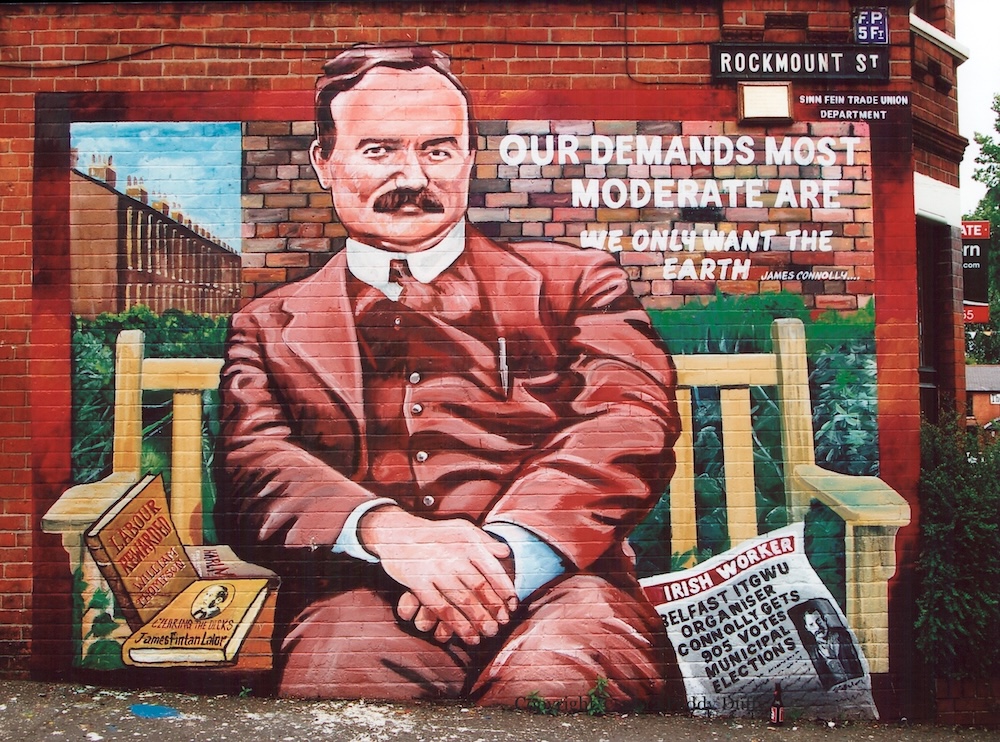
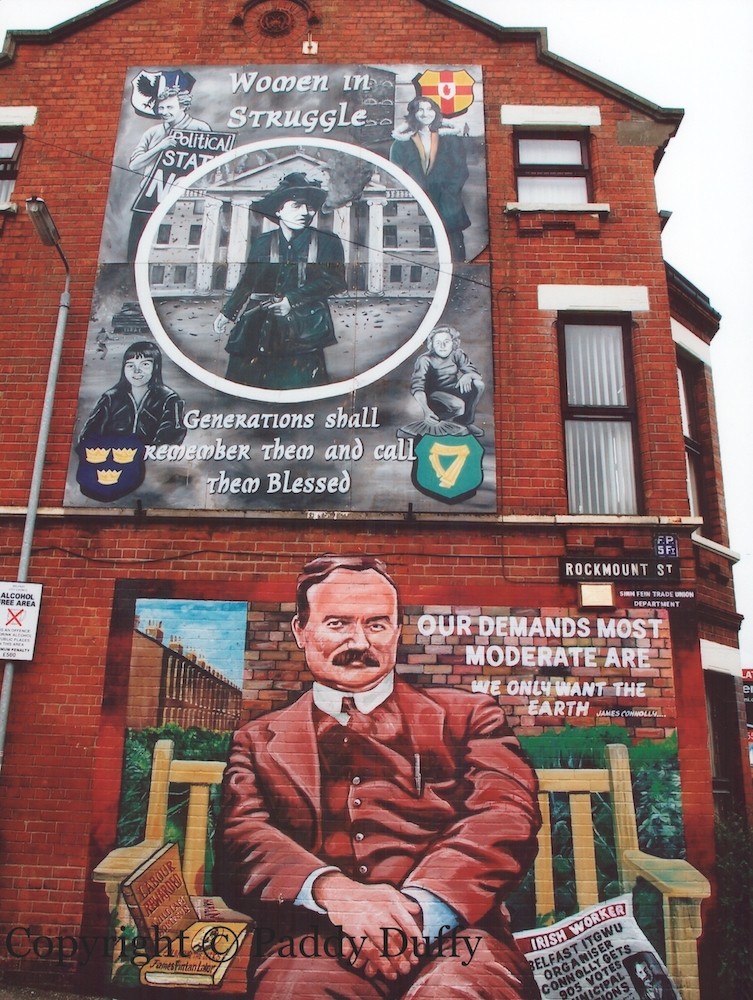
The sixteen-year old Sınn Féın Trade Union Dept mural has been replaced (though the plaque remains in the top right-hand corner) with another mural featuring James Connolly but with a new quote, from his 1907 poem: “Our demands most moderate are/We only want the earth.” The Irish Worker headline reads “Belfast ITGWU organiser Connolly gets 905 votes municipal elections” referring to the municipal elections of 1913 – Connolly stood in the Dock Ward (SIPTU). At Connolly’s right hand are books by James Fintan Lalor (Clearing The Decks), William Thompson (Labour [Labor] Rewarded) and Karl Marx.
Above the mural is a painted board celebrating “women in struggle – generations shall remember them and call them blessed.” With images of female activists including Máıre Drumm, Maıréad Farrell, and Countess Markievicz.

 Paddy Duffy Collection