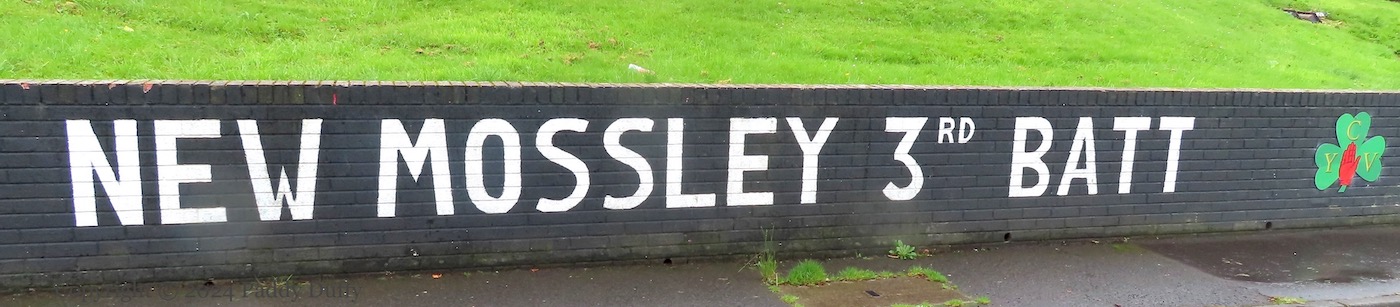
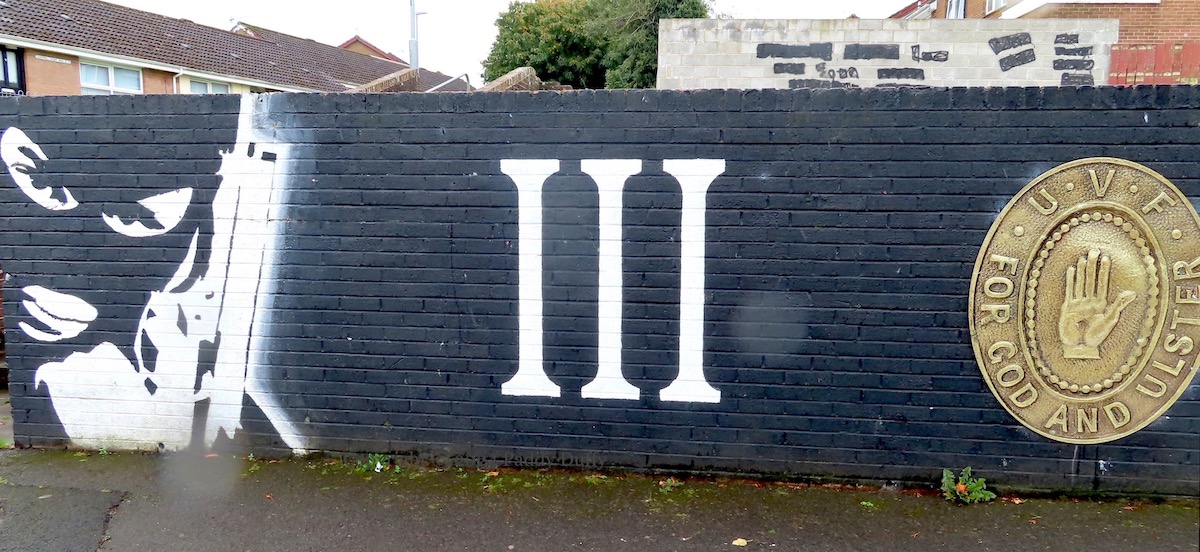
The hooded gunman at the New Mossley playground – seen previously in Welcome To New Mossley Play Area – has been upgraded with a golden UVF emblem (shown last, below), and has been joined by two new pieces: the printed board above and the low wall below. The 3rd battalion also includes Rathcoole, Mount Vernon, and Tiger’s Bay.
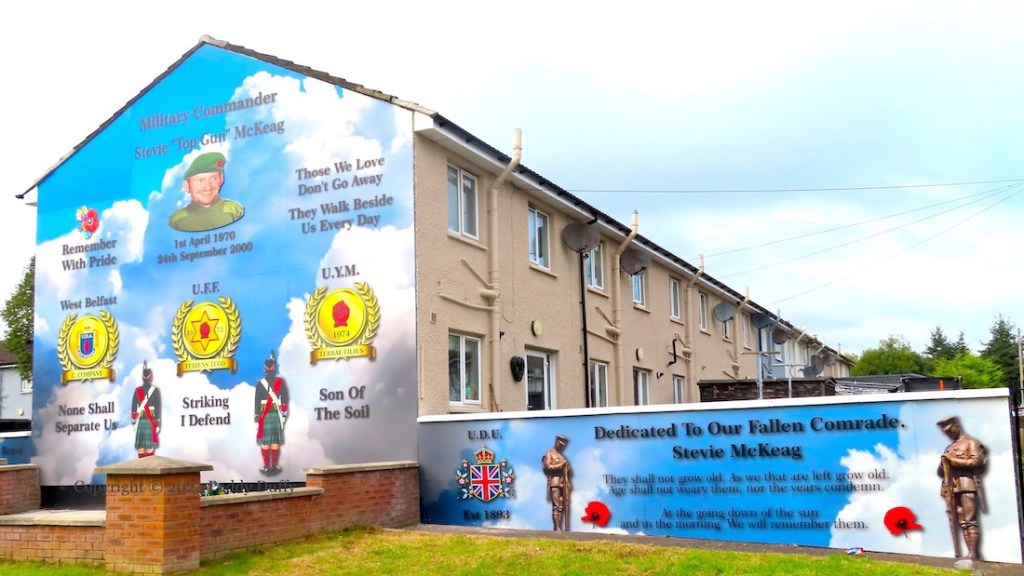
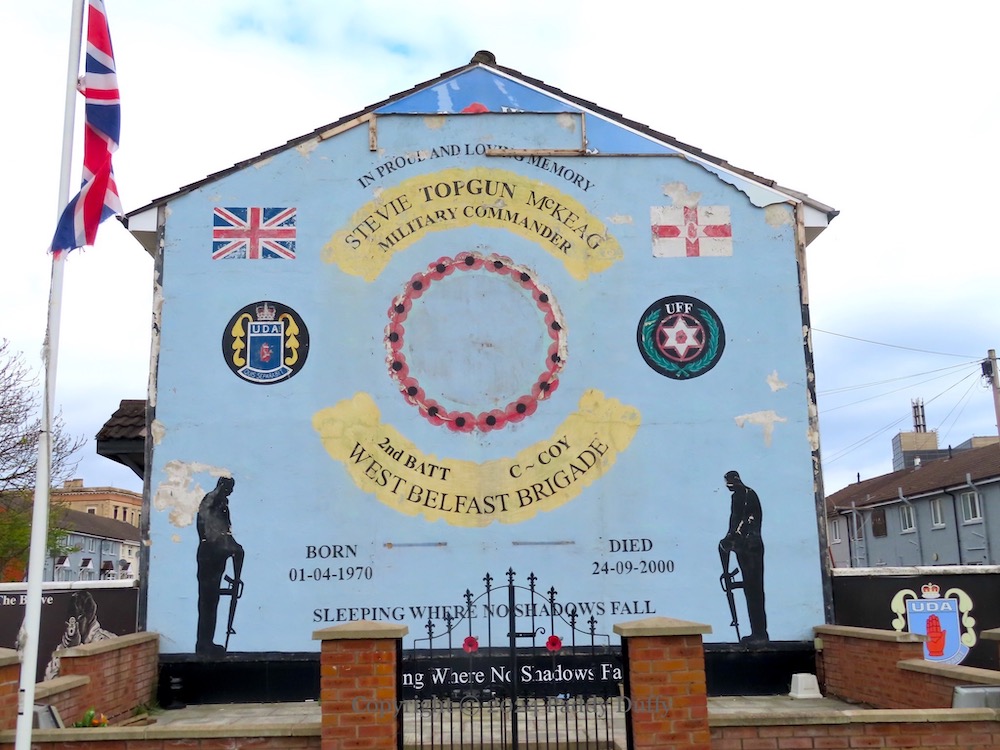
After a long spring and summer of inaction, a new tribute to UDA assassin Stevie “Top Gun” McKeag has been put in place in the lower Shankill, replacing the flat-capped version of 2016.
In Tolstoy’s War And Peace, the prince Andrei Bolkonsky at one early point remarks, “It is not given to people judge what’s right or wrong. People have eternally been mistaken and will be mistaken, and in nothing more so than in what they consider right and wrong.” But after he is wounded at the Battle Of Austerlitz in 1805 and again in 1812 at the Battle Of Borodino, he loses his admiration for the blood-thirsty Napoleon and for war in general, and comes to think that events are a function of many individual decisions.
Stevie McKeag, hit-man for the UDA’s second battalion (west Belfast) ‘C company’, killed at least a dozen Catholics between 1990 and 1998 (WP). The version presented on the left-hand side-wall (just below) begins, “It is not given to people to judge what’s right or wrong. People have internally been mistaken and will be mistaken …” which seems to be contradictory, and then continues “… and in nothing more than in what they consider right and wrong” which is difficult to parse so as to give the intended meaning.
The mirrored hooded gunmen on either side of the quote come from an old mural in the estate – see UDU-UFF-UDA.
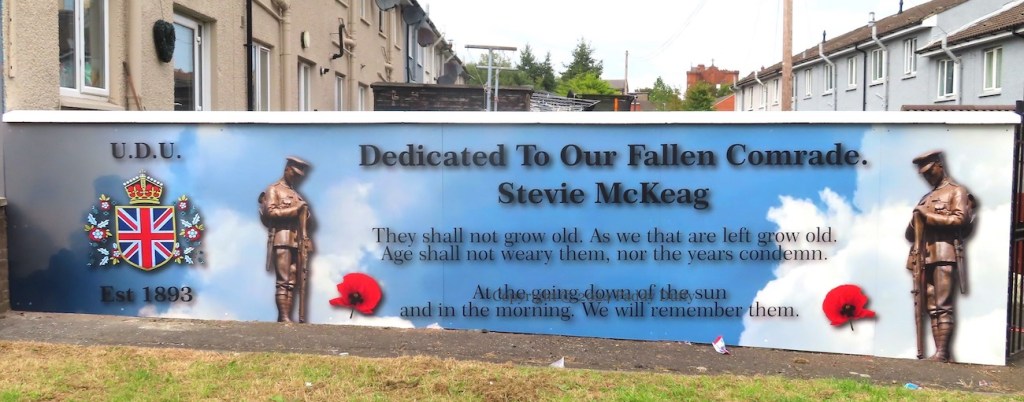
The smiling McKeag is here shown in the main panel wearing a green beret (as is the anonymous volunteer in the side-wall) and commando jumper (with shoulder patches) as though he were a “military commander” in the Commandos or Royal Marines of the British Army. The UDU, the poppies, and the graveside mourners in the right-hand side-wall are used to put McKeag’s actions in the context of resistance to Home Rule and the British Army’s role in the Great War.
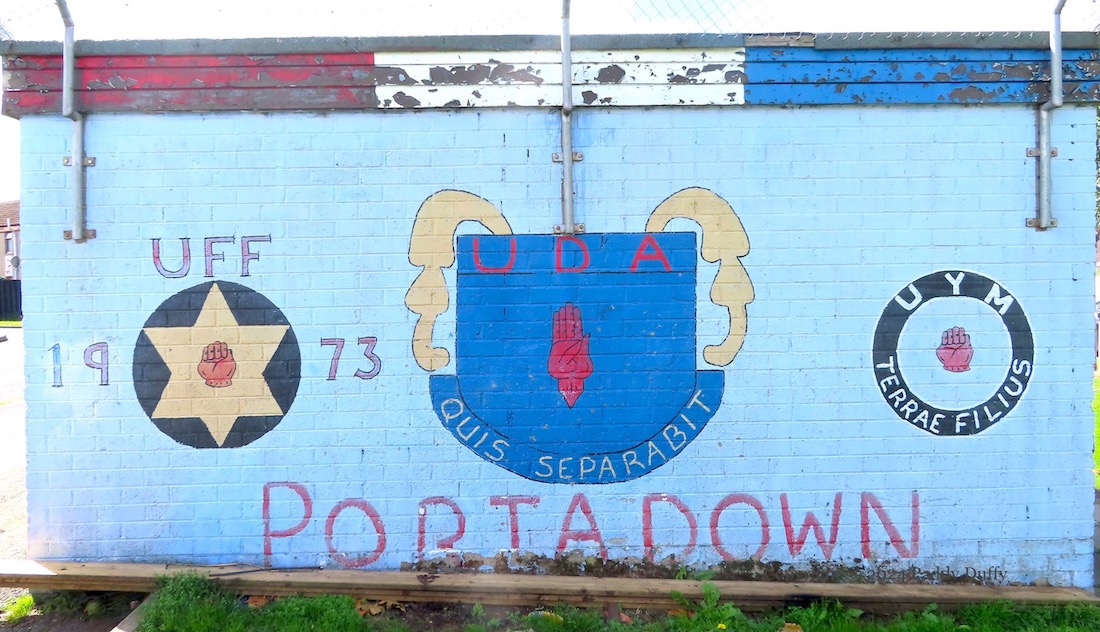
For the composition of the main panel, as well as its use of boards on top of the background, compare with the UDA piece in the Woodvale. The translation into English of the UDA’s, UFF’s, and UYM’s Latin mottos – [Quis separabit] / None shall separate us | Feriens tego / Striking I defend | Terrae Filius / Son Of The Soil – is unusual, as is the bouquet of flowers behind the poppy.
For more, including the mourning soldiers, see the entry at Extramural Activity.
“Land of the free because of the brave”. “Remember with pride”. “Those we love don’t go away/They walk beside us every day”. “Dedicated to our fallen comrade”.
April 25th, 2024: The boards were taken off, revealing an older version that stood 2010-2015.
[In the middle circle there were, over the years, a series of printed portraits of McKeag (and one painted version). For the version from 2014, see M11119; see also the image 2011, which links back to other versions from 2010, 2009, 2008, and 2007).]
May 3rd, 2024: Scaffolding in front of the wall
This layer of paint (and plaster?) was also taken off, to reveal the remains of the original King Rat mural on the wall – see X15041 in the Seosamh Mac Coille collection.
Benjamin West painted The Battle Of The Boyne in 1778 and his composition – with William moving from left to right on a white horse and Marshal Schomberg dying in the bottom-right corner – has become the standard representation in loyalist culture, perhaps due to versions of it appearing on the covers of songbooks for the Orange Order and the Apprentice Boys soon after (Belinda Loftus 1982 Images In Conflict). It appears here on the wall of Whitehead Orange Hall, along with a board connecting service by Irish soldiers in British forces in WWI and Afghanistan (see previously: The Sacrifice Remains the Same in east Belfast).
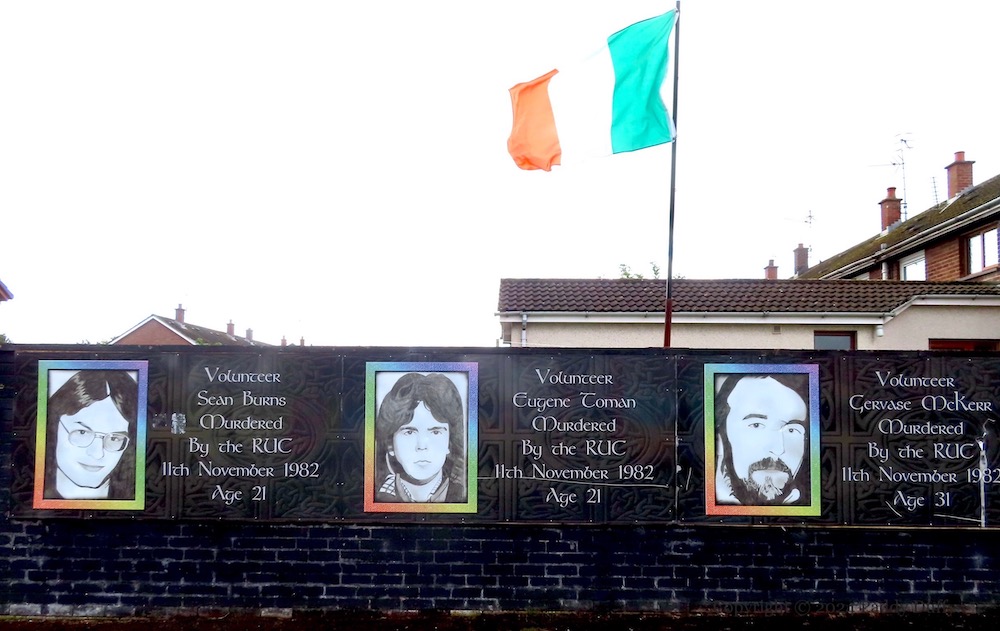
North Armagh remembers both the centenary of the Easter Rising – in black and white in the background are (above) the seven signatories of the Proclamation, (bottom left) Cumann Na mBan (see the 2014 west Belfast mural) and (bottom right) the Irish Citizen Army (depicted by the painting The Birth Of The Irish Republic) – but also nineteen local volunteers and activists from the Troubles era: (anti-clockwise from left) Thomas Harte, Michael Crossey, Charles Agnew, Julie Dougan, John Francis Green, Terry Brady, David Kennedy, Peter Corrigan, Sheena Campbell, Sam Marshall, Eamonn McCann, Harry McCartney, JB O’Hagan, Sean McIlvenna, Eddie Dynes, Eugene Toman, Garvase McKerr, Sean Burns.
The emblems in the upper corners of those of Na Fıanna Éıreann and the Irish National Volunteers. The inclusion of the National Volunteers is unusual and perhaps a mistake: they were formed in 1914, when the Irish Volunteers split after Redmond urged Irishmen to join the British Army in the Great War; about 24,000 National Volunteers joined the 10th and 16th (alongside roughly 180,000 other Irishmen) (WP). The intended emblem might instead be that of the Irish Volunteers, which kept the name of the pre-WWI organisation but only a fraction of the volunteers, some of whom participated in the Easter Rising; their emblem is also a harp but with “IV” or “Irish Volunteers” or (for the Dublin brigade) the Fıanna Fáıl sunburst. (If you can clarify, please comment/get in touch.)
This is a vintage UDA mural in Moeran Park, in the Rectory area of Portadown, still in reasonable shape after more than a decade – compare this image with the 2011 image in the Peter Moloney collection.
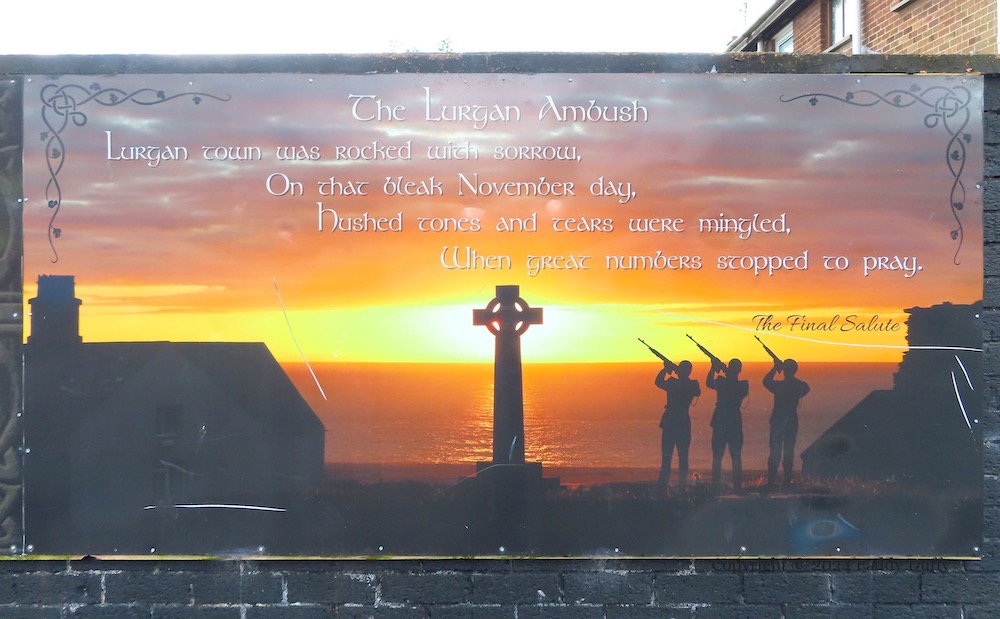
“Fuaır sıad bás ar son saoırse na hÉıreann. Óglach Sean Burns, Óglach Gervase McKerr, Óglach Eugene Toman. “But they dared to hold their heads up high and never once did fail to declare their wish for freedom like true sons of the Gael” – The Lurgan Ambush (A poem by Ita Green [set to music at Irish Folk Songs])”.
The IRA volunteers were three of the six people shot in Lurgan in three incidents in November and December of 1982; the others were Seamus Grew, Roddy Carroll, and Michael Tighe. The deaths of the three would be investigated by the RUC and then by the Stalker Inquiry into the shoot-to-kill policy (RN); an inquest was begun by the Coroner in 2007 (BelTel | Madden-Finucane). Under the Legacy Act, which came into effect on May 1st (2024), the inquest has been suspended and the case transferred to the Independent Commission for Reconciliation and Information Recovery (Irish News).
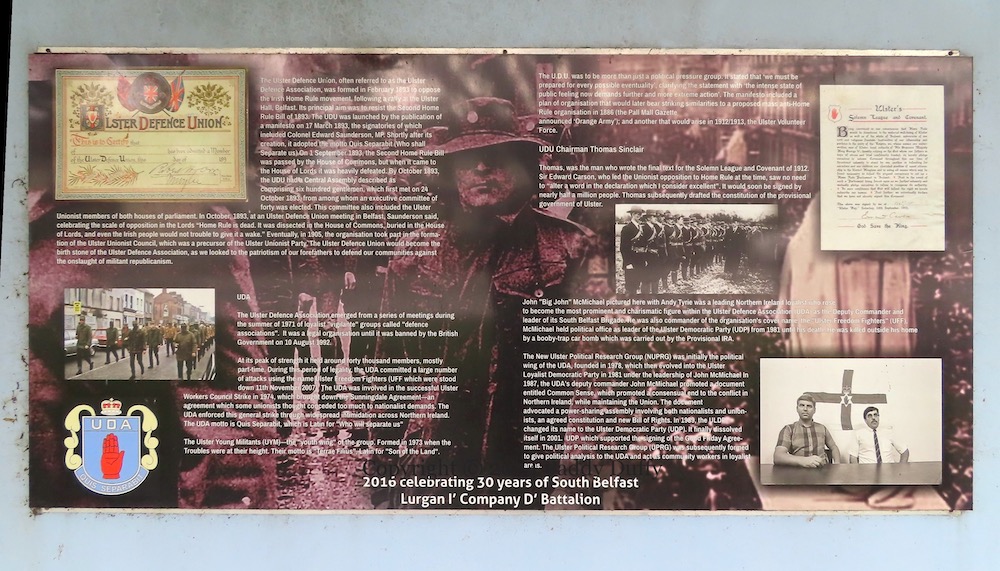
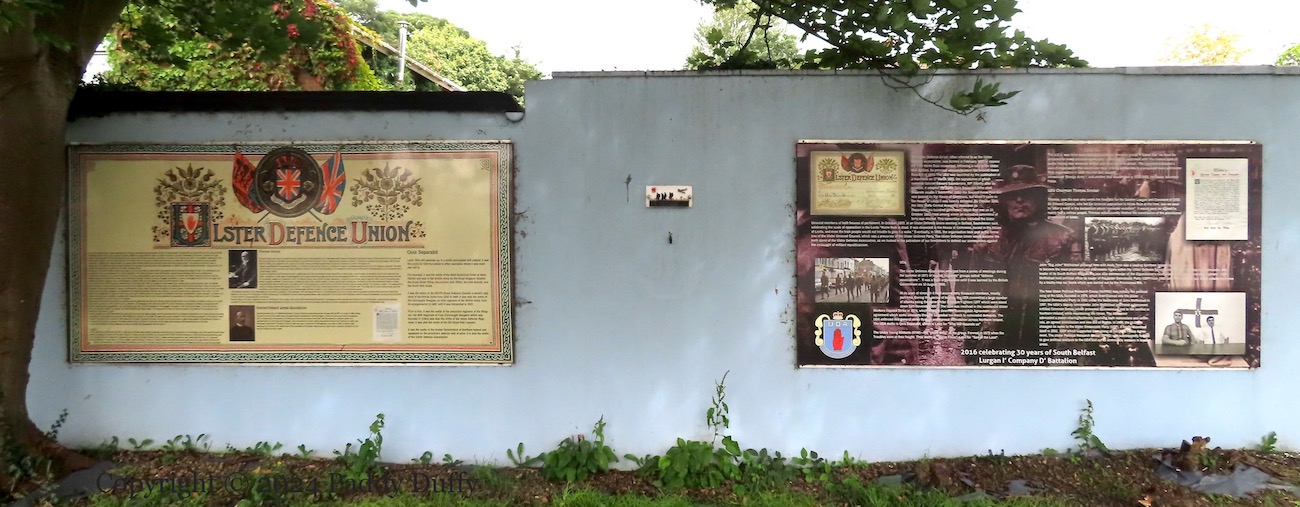
These are the UDA boards on Avenue Road, near Lurgan Park, which proved controversial when they were erected (in 2016), mainly because the second piece (below) “celebrat[es] 30 years of South Belfast/Lurgan 1 company D battalion” UDA and shows Troubles-era shows-of-strength (News Letter) and because it turned out the wall was owned by the Housing Executive (NIWorld).
The piece above describes the creation of the UDU in 1893, as a response to the second Home Rule bill, which was passed by the Commons but rejected in the Lords, and which Edward Saunderson celebrated by saying, “Home Rule is dead. It was dissected in the House of Commons, buried in the House of Lords, and even the Irish people would not trouble to give it a wake”. The UDU is as used an origin-story for the UDA, though often in vague terms, such as the verbiage here which reads “[the UDU] would become the birth stone of the Ulster Defence Association, as we looked to the patriotism of our forefathers to defend our communities”. (For more, see UDU-UFF-UDA. For Saunderson, see Union Is Strength.)
This year (2024), UVF lettering a stone’s throw away, on the other side of the entrance to the park, likewise drew criticism (BelTel | ArmaghI), but it has now been removed.
“Lurgan town was rocked with sorrow/On that bleak November day/Hushed tones and tears were mingled/When great numbers stopped to pray.” These lines come from ‘The Lurgan Ambush’, a poem by Ita Green [set to music at Irish Folk Songs], paying tribute to IRA volunteers Sean Burns, Eugene Toman, and Gervaise McKerr, who died together on the night of November 11th, 1982, when the car in which the three were travelling was hit by 109 bullets from officers at an RUC check-point.
The ECHR ‘asmissibility’ report gives a full account of the incident and the subsequent investigations into it, including the Stalker enquiry into ‘shoot-to-kill’.
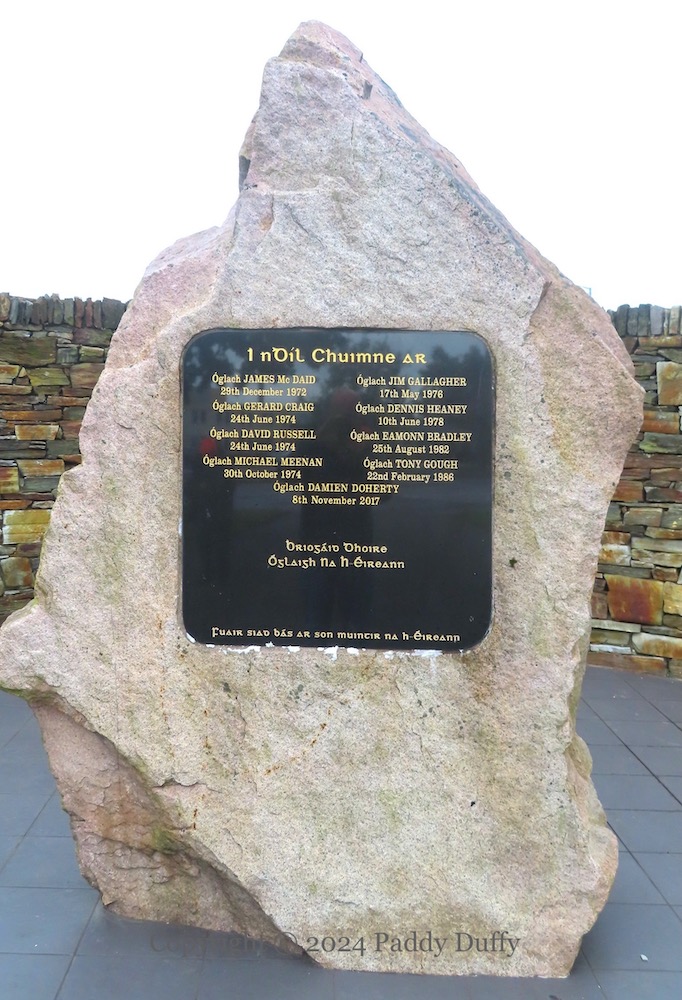
The IRA Derry Brigade/Brıogáıd Dhoıre Óglaıgh Na hÉıreann memorial at the shops on Racecourse Road, Shantollow, Derry, includes quotes from Robert Emmet (not: Emmett) – “When my country takes her place among the nations of the Earth, then and not until then let my epitaph be written” – and the 1916 Proclamation – “We declare the right of the people of Ireland, and to the unfettered control of Irish destinies to be sovereign and indefeasible” – in both English and Irish.
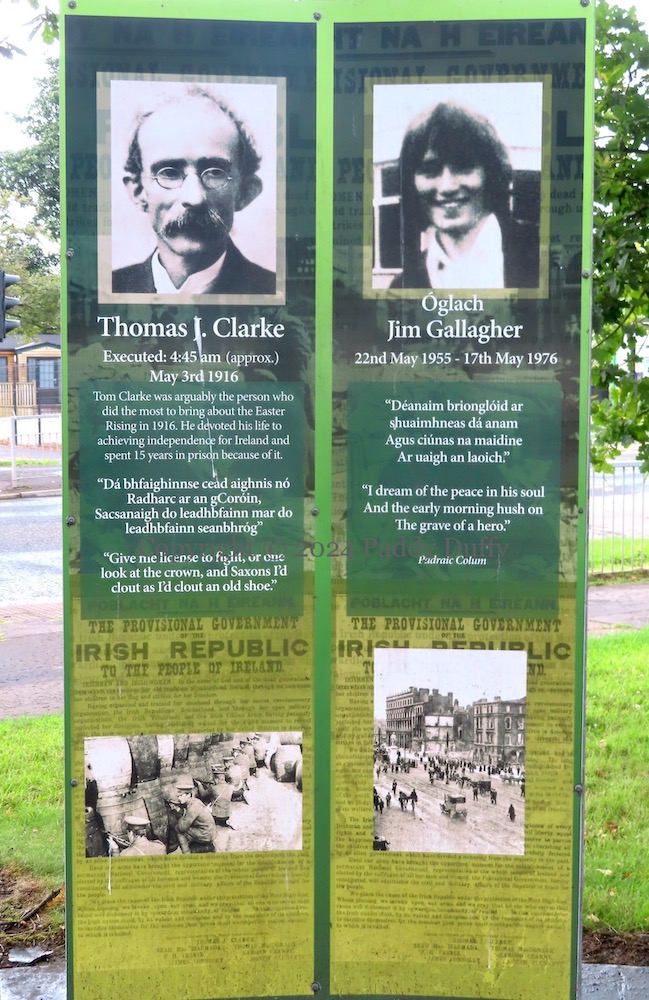
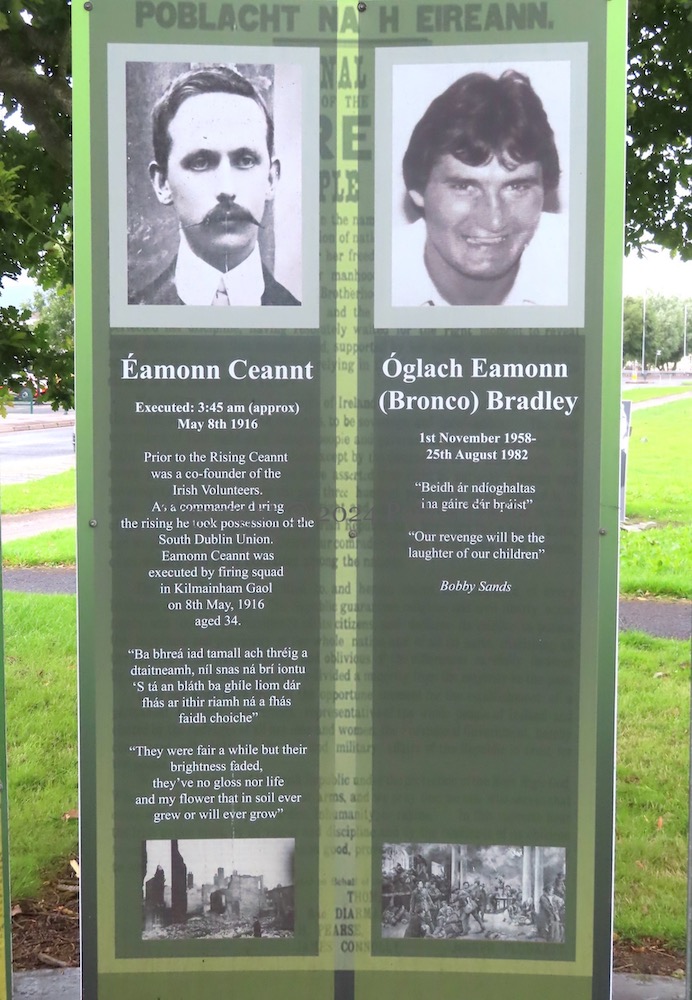
Seven members of the Derry Brigade are listed on the central stone: Junior McDaid, Gerard Craig, David Russell, Michael Meenan, Jim Gallagher, Dennis Heaney, Bronco Bradley, Tony Gough, and (a new addition compared to 2003) Damien Doherty. “Fuaır sıad bás ar son muıntır na hÉıreann”.
“Nuaır a ghlacfaıdh mo thír dhúchaıs a háıt cheart ı measc náısıún uıle an domhaın, ansın, agus chan go dtí sın, déanaıgí feartlaoı s’agamsa a scríobh amach. – Roıbéard Eıméıd 1803” – “When my country takes her place among the nations of the earth, then and not until then let my epitaph be written – Robert Emmett 1778-1803”
“Dearbhaıonn muıd gur cheart go mbeadh seılbh ag muıntır na hÉıreann ar thalamh na hÉıreann. Ba chóır ıad a bheıth ı gceannas ar thodhchaí na hÉıreann agus ar a dtarlóıdh dı amach anseo – Forógra na hÉıreann, An Cháısc 1916” – “We declare the right of the people of Ireland, to the ownership of Ireland, and to the unfettered control of Irish destinies to be sovereign and indefeasible – The Proclamation, Easter 1916”
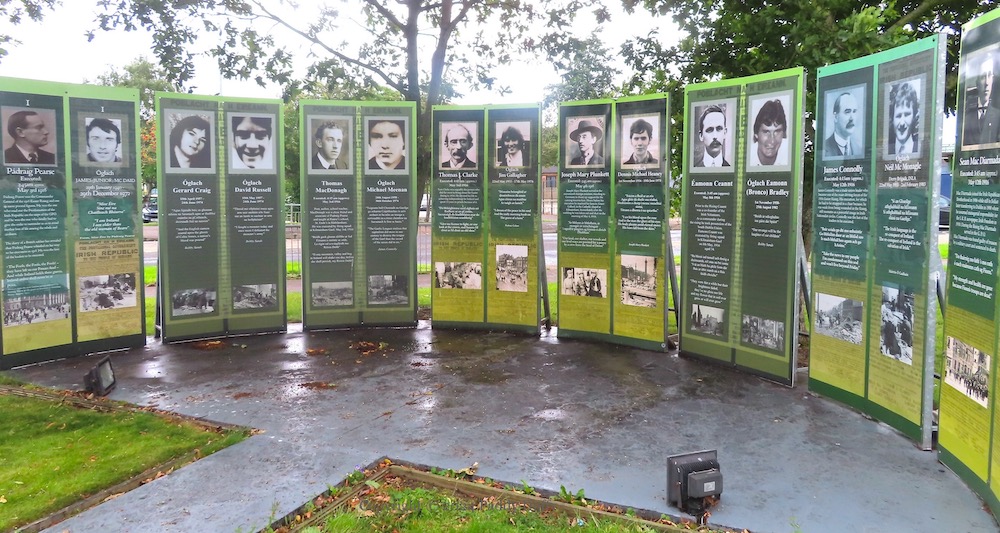
In this extension to the Shantallow memorial garden for the IRA’s Derry Brigade the seven signatories of the 1916 Proclamation, all of whom were executed following the Rising, are placed alongside nine Derry Brigade volunteers who died between 1972 and 1986.
Numbering the panels from left to right from 1 to 16, the seven are: (1) Pádraıg Pearse, (5) Thomas McDonagh, (7) Thomas Clarke, (9) Joseph Plunkett, (11) Éamonn Ceannt, (13) James Connolly, (15) Sean Mac Dıarmada. And the nine are (2) Junior McDaid d. 1972, (3) Gerard Craig d. 1974, (4) David Russell d. 1974, (6) Michael Meenan d. 1974, (8) Jim Gallagher d. 1976, (10) Dennis Heaney d. 1978, (12) Bronco Bradley d. 1982, (14) Neil McMonagle d. 1983, (16) Tony Gough d. 1986.
















 Paddy Duffy Collection