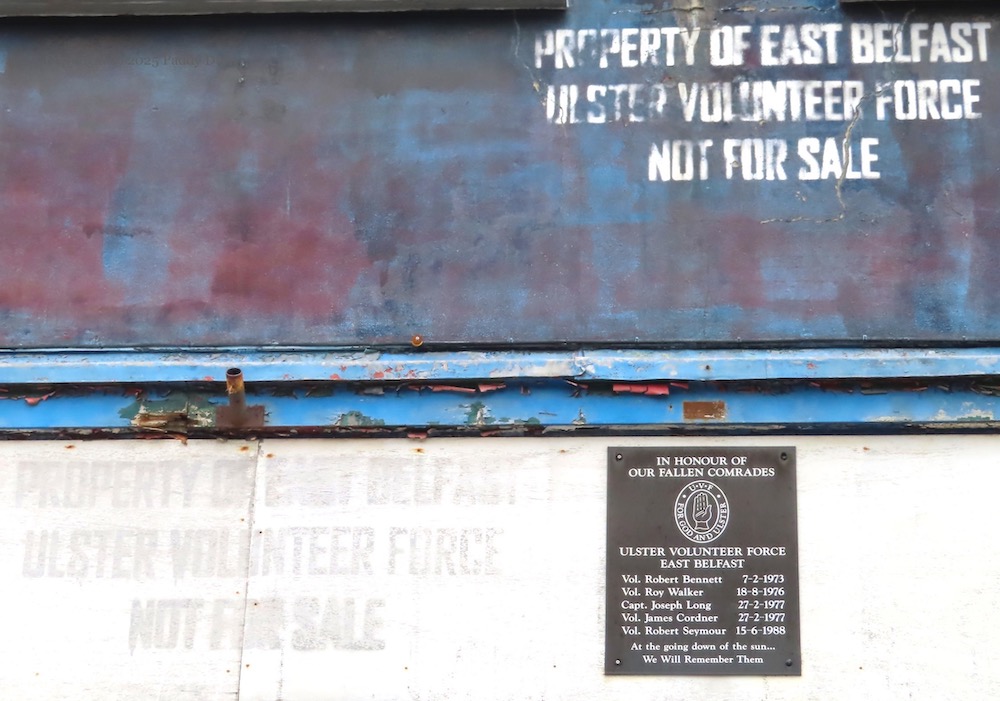
This notice is on the outside of the Belvoir Bar in east Belfast: “Property of east Belfast Ulster Volunteer Force – Not for sale” alongside a plaque to “fallen comrades” Robert Bennett, Roy Walker, Joseph Long, James Cordner, and Robert Seymour. It seems that the bar has been shuttered since 2011 (Belfast Telegraph | Irish Times).
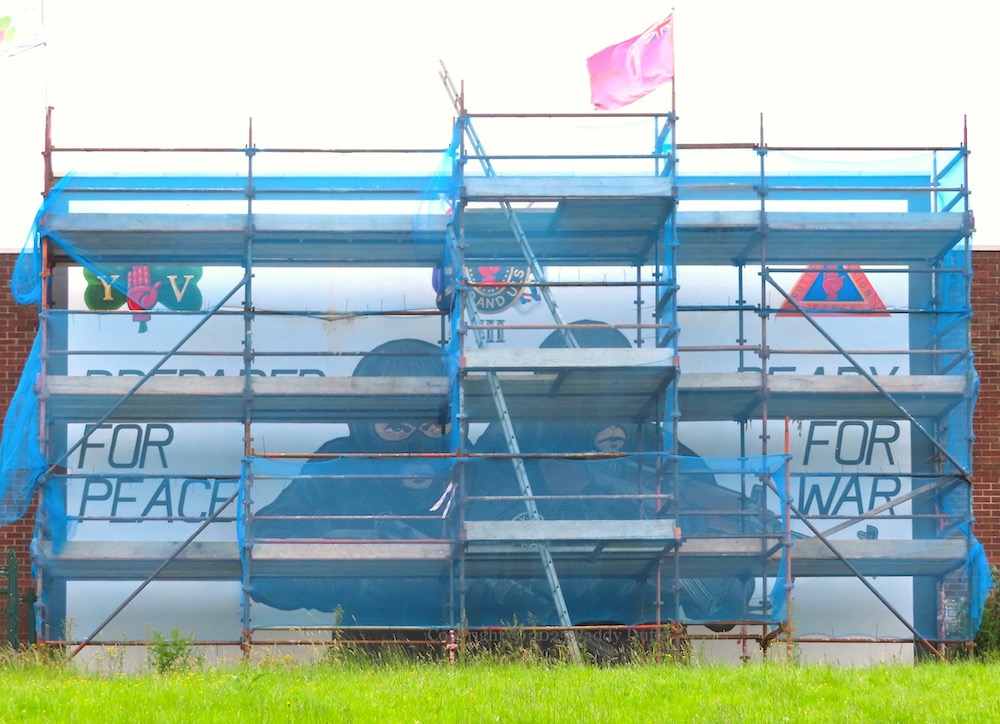
The UVF mural overlooking the entrance to Mount Vernon has been repainted after Storm Darragh back in December (2024) knocked down part of the wall it was painted on (see Taken By Storm) and the remainder of the wall was subsequently knocked down (see Prepared For Space, Ready For Wall).
There were local voices against the repainting of the mural (Sunday World) but after the wall (which is owned by the Housing Executive) was rebuilt, scaffolding went up at the end of March (BelTel) and painting began in June.
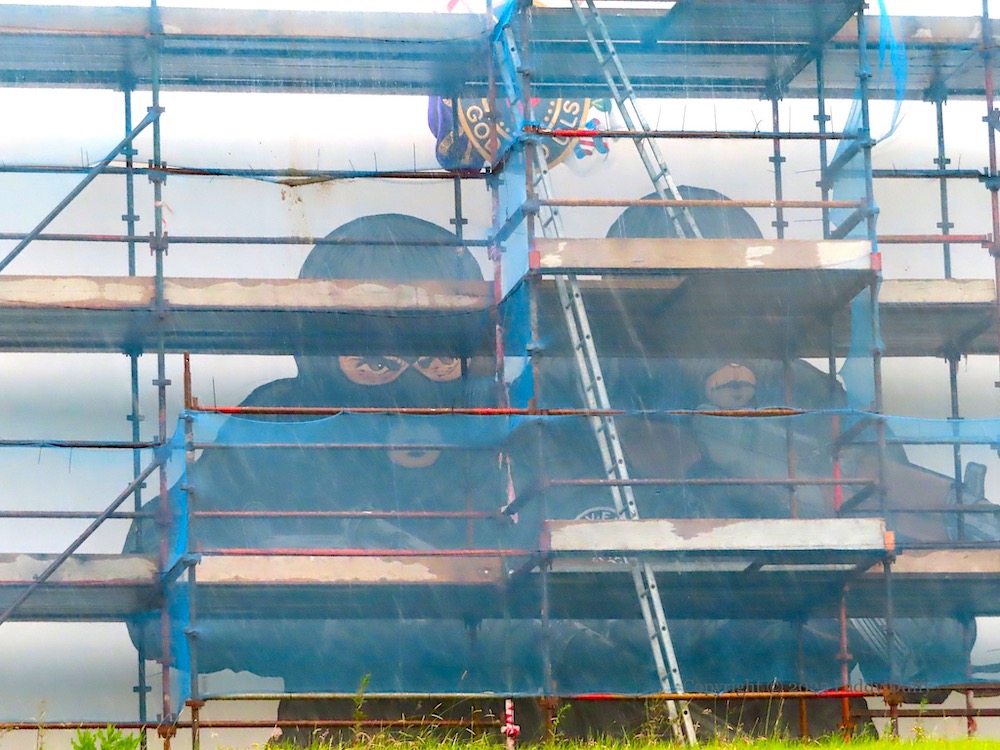
The mural will be officially launched at the Twelfth celebrations. The repainting has been criticised by the father of one UVF victim (BelTel). One (very) small mercy is that neither of the gunmen – from the North Belfast UVF – is directly confronting the viewer (including the drivers coming off the M2 at Fortwilliam.
Images of the completed mural are from June 26th; the in-progress images are as dated below.
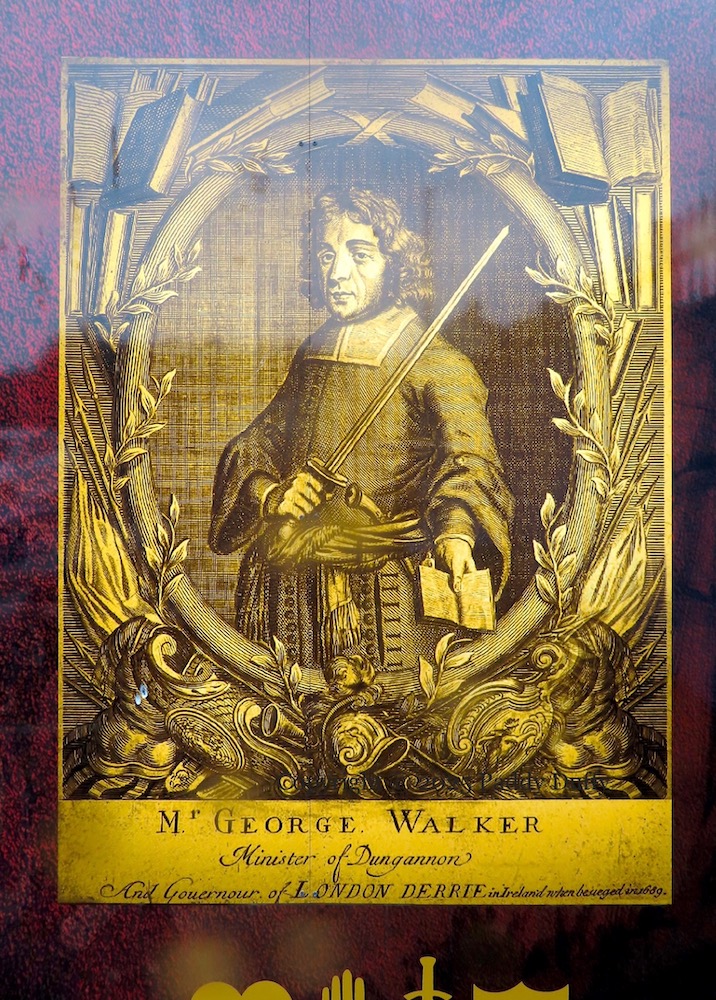
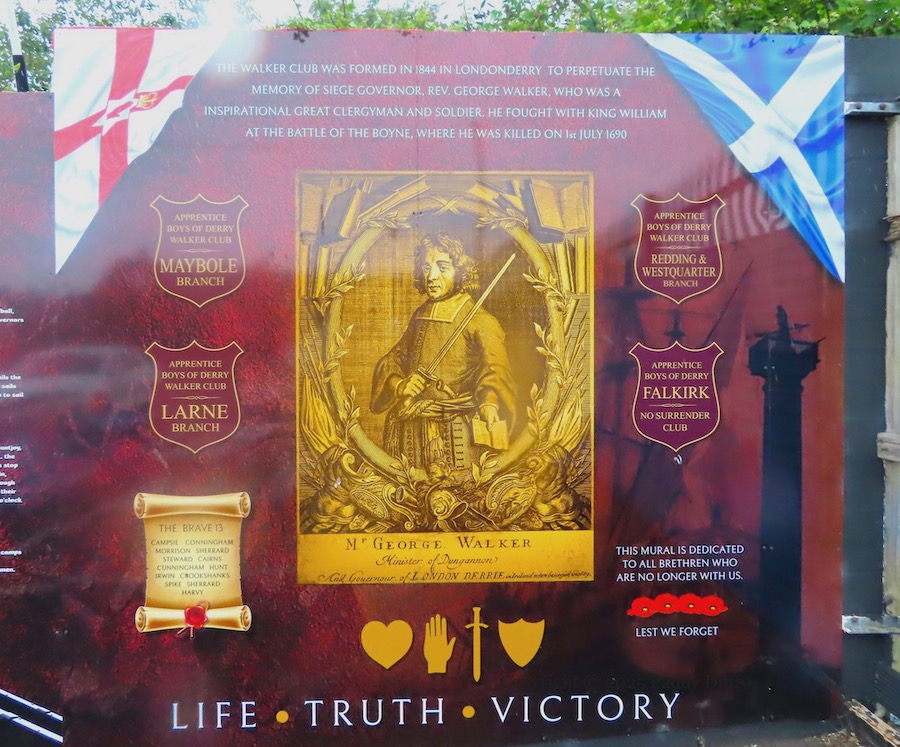
“Mr George Walker, Minister of Dungannon and Gouernour of London Derrie in Ireland when besieged in 1689.” Walker evacuated from Dungannon after Lundy’s troops pulled out and became joint governor of Derry after Lundy’s authority collapsed, first with Henry Baker and later with John Mitchelburne.
Walker put himself at the centre of his own “True Account Of The Siege Of London-Derry” (which can be read at archive.org) and drew criticism for minimising the role of Presbyterians (Walker was Anglican/CoI).
After the siege, Walker went on a victory tour of Scotland and England; while in London, he argued against a Derry trial for Lundy, on the ground that Lundy still had support there. He returned to Ireland in time to greet William III in June 1690 when William travelled from Carrickfergus to Belfast (see June 14th, 1690) and he went south with William to the Boyne, where he was shot and killed. (DIB | DIB | WP)
“The Walker Club was formed in 1844 in Londonderry to perpetuate the memory of siege governor, Rev. George Walker, who was a[n] inspirational great clergyman and soldier. He fought with King William at the Battle of the Boyne, where he was killed on 1st July 1690.”
The image of Walker is a line-engraving by John Savage, viewable at Sinclair Genealogy. “Life, truth, victory” is a translation of Londonderry’s Latin motto “Vita, veritas, victoria”.
These new boards are at the Rangers Supporters’ Club (Fb) in Boyne Square/Greenland, Larne.
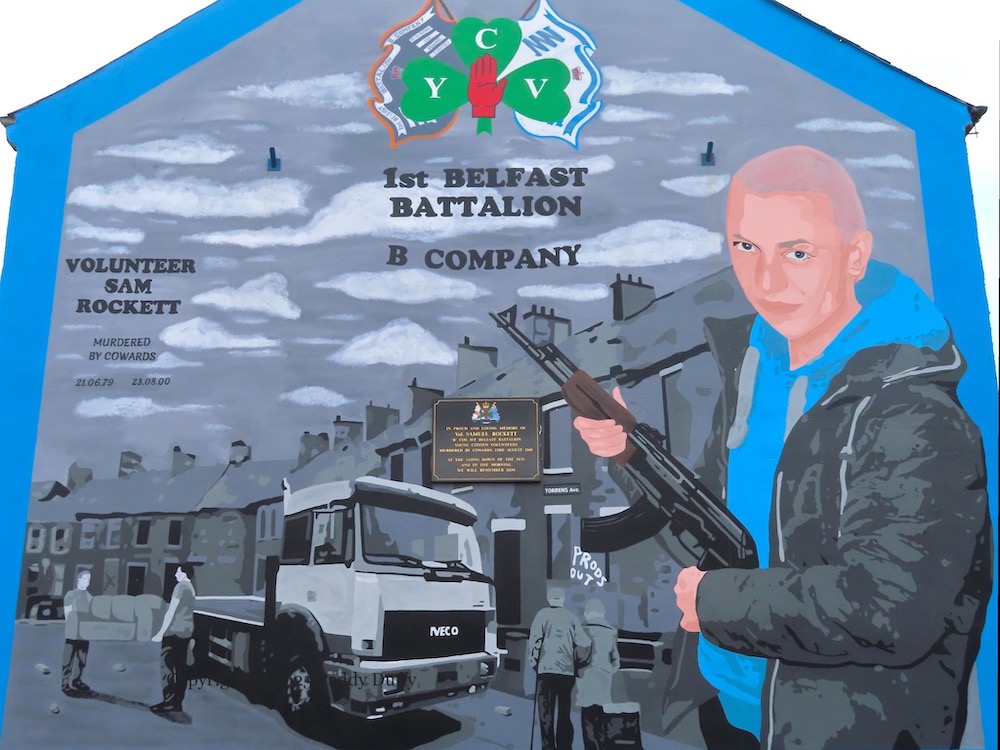
A few changes have been made to the Sam Rockett mural (compared to the 2023 original): Rockett’s hair has been lightened, the “Prods out” graffiti on the row of burned-out houses has been brightened, a simple “B Company” has replaced the smaller “1st Belfast Brigade, B Company”, and “Murdered by cowards 21.06.79 – 23.08.00” has been added on the left.
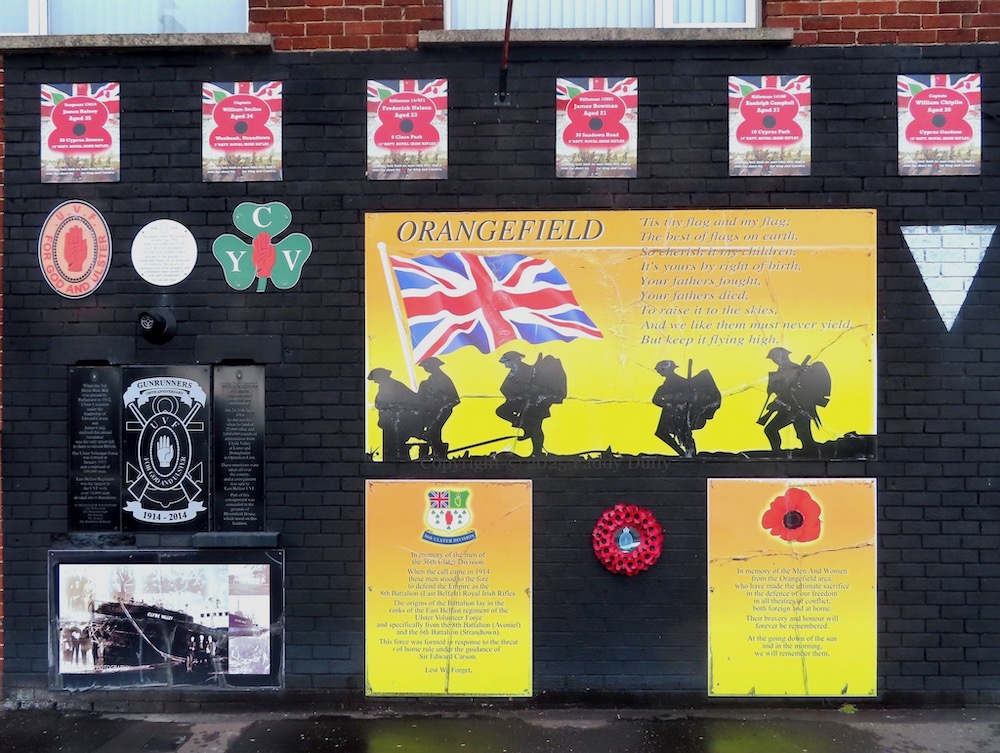
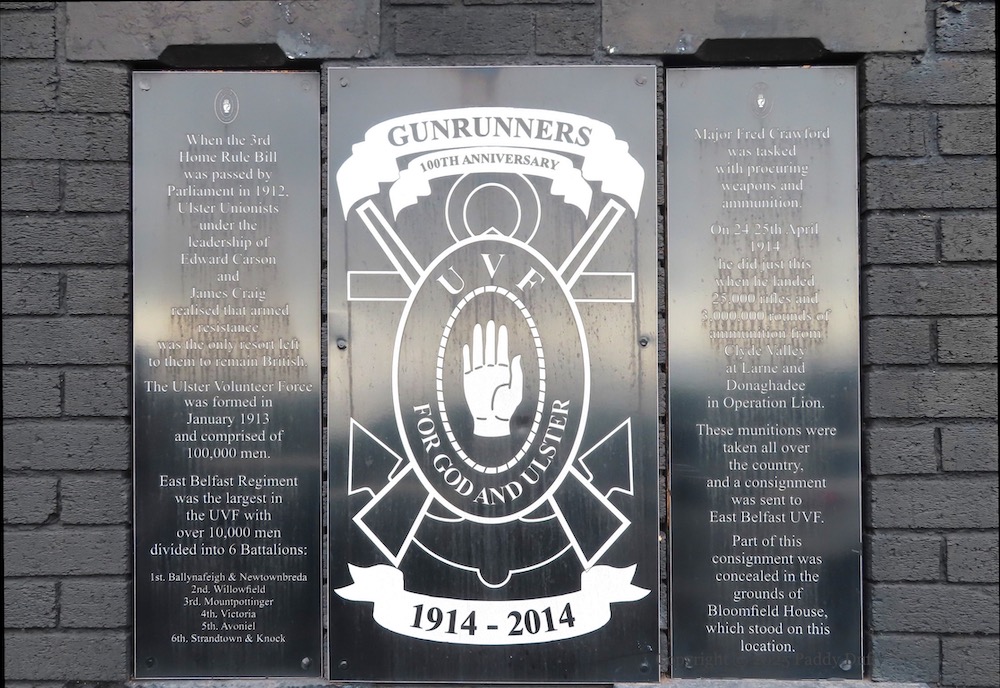
The image above shows a unified and wider view of the two pieces seen previously in Bloomfield House and In All Theatres Of Conflict: on the left, a board marking the centenary of the Ulster Volunteers’ ‘Larne Gun-Running’; on the right, a board commemorating the casualties from the 36th (Ulster) Division in WWI; above them both are small boards from the ‘Poppy Trail’ collection of deceased locals.
Korda’s famous photograph of the 31-year-old Che Guevara was taken in Havana, Cuba, in 1960, and was turned into the ubiquitous two-tone poster by Irish artist Jim Fitzpatrick in 1968. (For a more complete history of both the photo and the print, see the Visual History page on the influence of Jim Fitzpatrick.) This very faithful reproduction of Fitzpatrick’s Che is in Glen Road, Maghera.
“Marcella”, in the bottom right, might be the name of the artists; Bobby Sands used his sister’s name – “Marcella” – to sign the pieces that he wrote for newspapers outside Long Kesh.
The central space in Ardoyne’s Easter Rising centenary wall, combining stencils of the signatories to the Proclamation around a tarp of the document (see In Commemoration Of 1916) has been empty – except for some electoral signs – since 2019’s board marking the centenary of Sınn Féın (see Still The People Spoke). This new tarp returns to the Proclamation and Easter lily and matches the frame of signatories once more.
The last full mural on the wall fell down in 2014 and there does not appear to have been the energy to paint another full mural since then – but perhaps the fading paint around Clarke and Connolly will provoke a complete re-do.
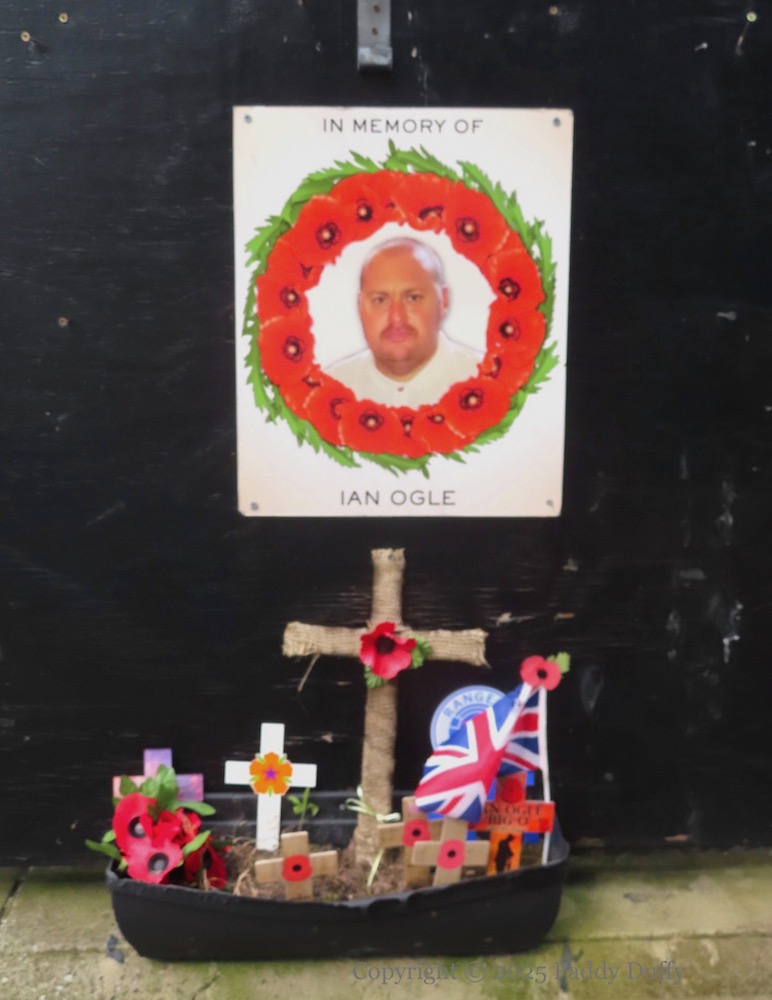
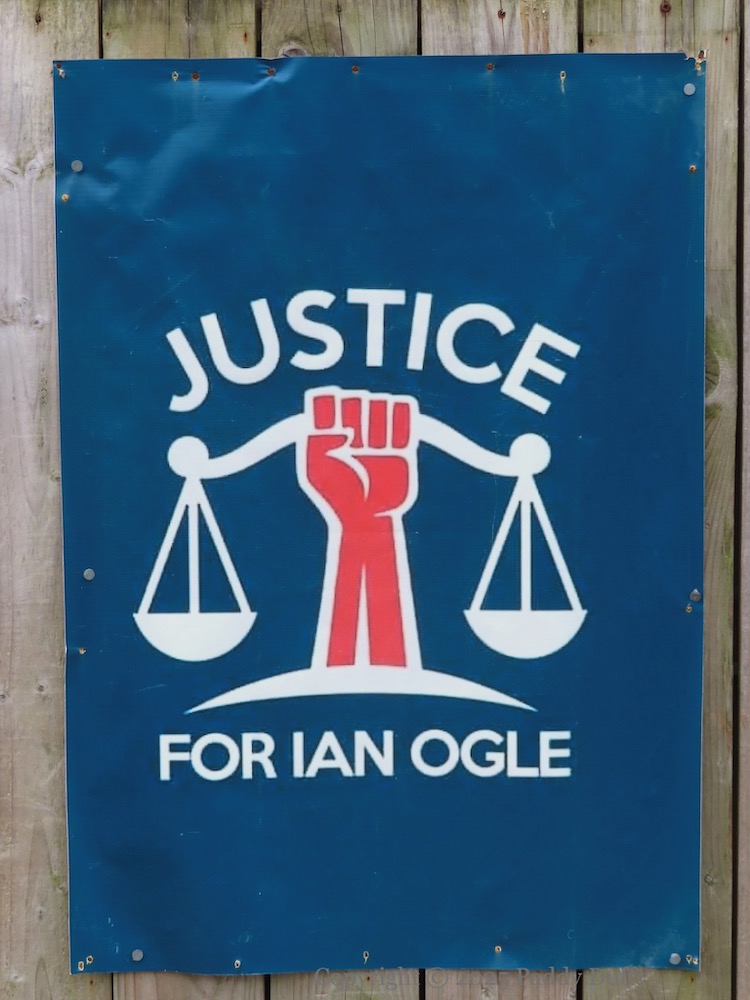
This is (at least) the third different tarp at the entrance to Cluan Place in memory of Ian Ogle, who was killed on the evening of January 27th, 2019. Five people have been found guilty of the murder and officially received their sentences in March; four others have been convicted of lesser charges (BBC | ITv | Belfast Media | Judiciary NI).
The small board “In memory of Ian Ogle” (immediately below) is also a recent addition.
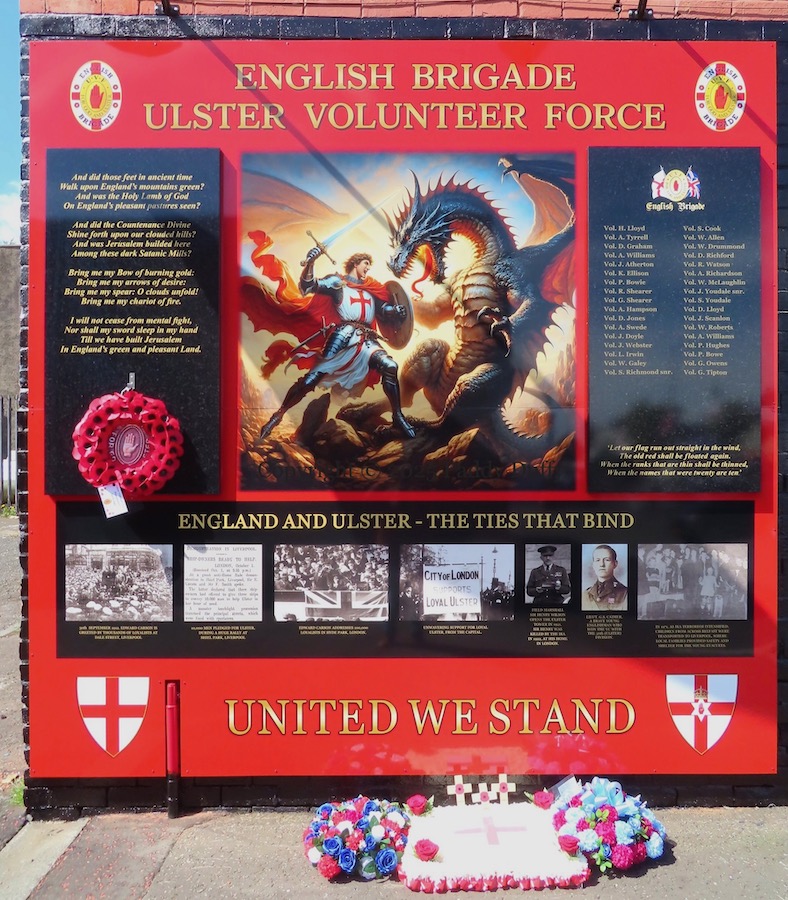
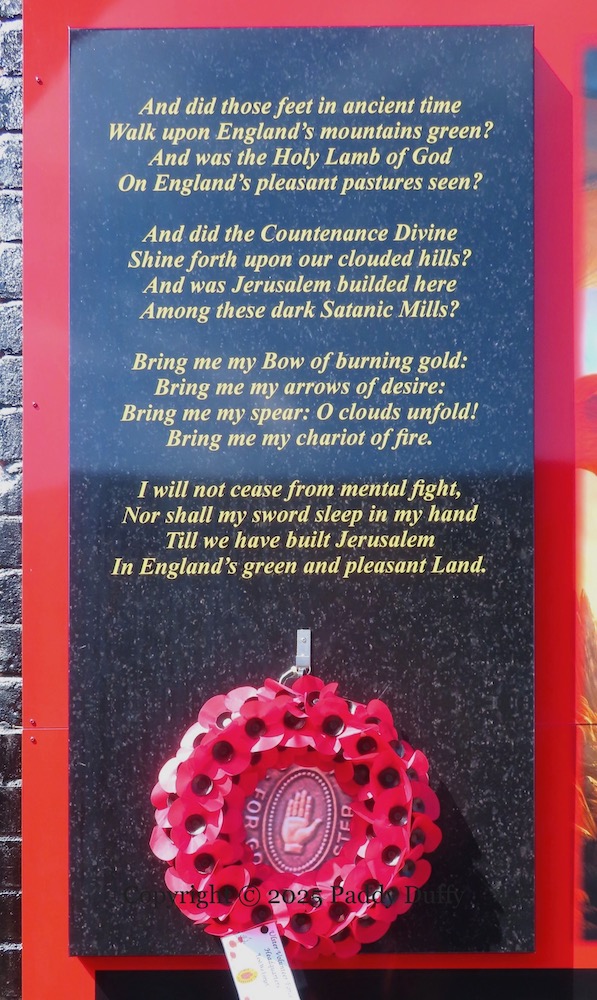
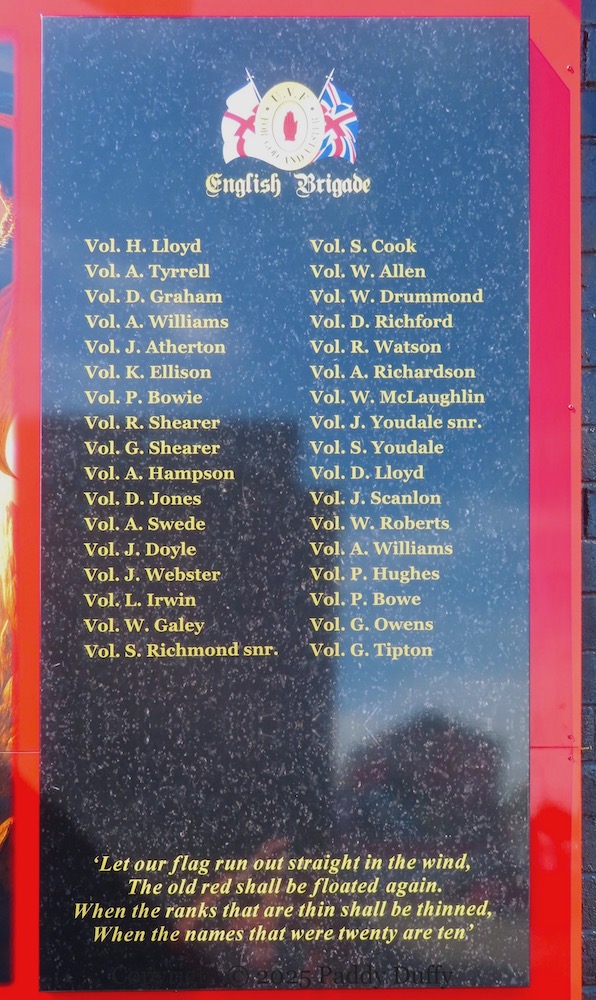
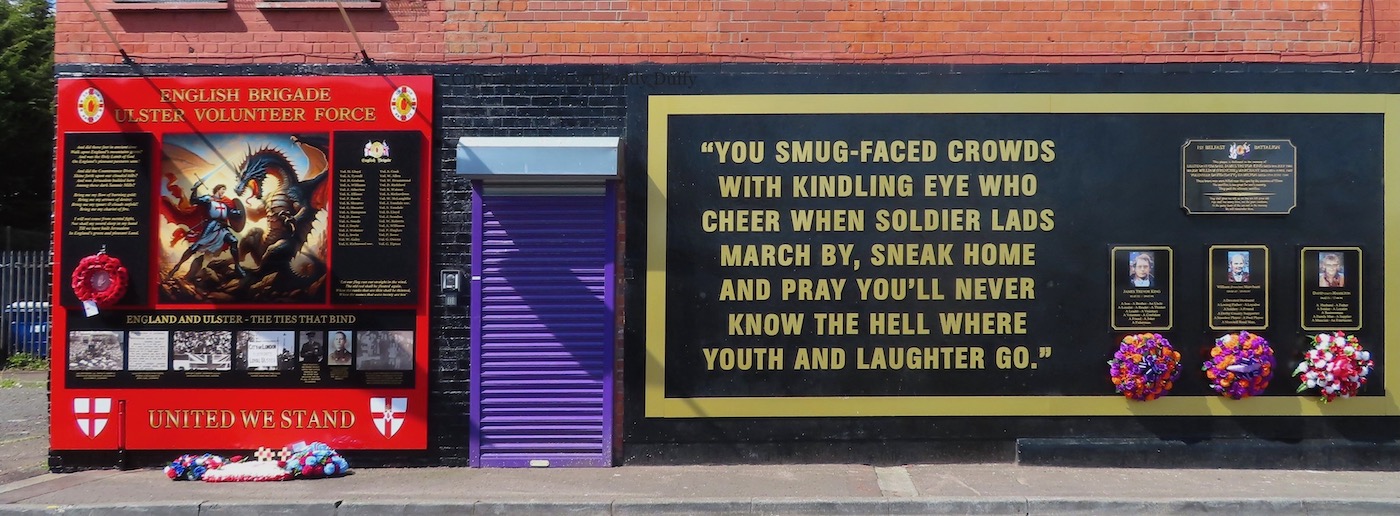
“English Brigade Ulster Volunteer Force.” “England and Ulster – the ties that bind.” “United we stand.”
On the left are the words from William Blake’s poem, which also serve as the lyrics to the hymn Jerusalem.
“Let our flag run out straight in the wind/The old red shall be floated again./When the ranks that are thin shall be thinned/When the names that were twenty are ten.” [from Swinburne’s A Song In Time Of Order which was also used as a socialist song]
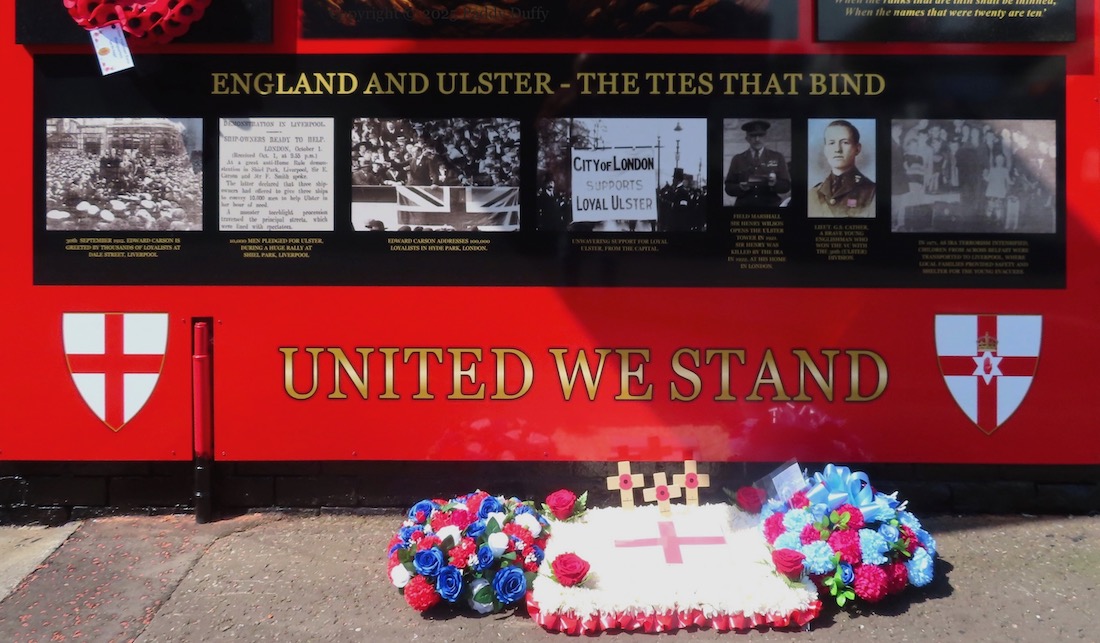
The images along the bottom illustrate the connection between Northern Ireland and England. From left to right: Edward Carson in Liverpool in 1912; 10,00 pledges from Liverpool men; Carson addressing 100,000 people in Hyde Park, London; a banner reading “City of London supports loyal Ulster”; “Field Marshall Sir Henry Wilson opens the Ulster Tower in 1921. Sir Henry was killed by the IRA in 1922 at his home in London”; GS Cather, VC winner with the Ulster Division; evacuees to Liverpool in 1973.
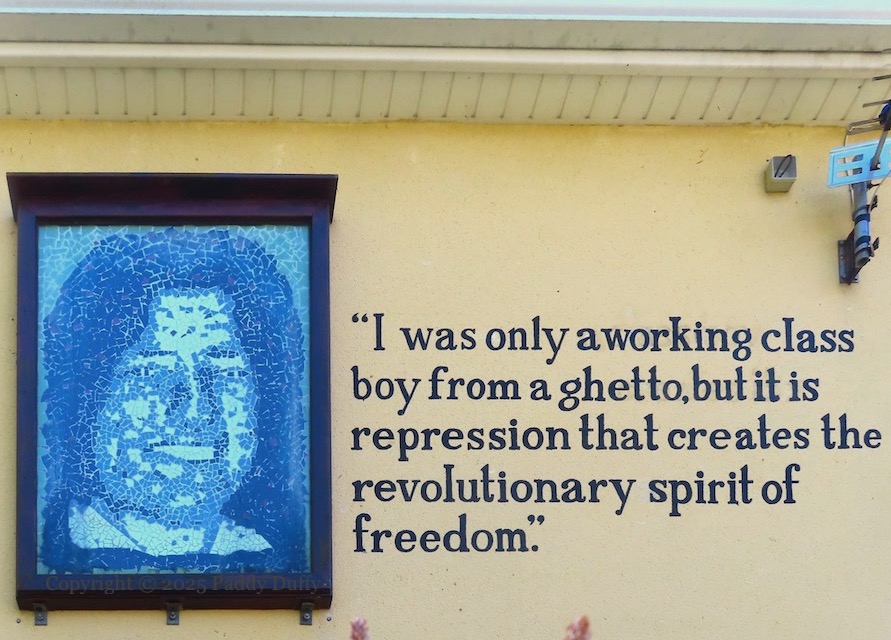
“I was only a working class boy from a [nationalist] ghetto, but it is repression that creates the revolutionary spirit of freedom.” This is a widely-quoted line from Bobby Sands, from an article in Republican News, 16 December, 1978 (page 7 pdf).














 Paddy Duffy Collection