“Britain’s genocide by starvation”, “Ireland’s holocaust 1845-1849”, “Over 1,500,000 deaths”. The great hunger is depicted using images from Illustrated London Newses of the time (see the Visual History page on an gorta mór).
The mural was begun in 1995 and was still in development in 1997. Whiterock Road, west Belfast
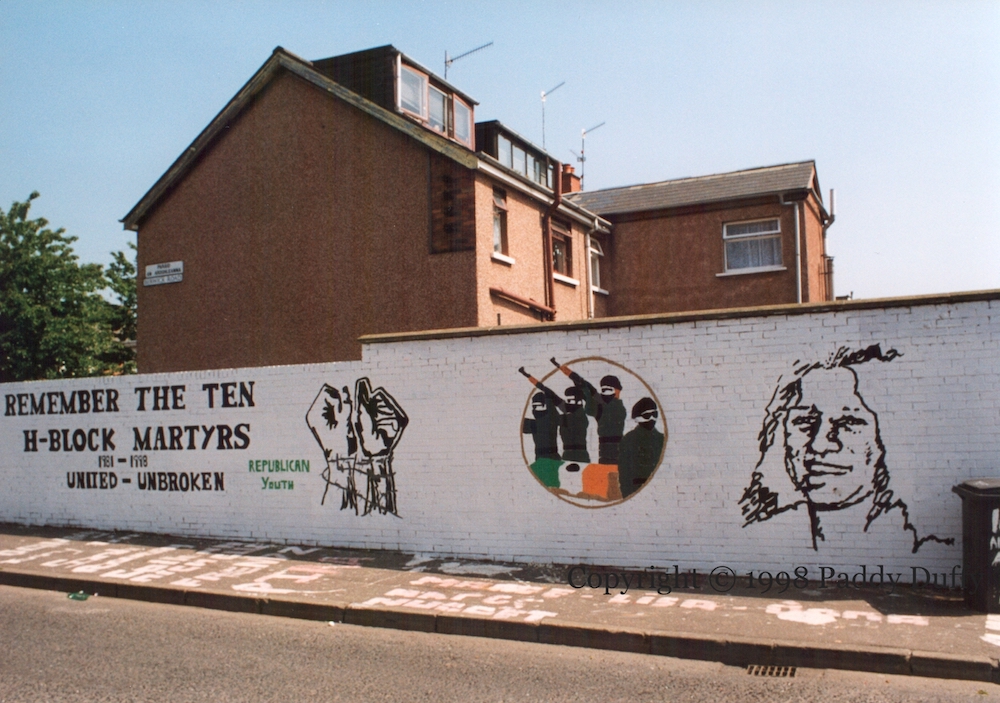
“Remember the ten H-Block martyrs. 1981-1998. Unbowed – unbroken.” With a pair of fists in barbed wire, a funeral volley fired over a coffin covered with Tricolour and beret, and a line-drawing of Bobby Sands. Signed “Republican Youth”
Berwick Road/Paráıd An Ardghleanna, Ardoyne,Ard Eoın, north Belfast/tuaısceart Bhéal Feırste
This painting of James Connolly in ICA uniform is perhaps based on Harry Kernoff’s woodcut, though with a wider head and background changed to show two flag-bearers standing on a high wall.
Berwick Road/Paráıd An Ardghleanna, Ardoyne,Ard Eoın, north Belfast/tuaısceart Bhéal Feırste
The main panels commemorate 25 years of “unbowed, unbroken” resistance in east Belfast (probably dating to the Battle Of St Matthew’s (WP) in 1970) with portraits of 16 deceased locals (“I measc laochra na nGael go raıbh a naınmeacha”) and two verses from Bobby Sands’s poem Weeping Winds(see below), on either side of Érıu the mythological queen of Ireland/Éıre as designed by Richard J King/Rísteard Ó Cíonga.
On the right (in the second image) is a copy of the 1916 Proclamation.
Oh, whistling winds why do you weep/When roaming free you are, Oh! Is it that your poor heart’s broke/And scattered off afar? Or is it that you bear the cries/Of people born unfree, Who like your way have no control/Or sovereign destiny?
Oh! Lonely winds that walk the night/To haunt the sinner’s soul/ Pray pity me a wretched lad/Who never will grow old. Pray pity those who lie in pain/The bondsman and the slave And whisper sweet the breath of God/Upon my humble grave.
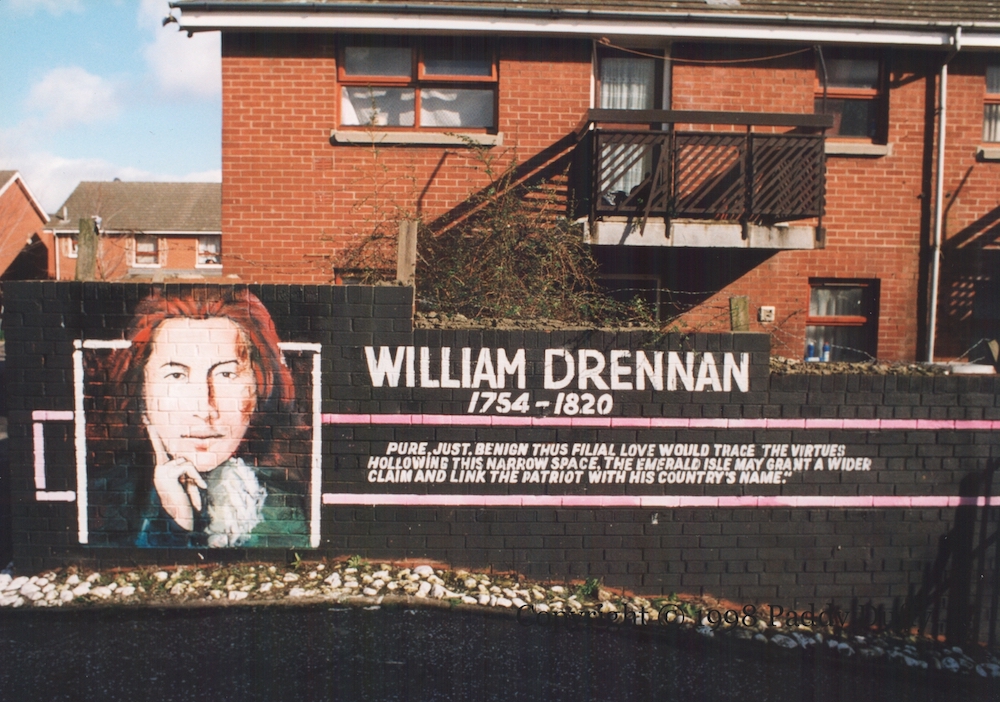
This is a trio of murals along the New Lodge Road to William Steel Dickson, William Drennan, and Mary Ann and Henry Joy McCracken. What the three have in common is that they were all Presbyterians and Irish republicans, and members of the Society Of United Irishmen.
William Steel Dickson was adjutant-general of the County Down Irishmen (see the blue plaque in Portaferry M08948) and was arrested a few days before the insurrection (WP). Like the McCrackens, he is buried in Clifton Street Cemetery.
William Drennan, 1754-1820, was a doctor, poet, a founder of the Society of United Irishmen, and the first person to refer to Ireland as “the Emerald Isle”, in his poem When Erin First Rose. The words in the mural are the epitaph on his stone in Clifton Street Cemetery: “Pure, just, benign. Thus filial love would trace the virtues, hollowing [sic] this narrow space. The Emerald Isle may grant a wider claim and link the patriot with his country’s name.”
Mary Ann McCracken (“What a wonderful clamour is now raised at the name of union, when in reality there has always been such a union between England and this country, as there is between husband and wife by which the former has the power to oppress the latter.”) and her older brother Henry Joy McCracken (“These are the times that try men’s souls … the rich always betray the poor.”) are the best-known of the figures. Henry led the Antrim uprising of the United Irishmen in 1798 and was executed for it; Mary Ann was an abolitionist and social reformer.
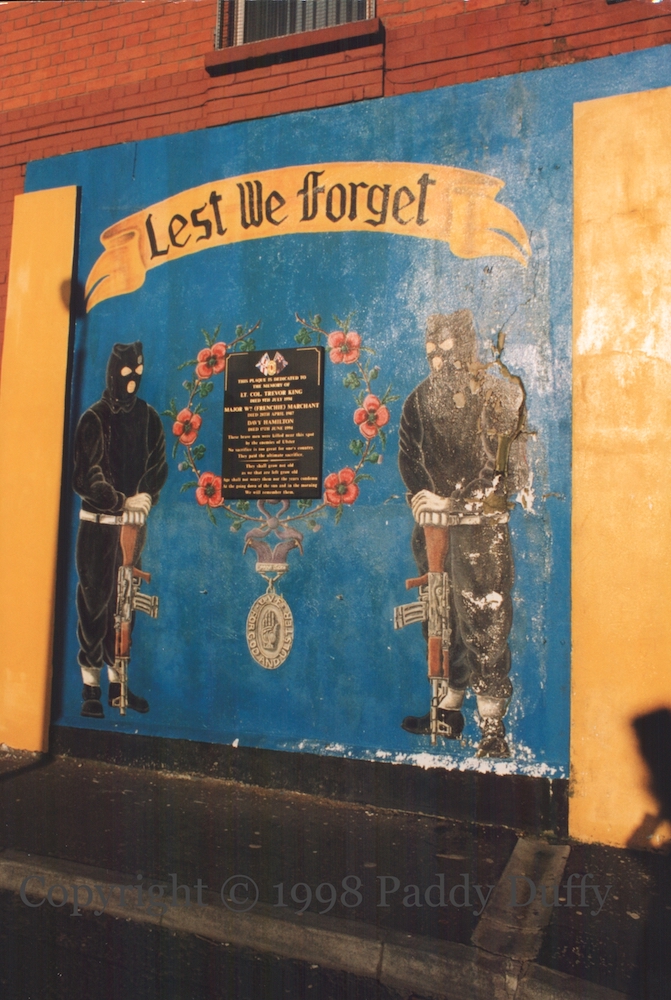
“This plaque is dedicated to the memory of Lt. Col. Trevor King, died 9th July 1994, Major Wm. (Frenchie) Marchant, died 28th April 1987, Davy Hamilton, Died 17th June 1994. These brave men died near this spot [the corner of Spier’s Place and Shankill Road, Belfast] by the enemies of Ulster. No sacrifice is too great for one’s country. They paid the ultimate sacrifice. ‘They shall grow not old/as we that are left grow old/Age shall not weary them nor the years condemn/At the going down of the sun and in the morning/We will remember them.’”
King and Hamilton (along with Colin Craig, an RUC informer and not included on the plaque) were shot by the INLA and died of their wounds three weeks and one day later. Frenchie Marchant was shot by the IRA outside The Eagle chip shop. The plaque is surrounded by a garland of three nation’s flowers: shamrock, rose, and thistle.
Spier’s Place, west Belfast. This is a new, larger, plaque, compared to previously.
A collage of image from the previous 30 years, including banging bin-lids on the ground, Maıréad Farrell in Armagh prison, men on the blanket, the cages of Long Kesh, marches in support of the hunger strikers, and reproductions of various posters, against Margaret Thatcher, plastic bullets, internment, and censorship. There’s a quote from Bob Dylan in the middle, “How many times can a man turn his head and pretend that he just doesn’t see – the answer, my friend, is blowing in the wind, the answer is blowing in the wind.”
A Robert Emmet mural was painted by Robbie Kane in 1953 (for the 150th anniversary of the 1803 rebellion and his execution) in Crumlin Street. This was one of a very few CNR murals painted prior to the Troubles, and nationalist symbols were formerly outlawed in the Flags And Emblems Act of 1954. (See Visual History 02.) As can be seen below, the original was accompanied by a Christian cross and the words “Hail Christ our king”. This version reproduces only the two medallions, showing a Celtic harp (left) and a dramatic portrait of Emmet waving his hat, from the mid-1800s (WP/LoC).
This image of an RUC officer aiming a plastic-bullet gun is the central panel of a mural at the top of Springhill Avenue that would otherwise go unfinished.
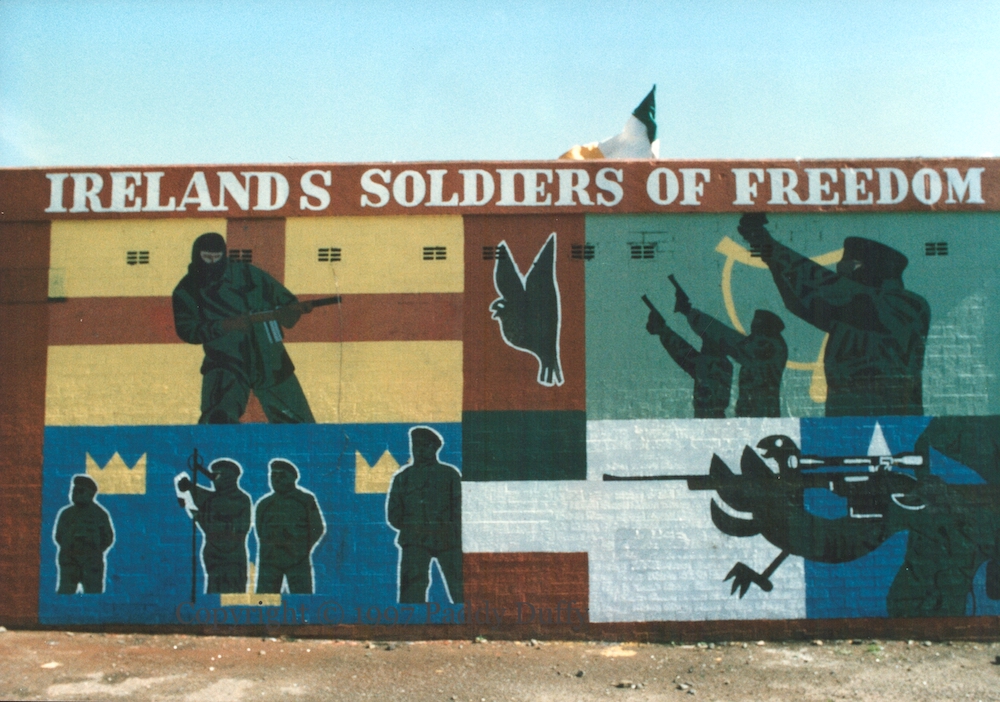
IRA volunteers are superimposed upon the flags of the four provinces. In the top left (Ulster) and bottom right (Connacht) they are aiming weapons (one with a sniper’s scope), while in the top right (Leinster) they are firing a funeral volley, and in the bottom left (Munster) are reading a statement at a microphone; in the middle are a lark and a Tricolour.
South Link, Andersonstown, west Belfast, replacing the even-more-heavily armed volunteers in Beıdh Ár Lá Lınn.






 Paddy Duffy Collection