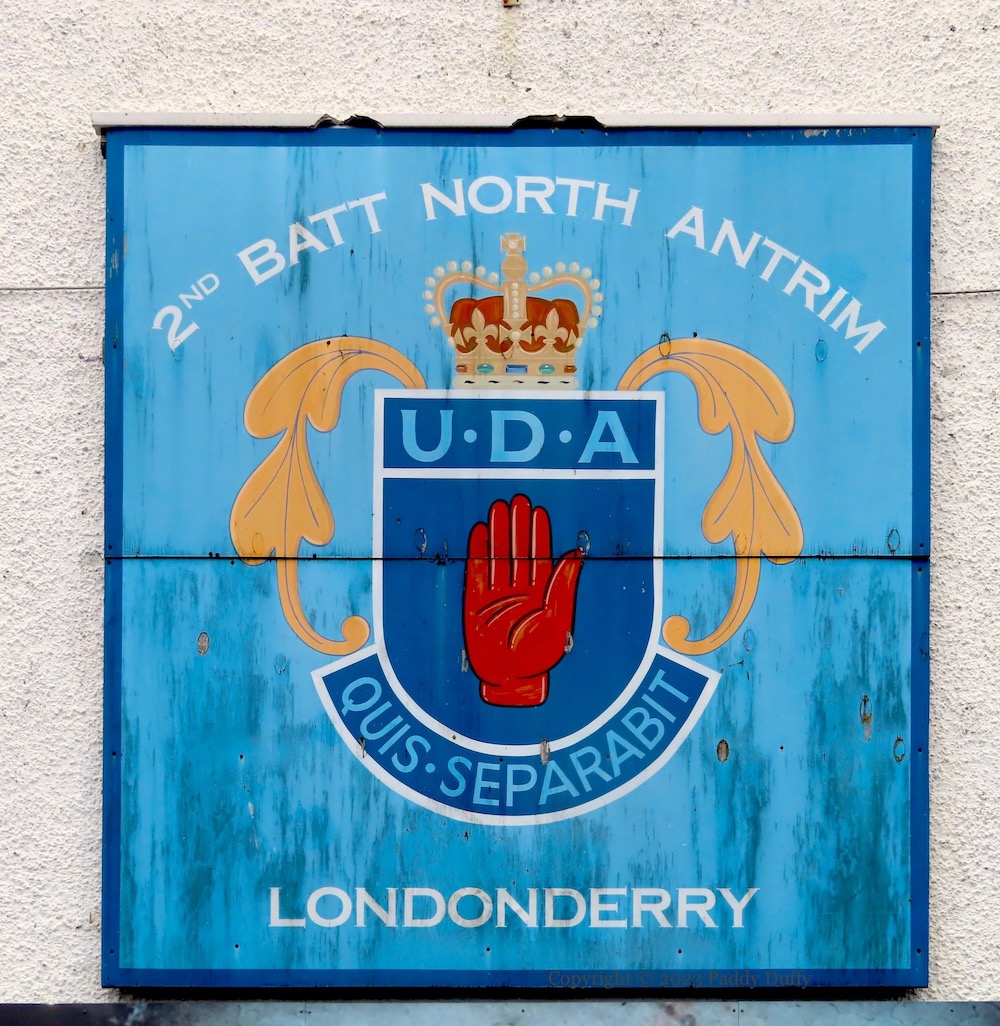
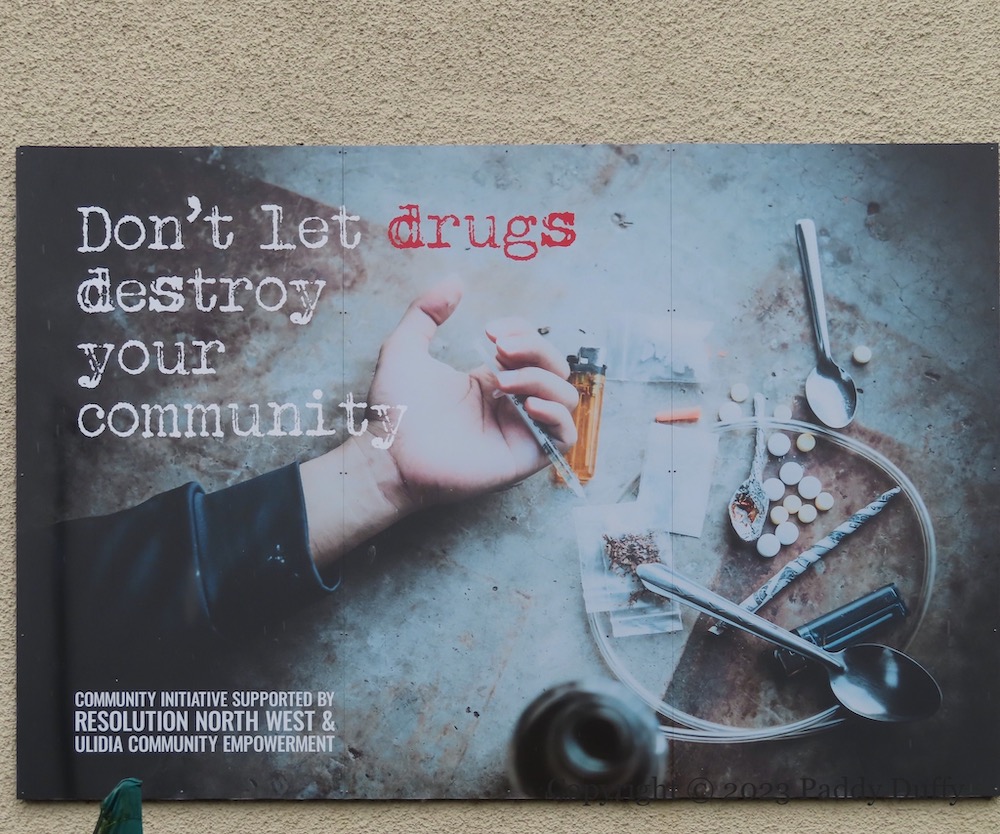
An anti-drug-dealing message (see Peace Impact Programme) has been added below the (2nd battalion North Antrim & Londonderry) UDA emblem (seen previously in 2012) in Linden Avenue, Coleraine.
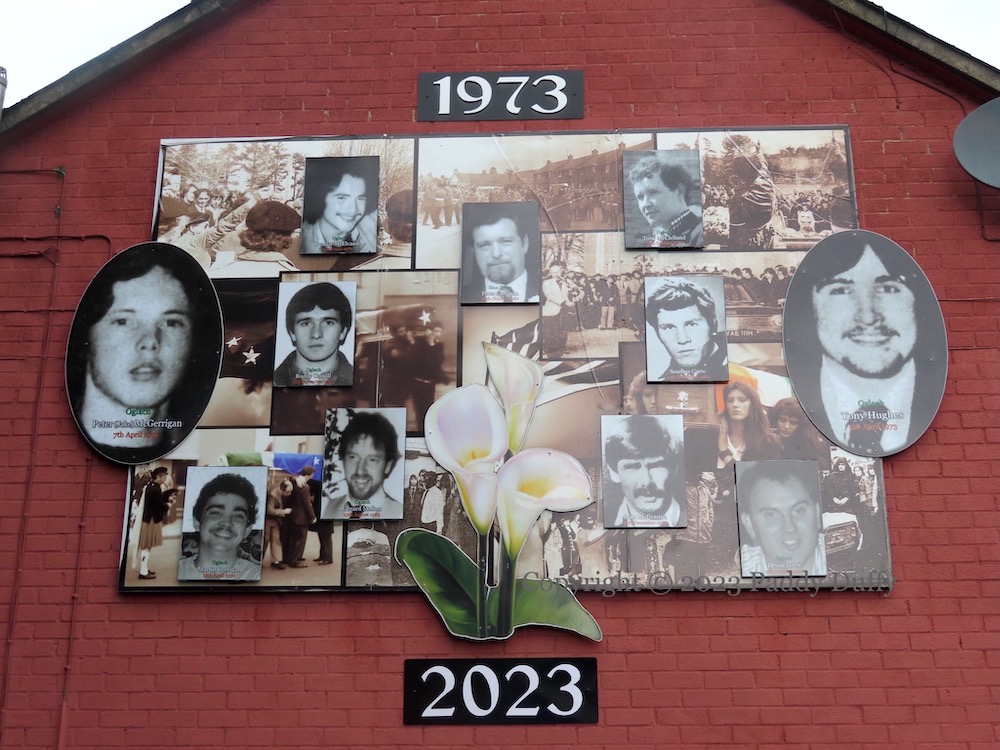
Jake McGerrigan and Tony Hughes of the OIRA were both shot and killed by British forces in the Windmill Hill area of Armagh in a 48-hour period spanning April 7th and 9th, 1973. (Lost Lives #791 incorrectly gives March 7th for McGerrigan.) The board shown above was mounted in Navan Street for the 40th anniversary of their deaths, in 2013, and the lower date has now been updated for the 50th anniversary.
The larger portraits on either side are of McGerrigan and Hughes; between them are (left) Peadar McElvanna, Roddy Carroll, Gerard Mallon, Martin Corrigan, (middle) Peter Corrigan, (right) Tony McClelland, Seamus Grew, Sean McIlvanna [McIlvenna], Dessie Grew.
There is an individual plaque to Hughes (shown immediately below) at the spot where he was shot and a stone (shown below; for text see McGerrigan – Hughes) to both of them in the same alley; there is also a stone (not shown) to McGerrigan in Windmill Avenue. (Video of Jake McGerrigan’s funeral.)
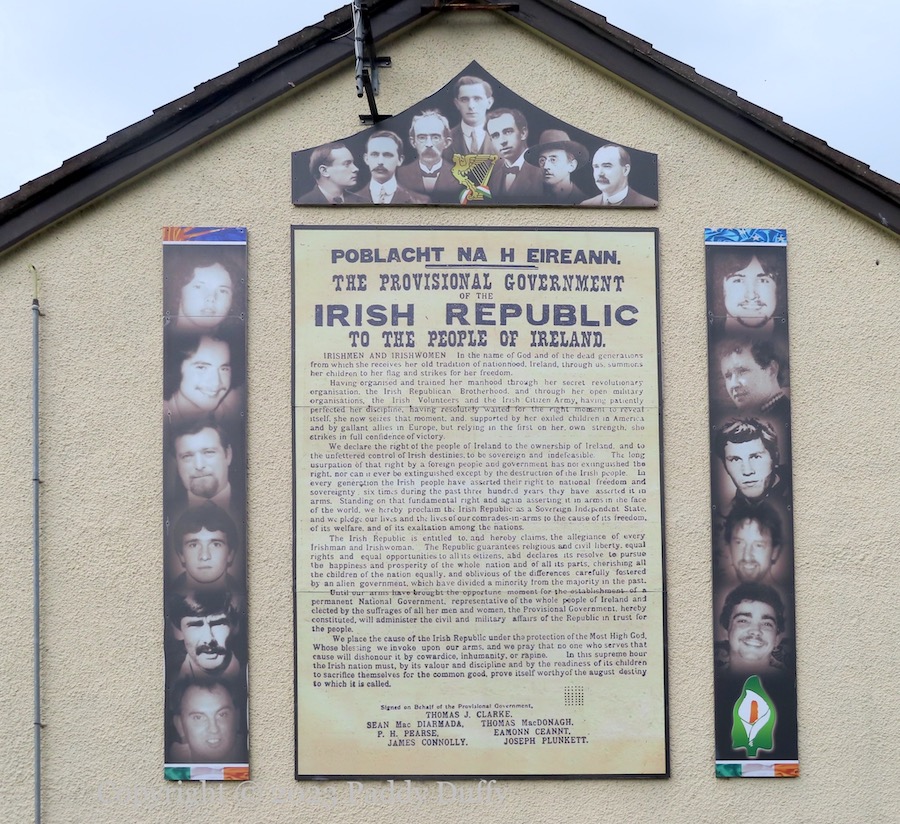
In the apex of the gable are the seven signatories to the 1916 Proclamation — all of whom were executed after the rising — and to the left and right of the text of the Proclamation are IRA dead from 1973 to 1990.
Left, top to bottom: Jake McGerrigan, Peadar McElvanna, Peter Corrigan, Roddy Carroll, Sean McIlvanna [McIlvenna], and Dessie Grew.
Right: Tony Hughes, Tony McClelland, Seamus Grew, Martin Corrigan, and Gerard Mallon.
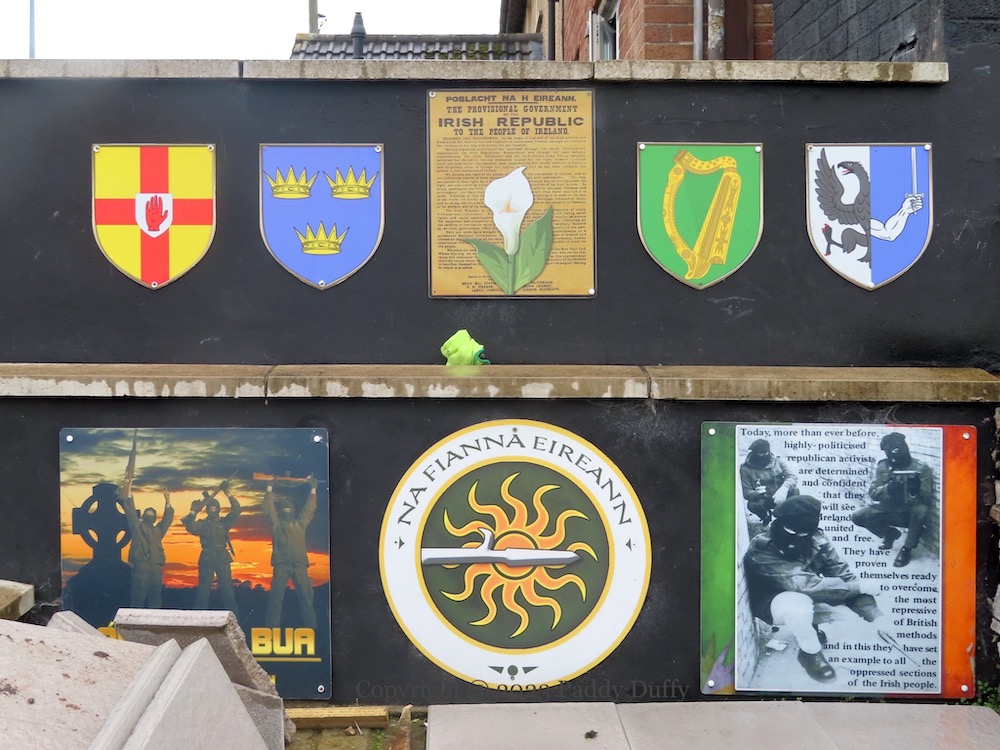
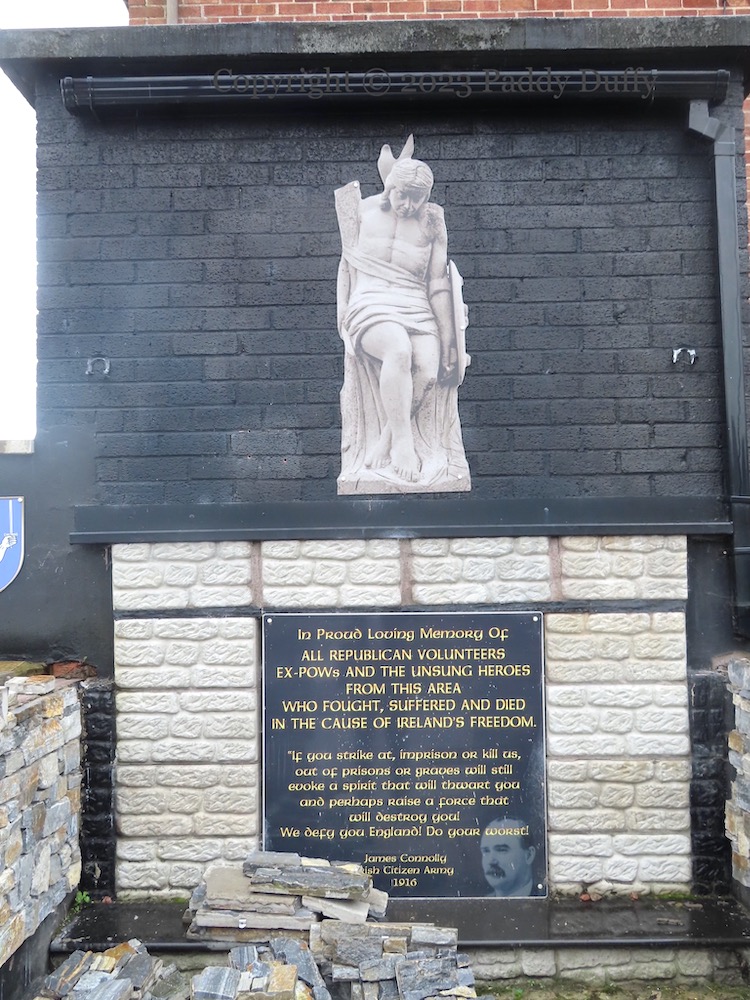
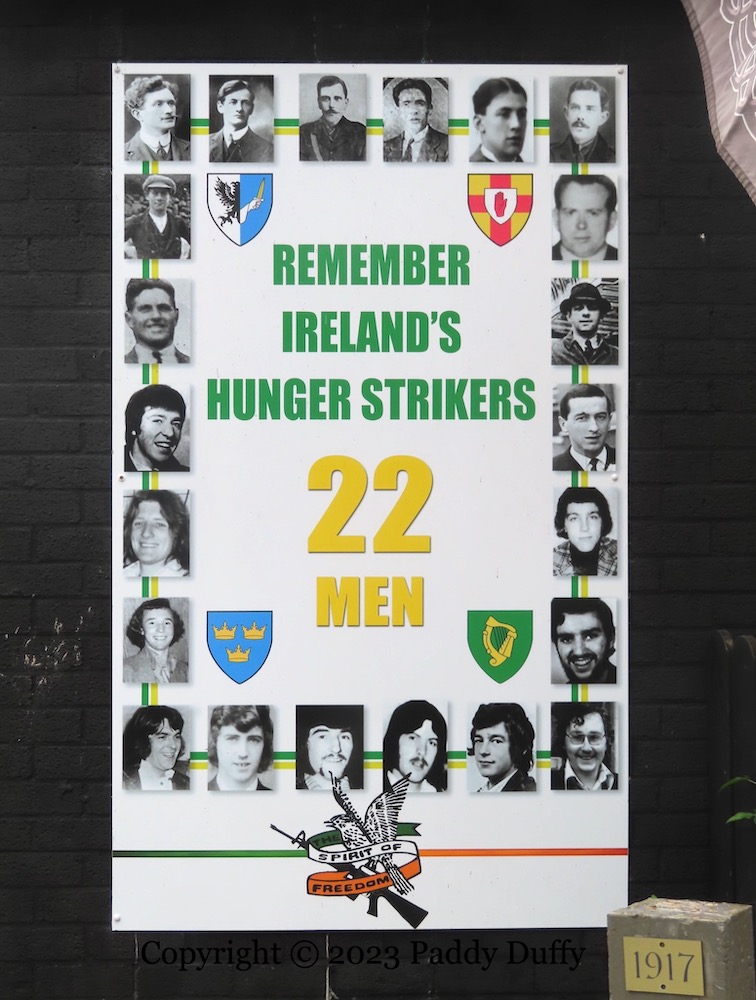
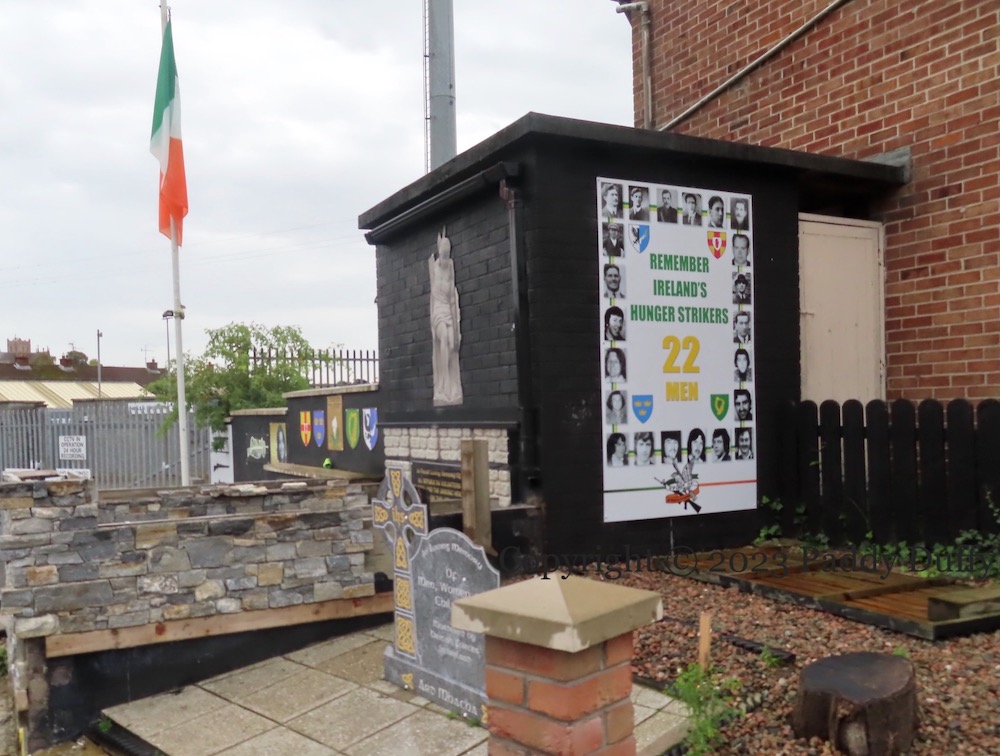
There is a memorial garden to the history of Irish resistance at the entrance to the Athletic Grounds in Armagh. From left to right, the images presented here show:
“More than 800 years of Irish resistence” – a sword for the Norman invasion under Strongbow, a pike for the 1798 and 1803 rebellions, a bolt-action rifle for the Easter Rising of 1916, and an assault rifle for the Troubles;
Cumann Na mBan, Mairéad Farrell and republican women who made “the supreme sacrifice”;
The Proclamation, Provisional IRA and Na Fianna;
The dying Cú Chulainn and a plaque “in proud and loving memory of all republican volunteers, ex-POWs and the unsung heroes from this area who fought, suffered and died in the cause of Ireland’s freedom, with a quote from James Connolly: ‘If you strike at, imprison or kill us, out of prisons or graves will still evoke a spirit that will thwart you and perhaps raise a force that will destroy you! We defy you England! Do your worst!”;
“Remember Ireland’s hunger strikers – 22 men” – the ten 1981 hunger strikers and Thomas Ashe, Terence MacSwiney, Michael Fitzgerald, Joe Murphy, Joseph Whitty, Andy O’Sullivan, Denny Barry, Tony D’Arcy, Jack McNeela, Seán McCaughey, Michael Gaughan, Frank Stagg;
A stone “in loving memory of men, women and children murdered by British forces in Ireland.”
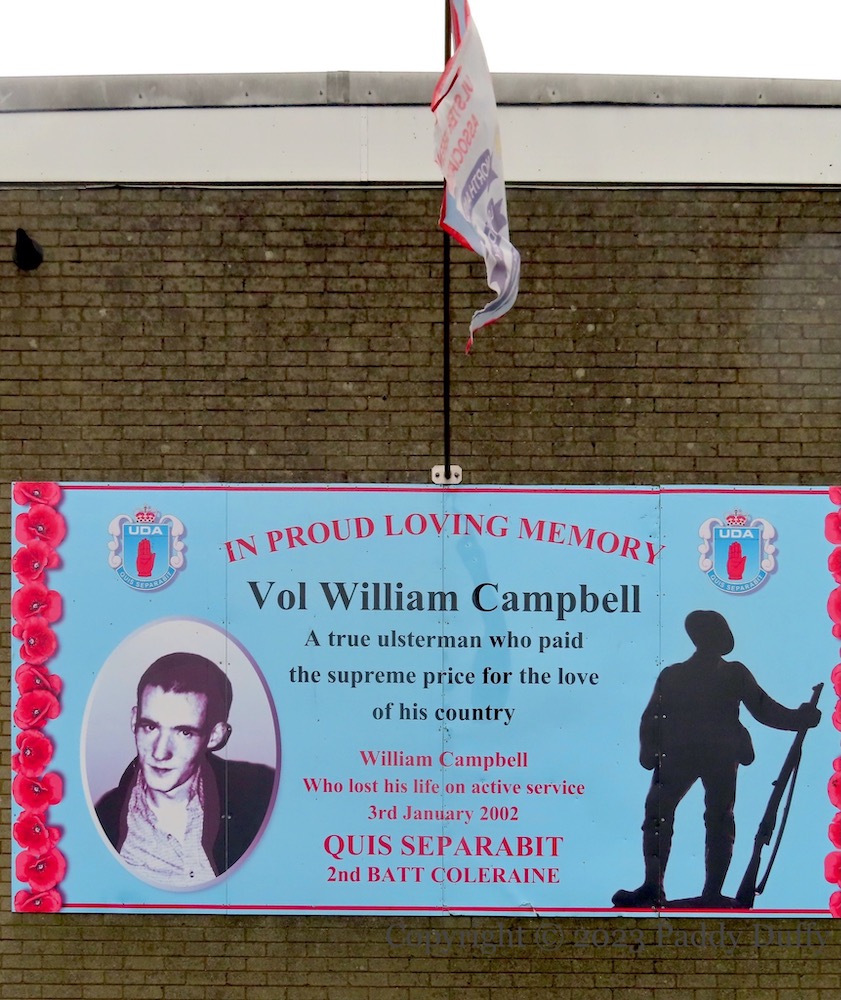
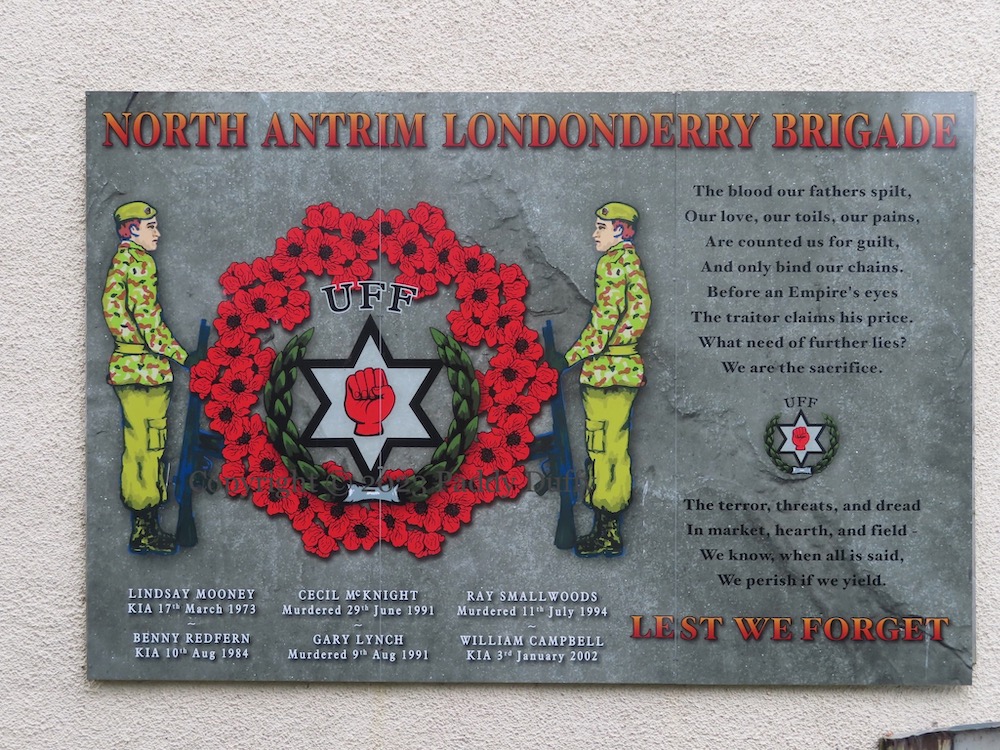
“In proud [and] loving memory: Vol William Campbell, a true Ulsterman who paid the supreme price for the love of his country. William Campbell, who lost his life on active service 3rd January 2002. Quis separabit. 2nd Batt Coleraine.”
This is the third memorial board to Campbell – who died at the age of 19 when a pipe-bomb exploded prematurely – replacing others seen in 2013 and in 2007.
The more familiar mythological figure in Northern Irish muraling — both CNR and PUL — is Cú Chulaınn (Visual History) but this Bushmills board features another larger-than-life figure, from slightly later mythology, Fıonn Mac Cumhaıll/Finn MacCool. In legend, Fionn ate the salmon of knowledge and became leader of the Fianna. His connection to the north Antrim coast is that he is the supposed creator of the “Giant’s Causeway”, the basalt columns that stretch out into the Atlantic Ocean, seemingly towards Scotland.
The Causeway and Finn are both used in the board shown above as symbols of the UDA North Antrim & Londonderry brigade’s 5th battalion/Giant’s Causeway Protestant Boys flute band (Fb) in Dundarave Road, Bushmills, which is about three miles from the Causeway. The board is also notable for its use of the flag of the proposed ‘independent Northern Ireland’, for which see (e.g.) We Must Share The Responsibility | One Island, Two Nations | Freedom Corner which features Cú Chulaınn.
The second image is a UDA/UYM emblem at the entrance to the estate. The third is further along. The last is not from Dundarave but from the exterior of a pub on Main Street.
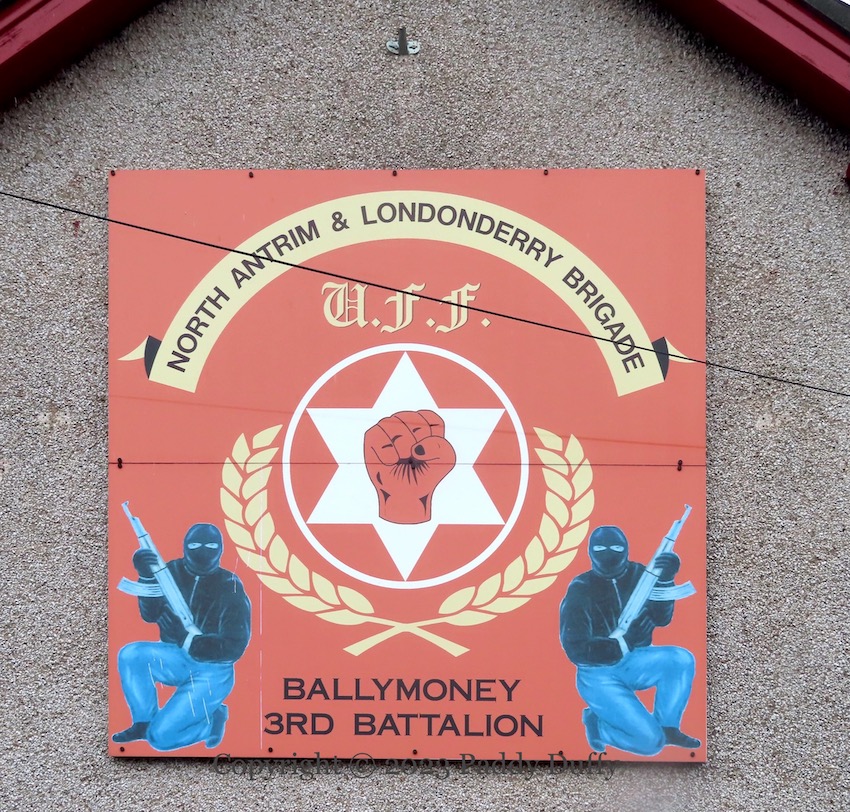
“North Antrim & Londonderry brigade, UFF, Ballymoney 3rd battalion” – hooded men with assault rifles remain on the walls in Alexandra Avenue/The Crescent, Ballymoney.
Here is a survey of the UDA boards in Carnany estate, Ballymoney. Many of these have been seen before (in Ulster’s Past Defenders, Ulster’s Present Defenders, The Terror, Threats, And Dread, and Ballymoney UDA). The anti-drugs board in the final image is new (see previously the one in Londonderry: Peace Impact Programme) and the one shown above and immediately below is an updated version of the board shown in Past, Present, For All Time. The dates given in the earlier version were 1972 and 2016; in this one, for “50 years of service”, they are 1971 and 2021. 1971 is the typical date given for the formation (in Belfast) of the the UDA; the 1972 date might have been a specific reference to the North Antrim And Londonderry brigade or the beginning of the Londonderry UDA’s actions, with bomb attacks on a factory and a pub in Donegal in October and November, 1972 (WP).
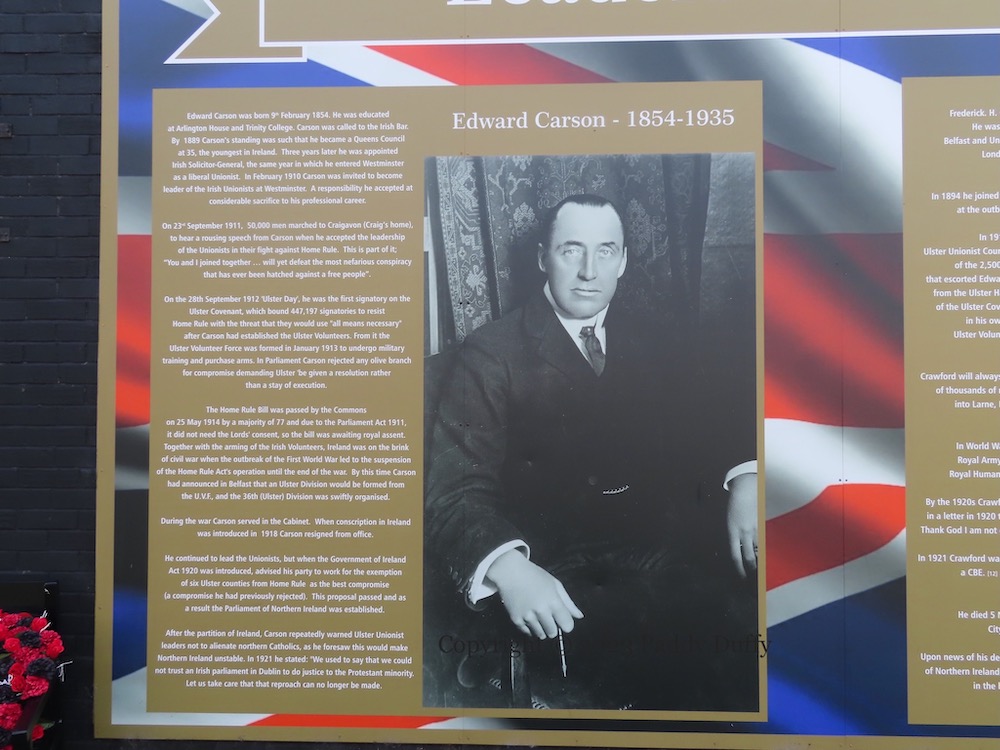
Carson, Crawford, and Craig are lionised as resisters of devolvement of Ireland to Dublin in the early twentieth century. Despite calling Home Rule “the most nefarious conspiracy that has ever been hatched against a free people” and vowing to fight it by “all means necessary”, including the Ulster Volunteers armed by Crawford’s “guns for Ulster”, Edward Carson “warned Ulster Unionist leaders not to alienate norther Catholics, as he foresaw this would make Northern Ireland unstable.”
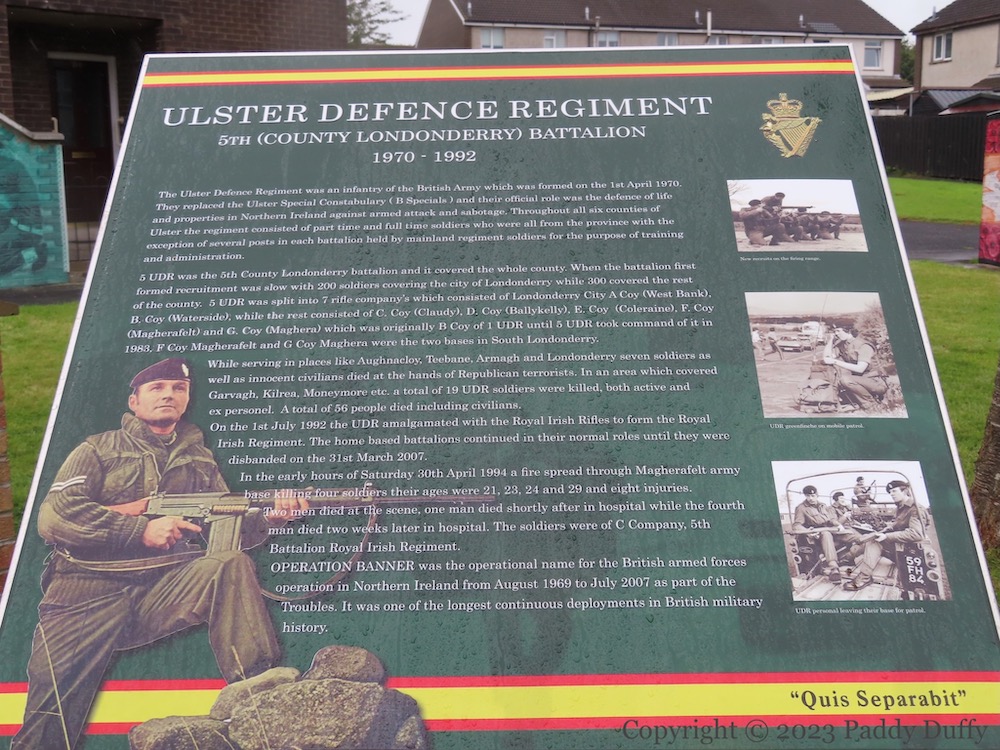
This selection of images from Leckagh Drive, Magherafelt, focuses on the memorials to the dead of WWI (and WWII in the mural above), with an additional board commemorating the UDR 5th (County Londonderry) battalion); there is also a mural and some plaques commemorating (modern-day) UVF volunteers, which will be in tomorrow’s post.
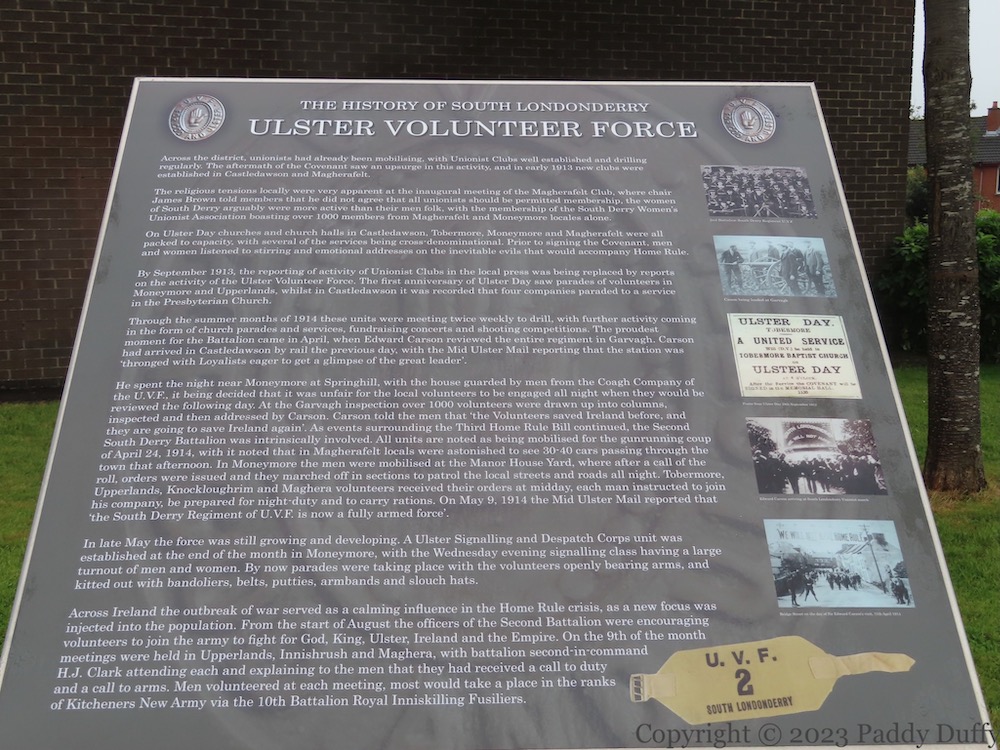
The board shown in the final image provides a history of the South Londonderry volunteers from towns such as Magherafelt, Castledawson, Moneymore, and Tobermore. Edward Carson reviewed the volunteers in April 1914. Later that same month, arms were received from the weapons landed in Larne. In the Great War, the men from the area served in the 10th battalion of the Royal Inniskilling Fusiliers in the 109th brigade of the 36th Division.














 Paddy Duffy Collection