The second mural along Ballee Way, Ballymena (between The Crown and The Lion Wears The Crown), is a tribute to the UDR [Ulster Defence Regiment], established in 1970 to replace the Specials and amalgamated with the Royal Irish Rangers in 1992 to form the Royal Irish Regiment. The mural shows a UDR soldier manning a checkpoint, on top of a free-floating Northern Ireland filled in with a Union Flag.
This is the third version (at least) of the circular King Billy in the centre of Ballymena. The first goes back to 1989 (D00471) and the second to 2000 (X00158 | M00711).
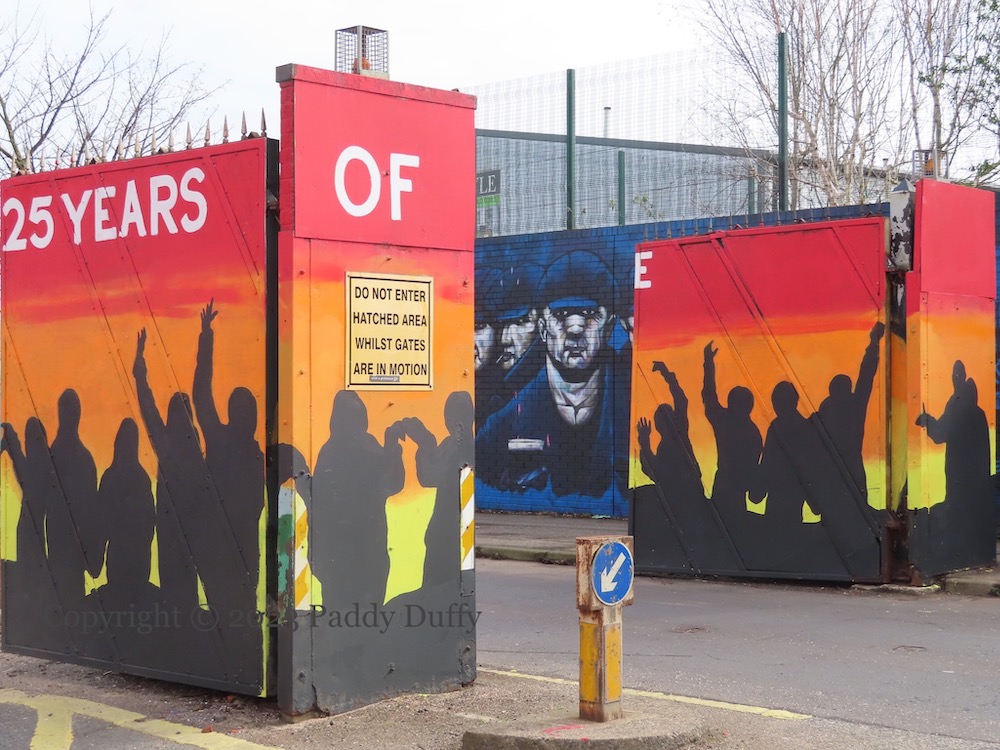
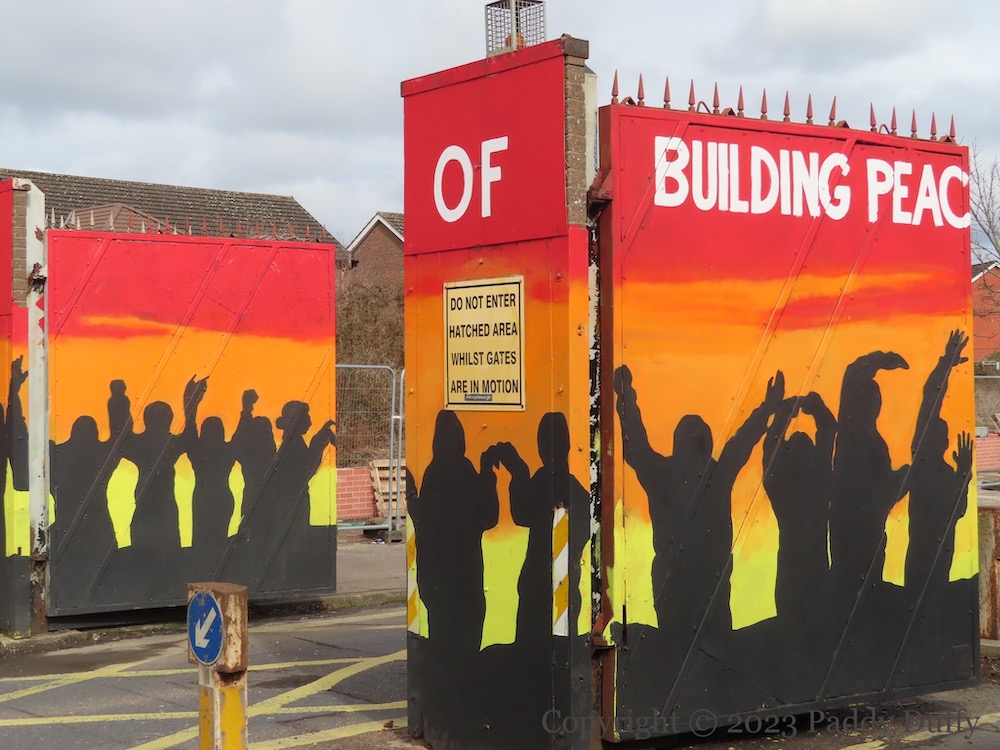
The gates on Lanark Way are part of the west Belfast “peace” wall. On this site we always put the word in scare-quotes to signify that it has a different meaning than it typically does. Without them, “peace wall” might suggest a place where people can go for a few moments of quiet reflection.
Rather, the wall – and the gates and the cages that surround many buildings on either side of the wall (see above) – is a divider meant to keep the peace by separating warring factions. Indeed the reason for the re-painting of the gates is not just the up-coming 25th anniversary of the Belfast or “Good Friday” Agreement (on April 10th) but the fact that they were damaged in the 2021 rioting (BBC). (This Irish News article surveys 150 years of violence at the site.)
The new art on the gates is inspired by the cover of the booklet sent to every household in advance of the May vote to ratify the Agreement (available at CAIN), which was similar in various ways to the television ad shown at the time (Ads On The Frontline). It showed a family of four in silhouette against a red-and-orange sunset; given the rioting associated with Lanark Way, on the gates this sunset could be mistaken for flames, and the rejoicing silhouetted figures for gesticulating and petrol-bomb-throwing rioters. For the previous art on the gates, see the Visual History page on the west Belfast “peace” line. (For the mural in the background, see Sailortown Dockers.)
Above is a trio of boards on a wall behind the Antiville community centre, softening (somewhat) the very aggressive set of six UDA boards next to it.
The experts’ best guess is that the gentleman on the white horse (on the right of the painting) is James Scott, Duke of Monmouth, at the siege of Maastricht in 1673. Scott was commander of the English forces fighting with the French during the Franco-Dutch war. It’s not clear, thus, what the connection is to the Antiville area of Larne or the wars fought in Ireland over the English crown. It was painted by Jan Wyck, who also did a painting of the Battle of the Boyne. On either side (as shown below) are a portrait of Queen Elizabeth II and the English version of the Royal coat of arms of the United Kingdom.
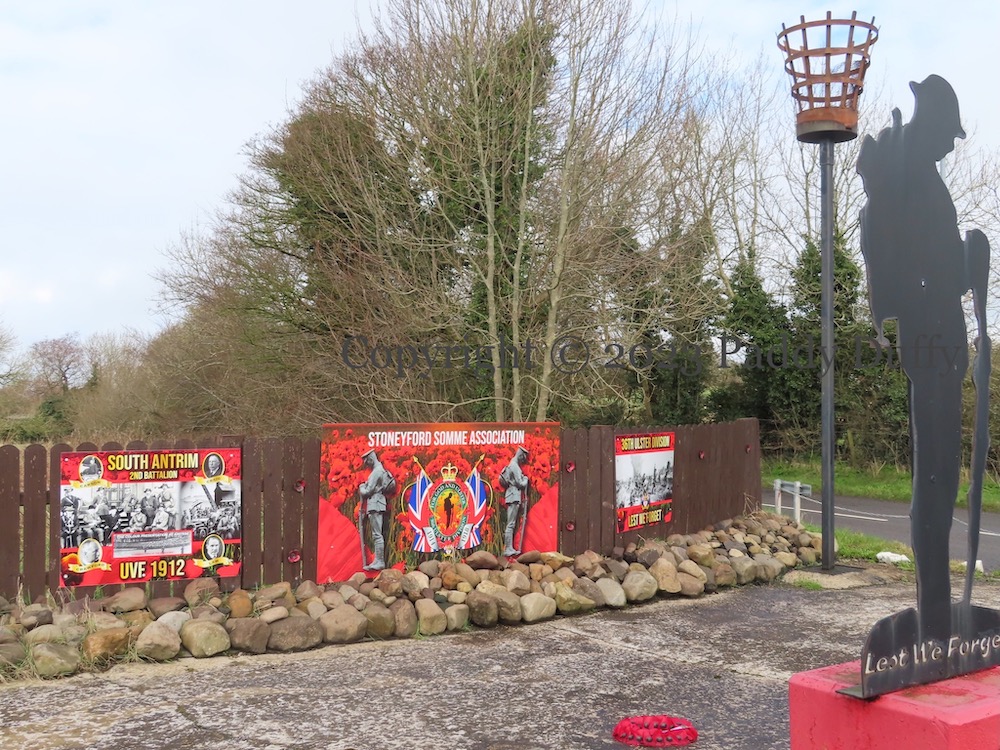
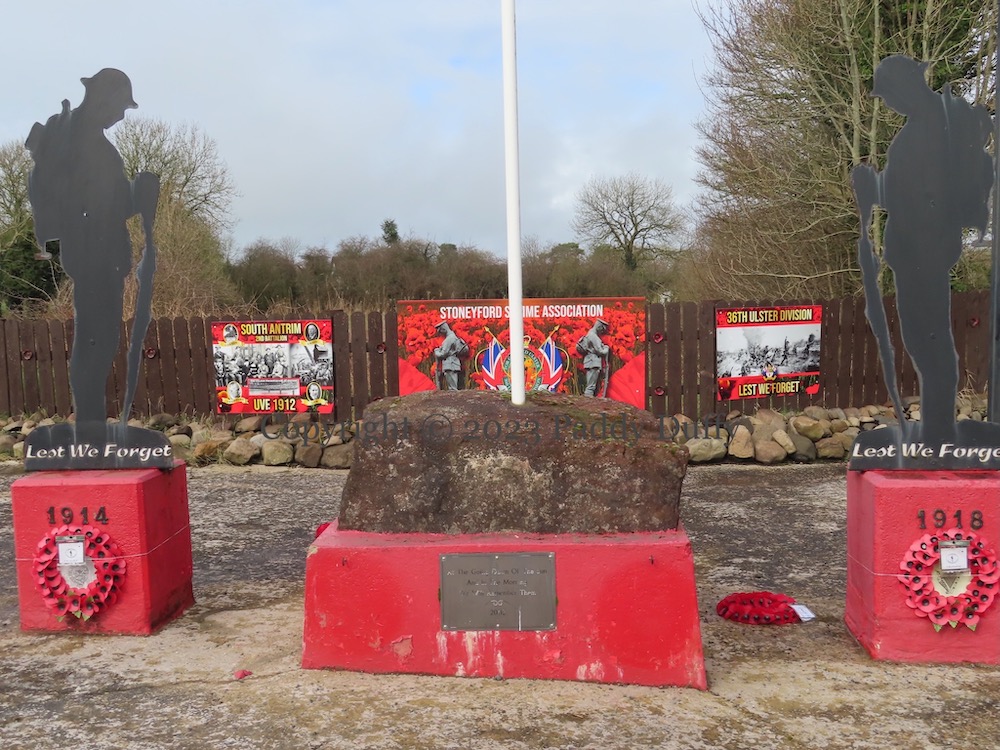
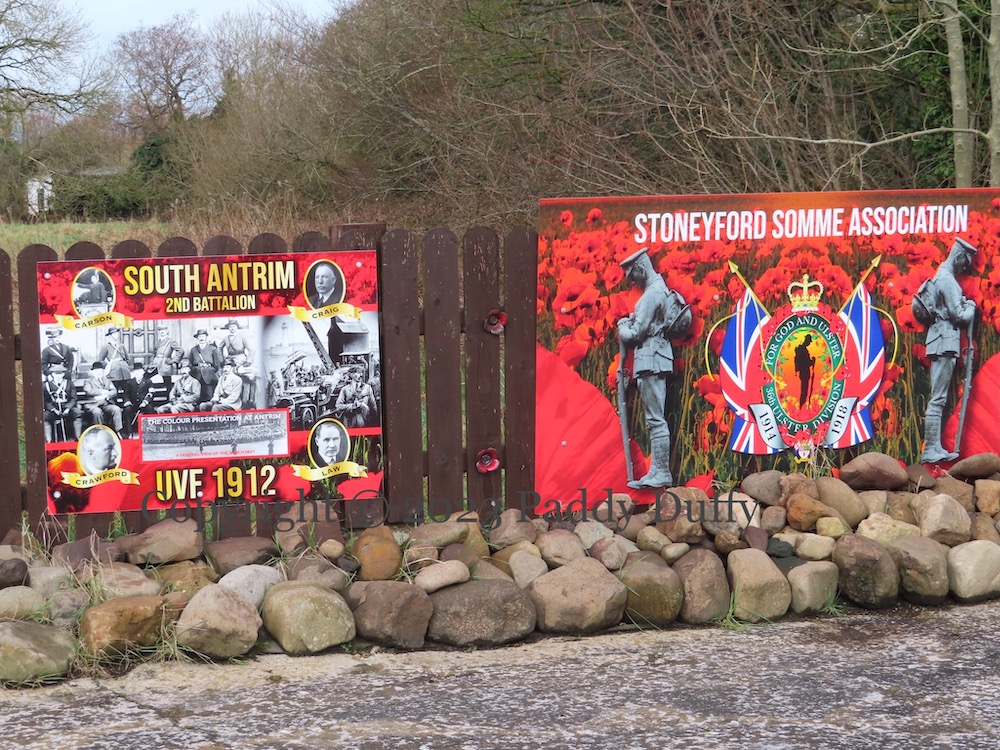
Boards have been added to the WWI memorial plaque in Stoneyford. On the right, the 36th Division go over the top in Beadle’s ‘Attack Of The Ulster Division’ (see Over The Top); the board on left more specifically commemorates the 2nd battalion of the South Antrim Ulster Volunteers, flanked by the leaders of the anti-Home Rule movement – Carson, Craig, Crawford, and Bonar Law.
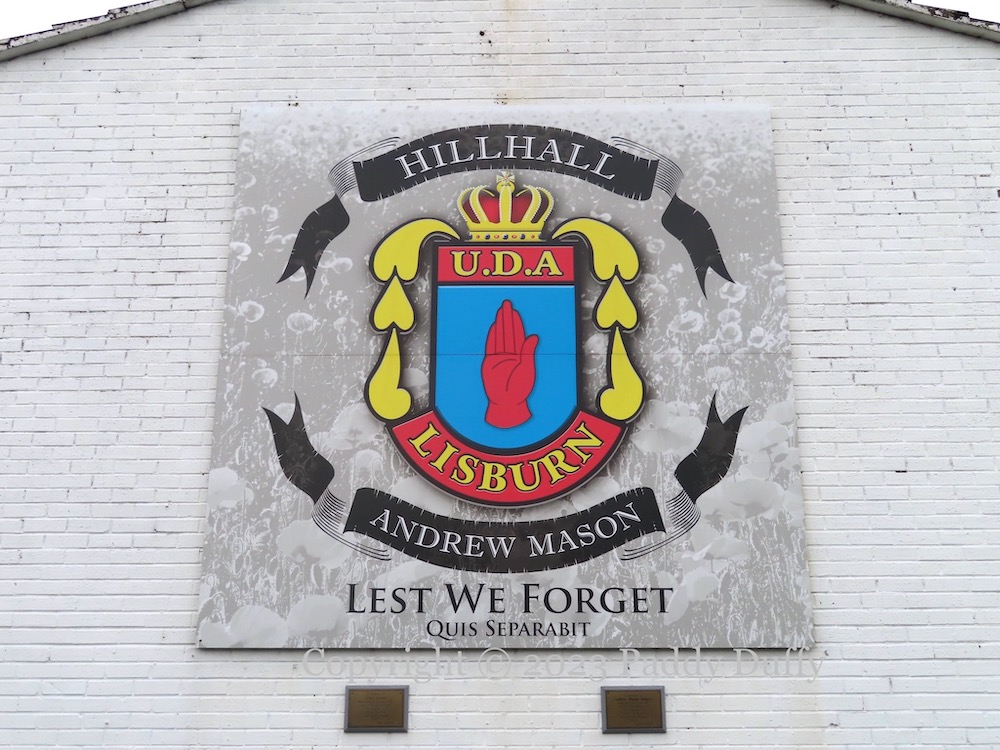
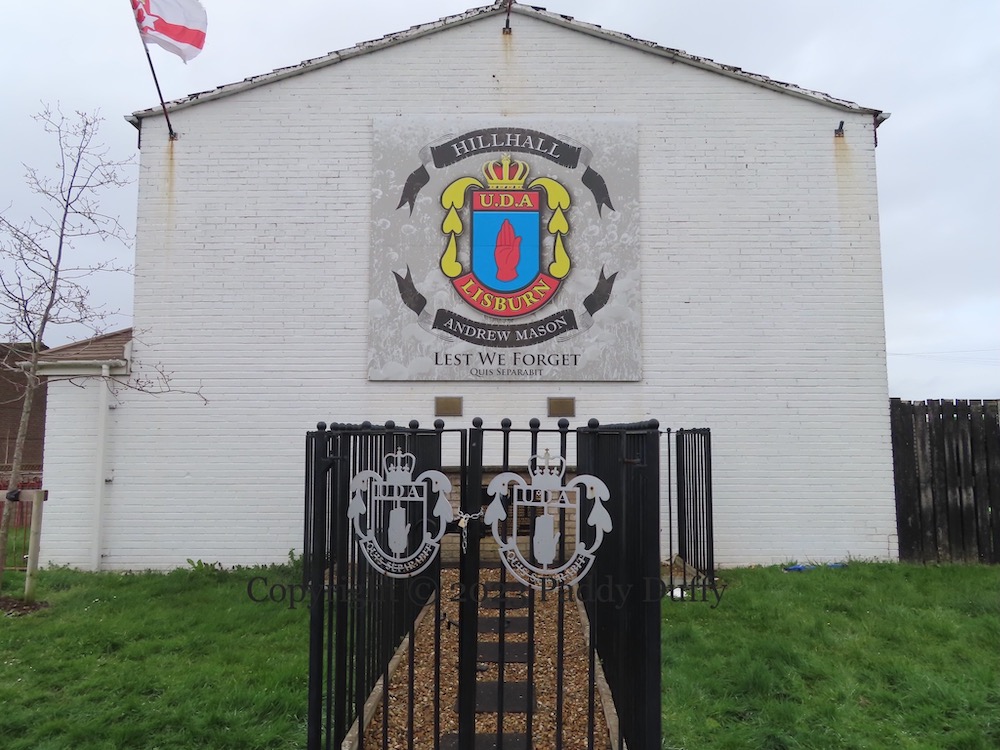
19-year-old Andrew “Macey” Mason was wearing his Hillhall band uniform and a UDA badge while en route to visit his girlfriend on April 19th, 1987, when he was set upon by two men near Carnlough on the Antrim coast. The gruesome details of the beatings and stabbings that followed are given in Lost Lives (#2827).
This is the second (see previously 2010 – M05938) memorial board to Mason in Hillhall. The memorial plaque (below) is a new version of the older plaque to John McMichael, Raymond Smallwood[s], Jim Guiney, and Mason.
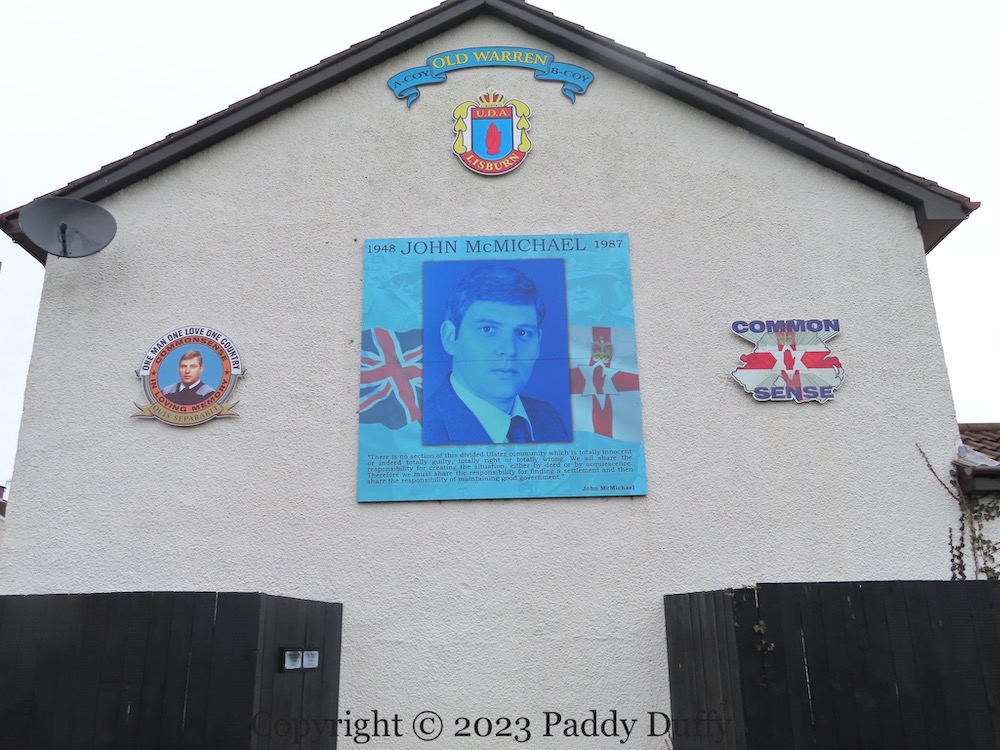
The South Belfast UDA/UFF commander John McMichael (1948-1987) was killed by an IRA car bomb. In addition to organising a team of assassins in the 70s and 80s, he founded a Political Research Group and wrote two documents proposing an independent Northern Ireland, 1979’s Beyond the Religious Divide and 1987’s Common Sense (available at CAIN), promoting the philosophy of ‘Ulster nationalism’. The quote on the board comes from the end of the Introduction to Common Sense:
“There is no section of this divided Ulster community which is totally innocent or indeed totally guilty, totally right or totally wrong. We all share the responsibility for creating the situation, either by deed or by acquiescence. Therefore we must share the responsibility for finding a settlement and then share the responsibility of maintaining good government.”
Above: “Old Warren A Coy/B Coy”. Right: “One man, one love, one country. Commonsense. In loving memory. Quis separabit.” around a portrait of McMichael. Left: “Common sense” with an Ulster Banner Northern Ireland.
“CR Gas & The Burning Of Long Kesh, 15th-16th October, 1974 in Long Kesh. Operation Pagoda – the British government authorised and sanctioned the use of a chemical weapon against Irish Republican prisoners. Members of the 22nd S.A.S. carried out the attack from a helicopter.”
Operation Pagoda was the name of the SAS’s counter-terrorism programme (WP). Its role in the ‘Battle Of Long Kesh’ in October 1974 and its alleged use of CR (dibenzoxazepine) powder – the successor to CS powder (and before that, CN or “tear” gas) (New Scientist) – remains a classified matter. CR had been authorised for use in 1973 (Guardian).
This hooded gunman from the UVF’s North Belfast/3rd battalion will keep an eye on your wains while they play in the playground across the street. This mural replaces a kids’ mural that read “New Mossley estate recognises the importance of its young people.” (Street View)
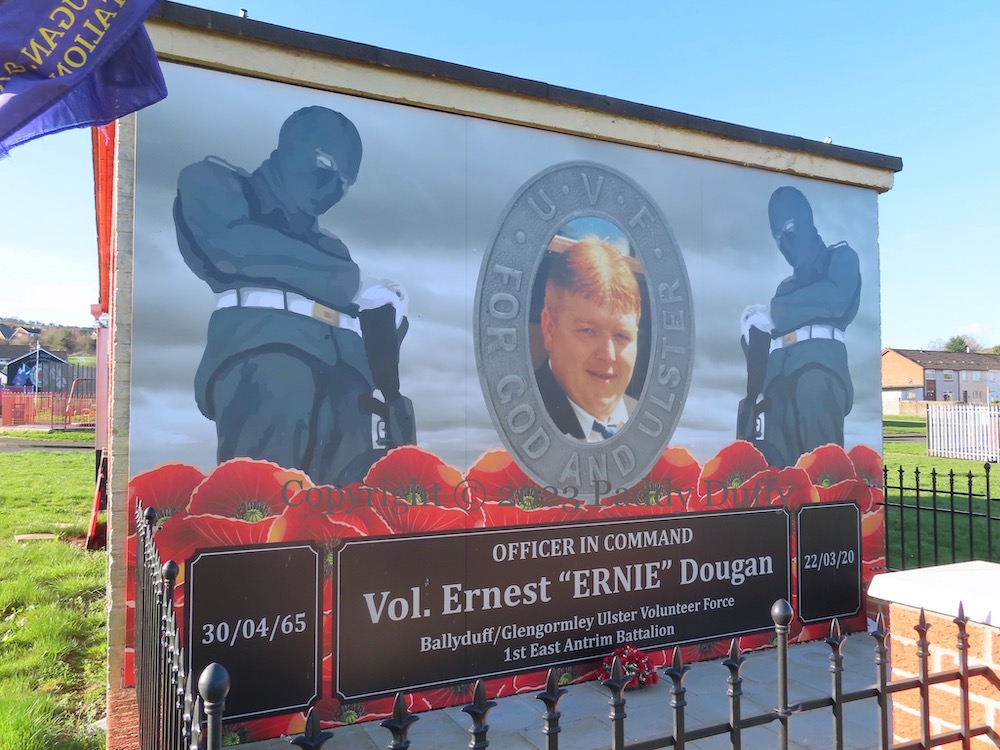
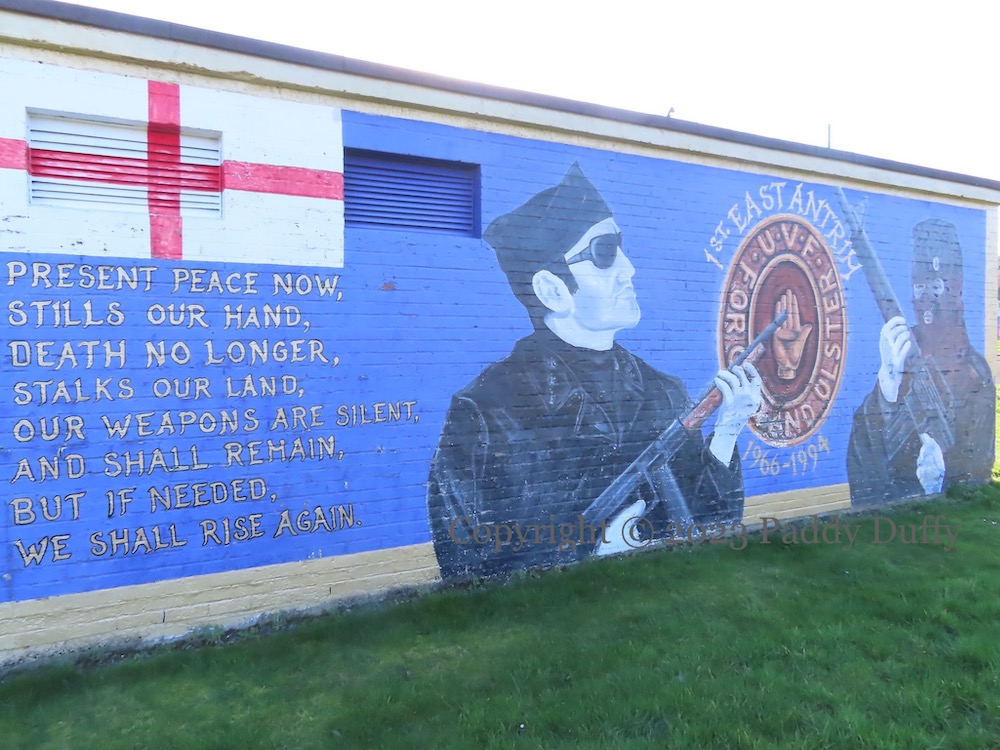
“Officer in command Vol. Ernest “Ernie” Dougan (30/04/65-22/03/20) Ballyduff/Glengormley Ulster Volunteer Force 1st East Antrim Battalion.” Dougan died at the beginning of lockdown and so the public commemoration of his passing did not take place until 2022. He was also involved in the Ballyduff Community Redevelopment Group (Fb). According to a Sunday World article, Dougan did not join the UVF until sometime after the Agreement, after he was given a punishment beating by the UDA in north Belfast (see Irish Times | Mirror) and moved out to Ballyduff.











 Paddy Duffy Collection