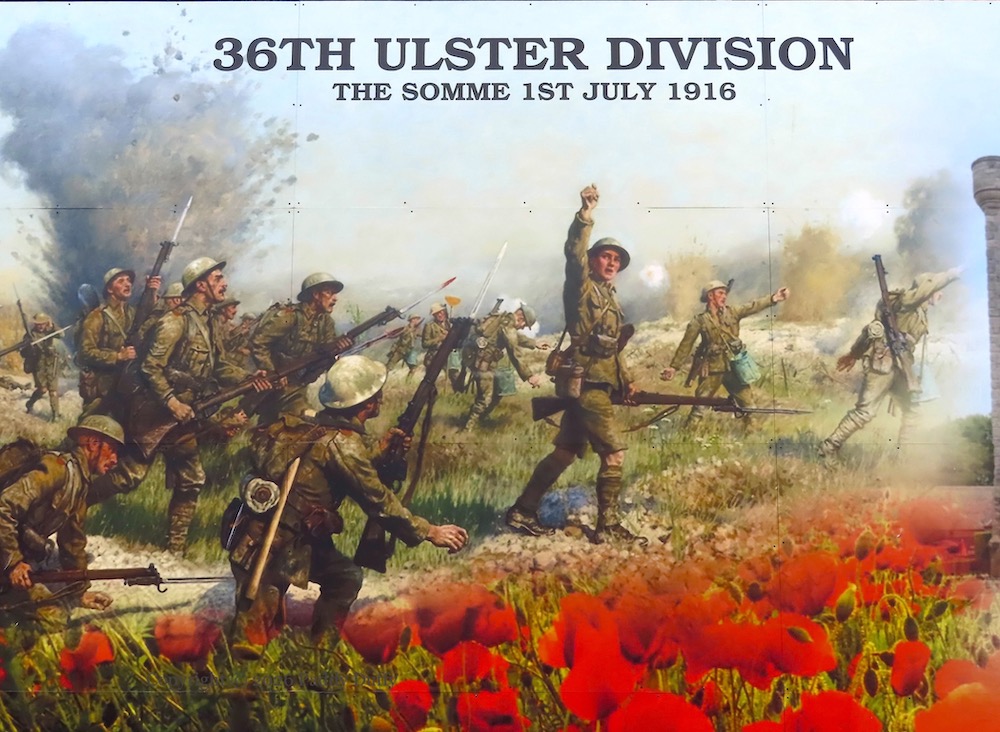
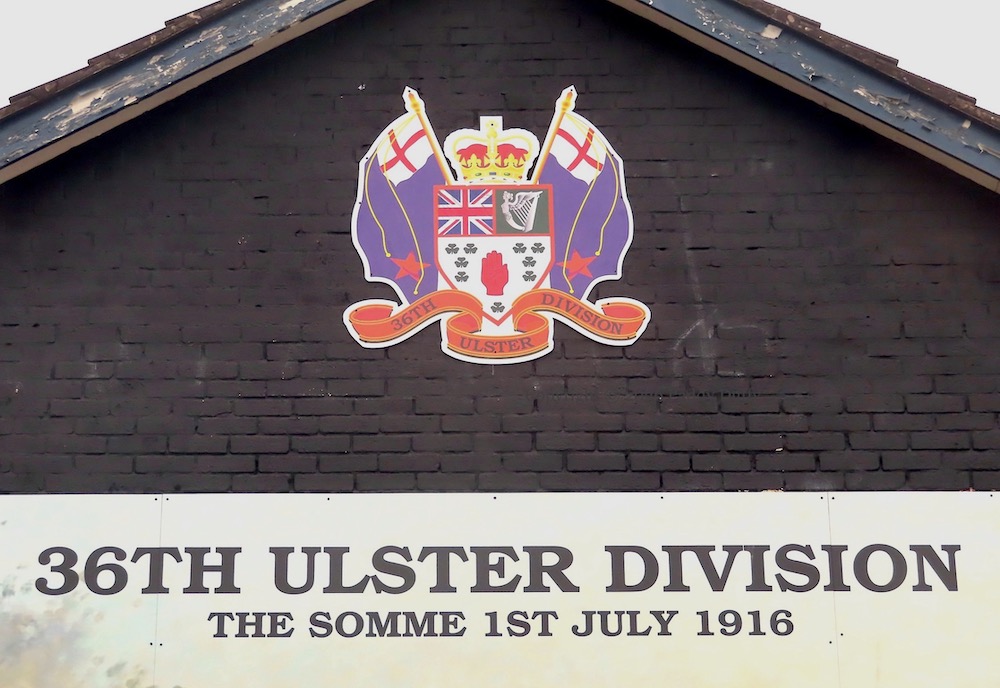
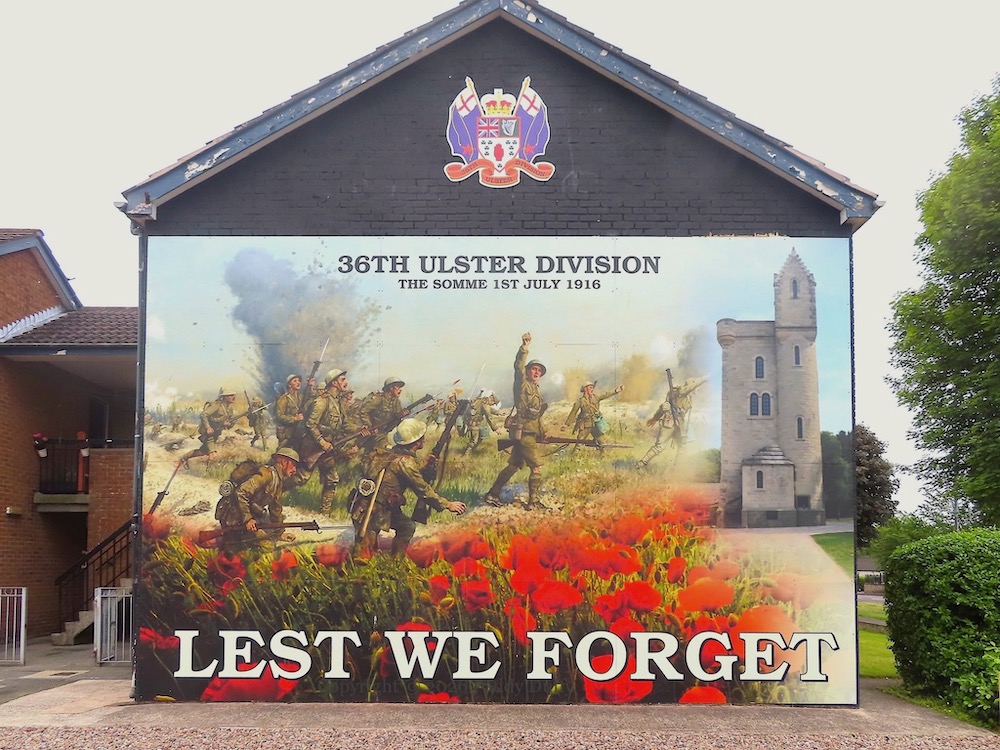
“Lest we forget.” JP Beadle’s painting “Battle Of The Somme: Attack Of The Ulster Division” shows soldiers of the 36th Division bravely going to their death on July 1st, 1916. The original painting hangs in Belfast City Hall (militaryprints.com). In the board shown here, a foreground of poppies has been added, along with the Ulster Tower in Thiepval, France, on the right.
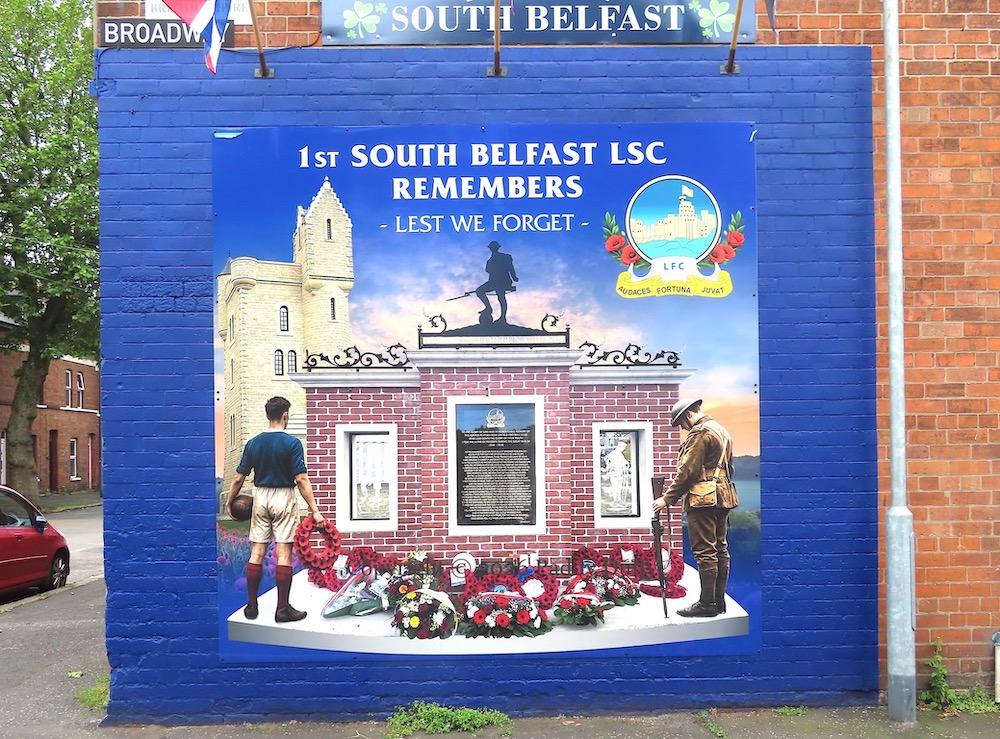
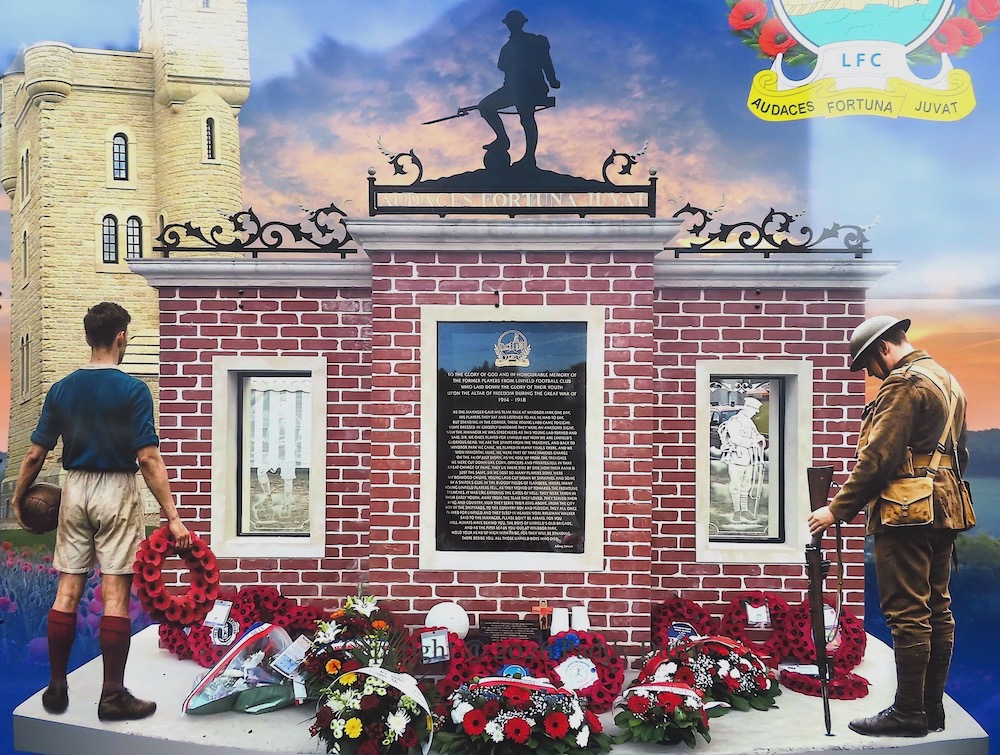
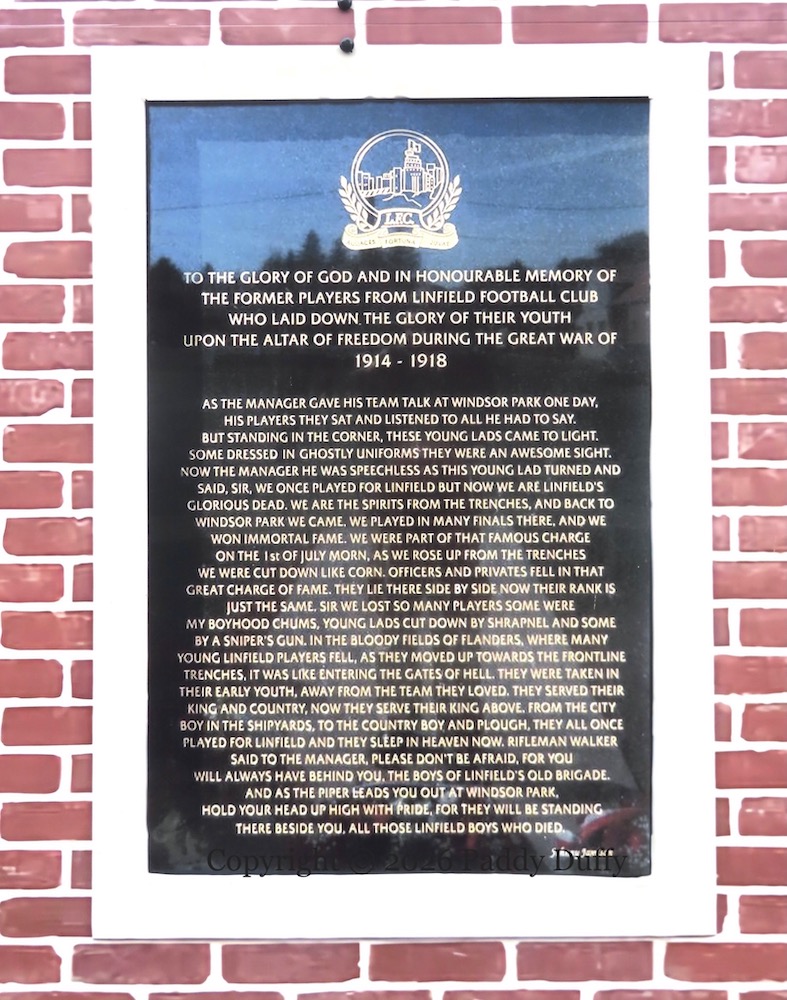
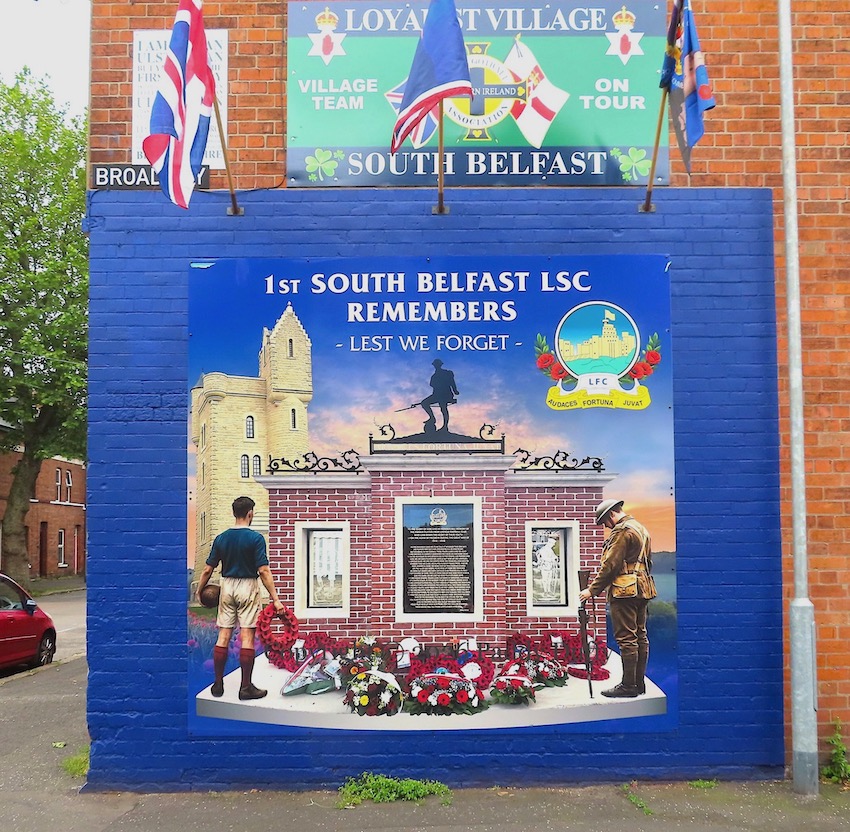
“1st south Belfast LSC [Fb] remembers. Lest we forget.” “To the glory of God and in honourable memory of the former players from Linfield Football Club who laid down the glory of their youth upon the altar of freedom during the Great War of 1914 – 1918.
The main part of this new board in the Village shows the Linfield memorial at Bertrancourt, France. The memorial was unveiled in 2022 (BBC). The BBC article explains the reference to “Rifleman Walker” in the poem by Johnny Jamison at the centre of the memorial: Walker had been a Linfield player before joining the Royal Irish Rifles and dying on May 6th, 1916. Jamison recites his poem in this Fb video. In the background is the familiar Ulster Tower.
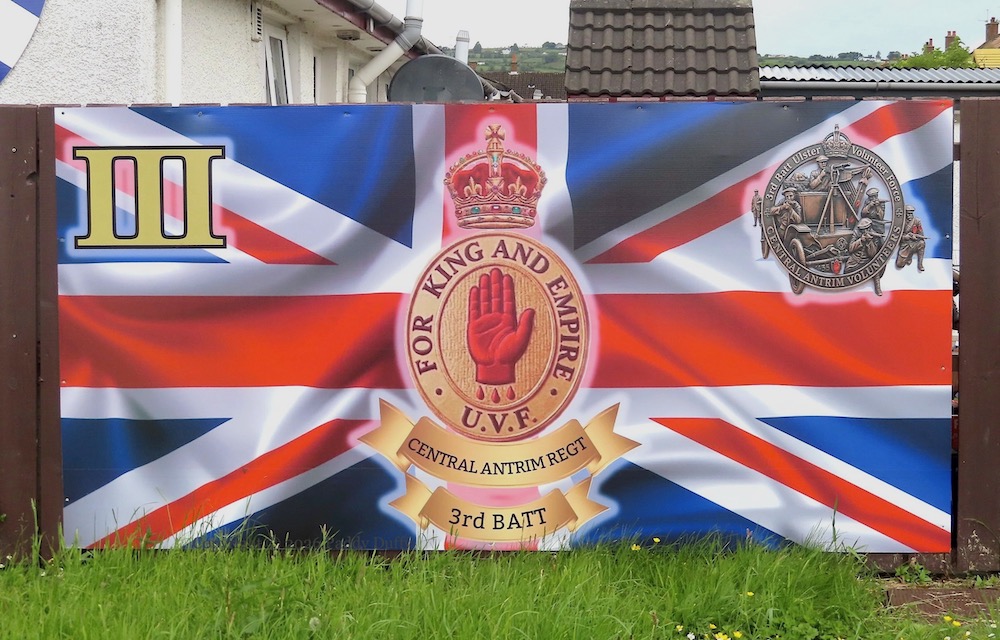
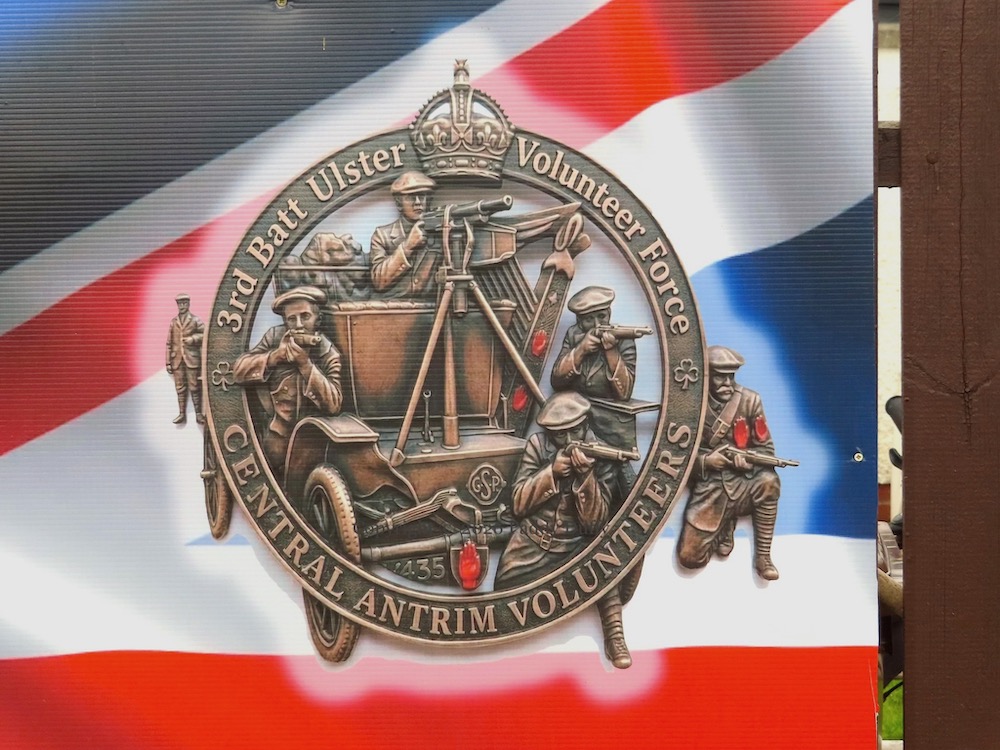
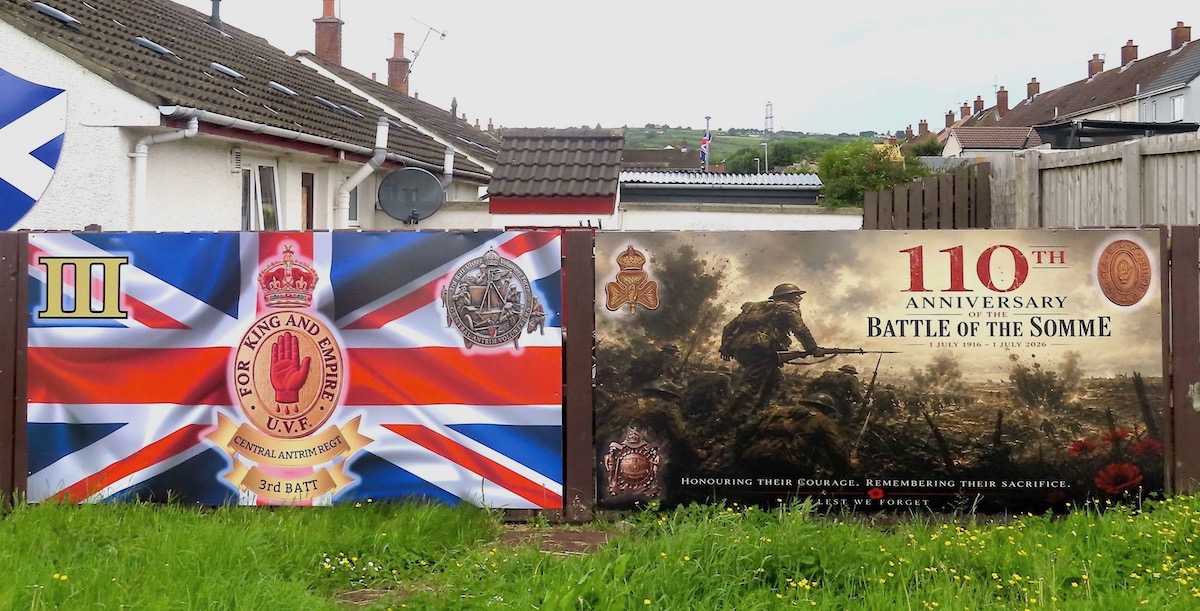
The colours of the third (Carrickfergus) battalion of the Central Antrim regiment of the Ulster Volunteers can be seen at Sam’s Flags. They are very similar to the piece shown above, except for the addition of the emblem in the top right corner (close-up immediately below) which shows the Ulster Volunteers drilling with a machine-gun mounted in a car, preparing to resist Home Rule – see this 1988 mural and the photograph in this History Ireland article. (See also UVF Motor Car Corps.) In the Royal Irish Rifles of WWI, however, Central Antrim became the 12th battalion (War Time Memories Project).
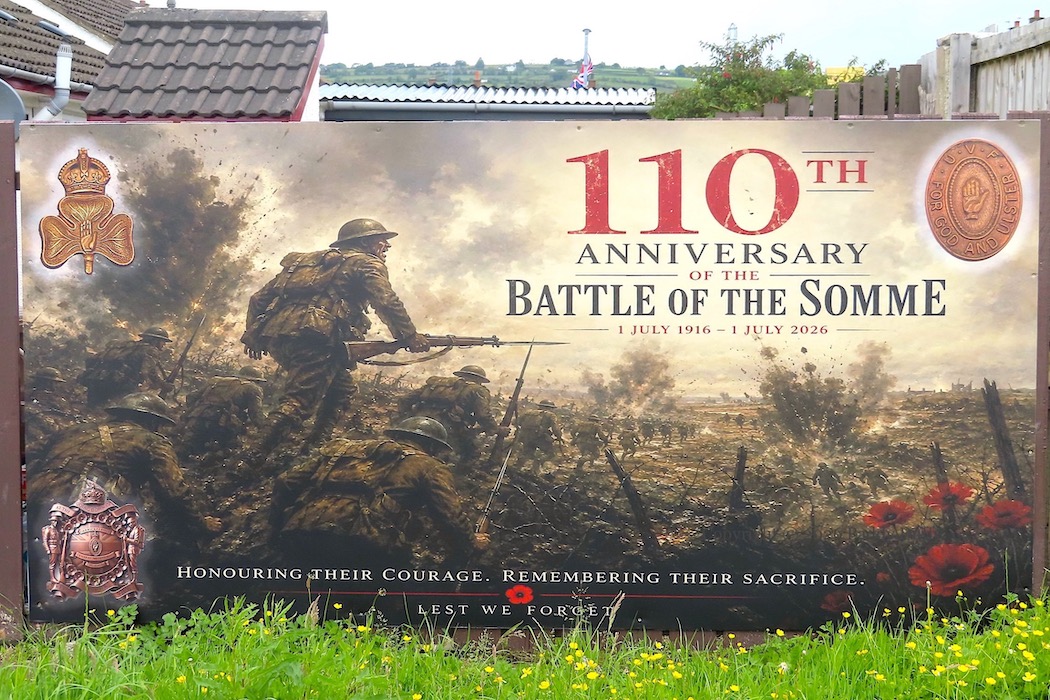
Next to the Central Antrim flag is a board marking the “110th anniversary of the Battle Of The Somme 1 July 1916 – 1 July 2026. Honouring their courage, remembering their sacrifice. Lest we forget.”
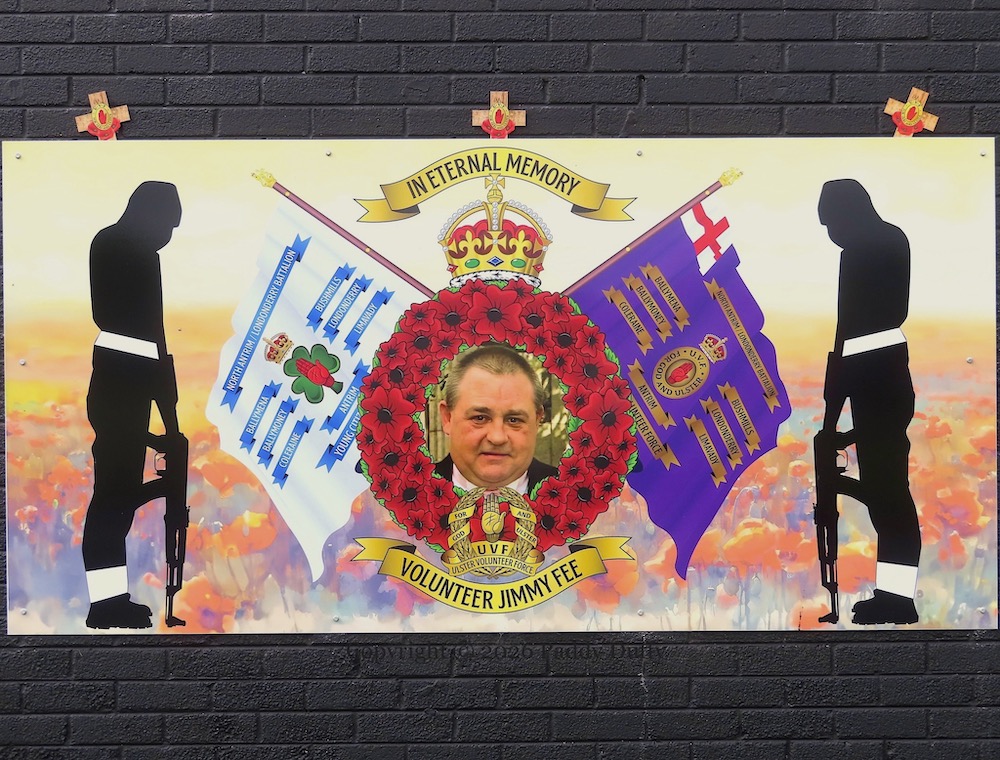
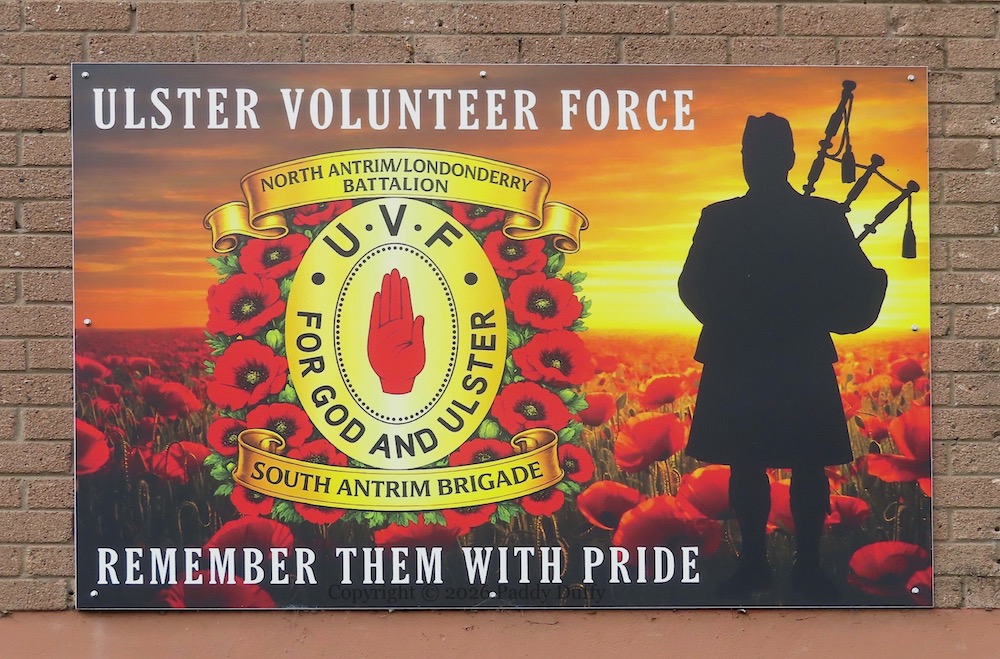
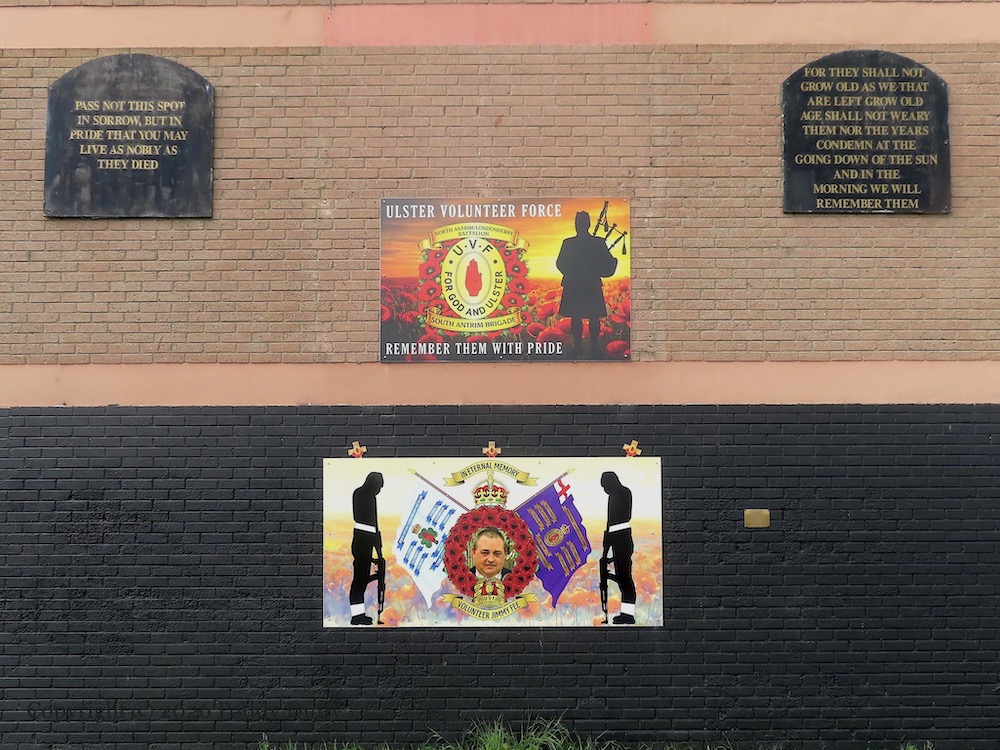
“In eternal memory, UVF Volunteer Jimmy Fee.” This entry updates 2023’s Pass Not This Spot In Sorrow, which showed a painted UVF flag in memory of Jimmy Fee. This has been replaced by a printed board which contains a photographic portrait of Fee. As reported in that earlier entry, there is no information readily available about Fee, who perhaps died around 2016, when the original mural was painted. The two upper boards (in the shape of gravestones) have been retained from the earlier work, while the “north Antrim/Londonderry battalion, south Antrim brigade – remember them with pride” board is new.
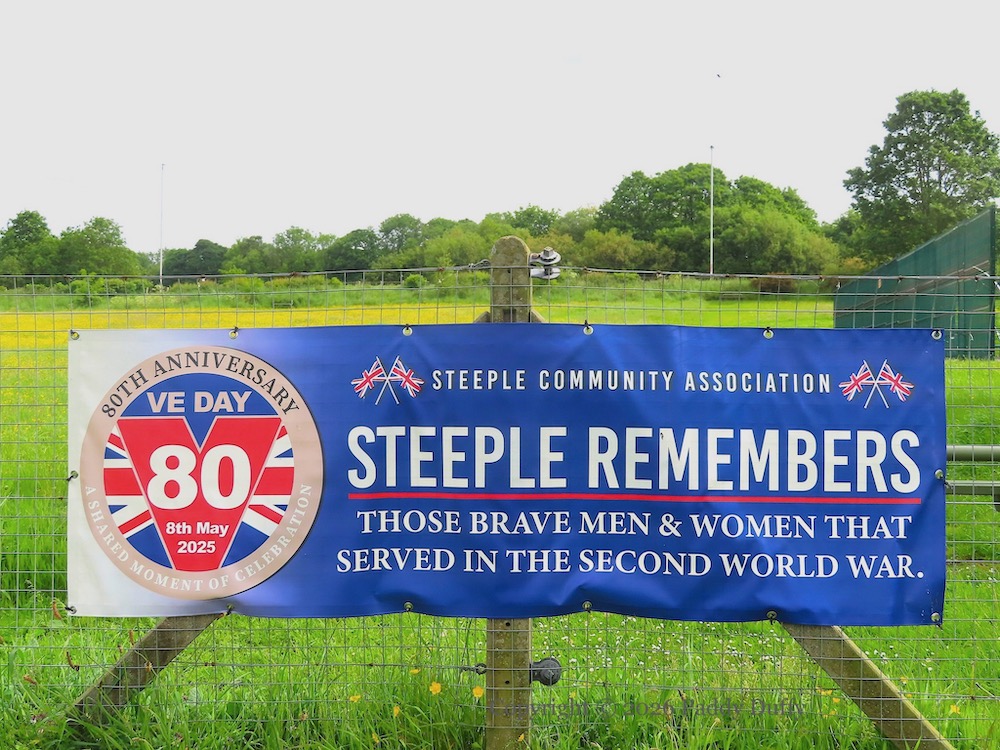
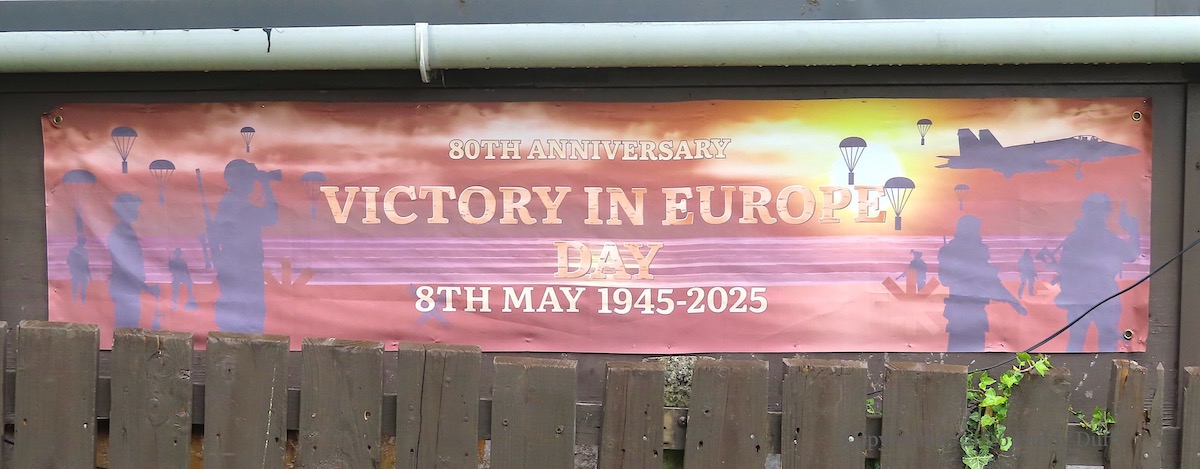
Parkhall Road, Steeple, Antrim. The WWII banner is in the nearby Steeple Park.
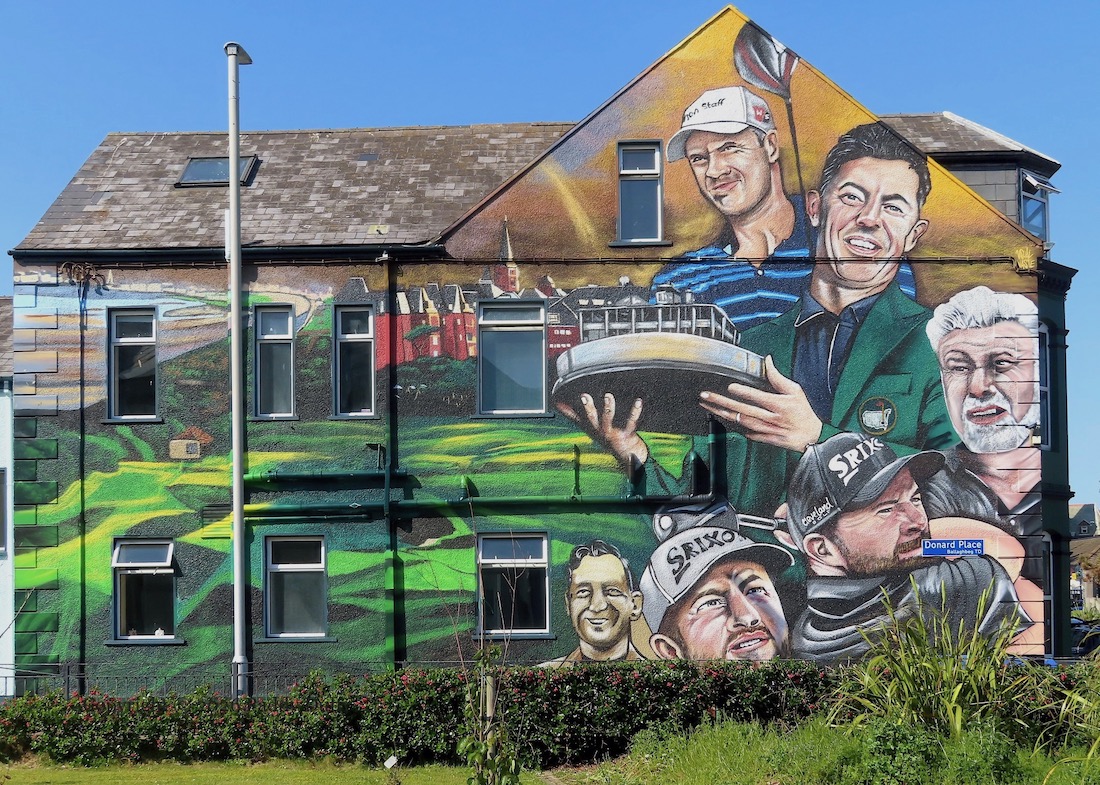
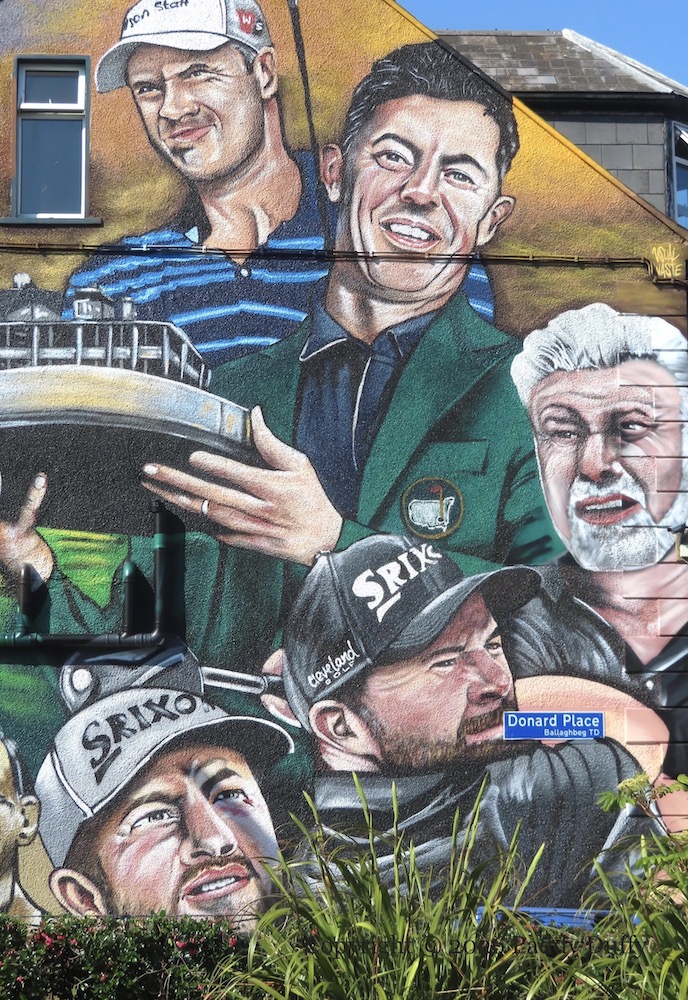
Golf Digest rated Royal County Down as the world’s number one course. Over the years it has hosted various important tournaments, including the Irish Open (most recently in 2024, won by Rasmus Højgaard).
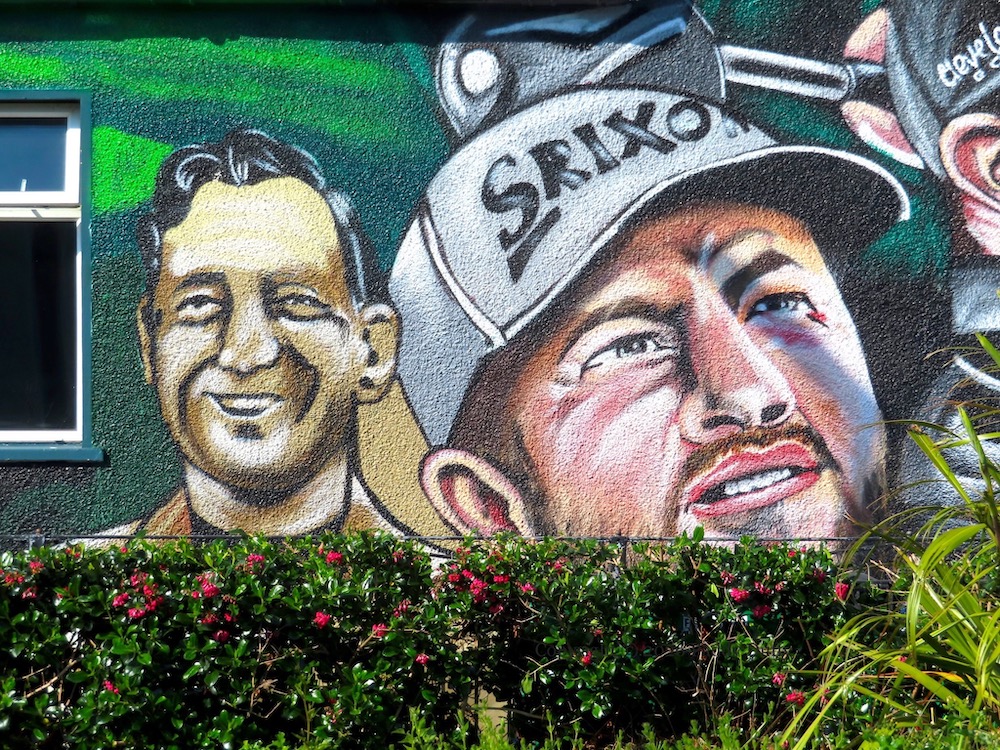
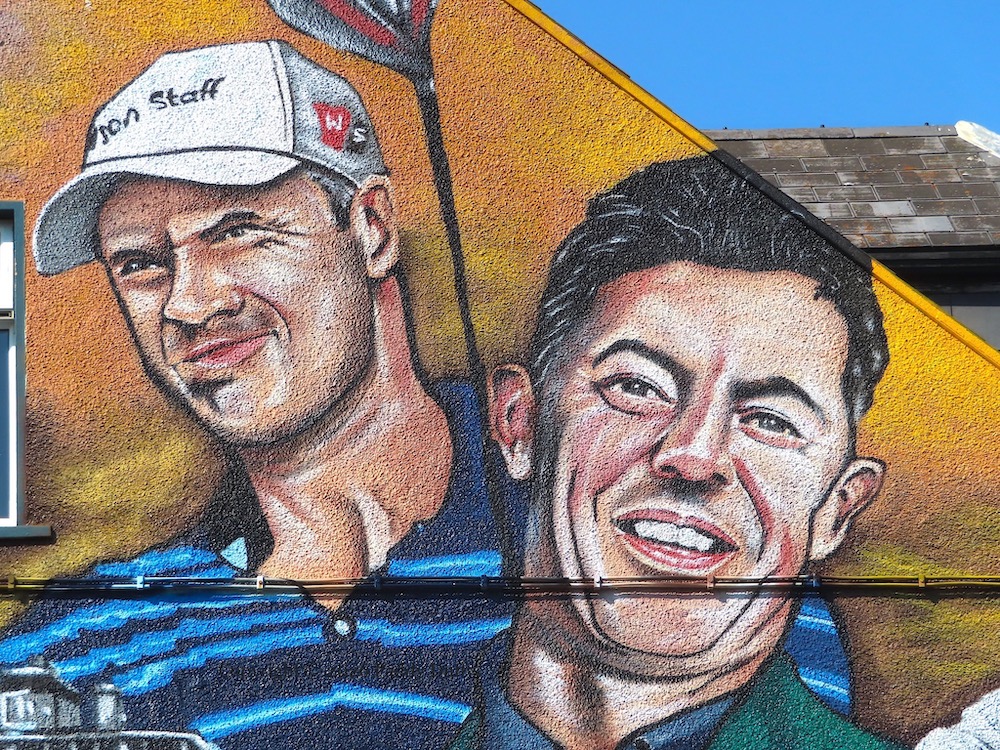
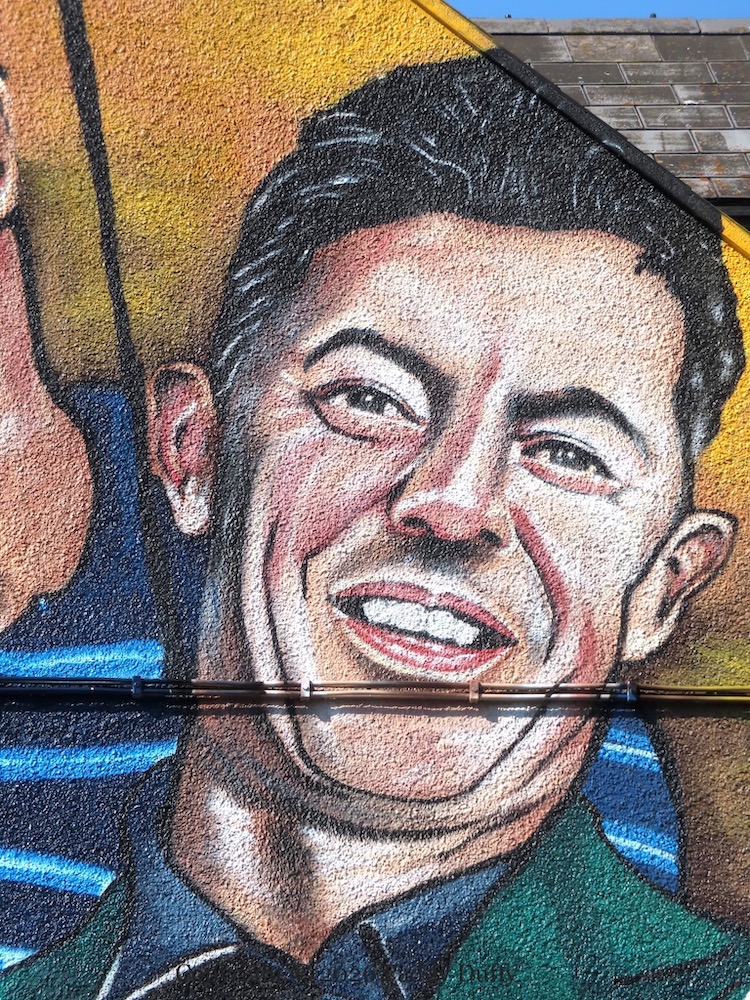
This mural features six famous golfers, past and present. Clockwise from top: Pádraıg Harrington, Rory McIlroy (holding his Masters trophy and wearing the green jacket), Darren Clarke, Graeme McDowell, Shane Lowry, and Fred Daly, who won the Irish Open in 1946 and the British Open in 1947. In the background of the mural is the Slieve Donard hotel, which is just to the south of the golf course.
Painted by Visual Waste (web) in Donard Place, Newcastle, Co Down
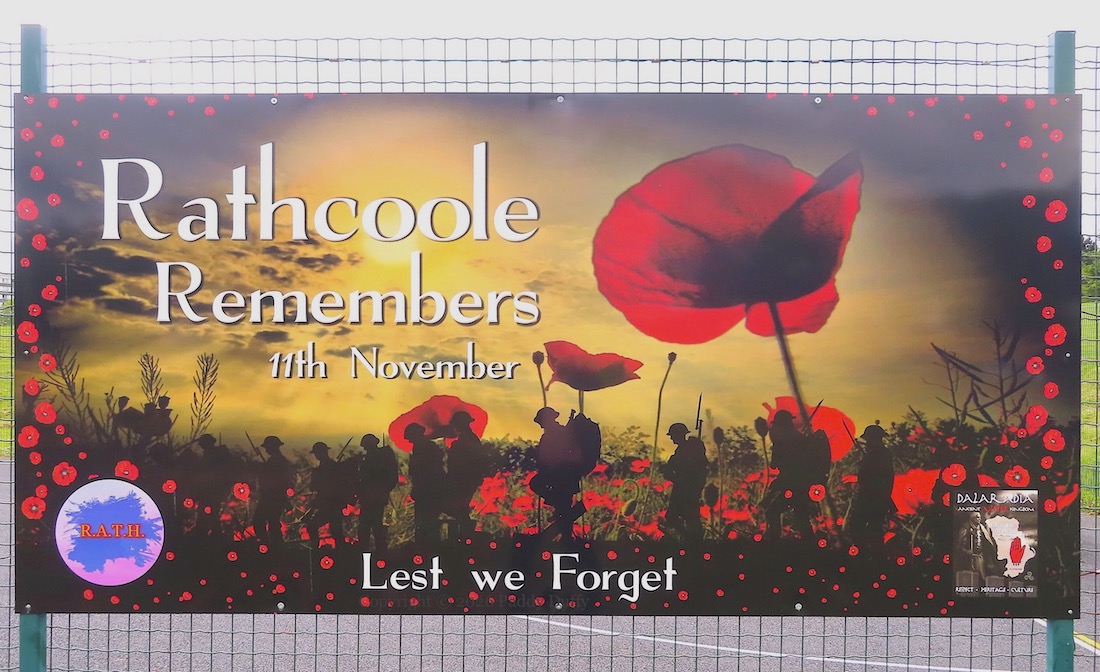
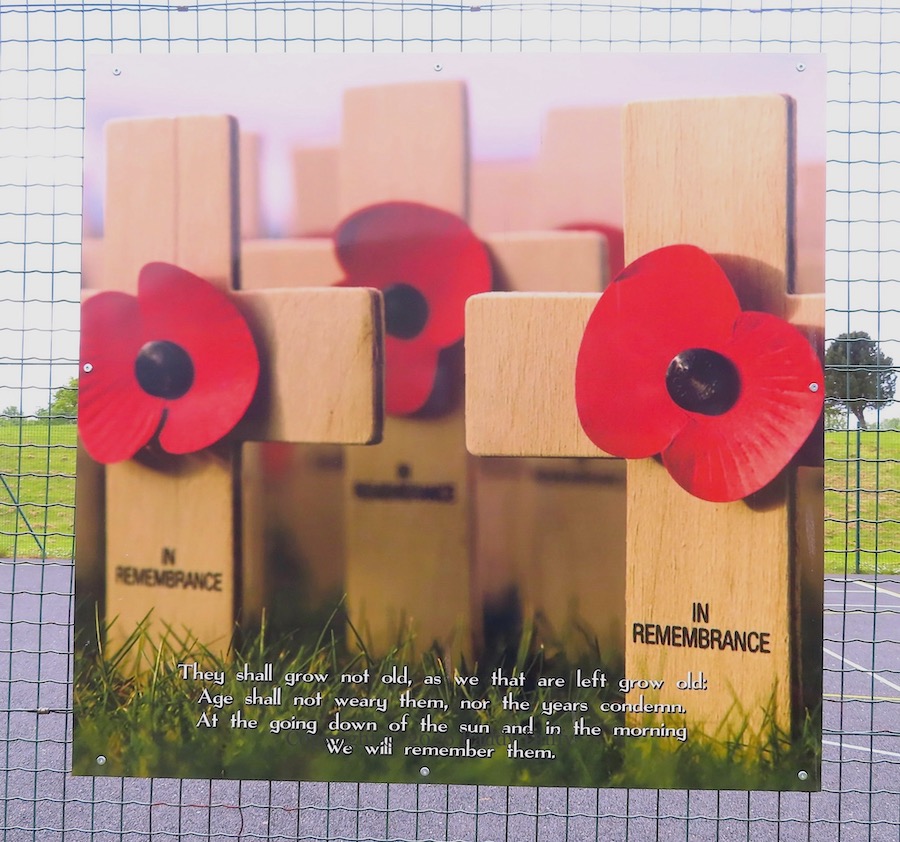
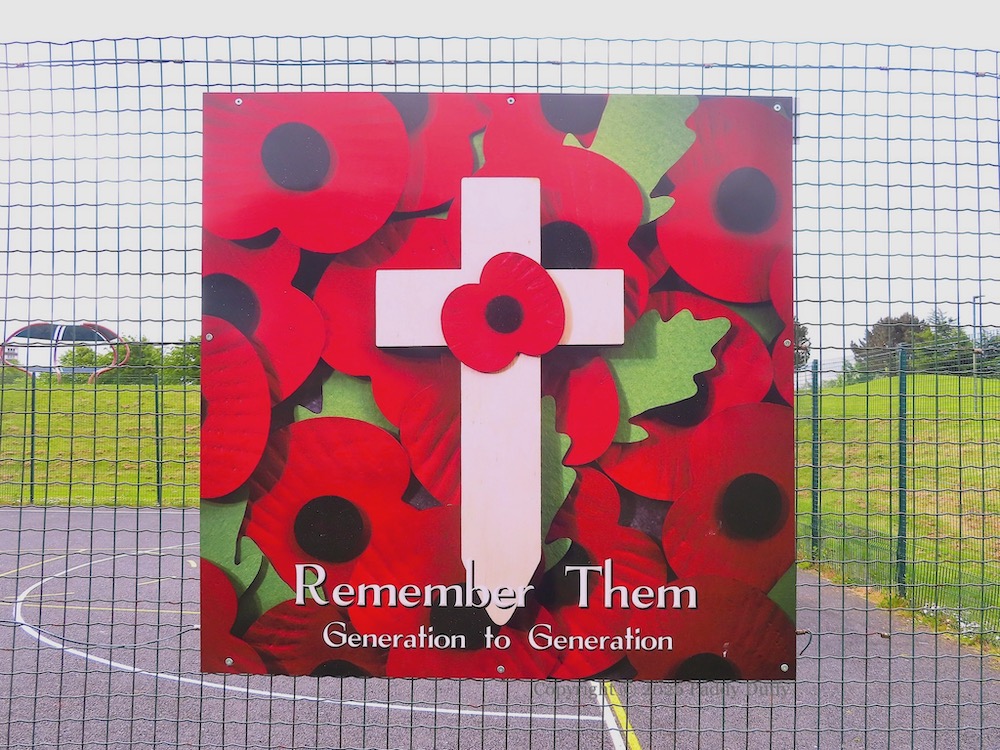
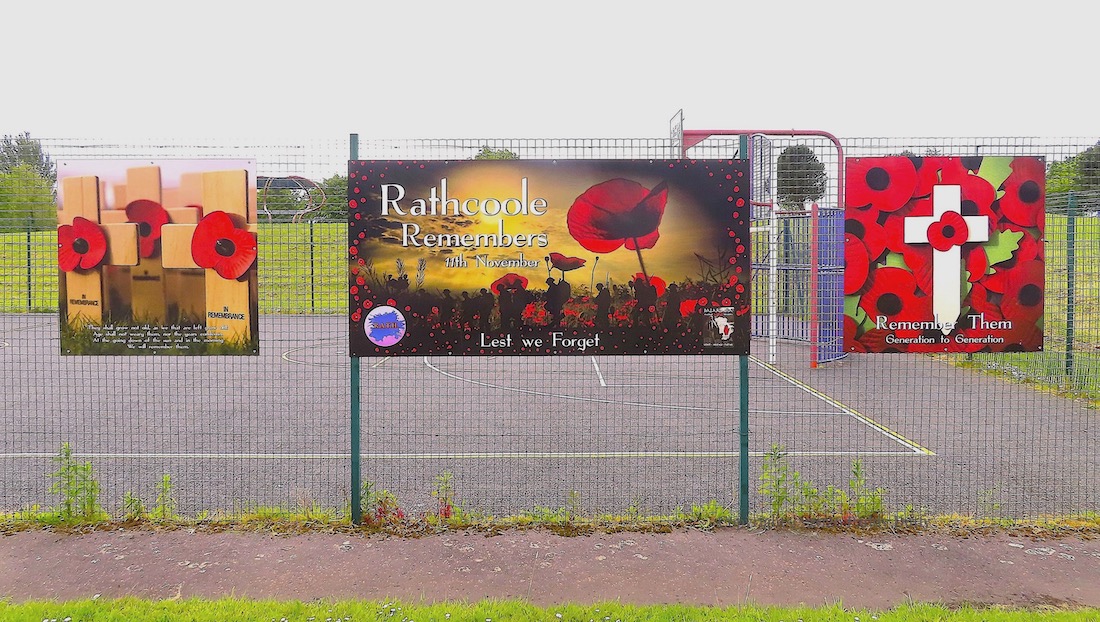
“Rathcoole remembers 11th November. Lest we forget”, “In remembrance” with some lines from For The Fallen, and “Remember them, generation to generation”.
This trio of WWI memorial boards is on the fence of the basketball court along Derrycoole Way, Rathcoole, Newtownabbey, next to an installation of gravestones and sandbags – Row On Row.
The sponsors in the corners of the board shown above are RATH Community Group (Fb) and Dalaradia (web); they previously jointly supported a QEII mural “On The Occasion Of Her Platinum Jubilee“. RATH holds a commemorative service annually in November.
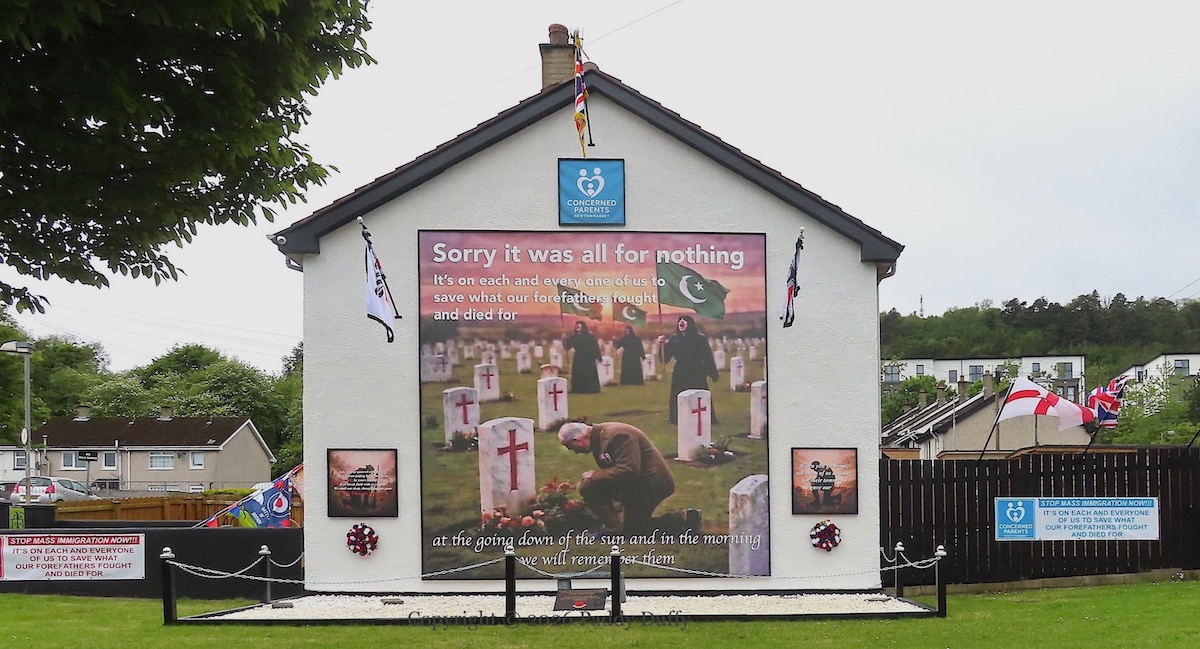
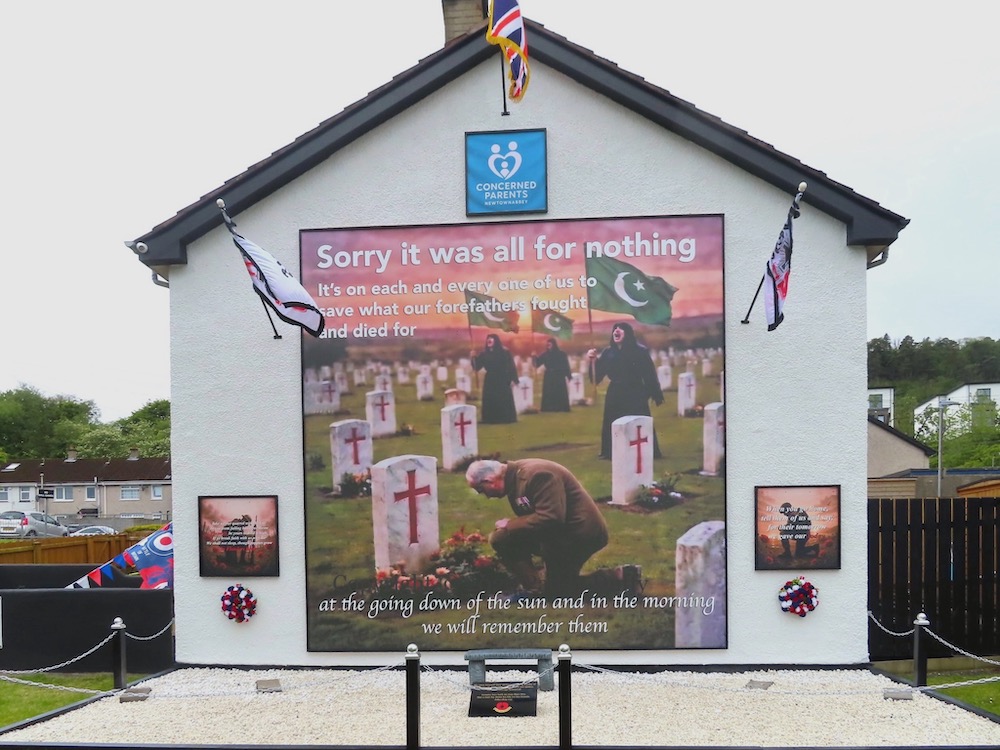
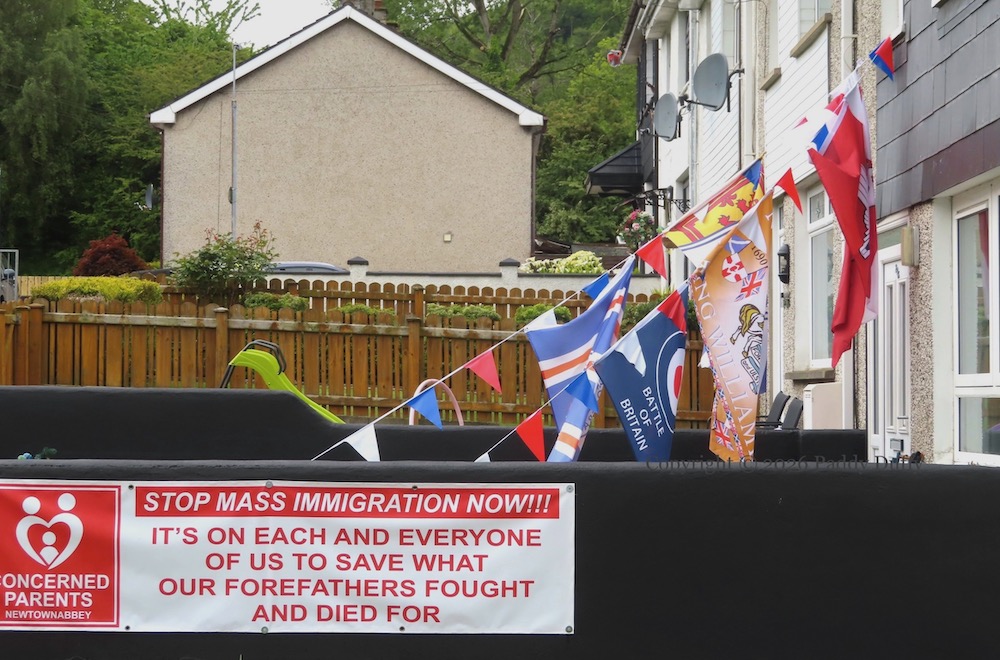
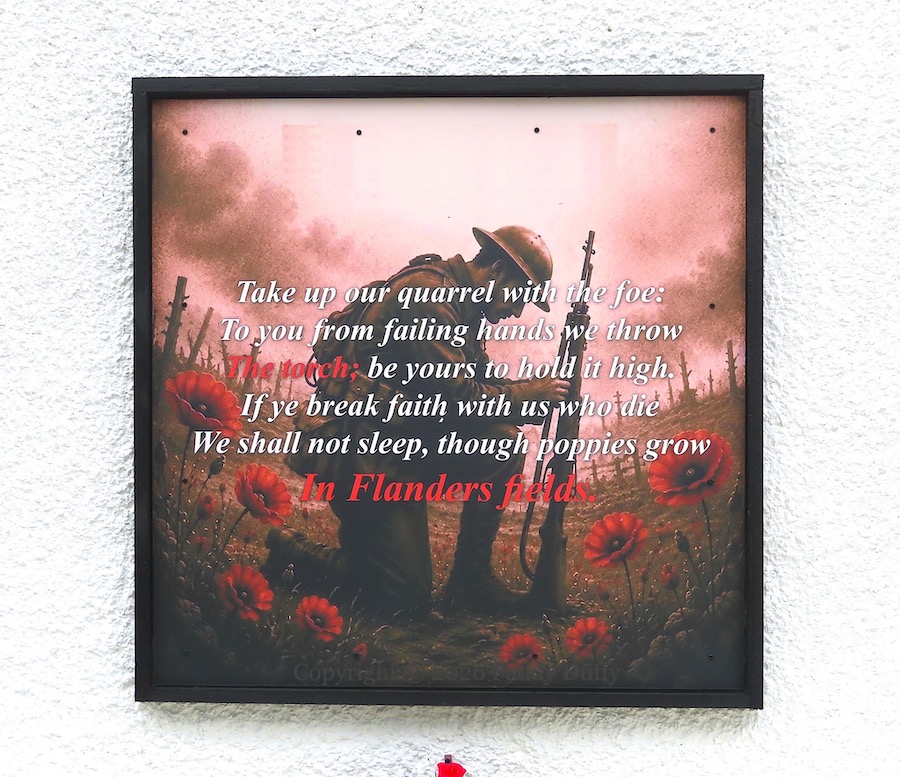
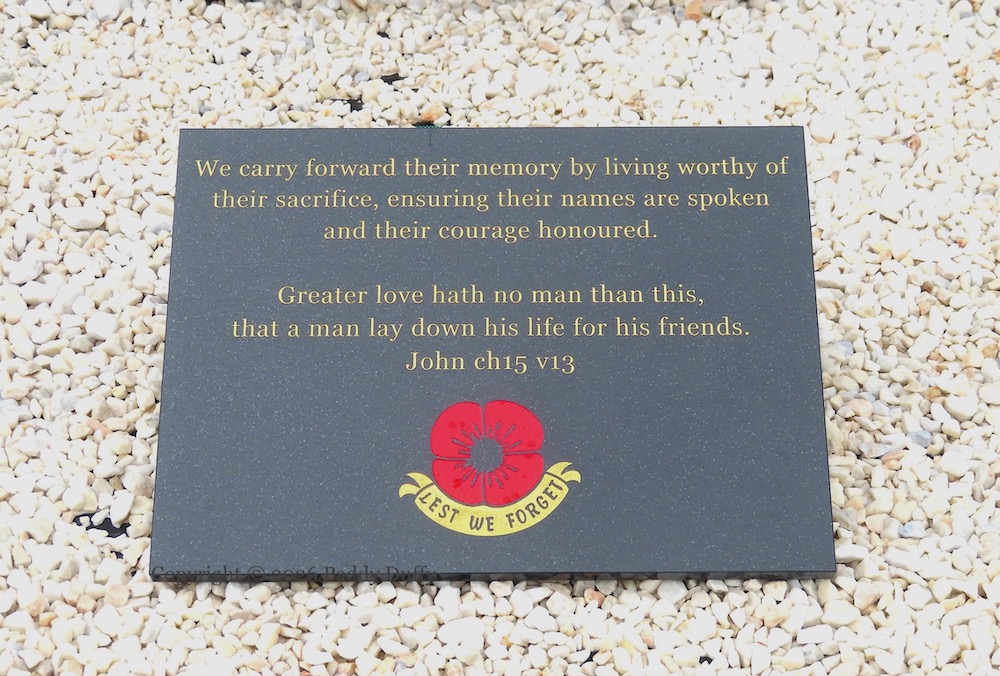
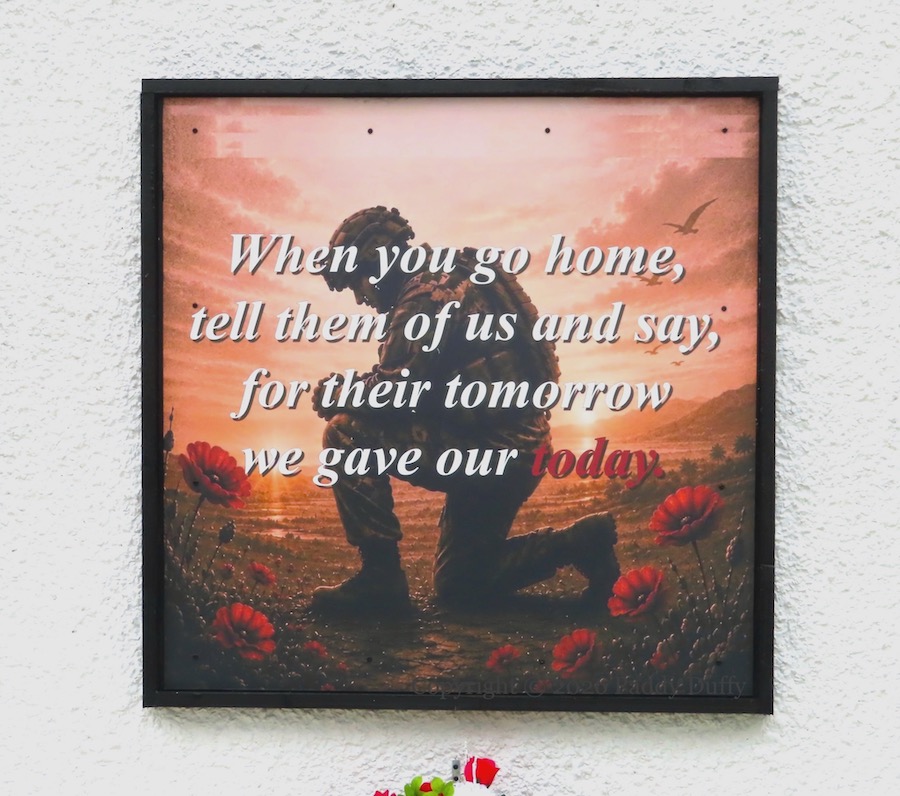
This entry updates the images in Sorry It Was All For Nothing, which showed the central board a few days before its official launch, on May 8th. In the few days before the launch, the “garden” area was added, the pebble-dashed wall was repainted, and the small boards of kneeling soldiers – both WWI and modern British forces – were added on either side.
Doagh Road, Cloughfern, Newtownabbey
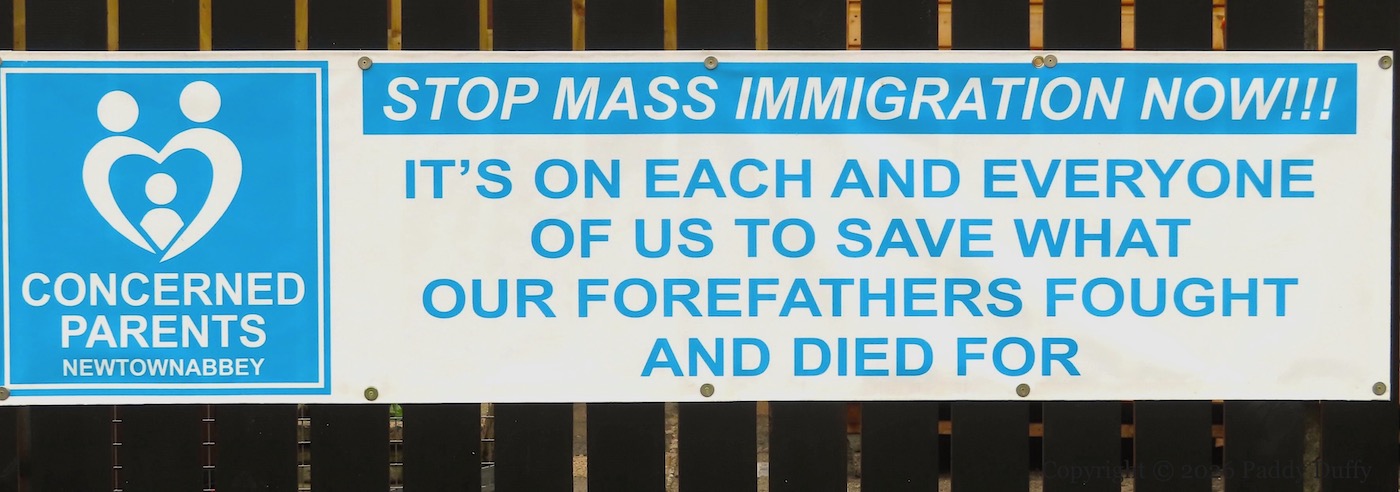
Update: the board was paint-bombed; Concerned Parents accused three immigrants in a silver Fiat (Fb) of attacking the “war memorial” but Lasaır Dhearg claimed responsibility (ig).
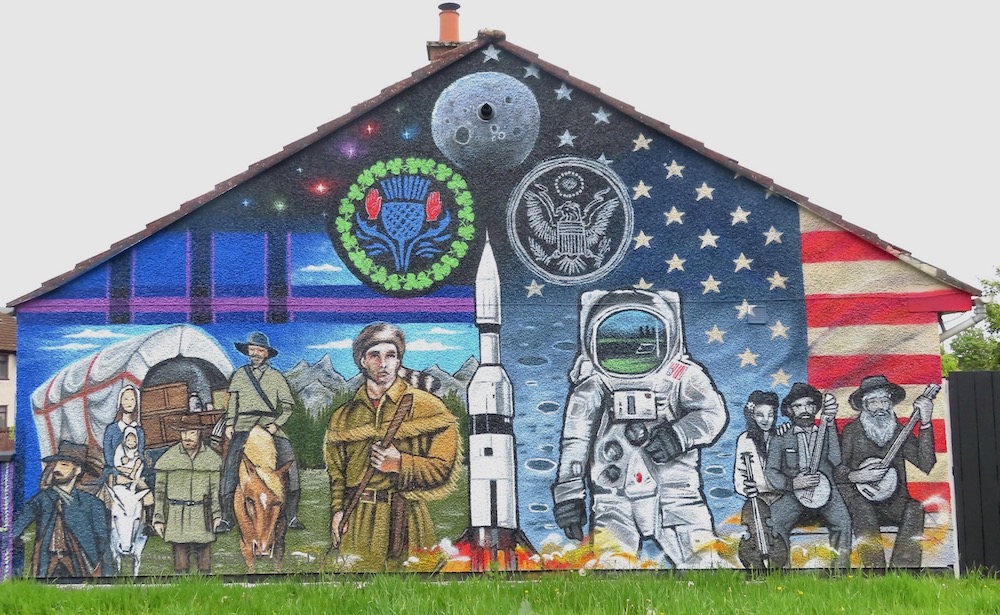
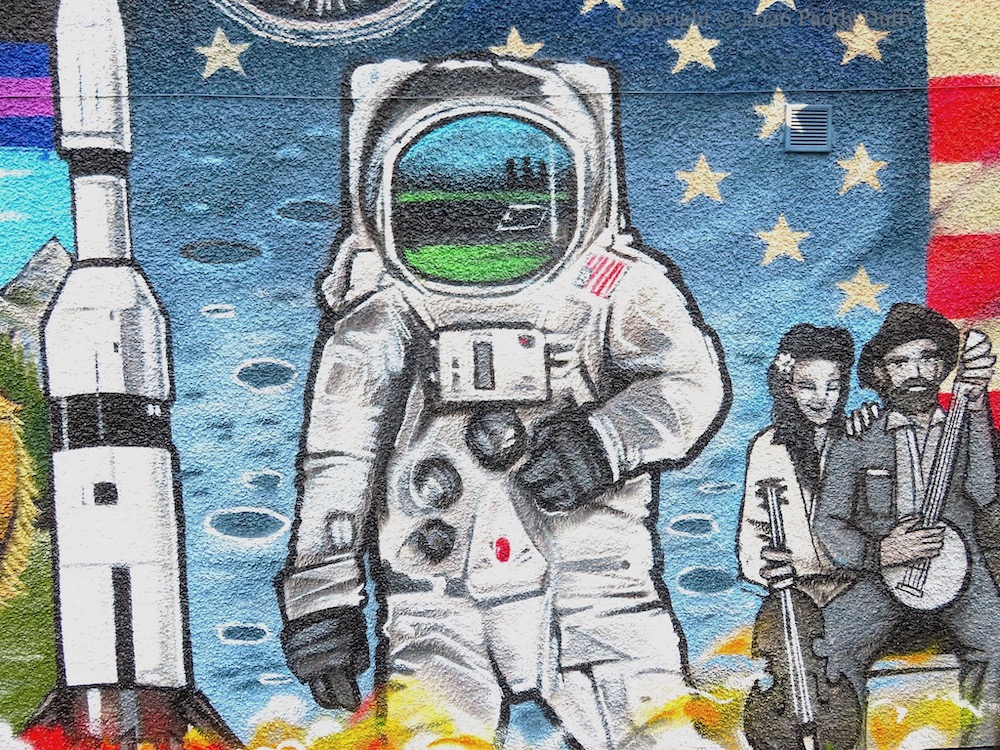
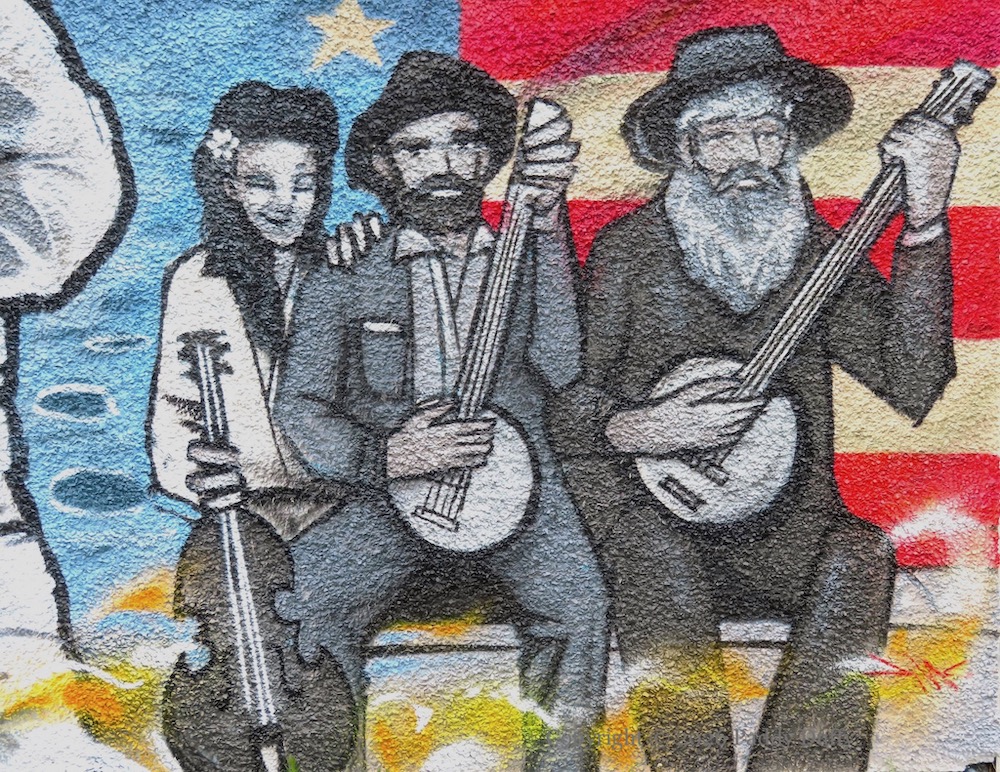
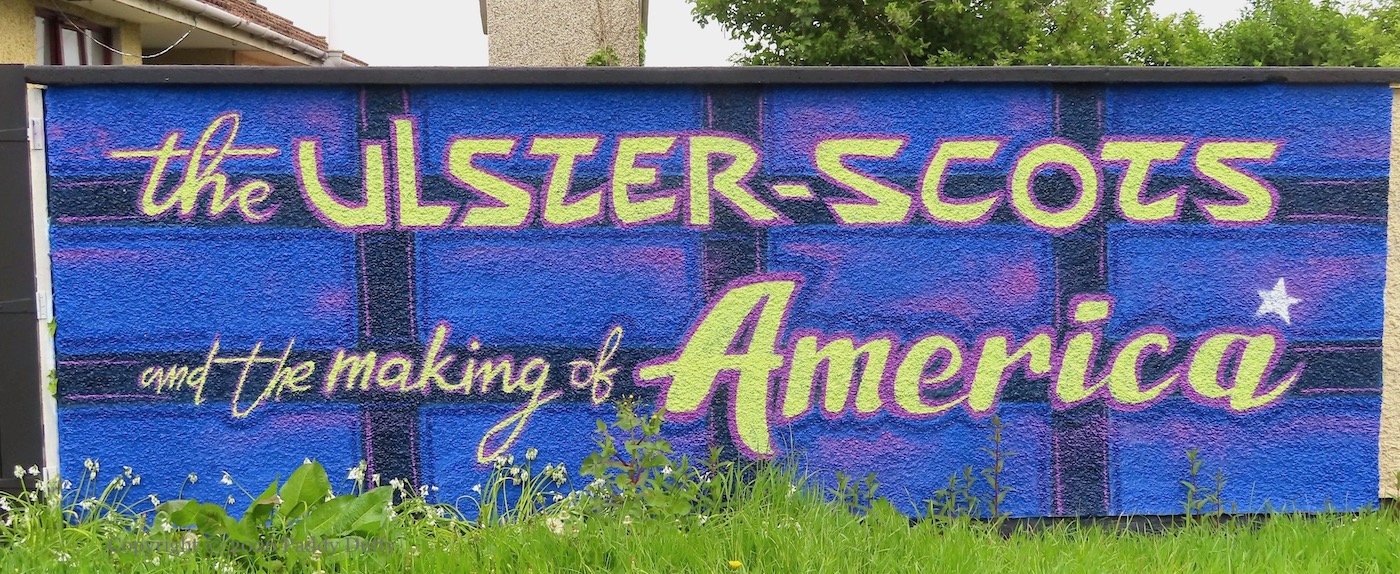
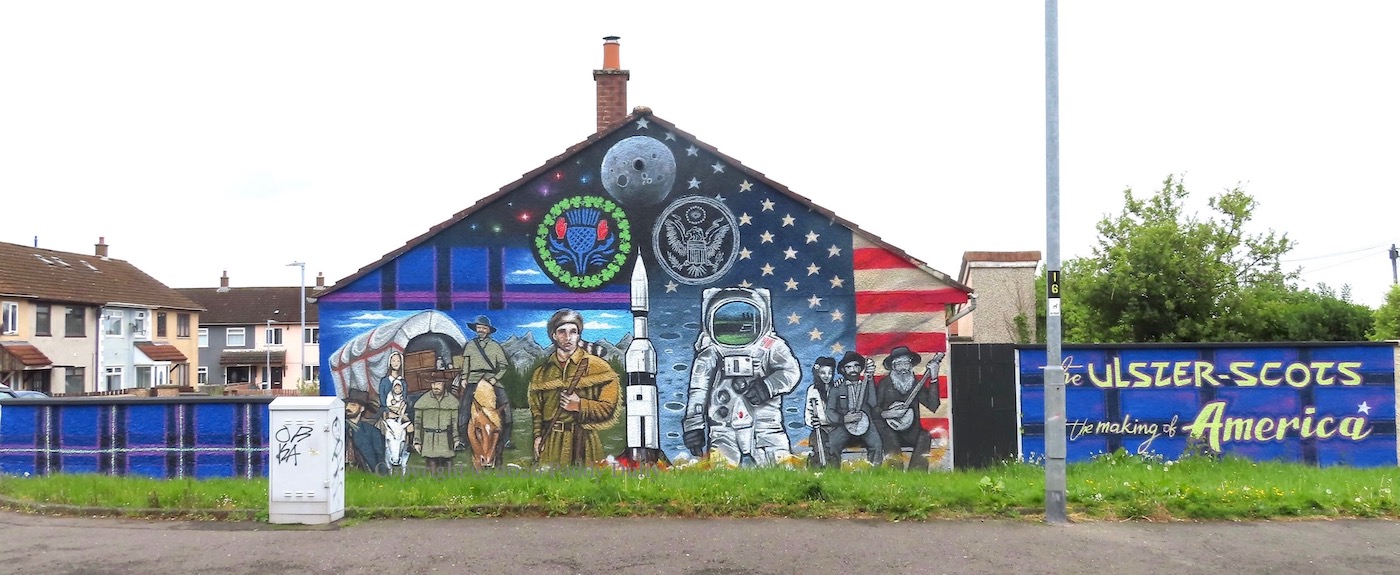
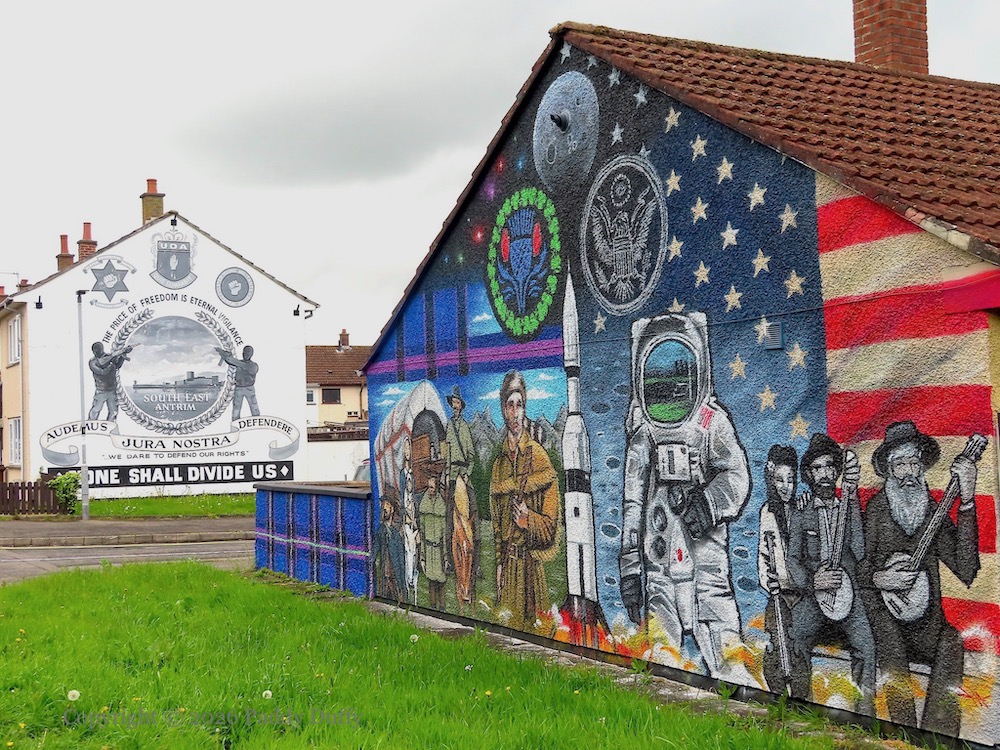
“The Ulster-Scots and the making of America” is a new mural in Carrickfergus celebrating the impact of Ulster-Scots (or, Scotch-Irish) emigrants to the colonies that became the United States.
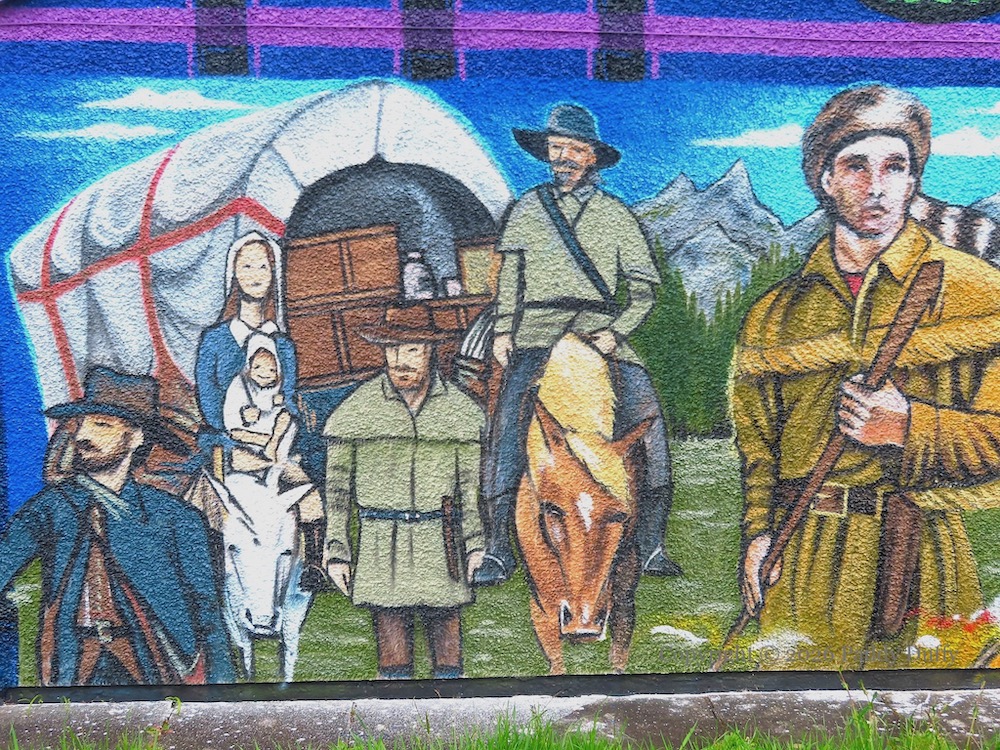
On the left and right of the main gable (above), the arrivals are shown expanding the territories as they travel in a covered wagon and as embodying Appalachian culture in the form of “old time” (fiddle and banjo) music. (For the Ulster-Scots as frontiersmen, see Ulster Sails West in Ballymoney.)
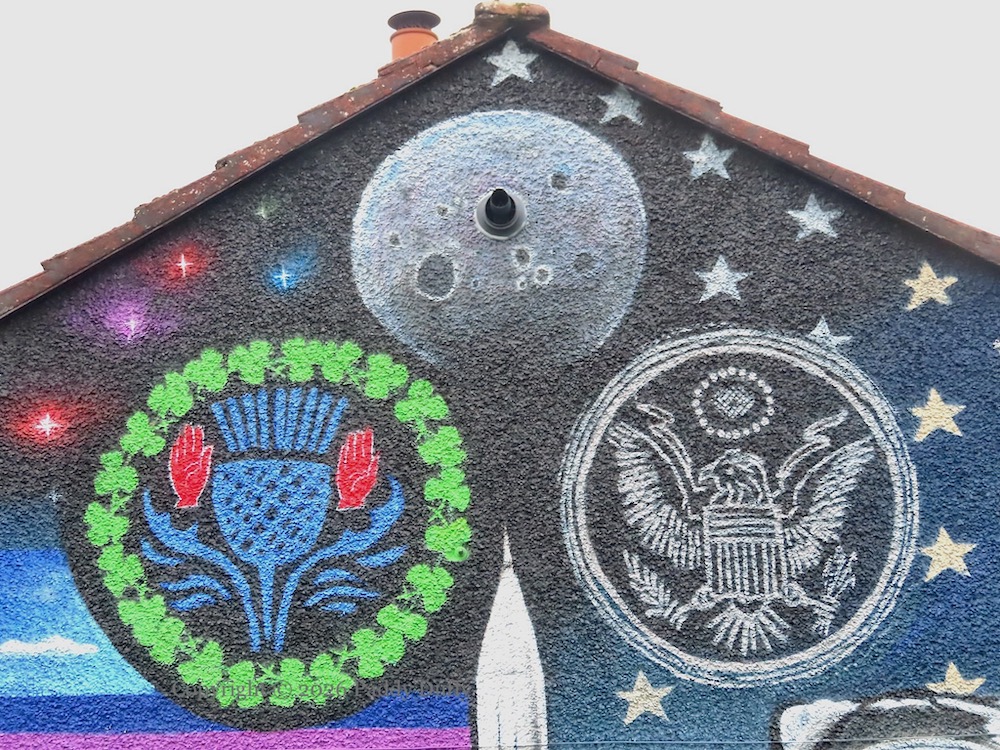
In the centre are images of space travel, the rocket (perhaps the Saturn V) is heading to the moon (shown in the apex of the wall), upon which Buzz Aldrin walked in the 1969 mission on Apollo 11.
(These are the same themes as deployed in the new mural for the 250th anniversary of the United States in the Shankill – see We Lead Across Time And Space.)
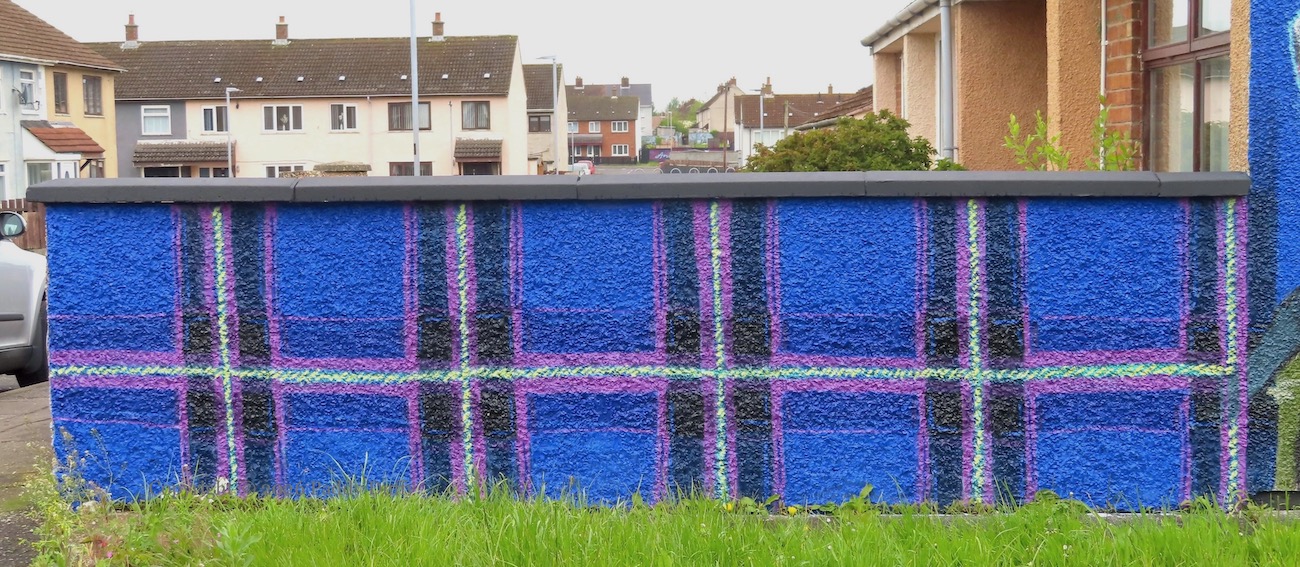
The tartan pattern is called “Ulster Scots” (Tartan Register). The emblem combining a thistle and two red hands within a circle of shamrocks appears to be original work. The Great Seal of the United States was designed by Charles Thomson from Maghera; his contribution is commemorated in his home town.
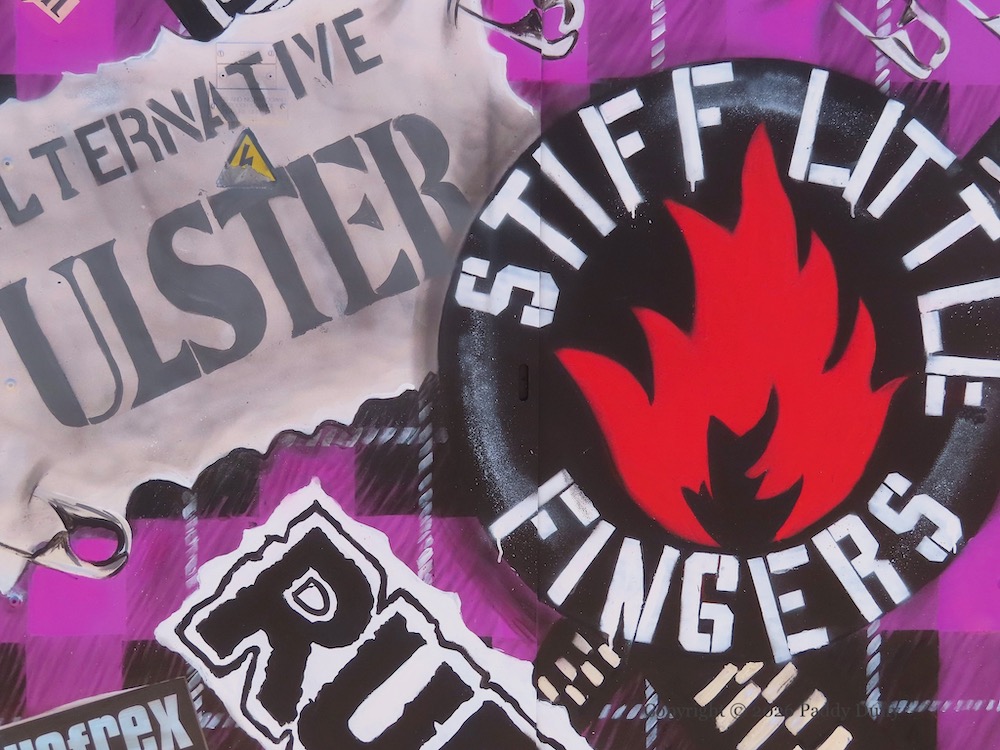
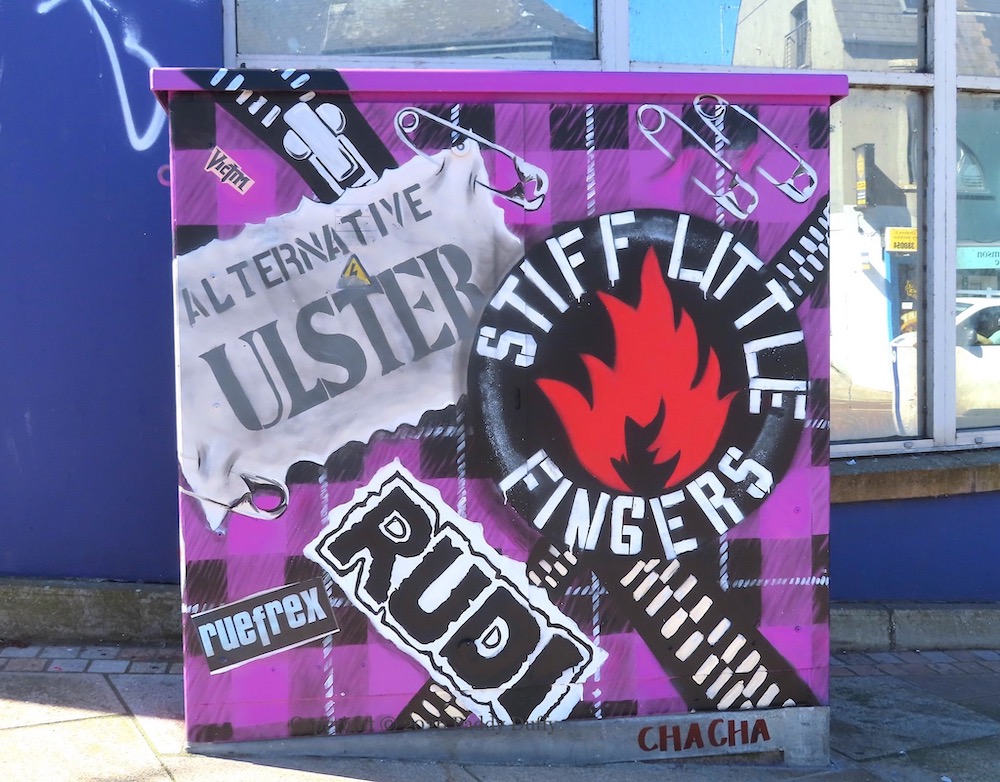
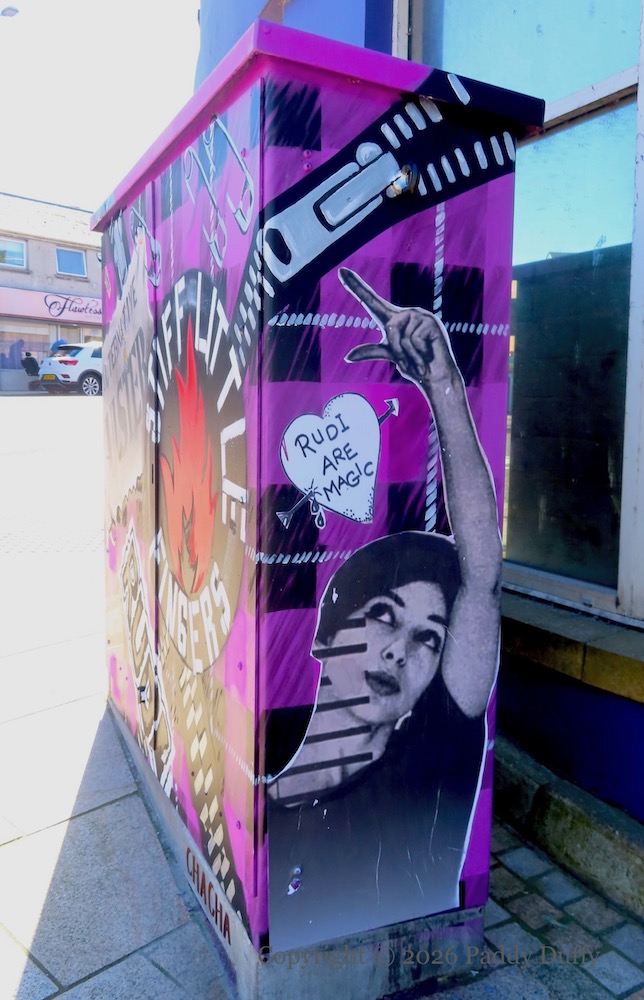
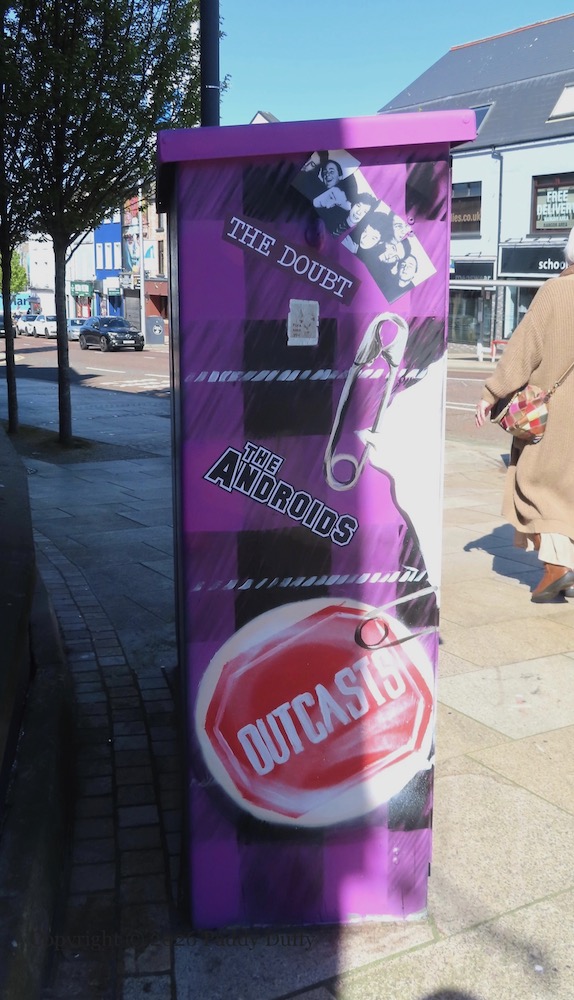
There is a ‘blue plaque’ outside the Trident bar in Bangor’s High Street, to commemorate its role in the punk movement of the late 1970s (BBC | Guardian). The bands listed on this painted electrical box are Ruefrex (web), Stiff Little Fingers (web), Rudi (Something Hard), The Doubt (Irish Rock), The Androids (Spit), The Outcasts (Faster & Louder).
The bar is referenced in the SLF song “Alternative Ulster” (lyrics). Despite the claim that “there’s nothing for us in Belfast”, there is a plaque remembering the punk scene outside the Harp Bar – see Belfast Has The Reason.
By Cha Cha (ig), one building up from the Trident (Wolsey’s), High Street, Bangor
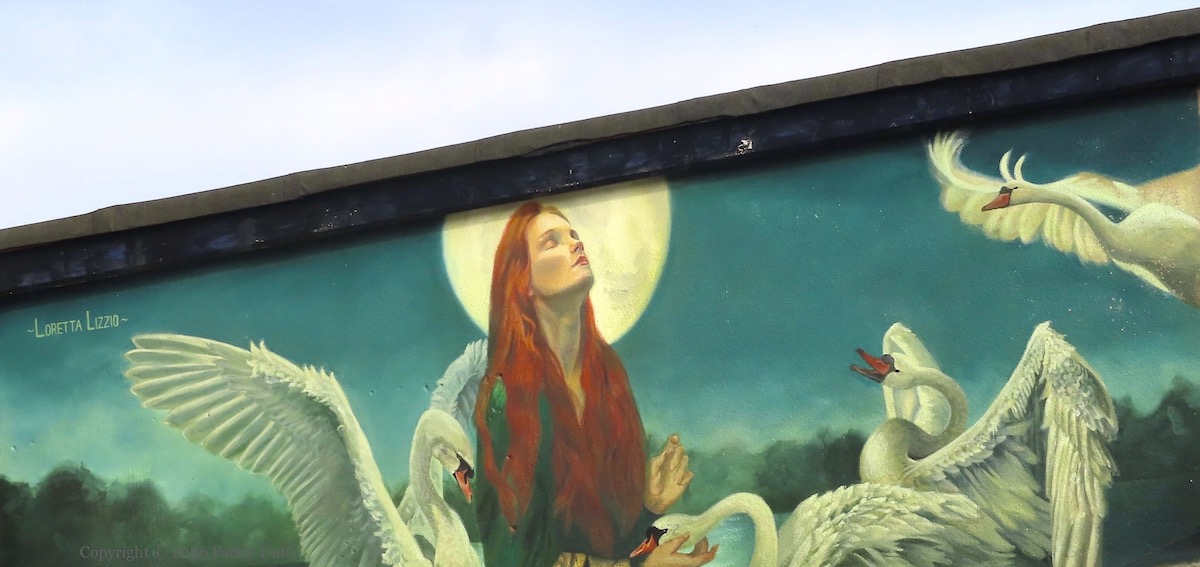
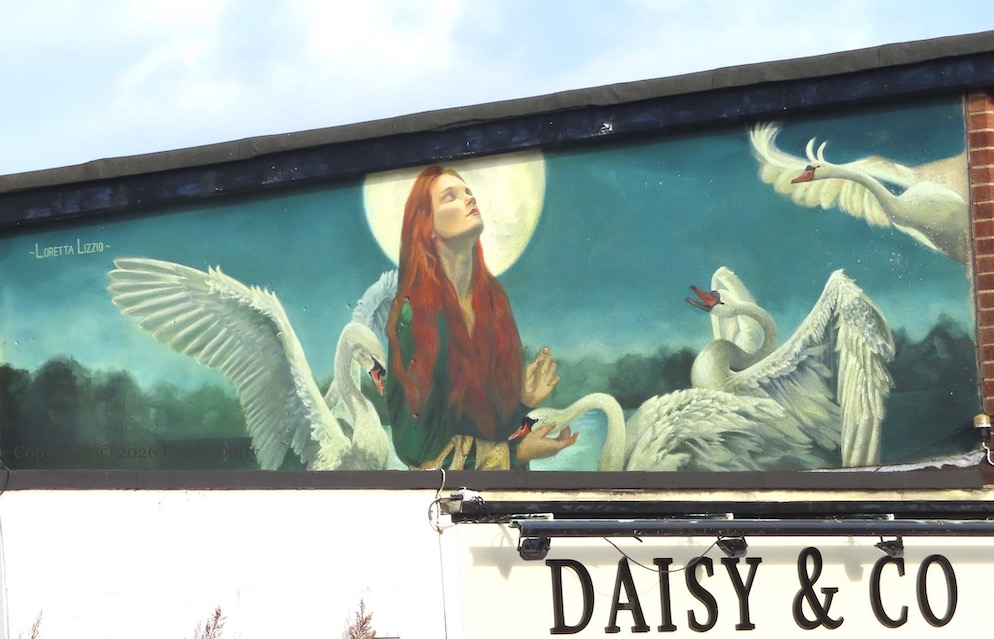
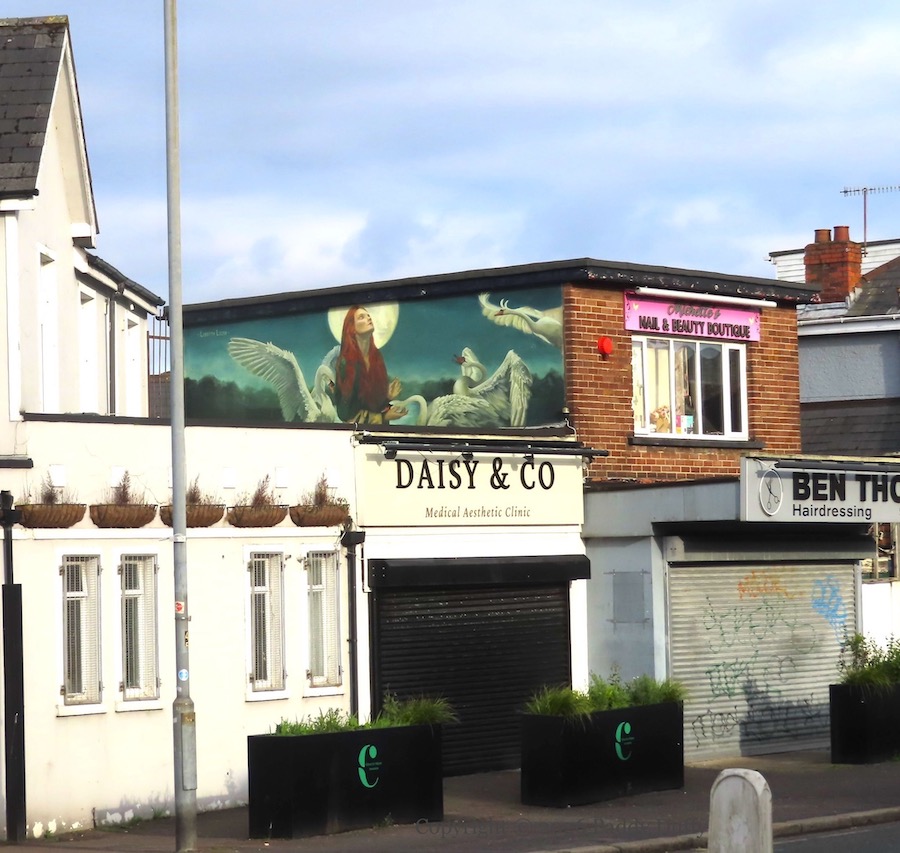
This scene from the story of Clann Lır (the Children Of Lear) appears to be the moment that Aoıfe casts a spell that turns her four step-children into swans on Loch Daırbhreach.
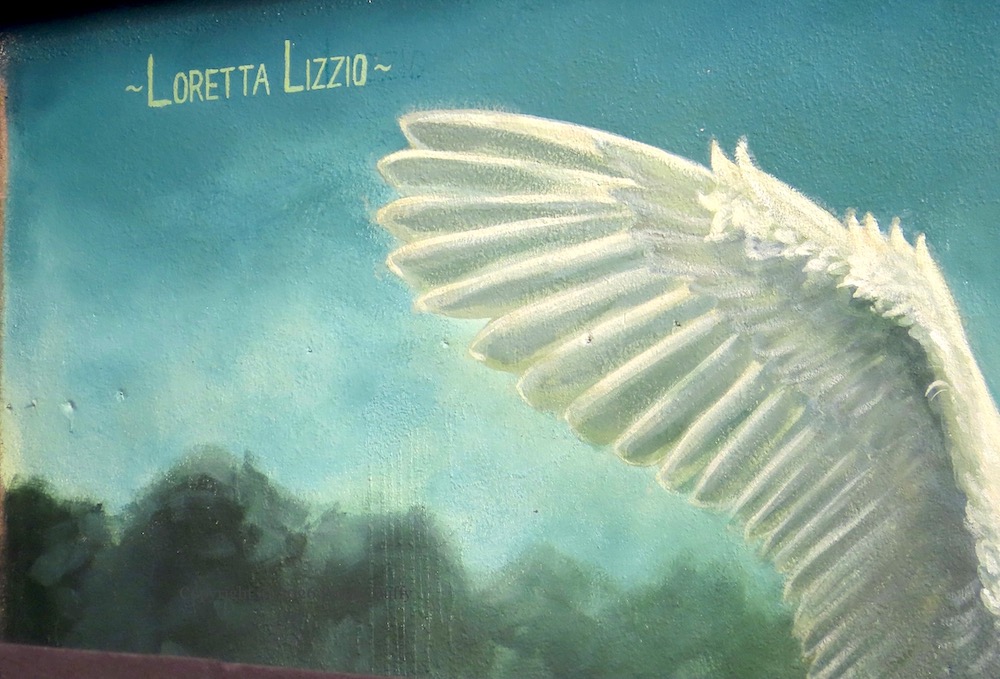
Painted by Loretta Lizzio (web) at the same time (2023-09) as her Dark Dreamer on the Oldpark Road, just below the first Cliftonville roundabout.
 Paddy Duffy Collection