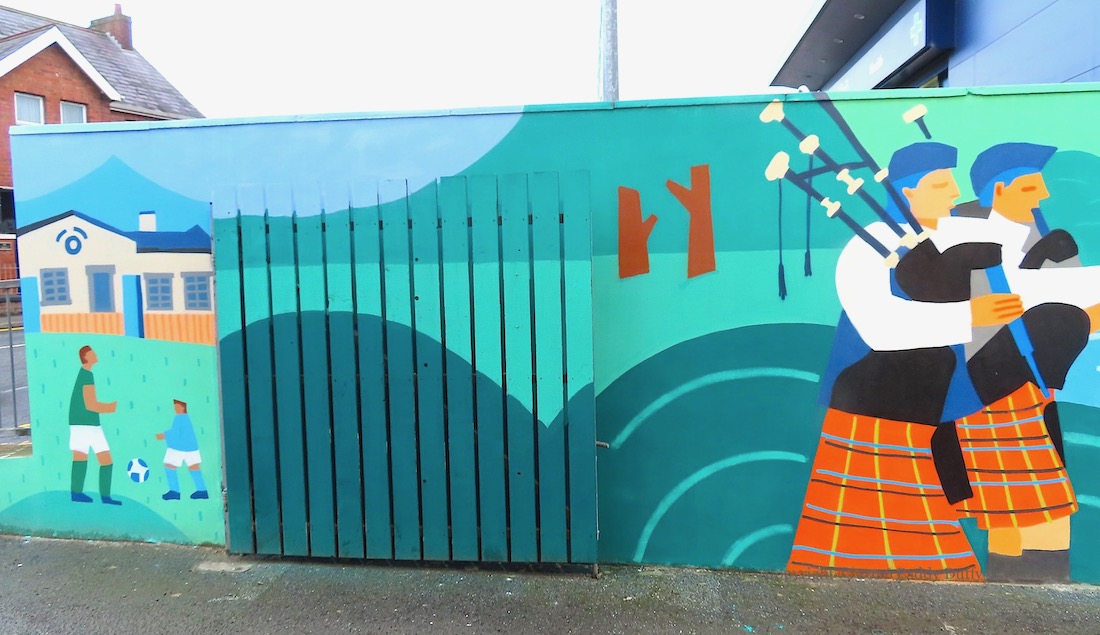
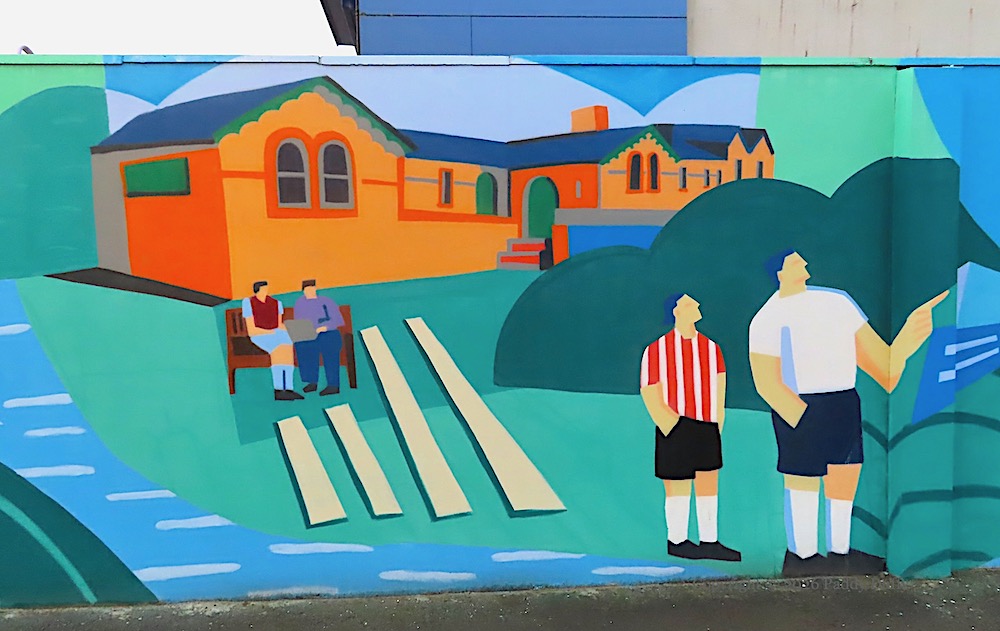
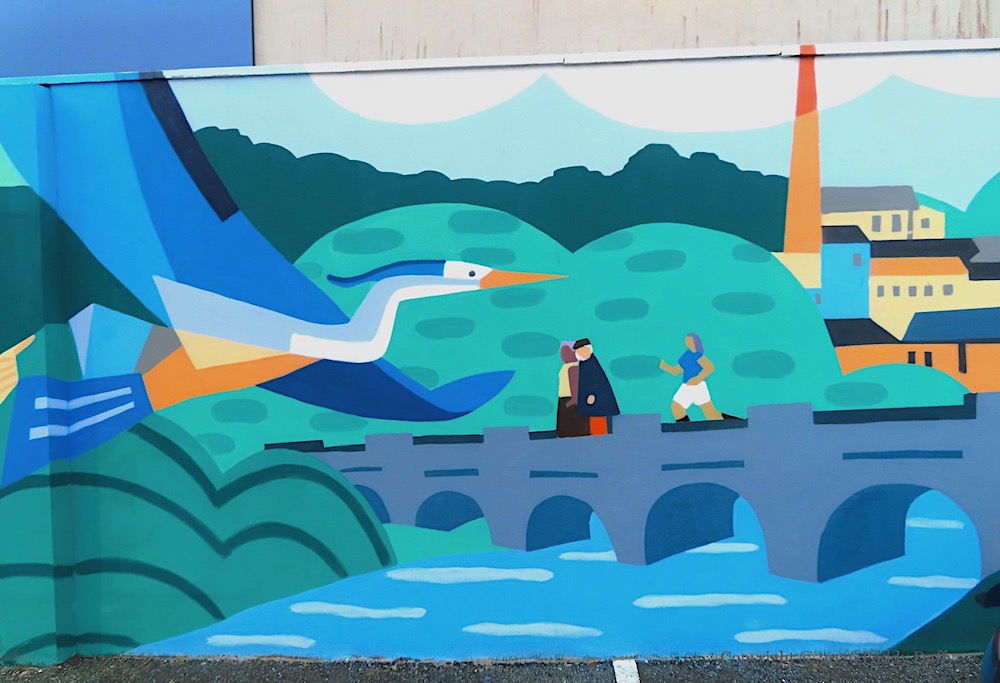
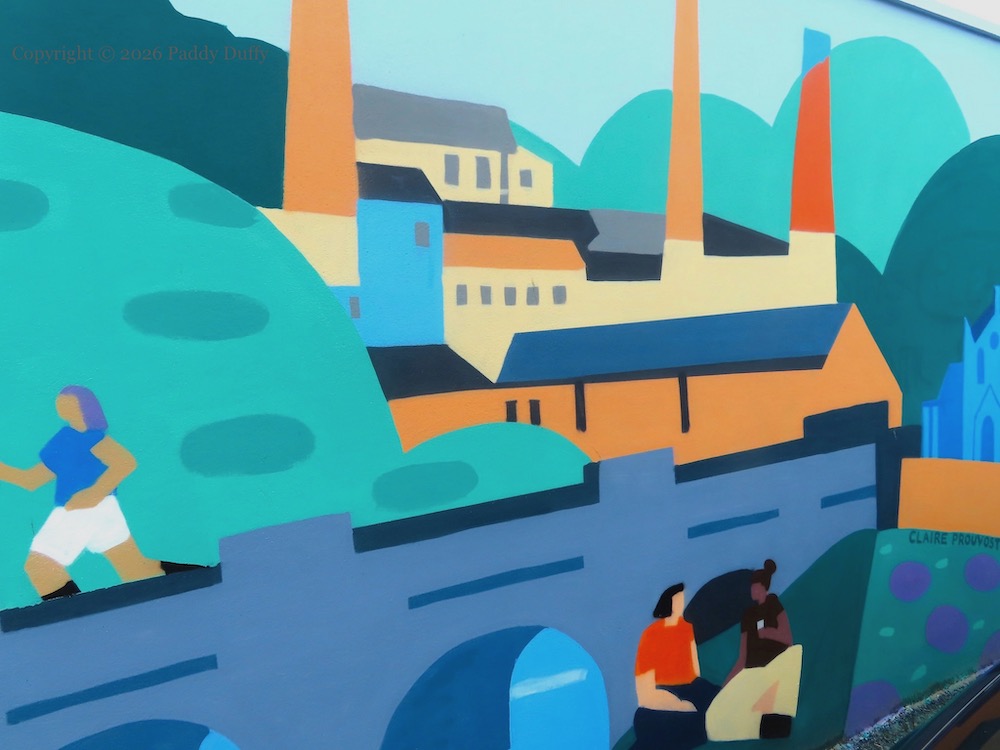
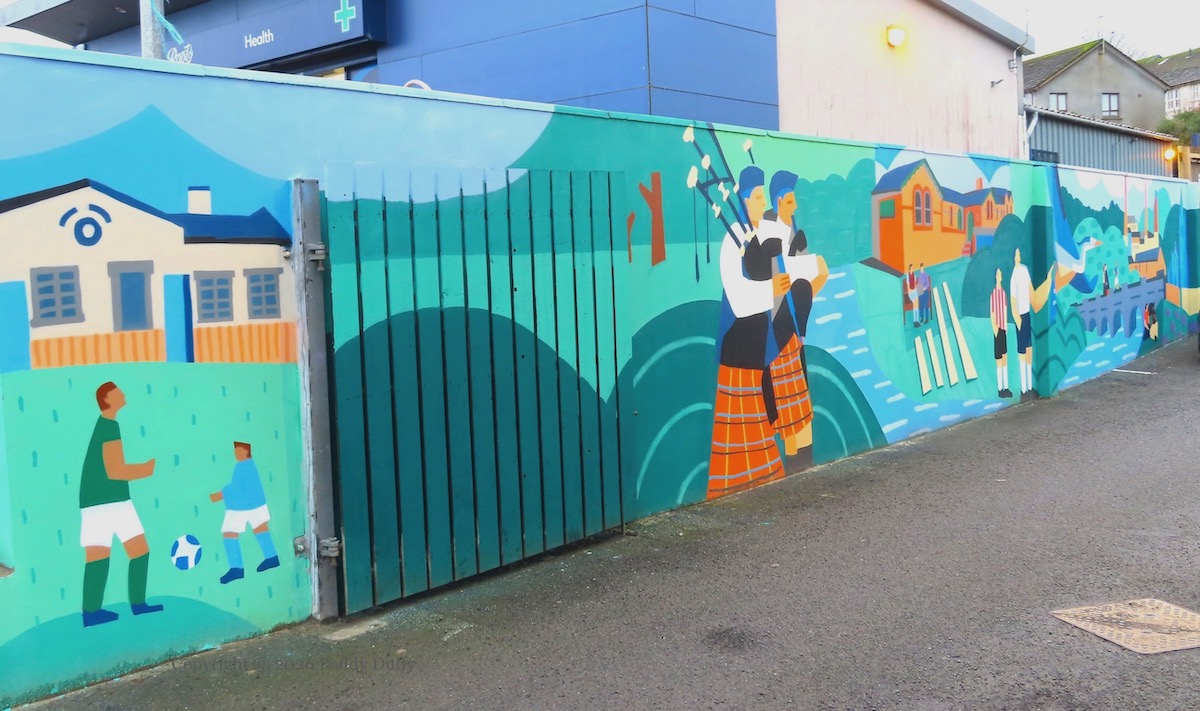
This Cullyback art is a “Shared Island” (gov.ie) project, created as a collaboration between Waterford City & County Council and Mid- & East-Antrim Borough Council. It shows, from left to right, children playing soccer in front of Buick Memorial school, the Cullybackey Pipe Band (Fb), the Railway Sleeper (Discover NI), wildlife at the Cullybackey Bridge (geograph), and Maine works.
Paint by Claire Prouvost (web), 2025-10, with support from The Walls Project (Fb) and Cullybackey Community Partnership (Fb).
Main Street, Cullybackey, between the Maine business centre and Boots.
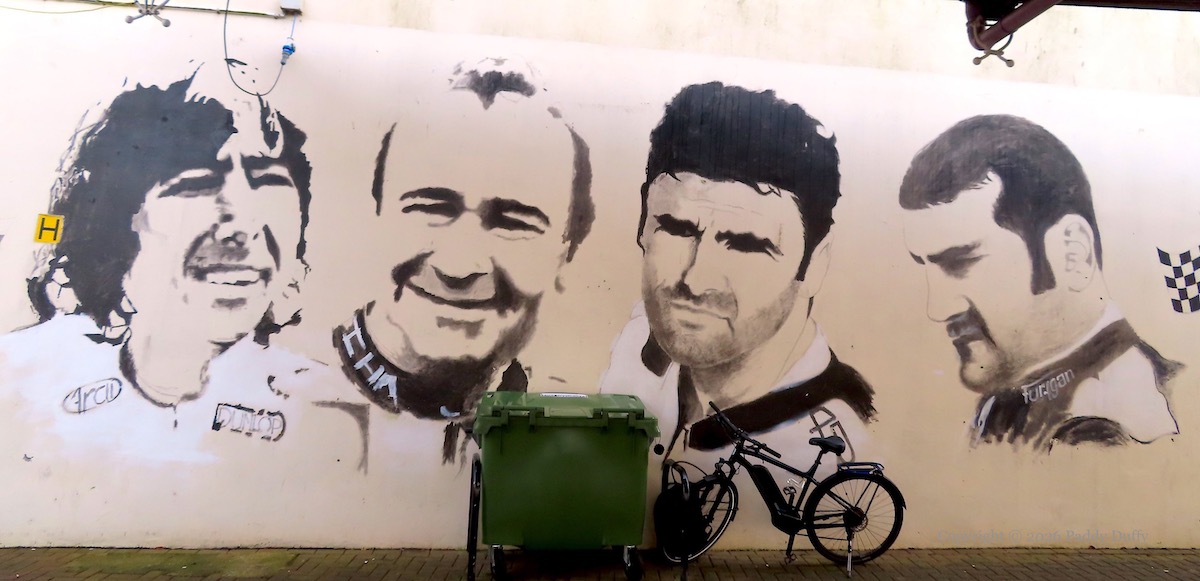
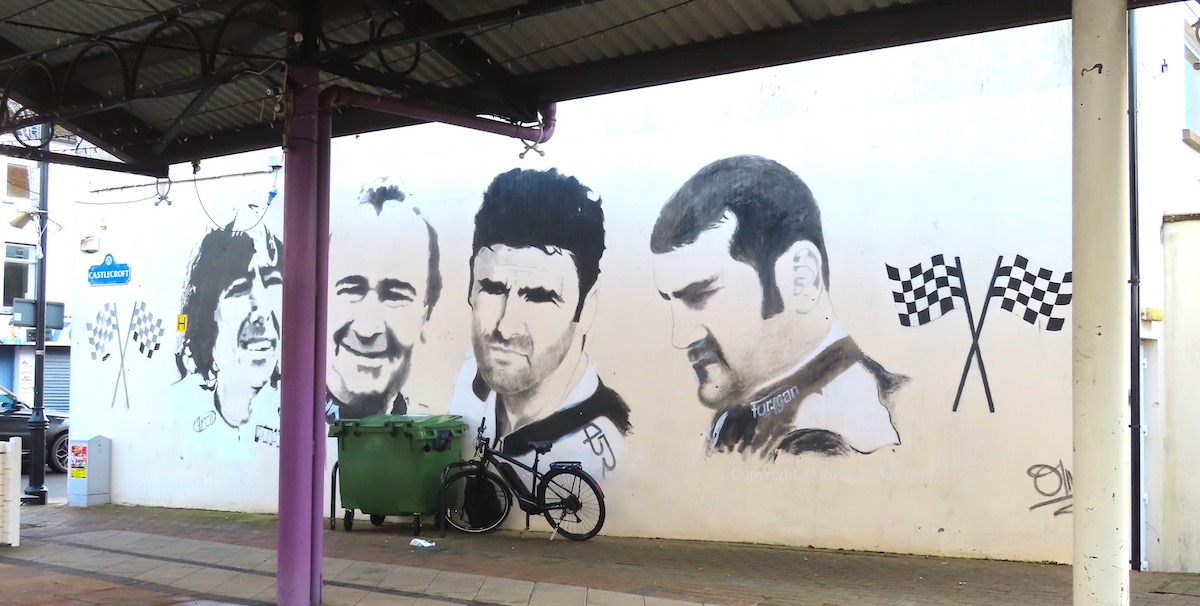
This Ballymoney mural celebrates and commemorates members of the Dunlop family of motorcycle racers. From left to right we see brothers Joey and Robert and then Robert’s sons William and Michael. Joey died in a race in Estonia in 2000; Robert died in 2008 of injuries sustained in a practice session for the North West 200; William died in 2018 in a crash during practice for the Skerries 100. Michael is still alive and currently aged 36; he was Irish Motorcyclist Of The Year in 2025 (BelTel).
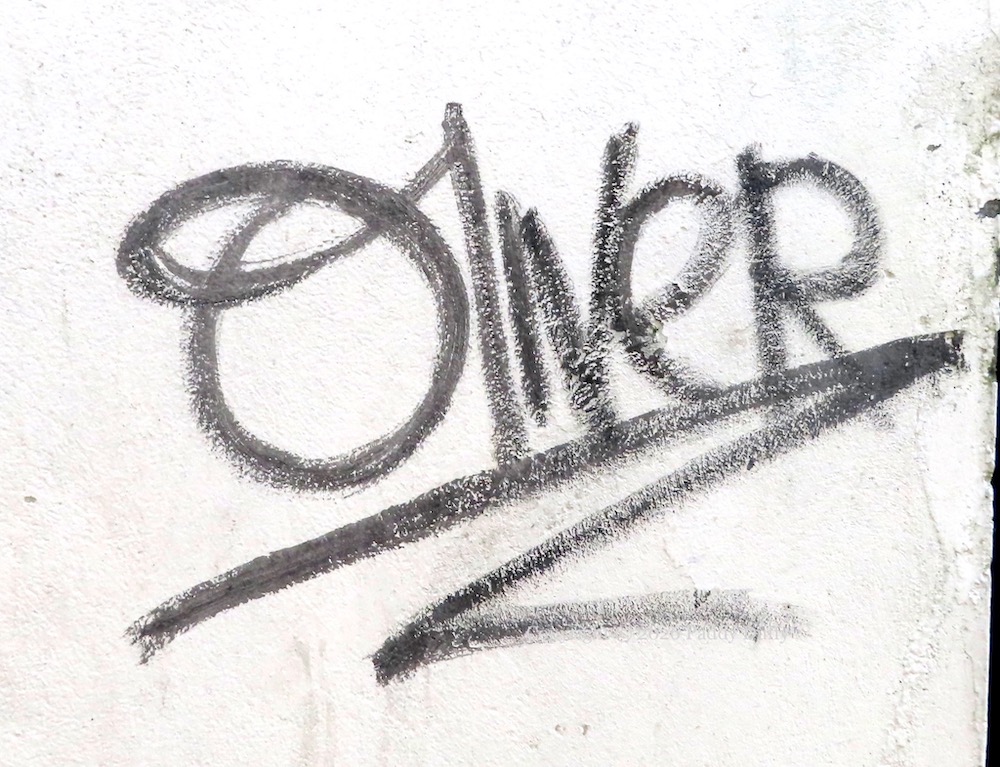
This mural was painted by Oliver McParland (web) in Castlecroft Square, Ballymoney.
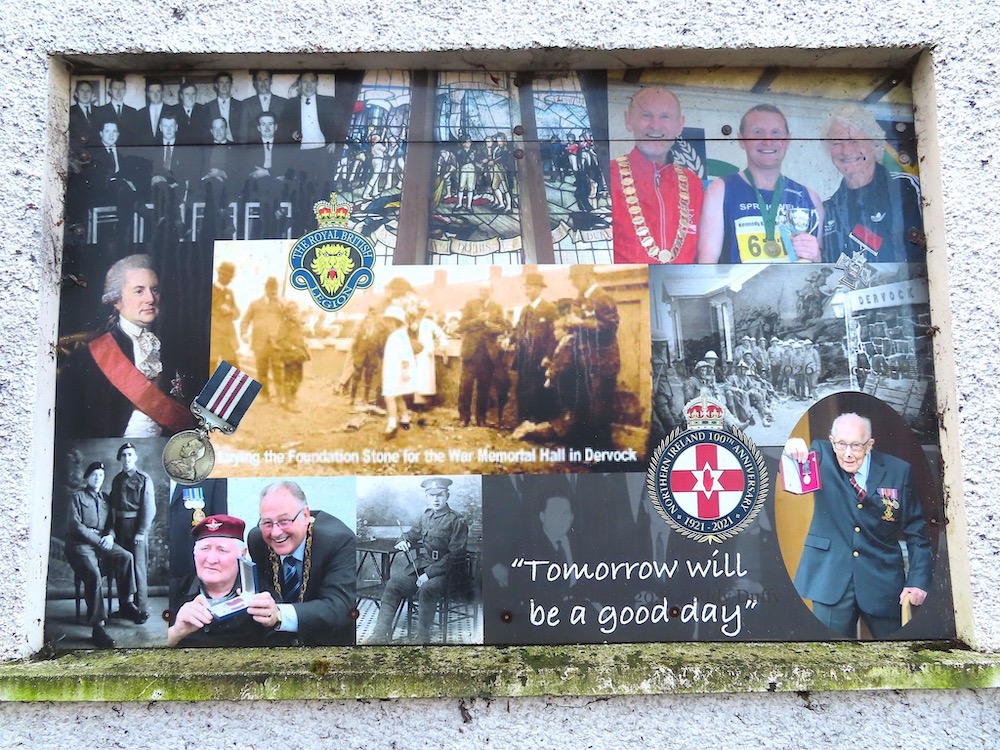
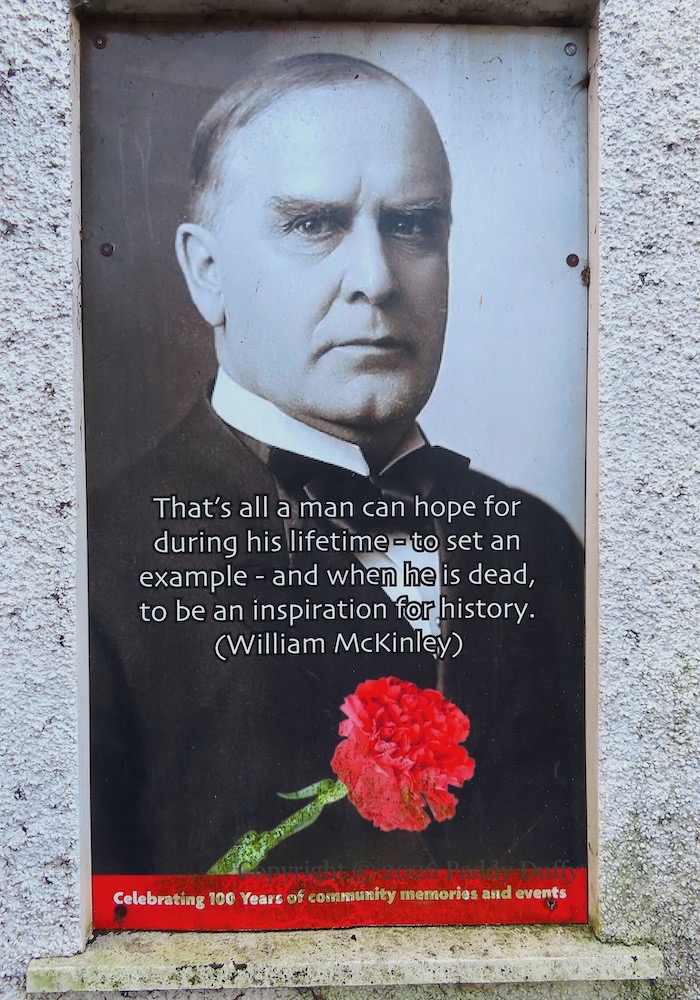
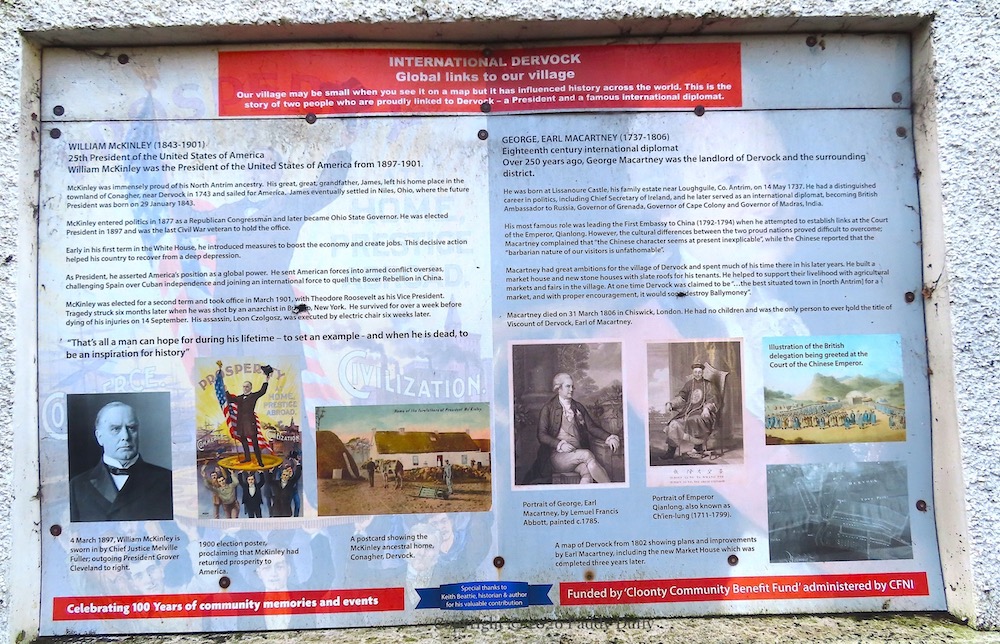
“Our village may be small when you see it on a map but it has influenced history across the world. This is the story of two people who are proudly linked to Dervock – a President and a famous international diplomat.”
The President is “William McKinley (1843-1901) 25th President of the United States … from 1897-1901. McKinley was immensely proud of his North Antrim ancestry. His great, great, grandfather, James, left his home place in the townland of Conagher, near Dervock in 1743 and sailed for American. James eventually settled in Niles, Ohio, where the future President was born on 29 January 1843. … “That’s all a man can hope for during his lifetime – to set an example – and when he is dead, to be an inspiration for history.””
The second figure is “George, Earl Macartney (1737-1806) Eighteenth century diplomat. Over 250 years ago, George Macartney was the landlord of Dervock and the surrounding district. He was born at Lissanoure Castle, his family estate near Loughguile, Co. Antrim, on 14 May 1737. … His most famous role was leading the First Embassy to China (1792-1794) …”
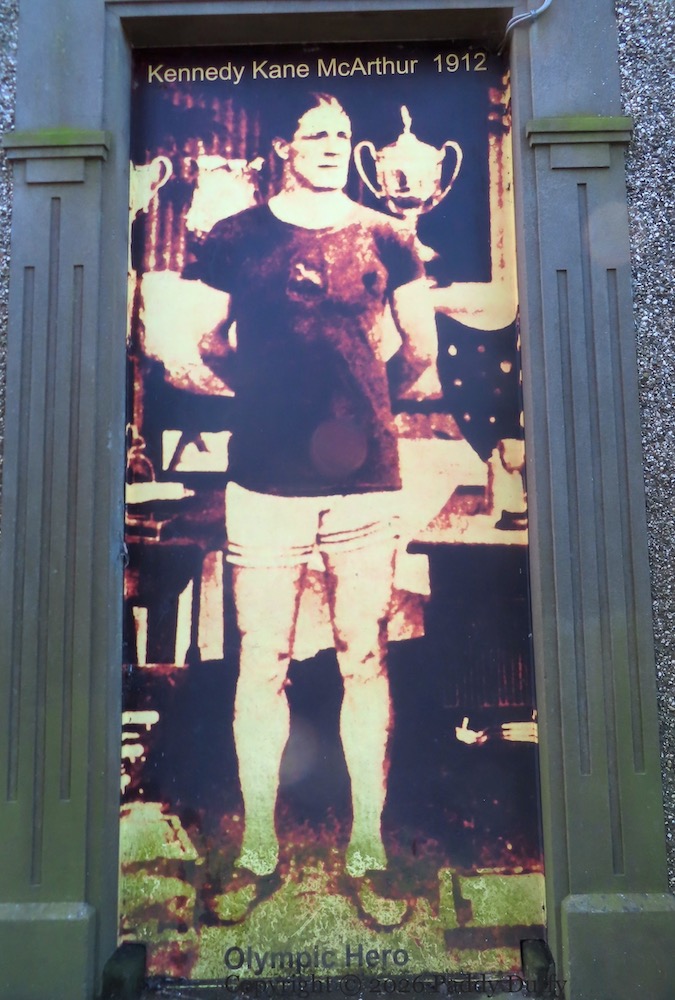
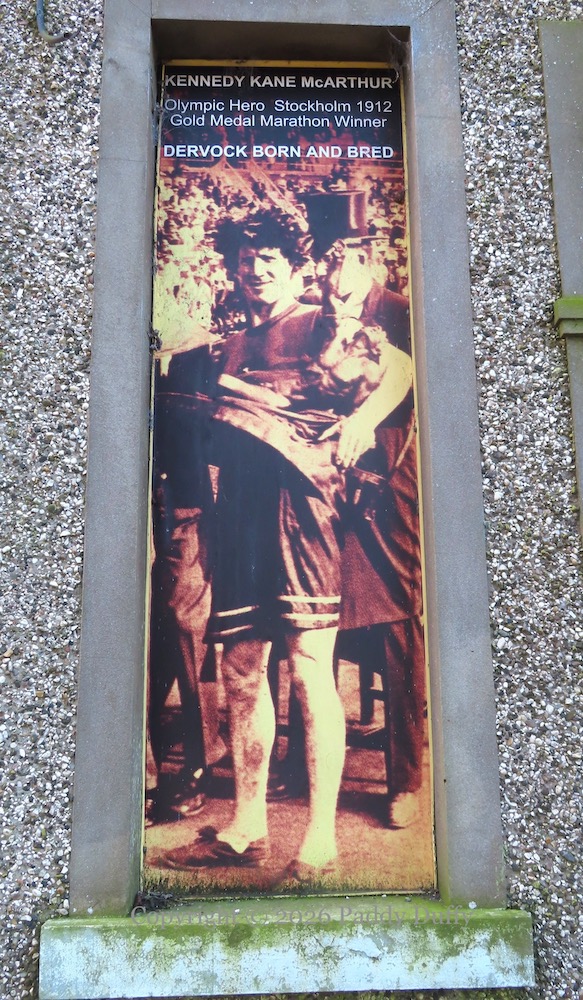
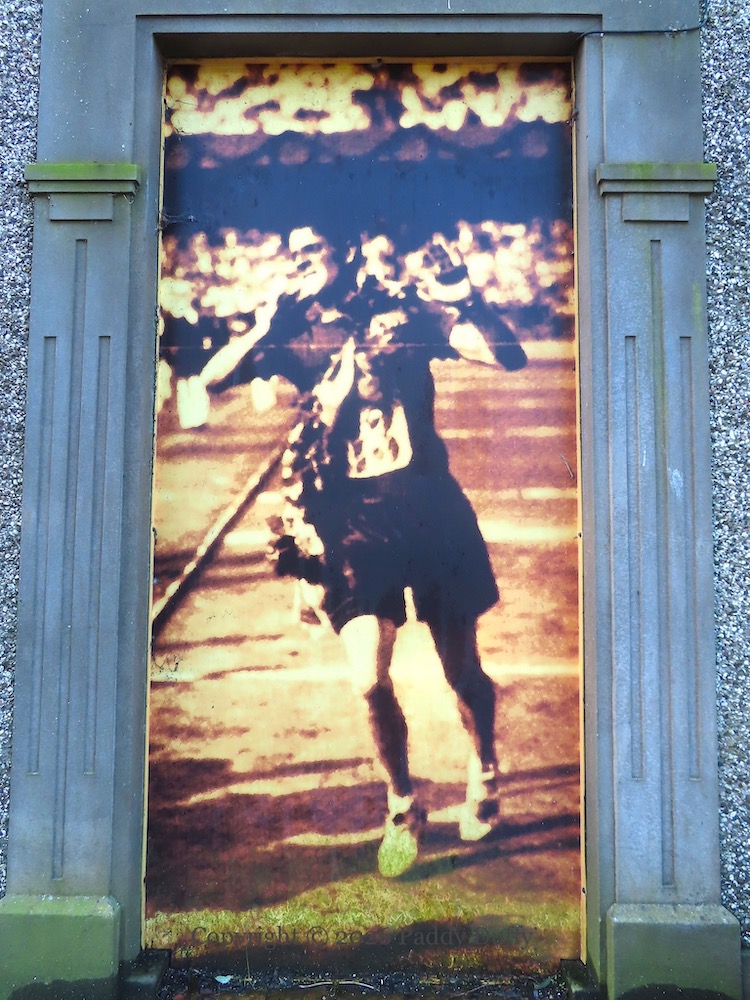
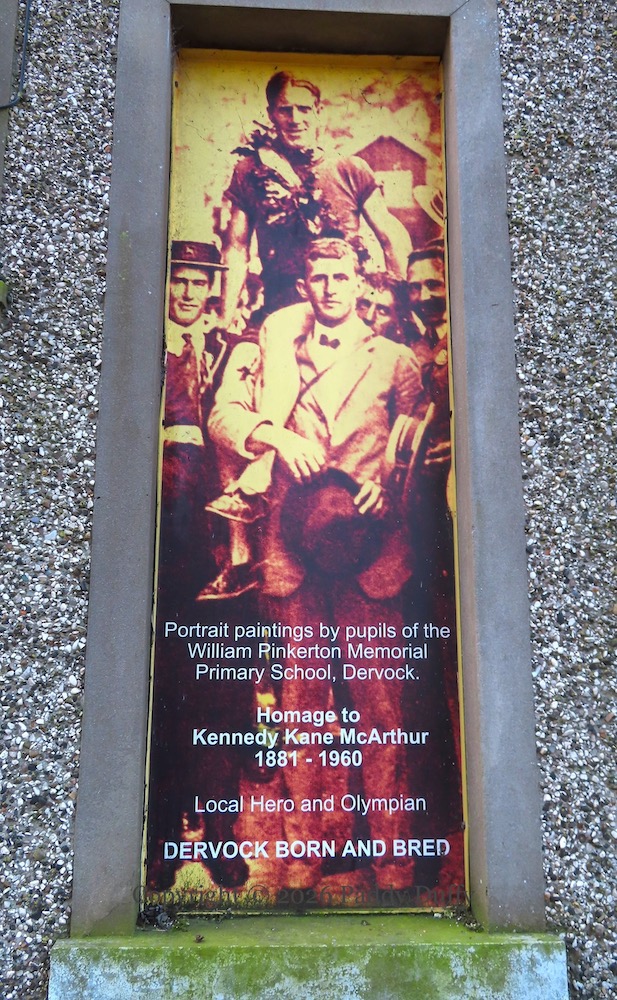
“Kennedy Kane McArthur, Olympic hero, Stockholm 1912, gold medal marathon winner. Dervock born and bred.”
Ken McArthur emigrated from Dervock to Johannesburg, South Africa, at age 20 and ran his first marathon at 28. Four years later, he represented South Africa at the Olympics and was victorious in the marathon (WP). There is footage of the race at olympics.com.
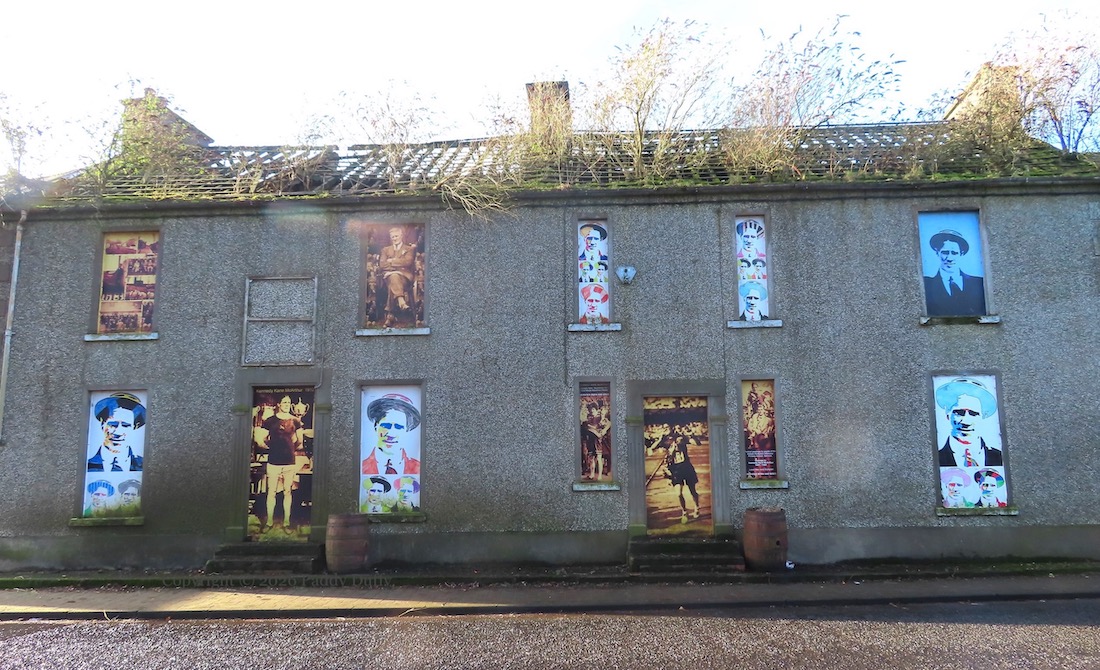
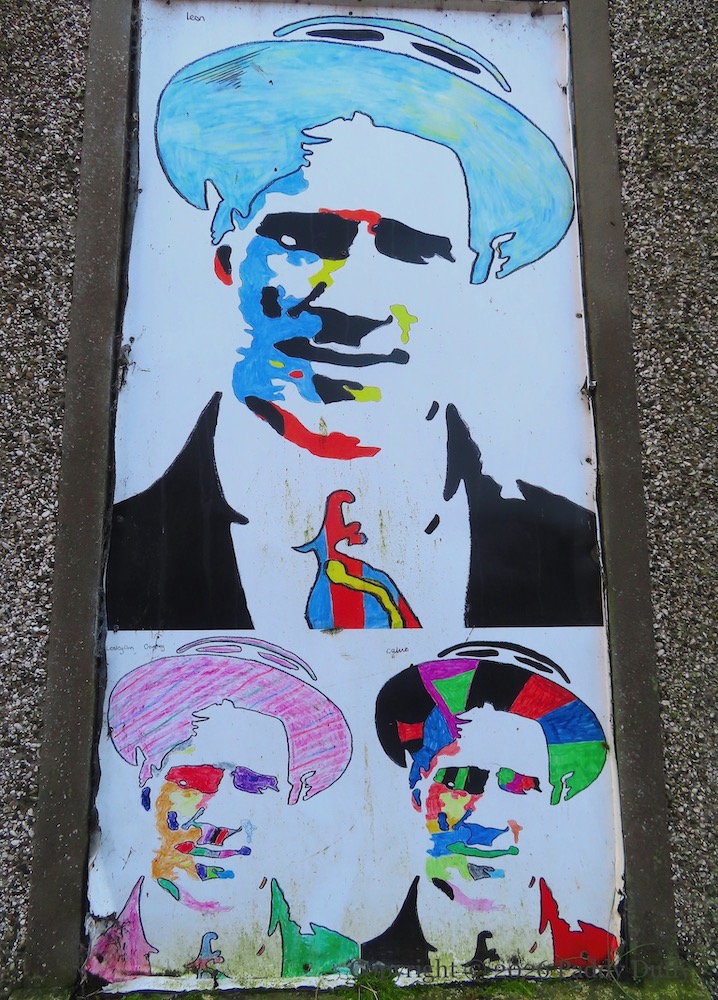
“Portrait paintings by pupils of the William Pinkerton Memorial primary school, Dervock. Homage to Kennedy Kane McArthur, 1881 – 1960, Local hero and Olympian. Dervock born and bred.”
Castlecat Road, Dervock
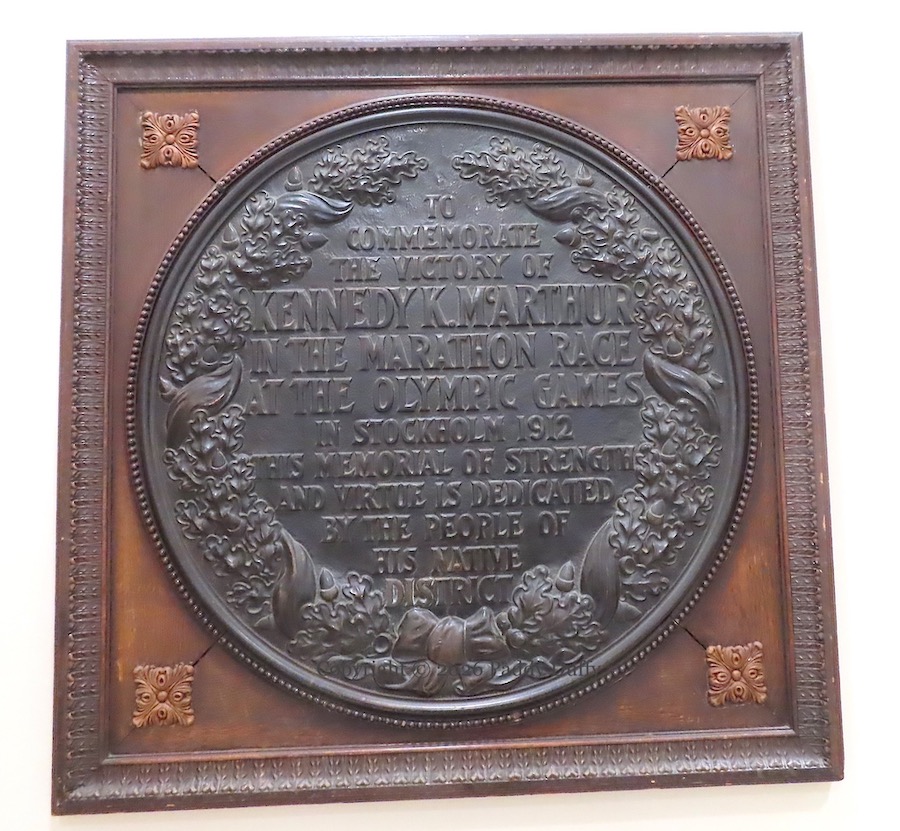
The large medallion is in the visitor centre in Townsend Street, Ballymoney. It reads, “To commemorate the victory of Kennedy K. McArthur in the marathon race at the Olympic Games in Stockholm 1912. This memorial of strength and virtue is dedicated by the people of his native district.”
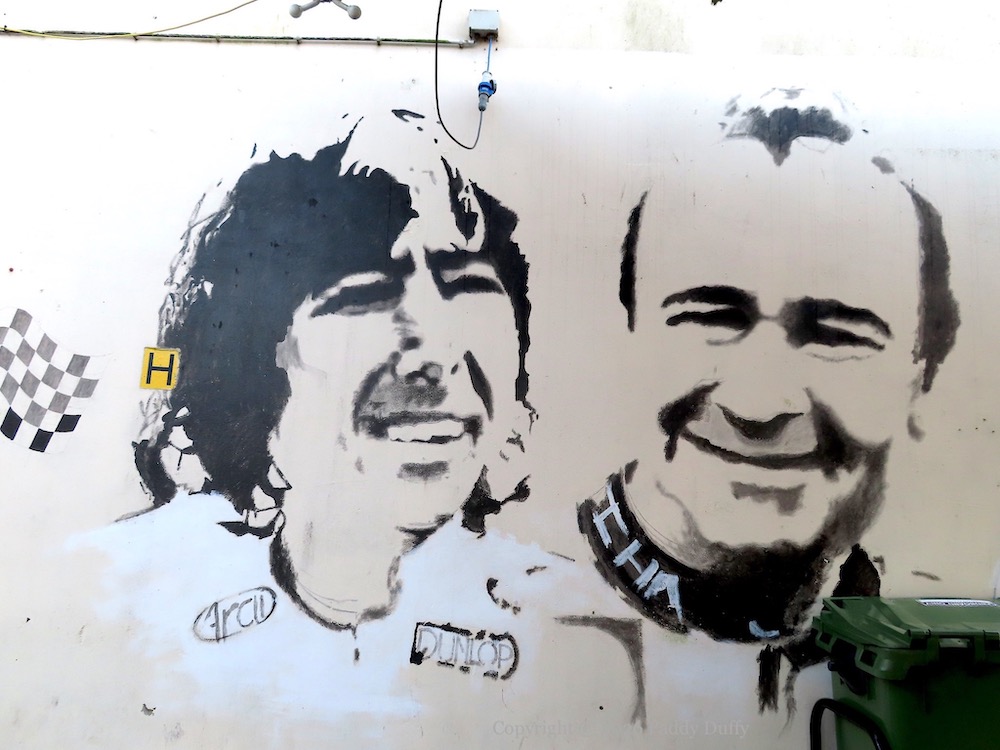
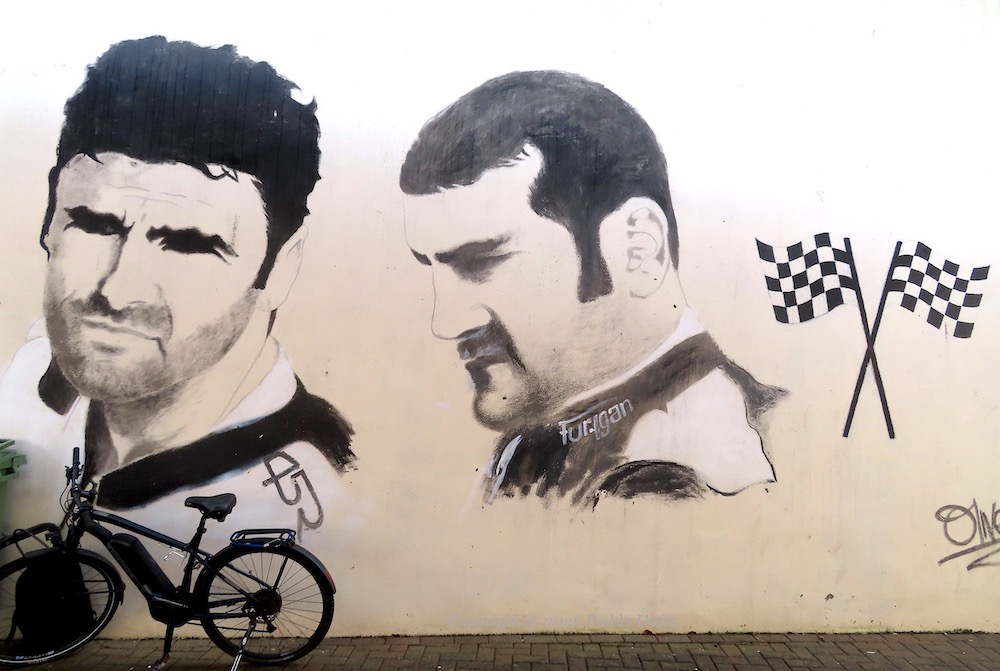
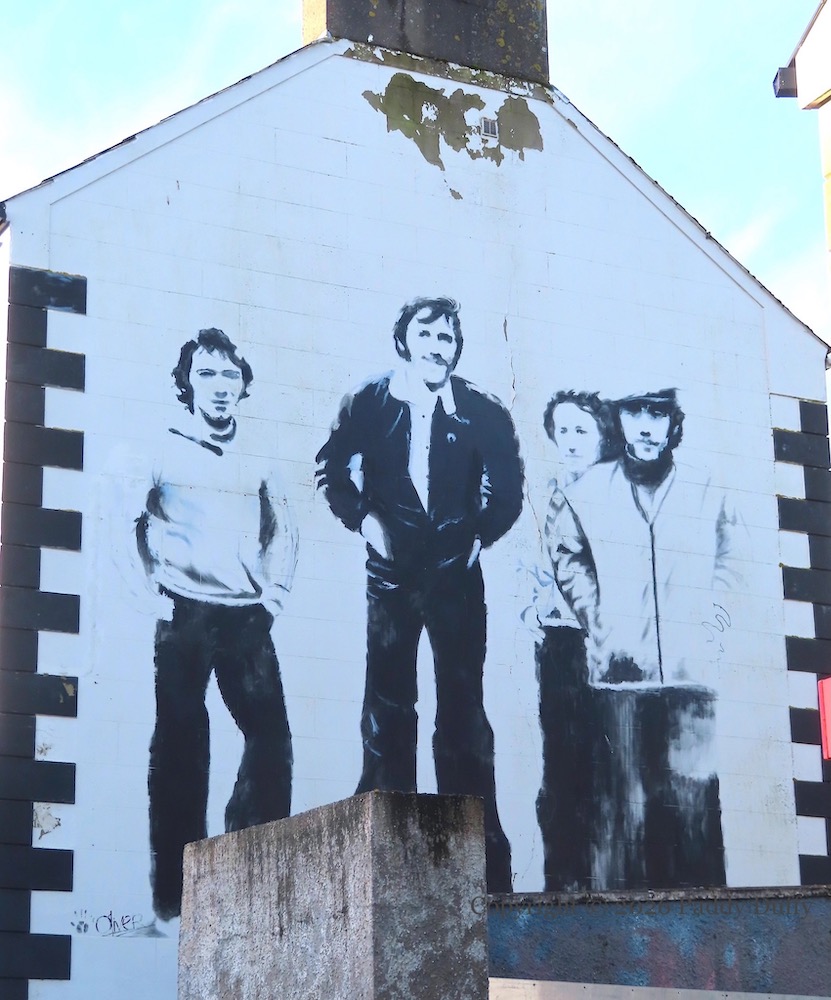
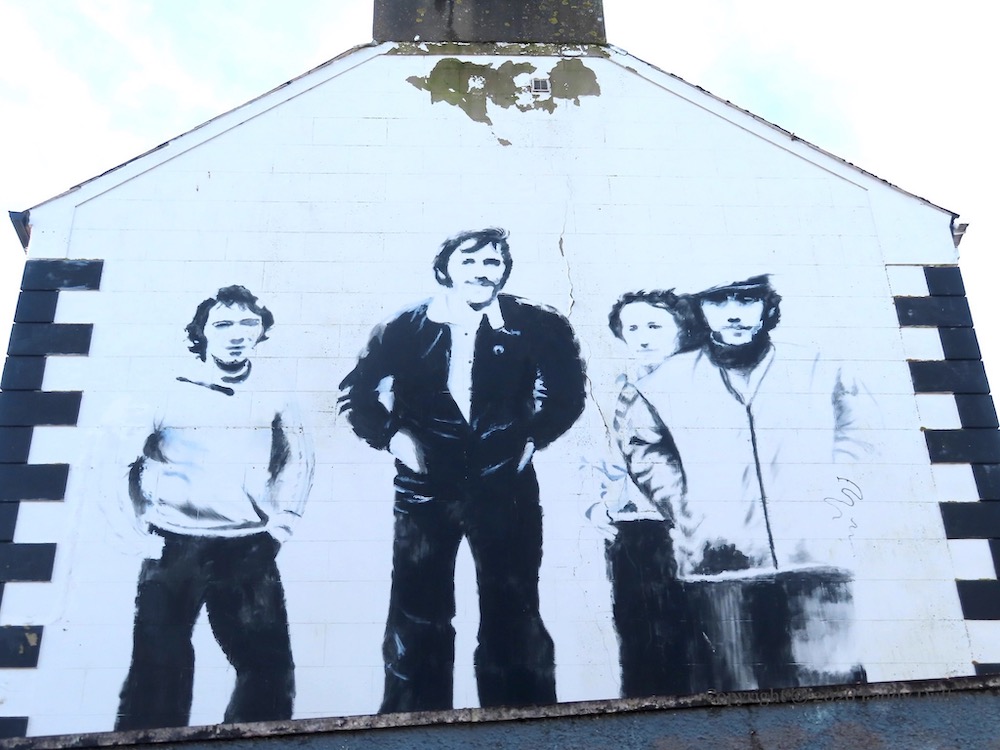
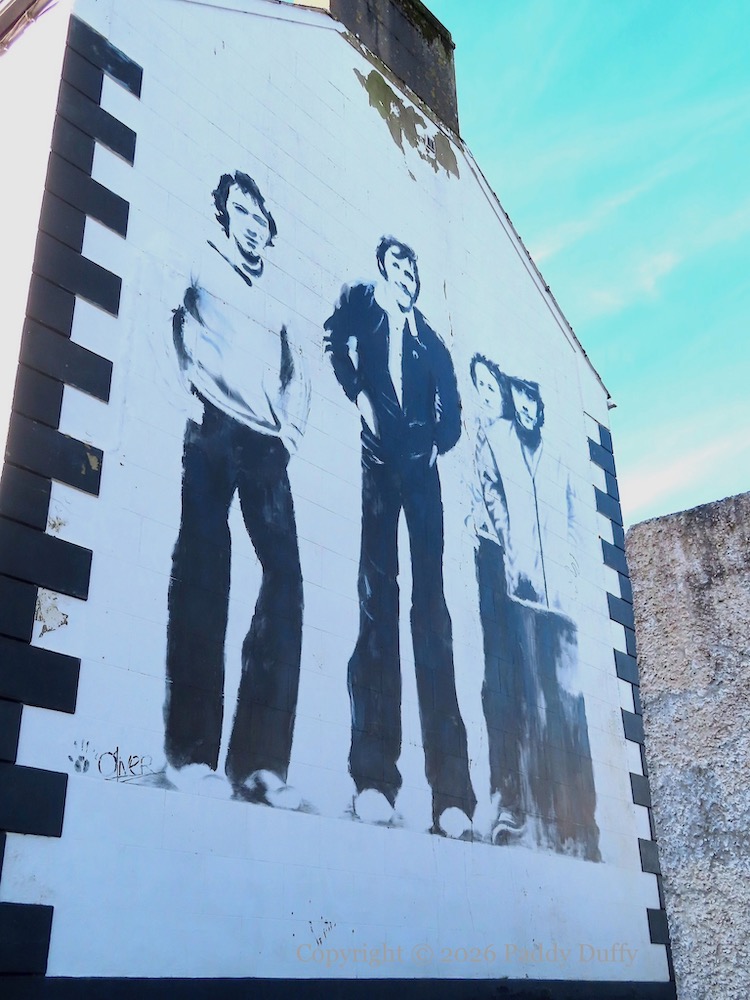
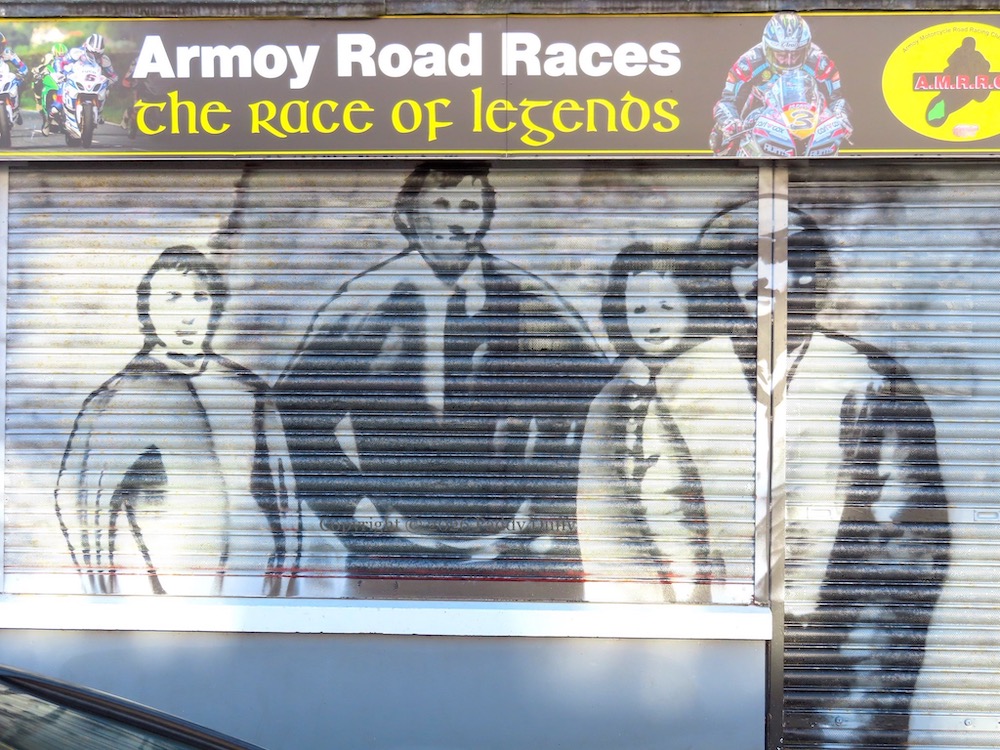
The “Armoy Armada” was (l-r) Joey Dunlop, Frank Kennedy, Jim Dunlop, Mervyn Robinson (AMRRC). The four formed a team of motorcycle racers from 1977 until 1979 when Kennedy was injured in the North West 200. In memory of the quartet, the Armoy Road Races have been held every July since 2009.
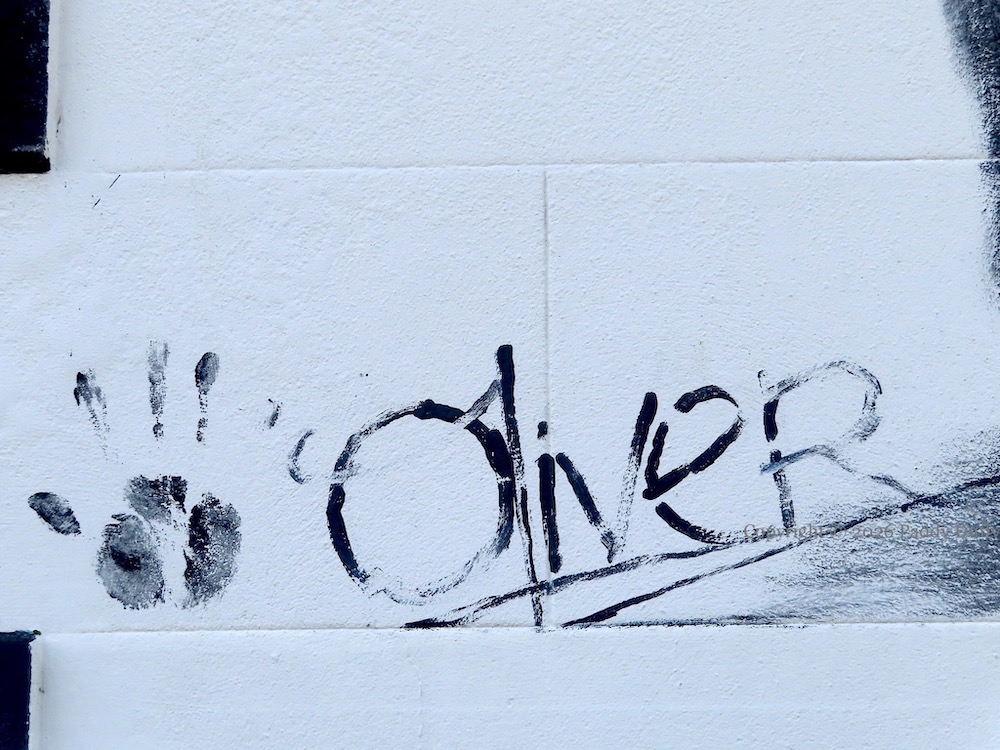
This mural was painted by Oliver McParland (web) in 2020 on a gable of a fast-food shop in Armoy. (For the original photograph, see Classic Motorbikes.) The cruder version in the final image, below, is also in Main Street, on the shutters of the Armoy Motorcycle Road Racing club.
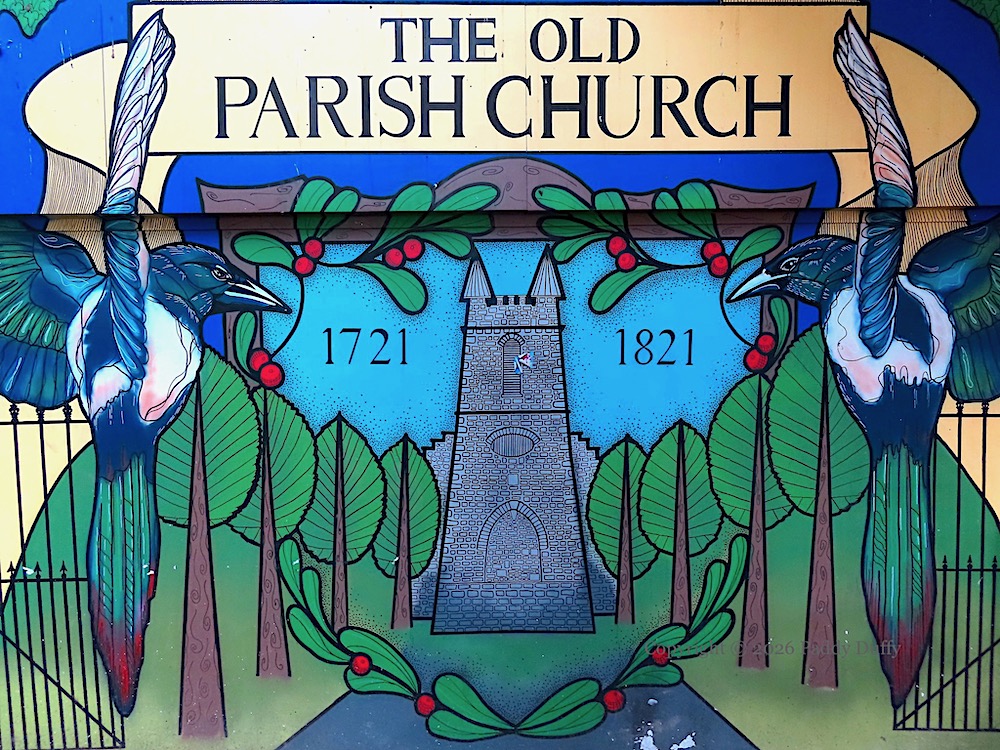
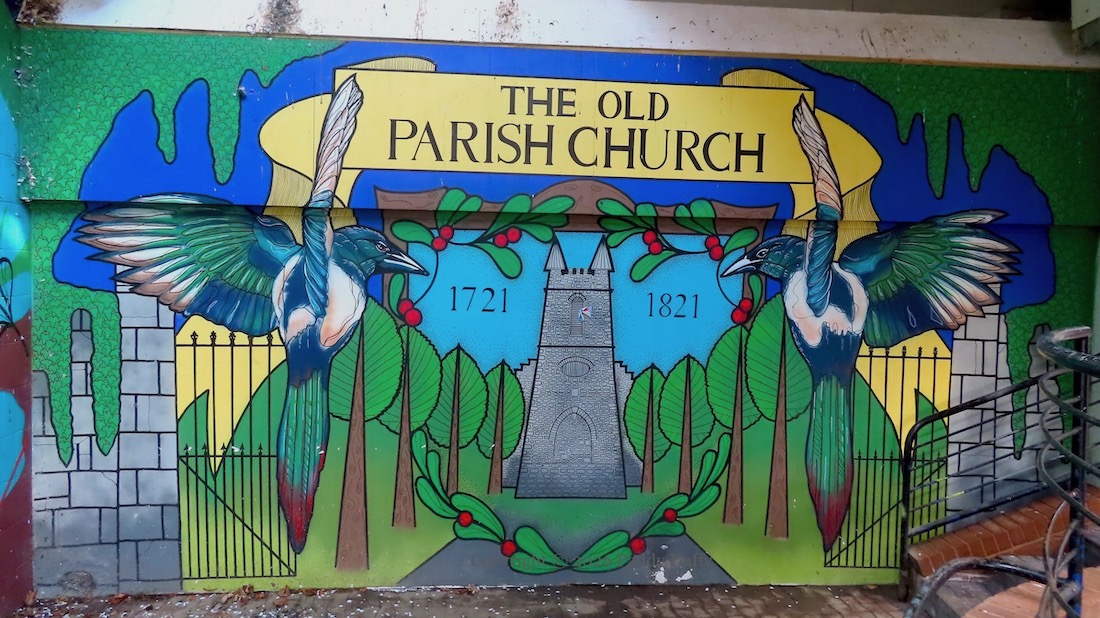
The Old Parish Church (Church Of Ireland) was consecrated in 1721, and a tower and gallery added in 1821. It was last used for a service in 1855 when it was replaced by St Patrick’s Church (Church History Trail youtube). Since then, the Old Parish Church has lain derelict.
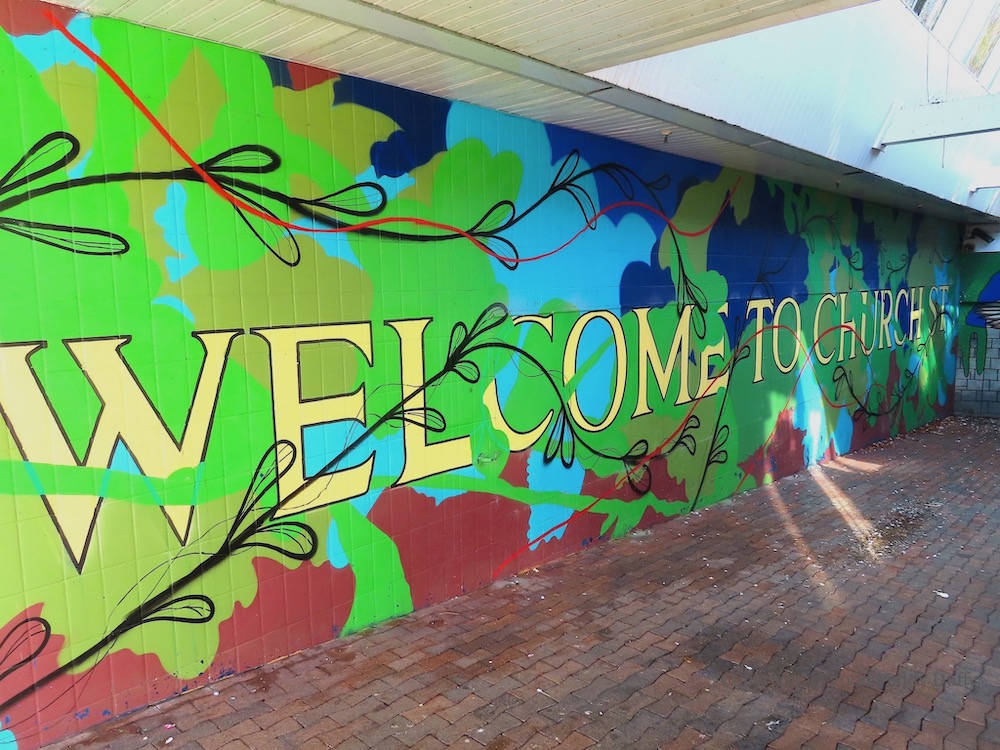
The wall-painting shown here is by Leanne McClelland (ig) in 2022 (Ballymena BID) in Church Street Arcade, off Church Street, Ballymena.
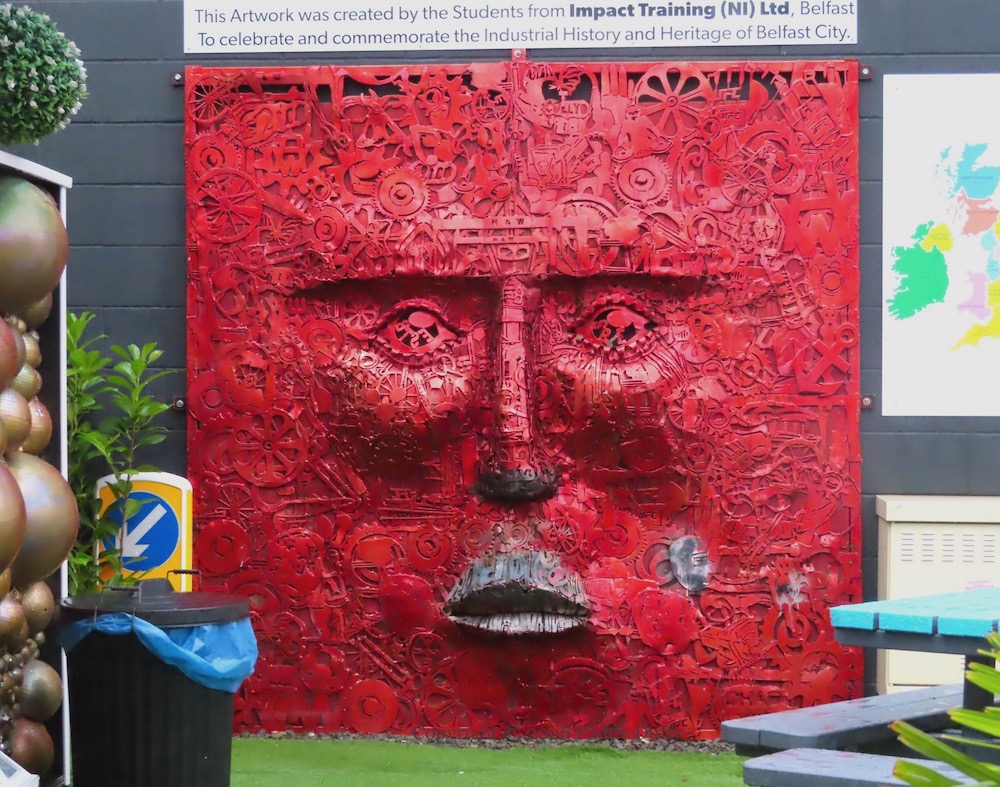
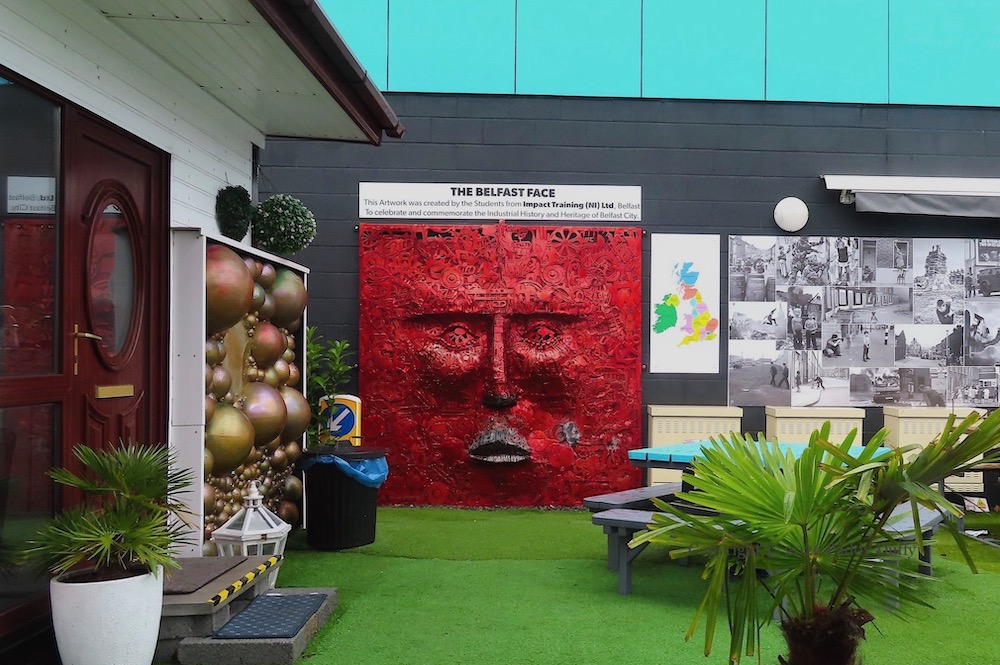
The Face was last seen on the Cupar Way war-wall in 2019 (see Please Respect Artwork). It was taken down (for reasons unknown) and put into storage in a works yard off Lanark Way, from where it was stolen it by thieves (perhaps thinking it might be valuable for its metal); it was found abandoned near the Slıabh Dubh car park (Belfast Live).
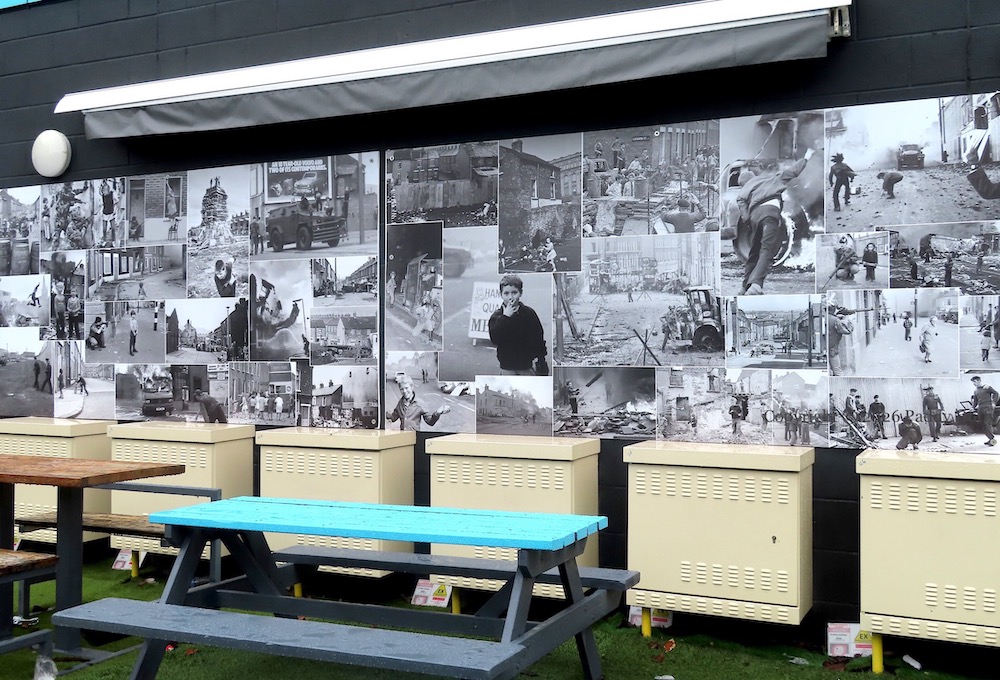
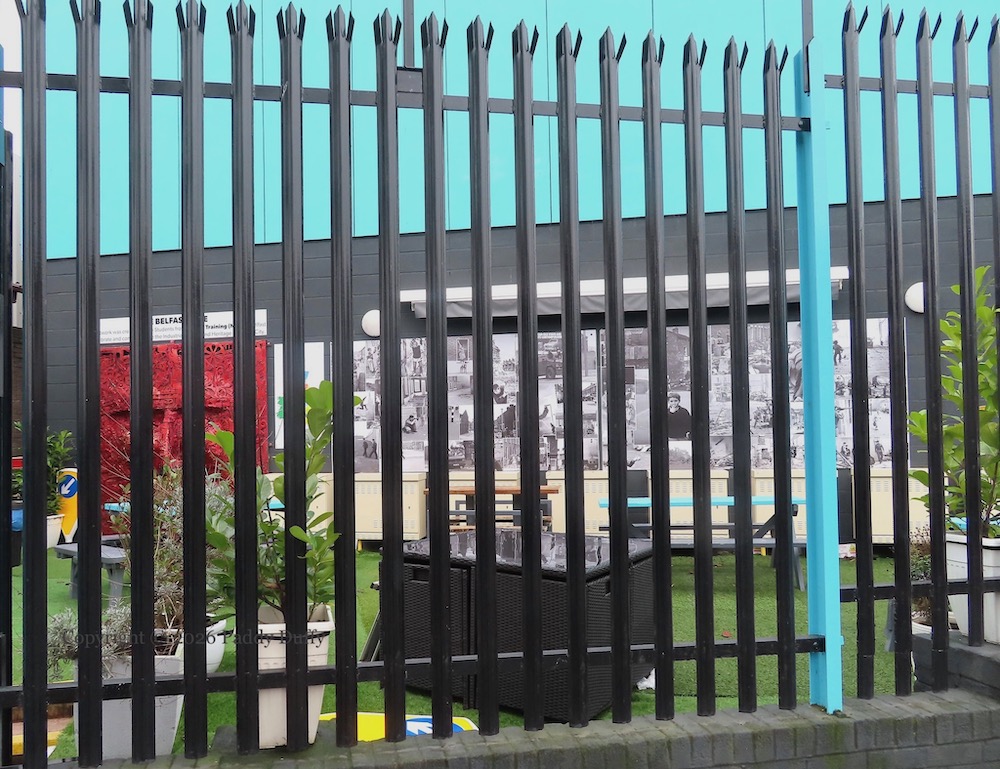
It has now found a home in a new coffee- and souvenir-shop (called Bean Around The World) that has been punched into the fencing at the top of Cupar Way in the shadow of a business park.
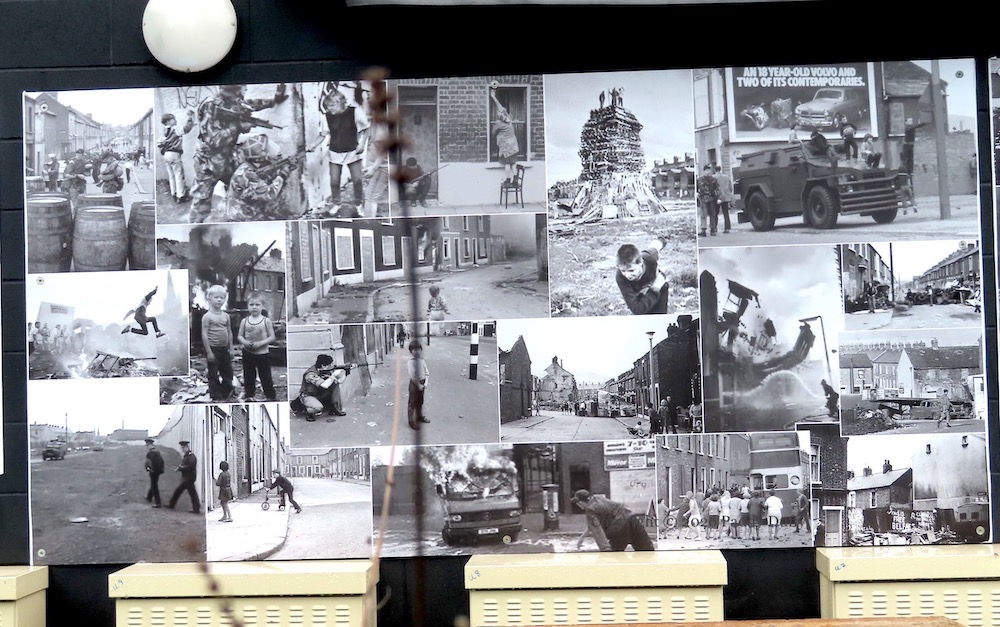
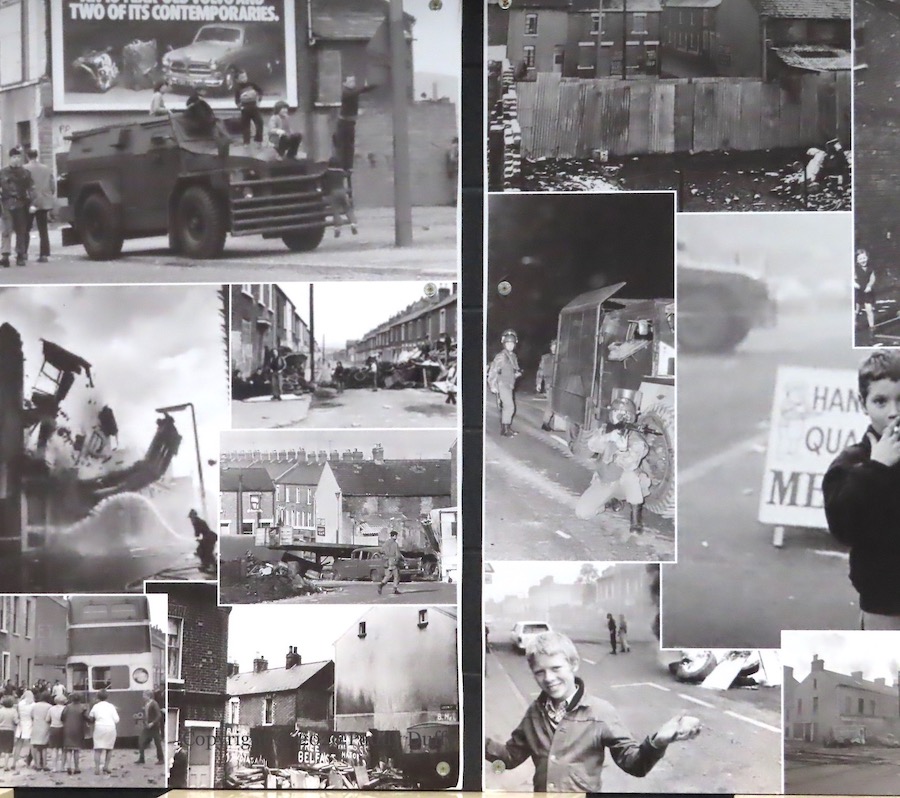
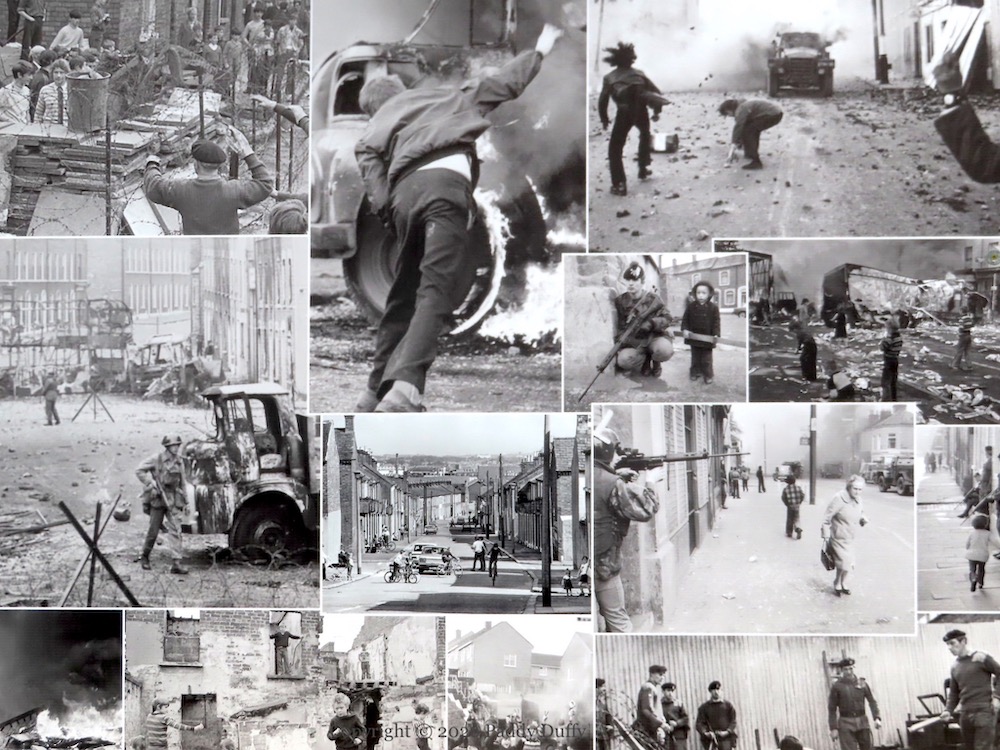
Next to The Face is a map of Ireland and Britain divided into regions, and a montage of black-and-white photographs from the Troubles (at least some of which come from the Belfast Archive Project).
The Face was created by Kevin Killen (web) and “the Students from Impact Training (NI) Ltd, Belfast To celebrate and commemorate the Industrial History and Heritage of Belfast City.”
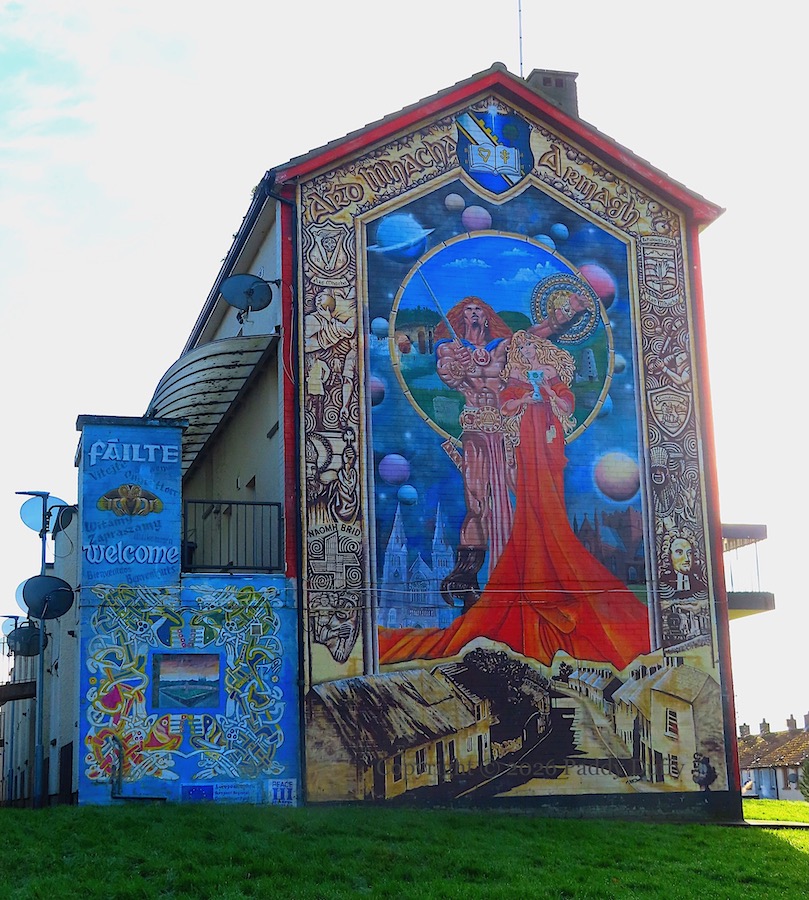
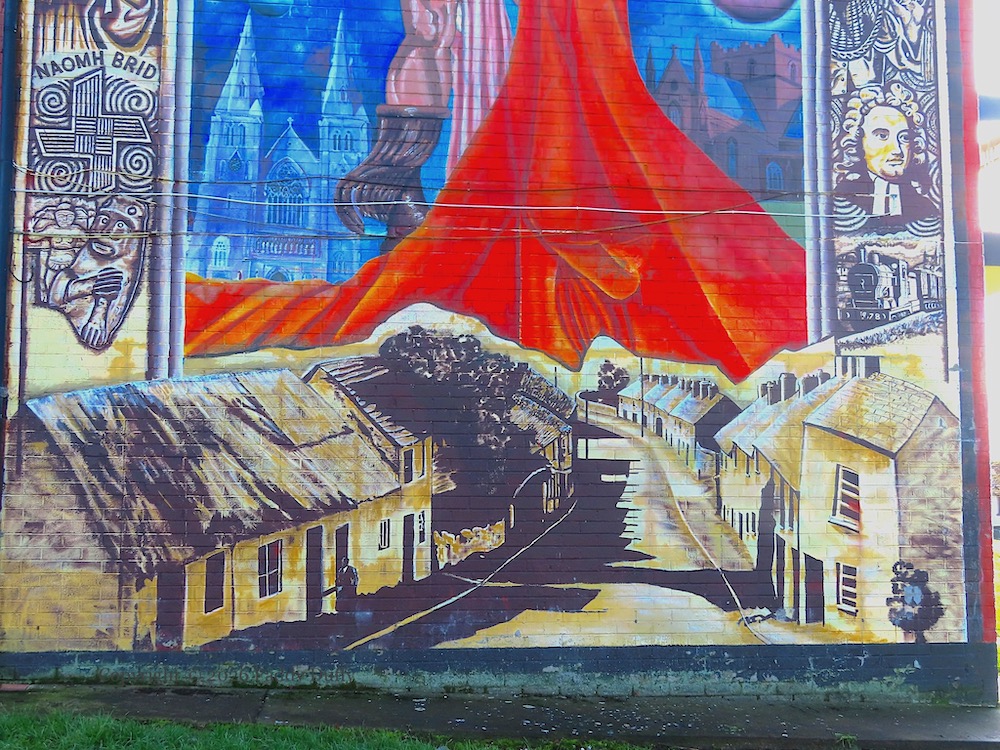
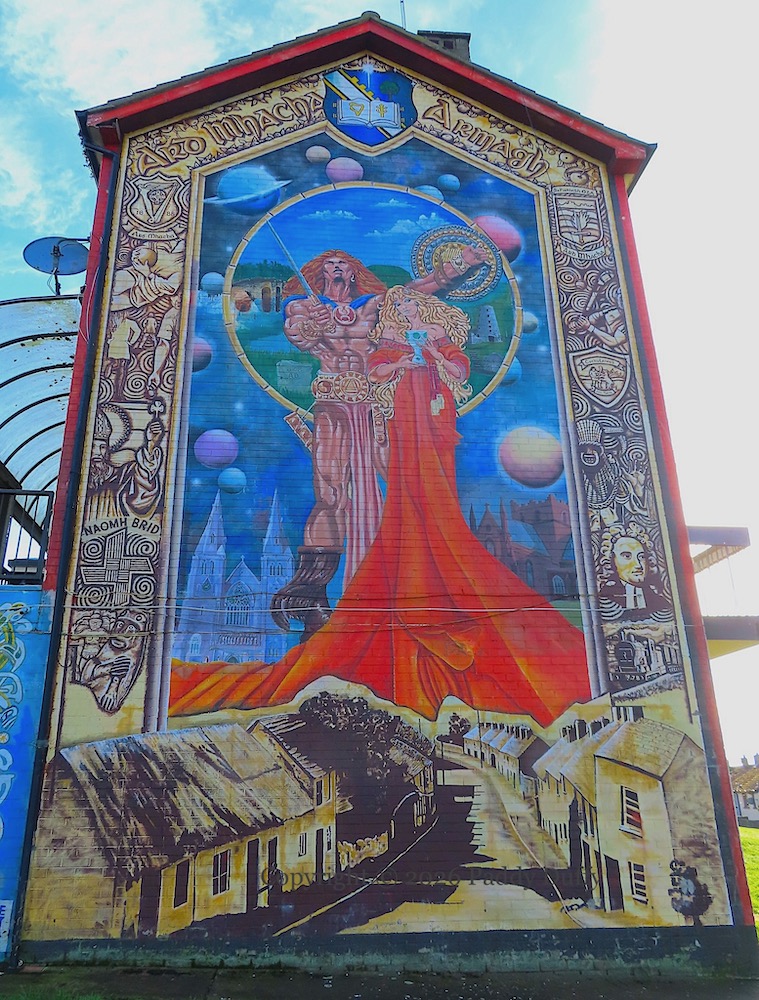
This is a mural of King Niall (Nıall Caılle, Niall of the Callan) and Queen Macha. Niall was high king of Ireland (in competition with Fedelmıd of Munster WP) who held off the Vikings in the late 800s (WP) and died in 846 by drowning in the Callan river. Macha is a much earlier and mythological queen, and gives her name to the town: Ard Mhacha.
The central figures reproduce paintings by Jim Fitzpatrick (Visual History). The Niall figure comes from Nemed The Great but the Macha figure comes from a label Fitzpatrick produced in 1988 for Rosc “mead”, even though Macha (one of them, at least) was the wife of Nemed and there is a female figure in Nemed The Great.
Below the planets and stars, St Patrick’s (Catholic) Cathedral is on the left (WP) and St Patrick’s (CofI) Cathedral is on the right (WP).
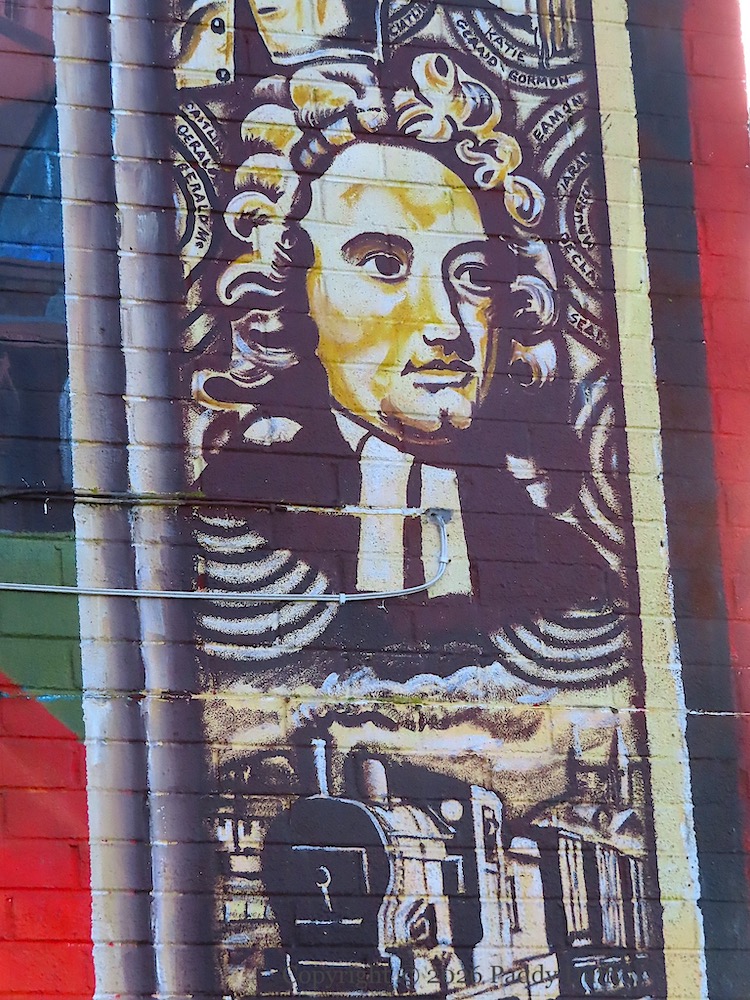
In the border, clockwise from left to right, we see: the Tandragee Idol (WP), Naomh Bríd/St Brigid’s, St Patrick preaching the trinity, Irish dancing, Gaelic football, Armagh Harps, “Ard Mhacha”, the Armagh county crest in colour in the apex (Club & County), “Armagh”, Na Pıarsaıgh Óga, hurling/camogie, Cú Chulaınn’s, mummers (perhaps specifically the Armagh Rhymers), Jonathan Swift, a steam locomotive (perhaps representing the Armagh rail disaster of 1889, in which 80 people died WP); a vintage image of Callan Street is depicted along the bottom (History Armagh).
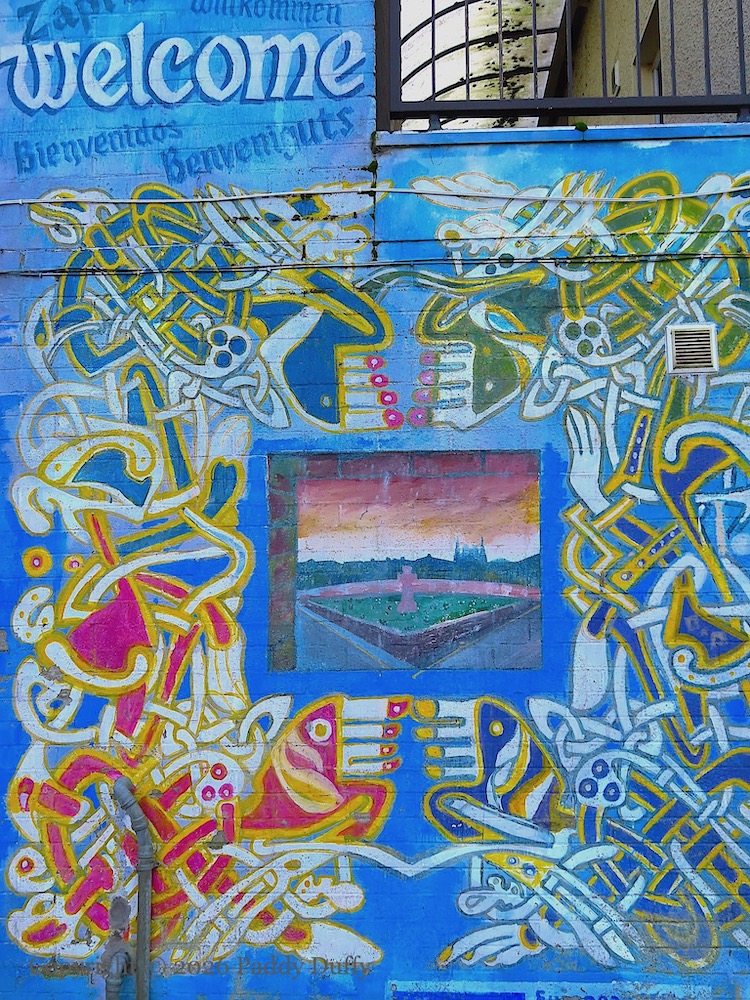
The side-wall features the word “welcome” in many languages, and Celtic knot-work surrounding an image of the Celtic Cross below St Patrick’s, perhaps inspired by this 1903 photograph (Flickr).
Painted by a crew of Belfast artists – Danny D and Mark Ervine, along with Lucas Quigley, Marty Lyons, Micky Doherty – and organised by the Callan Street Residents’ Association, with funding from the European Union’s Peace III initiative.
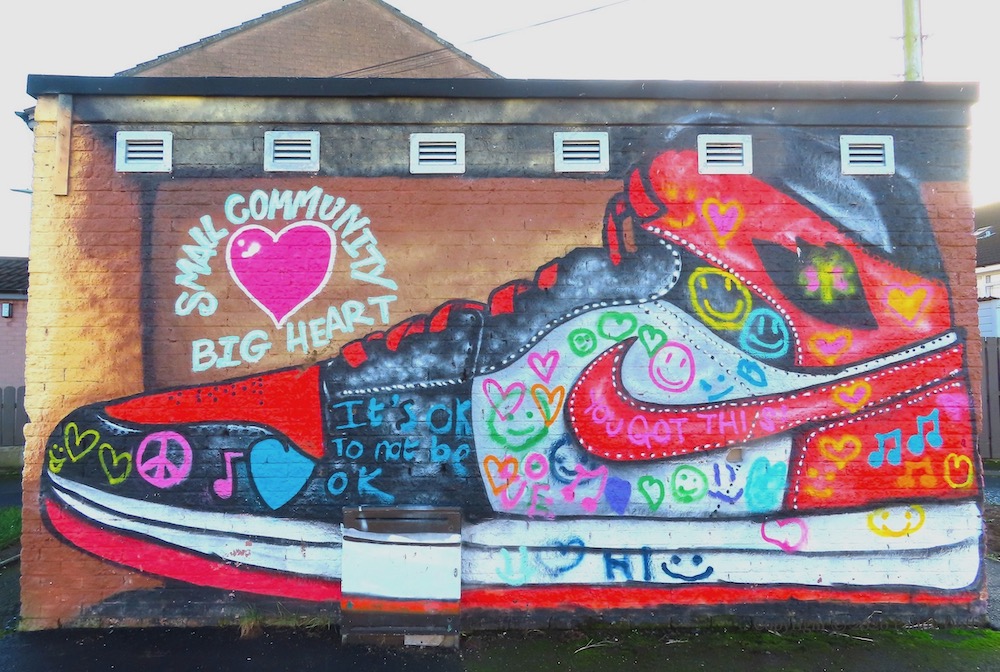
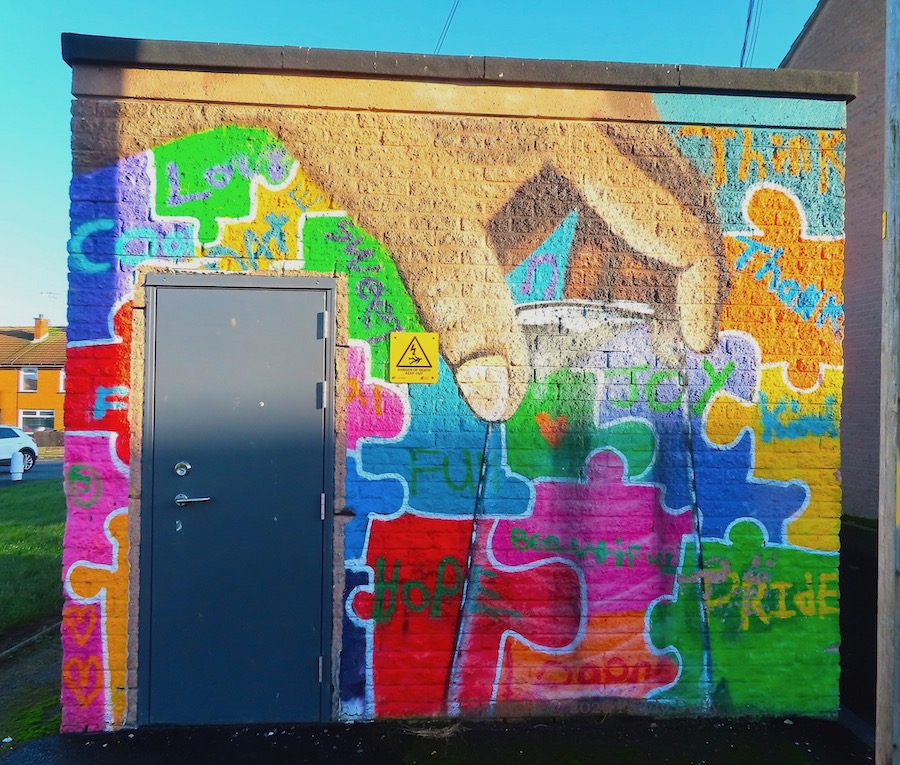
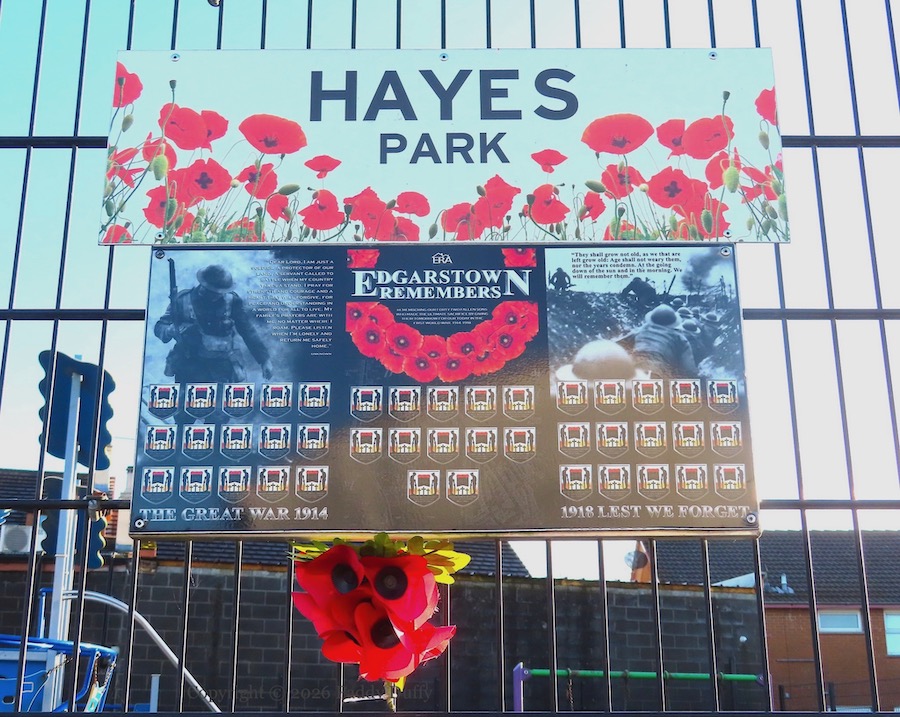
This is a kids/community/mental-health mural on the sub-station in Edgarstown. The art was painted by young people from the area, organised by Edgarstown Residents’ Association in the summer of 2024 (Fb).
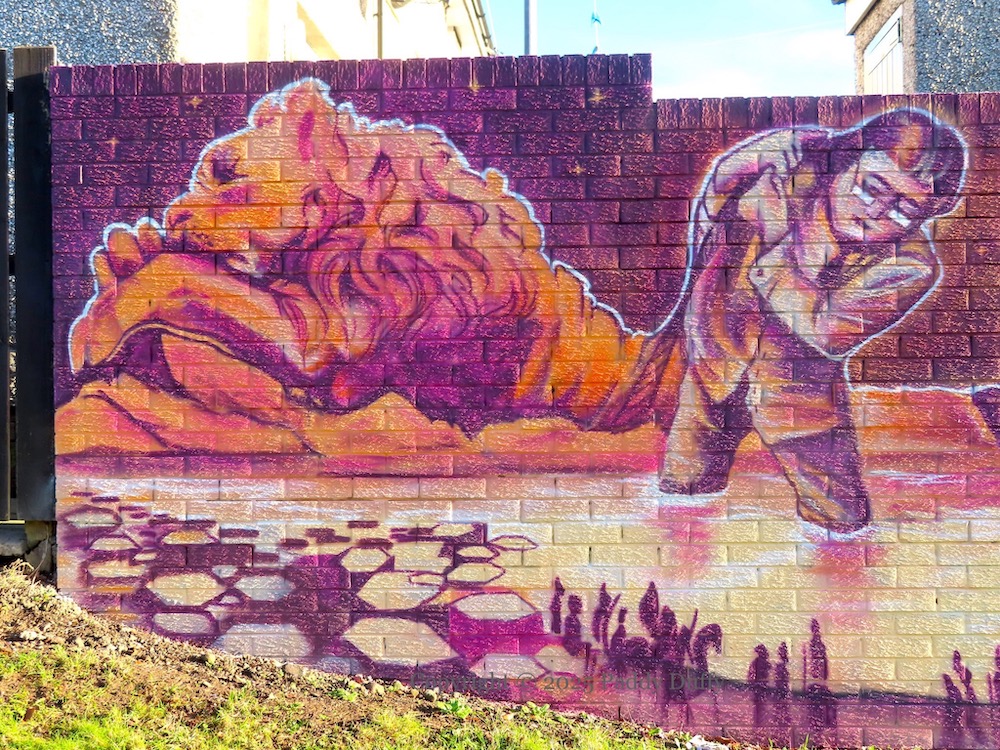
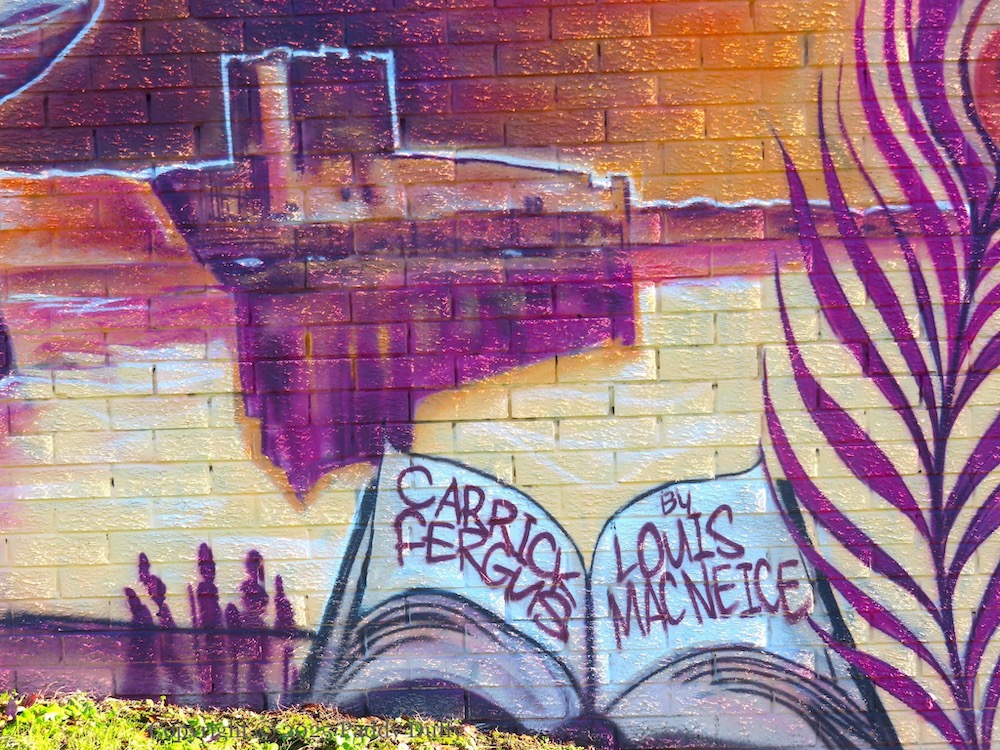
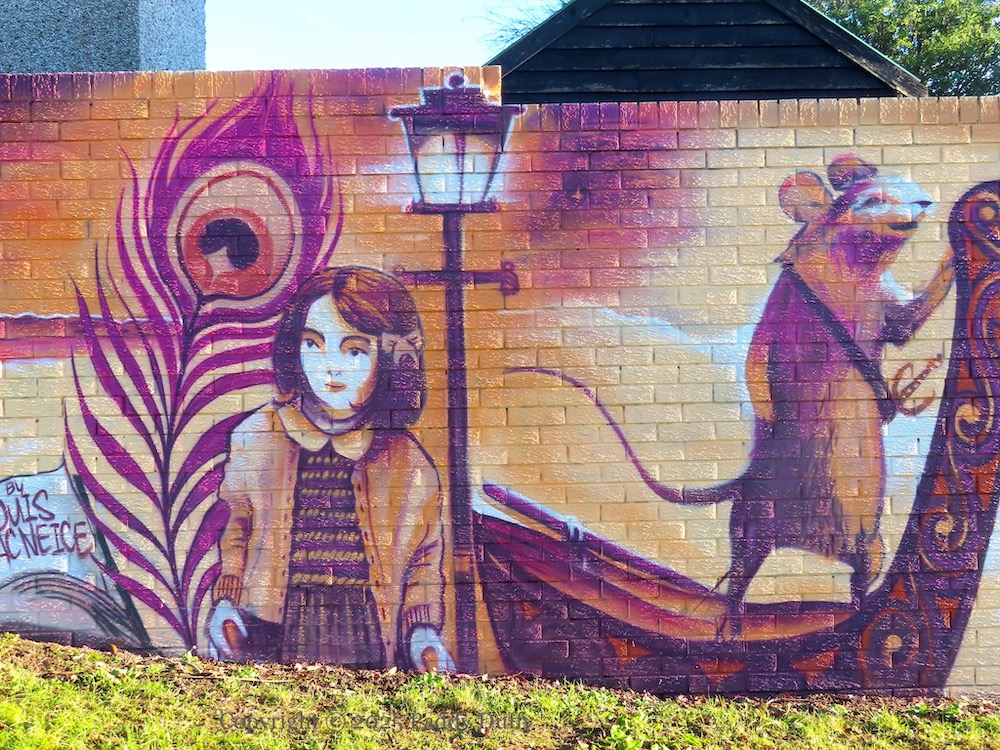
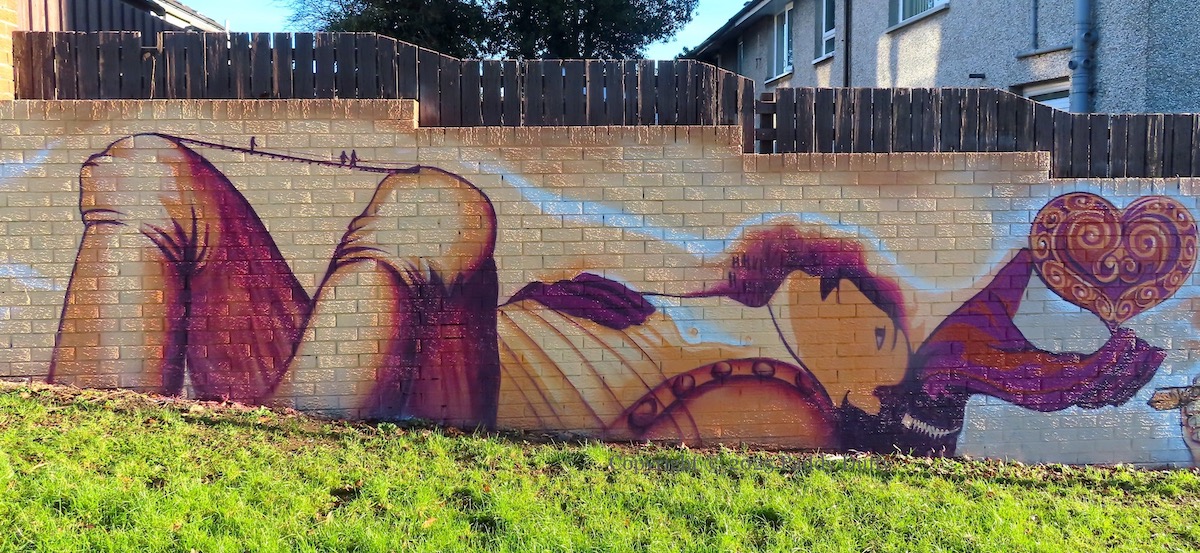
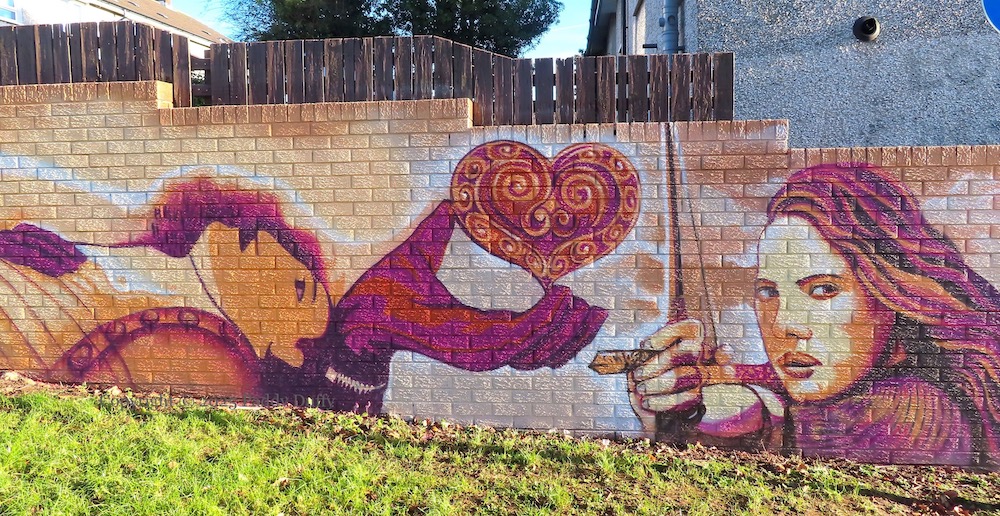
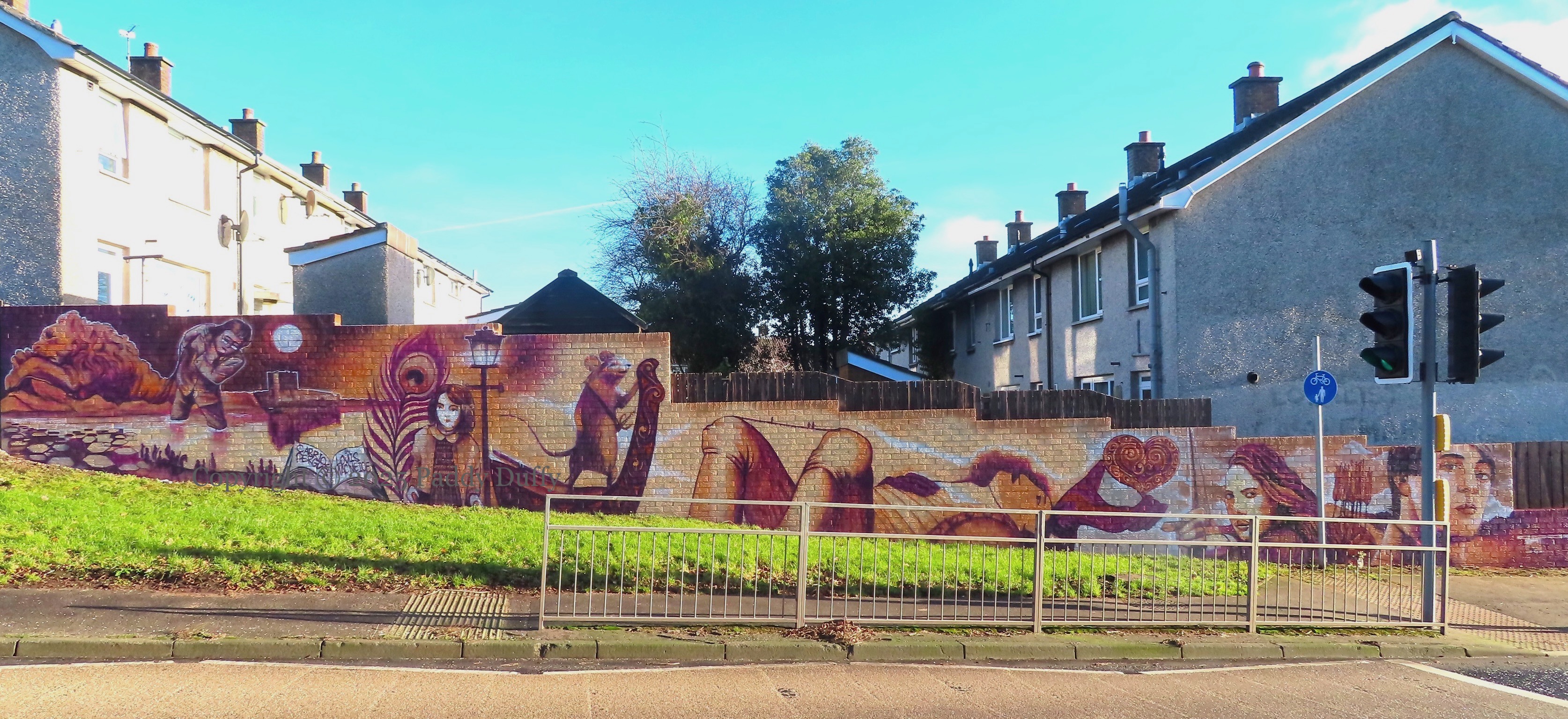
This new mural in Carrickfergus draws on local connections to literary figures Louis MacNeice and Jonathan Swift, as well as the more distantly located CS Lewis.
The MacNeices moved from Belfast to Carrickfergus in 1909 when Freddie (later Louis) was an infant and he grew up in the town until he was sent to Sherbourne Prep in Dorset, England, in 1917. In the mural, a book is opened to the page of his poem Carrickfergus, which was written in 1937 and describes the town in geological, historical, industrial, and sectarian terms, and more real than the “puppet world” of Sherbourne.
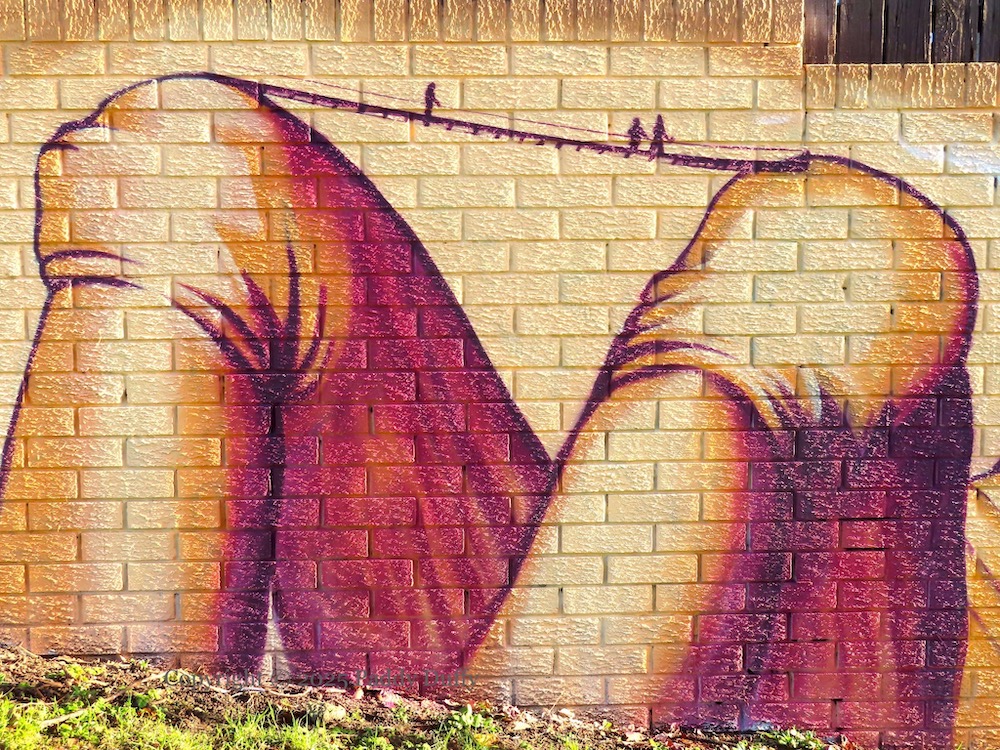
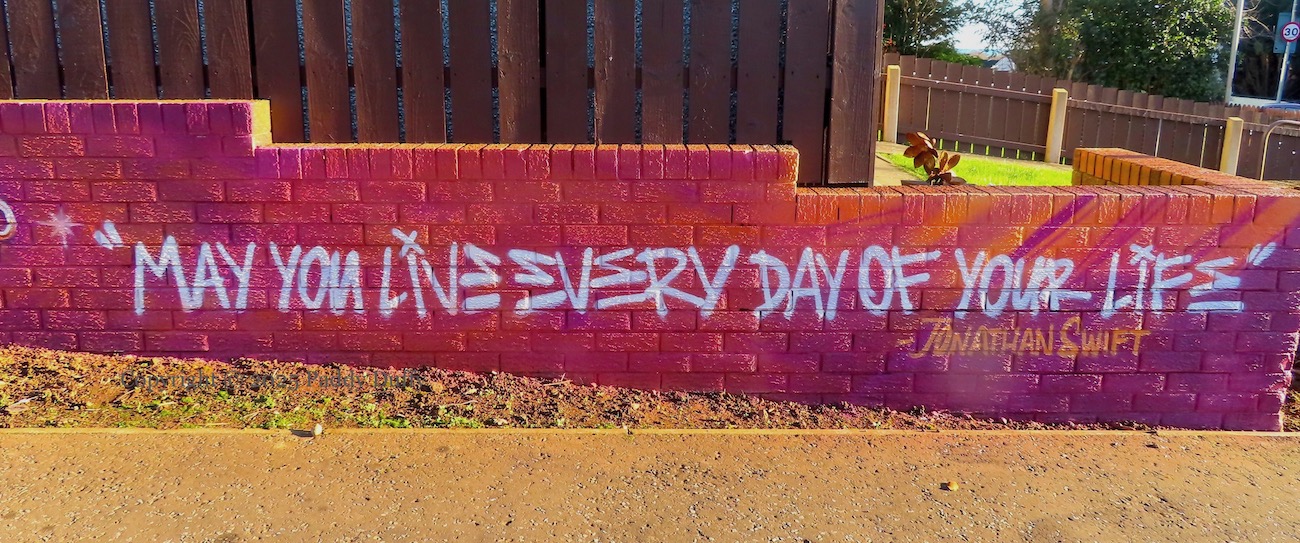
Jonathan Swift was briefly (1694-1696) a Church Of Ireland cleric in Kilroot, near Carrickfergus. In the mural, Carrick-A-Rede rope-bridge is shown strung between the knees of Gulliver as he wakes in Lilliput. The Swift quote on the extreme (viewer’s) right is from Polite Conversation (p. 154): Miss Notable is toasted by both Mr Neverout – “May you live a thousand years”; “Pray, Sir, don’t stint me”, she replies – and Colonel Atwit – “May you live every day of your life”.
Lewisian figures include Aslan the lion and Reepicheep the mouse. The final (right-most) figures would seem to be Katniss and Peeta from The Hunger Games.
Painted by DMC on North Road, Carrickfergus, at the entrance to the Castlemara estate, as a complement and competitor to the PUL boards.





 Paddy Duffy Collection