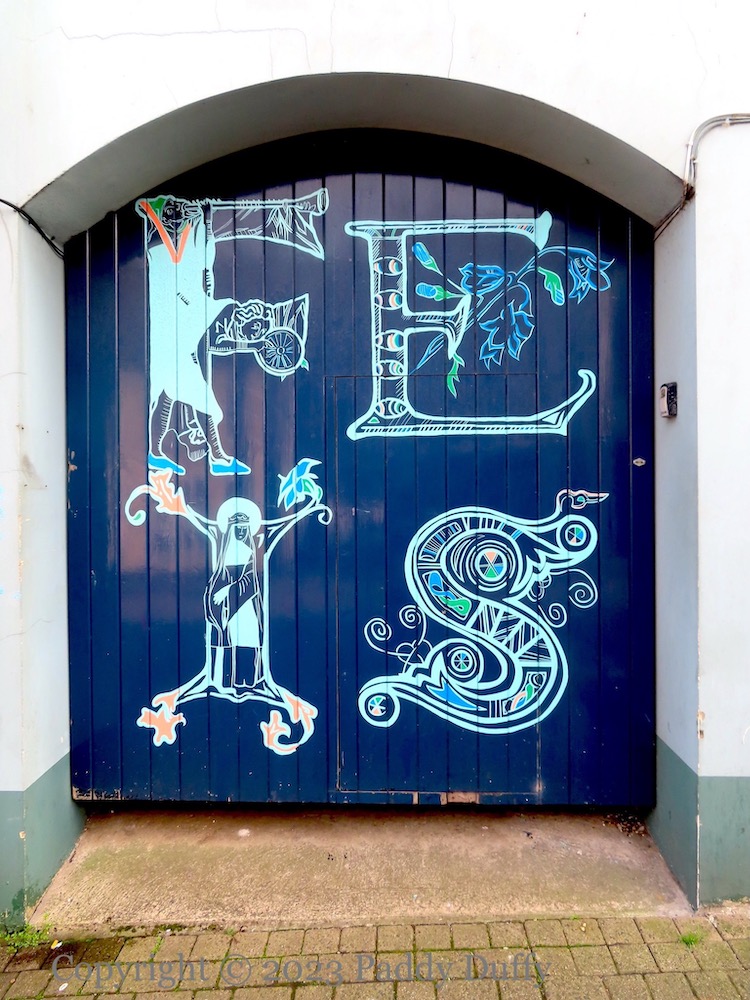
The inspiration for this piece is the Ould Lammas Fair, one of Ireland’s oldest and, some claim, biggest festivals, which is held in Ballycastle on the last Monday and Tuesday of August (Irish Culture & Customs). The piece, by emic (web), is in Castle Street which was perhaps the location of the market within the mediaeval town walls.
Feıs Na nGleann is an annual festival of Irish language, arts, and crafts, begun in Glenariffe in 1904. The website has not been updated since 2019, presumably due to COVID putting a stop to activity.
The “F” makes reference to the local “Irish (Peasant) Home Industries“, while the “E” shows the harebell (bluebell) in flower. The “I” might be St Brigid as an oak or a reference to Princess Taisie/Taobhgheal of Rathlin.
Here are two takes on the distinctively Antrim-coast foods dulse (a seaweed) and yellowman (a honeycomb confection) on Castle Street, Ballycastle. Above, Rob Hilken’s (web); below, Shane O’Driscoll’s (ig).
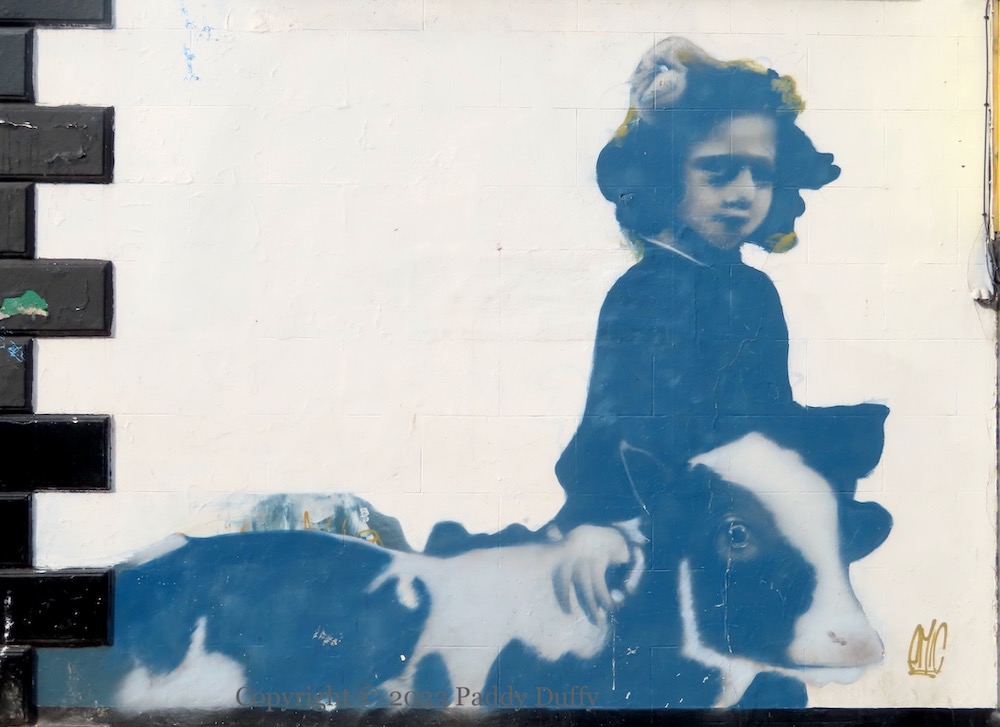
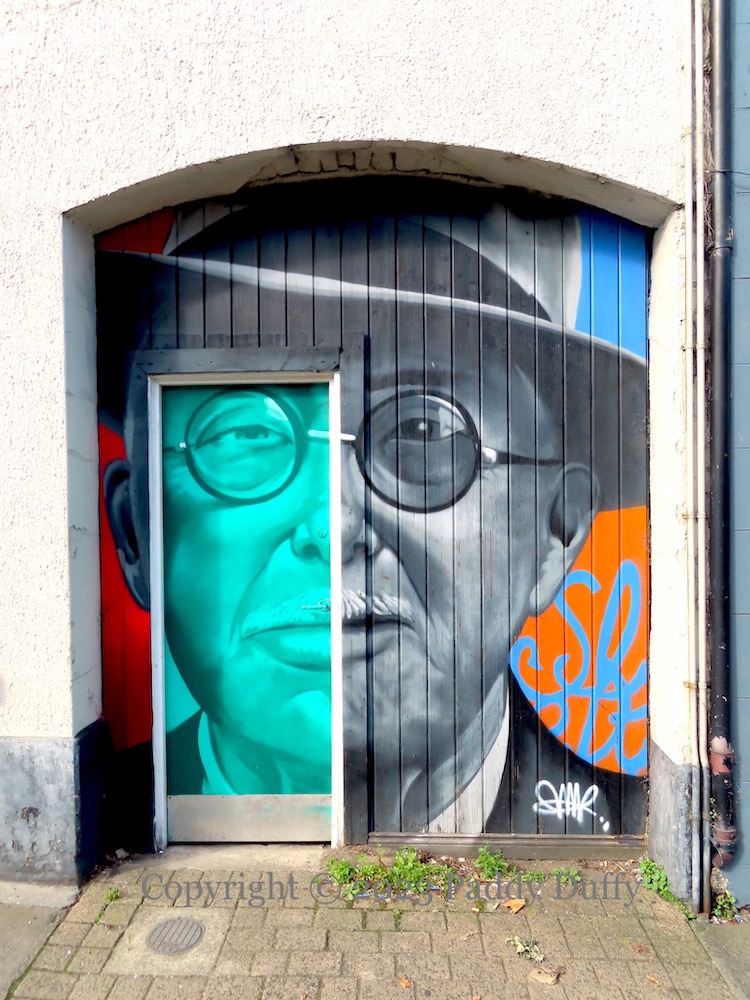
Local storyteller Hugh Dillon in Castle Street, Ballycastle, by JMK (Jonny McKerr). The original photograph, of Dillon in Leyland Road, Ballycastle, in 1956 and is available at Dúchas.
Glentaisie Drive – site of this mural by Friz (web) – is named for Glentaisie, the glen – one of the nine Glens Of Antrim, at the foot of which lies Ballycastle – and Glentaisie is named for Taise Taobhgheal (Taise the bright-cheeked), daughter of King Donn of Rathlin island, renowned for her beauty, and who lived in the glen with her husband Congal, who had to kill the Norwegian king Nabghdon to prevent her being carried off (Archaeology Ireland). Or so they say. She also inspired the name “Fair Head” for the local cliffs. Or so they say.
In later years (1565), Sorley Boy MacDonnell was taken prisoner by the O’Neill’s after a battle in Glentaisie (WP).
On the right, Major Quality and Miss Sweetly from the lid of a Quality Street tin. The confectionery collection was itself named after J.M. Barrie’s 1901 play and Coleraine native “Hugh Thompson” [Hugh Thomson] (WP | NVTv) provided the illustrations for a 1913 edition (many can be seen at RBKC); these probably inspired the “soldier and lady” characters for the tins (the leads in the play are called Captain Valentine Brown and Miss Phoebe Throssel), though they were drawn by Harold Oakes (WP); the tins and ads from 1936 can be seen at Metro. The image reproduced here is from the 1950s.
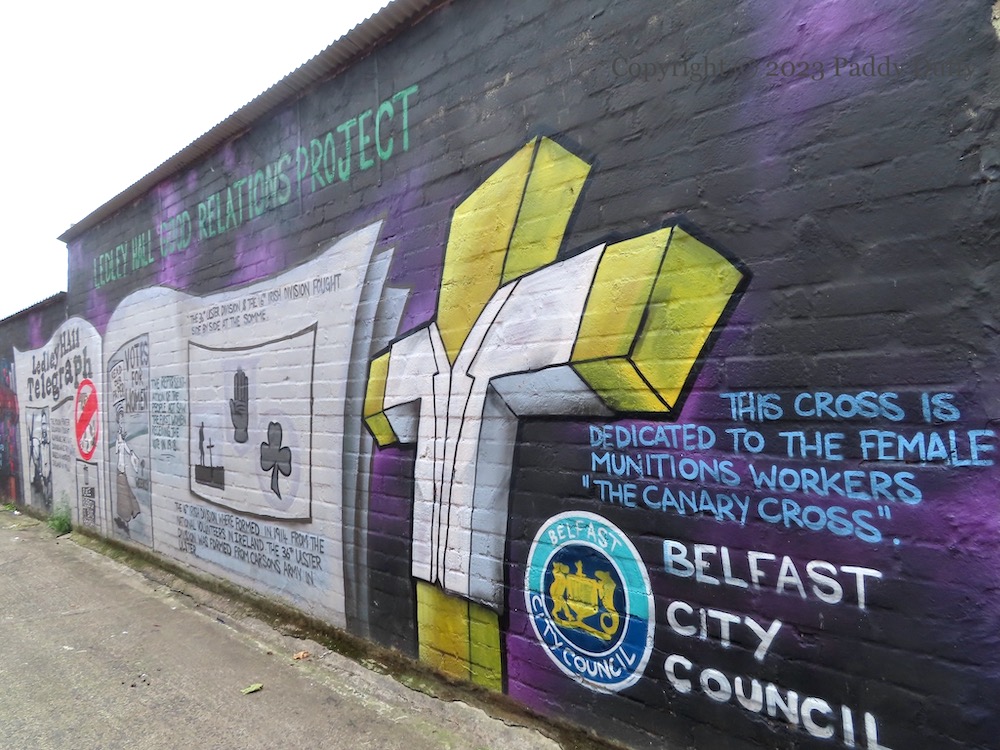
An imaginary newspaper called the “Ledley Hall Telegraph” includes stories on the 303 (Polish) RAF Squadron (which was stationed in Northern Ireland from 1943 to 1944), “Votes for women” (“the Representation Of The People Act saw the first women receiving the vote in 1918”), and the 16th and 36th Divisions (the mural says they “fought side by side at the Somme” – but the 36th was withdrawn on July 2nd after the Battle Of Albert and the 16th arrived in September and fought in the battles of Guillemont and Ginchy; both were withdrawn to Messines and both would take part in the Battle Of Messines in June 1917).
The “newspaper” is bookended by two painted crosses (for Row On Row), one for Guardsman Connor Lilley, a member of the Gertrude Star flute band, who was serving with the 1st battalion Royal Irish Guards when he was killed in an accident in Canada (Fb), and the other for WWI female munitions workers who, because of their work with TNT, risked yellowing skin both from direct exposure and from liver damage (“toxic jaundice”) (WP).
Also included is “The Kindness Hut”: “Be the reason someone smiles today”, “Kindness is free – please share”, “In a world where you can be anything, be kind”, “Take only what you need! If everyone shares there’s enough to go around”.
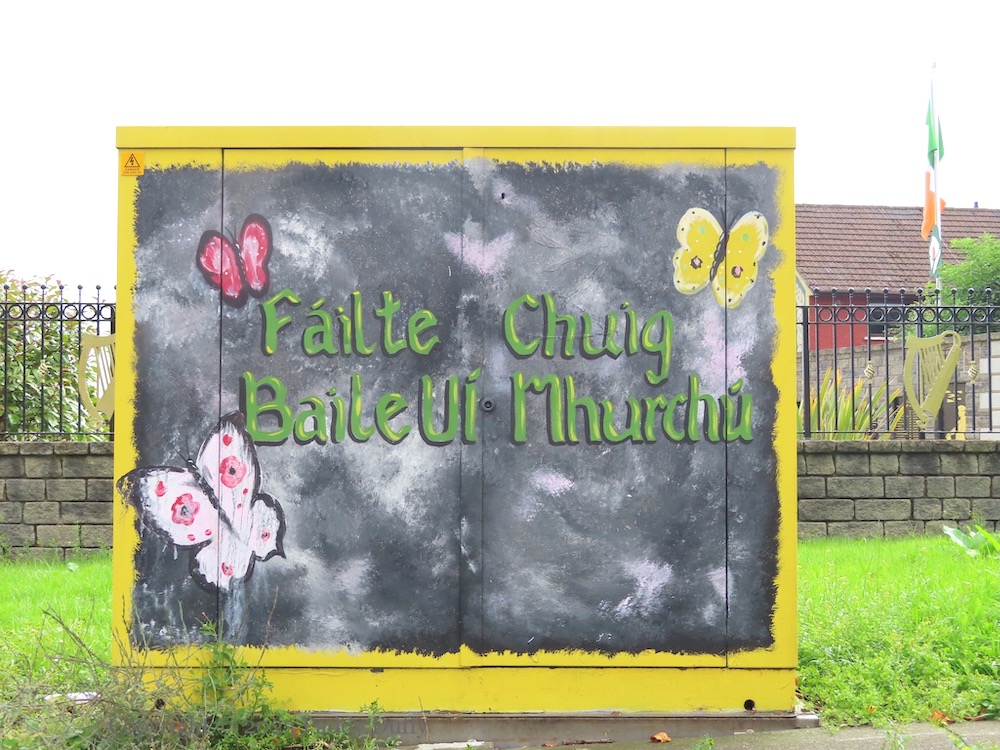
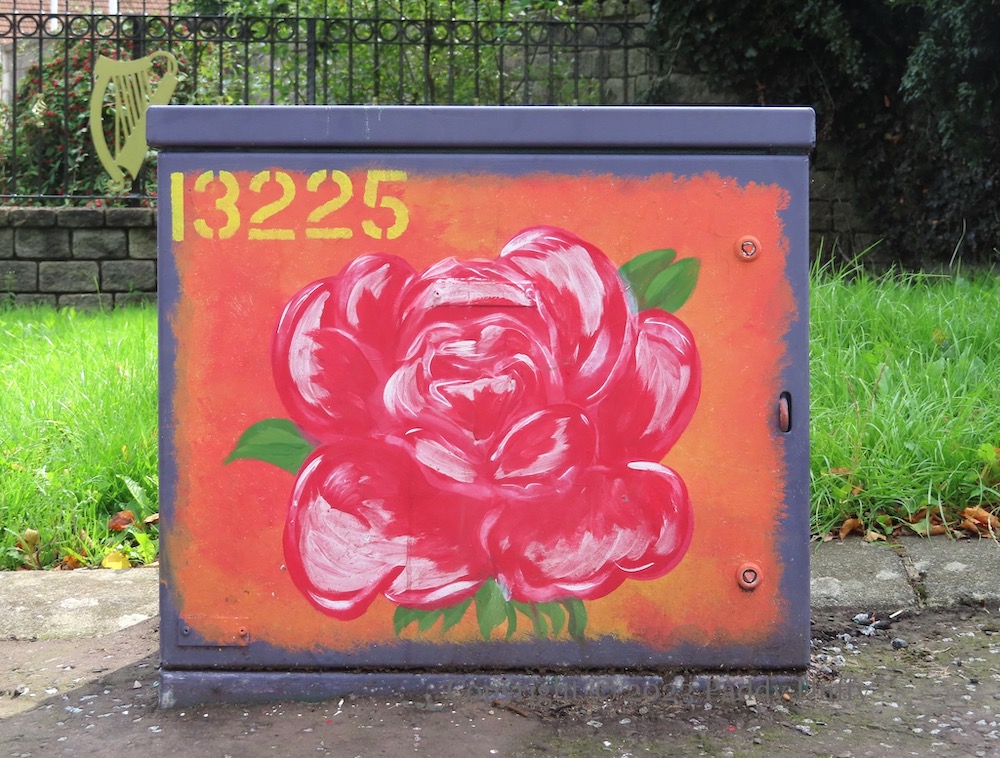
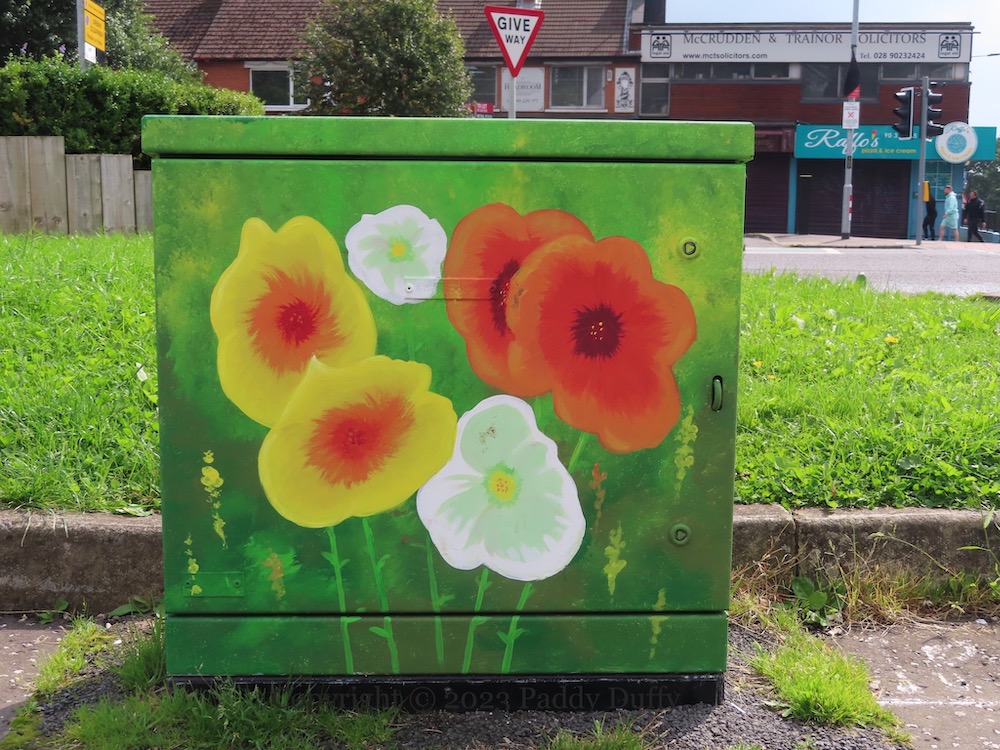
This post is an update to last year’s Gaırdín Na hÉıreann which showed various painted electrical boxes in Ballymurphy. To these have been added some boxes in Slıabh Dubh and New Barnsley.
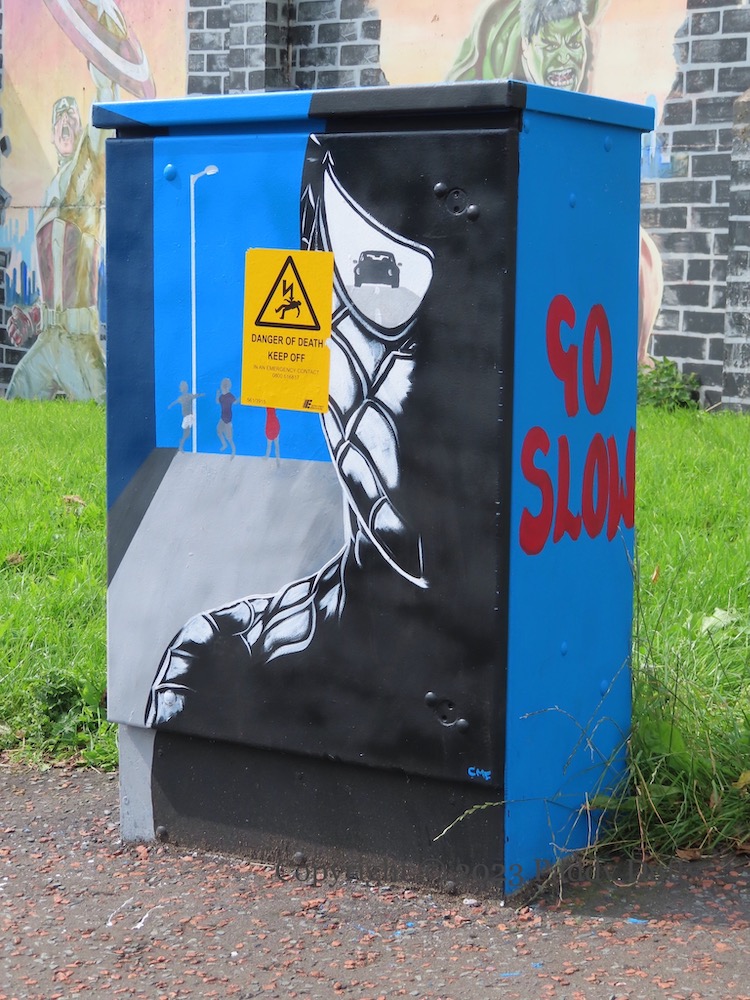
The second Slıabh Dubh image (immediately below) is of Spiderman, to fit with the wall of superheroes that can be seen in the background (seen previously in Red Eye).
(After three from the top of Ballymurphy which were included in last year’s post,) there are five from the New Barnsley side of Springfield Road, including two featuring Newhill Youth/Football Club (Fb) ahead of its 50th anniversary, which will be celebrated in City Hall this Saturday, September 2nd (Fb).
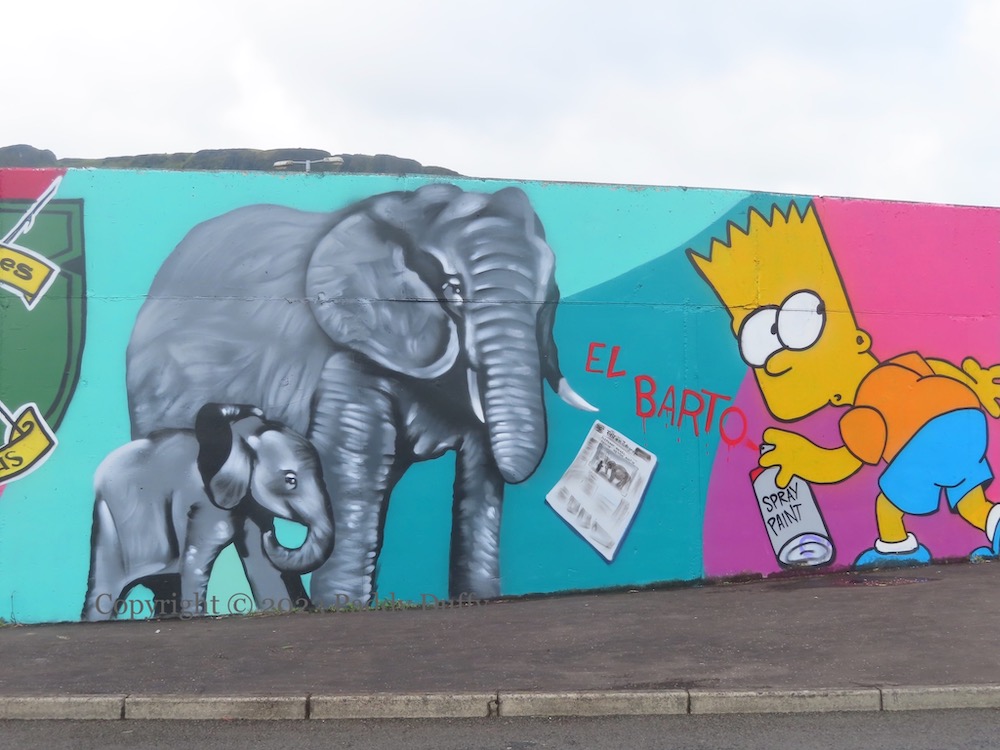
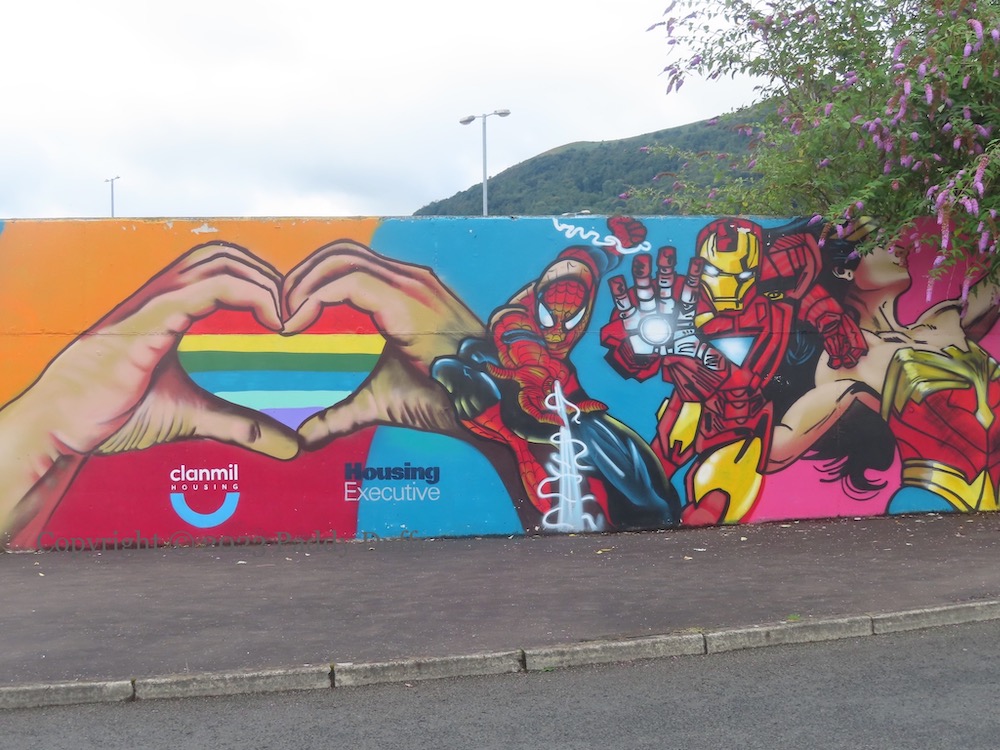
Here are six images showing the full expanse of the new mural at the entrance to Bawnmore. From left to right we see: a mill, a swan, a train (there used to be a station in Bawnmore), a guitarist, a farmer gathering hay, a hurler, Molly Seaton (who was captain of the Irish women’s soccer squad in a 1927 match played in Bond’s Field, in the Waterside – Derry Journal), Greencastle Rovers (Fb), Bawnmore Community, Wolfe Tone CLG (Fb), elephants from Belfast Zoo (a baby elephant called Shiela stayed in the Whitewell home of its keeper during the WWII Blitz – BelTel), El Barto (Bart Simpson), St Mary’s Star Of The Sea primary school (web), a hand-heart containing the rainbow colours, and superheroes Spiderman, Iron Man, and Wonder Woman. (NIHE)









 Paddy Duffy Collection