Lóıste Na Móna

“Welcome to Turf Lodge” — “Fáılte go dtí Lóıste Na Móna”. Turf Lodge was one of a number of estates built in the foothills of Black Mountain — including Westrock, Springhill, Ballymurphy, New Barnsley, and Dermot Hill — meant to house an underserved Catholic population and displaced families from other areas of Belfast.

The estate was built over a number of years but most people moved in between 1960 and 1962. (Northern Visions made a documentary about the history and people of the Turf Lodge estate that includes descriptions of the various ways in which the estate was left unfinished even as people took up residence.)

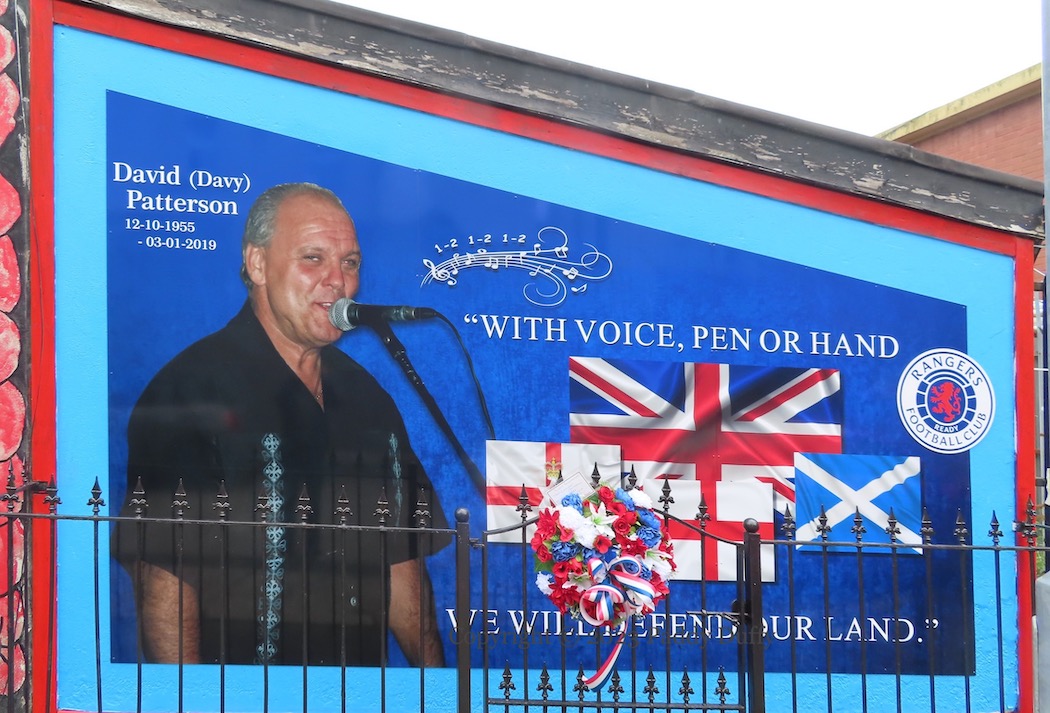
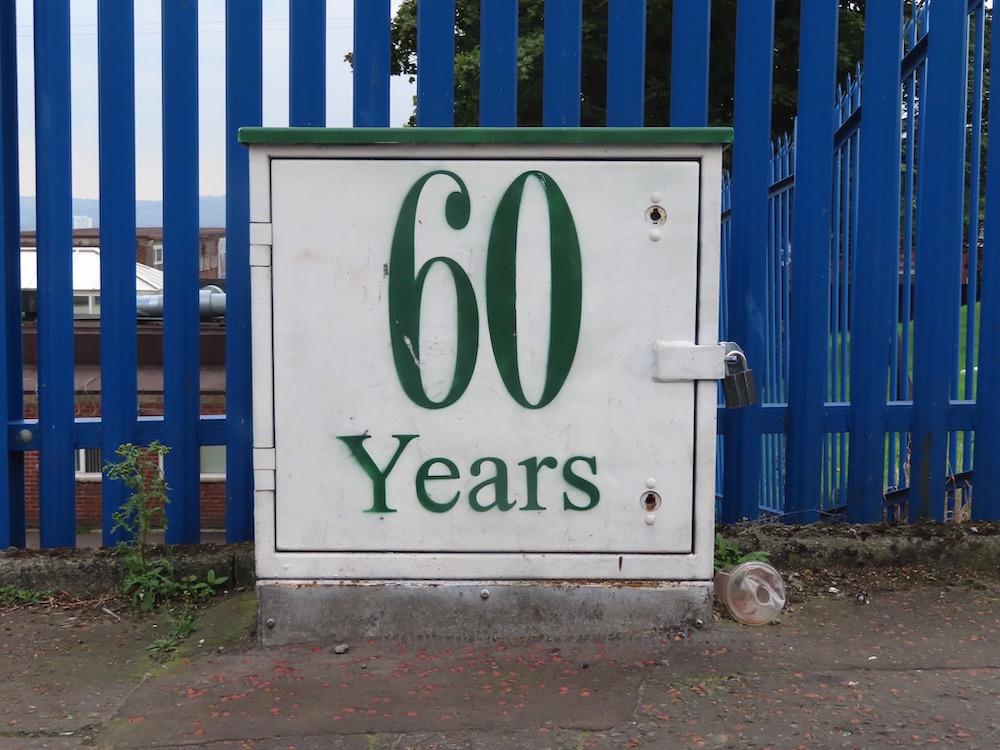
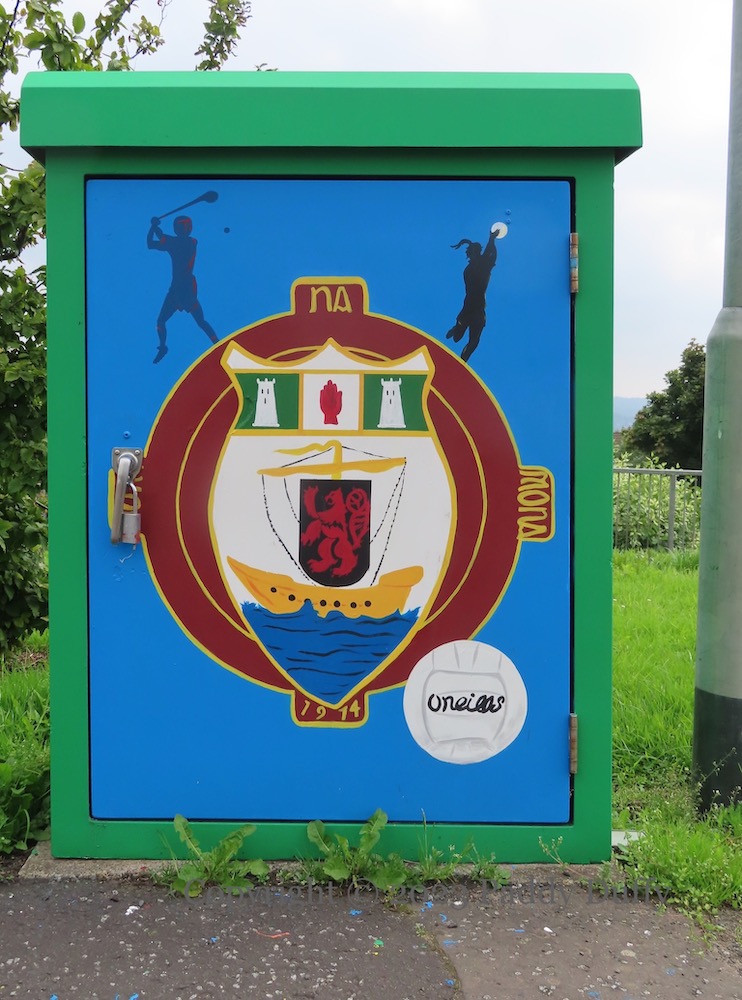
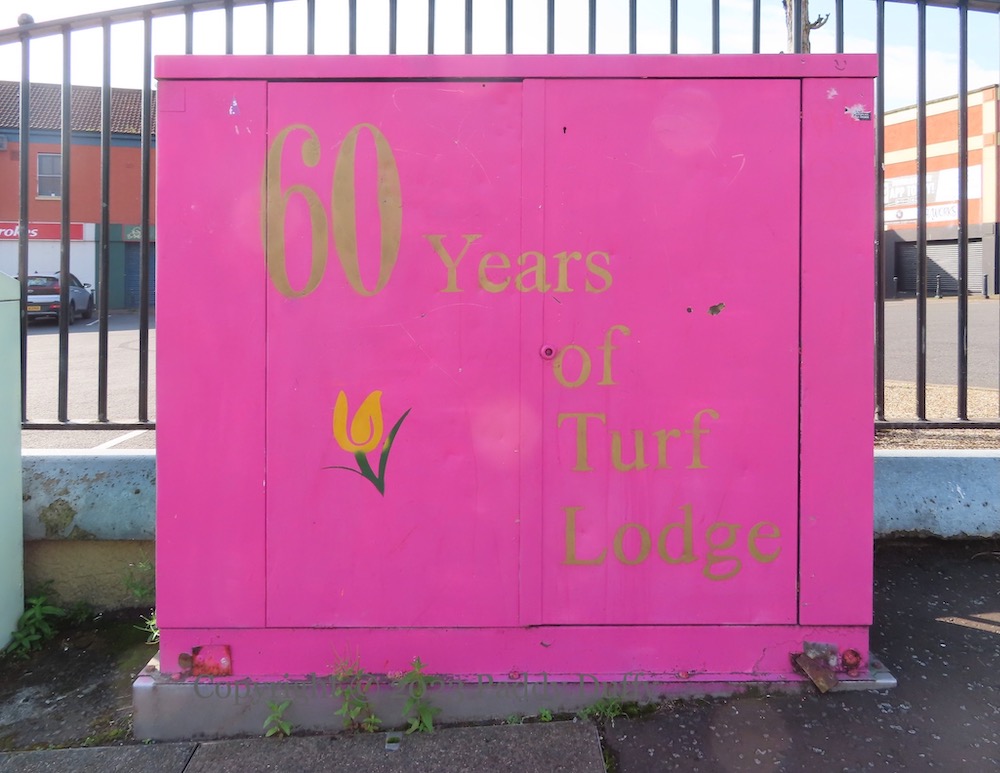
For the sixtieth anniversary, the electrical boxes outside John Paul II (formerly St Aidan’s) were stencilled (above and immediately below). This year (2023), more boxes have been painted, with images of gaelic games (see Gort Na Móna), bluebells (see Féıle Na gCloıgíní Gorma), and the silver fáınne on red background (see #AchtAnoıs).

See also: Klaus Fröhlich has a gallery of photos of the flats in the middle of the estate in great disrepair in 1979 (at BAP).

Click image to enlarge
Copyright © 2023 Paddy Duffy
T03113 T03114 T03115 T03116 T03120 T03209 T03210

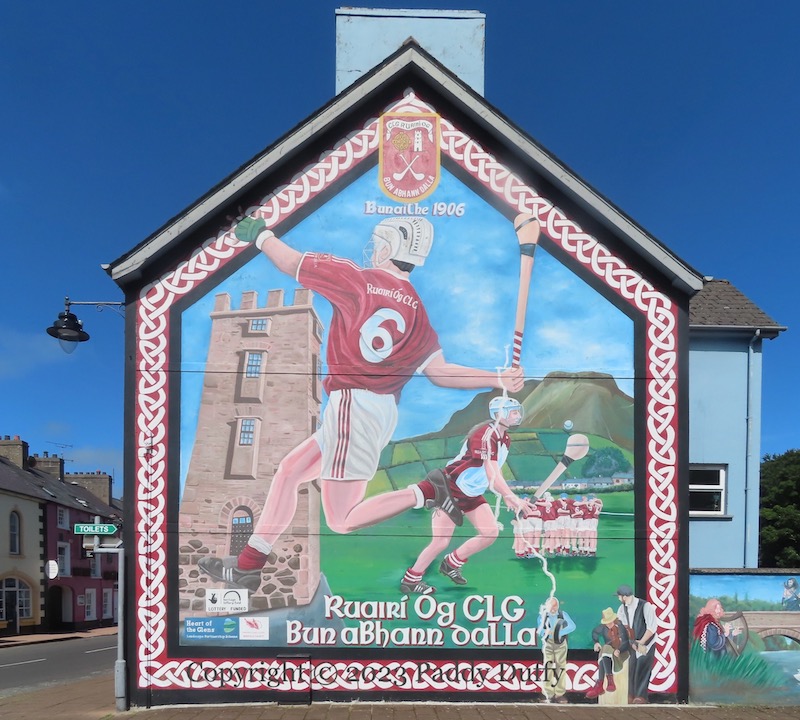
Ruaırí Óg CLG

This is the second version of the Ruaırí Óg (web) (and Clann Lır) mural in the middle of Cushendall – the original dates back to 2006, which was the 100th anniversary of the club’s founding (“bunaıthe”) (see M02832). The hurlers and Curfew tower remain; the “Big Ears” (Volunteer) trophy is gone and in its place are three traditional musicians. The Clann Lır has been painted to include the harper seen in Jim Fitzpatrick’s painting of the Lear myth. A Celtic warrior has appeared on the bridge over the Dall.

Click image to enlarge
Copyright © 2023 Paddy Duffy
T02962 [T02963] [T02964] T02965

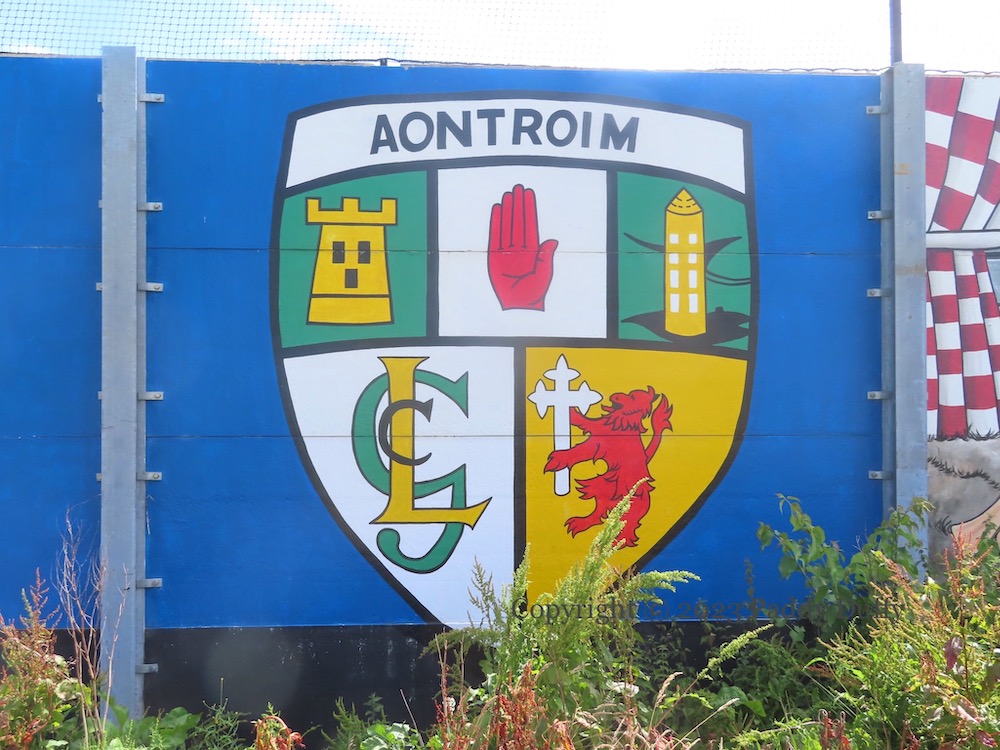
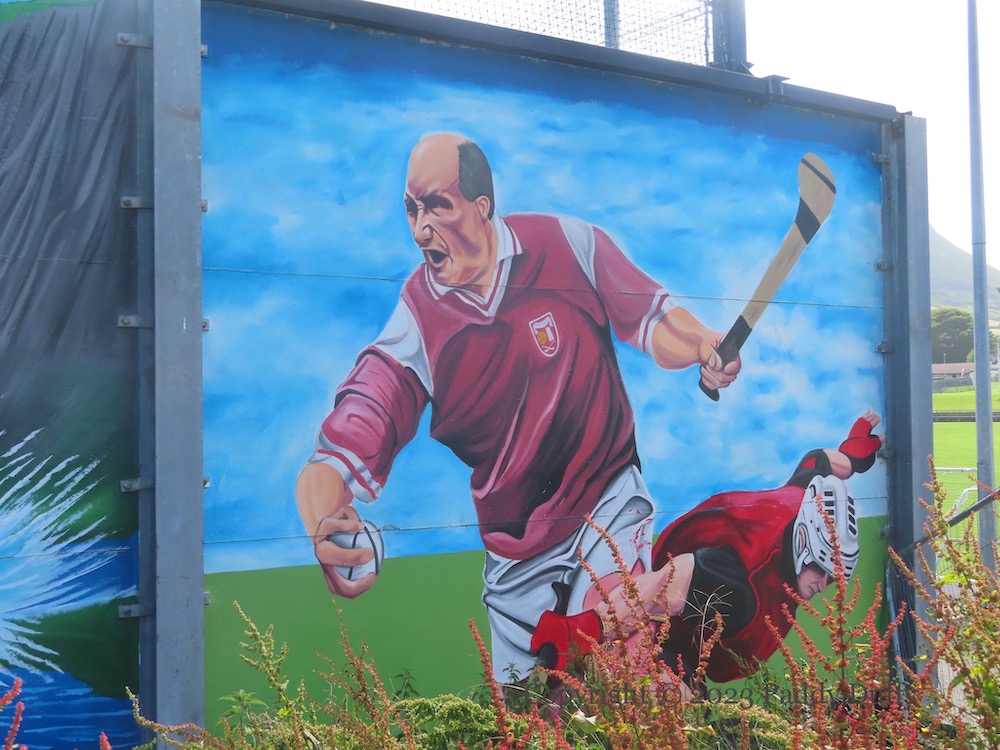
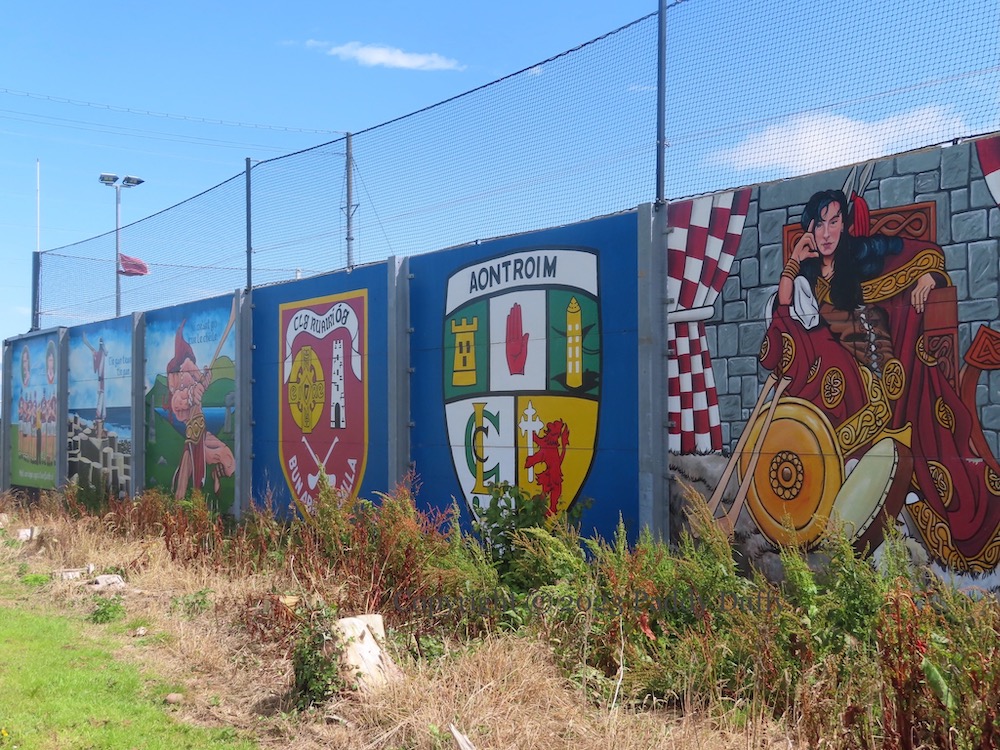
Laochra Gael

The two laochra featured in the first panel (above) are Danny McNaughton and John Darragh, while GAA hall-of-famer Terence “Sambo” McNaughton is featured in the final panel (BBC | GAA). Also included are Finn MacCool (on Giant’s Causeway), Setanta/Cú Chulaınn, and Queen Meadhbh – the latter two are in the style of Jim Fitzpatrick – the first is based on Fitzpatrick’s Hurling Match and the second takes Leyendecker’s painting of Maeve (WP) and renders it in Fitzpatrick’s style, complete with club-coloured drapes.  

Coast Road, Cushendall at the grounds of Ruaırí Óg CLG (web).

Click image to enlarge
Copyright © 2023 Paddy Duffy
T02953 T02954 T02955 T02956 T02957 T02958 T02959 T02960 T02961
Mol an óıge agus tıocfaıdh sí. Tír gan teanga, tír gan anam. Ní neart go cur le chéıle.

Bound Together

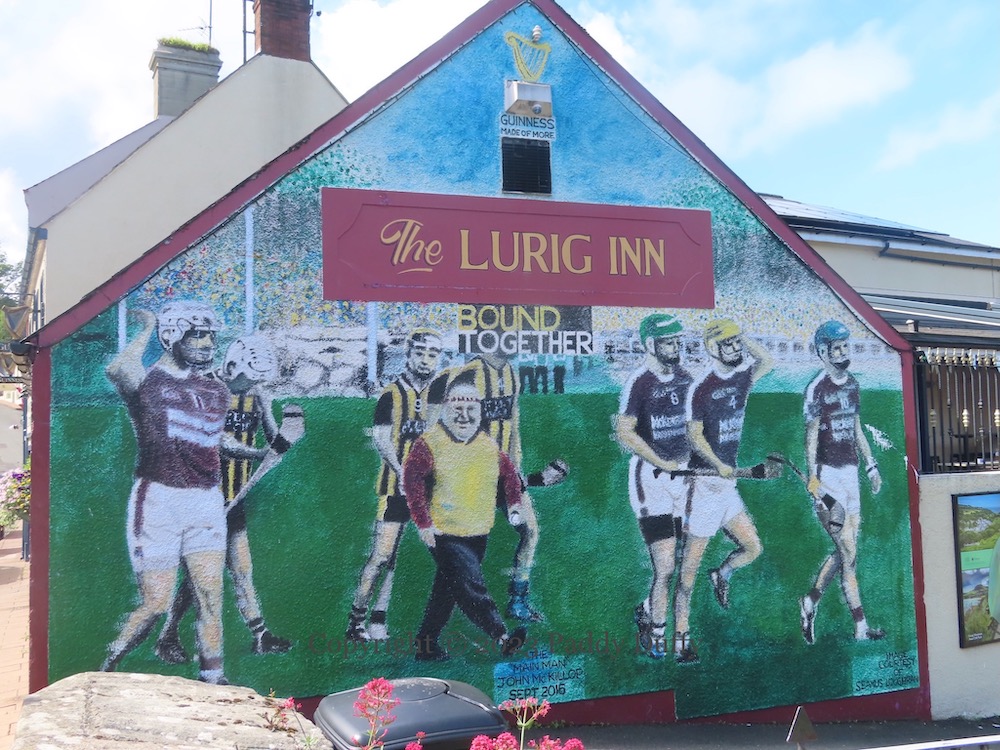
This Ruaırí Óg mural is on the side of the Lurig Inn (Fb), Coast Road, Cushendall, and features Ruaırí Óg superfan “Main Man” John McKillop (in the yellow bib).

The text in the centre reads “Main Man John McKillop Sept 2015”, which is when Ruaırí Óg senior hurlers defeated Ballycastle McQuillan for the Antrim title. “Image courtesy of Seamus Loughran” is the lower right-hand corner. For the photograph itself, see the Irish News.

See also Ruaırí Óg CLG and Laochra Gael.

Click image to enlarge
Copyright © 2023 Paddy Duffy
T02967

Tríocha Blıaın Ag Fás

What is now Coláıste Feırste began life as Meánscoıl Feırste in 1991, teaching a group of nine students a curriculum inspired by Patrick Pearse (discussed previously in An Tusa An Chéad Laoch Eıle?) and based in Cultúrlann MacAdam-Ó Fıaıch (Cultúrlann). It moved to Beechmount in 1998 and in 2018 expanded into new buildings that were meant to accommodate 600 pupils (Doherty Architects), which it has now exceeded (BBC) as it enters its thirty-third year in existence.

The theme of preserving and promoting the Irish language occurs in several places in the mural: next to Pearse we see his saying, “Máırtín Ó Chadháın ” [a land without a language [is] a land without a soul], in the classroom scene we have “Labhaır í agus maırfıdh sí” [speak it and it will endure], and finally we see the Dream Dearg protesting for an Irish-Language Act (see previously #AchtAnoıs).

The in-progress images included below among completed detailed shots date from May 6th and 20th.

Giant’s Foot/Beechview Park. Replaces the short-lived mural of Olympians, seen in Sporting Giants.

Click image to enlarge
Copyright © 2023 Paddy Duffy
T02779 T02778 T02777 T02776 T02780

Pobal Ag Fás

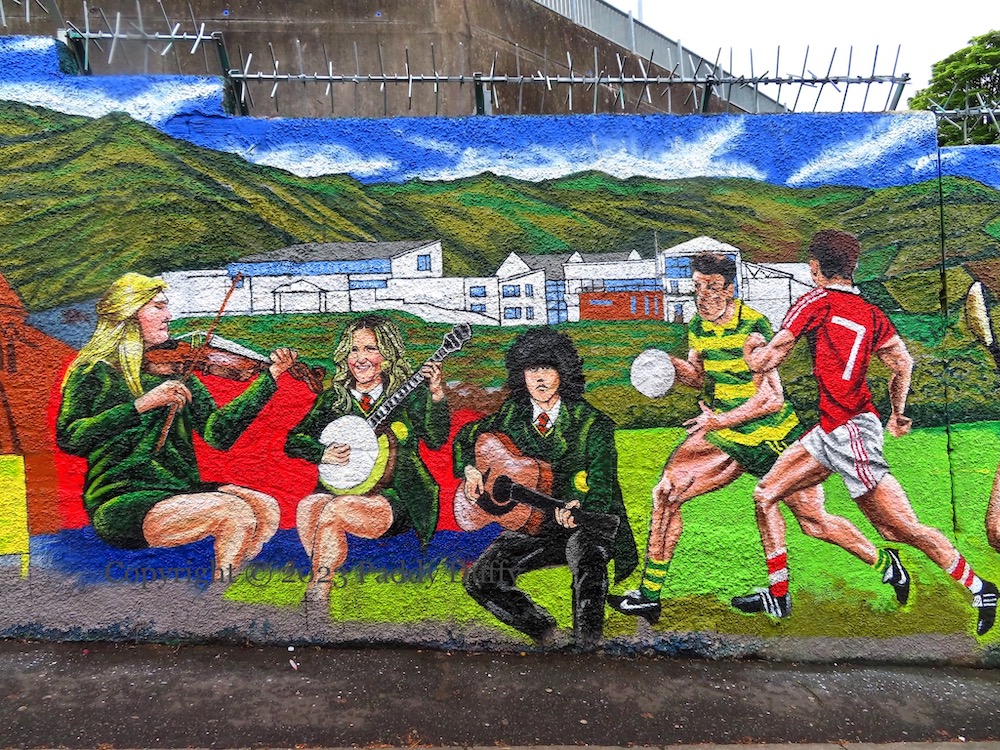
“Pobal ag foghlaım, pobal ag forbaırt, pobal ag fás” [a community learning, developing, growing]

Students from “Naíscoıl & Gaelscoıl An Lonnáın (Fb) bun[aithe] 1999″ [Nursery-school and Irish-language [primary] school of the loney, founded 1999] are shown playing Gaelic games, Irish dancing, and playing traditional instruments (and the guitar). On the left are representations from Irish mythology: the Children Of Lear and Setanta killing Culann’s hound (and taking the name Cú Chulaınn in taking its place), along with hedge-row school (see Hedge Row School).

The origin of the name is unclear; the nearest loney [lane] was the “Pound” loney, so-called because of the animal pen just outside Barrack Street, used to store livestock before moving on to the markets the following day (Rushlight | Uachtar Na bhFál). (The Pound Loney is included in the mural in Durham Street – see Et In Arcadia Ego.)

The other well-known loney in Belfast is the “buttermilk loney” which was either/both what is now Ballysillan Park (that is, connecting Olpark with the horsehoe bend) or the top part of the loney that connected Wheatfield (the top of Ardoyne) to the Ligoniel junction and on towards the old Ligoneil House (there are a mixture of usages in this Belfast Forum thread); this image from the 1930s might show the lane in (what was still at the time) the hills above Oldpark; a new housing-development towards the top of the Ballysillan Park is euphemistically called “Buttermilk Loney”. (It is also said to have been a prior name of Skegoniell Avenue (Belfast History).)

(The Uachtar Na bhFál page also mentions “Turf” loney, “Mountain” loney, and “Killoney”.)

The history of the Irish word “lonnán” is unclear. Uachtar na bhFál says the word is of Scots origin (perhaps as “loanin”). (See this BelTel article on the opening of the Ulster-Scots centre in 2014.) Spelled “lonnen”, it is also a Geordie word (Heslop’s Northumberland Words | wiktionary). The Irish News and Belfast Live, working from the same (uncited) press-release about Páırc An Lonnáın (which is along the Westlink below Raıdıó Fáılte), state that “loney” comes from the English word “loaning”. The Irish word “lonnán” does not appear in Dinneen 1904; Dinneen 1953 defines it (hyper-specifically) as “a grassy recess running up into high basaltic cliffs”.

The image above and immediately below are from May 19th, as the mural was nearing completion; other ‘in-progress’ images are as dated below. See Extramural Activity for images of the completed work.

May 10th:

April 20th:

Click image to enlarge
Copyright © 2023 Paddy Duffy
May 19th T02755 [T02756] T02757
May 10th T02718 [T02717]
Apr 25th [T02579] [T02580]
Apr 20th T02558 [T02557]
Marty Lyons

A Champion Gets Up

“A champion shows who he is by what he does when he’s tested. When he gets up and says “I can still do it”, he’s “a champion.” In Irish mythology, the Tuatha invade Ireland and battle the Fır Bolg. They are successful but their king Nuadha loses his arm and with it his kingship of the Tuatha. He had it replaced with an arm made of silver and regained his position. He is used here as an inspiration for those struggling with mental health, who are encouraged to call Lifeline or Aware.

(A history of Nuadha in murals is included in the Visual History page on Jim Fitzpatrick.)

The modern-day hero accompanying Nuadha is boxer James “The Assassin” Tennyson, current Irish super-featherweight champion. There are also four mental health boards (shown below) around the corner from Urban Villages Colin Safer Streets Initiative with messages such as “Think, Talk, Feel – Positive”, “Everything that you are is enough”, “Learn from yesterday, live for today, hope for tomorrow”,

Laurelglen Pharmacy, on the Stewartstown Road.

Click image to enlarge
Copyright © 2023 Paddy Duffy
T02307 T02308r T02309 [T02310] sally gardens youth saints youth centre ar scath a chéıle a mhaıreann na daoıne

The Future Of Football

When this mural of Northern Ireland players from Killyleagh was originally painted in 2006 it featured only three players:

– Hugh Davey, from Shrigley, five caps for “Ireland” (that is, for the IFA team) from “1925-1928” (NI Football)

– Terry Cochrane, 26 caps for Nothern Ireland from “1975-1984”; he played in the ’82 World Cup qualifiers but was injured for the tournament itself (NI Football)

– David Healy, 95 caps from “2000” to 2013; he scored the winning goal against England on 7th September, 2005 – the first victory over England since the 2-0 victory in 1927 that Hugh Davey played in – a feat memorialised in two Belfast murals: Our Wee Country | We’re Not Brazil, We’re Northern Ireland (NI Football)

A space and a question-mark were left at the bottom of the rainbow for future stars, in particular for then-seventeen-year-old up-and-comer Trevor Carson (Glasgow Times) who indeed went on to win his first (senior) cap in 2018 and currently has eight in total. He was added to the mural in 2021 (tw).

Braeside Gardens/Frederick Street, Killyleagh. Carson’s mother lives in the estate (Sunderland Echo).

Click image to enlarge
Copyright © 2023 Paddy Duffy
T02250 New Belfast Community Arts Initiative Housing Executive Down District Community Safety Partnership

Youth Of North Belfast

The local New Lodge GAA club Cumman An Phıarsaıgh is named in honour of Patrick Pearse, executed after the 1916 rising. The club’s new mural features footballers contesting a ball and Pearse’s image appears at the centre of a Celtic cross along with part of his 1912 poem Mıse Éıre in the bottom corner (shown below in a close-up). Painted by Lucas Quigley and Michael Doherty. Replaces ‘New Lodge 2000‘.

Mıse Éıre: Sıne mé na an Chaılleach Bhéarra.
Mór mo ghlóır: Mé a rug Cú Chulaınn croga.
Mór mo náır: Mo chlann féın a dhíol a máthaır.
[Mór mo phıan: Bıthnaımhde do mo shíorchıapadh.
Mór mo bhrón: D’éag an dream ınar chuıreas dóchas.]
Mıse Éıre: Uaıgní mé ná an Chaılleach Bhéarra.

I am Ireland: I am older than the old woman of Beare.
Great my glory: I who bore Cuchulainn, the brave.
Great my shame: My own children who sold their mother.
[Great my pain: My irreconcilable enemy who harasses me continually.
Great my sorrow: That crowd, in whom I placed my trust, died.]
I am Ireland: I am lonelier than the old woman of Beare.

Click image to enlarge
Copyright © 2024 Paddy Duffy
T01628 [T01629]