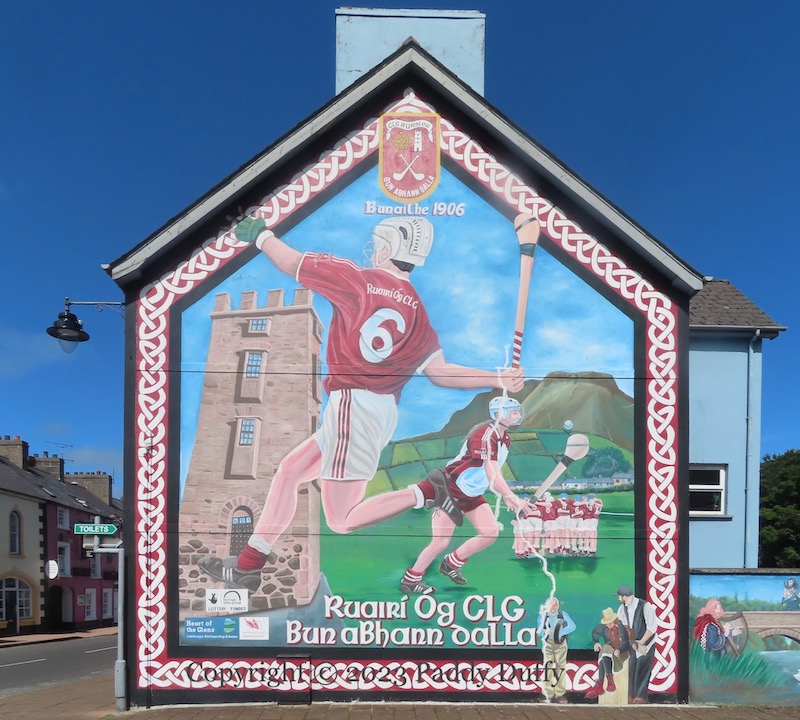
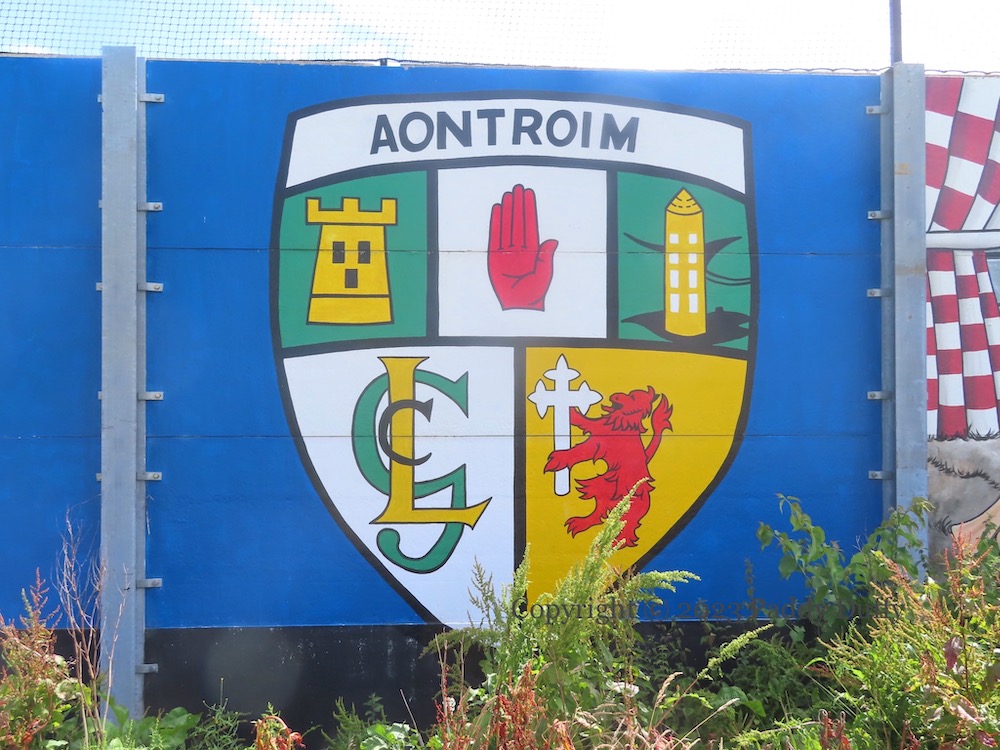
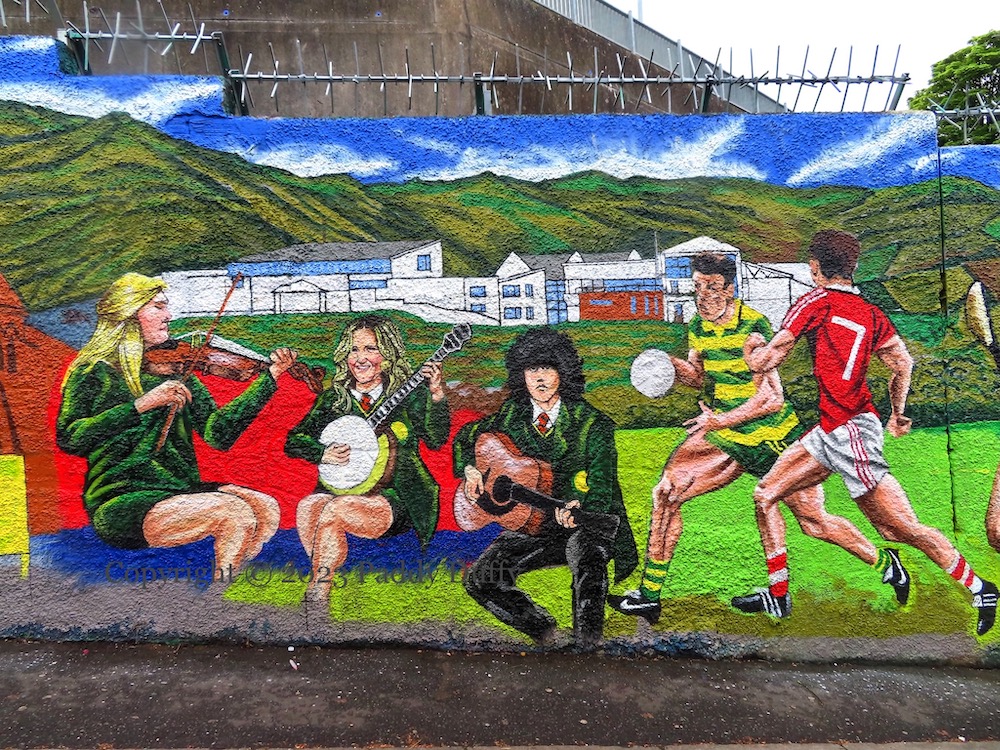
This is the second version of the Ruaırí Óg (web) (and Clann Lır) mural in the middle of Cushendall – the original dates back to 2006, which was the 100th anniversary of the club’s founding (“bunaıthe”) (see M02832). The hurlers and Curfew tower remain; the “Big Ears” (Volunteer) trophy is gone and in its place are three traditional musicians. The Clann Lır has been painted to include the harper seen in Jim Fitzpatrick’s painting of the Lear myth. A Celtic warrior has appeared on the bridge over the Dall.
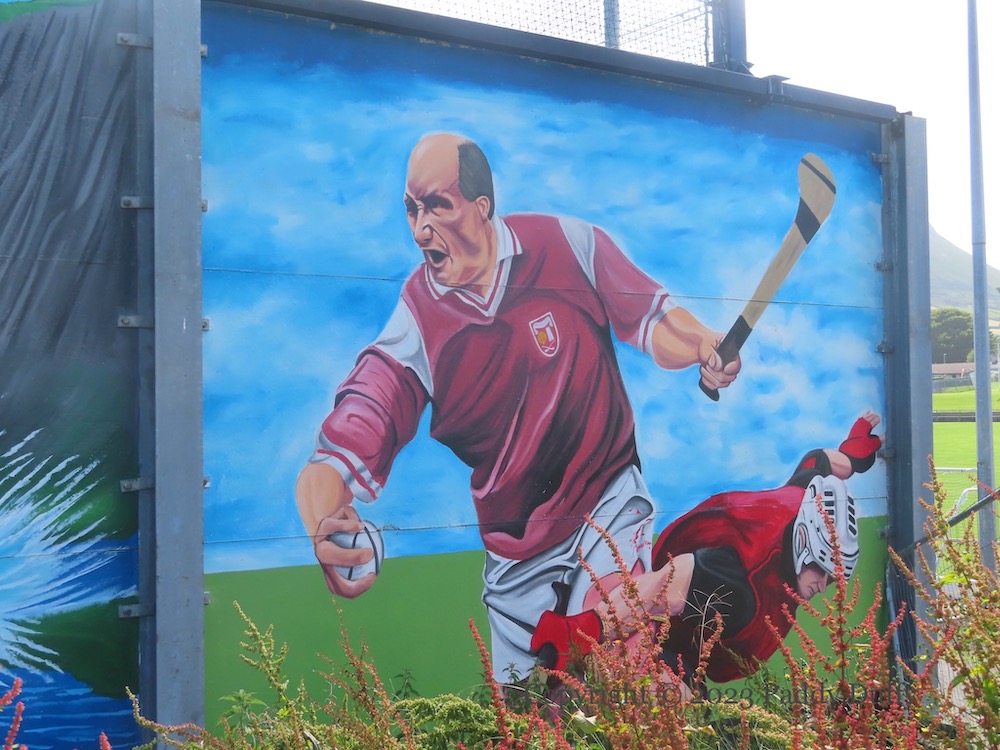
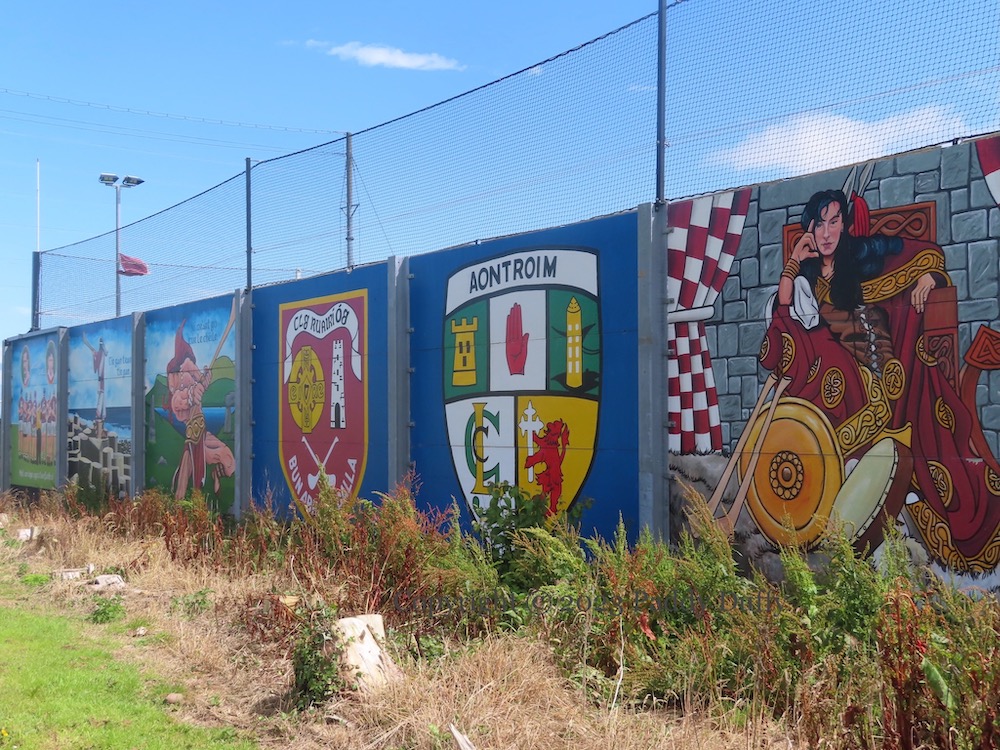
The two laochra featured in the first panel (above) are Danny McNaughton and John Darragh, while GAA hall-of-famer Terence “Sambo” McNaughton is featured in the final panel (BBC | GAA). Also included are Finn MacCool (on Giant’s Causeway), Setanta/Cú Chulaınn, and Queen Meadhbh – the latter two are in the style of Jim Fitzpatrick – the first is based on Fitzpatrick’s Hurling Match and the second takes Leyendecker’s painting of Maeve (WP) and renders it in Fitzpatrick’s style, complete with club-coloured drapes.
Coast Road, Cushendall at the grounds of Ruaırí Óg CLG (web).
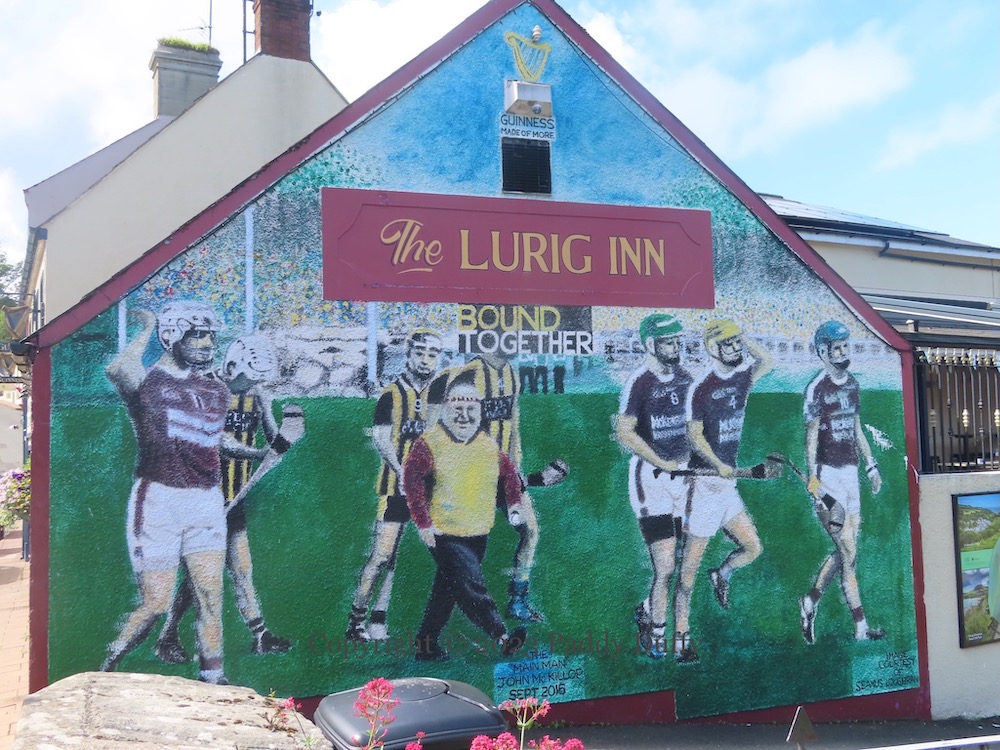
This Ruaırí Óg mural is on the side of the Lurig Inn (Fb), Coast Road, Cushendall, and features Ruaırí Óg superfan “Main Man” John McKillop (in the yellow bib).
The text in the centre reads “Main Man John McKillop Sept 2015”, which is when Ruaırí Óg senior hurlers defeated Ballycastle McQuillan for the Antrim title. “Image courtesy of Seamus Loughran” is the lower right-hand corner. For the photograph itself, see the Irish News.
What is now Coláıste Feırste began life as Meánscoıl Feırste in 1991, teaching a group of nine students a curriculum inspired by Patrick Pearse (discussed previously in An Tusa An Chéad Laoch Eıle?) and based in Cultúrlann MacAdam-Ó Fıaıch (Cultúrlann). It moved to Beechmount in 1998 and in 2018 expanded into new buildings that were meant to accommodate 600 pupils (Doherty Architects), which it has now exceeded (BBC) as it enters its thirty-third year in existence.
The theme of preserving and promoting the Irish language occurs in several places in the mural: next to Pearse we see his saying, “Máırtín Ó Chadháın ” [a land without a language [is] a land without a soul], in the classroom scene we have “Labhaır í agus maırfıdh sí” [speak it and it will endure], and finally we see the Dream Dearg protesting for an Irish-Language Act (see previously #AchtAnoıs).
The in-progress images included below among completed detailed shots date from May 6th and 20th.
Giant’s Foot/Beechview Park. Replaces the short-lived mural of Olympians, seen in Sporting Giants.
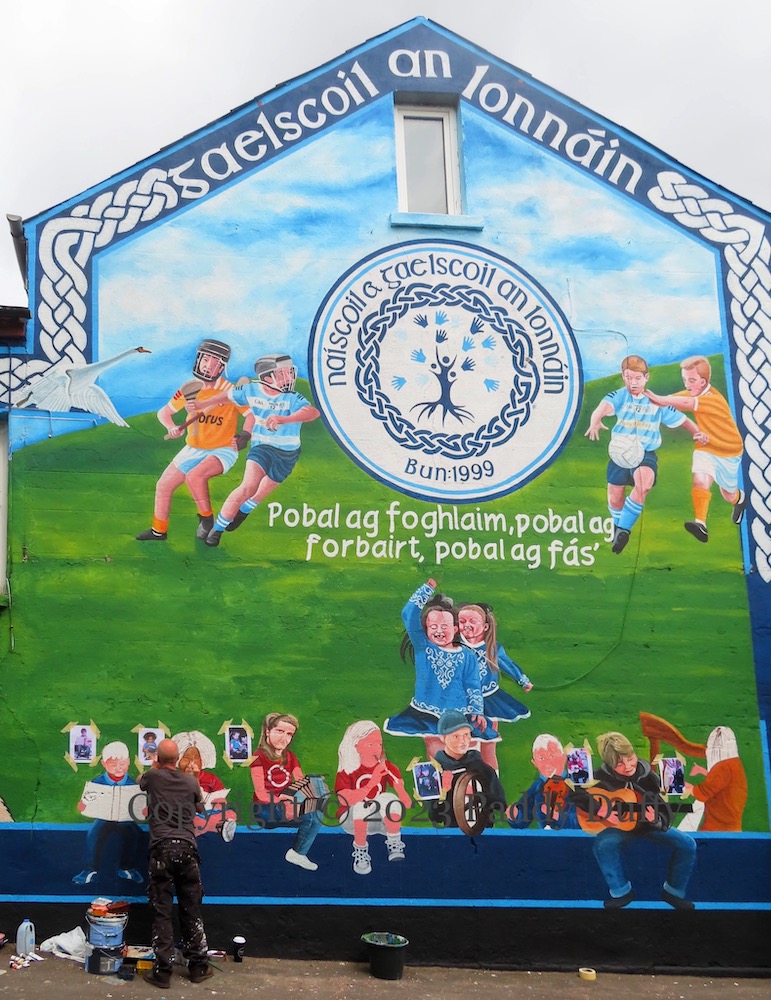
“Pobal ag foghlaım, pobal ag forbaırt, pobal ag fás” [a community learning, developing, growing]
Students from “Naíscoıl & Gaelscoıl An Lonnáın (Fb) bun[aithe] 1999″ [Nursery-school and Irish-language [primary] school of the loney, founded 1999] are shown playing Gaelic games, Irish dancing, and playing traditional instruments (and the guitar). On the left are representations from Irish mythology: the Children Of Lear and Setanta killing Culann’s hound (and taking the name Cú Chulaınn in taking its place), along with hedge-row school (see Hedge Row School).
The origin of the name is unclear; the nearest loney [lane] was the “Pound” loney, so-called because of the animal pen just outside Barrack Street, used to store livestock before moving on to the markets the following day (Rushlight | Uachtar Na bhFál). (The Pound Loney is included in the mural in Durham Street – see Et In Arcadia Ego.)
The other well-known loney in Belfast is the “buttermilk loney” which was either/both what is now Ballysillan Park (that is, connecting Olpark with the horsehoe bend) or the top part of the loney that connected Wheatfield (the top of Ardoyne) to the Ligoniel junction and on towards the old Ligoneil House (there are a mixture of usages in this Belfast Forum thread); this image from the 1930s might show the lane in (what was still at the time) the hills above Oldpark; a new housing-development towards the top of the Ballysillan Park is euphemistically called “Buttermilk Loney”. (It is also said to have been a prior name of Skegoniell Avenue (Belfast History).)
(The Uachtar Na bhFál page also mentions “Turf” loney, “Mountain” loney, and “Killoney”.)
The history of the Irish word “lonnán” is unclear. Uachtar na bhFál says the word is of Scots origin (perhaps as “loanin”). (See this BelTel article on the opening of the Ulster-Scots centre in 2014.) Spelled “lonnen”, it is also a Geordie word (Heslop’s Northumberland Words | wiktionary). The Irish News and Belfast Live, working from the same (uncited) press-release about Páırc An Lonnáın (which is along the Westlink below Raıdıó Fáılte), state that “loney” comes from the English word “loaning”. The Irish word “lonnán” does not appear in Dinneen 1904; Dinneen 1953 defines it (hyper-specifically) as “a grassy recess running up into high basaltic cliffs”.
The image above and immediately below are from May 19th, as the mural was nearing completion; other ‘in-progress’ images are as dated below. Here are images of the completed work.
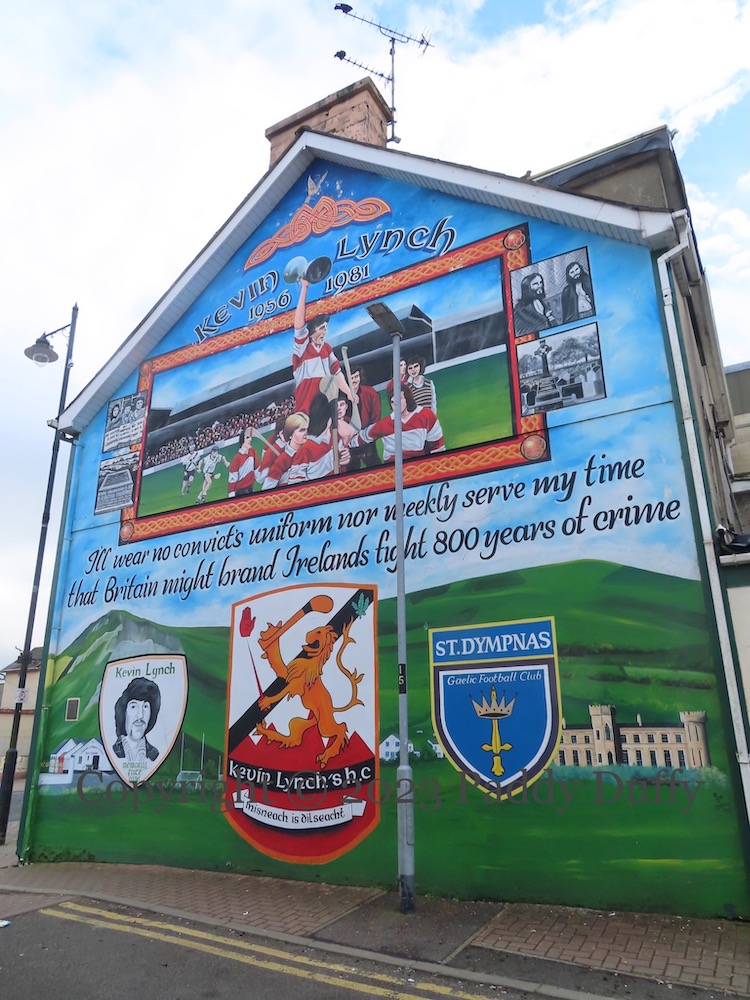
This is the repainted version of the mural to Kevin Lynch in Dún Geımhın/Dungiven. Lynch died after 71 days on hunger strike – the longest-surviving striker – in Long Kesh/the Maze prison (WP).
Along the bottom are the emblems of Kevin Lynch Memorial flute band (Fb), Kevin Lynch’s hurling club (“mısneach ‘s dílseacht”), and St Dympna’s football club, Luton (Fb).
“Mural unveiled on Saturday 4th August 2012 by Bridie Lynch & Jeannie McTaggart to commemorate Kevin Lynch and his comrades who died in the 1981 hunger strike.”
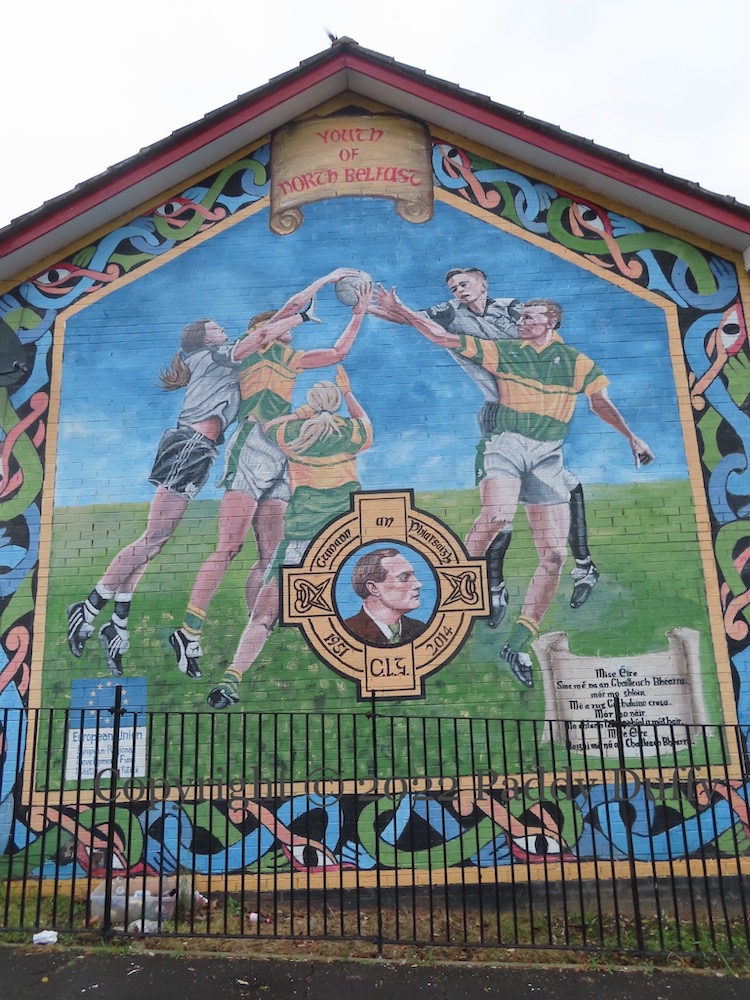
The local New Lodge GAA club Cumman An Phıarsaıgh is named in honour of Patrick Pearse, executed after the 1916 rising. The club’s new mural features footballers contesting a ball and Pearse’s image appears at the centre of a Celtic cross along with part of his 1912 poem Mıse Éıre in the bottom corner (shown below in a close-up). Painted by Lucas Quigley and Michael Doherty. Replaces ‘New Lodge 2000‘.
Mıse Éıre: Sıne mé na an Chaılleach Bhéarra. Mór mo ghlóır: Mé a rug Cú Chulaınn croga. Mór mo náır: Mo chlann féın a dhíol a máthaır. [Mór mo phıan: Bıthnaımhde do mo shíorchıapadh. Mór mo bhrón: D’éag an dream ınar chuıreas dóchas.] Mıse Éıre: Uaıgní mé ná an Chaılleach Bhéarra.
I am Ireland: I am older than the old woman of Beare. Great my glory: I who bore Cuchulainn, the brave. Great my shame: My own children who sold their mother. [Great my pain: My irreconcilable enemy who harasses me continually. Great my sorrow: That crowd, in whom I placed my trust, died.] I am Ireland: I am lonelier than the old woman of Beare.
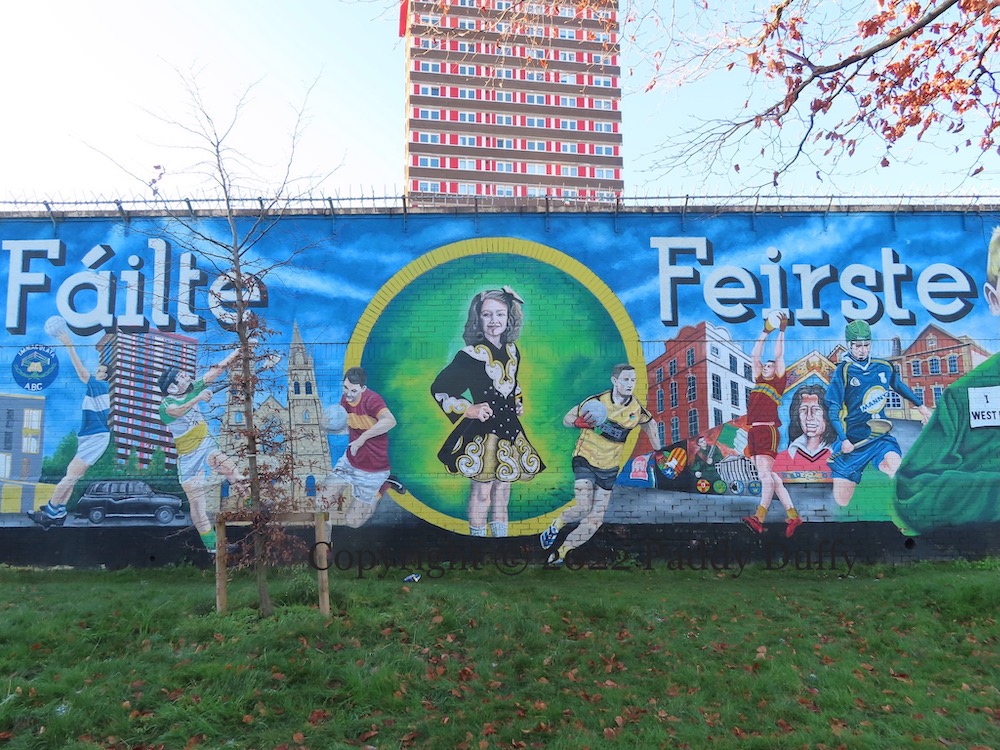
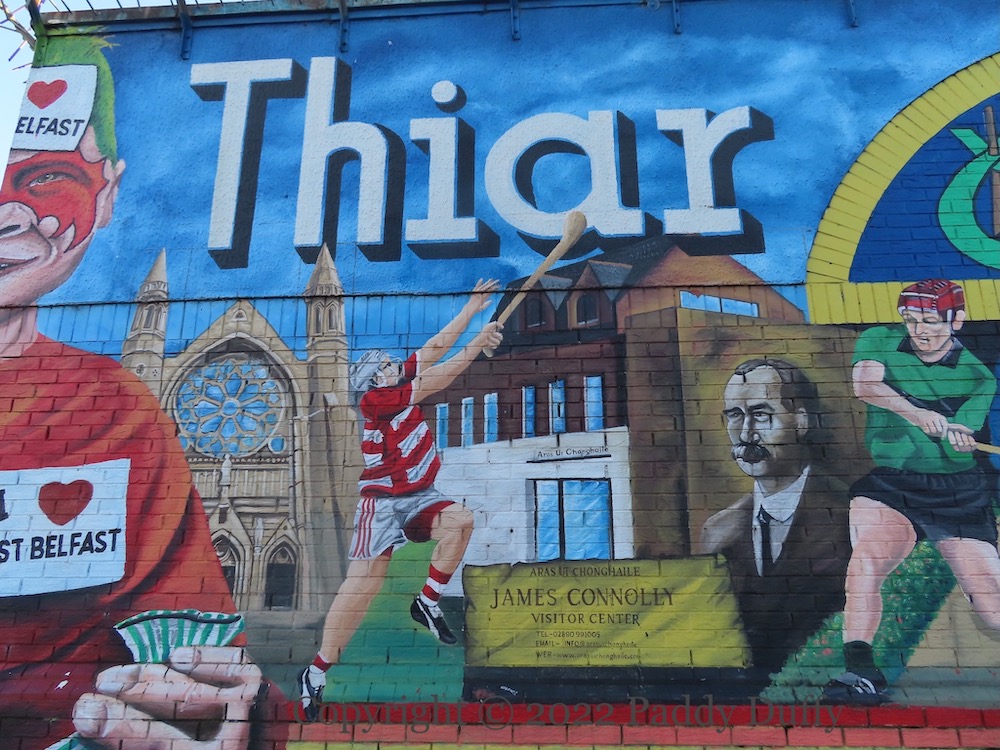
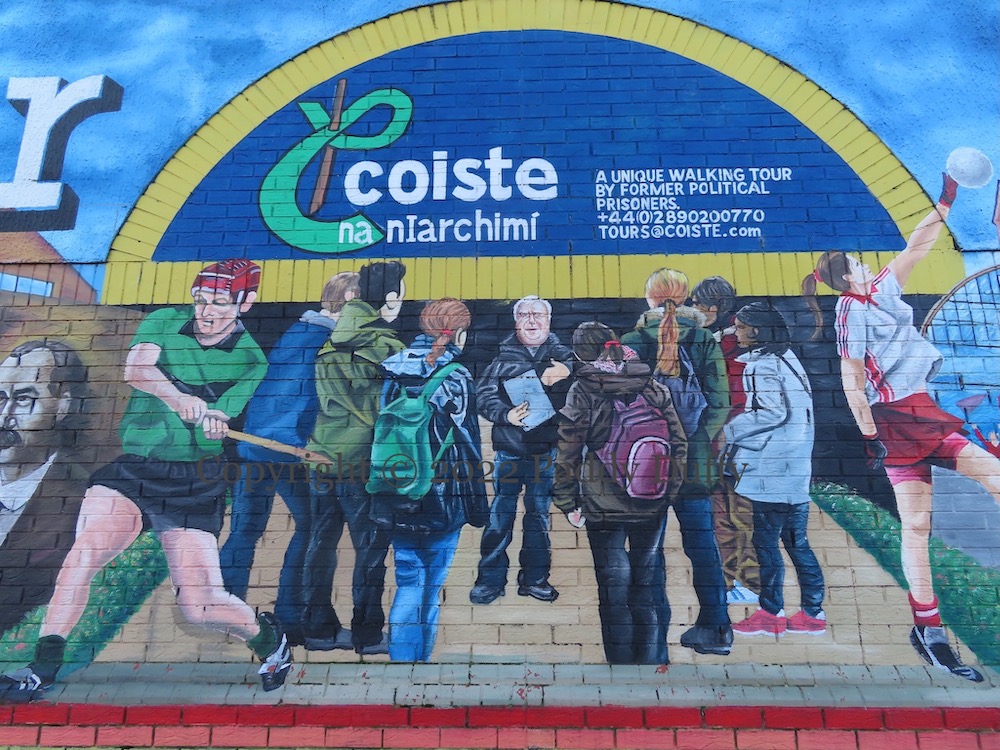
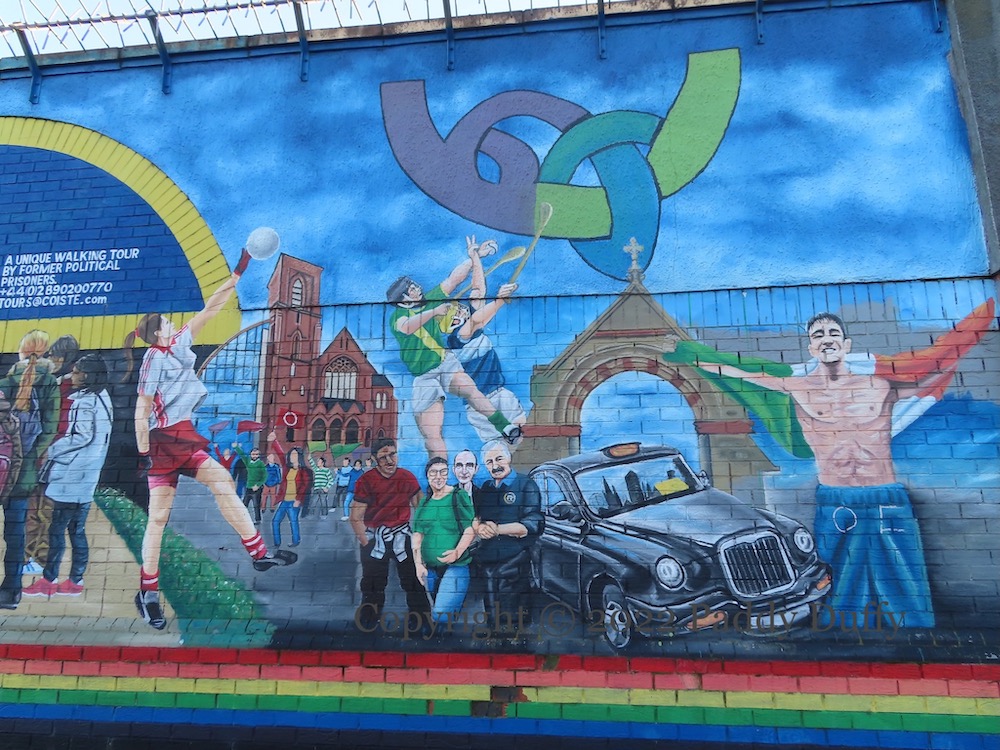
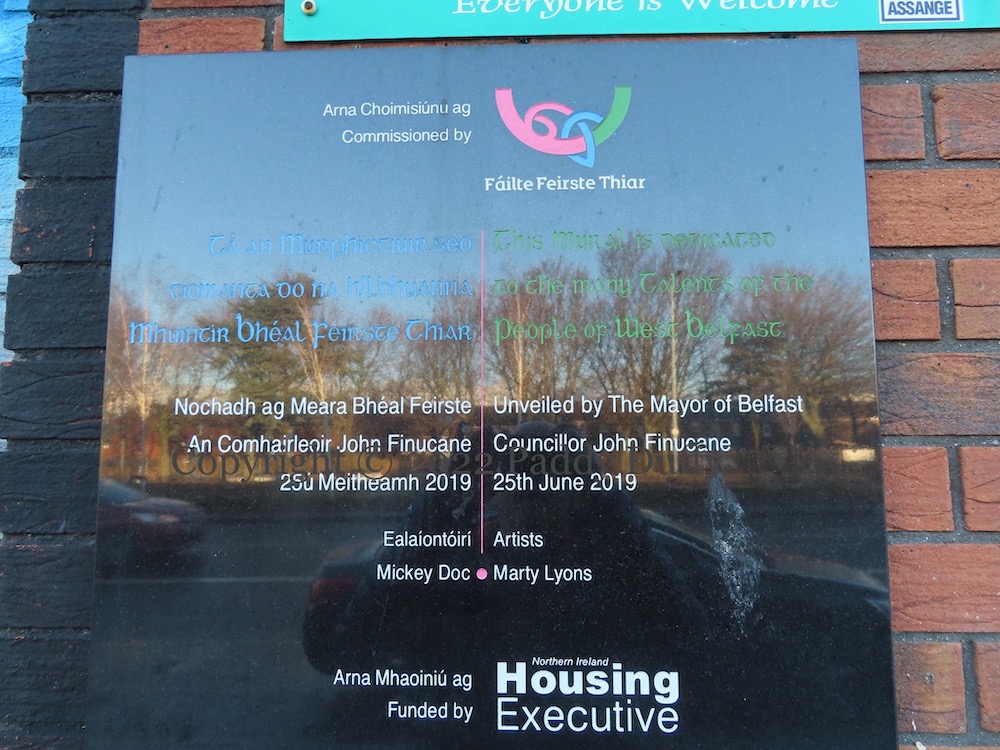
Fáılte Feırste Thıar‘s second mural (the first is outside its offices in the middle Falls – see Fáılte Feırste Thıar) reinforces the claim that (republican) west Belfast begins as soon as you cross the motorway, five minutes’ walk from the city centre. Coıste’s tour of republican murals begins at Divis Tower and the new mural already seems to be drawing tourists – see the final image, below. The previous Coıste mural (M04900) has been deleted and incorporated into the mural, promising tourists “a unique walking tour by former political prisoners”.
The mural is a mix of landmarks – the new Raıdıó Fáılte building (which is located just below the mural), Divis tower, St Peter’s, Conway Mill, the “international wall” of murals, the Bobby Sands mural, the Falls library, the new James Connolly centre, Cultúrlann, and Milltown cemetery – cultural images (Irish dancing and Féıle An Phobaıl) – and sporting images (clubs include Immaculata ABC, Gort Na Móna GAC, St Paul’s GAC). A gay pride ‘rainbow’ stripe runs below the Divis Street portion. Before the previous mural was painted (M07533), there was a Gateway To Belfast board at this spot.
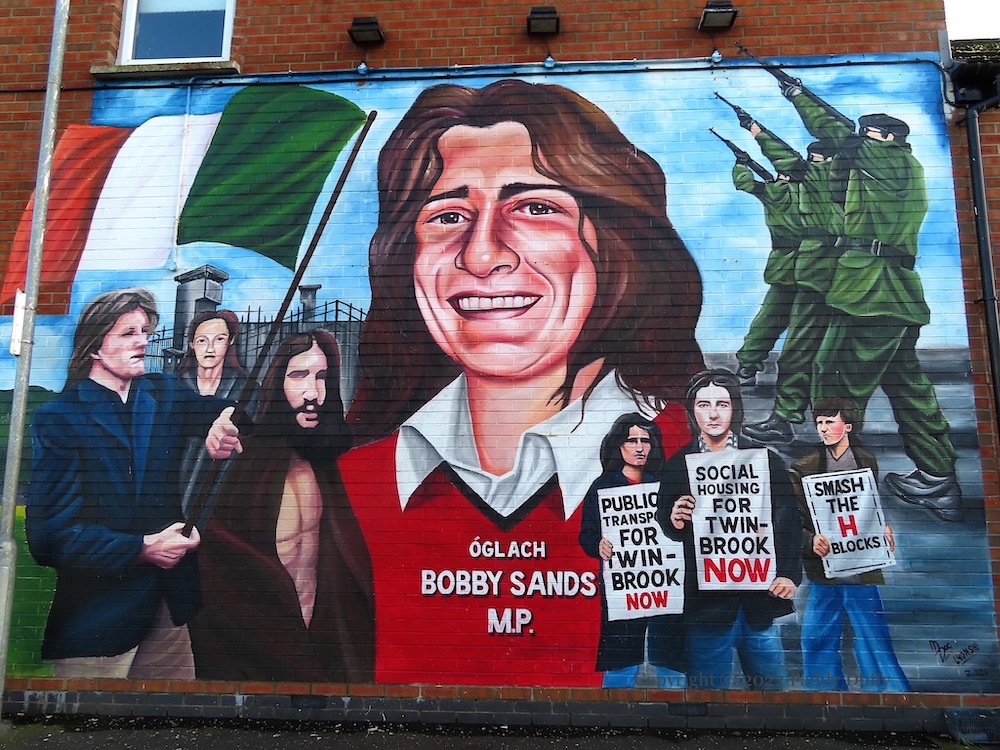
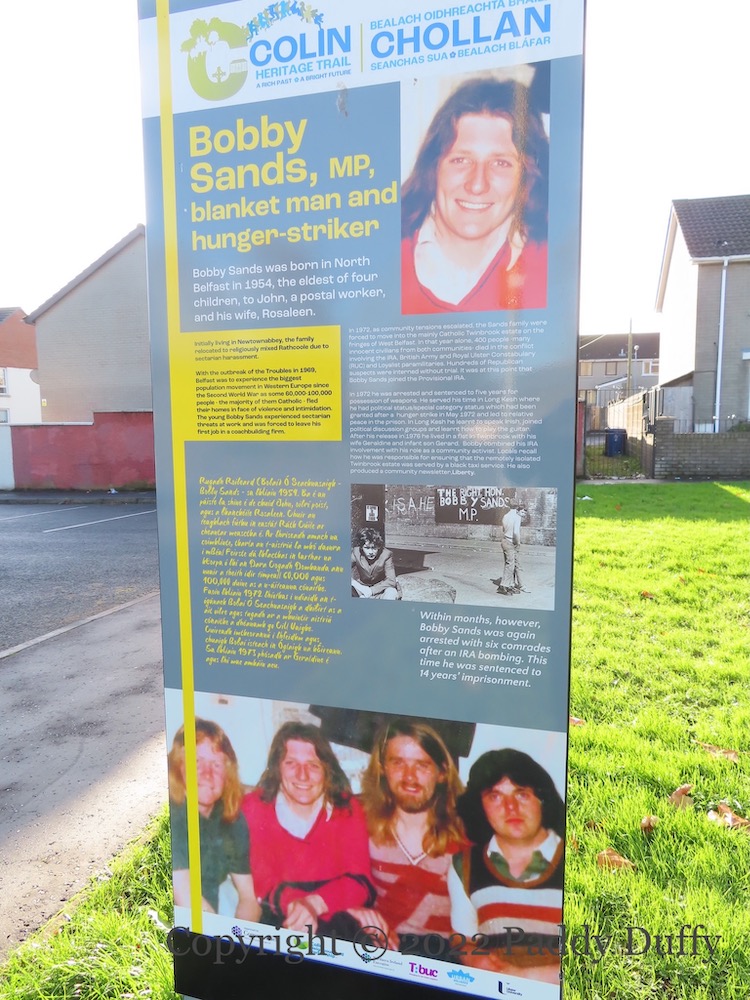
In 2019, images of Bobby Sands before his (second and final) arrest and imprisonment were rediscovered in the collection of French photographer Gérard Harlay. Sands was serving as a flag-bearer in an August 1976 march from the Busy Bee to Dunville Park to protest the withdrawal of political status. (For some of Harlay’s images, see Bobby Sands Trust.) This new mural in his home area of Twinbrook copies one of the images (though presents him as carrying a Tricolour rather than a harp) along with protesters protesting for “Public transport for Twinbrook now” and “Social housing for Twinbrook now”.
Glencolin estate was built next to Moyard House (which in 1984 became home to the Roddy’s (web)) on the Glen Road in 1979 (Belfast Forums). For the fortieth anniversary of “eastát Ghleann Collaınn” the mural at the entrance to the estate was (belatedly) repainted. The composition of the mural remains as in the previous version, with the Roddy’s and Oliver Plunkett church in the shadow of Dubhaıs and Slıabh Dubh; they are now joined by images of Gaelic games. The Bobby Sands quote has been removed.