Hunger Strikers Memorial

The hunger strikers memorial in Rossville Street, Derry, was launched in 2000. Compared to the entries from 2001 and 2004, this version has a new centre-piece – the metal lark has been replaced by a combination lark and hand cast in stone.

The central “H” carries the names of the ten deceased 1981 strikers, while the stones to either side carry the names of other republicans to have died on hunger strike: Thomas Ashe 1917, Michael Fitzgerald 1920, Joseph Murphy 1920, Terence McSwiney 1920, Joseph Whitty 1923, Denis Barry 1923, Andrew Sullivan 1923, Tony D’Aroy 1940, Jack McNeela 1940, Sean McCaughey 1946, Michael Gaughan 1974, Frank Stagg 1976.

In the background of the image below are (left) Free Derry Corner and (centre-right) The Petrol Bomber.

Rossville Street, Derry

Click image to enlarge
Copyright © 2007 Paddy Duffy
T00378 T00411

The Hunger Strike Era

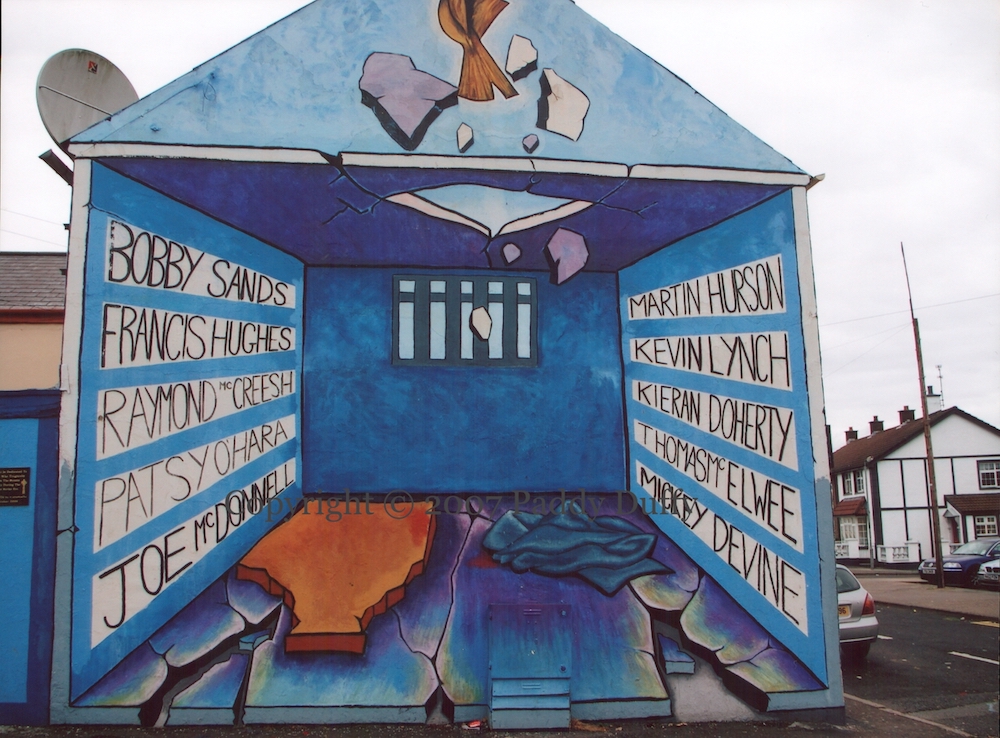
A lark (rather than a dove) bursts through the ceiling of a H-Block cell lined with the names of the ten deceased 1981 hunger strikers. “This mural is dedicated to all those who tragically died on the streets of Derry during the hunger strike era. Suımhneas Dé dá nanamacha. 3rd October 2006.”

Westland St, Derry

Click image to enlarge
Copyright © 2007 Paddy Duffy
T00404

Claiming Equality!

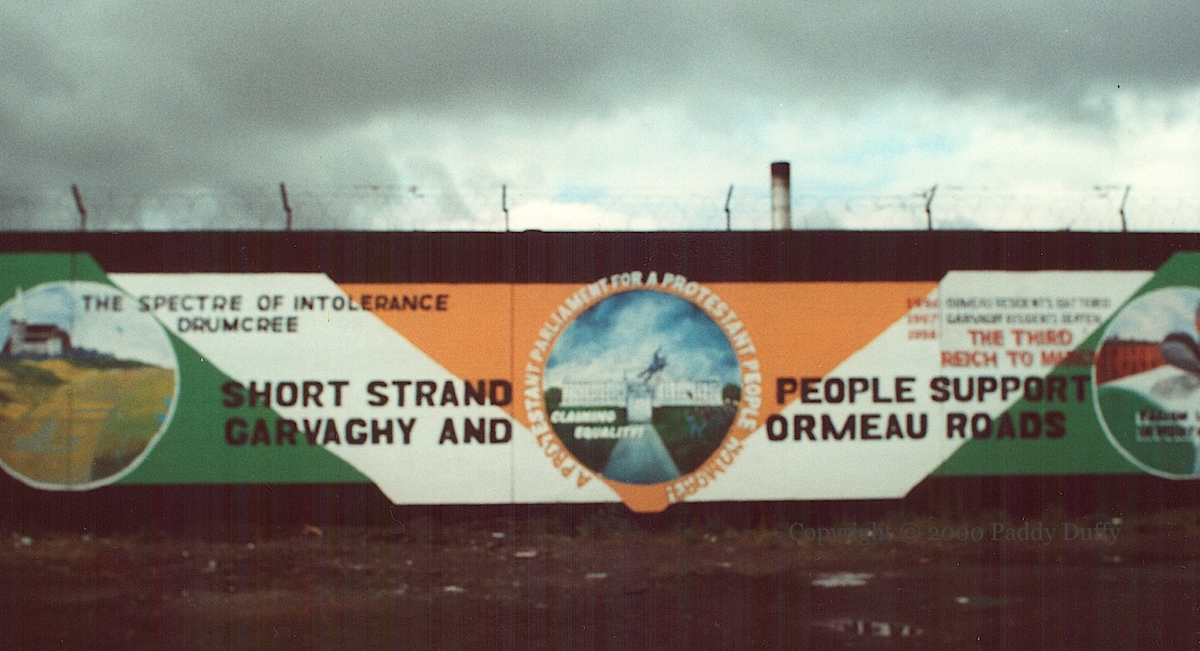
Northern Ireland’s first Prime Minister, James Craig, said in 1934, that Stormont was “carrying on a Protestant Government for a Protestant People” (NI Parliamentary Debates), though the phrase has now been transformed into the doubly alliterative “A Protestant parliament for a Protestant people”. In the centre of a long mural at the waste-ground at the top of Mountpottinger Road, people carrying Irish Tricolours tear down the statue to Northern Ireland’s most prominent leader, Sir Edward Carson, that stands outside Stormont, “claiming equality”.

The main issue that has tested the resolve of governments both local and national to the equality declared in the 1998 Belfast (Good Friday) Agreement is Orange Order parading through nationalist areas, such as the Garvaghy Road below Drumcree church in Portadown, and the Ormeau Road in south Belfast.

“Short Strand people support Garvaghy and Ormeau Roads.” On the left: The spectre of intolerance – Drumcree.” Centre: “A Protestant parliament for a Protestant people no more!” On the right “1996: Ormeau residents battered; 1997: Garvaghy residents beaten; 1998: The third reich to march.” and “Fascism lives! in Portadown”.

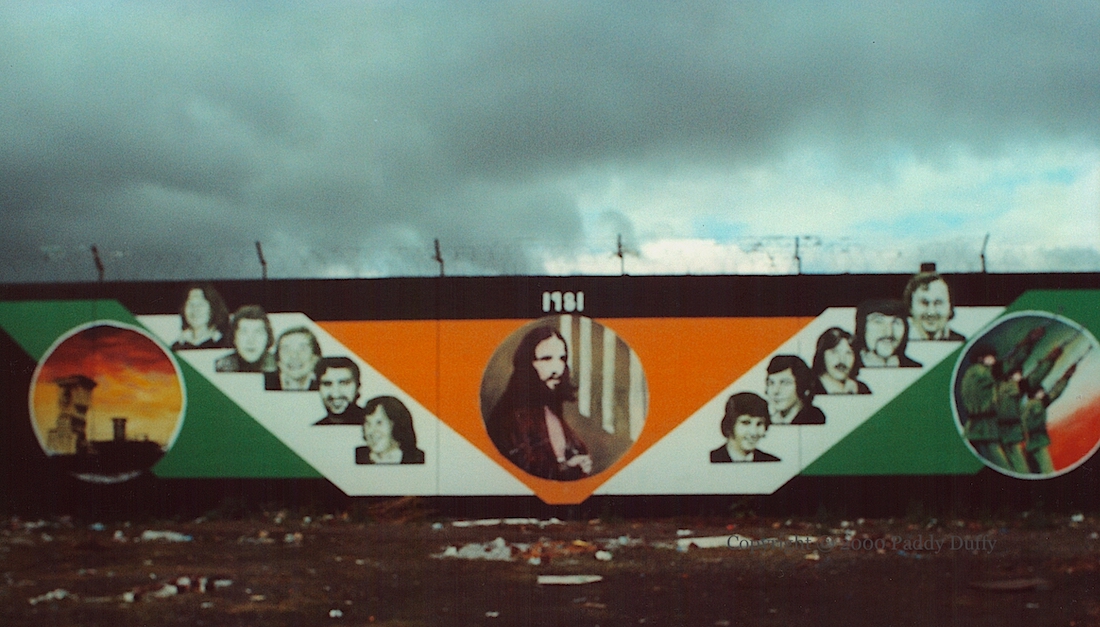
The piece is next to a hunger-strikers commemoration piece with ten portraits on shaped wooden boards against a painted background with blanket-man Hugh Rooney in the center. Between the two is a “spirit of freedom” lark and the names of the ten deceased 1981 strikers.

Mountpottinger Road, Short Strand, east Belfast

Click image to enlarge
Copyright © 2000 Paddy Duffy
T00426 T00427 T00417 T00416 T00418

Na Cımí Poblachtánacha

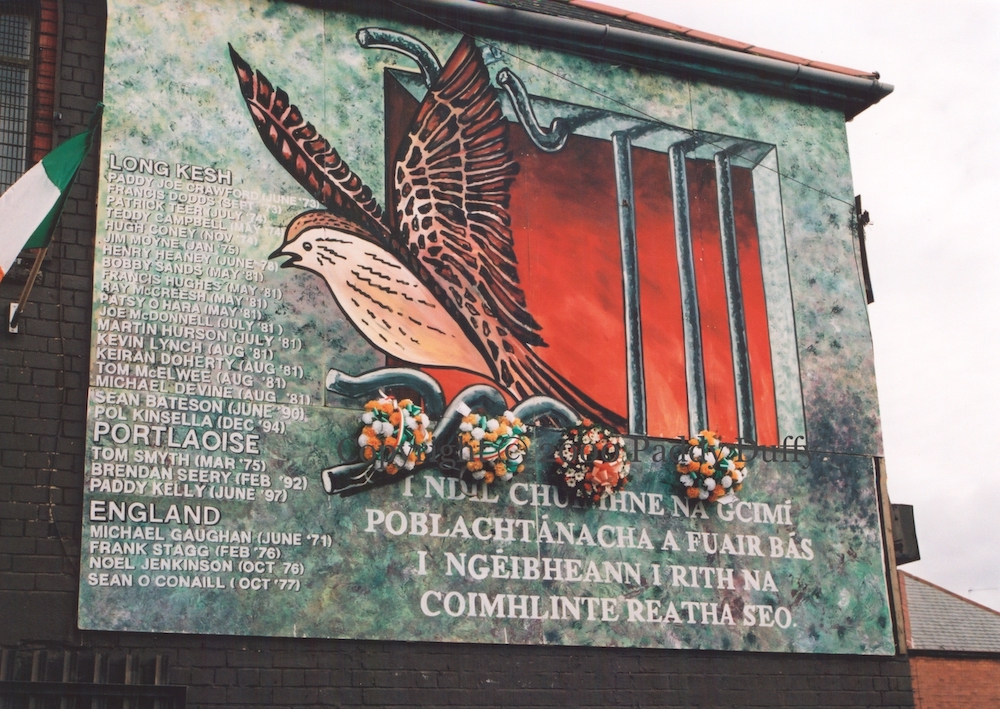
“I ndıl chuımhne na gcımí poblachtanacha a fuaır bas ı ngéıbheann ı rıth na coımhlınte reatha seo.” A lark bursts through prison bars of Long Kesh, Portlaoise, and prisons in England, in which republicans have died from the 70s to 90s.

Beechmount Avenue, west Belfast

Click image to enlarge
Copyright © 2000 Paddy Duffy (no date given)
T00339

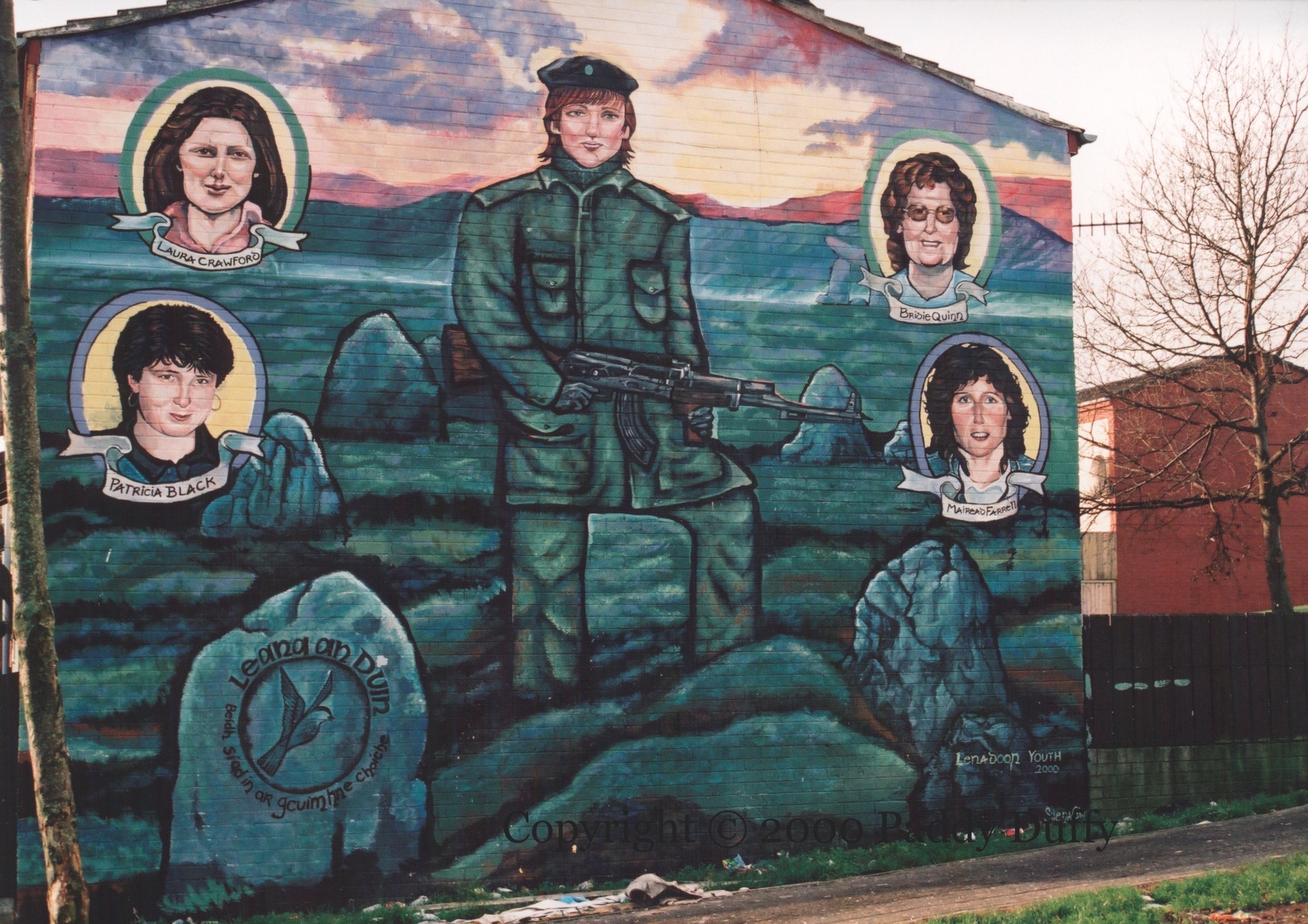
Lenadoon Republican Women

“Leanna An Dúın – Beıdh sıad ın ár gcuımhne choíche.” Local female IRA volunteers Laura Crawford, Patricia Black, Bridie Quinn, Maıréad Farrell and a generic female volunteer with assault rifle on manoeuvres in an Irish landscape strewn with standing stones.

Signed by “Lenadoon Youth 2000”. Glenveagh Drive, Lenadoon, Belfast

Click image to enlarge
Copyright © 2000 Paddy Duffy (no date given)
T00337 [T00379]

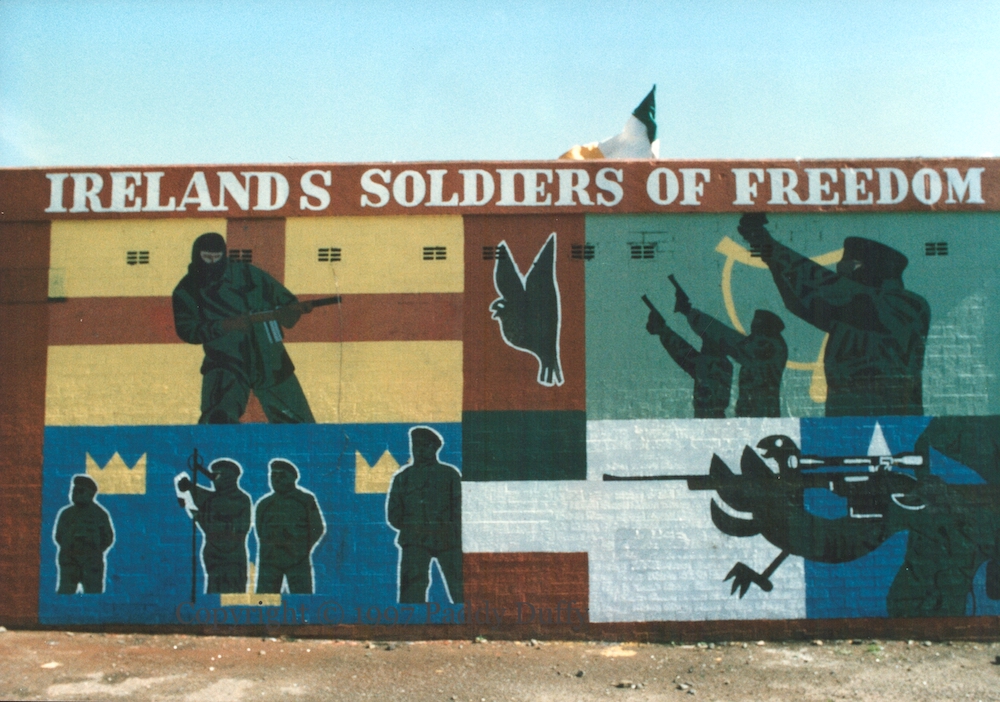
Ireland’s Soldiers Of Freedom

IRA volunteers are superimposed upon the flags of the four provinces. In the top left (Ulster) and bottom right (Connacht) they are aiming weapons (one with a sniper’s scope), while in the top right (Leinster) they are firing a funeral volley, and in the bottom left (Munster) are reading a statement at a microphone; in the middle are a lark and a Tricolour.

South Link, Andersonstown, west Belfast, replacing the even-more-heavily armed volunteers in Beıdh Ár Lá Lınn.

Click image to enlarge
Copyright © 1997 Paddy Duffy
T00294

Free Catalonia, United Ireland

The Catalan Countries include (in Spain) Catalonia, parts of Valencia, and the Balearic islands, plus Andorra, and (in France) the Roussillon region. In the separatist flag – the “Estelada” – the white star stands for freedom and the blue triangle stands for the sky of humanity (Vexillology), on top of the four red bars of the Senyera (WP). 

Rossnareen, west Belfast

Click image to enlarge
Copyright © 1996 Paddy Duffy
T00199

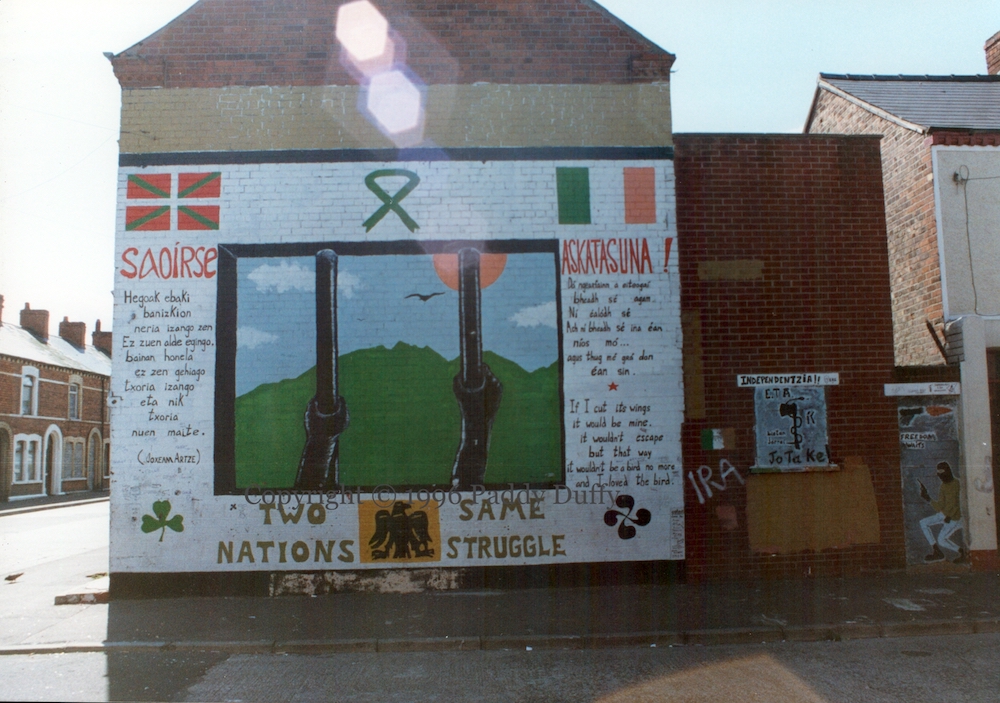
Two Nations, Same Struggle

“Saoırse – Askatasuna!” Lines from Joxean Artze’s poem Txoria Txori appear in three languages – Basque, Irish, and English – in this Clonard mural:

“Hegoak ebaki banizkion neria izango zen. Ez zuen alde egingo bainan, honela. Ez zen gehiago txoria izango … eta nik txoria nuen maite.”

“Dá ngearfaınn a eıteogaí, bheadh sé agam. Ní éalódh sé, ach ní bheadh sé ına éan níos mó … agus thug mé grá don éan sın.”

“If I cut its wings it would be mine, it wouldn’t escape, but that way it wouldn’t be a bird no more … and I loved the bird.”

The bird for Irish prisoners is the lark, which can be seen through the prison bars. The green ribbon above the central image is a symbol of the campaign to release political prisoners as part of any agreement that might come out of the peace process.

For Basque prisoners the bird is the “arrano beltza” [black eagle] which appears at the bottom of the mural.

The symbols on the left and right are the Irish shamrock and the Basque “lauburu” (four heads).

Painted by the Askapena Basque Internationalist Brigade in Cawnpore Street, Clonard, west Belfast, August 1995. To the right are two small murals in support of the ETA (“Independentzia!!”, “ETA” with the snake-and-axe (politics and armed struggle) and “bietan jarrai“, “Jo ta ke!” [push on!] and the IRA (a blazing pistol above a balaclava’d volunteer with pistol, “Freedom awaits”).

Click image to enlarge
Copyright © 1996 Paddy Duffy
T00169

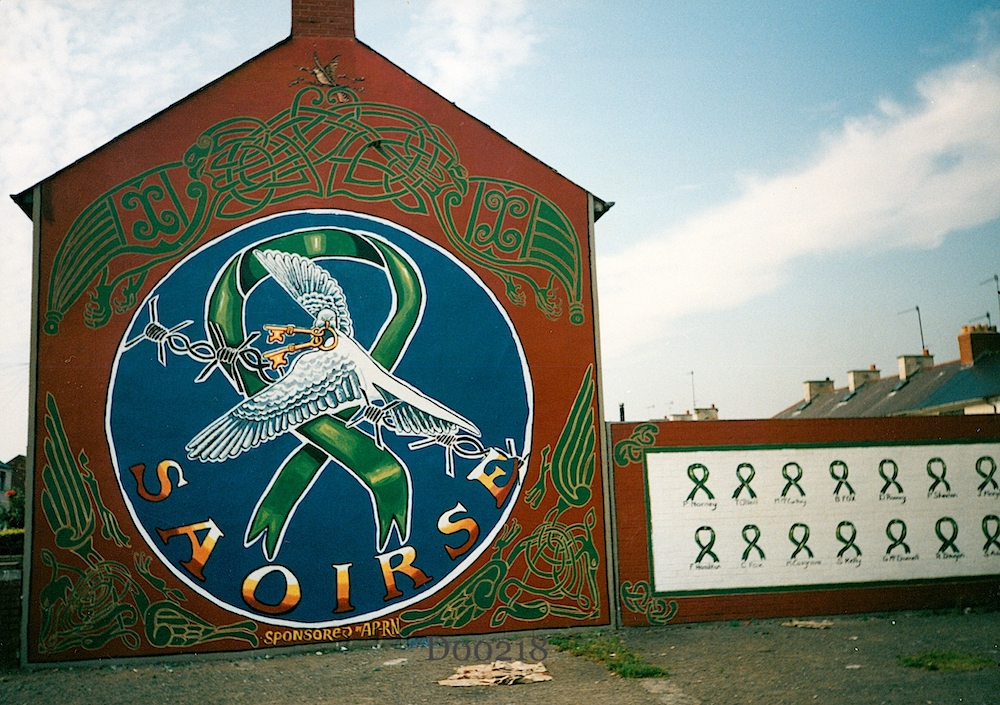
Saoırse

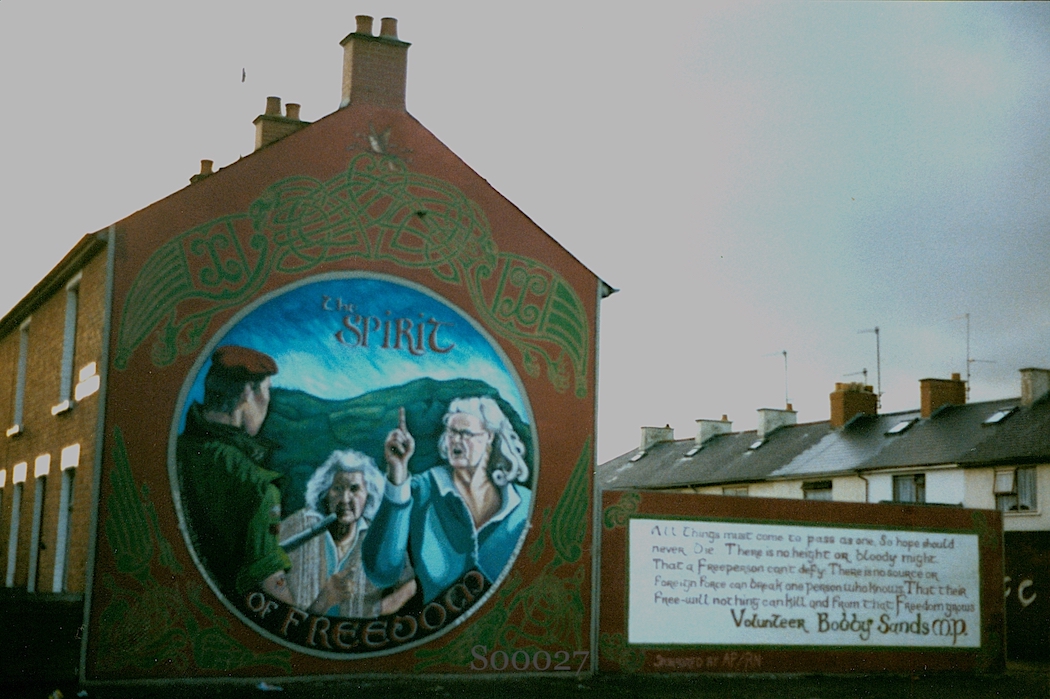
The frame of this mural in St James’s was originally painted by Andrea Redmond (Fb) in 1994 for a mural (included below) showing local pensioners remonstrating with a British Army soldier, under the title “The Spirit Of Freedom”, reproducing a photo that appeared in a French-language magazine (see below).

The central circle was repainted (again Redmond) for the 1995 “green ribbon” campaign: the dove holds the keys that will set free the republican prisoners, symbolised by the barbed wire and the lark in the apex. There was also a side-wall, showing two rows of green ribbons, each with the name of a POW (see immediately below).

“Sponsored by AP/RN” has been moved from the side-wall to the main wall.

Click image to enlarge
Copyright © 1995 Paddy Duffy
T00106

(D00218)

The 1994 ‘Spirit Of Freedom’ mural:

(S00027)

In small letters on the part of the circle at the back of the soldier is written “This mural is dedicated to the memory of J[…] D[…] and M[…] Fitzsimons”.

On the side wall is a verse from the poem The Crime Of Castlereagh by “Volunteer Bobby Sands MP”: “All things must come to pass as one/So hope should never die/There is no height or bloody might/That a freeman can’t defy./There is no source or foreign force/Can break one man who knows,/That his free will no thing can kill/And from that freedom grows.”

Fág Ár Sraıdeanna

This is a mural on Whiterock Road, west Belfast, bidding “Slán Abhaıle” to a British soldier who is himself standing on Whiterock Road in front of the 1916 mural (Who Fears To Speak Of Easter Week?).

In the medallions to the left and right are four demands from during the (first) ceasefire: “End collusion, Release POWs, Disband RIR RUC, End Unionist veto”. 

Click image to enlarge
Copyright © 1995 Paddy Duffy
T00105