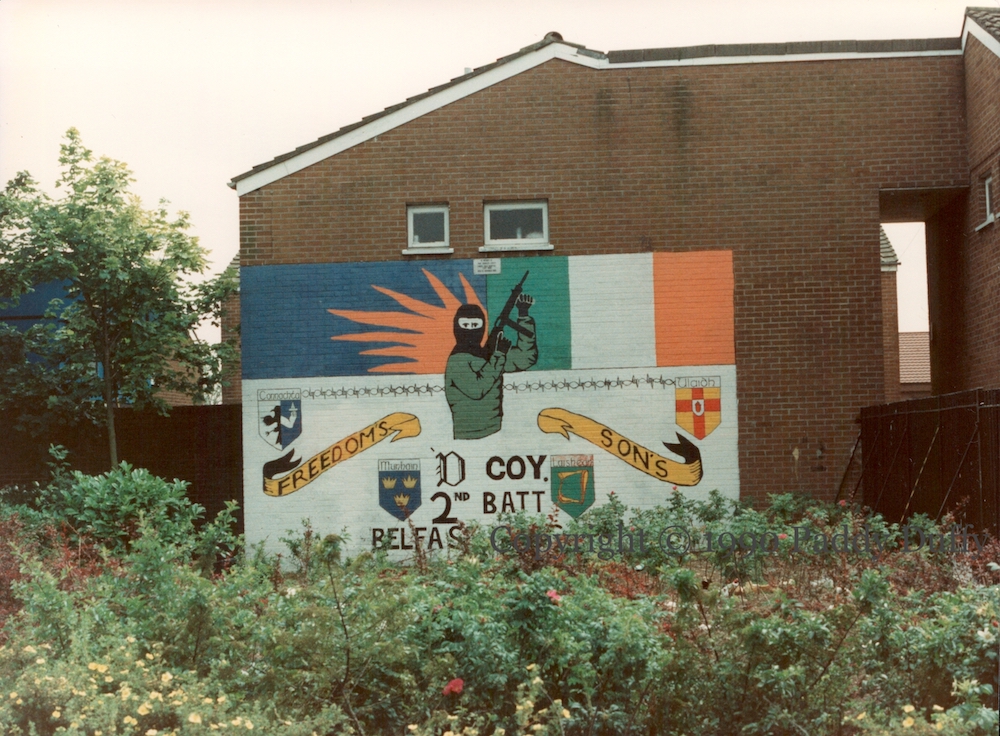
The writing – D coy, 2nd batt, Belfast Brigade [IRA] – has been added where the volunteer’s legs used to be – see the Peter Moloney Collection for the original. A small plaque has been added at the top. Otherwise, the mural remains as before, with a hooded volunteer raising an assault rifle in front of a sunburst and Tricolour, with a row of barbed wire and the four provinces named in Irish.
Falls Road, west Belfast, now the site of the Garden Of Remembrance
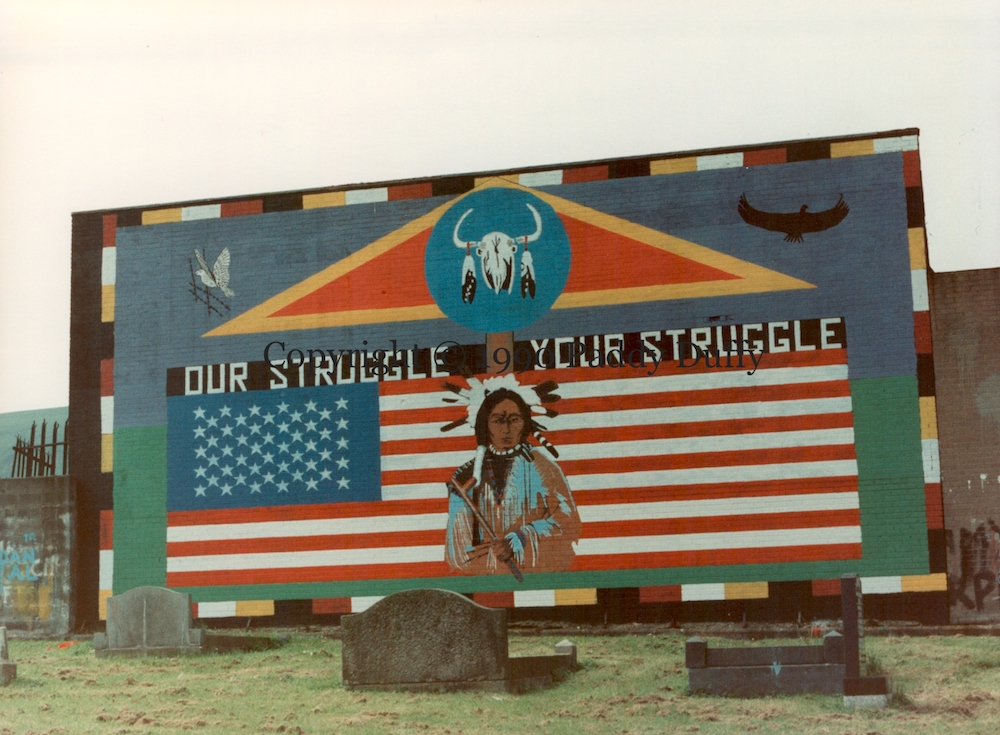
Chief sitting Bull with his back to the flag of the United States, with a lark (for the Irish struggle) and an eagle (for the Native American) and a border of the colours of humankind.
Painted by Mo Chara Kelly with Jan Attridge on the wall of the (then) Ballymurphy Community Centre just off the Whiterock Road, west Belfast.
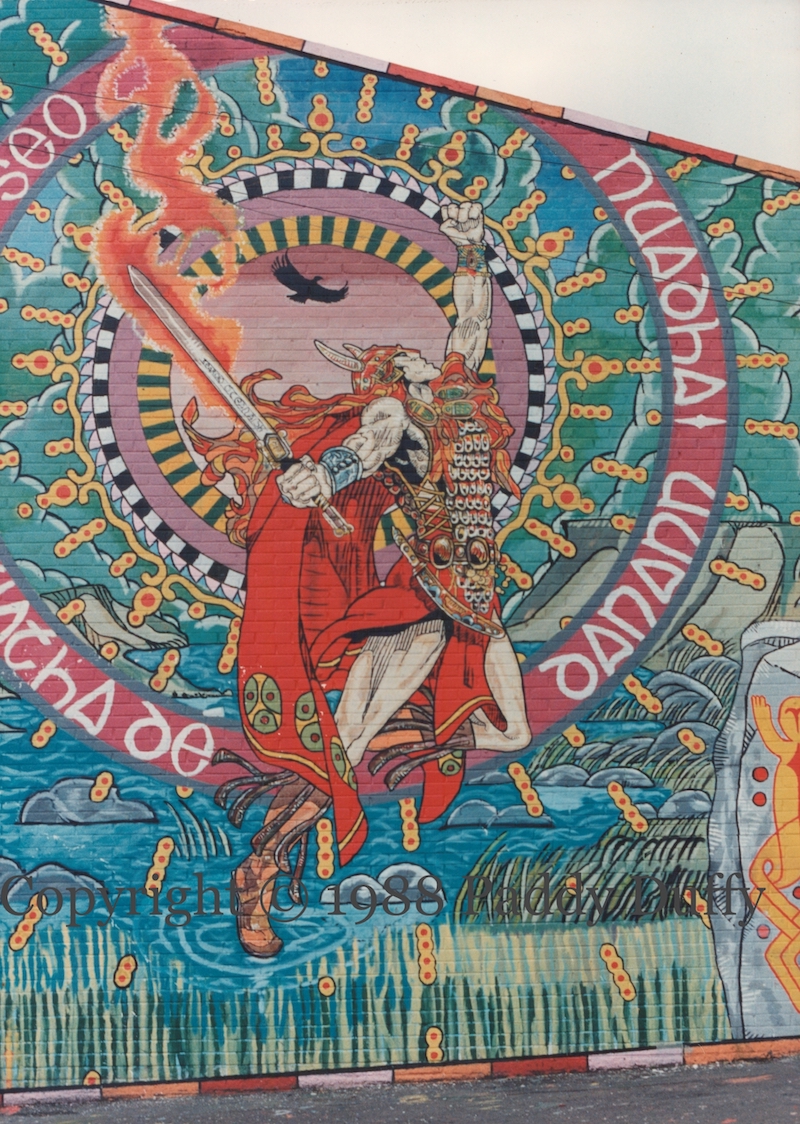
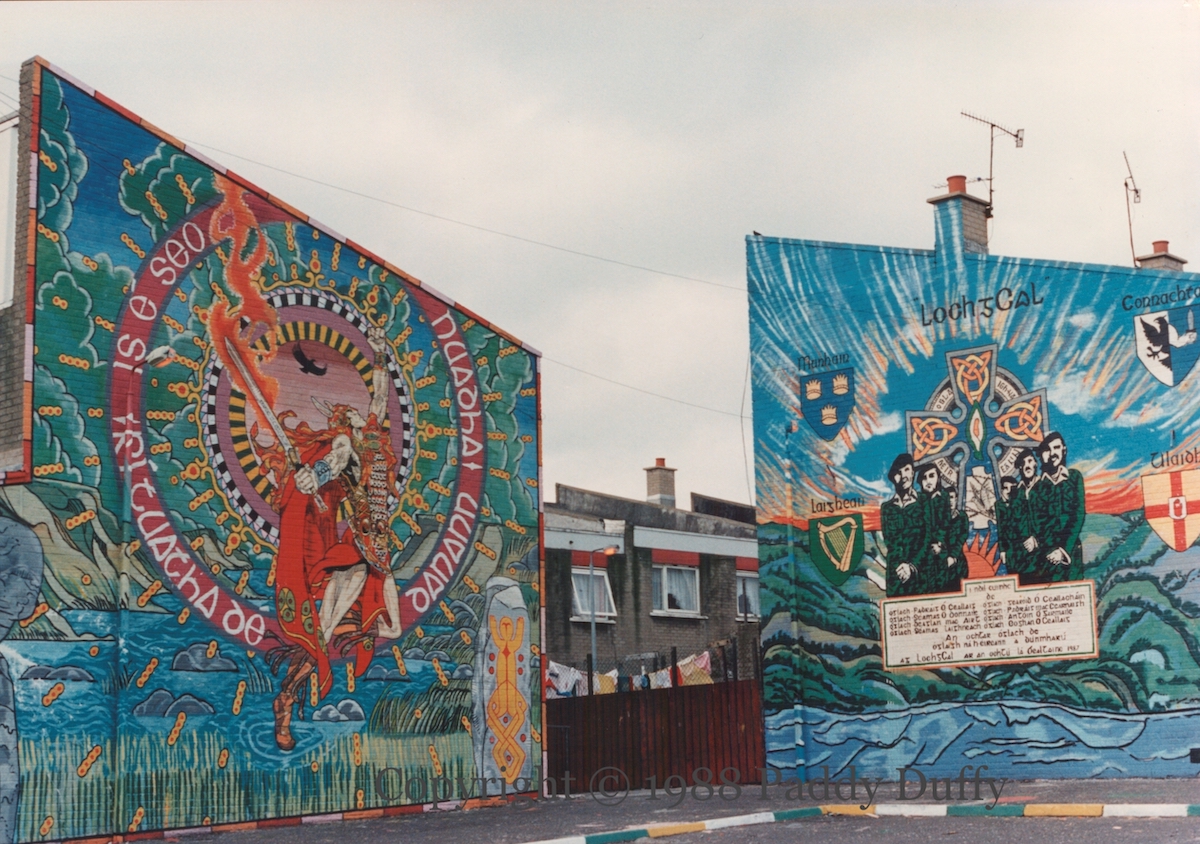
This pair of murals was painted by Mo Chara Kelly at the top of Springhill in 1987 after his release from prison. Both are inspired by the work of Jim Fitzpatrick. The central figure of the Rí Nuadha [King Nuada] mural above and immediately below comes from a painting of Fitzpatrick‘s called ‘Nuada Journeys To The Underworld’ while the background has a Fitzpatrick style and colour-scheme.
Of the myth of Nuada, Mo Chara said, “I had never heard the story of King Nuada before. Then I read the story. Wow! What a yarn! Nuada Of The Silver Arm is one of my favourite stories. As one of the Tuatha Dé Danann you had to be whole and physically perfect to hold the kingship. Nuada lost an arm in the first battle of Moy Tura and so he lost his kingship. He went into the other world, to middle earth, fought through trials and tribulations until Dıan Cécht made a silver arm for Nuada and he was restored to the kingship for another twenty years. But the moral of the story to me was that, no matter what happens, get up again and fight back. No matter how bad the situation you are in, you get back up and fight again. Do not let people isolate you. Get up and fight again. It was very inspiring!” (Painting My Community/An Pobal A Phéınteáıl – English-language version available for free.)
The Loch gCál/Loughgall mural likewise draws on Fitzpatrick for the landscape behind the Celtic cross and funeral guard in memory of the eight IRA volunteers from the East Tyrone brigade who were killed in an SAS ambush during an attack on an RUC base in May, 1987 (WP).
The names of the eight volunteers are given here in Irish and (partially) in the old script:
“I ndıl cuimh[n]e de [= ar] Óglach Pádraıg Ó Ceallaıġ [Patrick Kelly], Óglach Séamus Ó Donn[ġ]aıle [Seamus Donnelly], Óglach Deaglán Mac Aırt [Declan Arthurs], Óglach Séamus Laıghneach [Jim Lynagh], Óglach Gearóıd Ó Ceallacháın [Gerry O’Callaghan], Óglach Pádraıg Mac Cearnaıgh [Pádraıg McKearney], Óglach Antóın Ó Garmaıle [Ó Gormghaıle | Tony Gormley], Óglach Eoghan Ó Ceallaıġ [Eugene Kelly]
an ochtar óglach de óglaigh na hÉireann a dúnmharú ag Loch gCál ar an ochtú lá Bealtaine 1987.” [the eight volunteers from the Irish Volunteers [IRA] who were murdered at Loughgall on the eighth day of May, 1987]
The town (Loughgall) and the four provinces are also named in Irish. An Easter lily is at the centre of the Celtic cross in the middle of the image, above a lark in barbed wire and a gal gréıne/sunburst.
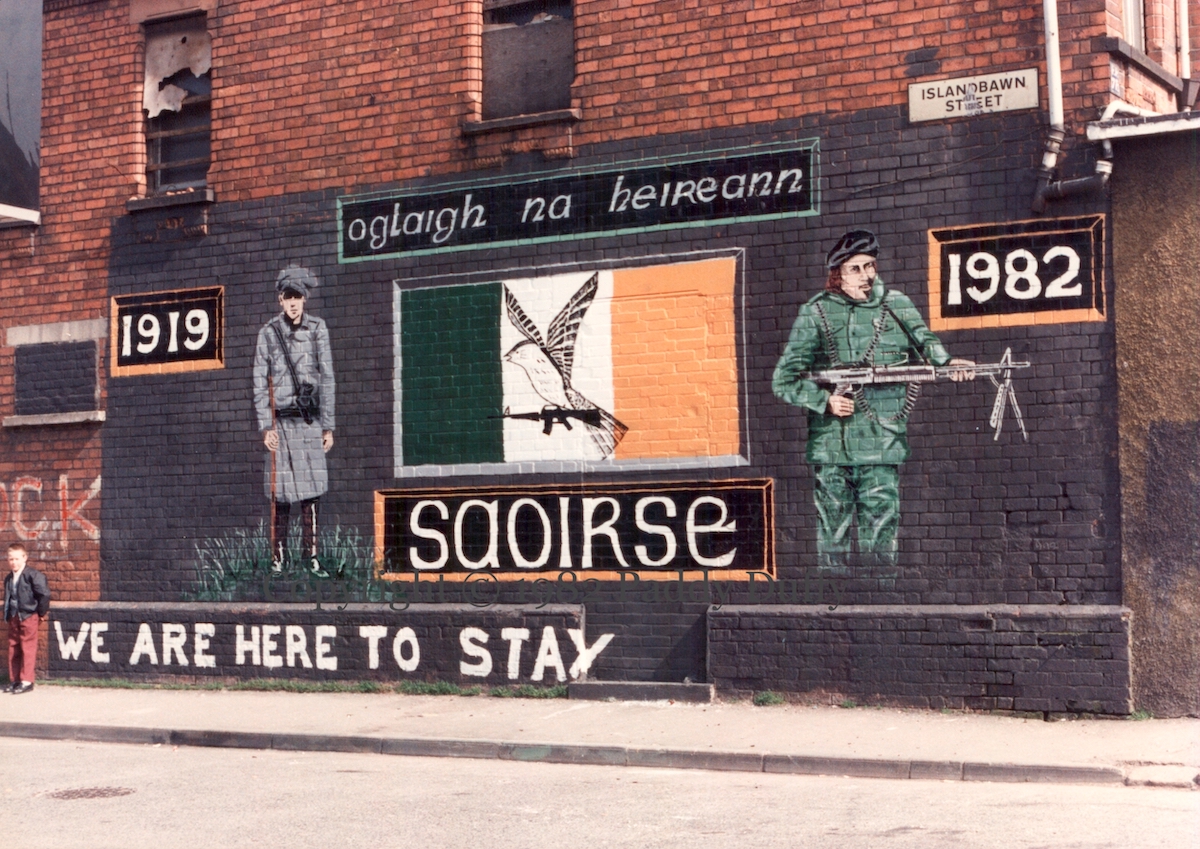
This mural celebrates the IRA (“Óglaigh Na hÉıreann” at the top) from 1919 (the army of the independent Dáıl Éıreann) to the “present” day of 1982. In the centre, a lark flies against a Tricolour, with the word “Saoırse” (“freedom”) beneath.
This is a repainted version of the original, which was one of several murals in Beechmount and the Rock streets that were paint-bombed by “marauding Coldstream Guards” (according to AP/RN of 1982-04-29) – for the damaged mural, see the Peter Moloney Collection. The “1919” date would be changed to “1916”.
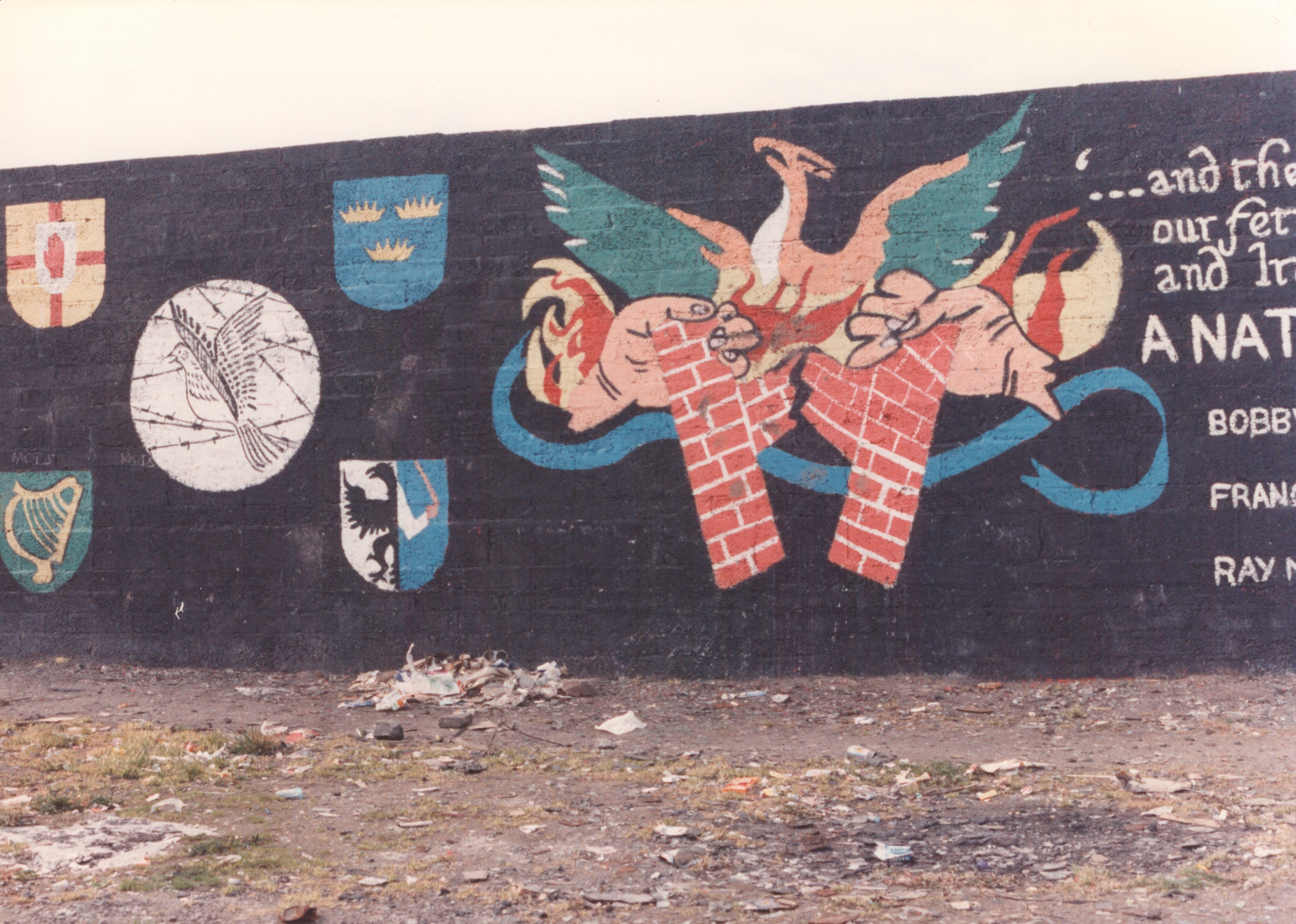
A phoenix rises from a pair of disembodied hands tearing apart an “H” made of brick, illustrating the lines (out of view to the right) “… and then I prayed I yet might see/our fetters rent in twain/and Ireland long a province be/a nation once again”. Also on the right are the names of six hunger strikers: Bobby Sands MP, Francis Hughes, Ray McCreesh, Patsy O’Hara, Joe McDonnell, Martin Hurson. On the left are the lark in barbed wire, and the shields of the four provinces.
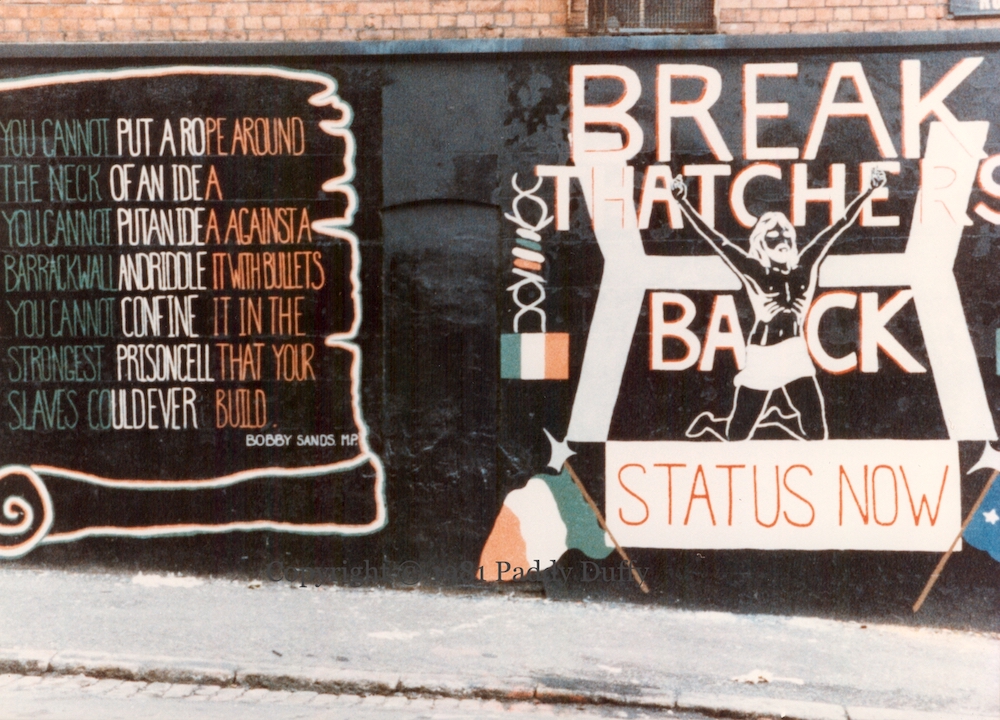
A Long Kesh/H-Block blanketman is on his knees, protesting for (political) “status now”, surrounded by barbed wire and two flags on halberds: the Irish Tricolour and the Starry Plough.
The quote on the left (in the wide-shot, below) is from Sean O’Casey, not “Bobby Sands MP”: “You cannot put a rope around the neck of an idea; you cannot put an idea up against the barrack-square wall and riddle it with bullets; you cannot confine it in the strongest prison cell that your slaves could ever build.”
(The quote is reportedly from O’Casey’s prose lament for Thomas Ashe, either the initial pamphlet in November 1917 (?entitled “The Story Of Thomas Ashe”?) or the expanded version of 1918 (entitled “The Sacrifice Of Thomas Ashe” (auction site)), though no copy of this can be found on-line, only two poems ‘Thomas Ashe’ and ‘Lament For Thomas Ashe’ (eastwallforall).
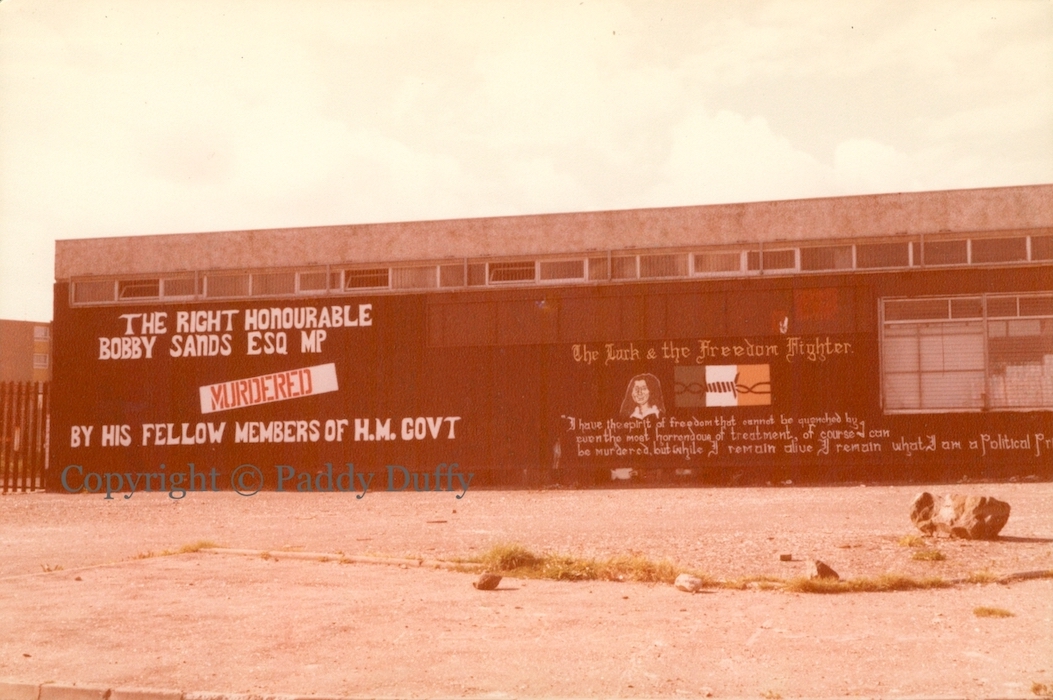
“The right honourable Bobby Sands Esq MP – Murdered by his fellow members of H.M. Govt”, “I have the spirit of freedom that cannot be quenched by even the most horrendous treatment. Of course I can be murdered, but while I remain alive, I remain what I am, a political prisoner of war, and no one can change that.” (From The Lark And The Freedom Fighter.) Barbed wire stretches over an Irish tricolour next to an image of Sands.