The Death Of Sean McCartney

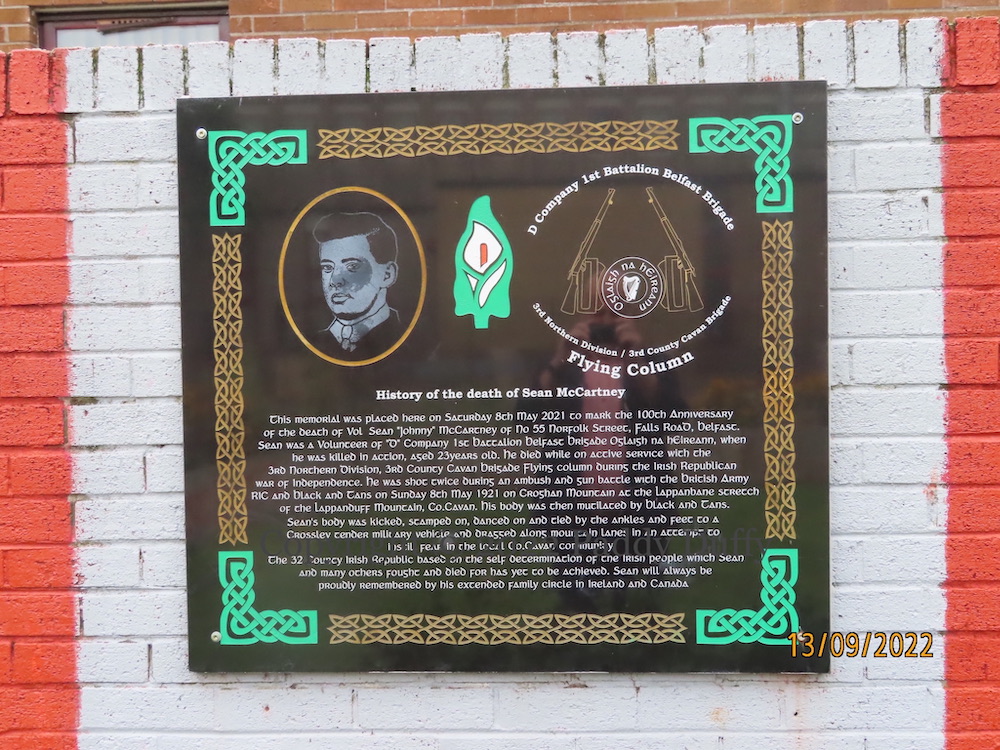
“History of the death of Sean McCartney. This memorial was placed here on Saturday 8th May 2021 to mark the 100th anniversary of the death of Vol Sean “Johnny” McCartney of no. 55 Norfolk Street, Falls Road, Belfast. Sean was a volunteer of “D” Company 1st battalion Belfast Brigade Oglaigh na hEireann, when he was killed in action, aged 23 years old. He died while on active service with the 3rd Northern Division, 3rd County Cavan Brigade flying column during the Irish Republican War of Independence. He was shot twice during an ambush and gun battle with the British Army RIC and Black and Tans on Sunday 8th May 1921 on Croghan Mountain at the Lappanbane stretch of the Lappanduff Mountain, Co. Cavan. His body was then mutilated by the Black and Tans. Sean’s body was kicked, stamped on, danced on and tied by the ankles and feet to a Crossley Tender military vehicle and dragged along mountain lanes in an attempt to instill fear in the local Co. Cavan community. The 32 county Irish republic based on the self determination of the Irish people which Sean and many others fought and died for has yet to be achieved. Sean will always be proudly remembered by his extended family circle in Ireland and Canada.” McCartney is buried in Milltown cemetery.

Click image to enlarge
Copyright © 2022 Paddy Duffy
T00848 [T00849]
Unrepentant Republicans

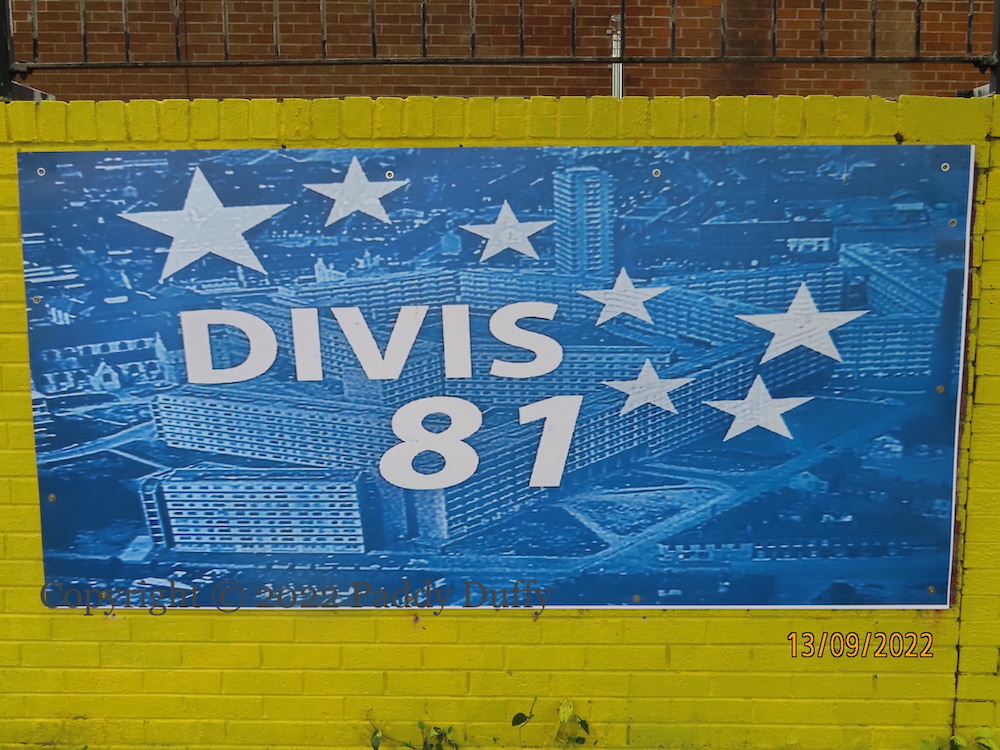
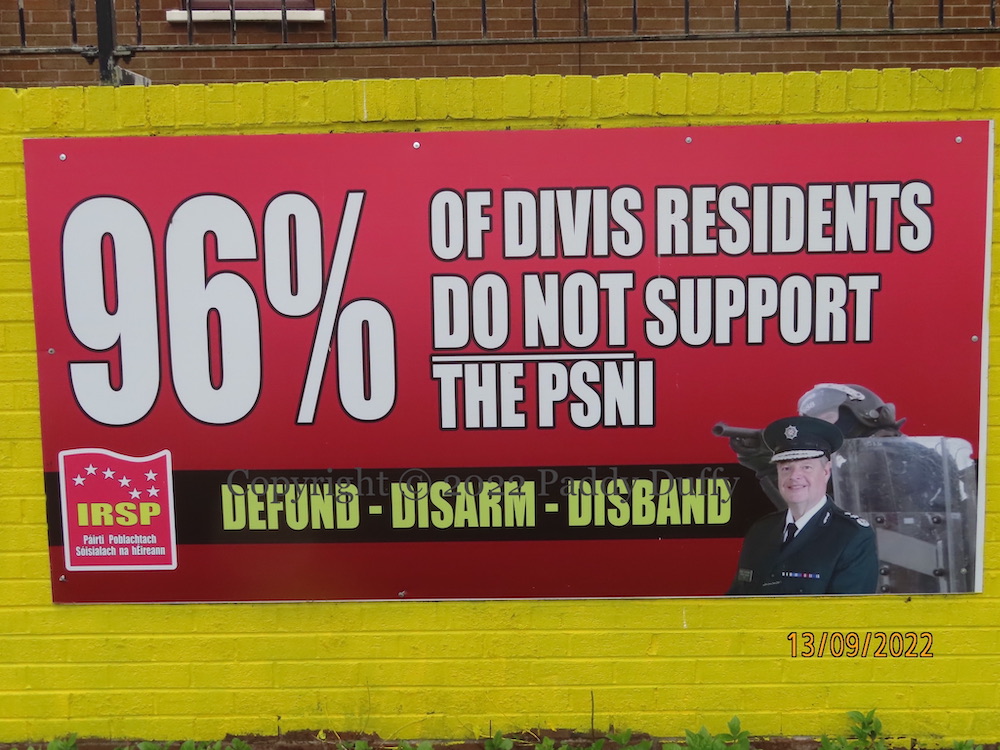
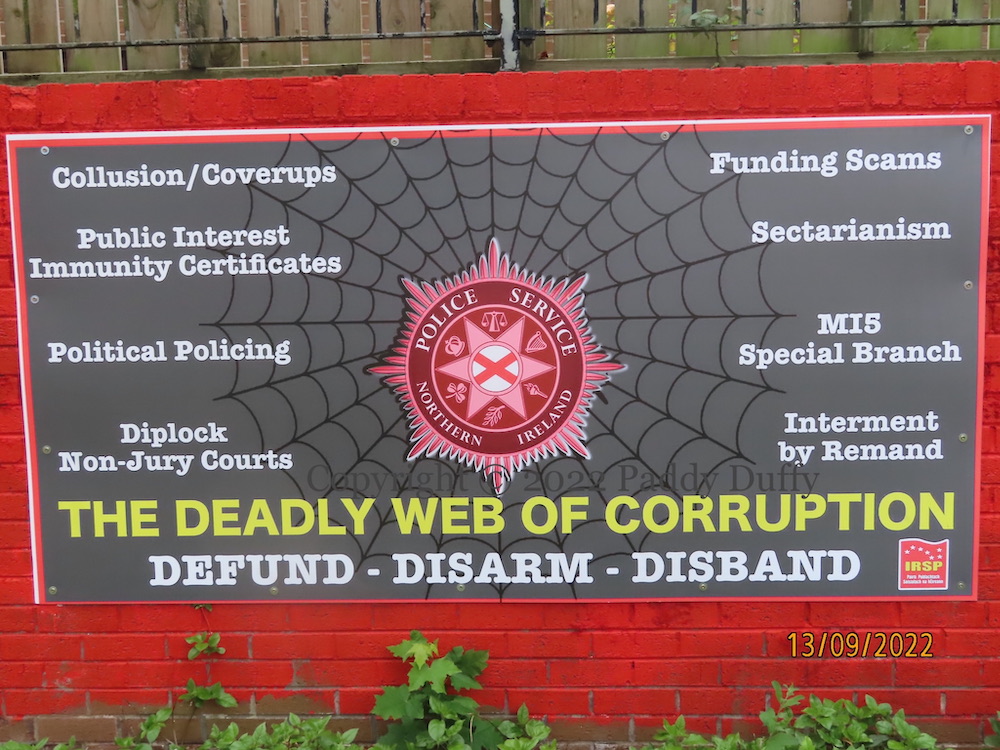
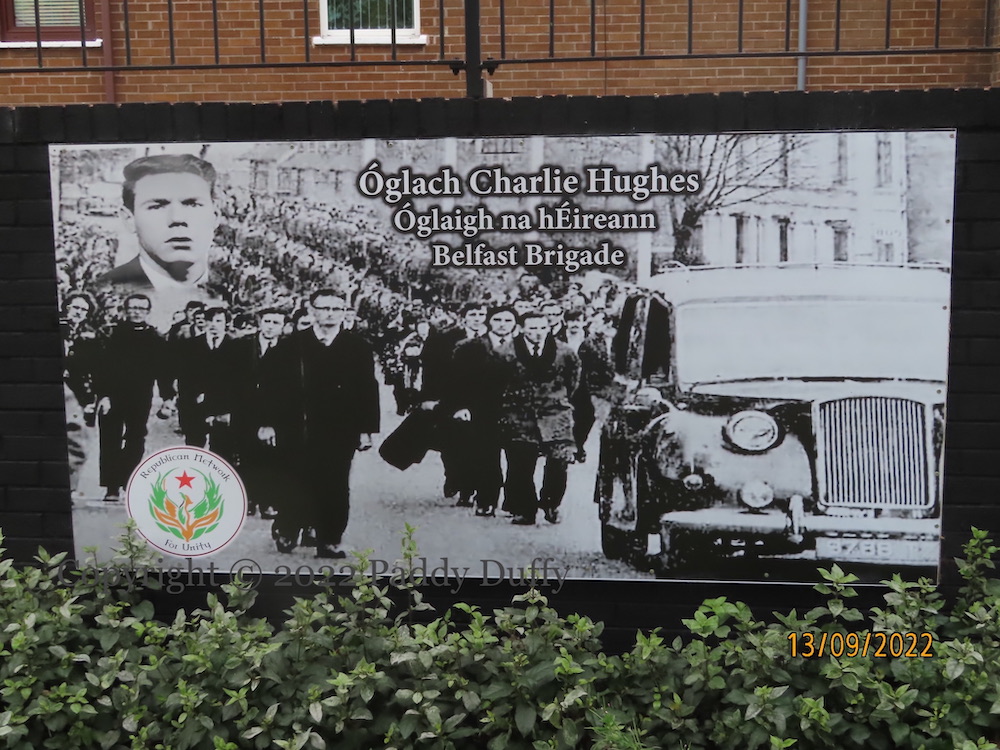
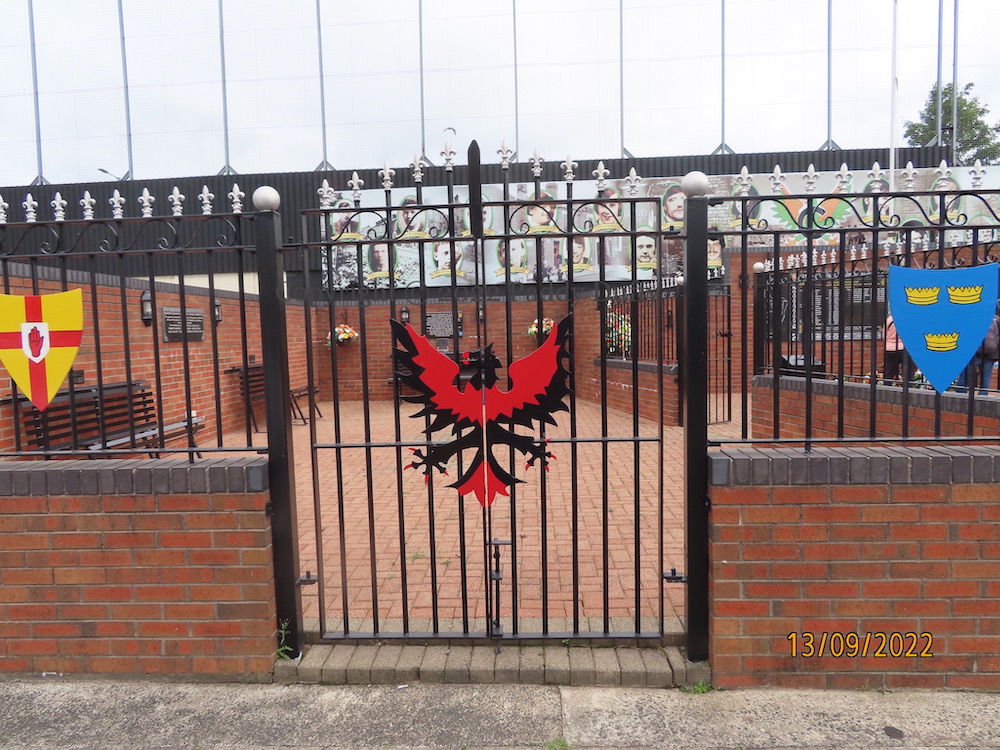
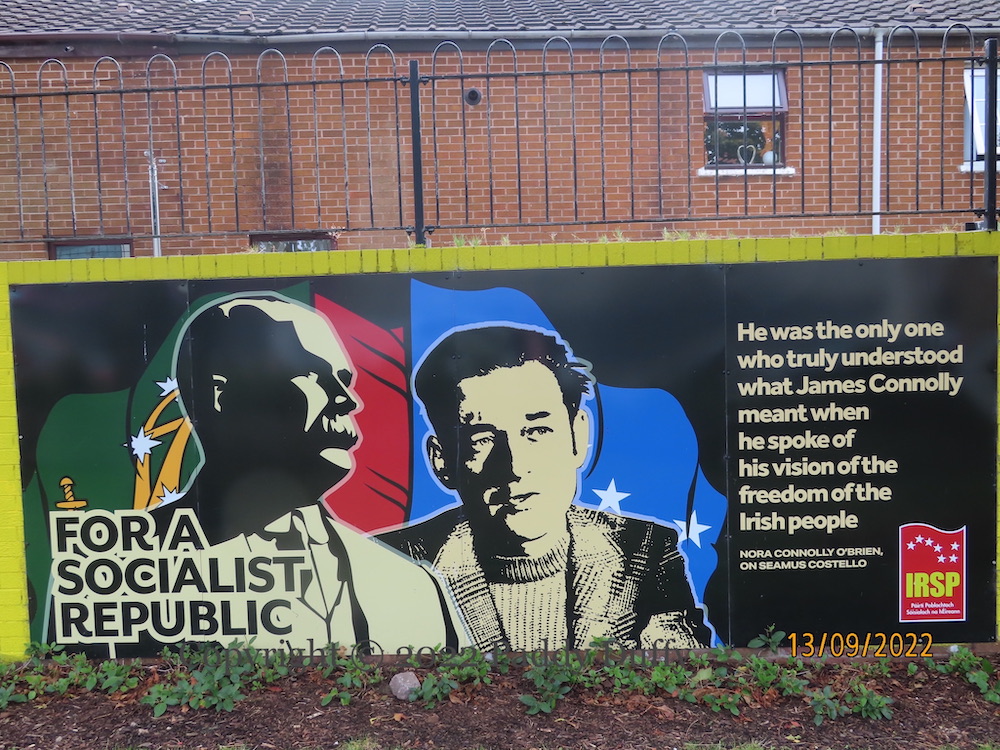
Here is a gallery of the republican boards along the low wall just east of the Falls garden of remembrance. From right to left: James Connolly and Seamus Costello; Divis 81; anti-PSNI; “web of corruption”; Charlie Hughes (killed in 1971 the feud with the OIRA); the Falls Curfew featuring Máıre Drumm; Billy McKee, Alec Murphy, and Brendan Hughes; the Falls Road Massacre 1920; Kieran Abram – Abram was knocked to the ground in the early hours of July 5th, 1992, and kicked to death by loyalists in running battles with nationalists on North Howard Street, near the old British Army sangar. Four people were convicted of manslaughter in the case (Judiciary NI).

Click image to enlarge
Copyright © 2022 Paddy Duffy
T00850 T00851 T00852 T00853 [T00854] T00855 T00856 T00857 T00858 T00859 T00860

Life Springs From Death

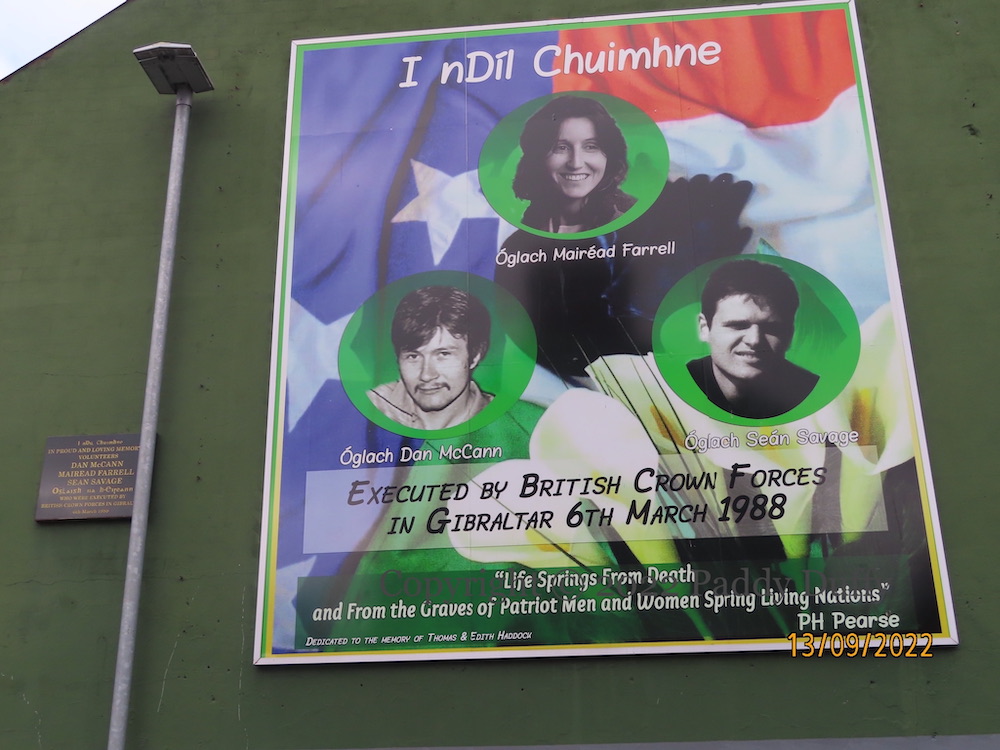
The new replacement board commemorating the Gibraltar 3 (Maıréad Farrell, Dan McCann, and Seán Savage “executed by British crown forces 6th March 1988) uses words from Pearse’s oration at the funeral of O’Donovan Rossa. Not the more common “the fools, the fools …” but “Life springs from death and from the graves of patriot men and women spring living nations” (used previously in Strabane in 1990 – M00860). The board is “dedicated to the memory of Thomas and Edith Haddock”.

Here is the previous board.

Click image to enlarge
Copyright © 2022 Paddy Duffy
[T00839] T00840

Killed In Action

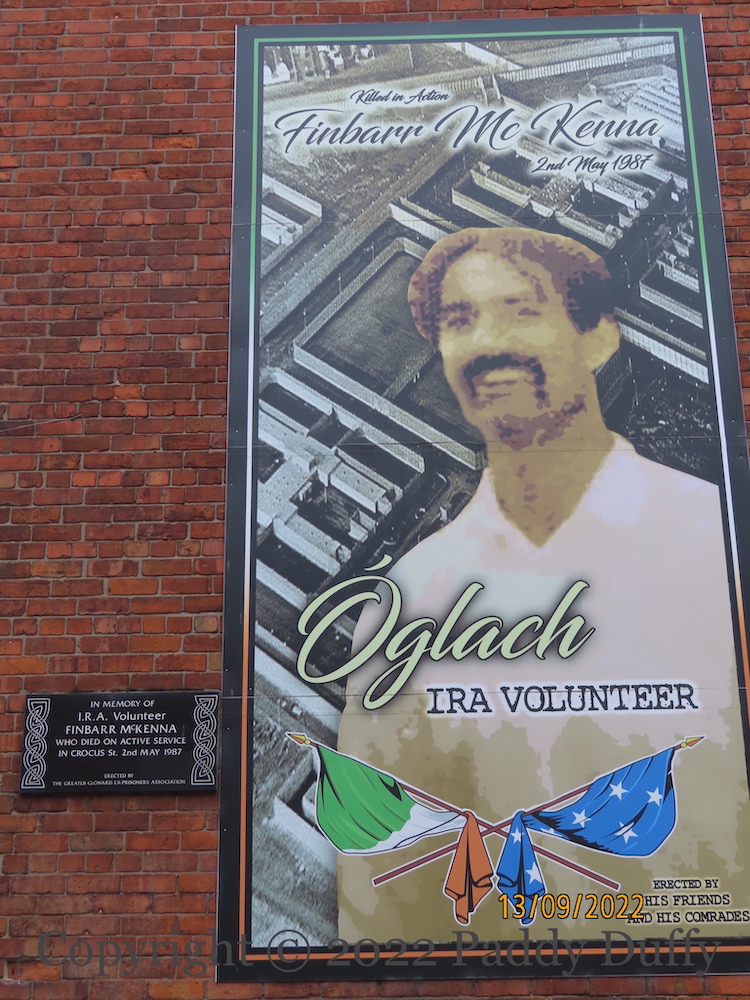
“Killed in action” (on the mural) or “on active service” (on the plaque) often means killed by a bomb exploding prematurely, as was the case of Finbarr McKenna, who died in Crocus Street intending to attack the RUC station on the Springfield Road at Violet Street. Here is an account of McKenna’s death from a British soldier. Lost Lives estimates that as many as 163 volunteers (9% of the total killed by the IRA) died from premature explosions. Footage of McKenna’s funeral appears in the (Sınn Féın-produced) account of Larry Marley’s funeral.

The plaque dates back to at least 2004.

Click image to enlarge
Copyright © 2022 Paddy Duffy
T00836

Never Again

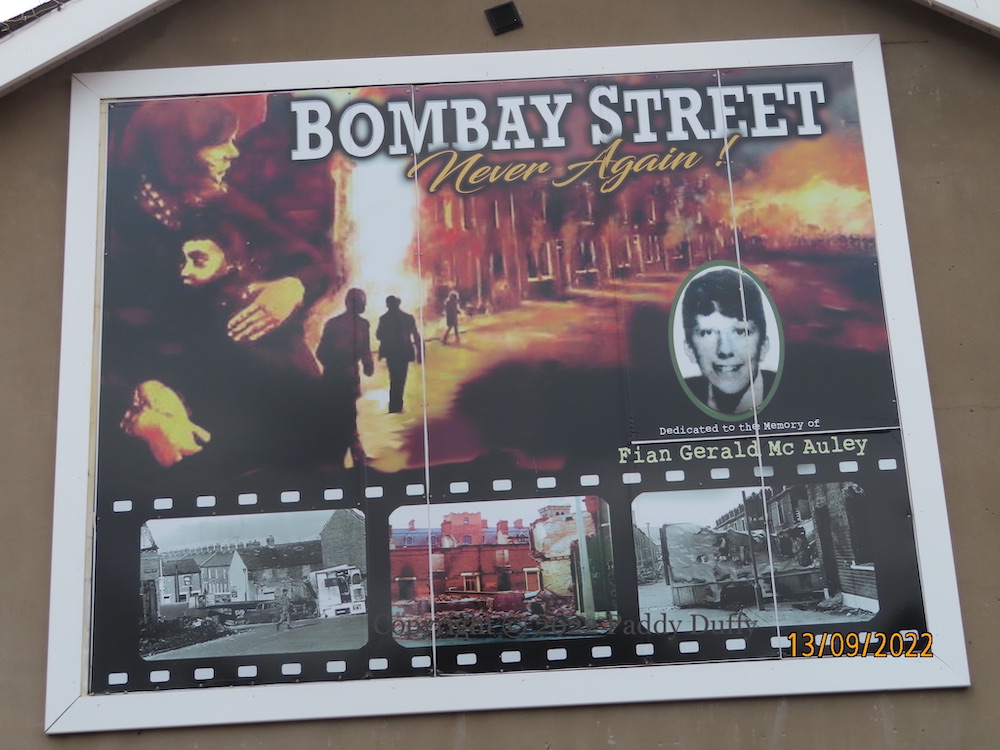
15 year-old Fıan Gerald McAuley was the first member of the IRA to die in the Troubles. He was shot in Waterville Street by a loyalist sniper while helping people move from burned-out homes in Bombay Street, along which the “peace” line separating the Falls and Shankill now runs, overlooking the Clonard Memorial Garden, site of the service for the 50th anniversary of McAuley’s death.

Click image to enlarge
Copyright © 2022 Paddy Duffy
T00830 [T00831] T00832 [T00833]

Executed

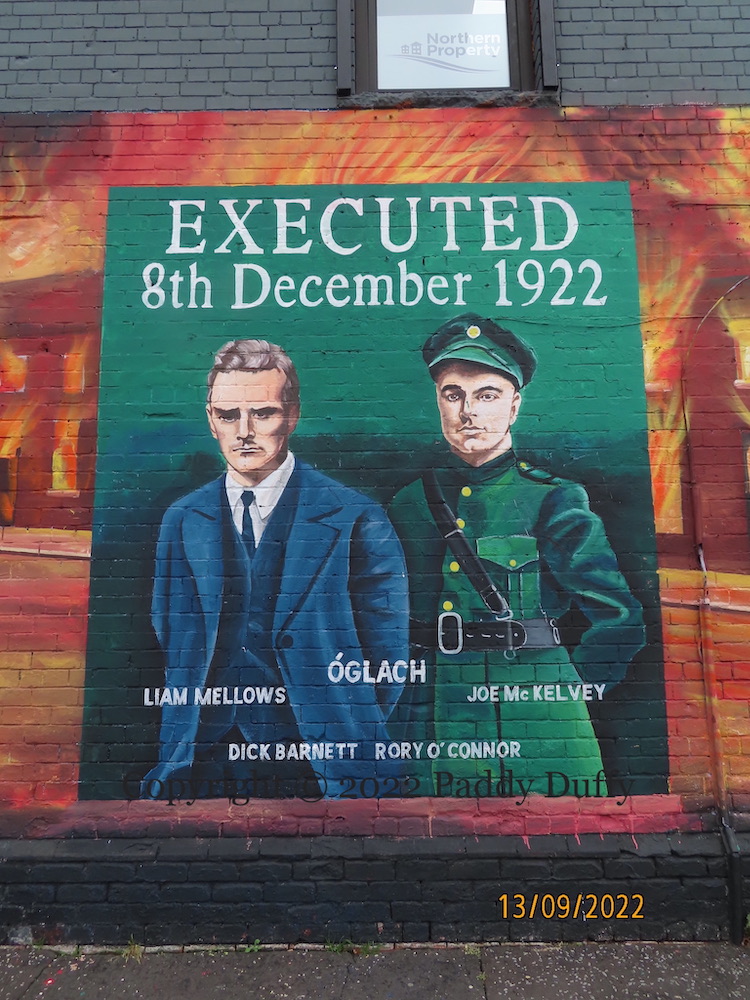
On October 18th, 1922, the third Dáıl/second Provisional Government Of Southern Ireland approved – in the absence of anti-Treaty members – a bill entitled the “Army Emergency Powers Resolution” which introduced martial law, including martial courts with the death penalty for anyone found in possession of an illegal firearm – “illegal” meaning not sanctioned by the nascent pro-Treaty Free State. Under these powers, seven IRA volunteers were executed on November 17th and 19th, followed on the 24th by Erskine Childers (a member of the team that negotiated the Treaty but subsequently against it). In response, the IRA declared that TDs who had voted for the bill were fair game, and on December 7th Seán Hales of Cork was shot and killed. In reprisal, the government ordered the execution of four more volunteers, one from each province: Liam Mellows, Joe McKelvey, Dick Barnett, Rory O’Connor. The four had been arrested five months earlier, on June 30th, 1922, at the start of the Civil War, after surrendering the Four Courts. By the end of the war, 81 executions had taken place. (An Phoblacht | Irish Times | The Irish Story | WP | WP)

For the left-hand side of the wall, on the shipyard clearings and the McMahon murders, see Belfast Butchery.

Click image to enlarge
Copyright © 2022 Paddy Duffy
T00803 [T00802]

Ní Thıg Leat Éıre A Chloígh

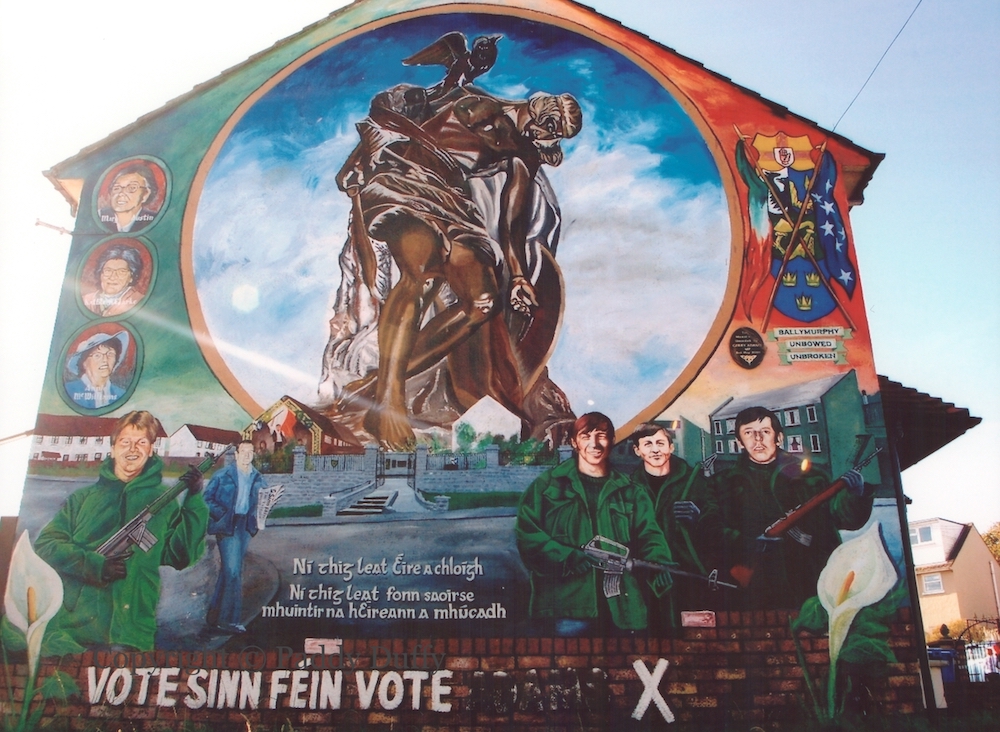
“Ní thıg leat Éıre a chloígh, ní thıg leat fonn saoırse mhuıntır na hÉıreann a mhúc[h]adh.” [“You cannot subdue Ireland; you cannot extinguish the desire for the freedom of the Irish people.”]

The mural presents images of Ballymurphy including the mural of McCrudden-O’Rawe–Jordan and memorial garden on Divismore Way (left) and Springhill (right), under the title “Ballymurphy unbowed, unbroken”.

The male figures in the foreground are unnamed but the four in jackets are presumably Stone, McWilliams, McCracken, and Dougal after their mural in Springhill Drive was blanked; the female activists on the left of Sheppard’s Cú Chulaınn are Mary Austin, Kathleen Clarke, Annie McWilliams. “This mural was unveiled by Gerry Adams MP 2nd May 2010” but Adams’s name has been scratched out from the (painted) low wall.

Glenalina Road, Ballymurphy, west Belfast

Click image to enlarge
Copyright © 2012 Paddy Duffy
T00756

Talk Of Us As Though We Were Beside You

“Grieve not nor speak of us with tears but laugh and talk of us as though we were beside you”. Óglaıgh Na hÉıreann, Belfast brigade, 2nd battalion, B company volunteers Kevin Delaney, Patrick Campbell, Michael Clarke, Anne Parker, and Michael Sloan are shown on patrol in Ballymurphy Parade, the street just to the left of this mural. Campbell was 16 when killed by friendly fire; the oldest at time of death was Delaney, at 26.

Also named on the plaque are “republican activists” Esther Valelly, Theresa Campbell, and Maggie Campbell.

Glenalina Road, Ballymurphy, west Belfast

Click image to enlarge
Copyright © 2012 Paddy Duffy
T00757 [T00765]

No Right In Ireland

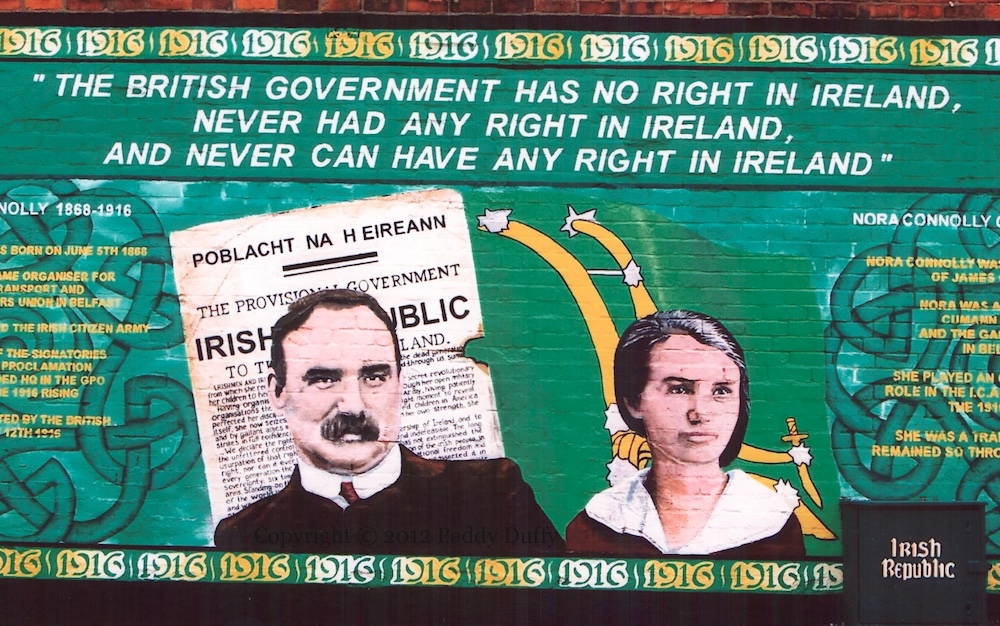
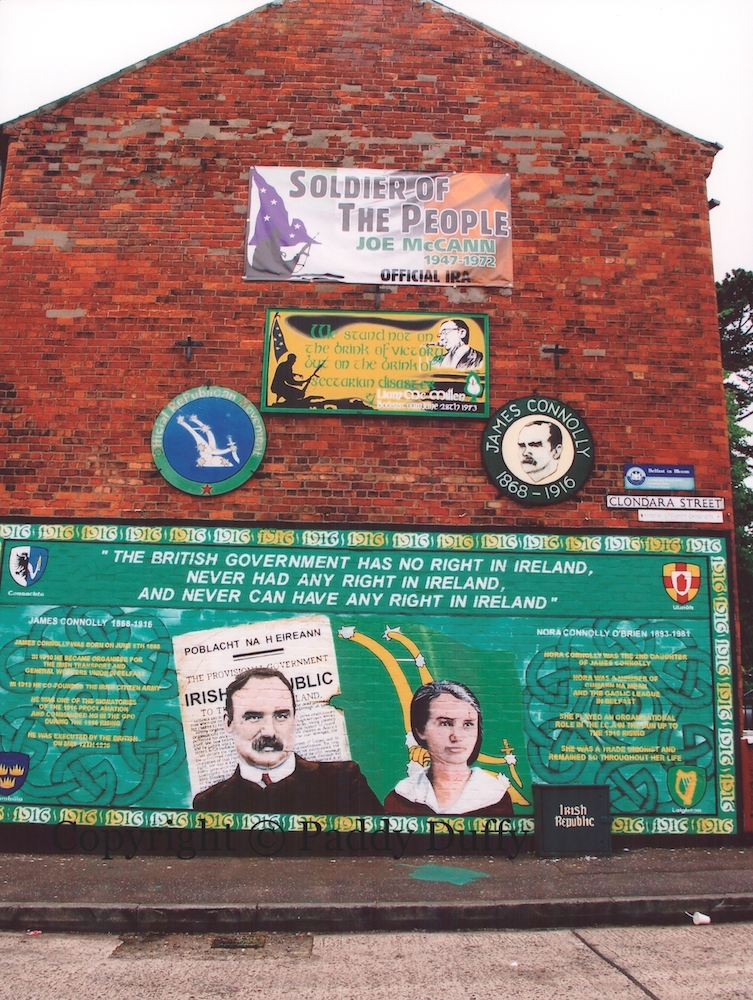
“The British government has no right in Ireland, never had any right in Ireland, and never can have any right in Ireland.” (Last Statement, 1916)

“James Connolly 1868-1916 James Connolly was born in June 5th 1868. In 1810 he became organiser for the Irish Transport And General Workers Union in Belfast. In 1913 he co-founded the Irish Citizen Army. He was one of the signatories of the 1916 Proclamation and commanded HQ in the GPO during the 1916 Rising. He was executed by the British on May 12th 1916.”

“Nora Connolly O’Brien 1893-1981 Nora Connolly was the 2nd daughter of James Connolly. Nora was a member of Cumann Na mBan and the Gaelic League in Belfast. She played an organisational role in the ICA in the run up to the 1916 Rising. She was a trade unionist and remained so throughout her life.”

The mural was launched on May 3rd, 2012.

For the gallery above the mural, see On The Brink Of Sectarian Disaster.

Clondara St, west Belfast

For close-ups of the upper banners and boards, see the Peter Moloney Collection.

Click image to enlarge
Copyright © 2012 Paddy Duffy
T00725 T00724

Out Of The Ashes Of 1969

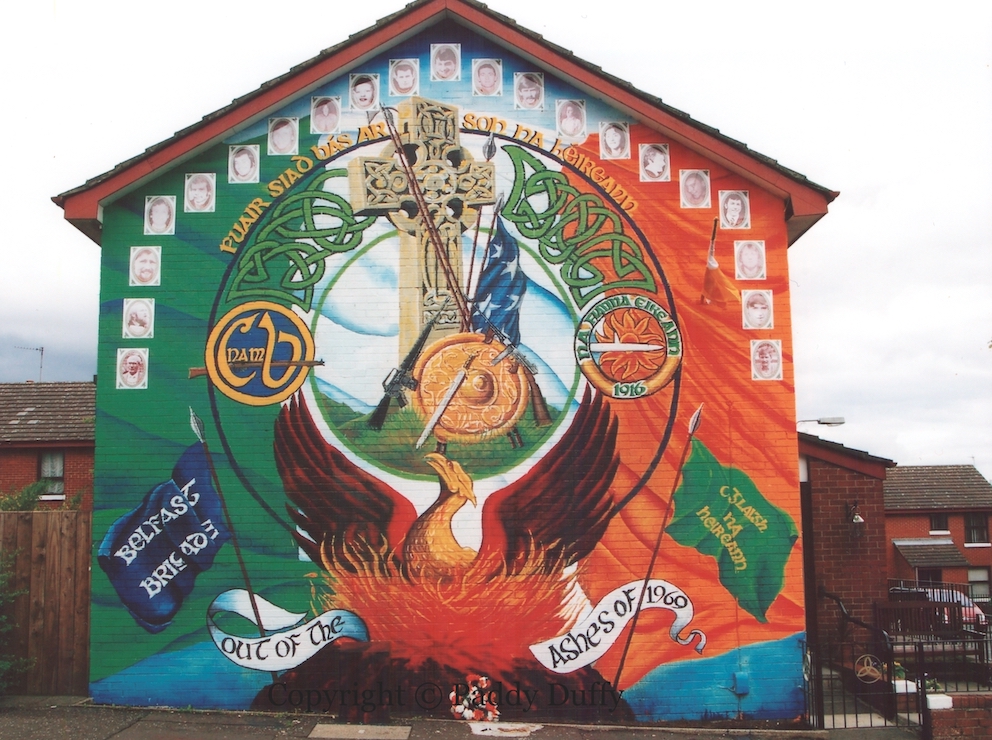
The Provisional IRA arose “Out of the ashes of 1969”, but the lineage is a long one and all but one of the organisations, events, and arms depicted here precede 1969: Cumann Na mBan, Na Fıanna Éıreann, Óglaıgh Na hÉıreann, a Celtic shield and sword, a pike (from the 1798 Rebellion), a Thompson gun, the Tricolour; only the assault rifle is modern and perhaps also is meant to indicate the “Belfast Brigade” Provisionals. “Fuaır sıad bás as son saoırse na hÉıreann.” Portraits of 21 locals appear along the roof-line.

For a PUL use of the phrase, see Out Of The Ashes.

New Lodge Road, north Belfast, replacing Laochra Na nGael

Click image to enlarge
Copyright © 2012 Paddy Duffy
T00585 [T00586]