Lest We Forget

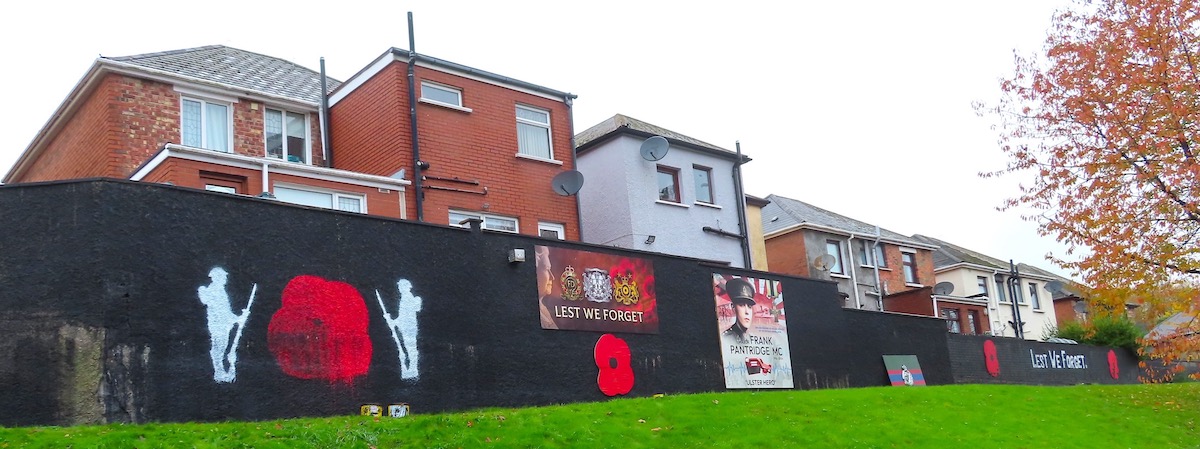
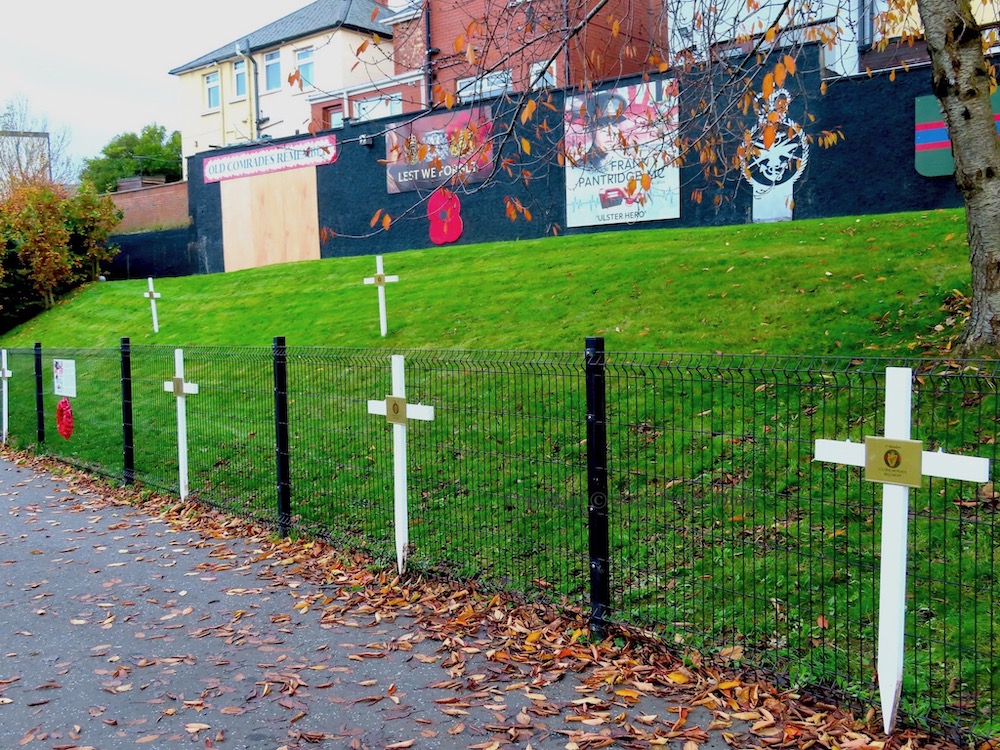
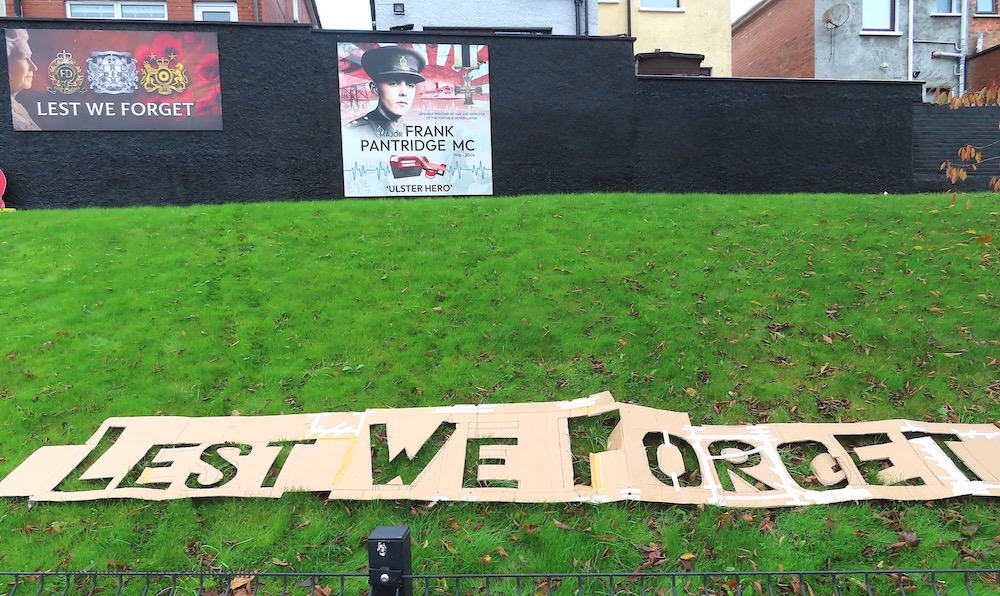
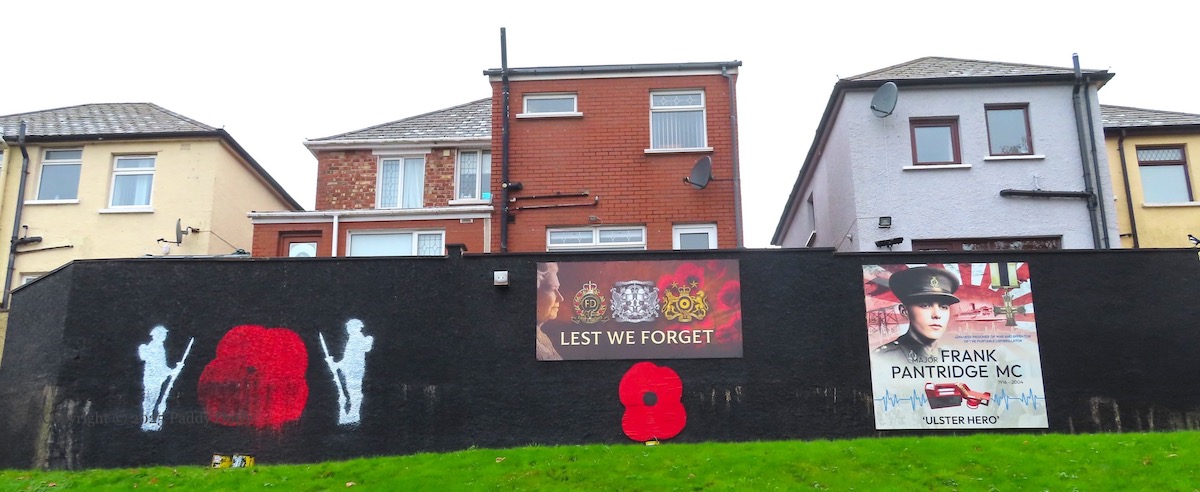
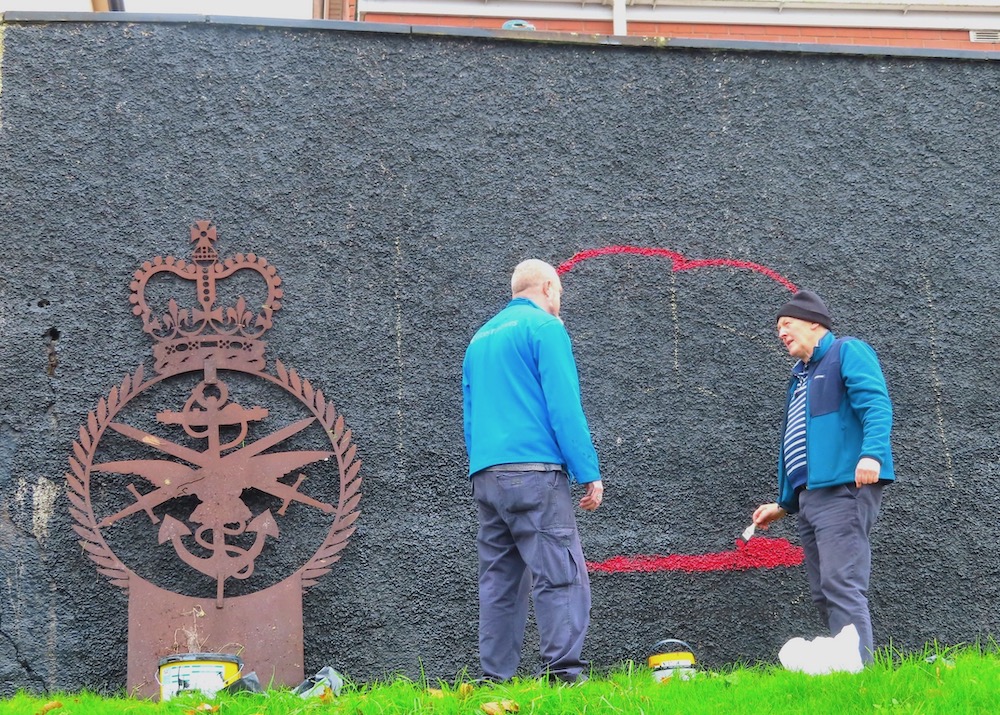
Here is a gallery of images from the wall behind the Shore Road ‘World Wars’ memorial (see Remembrance Sunday) which has a few new additions and re-ordered boards for this year’s commemorations. The main additions are the “Lest we forget” stencil shown above, and a large number of white crosses in the grass and along the fence bearing the emblem of the UDR. The UDR board has been moved from the slanted wall at the far left to what is now the central position on the wall.

For images from Sunday’s ceremonies at City Hall, see BBC.

Frank Pantridge was featured in September. The
November 4th
Click image to enlarge
Copyright © 2025 Paddy Duffy
T07979 T07980 [T07981] T07982 [T07983]
T07988 T07995 [T07996] T08009 [T08010] T07997 T07998
T07999 [T08000]
4th: T07975 [T07976] [T07977] T07978

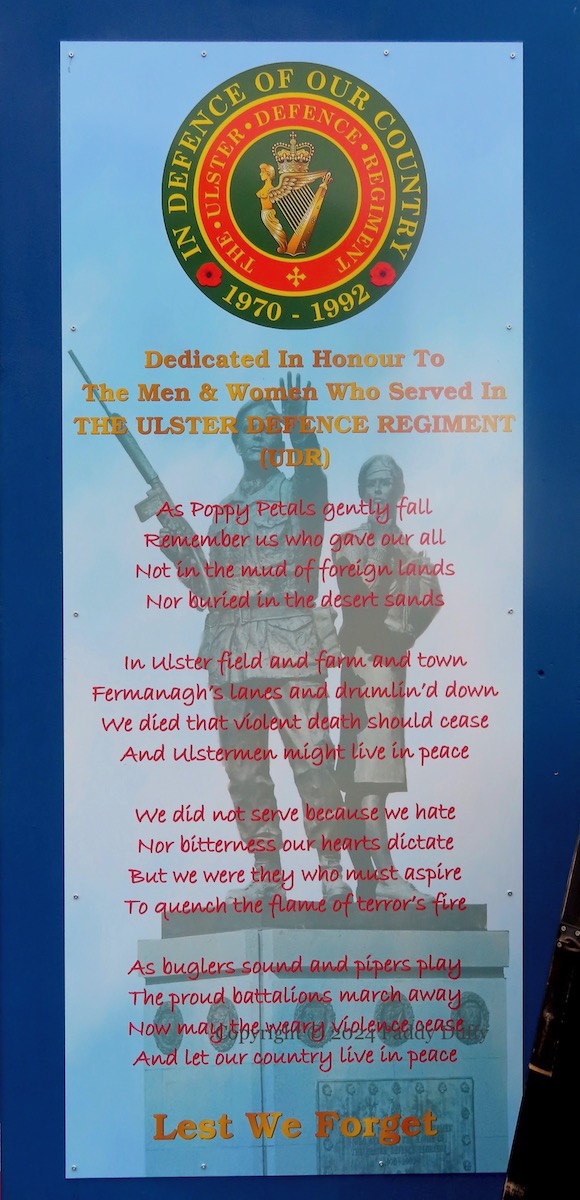
In Defence Of Our Country

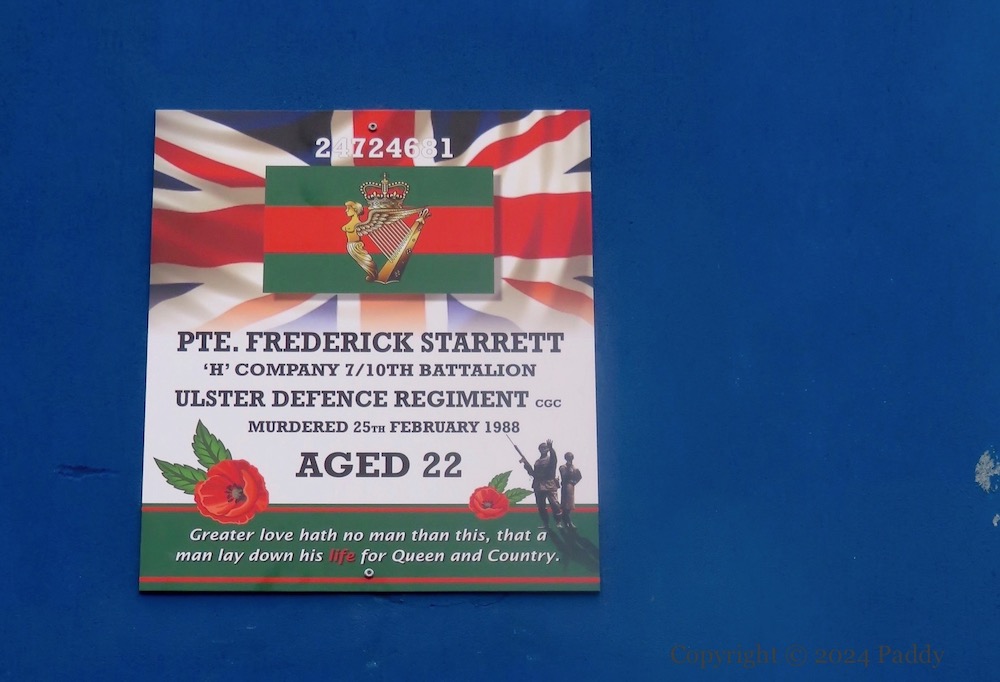
Privates Fred Starrett and James Cummings died in an IRA bombing on Belfast’s Royal Avenue on February 24th, 1988, two of the 197 UDR soldiers who died violently during the twenty-two year life-span of the regiment (UDR Association). The pair are also remembered in a UDR display in Thorndyke Street.

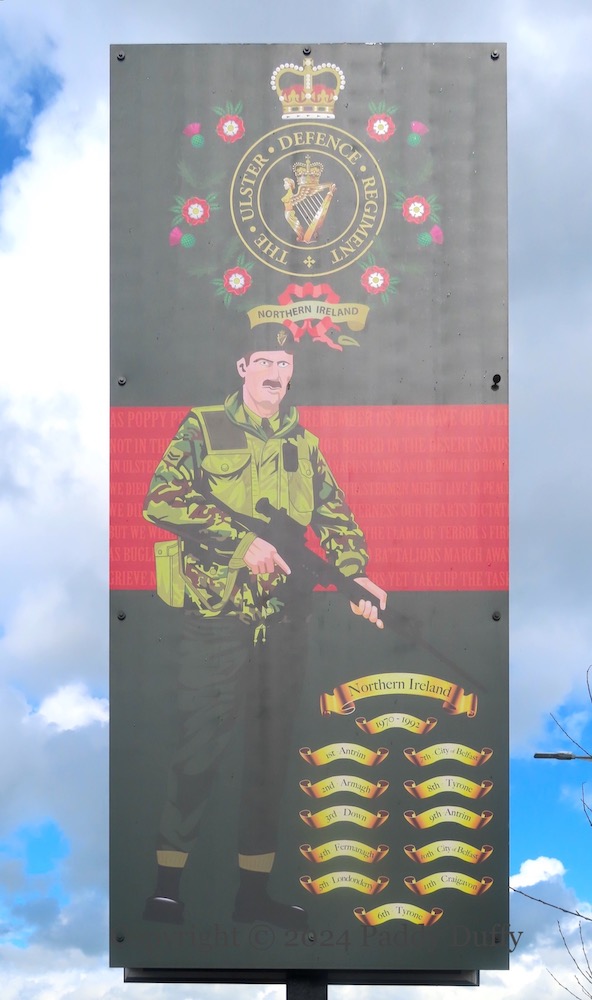
The poem on the right hand side (“as poppy petals gently fall …” by John Potter) is the same as on the Parkhall (Antrim) UDR board.

Ogilvie Street, east Belfast – compare the entry on the same wall from September.

“This project was completed through Belfast City Council’s ‘Promoting the Positive Expression of Cultural Heritage’ Programme, with funding through the EU Programme for Peace & Reconciliation in Northern Ireland and the Border Region of Ireland (PEACE III) under Priority 1.1. Building Positive Relations at a local level.”

Click image to enlarge
Copyright © 2024 Paddy Duffy
T05828 T05830c T05829 T05831 T05832
T05826 [T05827]

Peace Through Strength

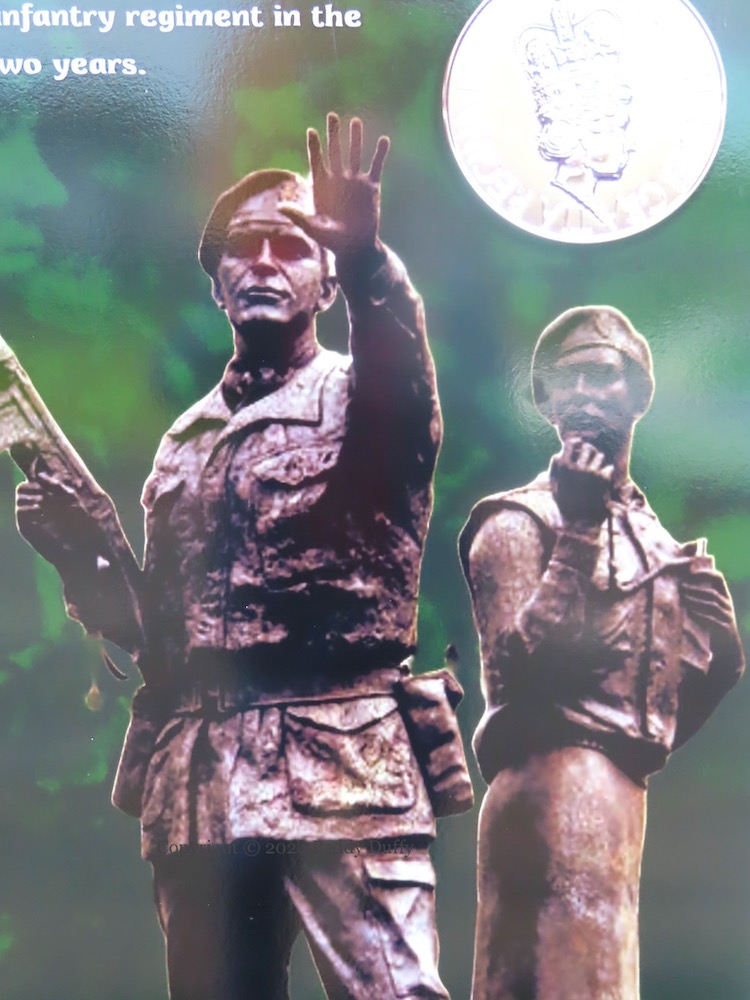
“The Ulster Defence Regiment (UDR) was an infantry regiment of the British Army established in 1970, with a comparatively short existence ending in 1992. Raised through public appeal, newspaper and television advertisements, their official role was the “defence of life or property in Northern Ireland against armed attack or sabotage” but unlike troops from Great Britain they were never used for “crowd control or riot duties in cities”. At the time the UDR was the largest infantry regiment in the British Army, formed with seven battalions plus another four added within two years.”

The UDR Soldier: As poppy petals gently fall,/Remember us who gave our all,/Not in the mud of foreign lands,/Not buried in the dessert sands.//In Ulster field and farm and town,/Fermanagh’s lanes and drumlin’d Down,/An Ulsterman should live in peace//We did not serve because we hate,/Nor bitterness our hearts dictate,/But we were they who must aspire,/To quench the flame of terror’s fire.//As buglers sound and pipers play/The proud Battalions march away./Now may the weary violence cease,/And let our country live in peace. – By John Potter”. Potter (bio at Royal Irish) also wrote a history of the UDR called A Testimony To Courage.

The statue featured on the right is the Lisburn UDR Memorial.

Next to the ‘B Specials’ board in Parkhall Road, Antrim

Click image to enlarge
Copyright © 2024 Paddy Duffy
T05753 T05756 T05754 T05755

Conspicuous Gallantry

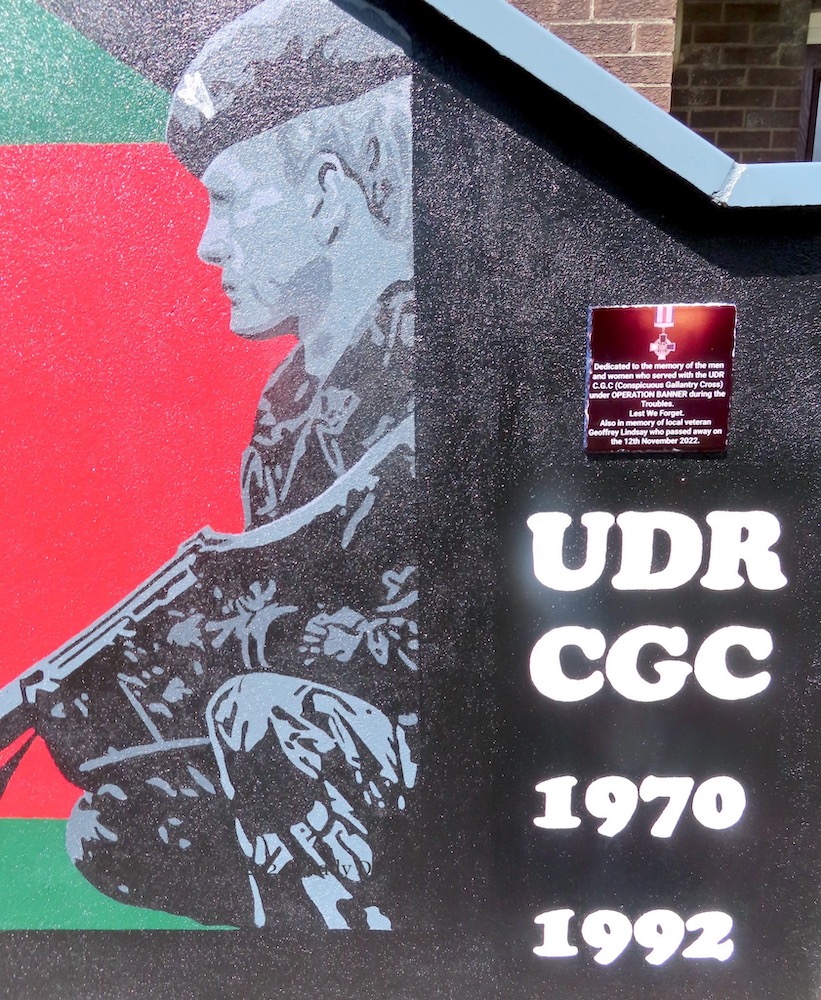
“Dedicated to the memory of the men and women who served with the UDR C.G.C (Conspicuous Gallantry Cross) under OPERATION BANNER during the Troubles. Lest we forget. Also in memory of local veteran Geoffrey Lindsay who passed away on the 12th November 2022.”

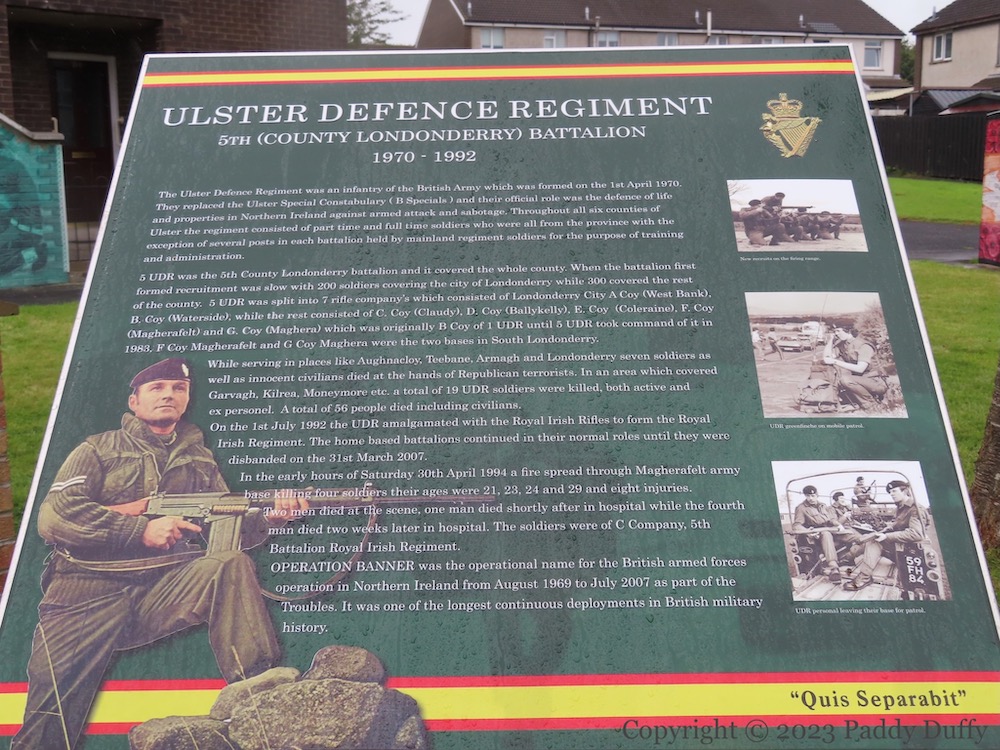
The Conspicuous Gallantry Cross is shown (in the close-up below) at the top of the board; it was awarded to the UDR retroactively in 2006 for its role in ‘Operation Banner’, i.e. the deployment of British Army troops to Northern Ireland – the regiment had been folded into the Royal Irish Regiment in 1992. The mural is specifically to the 5th (Co. Londonderry) battalion – here is a list of the 11 battalions (and bases).

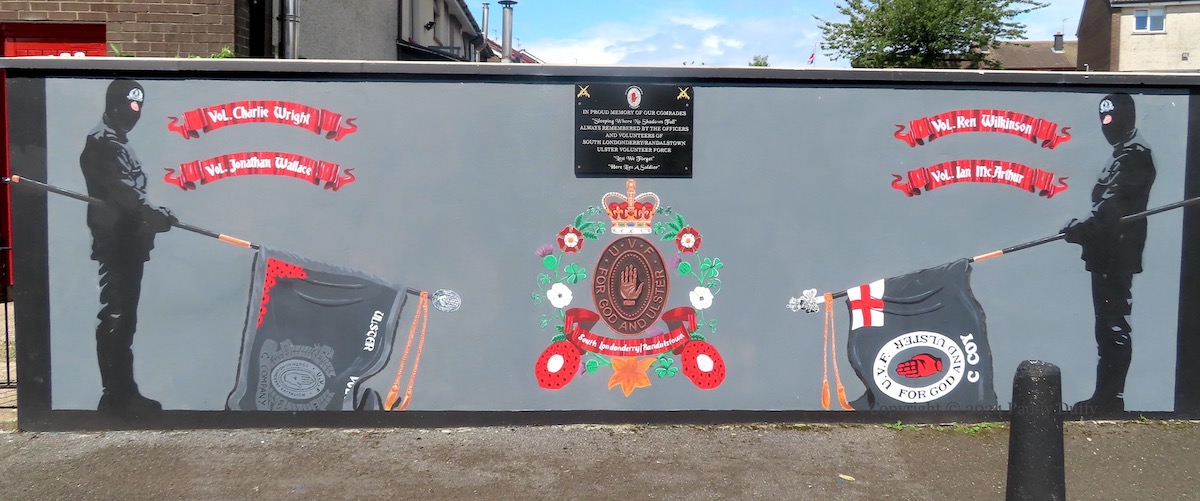
There is also a UDR information board (and an Ulster Volunteers board) in the green-space in front of this mural – see Leckagh Remembers The Fallen.

The memorial mural to the 36th (Ulster) Division on the end wall has also been completed since last (2023) year – in-progress images for both murals from last August are included below. For the previous murals on these walls, see C07766.

Two other pieces are included, below: the UVF mural was seen last year in Pause, Reflect, Remember; the ‘Ignite the fire’ board appears to be new.

Leckagh Drive, Magherafelt

August 27th green-washing of previous mural:

August 27th in-progress image of mural immediately above:

Click image to enlarge
Copyright © 2024 Paddy Duffy
T05144 T05145 T05146 T05147 T03150
T05143 T03149
T05148 T05149 T05150 T05151 T05152

In The Service Of Our Country

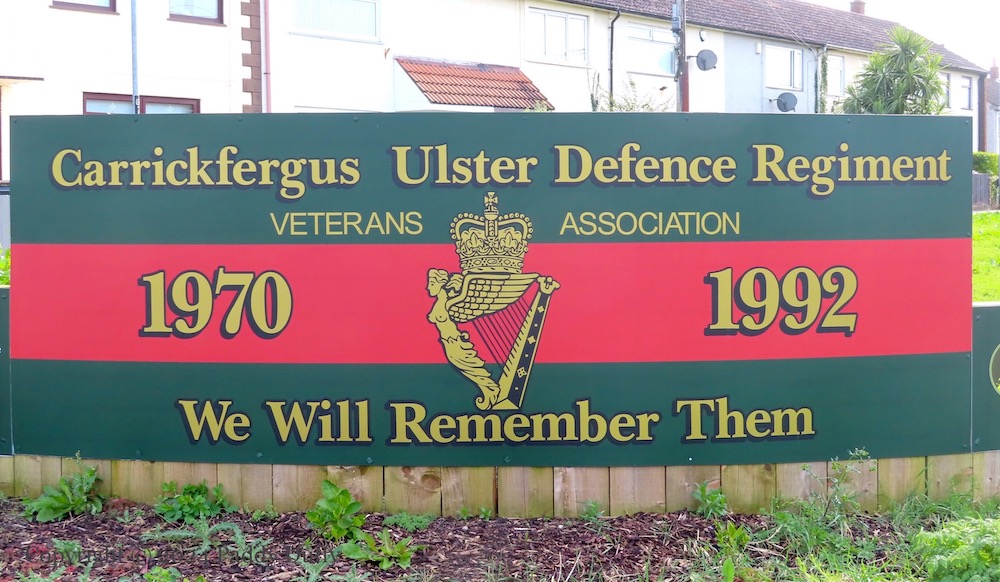
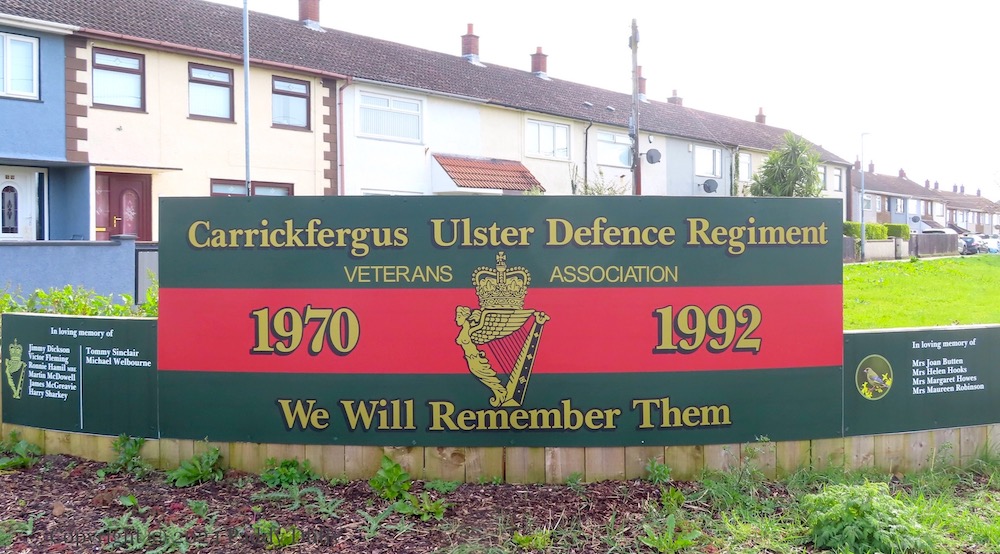
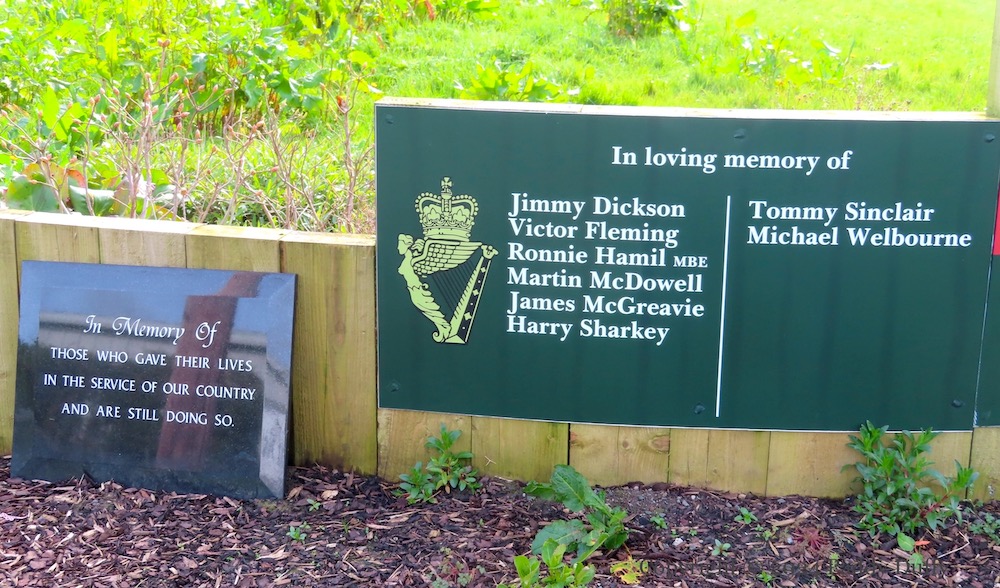
These are images of a new UDR [Ulster Defence Regiment] veterans association board in Woodburn Avenue, Carrickfergus (for the previous memorial plaques at this site, see M10770).

“In memory of those who gave their lives in the service of our country and are still doing so.”

At its peak (in 1973) the UDR had more than 9,000 personnel (Statista). The UDR was amalgamated into the Royal Irish Regiment in 1992 and a 2005 estimate put the number of its veterans at about 58,000 (Veterans Services NI).

Click image to enlarge
Copyright © 2024 Paddy Duffy
T04410 T04409 [T04411] T04412

How Real Men ‘Take A Knee’

Here is a survey of PUL boards (from left to right) at the shops in the centre of the village of Moygashel, just south of Dungannon.

First is a British Army soldier in a firing position. Compare this board to Now Is The Time To Kneel in Clonduff, Castlereagh, which suggested that the time for soldiers to kneel was in mourning for Queen Elizabeth.

The subject of the second image is obscure. Vanguard as a political and activist group dissolved in 1977 (WP) and the name and emblem have been taken up by the Vanguard Bears, a Rangers supporters’ club (see e.g. Defending Our Traditions).

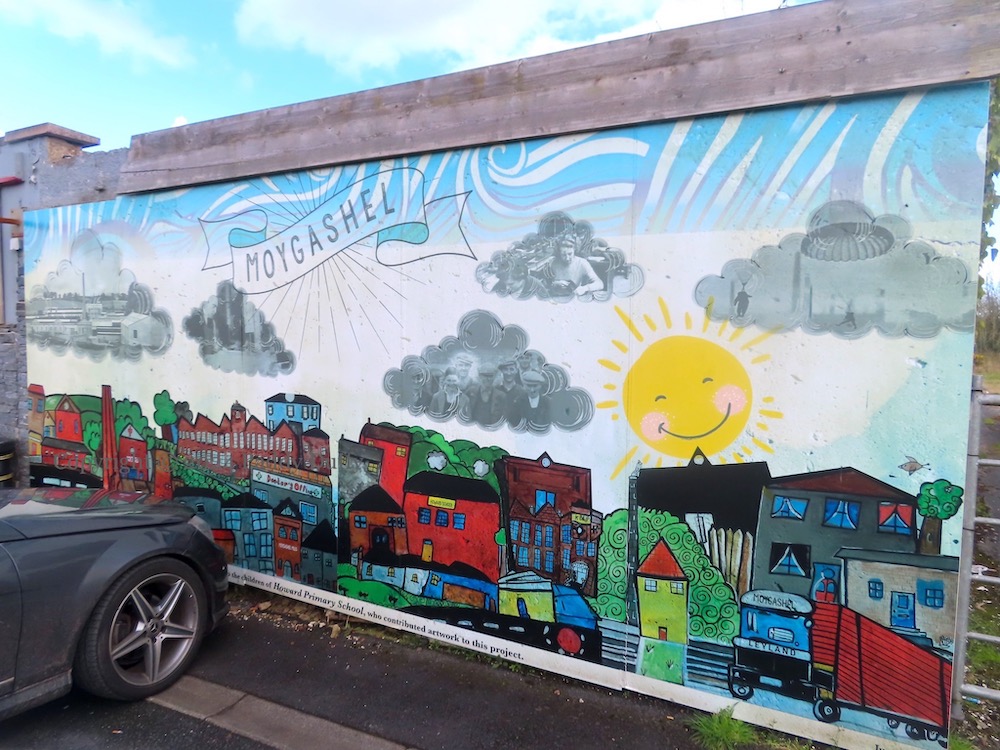
Third is a children’s mural, produced (in part) by children from Howard primary school.

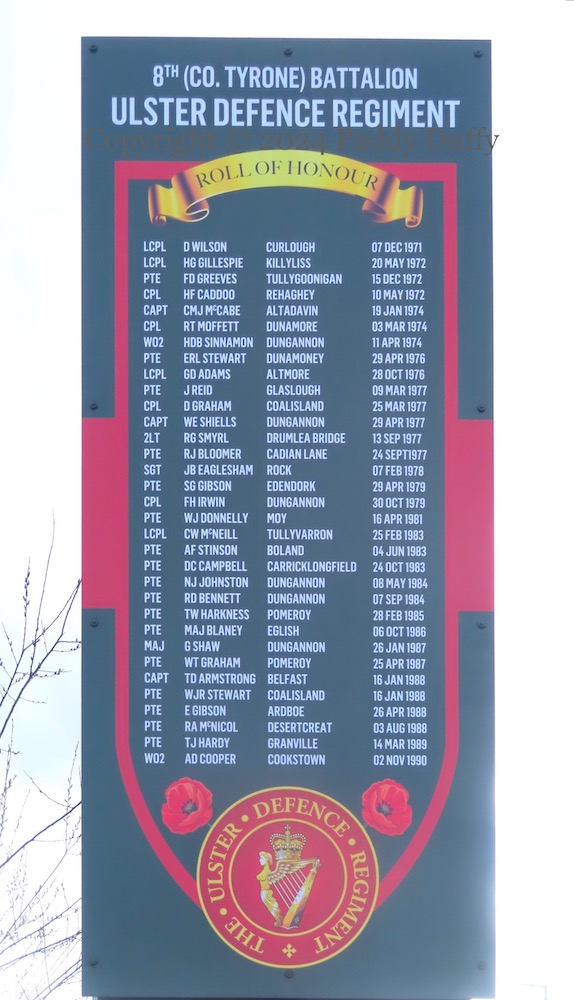
The ‘Time To Decide’ and UDR 8th (Co. Tyrone) battalion roll of honour were seen previously, alongside two others which are now absent, in Belfast Agreement Null & Void.

Beyond those is a tarp celebrating Queen Elizabeth II’s platinum jubilee, in 2022.

Finally, a Moygashel Youth Club (Fb) mural in disrepair.

Click image to enlarge
Copyright © 2024 Paddy Duffy
T04309 T04308 T04314 T04310 T04311 T04320 T04312 T04313

Some Gave All

“All gave some; some gave all.” During its twenty-two years of operation, 197 UDR soldiers were killed. The scroll on the left gives the dates of the regiment’s operation: 1970 (April 1) was the year it replaced the Special Constabulary, and 1992 (May 31) was the year seven of the nine battalions were amalgamated with the Royal Irish Rangers’ two battalions to form the (modern) Royal Irish Regiment (WP) – the piper in the top right is carrying a flag of the Royal Irish Regiment.

The inscription on the plaque reads: “Ulster Defence Regiment mural, dedicated on the 19th March 2016 by Chairman Roy Burton, Carrickfergus Glasgow Rangers Supporters Club [and] Chairman Stephen Weir, Carrickfergus Ulster Defence Regiment Association CGC. Lest we forget.”

The mural is at the Carrickfergus Rangers Supporters Club (Fb). Also from the Club: Club: a gallery of Rangers’ Managers in We Welcome The Chase | commemorative murals to the 36th Division in A Name That Equals Any In History | and to the Highland Fusiliers.

Click image to enlarge
Copyright © 2023 Paddy Duffy
T03494

Fifty Years Of Service

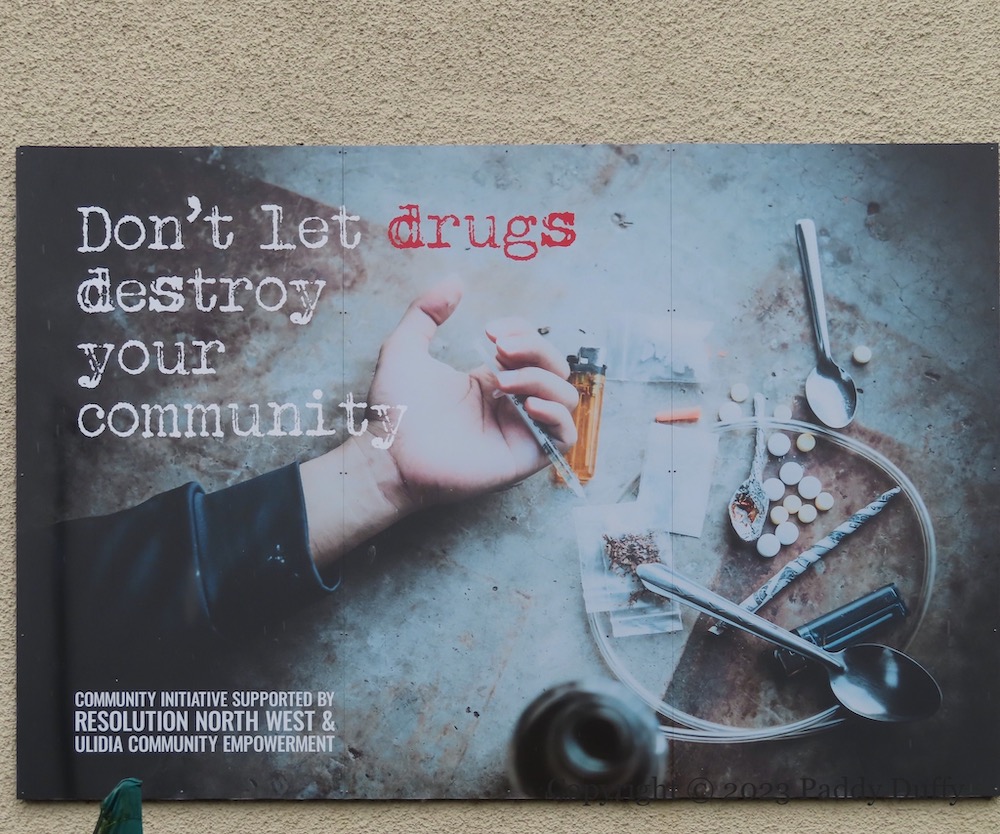
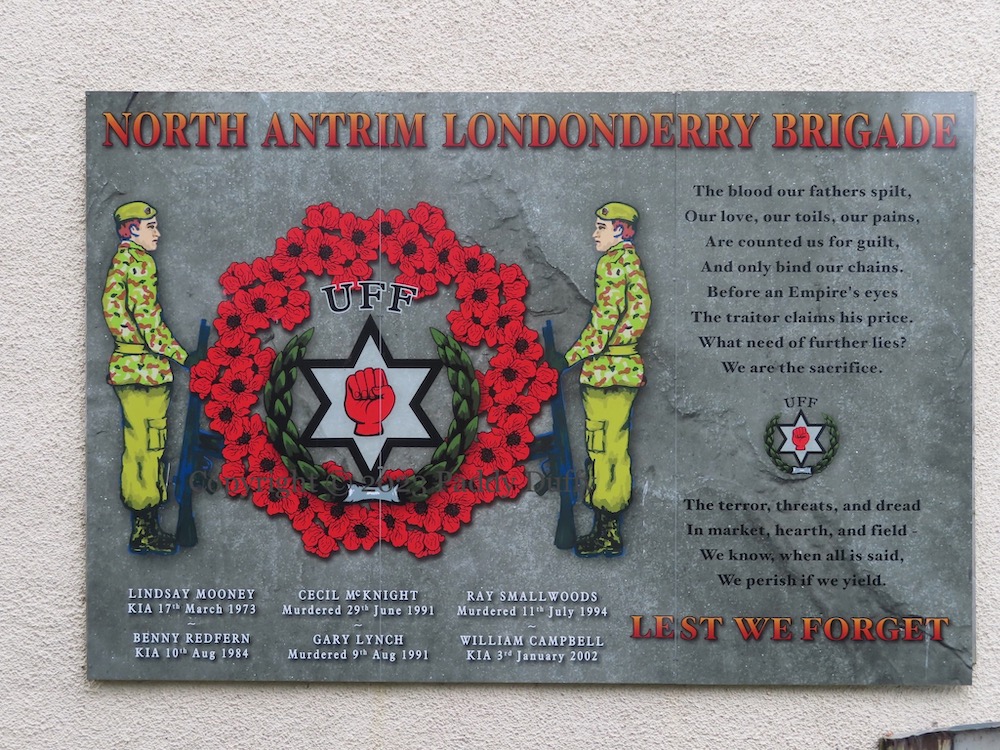
Here is a survey of the UDA boards in Carnany estate, Ballymoney. Many of these have been seen before (in Ulster’s Past Defenders, Ulster’s Present Defenders, The Terror, Threats, And Dread, and Ballymoney UDA). The anti-drugs board in the final image is new (see previously the one in Londonderry: Peace Impact Programme) and the one shown above and immediately below is an updated version of the board shown in Past, Present, For All Time. The dates given in the earlier version were 1972 and 2016; in this one, for “50 years of service”, they are 1971 and 2021. 1971 is the typical date given for the formation (in Belfast) of the the UDA; the 1972 date might have been a specific reference to the North Antrim And Londonderry brigade or the beginning of the Londonderry UDA’s actions, with bomb attacks on a factory and a pub in Donegal in October and November, 1972 (WP).

Click image to enlarge
Copyright © 2023 Paddy Duffy
T03227 T03226
T03231 T03224 [T03225] T03228 T03229 T03230
“The blood our comrades shed shall not have been in vain. We honour Ulster’s dead and staunch we will remain.” better to die on your knees than live in an Irish republic don’t let drugs destroy your community declaration of arbroath

Leckagh Remembers The Fallen

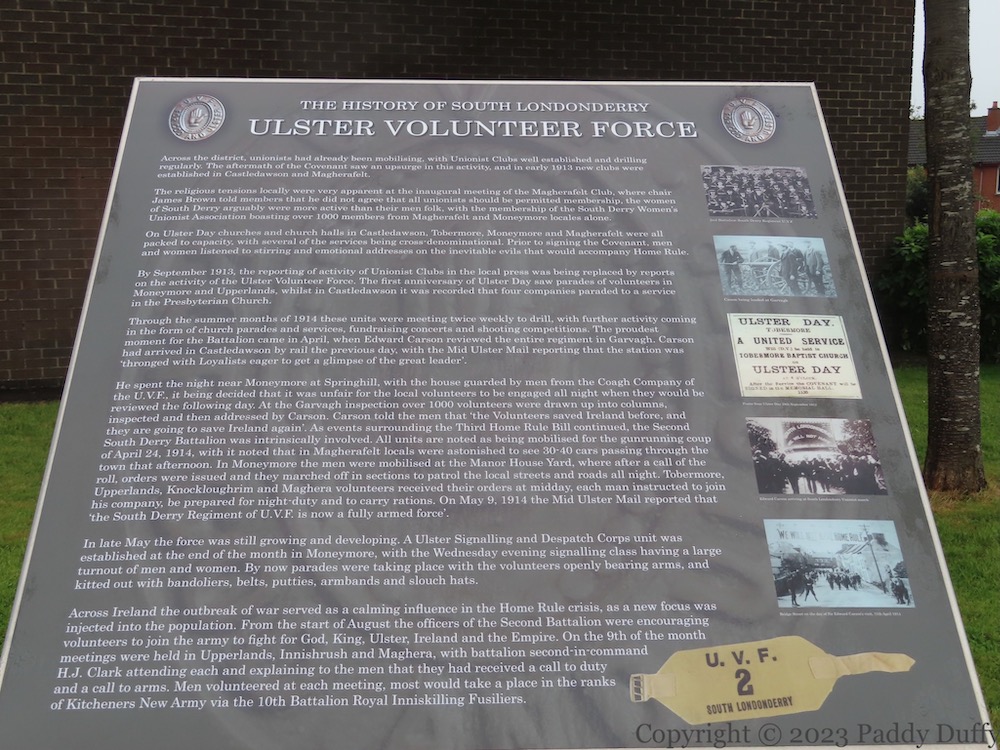
This selection of images from Leckagh Drive, Magherafelt, focuses on the memorials to the dead of WWI (and WWII in the mural above), with an additional board commemorating the UDR 5th (County Londonderry) battalion); there is also a mural and some plaques commemorating (modern-day) UVF volunteers, which will be in tomorrow’s post.

The board shown in the final image provides a history of the South Londonderry volunteers from towns such as Magherafelt, Castledawson, Moneymore, and Tobermore. Edward Carson reviewed the volunteers in April 1914. Later that same month, arms were received from the weapons landed in Larne. In the Great War, the men from the area served in the 10th battalion of the Royal Inniskilling Fusiliers in the 109th brigade of the 36th Division.

Click image to enlarge
Copyright © 2023 Paddy Duffy
T03155
T03142 [T03141]
T03143 T03144 T03146

We Will Reorganise

“Ulster Special Constabulary 1920-1970. The Ulster Special Constabulary (USC; commonly called the “B-Specials” of “B Men”) was a quasi-military reserve special constable police force in what would later become Northern Ireland. It was set up in October 1920, shortly before the partition of Ireland. It was an armed corps, organised partially on military lines and called out in times of emergency, such as war or insurgency. It performed this role most notably in the early 1920s during the Irish War of Independence and the 1956-1962 IRA Border Campaign.

During its existence, 95 USC members were killed in the line of duty. Most of these (72) were killed in conflict with the IRA in 1921 and 1922. Another 8 died during the Second World War, in air raids or IRA attacks. Of the remainder, most died in accidents but two former officers were killed during the Troubles in the 1980s. [The WP page from which this text is drawn at this point goes on to talk about Catholic mistrust of the Specials.] The Special Constabulary was disbanded in May 1970, after the Hunt Report, which advised re-shaping Northern Ireland’s security forces [to attract more Catholic recruits] and demilitarizing the police. Its functions and membership were largely taken over by the Ulster Defence Regiment and the Royal Ulster Constabulary.

[Accompanying the small photograph:] At the Twelfth demonstration at Finaghy, Sir Edward Carson, the unionist leader, deploring the state of the county, advised the government: ‘If … you are yourself unable to protect us from the machinations of Sinn Fein … we will take the matter into our own hands. We will reorganise [the Ulster Volunteers]’.” [From a NewsLetter article ‘USC Helped Establish Peace In Early Years Of NI’]

Carson’s quote is also used in a Belfast UVF mural. As is noted there, the speech is probably from the 12th of July – Treason Felony | RTÉ – and concerns the reformation of the Ulster Volunteers as a force to protect Protestant interests in the north of Ireland in light of the proposal in the (fourth) Home Rule bill to create separate northern and southern states.

Parkhall Road, Antrim

Click image to enlarge
Copyright © 2023 Paddy Duffy
T02584 [T02585]