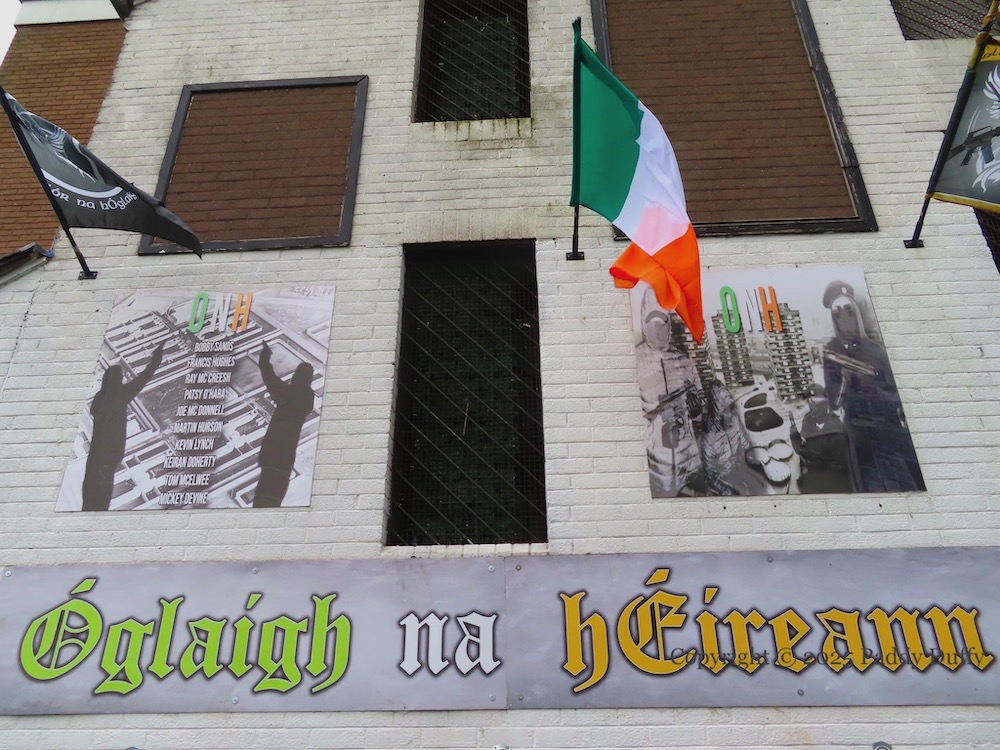
Anti-Agreement armed group Óglaıgh Na hÉıreann split in 2024 (BelTel) with the larger faction following Tony McDonnell (BelTel). Death threats against seven members from the smaller faction (under Sean O’Reilly) were issued and attacks were made in February (BBC), March (Irish News/reddit), and July (Irish News).
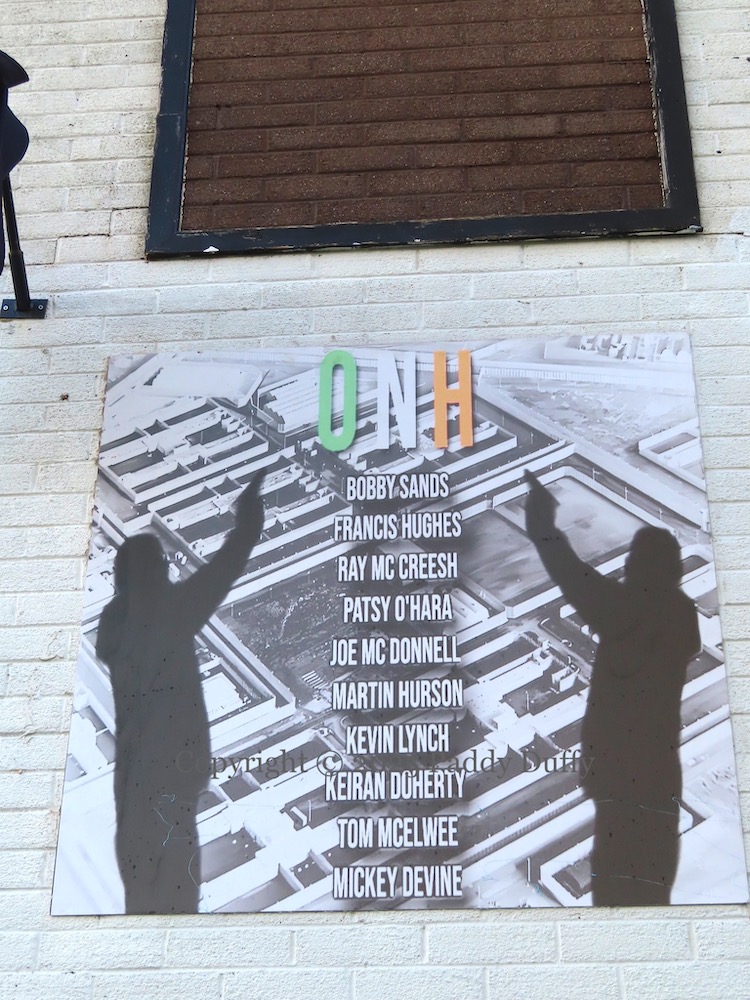
The signage seen here is in the New Lodge in north Belfast. On the left are the names of the ten deceased 1981 hunger-strikers, on the right, armed and masked volunteers pose against a background of a vintage picture of the flats (from Getty Images – BBC).
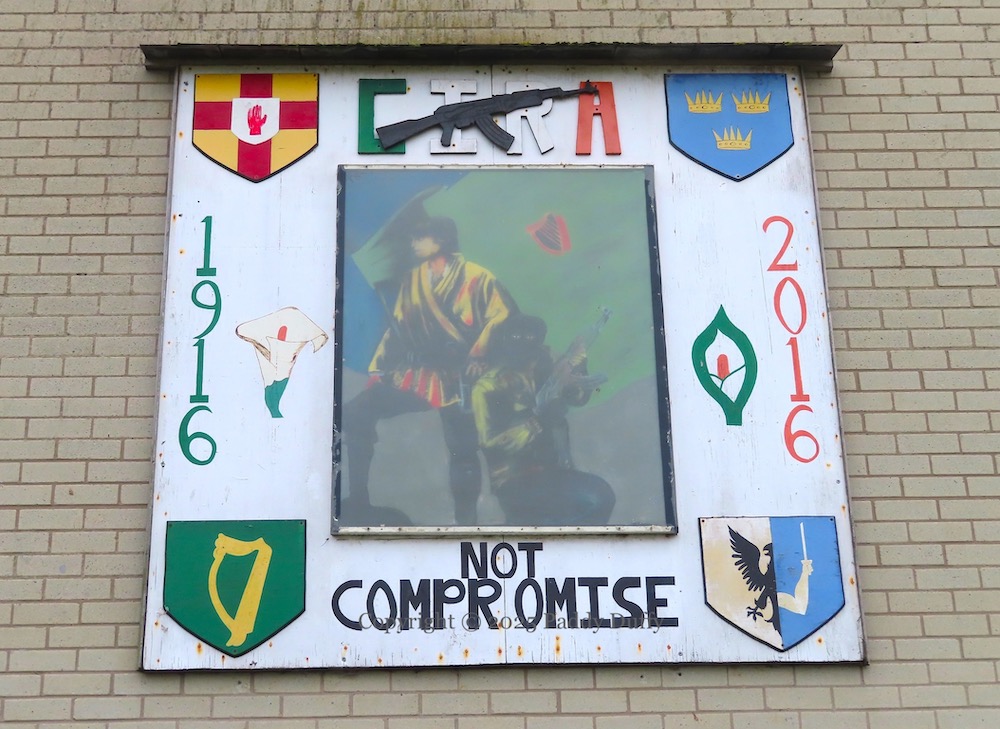
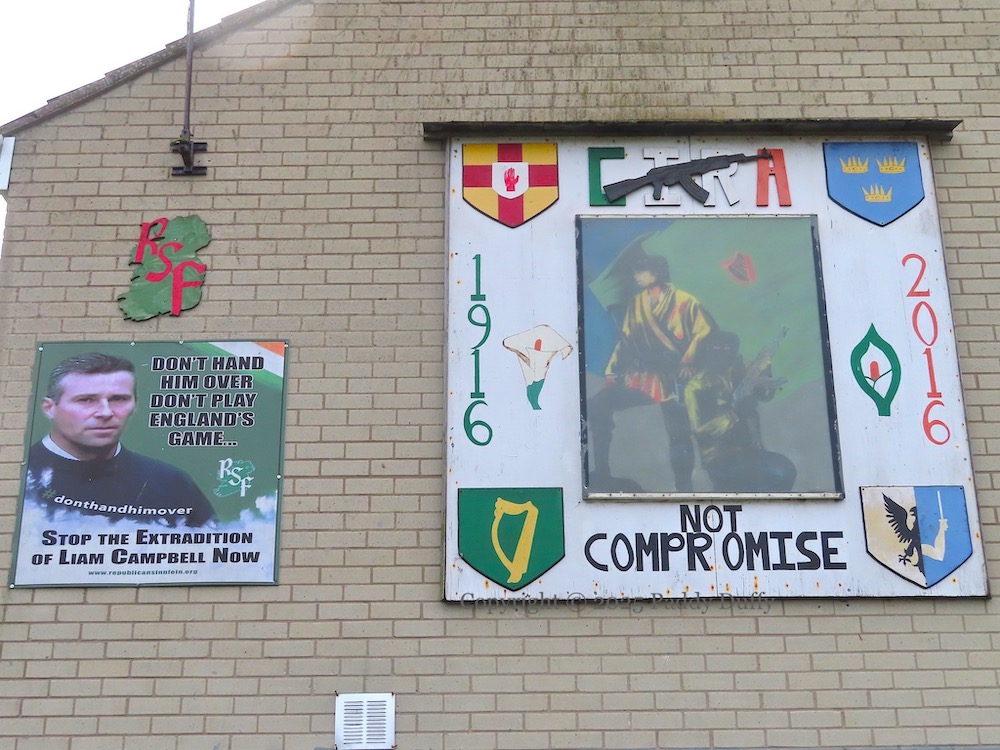
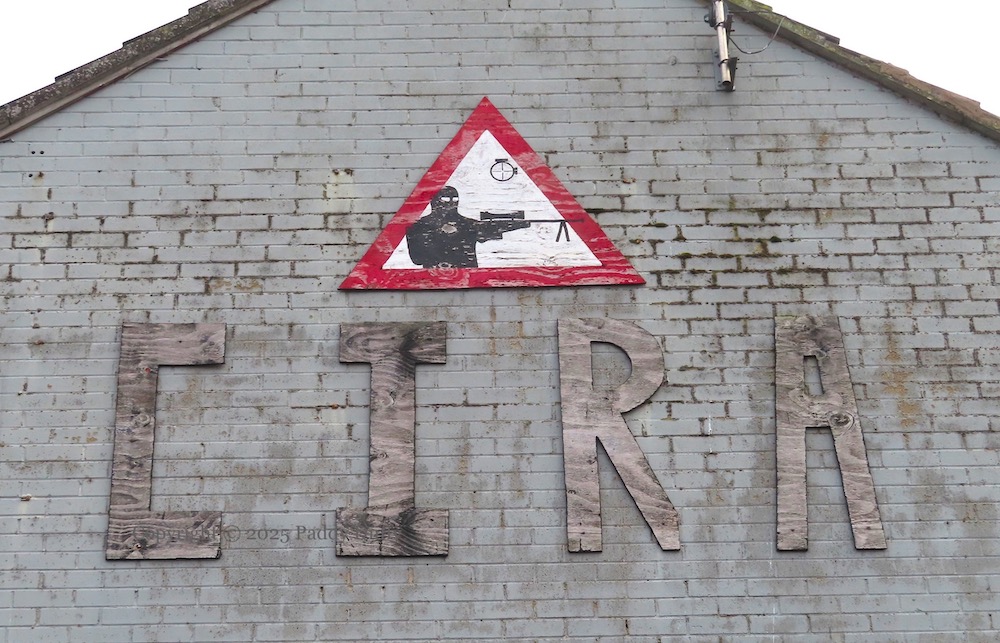
The CIRA (Continuity IRA) is the military wing of Republican Sınn Féın (RSF web), which split from Provisional Sınn Féın in 1986, though the military campaign did not begin until the Provisional IRA ceasefire in 1994. Like all of the various IRAs, the CIRA claims to be continuing the fight for (all-island) Irish freedom begun with the 1916 Easter Rising – the board (above) commemorates the centenary of the Rising.
To the left is a slightly newer RSF board: “Stop the extradition of Liam Campbell now – don’t hand him over, don’t play England’s game”. Campbell was extradited from the Republic to Lithuania in 2022 (BBC) but was returned to Ireland later the same year when a court ruled the statute of limitations has expired (RN).
The CIRA’s armed campaign is represented by the hooded gunman in the ‘warning sign’ below.
Also included (last below) is a small IRSP (web) stencil.
The pieces are in the adjacent Meadowbrook and Drumbeg areas of Lurgan.
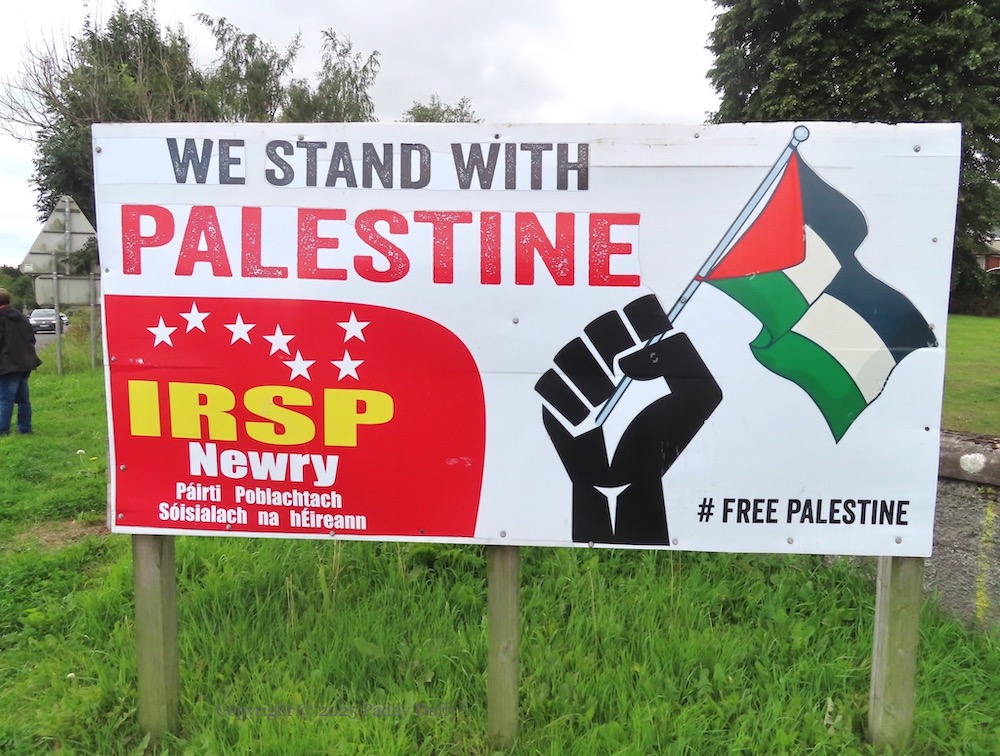
Here are two IRSP (web) boards and one IRPWA (web) board at Camlough Road on the edge of Derrybeg, Newry. Above, “Stop the genocide – Newry supports Palestine” (Teach Na Fáilte is the IRSP’s ex-prisoners division – Newry Fb); immediately below, “For a socialist republic – ‘He was the only one who truly understood what James Connolly meant when he spoke of his vision of the freedom of the Irish people’ – Nora O’Connolly O’Brien on Seamus Costello”; last below, “End internment – Portlaoise, Maghaberry, Hydebank”.
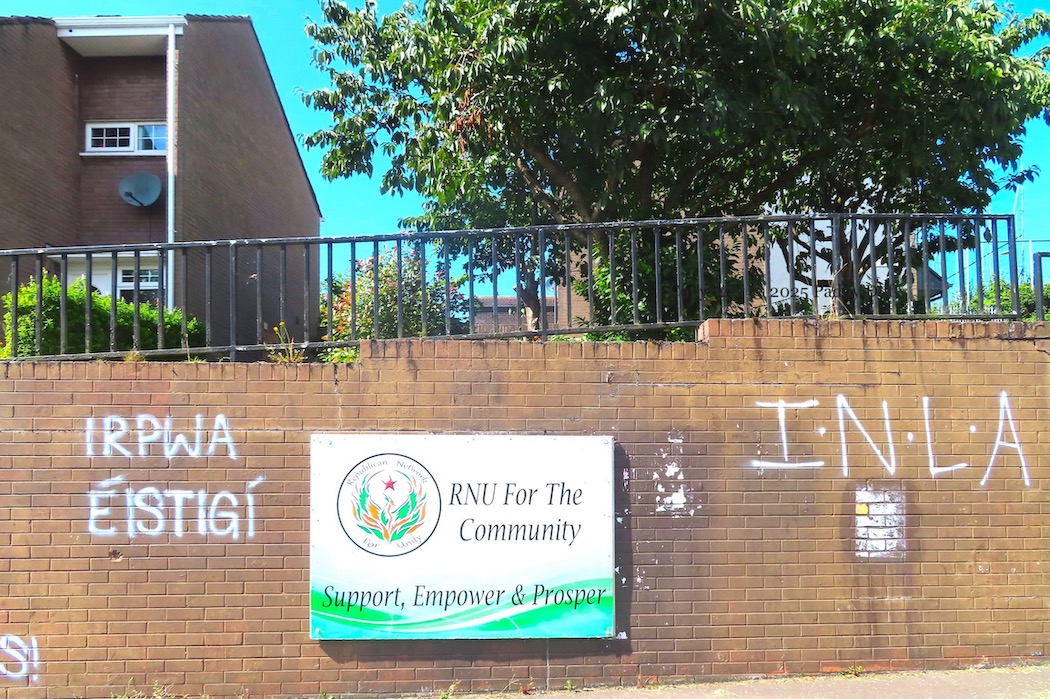
Here are IRSP (web) and RNU (Fb) signs side-by-side in Bishop Street, Derry, both employing the idea of ’empowerment’. Above: “Empower your community – Join the IRSP, the party of Connolly and Costello”; below: “RNU for the community – support, empower & prosper”.
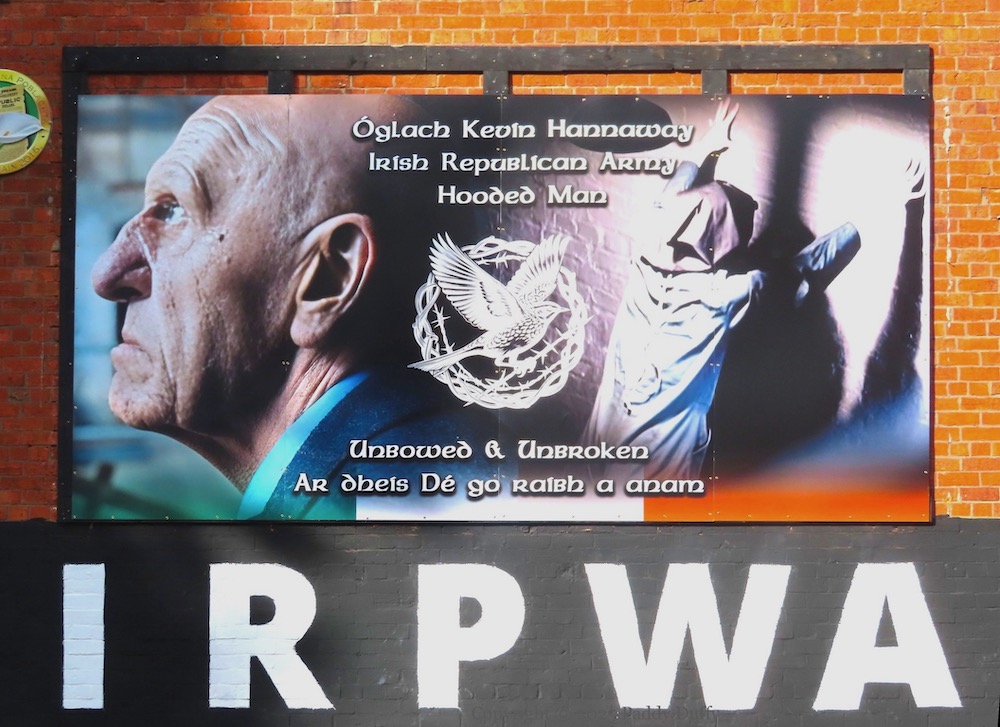
“Óglach Kevin Hannaway, Irish Republican Army, hooded man. Unbowed & unbroken. Ar dheıs Dé go raıbh a anam.”
Kevin Hannaway died in January (2025), aged 77. In 1971 he was interned (Belfast Media) and subjected, along with thirteen others, to the “five techniques” – deprivation of food/drink and of sleep, subjection to noise, prolonged stress positions, and hooding (WP) – as well as being beaten and dropped out of a helicopter (Irish Times). The ‘five techniques’ were found to constitute torture in 2021 (RTÉ) and the PSNI apologised to the victims in 2023 (BBC | Irish Legal News).
Hannaway remained a republican throughout his life and was anti-Agreement in recent years (BBC). The board in Hannaway’s honour was launched on Sunday July 13th (Fb video). The panels of the board were siezed by the PSNI during a drug raid on a home in St James’s on the 11th but returned the next day (BelTel).
“IRPWA [web]. Republican prisoners still exist! Unfinished revolution. Unbowed, unbroken.”
Hugo Street, west Belfast. For a close-up of the Pearse Jordan plaque on the left, see the Peter Moloney Collection.
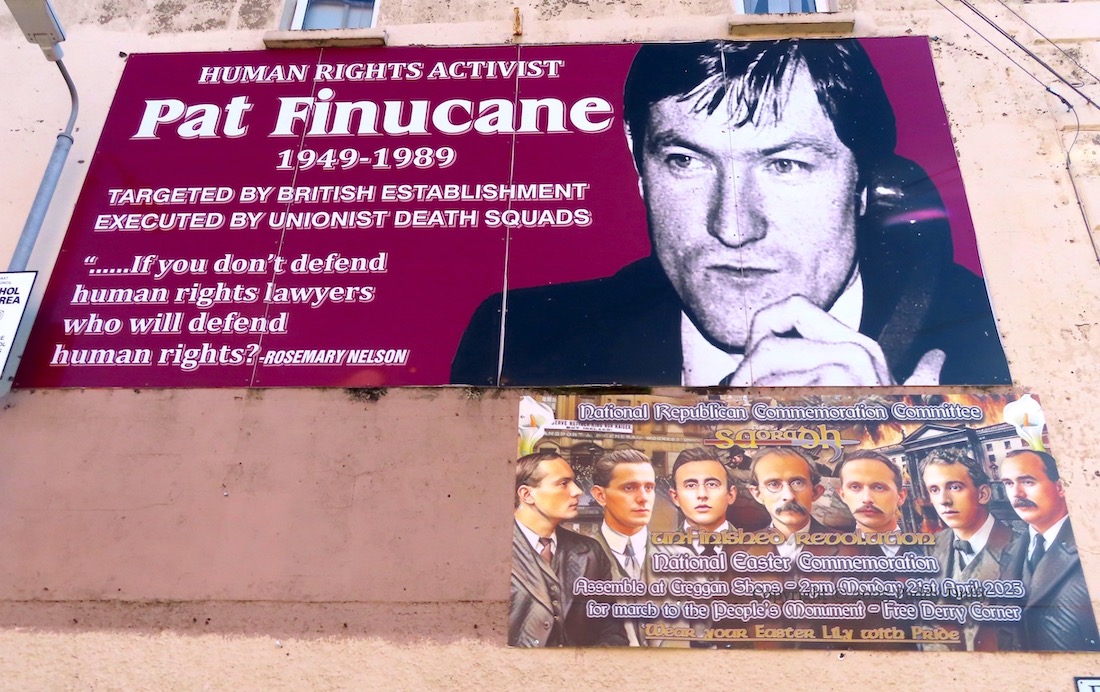
These Saoradh (web) boards calling for attendance at the national march from Creggan to the new (2022) “People’s Monument” in Rossville Street are in Hugo Street (above) and Beechmount Drive (below):
“National Republican Commemoration Committee national Easter commemoration: assemble at Creggan shops – 2pm Monday 21st April 2025 for march to the People’s Monument — Free Derry Corner. Wear your Easter lily with pride.”
For a full list of this year’s commemorative marches, see Republican News.
Easter Monday falls late this year – April 21st – though still not as late as it did in 1916, when it was on the 24th. The event is typically celebrated at Easter, regardless of its proximity to the 24th, though for the centenary in 2016, anti-Agreement republicans commemorated the Rising on April 24th, specifically, while others paraded at Easter (which was at the end of March).
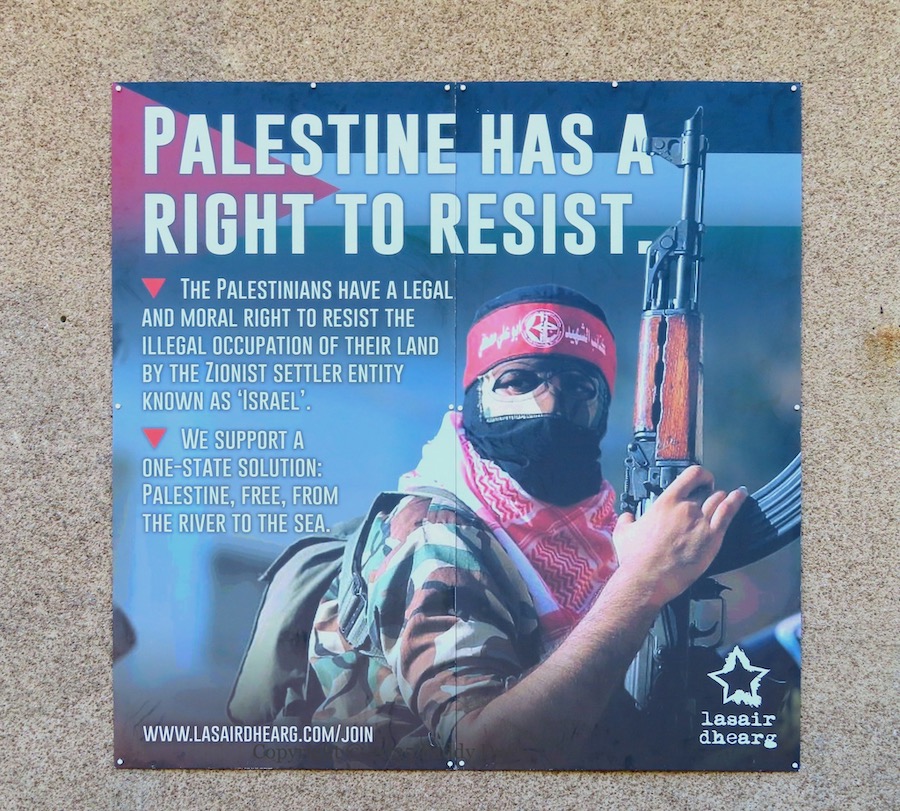
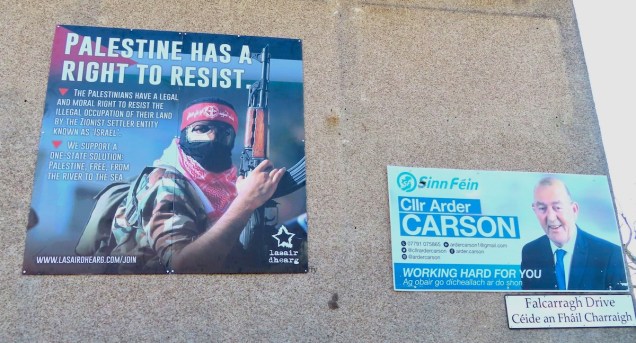
This Lasaır Dhearg (web) board in Lenadoon is explicit in defending the use of physical force by Palestinians (specifically by the Popular Front For The Liberation Of Palestine – WP): “Palestine has a right to resist. The Palestinians have a legal and moral right to resist the illegal occupation of their land by the Zionist settler entity known as ‘Israel’. We support a one-state solution: Palestine, free, from the river to the sea.”
At the Suffolk Road end of Falcarragh Drive/Céıde An Fháıl Charraıgh, formerly the site of Car Crime Is A Growing Problem.
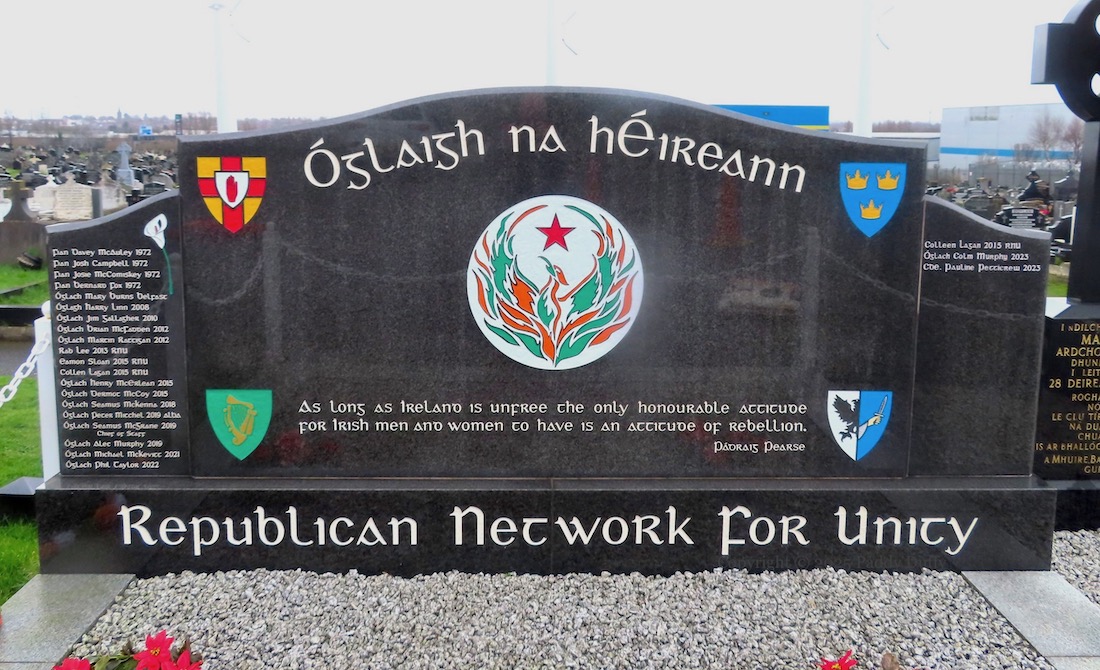
“”As long as Ireland is unfree the only honourable attitude for Irish men and women is an attitude of rebellion” – Pádraıg Pearse”. Pearse wrote the lines in July 1913, in an essay for Irish Freedom (Cartlann), though with “revolt” rather than “rebellion”.
The stone features the phoenix and the lily, and the crests of the four provinces of Ireland. It was unveiled in 2023 and an image of it was used in an RNU board on the Falls Road.
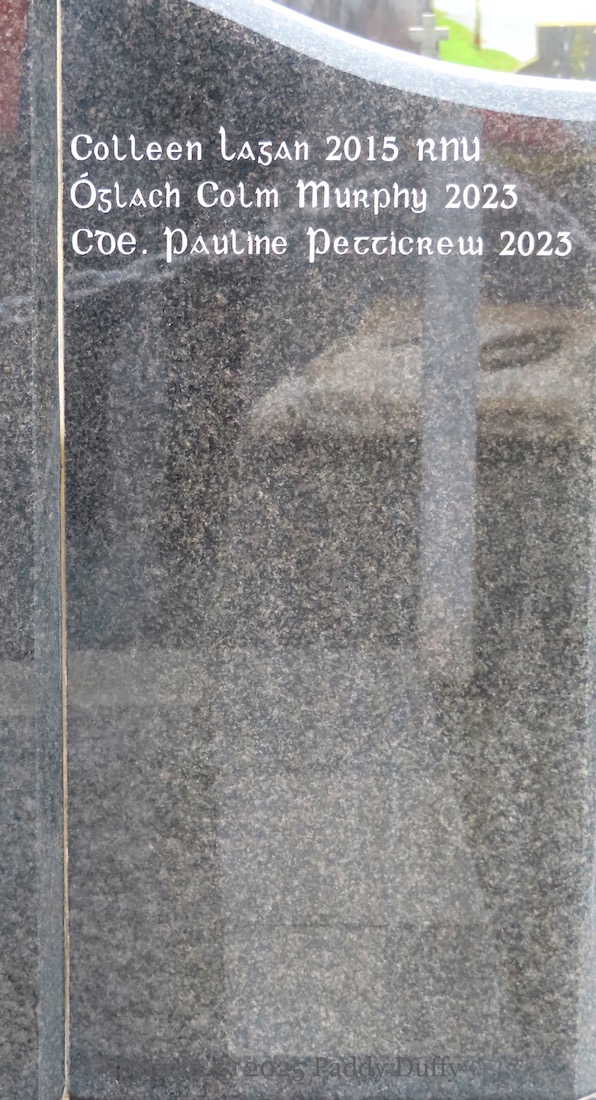
Among the volunteers listed are the four Ardoyne Fıanna who died in 1972 (commemorated in Ardoyne) and Michael McKevitt, founder and (alleged) chief of staff of the RIRA/Óglaıgh Na hÉıreann (WP) who died in 2021.
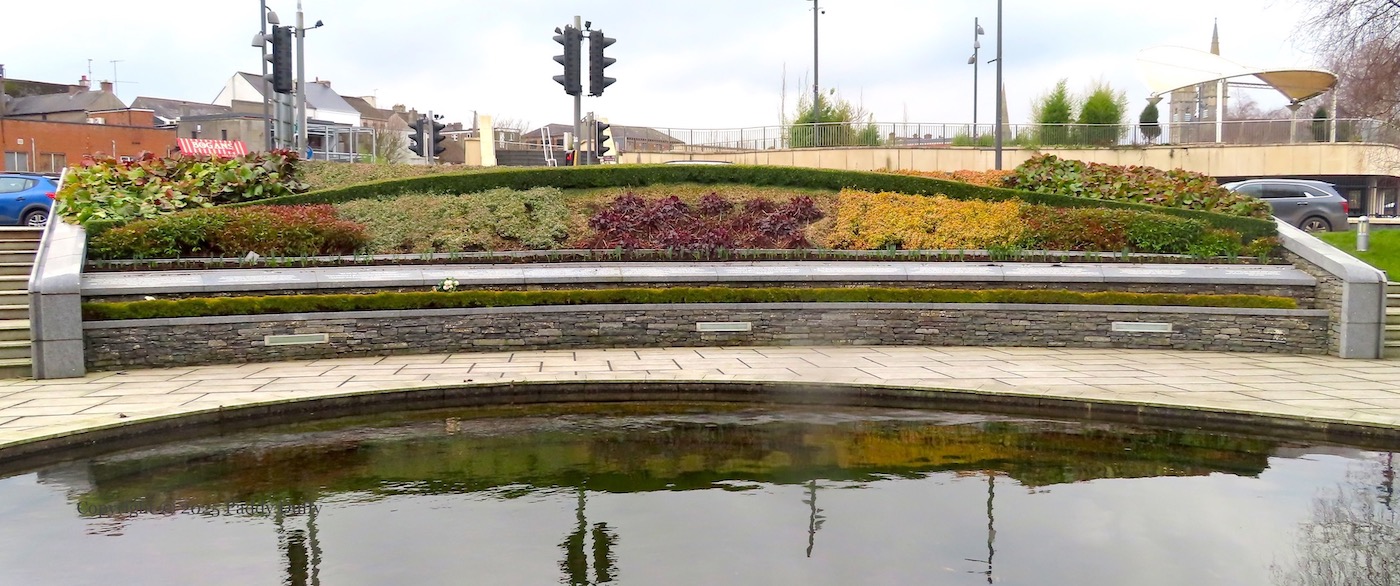
This memorial to the victims of the Omagh bombing is in a green-space along the Strule river about 300 metres (WP) from the spot where an RIRA car-bomb exploded on the afternoon of 15th of August 1998, killing twenty-nine people and injuring more than 200 others.
The garden was opened on the tenth anniversary, in 2008 (replacing a smaller obelisk). It includes 31 mirrors on poles (including a set of unborn twins in the number of deceased) which are part of a reflective system that sends sunlight towards a crystal pillar in Market Street that marks that spot of the bomb (Troubles Archive).
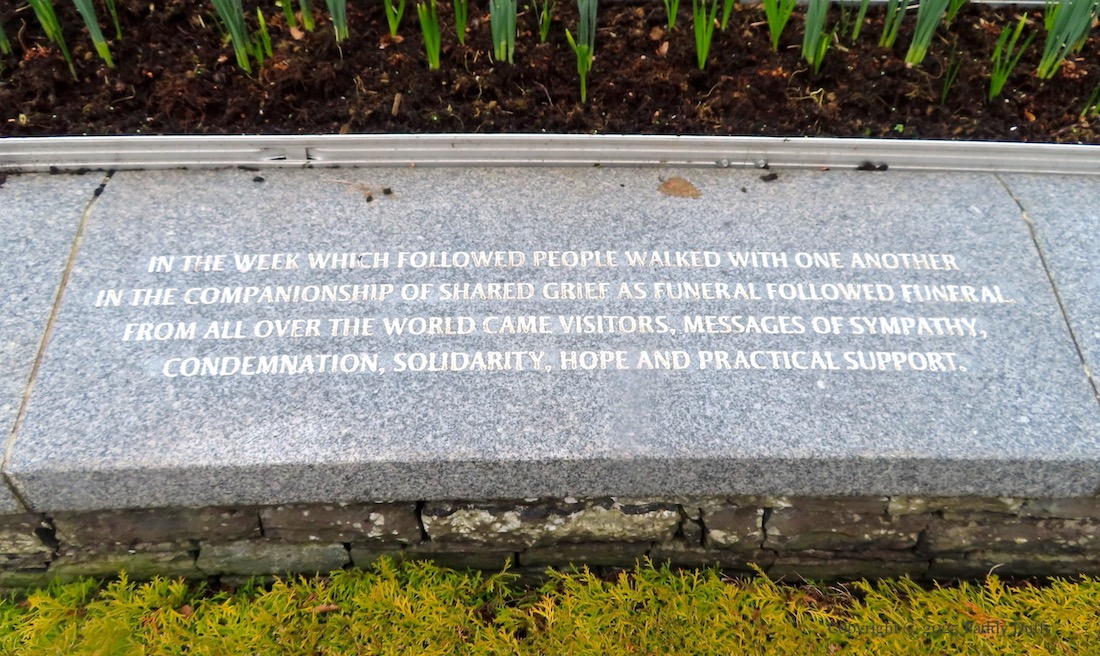
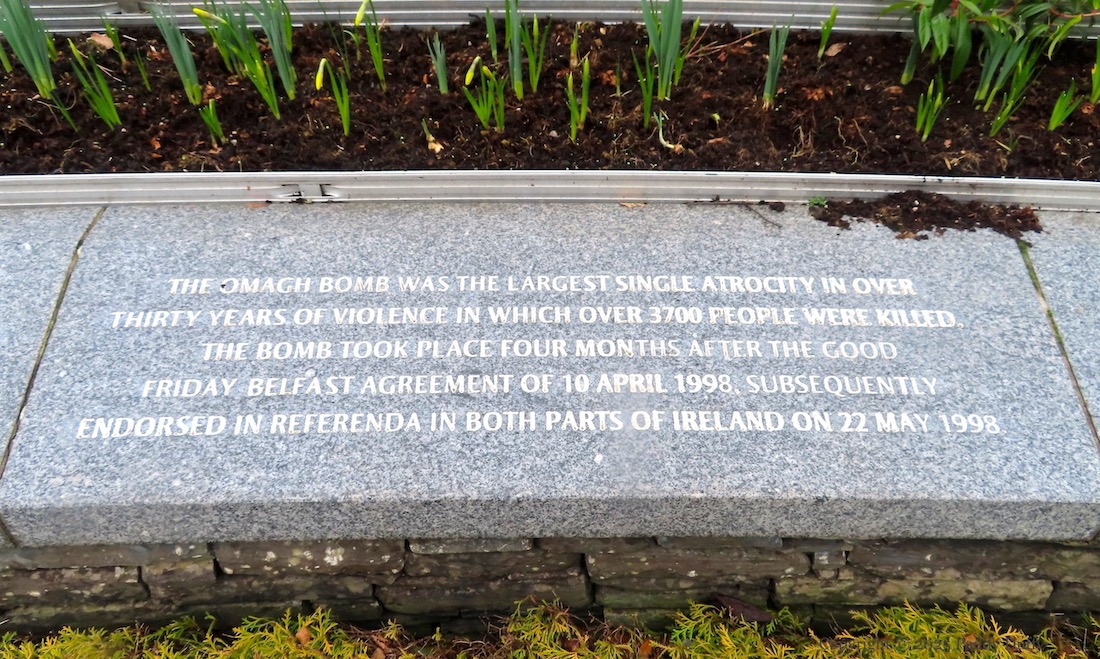
There are also a series of engraved stones on an arc around the pool that tell the story of the day and its aftermath, as well as naming the dead:
“Weather wise it was one of the best days that summer had seen. Ordinary people were doing ordinary things on an ordinary day. In one fateful moment all this was changed forever. Time stood still, futures were obliterated, loves were shattered, hearts were broken. In the carnage, emergency personnel and many ordinary people reached out, helped the injured, gave hope to the dying and held the dead. That evening a great silence descended on the town. In the week which followed the people walked with one another in the companionship or shared grief as funeral followed funeral. From all over the world came visitors, messages of sympathy, condemnation, solidarity, hope and practical support. The Omagh bomb was the largest single atrocity in over thirty years of violence in which over 3700 people were killed. The bomb took place four months after the Good Friday/Belfast Agreement of 10 April 1998, subsequently endorsed in referenda in both parts of Ireland on 22 May 1998. In the years that followed people Omagh and elsewhere sought to rebuild their lives, their families, their community, and to create a new future. Regardless of the past, every new days dawns as a gift laden with its own possibilities, as the morning sun banishes the darkness of night.”
One of the stones reads “Bear in mind these dead/Coınnıgh ı gcuımhne na maırıbh seo/Tened en cuenta a estos muertos – (John Hewitt)”; two of the victims were Spanish.
Drumragh Avenue, Omagh
“Saturday 15 August 1998 at 3.10 PM. To honour and remember the 31 men, women and children who were killed, the hundreds injured and those whose lives were changed forever in the Omagh bomb. ‘The light shines in the darkness and the darkness has not overcome it’ (John 1.5)”
“To honour and remember 31 people murdered and hundreds injured from three nations by a dissident republican terrorist car bomb. (Omagh Support And Self Help Group)”
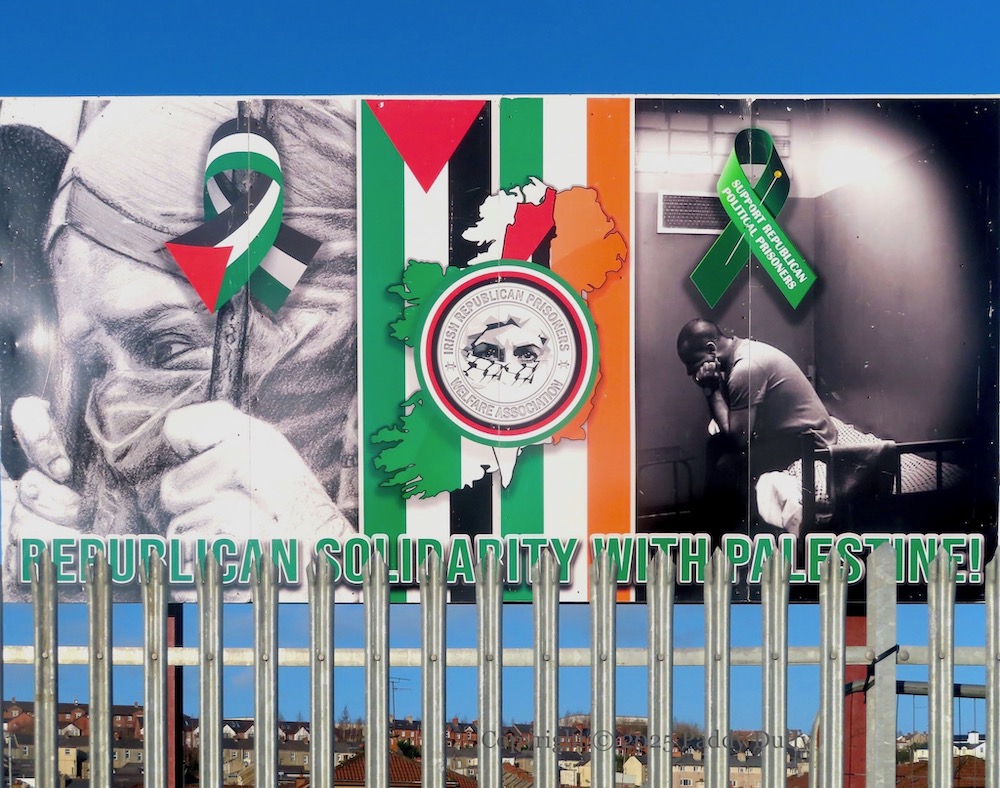
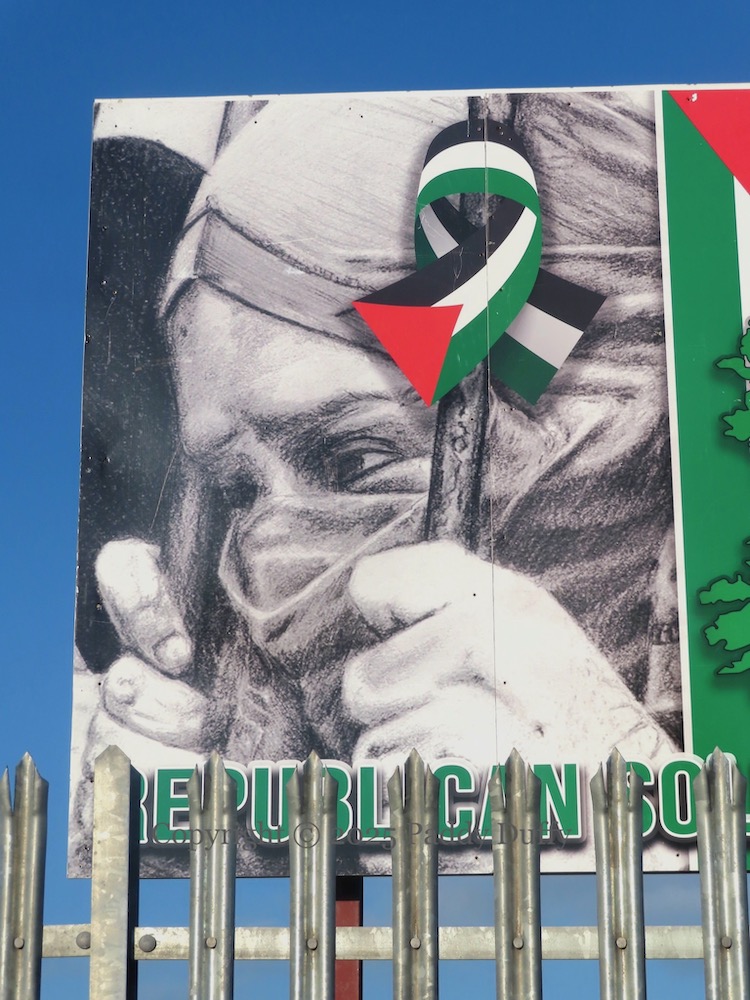
Since the October 7th attack by Hamas and the subsequent Israeli invasion of Gaza, the number of Palestinian prisoners held by Israel has gone up from about 5,000 to about 9,000, including about 3,500 prisoners held under what is called “administrative detention” or what would be known here as “internment without trial”. (Figures for the last fifteen years are available at HaMoked and at B’Tselem.) Prisoners recently released from Israeli detention have described the beatings and degrading treatment they received (Amnesty | Reuters | Haaretz).
During the peace process of the mid-1990s, a green ribbon was used as a symbol of republican political prisoners, whose release was one of the major goals in a peace settlement – see this large example from Shantallow, Derry, from 1998. It is still used post-Agreement by physical-force republicans, e.g. End Brit Brutality and Maghaberry Concentration Camp.
The board is on the Meenan Square construction site in the Bogside, Derry. For the INLA board in the background of the wide shot, see Serious Trouble.
















 Paddy Duffy Collection